REVIEW 2 major objections 1 minor 1 cited by
Majority voting in test-time RL permanently suppresses correct answers after a brief window in low-ability problems
Reviewed by Pith at T0; open to challenge. T0 means a machine referee read the full paper against a public rubric. the ladder, T0–T4 →
T0 review · grok-4.3
2026-06-30 17:50 UTC pith:FC5CRF5A
load-bearing objection TTRL majority voting risks locking onto wrong answers on some problems, and the three proposed guards deliver reported gains but the causal isolation is thin. the 2 major comments →
Detecting and Mitigating the Correct-Answer Extinction Window in Test-Time Reinforcement Learning with Majority Voting
The pith
A machine-rendered reading of the paper's core claim, the machinery that carries it, and where it could break.
Core claim
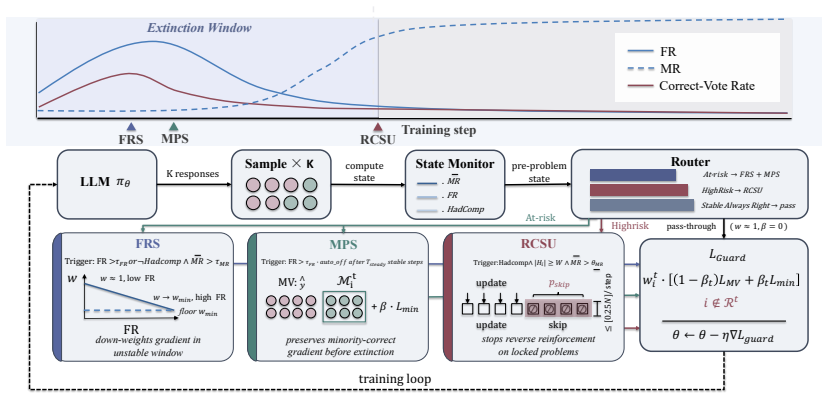
The central claim is that majority-vote pseudo-labels in TTRL create a Correct-Answer Extinction Window: correct-answer signals in low-ability problems are briefly active before majority vote permanently suppresses them. Flip Rate tracks the onset of this window. Net damage results because corrupted problems outnumber genuinely learned ones and the damage cannot be reversed once the wrong answer dominates. TTRL-Guard counters the window through Flip-Rate-Aware Reward Scaling that down-weights risky updates, Minority-Preserving Sampling that keeps gradient from minority correct answers, and Risk-Conditioned Sparse Updatings that suspend learning on polarized problems.
What carries the argument
The Correct-Answer Extinction Window, identified by per-problem tracking of answer flips and led by the Flip Rate indicator, which triggers protective adjustments before majority vote locks the model onto incorrect answers.
Load-bearing premise
The assumption that observed flips from correct to incorrect answers are caused by majority-vote locking rather than other aspects of the RL update rule or sampling process.
What would settle it
Run the same TTRL process but replace majority vote with an oracle label source and measure whether the rate of correct-to-incorrect flips drops sharply or remains comparable.
If this is right
- TTRL-Guard achieves the highest average pass@1 across tested models and benchmarks.
- Relative improvement over plain TTRL reaches +54 percent on AIME 2025.
- Down-weighting updates as Flip Rate declines reduces the number of irreversible corruptions.
- Retaining minority correct answers preserves gradient signal that would otherwise be lost.
- Suspending updates on polarized problems prevents further damage once the window closes.
Where Pith is reading between the lines
- Similar extinction dynamics may appear in other test-time methods that rely on self-generated pseudo-labels rather than external supervision.
- Per-problem tracking of answer stability could be used to diagnose failure modes in any iterative self-improvement loop.
- The three guard mechanisms might transfer to non-RL settings that use majority voting for label generation during adaptation.
Editorial analysis
A structured set of objections, weighed in public.
Referee Report
Summary. The manuscript claims that test-time reinforcement learning (TTRL) with majority voting as pseudo-labels systematically misinterprets accuracy gains: most gains reflect sharpening of already-solvable problems, while problems corrupted from correct to incorrect outnumber truly learned ones, and the damage is irreversible once majority vote locks onto a wrong answer. Per-problem tracking identifies a 'Correct-Answer Extinction Window' in low-ability problems (with Flip Rate as leading indicator), and the authors propose TTRL-Guard (Flip-Rate-Aware Reward Scaling, Minority-Preserving Sampling, Risk-Conditioned Sparse Updatings) to target it, reporting best average pass@1 on Qwen2.5-7B-Instruct and Qwen3-4B plus +54% relative improvement over TTRL on AIME 2025 across three models and four benchmarks.
Significance. If the extinction window exists and the proposed mechanisms demonstrably reduce irreversible corruption without sacrificing gains on solvable problems, the work would meaningfully caution the community against naive majority-vote TTRL and supply practical, lightweight safeguards. The framing of FR as a diagnostic and the three targeted interventions would constitute a useful empirical contribution to test-time adaptation for reasoning models.
major comments (2)
- [Abstract] Abstract, per-problem tracking paragraph: the assertion that observed correct-to-incorrect flips are specifically caused by majority-vote locking is not supported by any described controls that hold sampling distribution, reward scaling, gradient step size, or policy entropy fixed while varying only whether the pseudo-label is permitted to flip; without such isolation the attribution to the extinction window cannot be distinguished from other TTRL update components.
- [Abstract] Abstract, experiments paragraph: the central reinterpretation that corrupted problems outnumber learned ones rests on per-problem tracking and corruption counts, yet the manuscript provides neither the raw per-problem trajectories, the exact counts of corrupted versus learned problems, nor verification that the observed suppression is irreversible under the proposed guard; these data are load-bearing for the claim that TTRL gains are 'systematically misinterpreted.'
minor comments (1)
- [Abstract] The relative improvement figure '+54% on AIME 2025' should be accompanied by the absolute pass@1 values for both TTRL and TTRL-Guard (and the other baselines) so readers can assess effect size directly.
Simulated Author's Rebuttal
Thank you for the constructive feedback. We agree that the manuscript would benefit from explicit controls isolating the pseudo-label mechanism and from inclusion of raw per-problem data to support the extinction-window claims. We respond to each major comment below and will incorporate the requested elements in the revision.
read point-by-point responses
-
Referee: [Abstract] Abstract, per-problem tracking paragraph: the assertion that observed correct-to-incorrect flips are specifically caused by majority-vote locking is not supported by any described controls that hold sampling distribution, reward scaling, gradient step size, or policy entropy fixed while varying only whether the pseudo-label is permitted to flip; without such isolation the attribution to the extinction window cannot be distinguished from other TTRL update components.
Authors: We acknowledge that the current manuscript does not include an ablation holding sampling distribution, reward scaling, gradient step size, and policy entropy fixed while varying only whether the pseudo-label is allowed to flip. The per-problem tracking shows temporal alignment between majority-vote changes and correctness flips, which we interpret as locking, but this does not constitute the requested isolation. To address the concern, we will add a controlled experiment in the revised manuscript comparing standard TTRL against a variant with fixed pseudo-labels after the first majority vote, thereby isolating the contribution of label flipping. revision: yes
-
Referee: [Abstract] Abstract, experiments paragraph: the central reinterpretation that corrupted problems outnumber learned ones rests on per-problem tracking and corruption counts, yet the manuscript provides neither the raw per-problem trajectories, the exact counts of corrupted versus learned problems, nor verification that the observed suppression is irreversible under the proposed guard; these data are load-bearing for the claim that TTRL gains are 'systematically misinterpreted.'
Authors: The manuscript describes the per-problem tracking procedure and reports aggregate outcomes but does not supply the raw trajectories, exact corrupted-versus-learned counts, or explicit verification of irreversibility under TTRL-Guard. We agree these elements are necessary to substantiate the reinterpretation. In the revision we will add an appendix containing representative per-problem trajectories, tables with exact corruption and learning counts across all benchmarks and models, and a direct comparison showing reduced irreversible corruption when the guard mechanisms are applied. revision: yes
Circularity Check
No significant circularity; claims rest on empirical tracking and explicit mitigation design
full rationale
The paper's central claim derives from per-problem tracking of answer flips during TTRL, which is presented as an observational finding rather than a fitted or self-defined quantity. The Correct-Answer Extinction Window and Flip Rate are introduced as descriptive terms for observed patterns, with TTRL-Guard mechanisms (FRS, MPS, RCSU) defined as direct responses to those observations. No equations or steps reduce the reported phenomenon or proposed fixes to the inputs by construction, and no self-citation chains or uniqueness theorems are invoked in the provided text. The derivation chain remains self-contained against external benchmarks.
Axiom & Free-Parameter Ledger
axioms (1)
- domain assumption Majority vote among sampled answers can be treated as a reliable pseudo-label for test-time RL updates.
invented entities (1)
-
Correct-Answer Extinction Window
no independent evidence
read the original abstract
Test-time reinforcement learning (TTRL) reports substantial accuracy gains on mathematical reasoning benchmarks using majority vote as a pseudo-label signal. We argue these gains are systematically misinterpreted: most reflect sharpening of already-solvable problems rather than genuine learning, while problems corrupted from correct to incorrect outnumber truly learned ones, and this damage is irreversible once majority vote locks onto a wrong answer. Per-problem tracking reveals that correct-answer signals in low-ability problems are briefly active before being permanently suppressed, a phenomenon we term the \textit{Correct-Answer Extinction Window}, with Flip Rate (FR) as its leading indicator. We thus propose TTRL-Guard, a lightweight framework with three mechanisms targeting the extinction window: Flip-Rate-Aware Reward Scaling (FRS) down-weights at-risk updates as FR declines, Minority-Preserving Sampling (MPS) retains gradient signal from minority correct answers, and Risk-Conditioned Sparse Updatings (RCSU) suspends updates on polarized problems. Experiments across three models and four benchmarks show that TTRL-Guard achieves the best average pass@1 on Qwen2.5-7B-Instruct and Qwen3-4B, improves relatively over TTRL by +54\% on AIME 2025.
Figures





Forward citations
Cited by 1 Pith paper
-
SERPO: Self-Evolving Rubric Policy Optimization for Open-Ended Test-Time Reinforcement Learning
SERPO co-evolves G-N-B response archives, query-specific rubrics, and actor parameters to raise open-ended TTRL scores by up to ~20 points without external judges or labels.
Reference graph
Works this paper leans on
-
[1]
Qwen3 technical report.arXiv preprint arXiv:2505.09388. Chengyi Yang, Zhishang Xiang, Yunbo Tang, Zong- pei Teng, Chengsong Huang, Fei Long, Yuhan Liu, and Jinsong Su. 2026. Ttcs: Test-time curricu- lum synthesis for self-evolving.arXiv preprint arXiv:2601.22628. Qingyang Zhang, Haitao Wu, Changqing Zhang, Peilin Zhao, and Yatao Bian. 2026. Right question...
work page internal anchor Pith review Pith/arXiv arXiv 2026
-
[2]
All reported metrics represent the average of 5 independent runs. Theextinction windowis not a hyperparame- ter but an empirical phenomenon: a brief early- training phase in which the correct answer still holds a competitive minority before majority voting locks irreversibly onto the wrong answer. TTRL- Guard does not require its boundaries to be speci- f...
work page 2024
-
[3]
Phase 1 (Competition).In the early train- ing steps, the correct answer and a highly plausible incorrect answer co-exist, compet- ing closely for the majority vote. As shown in Figure 10a, aggregated over all three models (Llama-3.2-3B-Instruct, Qwen2.5-7B- Instruct, and Qwen3-4B) on AIME 2024, AMC, and MATH-500, roughly 30% of De- graded problems still h...
work page 2024
-
[4]
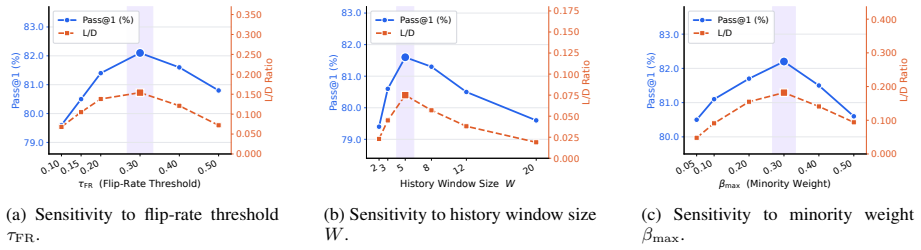
Phase 2 (Suppression).Due to the winner- takes-all nature of the standard GRPO loss, any step in which the incorrect answer wins the majority vote heavily penalises the cor- rect answer. The incorrect answer system- atically suppresses the correct answer’s log- 0.100.150.20 0.30 0.40 0.50 τFR (Flip-Rate Threshold) 79.0 80.0 81.0 82.0 83.0Pass@1 (%) Pass@1...
work page 2024
-
[5]
Phase 3 (Lock-in).Once the Match Rate of the incorrect answer crosses a critical threshold, the flip rate collapses and the cor- rect answer’s sampling probability drops near zero, finalising irreversible degradation. Fig- ures 10c and 10d confirm this pattern across all nine model-dataset pairs: the number of steps in which the correct answer wins the ma...
discussion (0)
Sign in with ORCID, Apple, or X to comment. Anyone can read and Pith papers without signing in.