Finite-Particle Convergence Rates for Conservative and Non-Conservative Drifting Models
Pith reviewed 2026-06-30 15:57 UTC · model grok-4.3
The pith
A conservative drifting method using KDE-gradient velocity achieves explicit finite-particle convergence rates for one-step generative modeling on R^d.
A machine-rendered reading of the paper's core claim, the machinery that carries it, and where it could break.
Core claim
The conservative drifting method on R^d admits continuous-time finite-particle convergence bounds via a joint-entropy identity, with bounds on the empirical Stein drift, the smoothed Fisher discrepancy of the KDE, and the squared center velocity; the main correction is the reciprocal-KDE self-interaction term controlled by local-occupancy conditions, yielding the rate N^{-1/(d+4)} under h-uniform quadrature regularity or the optimized rate N^{-(2-β)/(2(d+4-β))} for 0 ≤ β < 2 under a general growth condition. The non-conservative method with Laplace kernel admits an analogous rate with an unavoidable residual term from a sharp companion kernel decomposition.
What carries the argument
The joint-entropy identity that produces bounds for empirical Stein drift, smoothed Fisher discrepancy, and squared center velocity, together with the reciprocal-KDE self-interaction term as the leading finite-particle correction.
If this is right
- The explicit drift size η converts the residual-velocity bounds into one-step generation guarantees.
- The non-conservative Laplace-kernel method yields a comparable finite-particle rate that necessarily includes a scale-mismatch residual.
- Quadrature constants remain explicit and their possible bandwidth dependence is tracked in all bounds.
- The root rate N^{-1/(d+4)} improves to the optimized form under the weaker general growth condition when β is chosen appropriately.
Where Pith is reading between the lines
- The local-occupancy conditions imply that practical performance improves when particles avoid extreme clustering, which may inform bandwidth choice in implementation.
- Similar companion-kernel decompositions could be derived for other kernels in the non-conservative case.
- The translation from continuous-time residual bounds to discrete one-step generation suggests direct applicability to sampling algorithms that run for a fixed number of steps.
Load-bearing premise
The local-occupancy conditions that control the reciprocal-KDE self-interaction term, together with the additional h-uniform quadrature regularity condition required to reach the root rate N^{-1/(d+4)}.
What would settle it
A simulation in which the residual velocity or empirical Stein drift fails to decay at rate N^{-1/(d+4)} (or the optimized rate) when local-occupancy holds but the h-uniform quadrature regularity condition is violated.
Figures
read the original abstract
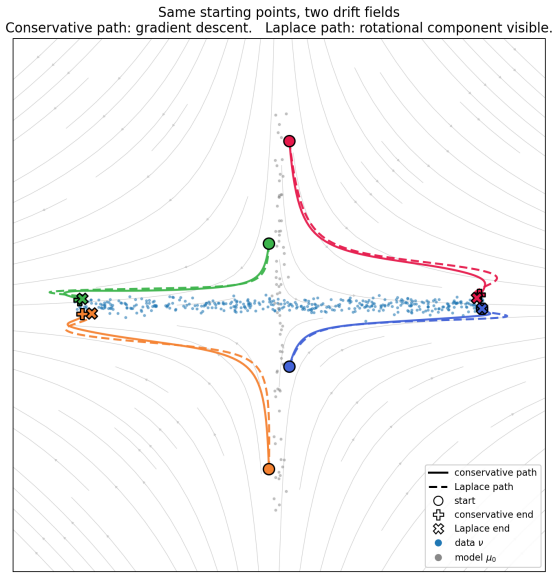
We propose and analyze a conservative drifting method for one-step generative modeling. The method replaces the original displacement-based drifting velocity by a kernel density estimator (KDE)-gradient velocity, namely the difference of the kernel-smoothed data score and the kernel-smoothed model score. This velocity is a gradient field, addressing the non-conservatism issue identified for general displacement-based drifting fields. We prove continuous-time finite-particle convergence bounds for the conservative method on $\R^d$: a joint-entropy identity yields bounds for the empirical Stein drift, the smoothed Fisher discrepancy of the KDE, and the squared center velocity. The main finite-particle correction is a reciprocal-KDE self-interaction term, and we give deterministic and high-probability local-occupancy conditions under which this term is controlled. We keep the quadrature constants explicit and track their possible bandwidth dependence: the root residual-velocity rate $N^{-1/(d+4)}$ holds under an additional $h$-uniform quadrature regularity condition, while a more general growth condition yields the optimized root rate $N^{-(2-\beta)/(2(d+4-\beta))}$, where $0\le \beta<2$. We also analyze the non-conservative drifting method with Laplace kernel, corresponding to the original displacement-based velocity proposed in Deng et al., 2026 (arxiv:2602.04770). For this method, a sharp companion kernel decomposes the velocity into a positive scalar preconditioning of a sharp-score mismatch plus a Laplace scale-mismatch residual, producing an analogous finite-particle rate with an unavoidable residual term. Finally, we explain how the continuous-time residual-velocity bounds translate into one-step generation guarantees through the explicit drift size $\eta$.
Editorial analysis
A structured set of objections, weighed in public.
Referee Report
Summary. The manuscript proposes a conservative drifting method for one-step generative modeling that replaces the displacement-based drifting velocity with a KDE-gradient velocity (difference of kernel-smoothed data score and model score), ensuring the velocity is a gradient field. It proves continuous-time finite-particle convergence bounds on R^d via a joint-entropy identity, yielding explicit bounds on the empirical Stein drift, the smoothed Fisher discrepancy of the KDE, and the squared center velocity. The dominant finite-particle correction is a reciprocal-KDE self-interaction term, controlled under deterministic and high-probability local-occupancy conditions; quadrature constants are kept explicit with bandwidth dependence tracked. This yields the root rate N^{-1/(d+4)} under an additional h-uniform quadrature regularity condition, or the optimized rate N^{-(2-β)/(2(d+4-β))} (0 ≤ β < 2) under a weaker general growth condition. The non-conservative Laplace-kernel case is analyzed via a sharp companion kernel decomposition, and the residual-velocity bounds are translated to one-step generation guarantees via the explicit drift size η.
Significance. If the derivations and conditions hold, the work supplies explicit, bandwidth-aware finite-particle convergence rates for both conservative and non-conservative drifting models, directly addressing the non-conservatism issue in displacement-based methods. The joint-entropy identity, explicit quadrature tracking, and deterministic/high-probability local-occupancy conditions constitute concrete technical contributions that could inform practical bandwidth and particle-number choices in generative modeling.
major comments (1)
- [Abstract (rate statements) and the theorems deriving the finite-particle bounds from the joint-entropy identity] The root rate N^{-1/(d+4)} is stated to hold only under the additional h-uniform quadrature regularity condition (distinct from the weaker growth condition that yields the β-optimized rate). The manuscript presents the local-occupancy conditions as sufficient to control the reciprocal-KDE self-interaction term after the joint-entropy identity, yet leaves verification of the h-uniform regularity implicit for the specific scaling h ~ N^{-1/(d+4)} and for distributions with spatially varying density. Because this regularity is required for the headline improvement over the general-growth case, its status directly affects the central rate claim.
minor comments (1)
- [Abstract] The citation 'Deng et al., 2026 (arxiv:2602.04770)' appears in the abstract; confirm the reference is correctly dated and formatted.
Simulated Author's Rebuttal
We thank the referee for the careful reading and for highlighting the need to make the status of the h-uniform quadrature regularity condition fully explicit. We address the comment point by point below and will revise the manuscript accordingly.
read point-by-point responses
-
Referee: [Abstract (rate statements) and the theorems deriving the finite-particle bounds from the joint-entropy identity] The root rate N^{-1/(d+4)} is stated to hold only under the additional h-uniform quadrature regularity condition (distinct from the weaker growth condition that yields the β-optimized rate). The manuscript presents the local-occupancy conditions as sufficient to control the reciprocal-KDE self-interaction term after the joint-entropy identity, yet leaves verification of the h-uniform regularity implicit for the specific scaling h ~ N^{-1/(d+4)} and for distributions with spatially varying density. Because this regularity is required for the headline improvement over the general-growth case, its status directly affects the central rate claim.
Authors: We agree that the verification of the h-uniform quadrature regularity condition for the scaling h ∼ N^{-1/(d+4)} and for densities with spatial variation is left implicit. The local-occupancy conditions suffice to control the reciprocal-KDE self-interaction term after the joint-entropy identity, but the additional h-uniform regularity is required to obtain the root rate rather than the β-optimized rate. In the revision we will add an explicit remark (and, if space permits, a short appendix paragraph) stating the standard nonparametric assumptions under which the h-uniform condition holds for this scaling—for instance, when the target density is bounded away from zero and infinity on compact sets with Lipschitz score, or under a high-probability bound derived from mild moment conditions on the data. This will clarify that the root rate is attainable under the same regularity classes routinely used for KDE convergence, while the weaker growth condition yields the more general (but slower) rate. revision: yes
Circularity Check
No significant circularity; derivation from joint-entropy identity is self-contained
full rationale
The paper derives continuous-time finite-particle bounds via a joint-entropy identity that produces explicit controls on empirical Stein drift, smoothed Fisher discrepancy, and center velocity, with the reciprocal-KDE term handled by stated deterministic or high-probability local-occupancy conditions. These steps do not reduce by construction to the target rates or to any fitted input; the additional h-uniform quadrature regularity condition is an explicit assumption rather than a self-referential definition or renamed result. No load-bearing self-citation chain or uniqueness theorem imported from the authors' prior work appears in the derivation. The analysis is therefore independent of its own outputs.
Axiom & Free-Parameter Ledger
free parameters (2)
- bandwidth h
- beta
axioms (2)
- domain assumption The KDE-gradient velocity is a gradient field
- ad hoc to paper Local-occupancy conditions hold
Forward citations
Cited by 1 Pith paper
-
Uniform-in-time Propagation-of-Chaos for Stein Variational Gradient Descent
Uniform-in-time propagation-of-chaos bounds for SVGD are obtained via cutoff for distributional metrics (logarithmic rates) and via finite-dimensional closure plus conjugacy for Gaussian targets (parametric N^{-1/2} rates).
Reference graph
Works this paper leans on
-
[1]
ISSN 2835-8856. URLhttps://openreview.net/forum? id=cqDH0e6ak2. Jiarui Cao, Zixuan Wei, and Yuxin Liu. Gradient flow drifting: Generative modeling via Wasserstein gradient flows of KDE-approximated divergences.arXiv preprint arXiv:2603.10592,
-
[2]
Generative Modeling via Drifting
Mingyang Deng, He Li, Tianhong Li, Yilun Du, and Kaiming He. Generative modeling via drifting. arXiv preprint arXiv:2602.04770,
work page internal anchor Pith review Pith/arXiv arXiv
-
[3]
Learning Monge maps with constrained drifting models
42 Th´ eo Dumont, Th´ eo Lacombe, and Fran¸ cois-Xavier Vialard. Learning Monge maps with con- strained drifting models.arXiv preprint arXiv:2603.25182,
work page internal anchor Pith review Pith/arXiv arXiv
-
[4]
Kernel-Gradient Drifting Models
Maria Esteban-Casadevall, Jorge Carrasco-Pollo, Max Welling, Jan-Willem van de Meent, Erik J. Bekkers, and Floor Eijkelboom. Kernel-gradient drifting models.arXiv preprint arXiv:2605.10727,
work page internal anchor Pith review Pith/arXiv arXiv
-
[5]
Drifting Fields are not Conservative
Leonard Franz, Sebastian Hoffmann, and Georg Martius. Drifting fields are not conservative.arXiv preprint arXiv:2604.06333,
work page internal anchor Pith review Pith/arXiv arXiv
-
[6]
On the Wasserstein Gradient Flow Interpretation of Drifting Models
Arthur Gretton, Li Kevin Wenliang, Alexandre Galashov, James Thornton, Valentin De Bortoli, and Arnaud Doucet. On the Wasserstein Gradient Flow Interpretation of Drifting Models.arXiv preprint arXiv:2605.05118,
work page internal anchor Pith review Pith/arXiv arXiv
-
[7]
arXiv preprint arXiv:2603.12366 , year =
Ping He, Om Khangaonkar, Hamed Pirsiavash, Yikun Bai, and Soheil Kolouri. Sinkhorn-Drifting Generative Models.arXiv preprint arXiv:2603.12366, 2026a. Ye He, Krishnakumar Balasubramanian, Sayan Banerjee, and Promit Ghosal. Finite-Particle Rates for Regularized Stein Variational Gradient Descent.arXiv preprint arXiv:2602.05172, 2026b. Jonathan Ho, Ajay Jain...
-
[8]
A Unified View of Score-Based and Drifting Models
Chieh-Hsin Lai, Bac Nguyen, Naoki Murata, Yuhta Takida, Toshimitsu Uesaka, Yuki Mitsufuji, Stefano Ermon, and Molei Tao. A unified view of drifting and score-based models.arXiv preprint arXiv:2603.07514,
work page internal anchor Pith review Pith/arXiv arXiv
-
[9]
Identifiability and Stability of Generative Drifting with Companion-Elliptic Kernel Families
Hak Geun Lee and Hyonho Chun. Identifiability and Stability of Generative Drifting with Companion-Elliptic Kernel Families.arXiv preprint arXiv:2604.24196,
work page internal anchor Pith review Pith/arXiv arXiv
-
[10]
arXiv preprint arXiv:2602.20463 , year =
Zhiqi Li and Bo Zhu. A Long-Short Flow-Map Perspective for Drifting Models.arXiv preprint arXiv:2602.20463,
-
[11]
Generative Drifting is Secretly Score Matching: a Spectral and Variational Perspective
Erkan Turan and Maks Ovsjanikov. Generative drifting is secretly score matching: A spectral and variational perspective.arXiv preprint arXiv:2603.09936,
work page internal anchor Pith review Pith/arXiv arXiv
-
[12]
ISSN 2835-8856. URLhttps://openreview.net/forum?id= dpGSNLUCzu. Guoqiang Zhang, Kenta Niwa, and W. Bastiaan Kleijn. Lookahead drifting model.arXiv preprint arXiv:2605.04060,
work page internal anchor Pith review Pith/arXiv arXiv
-
[13]
Letg θ :Z →R d be the generator and let xk i :=g θk(ξi), i= 1,
A Stop-gradient Training and The Particle ODE We briefly explain how the continuous-time particle dynamics arise from the practical stop-gradient training rule. Letg θ :Z →R d be the generator and let xk i :=g θk(ξi), i= 1, . . . , N, be the generated batch at training stepk, for fixed latent variablesξ 1, . . . , ξN. Letv xk denote the drift field comput...
2026
discussion (0)
Sign in with ORCID, Apple, or X to comment. Anyone can read and Pith papers without signing in.