REVIEW 2 major objections 2 minor 1 cited by
TriVAL adds explicit validation at semantic, mathematical, and code stages to stop errors from propagating in LLM-based optimization modeling.
Reviewed by Pith at T0; open to challenge. T0 means a machine referee read the full paper against a public rubric. the ladder, T0–T4 →
T0 review · grok-4.3
2026-06-30 21:58 UTC pith:5LMQKZSD
load-bearing objection TriVAL adds three-stage validation loops and the NL4COP benchmark to LLM optimization modeling, but the abstract supplies no numbers or implementation details, leaving the consistency of revisions untested. the 2 major comments →
TriVAL: A Tri-Validation Framework for Faithful Automatic Optimization Modeling
The pith
A machine-rendered reading of the paper's core claim, the machinery that carries it, and where it could break.
Core claim
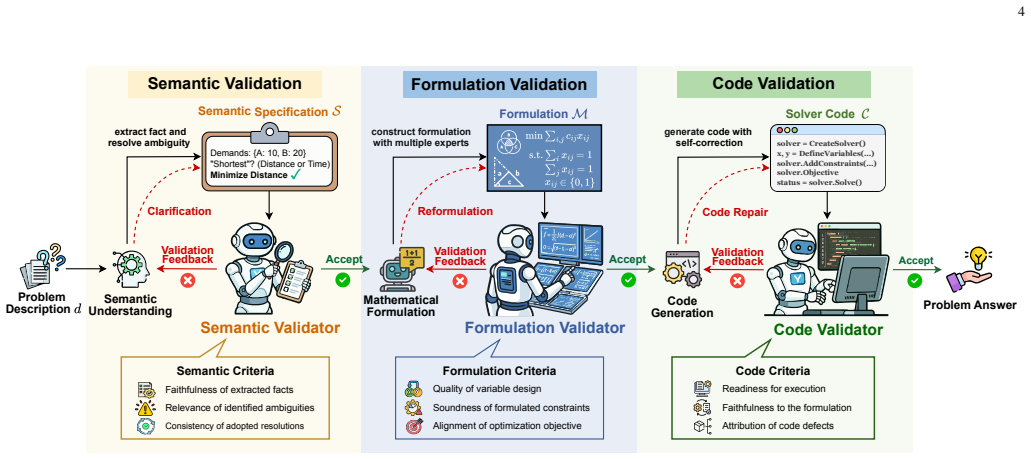
TriVAL is a tri-validation framework that performs explicit validation at three stages of automatic optimization modeling: semantic specification, mathematical formulation, and code generation. At each stage it follows a construct-validate-revise loop that assesses the current output against stage-specific criteria and revises it when needed, thereby identifying and correcting errors before they accumulate across stages and preserving faithfulness throughout the modeling process.
What carries the argument
Tri-validation framework using construct-validate-revise loops applied independently at the semantic-specification, mathematical-formulation, and code-generation stages.
Load-bearing premise
The construct-validate-revise loops at each stage can reliably detect and correct errors using only the stage-specific criteria and LLM revision without introducing new inconsistencies that propagate downstream.
What would settle it
A direct comparison on the NL4COP benchmark in which the final solver-ready models produced by TriVAL show the same or higher rate of semantic or formulation errors than single-pass baselines on the same problem instances.
If this is right
- Errors introduced at any one stage are corrected before reaching later stages, reducing the chance that an incorrect model reaches the solver.
- Accuracy gains appear on both the new NL4COP benchmark and on established benchmarks, with the largest improvements on problems that have more complex decision logic and tightly coupled constraints.
- The three-stage structure provides a systematic way to maintain faithfulness when LLMs translate natural-language problem statements into executable optimization code.
Where Pith is reading between the lines
- The same staged-validation pattern could be applied to other multi-step LLM pipelines that generate formal artifacts from text, such as constraint programming or simulation model creation.
- If the validation criteria at each stage are made public, they could serve as reusable checklists for human modelers working on similar problems.
- The introduction of NL4COP implies that future automatic-modeling systems should be evaluated on instances whose constraint coupling and decision complexity exceed those of current public benchmarks.
Editorial analysis
A structured set of objections, weighed in public.
Referee Report
Summary. The paper introduces TriVAL, a framework for automatic optimization modeling from natural-language descriptions that applies explicit construct-validate-revise loops at three stages—semantic specification, mathematical formulation, and code generation—using stage-specific criteria to detect and correct errors before they propagate. It also presents NL4COP, a benchmark of 150 instances across 50 combinatorial problem types designed to be more challenging than prior benchmarks. Experiments on NL4COP and existing benchmarks are reported to show that TriVAL outperforms state-of-the-art methods, with the largest gains on the most difficult instances.
Significance. If the reported gains are robust and attributable to the tri-validation design, the work would be a useful engineering contribution to LLM-based optimization modeling pipelines. The introduction of NL4COP addresses a clear gap in benchmark difficulty. The structured validation approach is a practical idea that could improve reliability, though its value hinges on whether the LLM-driven revisions reliably preserve consistency across stages without formal verification.
major comments (2)
- [§3] §3 (TriVAL Framework description): The construct-validate-revise loops are defined using only stage-specific criteria (semantic, mathematical, code) with no cross-stage consistency checks or formal verification mentioned. This is load-bearing for the central faithfulness claim, because a revision at the formulation stage could alter variable definitions or constraints in ways that violate the semantic specification yet still pass local code validation, especially on the tightly coupled NL4COP instances where largest gains are claimed.
- [Experiments] Experiments section (and abstract): The claim of consistent outperformance with largest gains on challenging problems is presented without reported quantitative metrics, error analysis, ablation studies isolating the contribution of each validation stage, or details on how the stage-specific criteria are implemented and measured. This prevents verification that the tri-validation mechanism is responsible for the gains rather than other factors.
minor comments (2)
- [Abstract] Abstract: Typo in 'state-ofthe-art' should be 'state-of-the-art'.
- [§3] The paper should clarify the exact prompting strategies and decision thresholds used in the validate and revise steps for reproducibility.
Simulated Author's Rebuttal
We thank the referee for the constructive feedback and the recommendation for major revision. The comments highlight important areas for strengthening the faithfulness claims and experimental rigor. We respond point-by-point below and will incorporate the suggested changes in the revised manuscript.
read point-by-point responses
-
Referee: [§3] §3 (TriVAL Framework description): The construct-validate-revise loops are defined using only stage-specific criteria (semantic, mathematical, code) with no cross-stage consistency checks or formal verification mentioned. This is load-bearing for the central faithfulness claim, because a revision at the formulation stage could alter variable definitions or constraints in ways that violate the semantic specification yet still pass local code validation, especially on the tightly coupled NL4COP instances where largest gains are claimed.
Authors: We agree that the current §3 description relies on stage-specific criteria without explicit cross-stage checks, which leaves open the possibility of inconsistencies introduced during revision. While the sequential pipeline is intended to mitigate error propagation, this is a valid concern for the faithfulness claim on challenging instances. In the revision we will add a new paragraph in §3 that introduces an explicit cross-stage consistency check: after each revision, the updated artifact is compared against the semantic specification (via LLM-assisted alignment of variables, constraints, and objectives) and any detected violations trigger further revision. We will also report the frequency of such cross-stage revisions on NL4COP. This addition directly addresses the load-bearing issue while remaining within the LLM-driven paradigm; formal verification remains outside the paper's scope. revision: yes
-
Referee: [Experiments] Experiments section (and abstract): The claim of consistent outperformance with largest gains on challenging problems is presented without reported quantitative metrics, error analysis, ablation studies isolating the contribution of each validation stage, or details on how the stage-specific criteria are implemented and measured. This prevents verification that the tri-validation mechanism is responsible for the gains rather than other factors.
Authors: We acknowledge that the current experimental reporting is insufficient to isolate the contribution of tri-validation. The manuscript presents aggregate outperformance but omits the requested details. In the revised version we will expand the Experiments section (and update the abstract accordingly) with: (i) quantitative metrics including per-stage accuracy, overall success rates with 95% confidence intervals, and statistical significance tests; (ii) a categorized error analysis of failure modes across stages; (iii) ablation studies that successively disable each validation stage to quantify incremental gains; and (iv) implementation details including the exact stage-specific criteria, prompt templates, and measurement rubrics. These additions will enable verification that the reported gains, especially on NL4COP, are attributable to the tri-validation design. revision: yes
Circularity Check
No circularity: empirical framework with no derivation or fitted inputs
full rationale
The paper presents TriVAL as an engineering framework of three construct-validate-revise loops evaluated empirically on NL4COP and other benchmarks. No equations, parameters, uniqueness theorems, or self-citations are invoked as load-bearing premises for any claimed derivation. The performance claims rest on experimental results rather than any reduction to the framework's own inputs by construction. This matches the default expectation for non-derivational papers and the reader's assessment of score 2.0 with no equations or fitted parameters.
Axiom & Free-Parameter Ledger
axioms (1)
- domain assumption LLMs can assess outputs against stage-specific criteria and produce useful revisions when errors are detected.
invented entities (1)
-
TriVAL framework
no independent evidence
read the original abstract
Optimization modeling serves as the pivotal bridge between natural-language problem descriptions and optimization solvers, and remains a cornerstone for bringing operations research (OR) into real-world decision making. Recent advances in large language models (LLMs) have driven significant progress in automatic optimization modeling. However, existing methods still lack explicit validation during the modeling process, allowing errors introduced in earlier stages to carry through the pipeline and ultimately reduce final modeling accuracy. To address this challenge, we introduce TriVAL, a tri-validation framework that performs explicit validation at three stages of automatic optimization modeling: semantic specification, mathematical formulation, and code generation. At each stage, TriVAL follows a construct-validate-revise loop that assesses the current result against stage-specific criteria and revises it when needed. This design helps identify and correct errors before they accumulate across stages, helping preserve faithfulness throughout the modeling process. To evaluate automatic optimization modeling on more challenging combinatorial problems, we further introduce NL4COP, a benchmark of 150 instances across 50 diverse problem types with more complex decision logic, more tightly coupled constraints, and more demanding modeling requirements than existing benchmarks. Experiments on NL4COP and established benchmarks show that TriVAL consistently outperforms state-ofthe-art methods, with the largest gains on the most challenging problems.
Figures


Forward citations
Cited by 1 Pith paper
-
Falsification-Based Verification of LLM-Generated Optimization Models: Sound Test Batteries and Their Detection Limits
A sound, threshold-free battery of optimization-theoretic tests can catch unfaithful LLM-generated MILP models while never flagging faithful ones, and provably cannot catch certain error classes.
Reference graph
Works this paper leans on
-
[1]
A. Nagurney, “Optimization of supply chain networks with inclusion of labor: Applications to covid-19 pandemic disruptions,”International Journal of Production Economics, vol. 235, p. 108080, 2021
work page 2021
-
[2]
Learning to solve large-scale security-constrained unit commitment problems,
´A. S. Xavier, F. Qiu, and S. Ahmed, “Learning to solve large-scale security-constrained unit commitment problems,”INFORMS Journal on Computing, vol. 33, no. 2, pp. 739–756, 2021
work page 2021
-
[3]
The two-echelon production-routing problem,
C. M. Schenekemberg, C. T. Scarpin, J. E. Pecora Jr, T. A. Guimar ˜aes, and L. C. Coelho, “The two-echelon production-routing problem,” European journal of operational research, vol. 288, no. 2, pp. 436–449, 2021
work page 2021
-
[4]
H. P. Williams,Model building in mathematical programming, 5th ed. John Wiley & Sons, 2013
work page 2013
-
[5]
A survey of optimization modeling meets llms: progress and future directions,
Z. Xiaoet al., “A survey of optimization modeling meets llms: progress and future directions,” inProceedings of the Thirty-Fourth International Joint Conference on Artificial Intelligence, ser. IJCAI ’25, 2025. 13
work page 2025
-
[6]
Large language models in operations research: Methods, applications, and challenges,
Y . Wang and K. Li, “Large language models in operations research: Methods, applications, and challenges,” 2025
work page 2025
-
[7]
LLMOPT: Learning to define and solve general optimization problems from scratch,
C. JIANGet al., “LLMOPT: Learning to define and solve general optimization problems from scratch,” inThe Thirteenth International Conference on Learning Representations, 2025
work page 2025
-
[8]
Autoformulation of mathematical optimization models using llms,
N. Astorga, T. Liu, Y . Xiao, and M. Van Der Schaar, “Autoformulation of mathematical optimization models using llms,” inInternational Conference on Machine Learning. PMLR, 2025, pp. 1864–1886
work page 2025
-
[9]
M. Mostajabdaveh, T. T. Yu, R. Ramamonjison, G. Carenini, Z. Zhou, and Y . Zhang, “Optimization modeling and verification from problem specifications using a multi-agent multi-stage llm framework,”INFOR: Information Systems and Operational Research, vol. 62, no. 4, pp. 599– 617, 2024
work page 2024
-
[10]
S. Wasserkruget al., “Enhancing decision making through the integra- tion of large language models and operations research optimization,” in Proceedings of the AAAI Conference on Artificial Intelligence, vol. 39, no. 27, 2025, pp. 28 643–28 650
work page 2025
-
[11]
Orlm: A customizable framework in training large models for automated optimization modeling,
C. Huanget al., “Orlm: A customizable framework in training large models for automated optimization modeling,”Operations Research, vol. 73, no. 6, pp. 2986–3009, 2025
work page 2025
-
[12]
Optmath: A scalable bidirectional data synthesis framework for optimization modeling,
H. Lu, Z. Xie, Y . Wu, C. Ren, Y . Chen, and Z. Wen, “Optmath: A scalable bidirectional data synthesis framework for optimization modeling,” inInternational Conference on Machine Learning. PMLR, 2025, pp. 40 769–40 802
work page 2025
-
[13]
Solver-informed RL: Grounding large language models for authentic optimization modeling,
Y . Chen, J. Xia, S. Shao, D. Ge, and Y . Ye, “Solver-informed RL: Grounding large language models for authentic optimization modeling,” inThe Thirty-ninth Annual Conference on Neural Information Process- ing Systems, 2025
work page 2025
-
[14]
Tdag: A multi-agent framework based on dynamic task decomposition and agent generation,
Y . Wang, Z. Wu, J. Yao, and J. Su, “Tdag: A multi-agent framework based on dynamic task decomposition and agent generation,”Neural Networks, vol. 185, p. 107200, 2025
work page 2025
-
[15]
Chain-of-experts: When LLMs meet complex opera- tions research problems,
Z. Xiaoet al., “Chain-of-experts: When LLMs meet complex opera- tions research problems,” inThe Twelfth International Conference on Learning Representations, 2024
work page 2024
-
[16]
Optimai: Optimization from natural language using llm-powered ai agents,
R. Thind, Y . Sun, L. Liang, and H. Yang, “Optimai: Optimization from natural language using llm-powered ai agents,” 2026
work page 2026
-
[17]
B. Zhang, P. Luo, G. Yang, B.-H. Soong, and C. Yuen, “Or-llm-agent: Automating modeling and solving of operations research optimization problems with reasoning llm,” 2025
work page 2025
-
[18]
CVXPY: A Python-embedded modeling language for convex optimization,
S. Diamond and S. Boyd, “CVXPY: A Python-embedded modeling language for convex optimization,”J. Mach. Learn. Res., vol. 17, no. 83, pp. 1–5, Jan. 2016
work page 2016
-
[19]
Gurobi Optimization, LLC,Gurobi Optimizer Reference Manual, 2025, version 13.0. Accessed: Mar. 2, 2026. [Online]. Available: https://docs.gurobi.com/projects/optimizer/en/current/
work page 2025
-
[20]
L. Perron and V . Furnon,OR-Tools, Google, 2024, version 9.10, released May 7, 2024. Accessed: Mar. 2, 2026. [Online]. Available: https://developers.google.com/optimization/
work page 2024
-
[21]
Optibench meets resocratic: Measure and improve LLMs for optimization modeling,
Z. Yanget al., “Optibench meets resocratic: Measure and improve LLMs for optimization modeling,” inThe Thirteenth International Conference on Learning Representations, 2025
work page 2025
-
[22]
Optimind: Teaching llms to think like optimization experts,
X. Zhanget al., “Optimind: Teaching llms to think like optimization experts,” 2026
work page 2026
-
[23]
Holy grail 2.0: From natural language to constraint models,
D. Tsouros, H. Verhaeghe, S. Kadıo ˘glu, and T. Guns, “Holy grail 2.0: From natural language to constraint models,” 2023
work page 2023
-
[24]
Optimus: Scalable opti- mization modeling with (mi) lp solvers and large language models,
A. Ahmaditeshnizi, W. Gao, and M. Udell, “Optimus: Scalable opti- mization modeling with (mi) lp solvers and large language models,” inInternational Conference on Machine Learning. PMLR, 2024, pp. 577–596
work page 2024
-
[25]
Optitree: Hierarchical thoughts generation with tree search for LLM optimization modeling,
H. Liu, J. Wang, Y . Cai, X. Han, Y . Kuang, and J. HAO, “Optitree: Hierarchical thoughts generation with tree search for LLM optimization modeling,” inThe Thirty-ninth Annual Conference on Neural Informa- tion Processing Systems, 2025
work page 2025
-
[26]
Constraint Modelling with LLMs Using In-Context Learning,
K. Michailidis, D. Tsouros, and T. Guns, “Constraint Modelling with LLMs Using In-Context Learning,” in30th International Conference on Principles and Practice of Constraint Programming (CP 2024), ser. Leibniz International Proceedings in Informatics (LIPIcs), P. Shaw, Ed., vol. 307. Dagstuhl, Germany: Schloss Dagstuhl – Leibniz-Zentrum f ¨ur Informatik, ...
work page 2024
-
[27]
Sac-opt: Semantic anchors for iterative correction in optimization modeling,
Y . Zhanget al., “Sac-opt: Semantic anchors for iterative correction in optimization modeling,” 2026
work page 2026
-
[28]
Self-refine: Iterative refinement with self-feedback,
A. Madaanet al., “Self-refine: Iterative refinement with self-feedback,” inAdvances in Neural Information Processing Systems, A. Oh, T. Nau- mann, A. Globerson, K. Saenko, M. Hardt, and S. Levine, Eds., vol. 36. Curran Associates, Inc., 2023, pp. 46 534–46 594
work page 2023
-
[29]
H. Lightmanet al., “Let’s verify step by step,” inThe Twelfth Interna- tional Conference on Learning Representations, 2024
work page 2024
-
[30]
Teaching large language models to self-debug,
X. Chen, M. Lin, N. Sch ¨arli, and D. Zhou, “Teaching large language models to self-debug,” inThe Twelfth International Conference on Learning Representations, 2024
work page 2024
-
[31]
CRITIC: Large language models can self-correct with tool-interactive critiquing,
Z. Gouet al., “CRITIC: Large language models can self-correct with tool-interactive critiquing,” inThe Twelfth International Conference on Learning Representations, 2024
work page 2024
-
[32]
Y . Wang, W. Wu, J. Wang, and Q. Wang, “From flat logs to causal graphs: Hierarchical failure attribution for llm-based multi-agent sys- tems,” 2026
work page 2026
-
[33]
Optiver: Unleashing the power of LLMs for optimization modeling via dual-side verification,
H. Liuet al., “Optiver: Unleashing the power of LLMs for optimization modeling via dual-side verification,” 2026
work page 2026
-
[34]
An agent-based frame- work for the automatic validation of mathematical optimization models,
A. Zadorojniy, S. Wasserkrug, and E. Farchi, “An agent-based frame- work for the automatic validation of mathematical optimization models,” 2026
work page 2026
-
[35]
React: Synergizing reasoning and acting in language models,
S. Yaoet al., “React: Synergizing reasoning and acting in language models,” inThe Eleventh International Conference on Learning Repre- sentations, 2023
work page 2023
-
[36]
Code repair with llms gives an exploration-exploitation tradeoff,
H. Tanget al., “Code repair with llms gives an exploration-exploitation tradeoff,”Advances in Neural Information Processing Systems, vol. 37, pp. 117 954–117 996, 2024
work page 2024
-
[37]
Cp-bench: Evaluating large language models for constraint modelling,
K. Michailidis, D. Tsouros, and T. Guns, “Cp-bench: Evaluating large language models for constraint modelling,” 2025
work page 2025
-
[38]
Y . Liu, C. Zhou, Y . Chen, S. Zhang, X. Lin, and X. Wang, “Hard constraints meet soft generation: Guaranteed feasibility for llm-based combinatorial optimization,” 2026
work page 2026
-
[39]
Nl4opt competition: Formulating optimization problems based on their natural language descriptions,
R. Ramamonjisonet al., “Nl4opt competition: Formulating optimization problems based on their natural language descriptions,” inNeurIPS 2022 competition track. PMLR, 2023, pp. 189–203
work page 2022
-
[40]
X. Huang, Q. Shen, Y . Hu, A. Gao, and B. Wang, “Llms for mathe- matical modeling: Towards bridging the gap between natural and math- ematical languages,” inFindings of the Association for Computational Linguistics: NAACL 2025, 2025, pp. 2678–2710
work page 2025
-
[41]
Deepseek-v3.2: Pushing the frontier of open large language models,
DeepSeek-AIet al., “Deepseek-v3.2: Pushing the frontier of open large language models,” 2025
work page 2025
-
[42]
GPT-5.1: A smarter, more conversational ChatGPT,
OpenAI, “GPT-5.1: A smarter, more conversational ChatGPT,” OpenAI Official Website, Nov. 2025, accessed: Mar. 2, 2026. [Online]. Available: https://openai.com/index/gpt-5-1/
work page 2025
discussion (0)
Sign in with ORCID, Apple, or X to comment. Anyone can read and Pith papers without signing in.