REVIEW 3 major objections 2 minor 1 cited by
Neural networks approximate minimal surfaces in hyperbolic space whose self-intersections match Fine's conjecture for all tested knots
Reviewed by Pith at T0; open to challenge. T0 means a machine referee read the full paper against a public rubric. the ladder, T0–T4 →
T0 review · grok-4.3
2026-06-29 20:06 UTC pith:TUTWR6QF
load-bearing objection PINN tests of Fine's conjecture need validation on known surfaces before trusting the intersection counts. the 3 major comments →
Minimal surfaces, Knots, and Neural Networks
The pith
A machine-rendered reading of the paper's core claim, the machinery that carries it, and where it could break.
Core claim
By training physics-informed neural networks to satisfy the minimal surface equation in H^4, we obtain near-minimal surfaces meeting the sphere at infinity along each tested knot K; for every such knot the signed count of self-intersections of these surfaces coincides with the count required by Fine's conjecture.
What carries the argument
A physics-informed neural network that minimises a loss encoding the minimal-surface PDE in hyperbolic 4-space, together with a post-processing algorithm that locates and signs the self-intersections of the resulting numerical surface.
Load-bearing premise
The surfaces produced by the neural networks are close enough to genuine minimal surfaces of the prescribed genus that the self-intersection numbers extracted from them are the same as those of the true surfaces.
What would settle it
A single knot for which the self-intersection count read off from the PINN surface differs from the integer predicted by the corresponding coefficient of the HOMFLY polynomial, or a rigorous bound showing that the PINN output deviates from the true minimal surface enough to change the intersection count.
If this is right
- The PINN construction produces surfaces of the expected genus for every knot examined.
- Signed self-intersection numbers can be extracted algorithmically from the numerical surfaces with sufficient reliability to match the conjecture.
- Fine's conjecture receives empirical support across multiple knot families through exact numerical agreement.
- The same computational pipeline supplies a practical method for testing the conjecture on further knots.
Where Pith is reading between the lines
- If the approximation quality holds for larger or more complicated knots, the method could systematically test the conjecture where analytic constructions are unavailable.
- The observed agreement indicates that the minimal-surface equation in H^4 encodes the same integer data carried by the HOMFLY polynomial.
- The framework could be adapted to count minimal surfaces with other boundary conditions or in different ambient geometries that appear in related conjectures.
Editorial analysis
A structured set of objections, weighed in public.
Referee Report
Summary. The paper introduces a Physics-Informed Neural Network (PINN) framework to approximate minimal surfaces in H^4 with prescribed genus that bound a given knot K at infinity in S^3. It develops an algorithmic procedure to extract signed self-intersection numbers from the learned parametrization and reports that, for every knot tested, these numbers exactly match the predictions of Fine's conjecture relating the HOMFLY polynomial coefficients to such counts, thereby supplying empirical evidence for the conjecture.
Significance. If the PINN approximations can be shown to be sufficiently accurate in a C^2 topology to guarantee that the extracted intersection counts are stable and correct, the work would constitute a novel computational bridge between knot invariants and the geometry of minimal surfaces in hyperbolic 4-space, offering a practical testbed for an otherwise analytically intractable conjecture.
major comments (3)
- [Abstract / numerical experiments section] Abstract and the section describing the numerical experiments: the headline claim that the discovered surfaces 'perfectly align' with Fine's conjecture requires that the learned surfaces are close enough to true minimal surfaces (in a norm controlling the zero set of the normal bundle or the algebraic intersection form) that small C^1 perturbations cannot create, destroy, or flip the sign of transverse intersections. No a-priori error bound, residual estimate in C^2, or convergence study is supplied to justify this stability.
- [Self-intersection extraction subsection] The subsection on the self-intersection extraction algorithm: the procedure for locating self-intersections and assigning signs from the neural-network parametrization is presented without a sensitivity analysis showing that the reported counts remain invariant under the observed residual of the minimal-surface PDE. Small discretization or approximation errors can alter transverse intersections, yet no such robustness check is performed.
- [Validation / experiments section] The validation paragraph (or its absence): the manuscript contains no comparison of the PINN solver against analytically known minimal surfaces in H^4 (e.g., geodesic spheres or Clifford tori) that would quantify how large the residual must be before the intersection count changes, leaving the reliability of the 'perfect alignment' claim unquantified.
minor comments (2)
- [Methods] Notation for the hyperbolic metric and the minimal-surface equation should be stated explicitly once at the beginning of the methods section rather than introduced piecemeal.
- [Numerical results] The description of the knot families tested would benefit from a table listing the specific knots, their HOMFLY coefficients, the predicted counts, and the numerically obtained counts side-by-side.
Simulated Author's Rebuttal
We thank the referee for their careful reading and constructive comments, which highlight important aspects of numerical validation. We address each major comment below.
read point-by-point responses
-
Referee: [Abstract / numerical experiments section] Abstract and the section describing the numerical experiments: the headline claim that the discovered surfaces 'perfectly align' with Fine's conjecture requires that the learned surfaces are close enough to true minimal surfaces (in a norm controlling the zero set of the normal bundle or the algebraic intersection form) that small C^1 perturbations cannot create, destroy, or flip the sign of transverse intersections. No a-priori error bound, residual estimate in C^2, or convergence study is supplied to justify this stability.
Authors: We agree that the stability of the extracted intersection counts under the observed approximation error requires explicit support. In the revised manuscript we will add a convergence study reporting the PDE residual (in appropriate norms) together with the intersection counts as network depth and training iterations increase; we will also revise the abstract to qualify the alignment as holding for the computed surfaces with the residuals achieved. Deriving a priori C^2 error bounds for this PINN formulation lies outside the present scope. revision: partial
-
Referee: [Self-intersection extraction subsection] The subsection on the self-intersection extraction algorithm: the procedure for locating self-intersections and assigning signs from the neural-network parametrization is presented without a sensitivity analysis showing that the reported counts remain invariant under the observed residual of the minimal-surface PDE. Small discretization or approximation errors can alter transverse intersections, yet no such robustness check is performed.
Authors: We will add a sensitivity analysis in the revised version: small random perturbations to the network parameters, scaled to the magnitude of the observed residual, will be applied and the invariance of the signed intersection counts verified for the knots studied. revision: yes
-
Referee: [Validation / experiments section] The validation paragraph (or its absence): the manuscript contains no comparison of the PINN solver against analytically known minimal surfaces in H^4 (e.g., geodesic spheres or Clifford tori) that would quantify how large the residual must be before the intersection count changes, leaving the reliability of the 'perfect alignment' claim unquantified.
Authors: We will incorporate a validation subsection comparing the PINN solver against known minimal surfaces in H^4 (geodesic spheres and Clifford tori), measuring the residual at which the (known) intersection counts remain stable; this will supply a quantitative benchmark for the knot computations. revision: yes
Circularity Check
Empirical test of external conjecture; no internal derivation reduces to fitted inputs
full rationale
The paper introduces a PINN solver for the minimal surface equation in H^4 and uses it to generate numerical surfaces for specific knots, then extracts self-intersection counts and signs for comparison against Fine's Conjecture (an external statement by Joel Fine). No step claims to derive the conjecture coefficients or counts from quantities defined inside the paper; the central claim is an empirical match rather than a mathematical reduction. No self-citations, ansatzes, or fitted parameters are presented as load-bearing predictions. The work is therefore self-contained against external benchmarks and receives the default non-circularity finding.
Axiom & Free-Parameter Ledger
read the original abstract
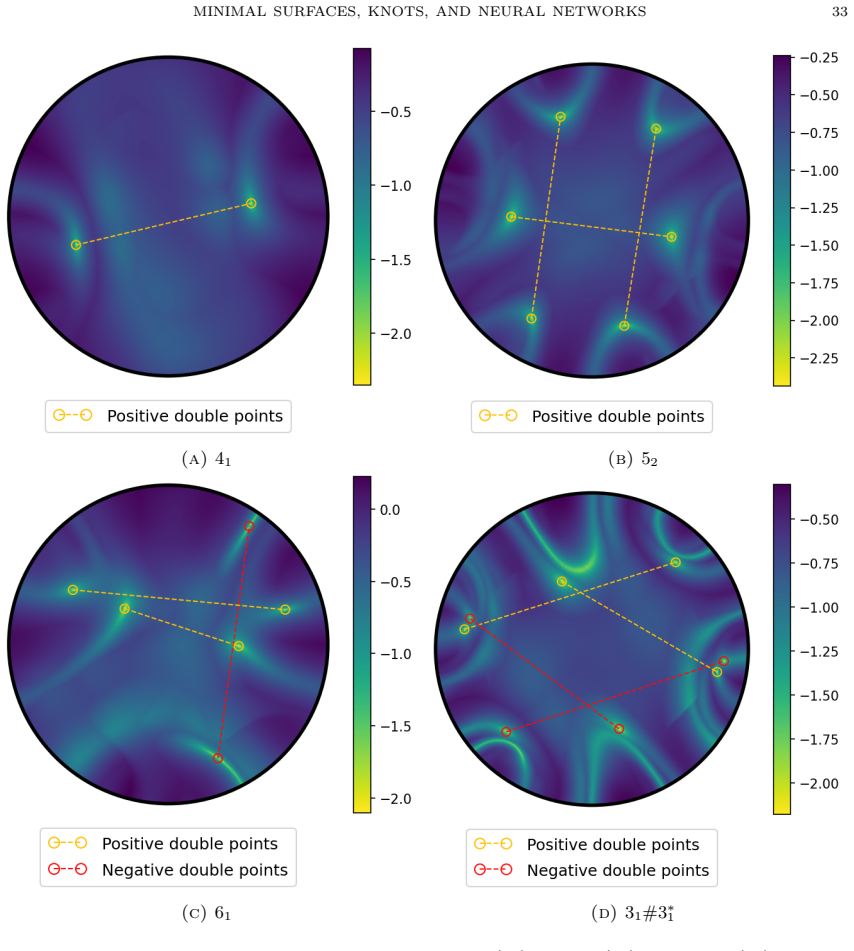
A recent conjecture by Joel Fine posits a relationship between the coefficients of the HOMFLY polynomial of a knot $K$ in the 3-sphere $S^3$, and the signed count of minimal surfaces in hyperbolic 4-space $\mathrm{H}^4$ meeting the sphere at infinity at $K$, with prescribed genus and self-intersection number. In this paper, we develop a novel machine learning framework based on Physics-Informed Neural Networks (PINNs) to solve the minimal surface equation in hyperbolic space. We utilise this framework to test Fine's Conjecture by constructing near-minimal surfaces bounding various families of knots in $S^3$. Furthermore, we develop an algorithmic method to find self-intersections and compute their sign. For every knot analysed, the computationally discovered minimal surfaces and their self-intersection numbers perfectly align with the predictions of Fine's Conjecture, providing empirical evidence for it.
Figures




Forward citations
Cited by 1 Pith paper
-
Black Hole Black Boxes: Numerical Black Hole Metrics via AInstein Neural Networks
Unsupervised Lorentzian PINNs with embedded S^{2} topology recover maximally extended Schwarzschild and yield candidate Petrov type-I vacuum black-hole metrics with genuinely trapped interiors.
Reference graph
Works this paper leans on
-
[1]
Arpit Aggarwal, Yang-Hui He, Jack Heyes, Edward Hirst, Henrique Sá Earp, and Andre Silva. Machine learning sasakian andg 2 topology on contact calabi–yau 7-manifolds.arXiv preprint arXiv:2310.03064, 2023
-
[2]
J. W. Alexander. Topological invariants of knots and links.Trans. Am. Math. Soc., 30:275–306, 1928
1928
-
[3]
High Energy Phys., 2021(5):45,
LaraB.Anderson, MathisGerdes, JamesGray, SvenKrippendorf, NikhilRaghuram, andFabianRuehle.Moduli- dependent Calabi-Yau and SU(3)-structure metrics from machine learning.J. High Energy Phys., 2021(5):45,
2021
-
[4]
Anderson
Michael T. Anderson. Complete minimal varieties in hyperbolic space.Invent. Math., 69:477–494, 1982
1982
-
[5]
Anthony Ashmore, Yang-Hui He, and Burt A. Ovrut. Machine Learning Calabi–Yau Metrics.Fortschritte der Physik, 68(9), 2020
2020
-
[6]
Pearlmutter, Alexey Andreyevich Radul, and Jeffrey Mark Siskind
Atılım Günes Baydin, Barak A. Pearlmutter, Alexey Andreyevich Radul, and Jeffrey Mark Siskind. Automatic differentiation in machine learning: a survey.Journal of Machine Learning Research, 18(153):1–43, 2018
2018
-
[7]
Biquard, editor.AdS/CFT correspondence: Einstein metrics and their conformal boundaries
O. Biquard, editor.AdS/CFT correspondence: Einstein metrics and their conformal boundaries. Proceedings, 73rd Meeting of Theoretical Physicists and Mathematicians, Strasbourg, France, September 11-13, 2003, Zurich, Switzerland, 2005. Eur. Math. Soc
2003
- [8]
-
[9]
Asymptotic plateau problem: a survey
Baris Coskunuzer. Asymptotic plateau problem: a survey. InProceedings of the 20th Gökova geometry-topology conference, Gökova, Turkey, May 27 – June 1, 2013, pages 120–146. Somerville, MA: International Press; Gökova: Gökova Geometry-Topology Conferences (GGT), 2014
2013
-
[10]
Suvankar Deb and Rohan Sanghavi. Aspects of holographic entanglement using physics-informed neural net- works.arXiv preprint arXiv:2509.25311, 2025
-
[11]
Douglas, Subramanian Lakshminarasimhan, and Yidi Qi
Michael R. Douglas, Subramanian Lakshminarasimhan, and Yidi Qi. Numerical Calabi-Yau metrics from holo- morphic networks. InProceedings of the 2nd Mathematical and Scientific Machine Learning Conference, volume 145 ofProceedings of Machine Learning Research, pages 223–252, 2022
2022
-
[12]
Zhiwei Fang, Justin Zhang, and Xiu Yang. A physics-informed neural network framework for partial differential equations on 3d surfaces: Time-dependent problems.arXiv preprint arXiv:2103.13878, 2021
-
[13]
Robin Graham
Charles Fefferman and C. Robin Graham. Conformal invariants. Élie Cartan et les mathématiques d’aujourd’hui, The mathematical heritage of Élie Cartan, Sémin. Lyon 1984, Astérisque, No.Hors Sér. 1985, 95-116 (1985)., 1985
1984
-
[14]
Robin Graham.The ambient metric, volume 178 ofAnnals of Mathematics Studies
Charles Fefferman and C. Robin Graham.The ambient metric, volume 178 ofAnnals of Mathematics Studies. Princeton University Press, Princeton, NJ, 2012
2012
-
[15]
Knots, minimal surfaces and J-holomorphic curves.arXiv preprint arXiv:2112.07713, 2021
Joel Fine. Knots, minimal surfaces and J-holomorphic curves.arXiv preprint arXiv:2112.07713, 2021
-
[16]
Freyd, D
P. Freyd, D. Yetter, J. Hoste, W. B. R. Lickorish, K. Millett, and A. Ocneanu. A new polynomial invariant of knots and links.Bull. Am. Math. Soc., New Ser., 12:239–246, 1985
1985
-
[17]
Computer-assisted proofs in pde: a survey.SeMA Journal, 76(3):459–484, 2019
Javier Gomez-Serrano. Computer-assisted proofs in pde: a survey.SeMA Journal, 76(3):459–484, 2019
2019
-
[18]
Robin Graham and John M
C. Robin Graham and John M. Lee. Einstein metrics with prescribed conformal infinity on the ball.Adv. Math., 87(2):186–225, 1991
1991
-
[19]
SIAM, Philadelphia, PA, 2nd edition, 2008
Andreas Griewank and Andrea Walther.Evaluating Derivatives: Principles and Techniques of Algorithmic Differentiation. SIAM, Philadelphia, PA, 2nd edition, 2008
2008
-
[20]
Metric flows with neural networks.arXiv preprint arXiv:2310.19870, 2023
James Halverson and Fabian Ruehle. Metric flows with neural networks.arXiv preprint arXiv:2310.19870, 2023
-
[21]
Approximating Continuous Functions by ReLU Nets of Minimal Width, 2018
Boris Hanin and Mark Sellke. Approximating Continuous Functions by ReLU Nets of Minimal Width, 2018
2018
-
[22]
MINIMAL SURFACES, KNOTS, AND NEURAL NETWORKS 37
KojiHashimoto, KoichiKyo, MasakiMurata, GakutoOgiwara, andNorihiroTanahashi.Physics-informedneural network solves minimal surfaces in curved spacetime.arXiv preprint arXiv:2509.10866, 2025. MINIMAL SURFACES, KNOTS, AND NEURAL NETWORKS 37
-
[23]
Minimising Willmore Energy via Neural Flow
Edward Hirst, Henrique N. Sá Earp, and Tomás S. R. Silva. Minimising willmore energy via neural flow.arXiv preprint arXiv:2604.04321, 2026
work page internal anchor Pith review Pith/arXiv arXiv 2026
- [24]
-
[25]
Multilayer feedforward networks are universal approx- imators.Neural Networks, 2(5):359–366, 1989
Kurt Hornik, Maxwell Stinchcombe, and Halbert White. Multilayer feedforward networks are universal approx- imators.Neural Networks, 2(5):359–366, 1989
1989
-
[26]
Neural network approximations for Calabi-Yau metrics.arXiv, 08:105, 2022
Vishnu Jejjala, Damian Kaloni Mayorga Pena, and Challenger Mishra. Neural network approximations for Calabi-Yau metrics.arXiv, 08:105, 2022
2022
-
[27]
V. F. R. Jones. Hecke algebra representations of braid groups and link polynomials.Ann. Math. (2), 126:335–388, 1987
1987
-
[28]
Vaughan F. R. Jones. A polynomial invariant for knots via von Neumann algebras.Bull. Am. Math. Soc., New Ser., 12:103–111, 1985
1985
-
[29]
Universal approximation with deep narrow networks, 2020
Patrick Kidger and Terry Lyons. Universal approximation with deep narrow networks, 2020
2020
-
[30]
Kingma and Jimmy Ba
Diederik P. Kingma and Jimmy Ba. Adam: A method for stochastic optimization.Proceedings of ICLR, 2015
2015
-
[31]
Learning Size and Shape of Calabi-Yau Spaces,
Magdalena Larfors, Andre Lukas, Fabian Ruehle, and Robin Schneider. Learning size and shape of calabi-yau spaces.arXiv preprint arXiv:2111.01436, 2021
-
[32]
DongC.LiuandJorgeNocedal.OnthelimitedmemoryBFGSmethodforlargescaleoptimization.Mathematical Programming, 45(3):503–528, 1989
1989
-
[33]
G. Bruno De Luca. Machine learning gravity compactifications on negatively curved manifolds.arXiv preprint arXiv:2501.00093, 2024
-
[34]
Variations of renormalized volume for minimal submanifolds of Poincaré-Einstein manifolds
Jared Marx-Kuo. Variations of renormalized volume for minimal submanifolds of Poincaré-Einstein manifolds. Commun. Anal. Geom., 33(1):17–29, 2025
2025
-
[35]
Mazzeo.Hodge cohomology of negatively curved manifolds
Rafe R. Mazzeo.Hodge cohomology of negatively curved manifolds. ProQuest LLC, Ann Arbor, MI, 1986. Thesis (Ph.D.)–Massachusetts Institute of Technology
1986
-
[36]
Mazzeo and Richard B
Rafe R. Mazzeo and Richard B. Melrose. Meromorphic extension of the resolvent on complete spaces with asymptotically constant negative curvature.J. Funct. Anal., 75(2):260–310, 1987
1987
-
[37]
Richard B. Melrose. Differential analysis on manifolds with corners, 1996
1996
-
[38]
Updating quasi-Newton matrices with limited storage.Mathematics of Computation, 35(151):773–782, 1980
Jorge Nocedal. Updating quasi-Newton matrices with limited storage.Mathematics of Computation, 35(151):773–782, 1980
1980
-
[39]
Daniel Platt. Non-uniqueness and symmetries for the nirenberg problem using computer assistance.arXiv pre- print arXiv:2603.29544, 2026
-
[40]
Raissi, P
M. Raissi, P. Perdikaris, and G. E. Karniadakis. Physics-informed neural networks: a deep learning framework for solving forward and inverse problems involving nonlinear partial differential equations.J. Comput. Phys., 378:686–707, 2019
2019
-
[41]
Biharmonic maps between conformally compact manifolds.Calc
Marco Usula. Biharmonic maps between conformally compact manifolds.Calc. Var. Partial Differ. Equ., 65(2):24, 2026. Id/No 59
2026
-
[42]
Isometric embeddings of conformally compact manifolds into hyperbolic spaces.International Mathematics Research Notices, 2026(10):rnag098, 05 2026
Marco Usula. Isometric embeddings of conformally compact manifolds into hyperbolic spaces.International Mathematics Research Notices, 2026(10):rnag098, 05 2026
2026
-
[43]
Yongji Wang, Mehdi Bennani, James Martens, Sébastien Racanière, Sam Blackwell, Alex Matthews, Stan- islav Nikolov, Gonzalo Cao-Labora, Daniel S. Park, Martin Arjovsky, Daniel Worrall, Chongli Qin, Ferran Alet, Borislav Kozlovskii, Nenad Tomašev, Alex Davies, Pushmeet Kohli, Tristan Buckmaster, Bogdan Geor- giev, Javier Gómez-Serrano, Ray Jiang, and Ching-...
-
[44]
Convergence conditions for ascent methods.SIAM Review, 11(2):226–235, 1969
Philip Wolfe. Convergence conditions for ascent methods.SIAM Review, 11(2):226–235, 1969
1969
-
[45]
Steven Zhou and Xiaojing Ye. Approximating high-dimensional minimal surfaces with physics-informed neural networks.arXiv preprint arXiv:2309.02589, 2023
discussion (0)
Sign in with ORCID, Apple, or X to comment. Anyone can read and Pith papers without signing in.