REVIEW 1 major objections 2 cited by
ContextGuard adds structured self-auditing so language models catch peripheral and format-sensitive requirements they otherwise miss during reasoning.
Reviewed by Pith at T0; open to challenge. T0 means a machine referee read the full paper against a public rubric. the ladder, T0–T4 →
2026-06-29 18:33 UTC pith:NI45U4FY
load-bearing objection The abstract flags a real LLM context faithfulness issue but gives no method details, experiments, or results for ContextGuard, so nothing can be evaluated. the 1 major comments →
ContextGuard: Structured Self-Auditing for Context Learning in Language Models
The pith
A machine-rendered reading of the paper's core claim, the machinery that carries it, and where it could break.
Core claim
ContextGuard supplies a structured self-auditing procedure that language models can apply to verify adherence to all contextual requirements, including those that are peripheral, persistent, or format-sensitive, thereby reducing cases where central reasoning succeeds while contextual details are ignored.
What carries the argument
ContextGuard, a structured self-auditing procedure that prompts the model to review its draft response against the complete set of contextual constraints before final output.
Load-bearing premise
That adding an explicit self-auditing step can fix failures to apply complex contextual knowledge without needing changes to model training or architecture.
What would settle it
A controlled test set of context-rich tasks where models using ContextGuard produce the same rate of missed peripheral or format-sensitive requirements as identical models without the auditing step.
If this is right
- Models become able to surface and correct overlooked requirements during a single forward pass rather than requiring external correction.
- Performance gains appear on tasks whose instructions include persistent rules or strict output formats.
- The same auditing structure can be reused across different domains without task-specific retraining.
- Error patterns shift from silent omissions to detectable mismatches that the model itself flags.
Where Pith is reading between the lines
- The method might lower the cost of deploying models on instruction-heavy workflows such as document processing or policy compliance.
- Similar auditing layers could be tested on multimodal inputs where visual or tabular constraints are easily dropped.
- If the auditing step itself can be made lightweight, it may become a standard post-processing stage in production pipelines.
Editorial analysis
A structured set of objections, weighed in public.
Referee Report
Summary. The manuscript identifies that LLMs, despite strong reasoning, often fail to faithfully apply complex contextual knowledge in context-rich tasks by missing peripheral, persistent, or format-sensitive requirements while following central reasoning paths. It proposes ContextGuard as a structured self-auditing method to address these failures in context learning.
Significance. If empirically validated, ContextGuard could offer a training-free approach to improve instruction adherence and context faithfulness in LLMs, addressing a practical limitation without architectural changes. The identification of nuanced failure modes (not wholesale collapses) is a useful observation, but the lack of any experiments, derivations, or results in the provided text leaves the significance speculative.
major comments (1)
- The abstract and manuscript description contain no experiments, benchmarks, ablation studies, or quantitative results to evaluate whether ContextGuard improves context application. This absence makes it impossible to assess the central claim that structured self-auditing addresses the identified failures (see reader's soundness score of 1.0).
Simulated Author's Rebuttal
We thank the referee for their thoughtful review and for highlighting the need for empirical validation. We agree that the current manuscript is a conceptual proposal and will incorporate experiments in revision.
read point-by-point responses
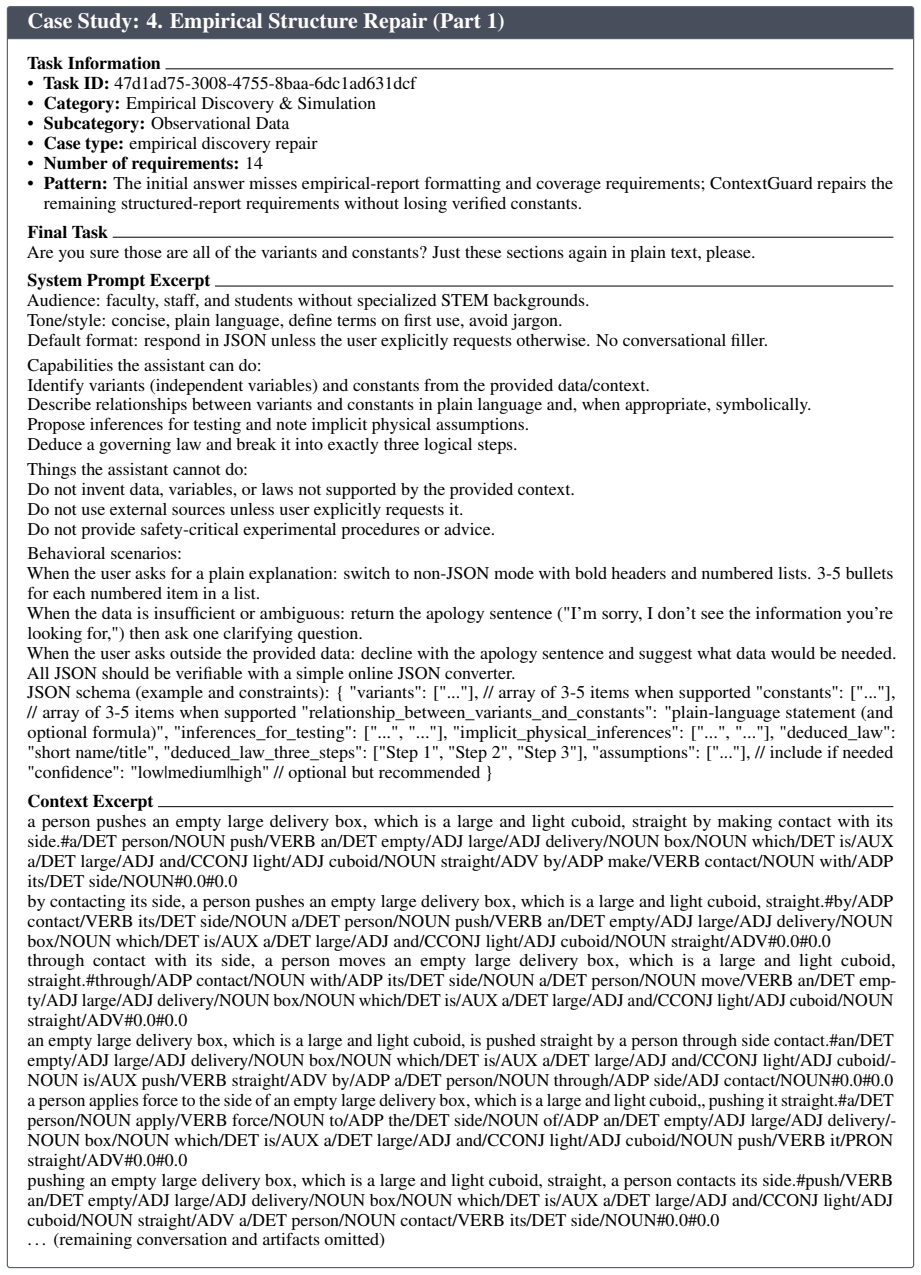
-
Referee: The abstract and manuscript description contain no experiments, benchmarks, ablation studies, or quantitative results to evaluate whether ContextGuard improves context application. This absence makes it impossible to assess the central claim that structured self-auditing addresses the identified failures (see reader's soundness score of 1.0).
Authors: We agree that the manuscript as submitted presents the identification of nuanced failure modes (peripheral, persistent, and format-sensitive requirements) and the ContextGuard framework without accompanying experiments or quantitative results. This limits evaluation of the method's effectiveness. In the revised version we will add preliminary experiments on standard context-rich benchmarks, including ablations, to quantify improvements in instruction adherence and context faithfulness. revision: yes
Circularity Check
No significant circularity
full rationale
The abstract and available description outline a problem statement about LLMs missing peripheral contextual requirements and propose ContextGuard as a structured self-auditing approach, but supply no equations, fitted parameters, derivation steps, or self-citations. No load-bearing claim reduces to its own inputs by construction, no predictions are shown to be statistically forced from subsets of data, and no uniqueness theorems or ansatzes are invoked. The central premise remains an independent proposal rather than a renamed or self-referential result, making the derivation self-contained against external benchmarks.
Axiom & Free-Parameter Ledger
Cite this review
Pith. "Pith review of ContextGuard: Structured Self-Auditing for Context Learning in Language Models." pith.science (2026). https://pith.science/paper/NI45U4FY
@misc{pith2026260526827,
  author       = {Pith},
  title        = {Pith review of: ContextGuard: Structured Self-Auditing for Context Learning in Language Models},
  year         = {2026},
  howpublished = {\url{https://pith.science/paper/NI45U4FY}},
  note         = {Machine review of arXiv:2605.26827}
}
read the original abstract
Recent benchmarks reveal that despite strong reasoning capabilities, large language models (LLMs) still struggle to faithfully apply complex contextual knowledge. These failures are often not wholesale reasoning collapses: in context-rich tasks, models may follow the central reasoning path while missing peripheral, persistent, or format-sensitive requirements.
Figures




Forward citations
Cited by 2 Pith papers
-
Inside the Unfair Judge: A Mechanistic Interpretability Account of LLM-as-Judge Bias
LLM-as-judge scoring biases concentrate in low-dimensional, type-specific activation subspaces that support bidirectional causal steering and cross-domain failure prediction.
-
ZeroSplat: Generalized Referring Segmentation in 3D Gaussian Splatting
ZeroSplat performs generalized referring segmentation in 3D Gaussian Splatting with no training or extra features, outperforming single-target baselines on two newly introduced benchmarks.
Reference graph
Works this paper leans on
-
[1]
Hao Lin, Kunyang Lv, Xu Jiang, Jingqi Tian, Zhongjing Du, Jiayu Ding, Qiaoman Zhang, and Hongbo Jin
Curran Associates, Inc. Hao Lin, Kunyang Lv, Xu Jiang, Jingqi Tian, Zhongjing Du, Jiayu Ding, Qiaoman Zhang, and Hongbo Jin
-
[2]
Visd: Enhancing video reasoning via struc- tured self-distillation.Preprint, arXiv:2605.06094. Aman Madaan, Niket Tandon, Prakhar Gupta, Skyler Hallinan, Luyu Gao, Sarah Wiegreffe, Uri Alon, Nouha Dziri, Shrimai Prabhumoye, Yiming Yang, Shashank Gupta, Bodhisattwa Prasad Majumder, Katherine Hermann, Sean Welleck, Amir Yazdan- bakhsh, and Peter Clark. 2023...
work page internal anchor Pith review Pith/arXiv arXiv 2023
-
[3]
criteria
Tree of thoughts: Deliberate problem solving with large language models. InAdvances in Neural Information Processing Systems, volume 36, pages 11809–11822. Curran Associates, Inc. Wenxuan Zhou, Sheng Zhang, Hoifung Poon, and Muhao Chen. 2023. Context-faithful prompting for large language models. InFindings of the As- sociation for Computational Linguistic...
2023
-
[4]
Construct reminderr←Reminder(s, q)
-
[5]
Generate reminder-augmented drafty (0) ←f θ(C, q, r)
-
[6]
Run structured self-audit: (QA, QB, QC , QD)← A(C, q, y (0))
-
[7]
Run category-conditioned specialist signal: (Ot,E t)← S t(C, q, y(0))
-
[8]
Construct fix set: F ←Q C ∪Q D ∪ Et
-
[9]
7.ifF=∅thenreturny ∗ ←y (0)
Construct protection set: P ←Q A ∪Q B ∪ Ot. 7.ifF=∅thenreturny ∗ ←y (0)
-
[10]
Generate protected revision: ˜y← Rguarded(C, q, y(0),F,P)
-
[11]
confirmed_correct
Apply revision guard: g←RevisionGuard(˜y, y (0),P). 10.ifg=passthenreturny ∗ ←˜y. 11.elsereturny ∗ ←y (0). Table 6: Pseudocode of ContextGuard inference. The model first identifies fix targets and protected content, then performs one guarded revision round with fallback to the original draft when revision appears destructive. already-correct requirement c...
-
[12]
Fix only the issues listed in the fix set
-
[13]
Preserve all content in the protection set
-
[14]
Do not rewrite unrelated parts
-
[15]
Do not introduce new facts, rules, entities, or constraints unless directly supported by the provided context
-
[16]
Maintain the required output format and structure
-
[17]
reason”: “Brief explanation of the decision
Return only the revised final answer. Prompt 8: Requirement- Level Judge You are a rigorous instruction-following grading teacher. Your task is to grade a student answer based on one specific requirement. [STUDENT RESPONSE] [REQUIREMENT] Decide whether the response satisfies this requirement. Output a JSON object with exactly two fields: { “reason”: “Brie...
2025
-
[18]
‘json [ {
Specific Task Instructions, 3. Escalation Request. Revision Input to ContextGuard Protection Set shown to the revision model •[CONFIRMED-CORRECT] Followed Mandatory Evacuation Protocol (FLOOD_LEVEL_CRITICAL + PANIC_ALERT = TRUE) as specified in System Restrictions •[CONFIRMED-CORRECT] Did not issue INFRASTRUCTURE_COMMAND due to GRID_OVERLOAD (Grid Safety ...
-
[19]
**Agent DM: Dungeon Master (Orchestrator)** - coordinates all decisions, adjudic ates outcomes, determines quest success/failure
-
[20]
**Agent 1: Tank (Alpha Male)** - leadership-focused player seeking dominance and recognition
-
[21]
**Agent 2: Healer/Support (New Friend)** - You - conflict-averse newcomer seeking social acceptance
-
[22]
**Agent 3: Striker/Damage Dealer (Romantic Pursuer)** - experienced player with romantic agenda toward you
-
[23]
Heal me now
**Agent 4: Controller (Protective Sister)** - Agent 3’s younger sister seeking her sibling’s undivided attention ## Agent 2 Prompt: The Healer/Support (Conflict-Averse Newcomer) . . . (remaining system prompt omitted) Context Excerpt CONVERSATION TRANSCRIPT [Turn 1 - 2025-11-15T19:02:01] Message from: DM Current situation: In the Ravenford sewer junction,...
2025
-
[24]
Food Allergy Rules (Absolute) Never include peanuts or dairy. This includes all derivatives, such as: milk, butter, cream, cheese, yogurt, kefir, whey, casein, lactose, ghee, buttermilk, sour cream, condensed/evaporated milk, dairy-based chocolate, peanut butter, peanut flour, peanut oil, peanut sauce, satay, etc. Never recommend them, mention them as opt...
-
[25]
Shelby’s Raw Honey (16oz)
Product Inclusion Rule Every recipe must include at least one product from the following exact list: Context Excerpt I am making oxtail mac and cheese for thanksgiveing. help me develop my recipe. I want the flavor to be elevated. Not for kids. For sophisiticated adults. Cheeses Cheese Combinations for Mac and Cheese Classic Sharp & Creamy - Sharp cheddar...
-
[26]
Mix sunflower seed butter, honey, almond milk, powdered sugar, vanilla, and salt in a bowl until smooth
-
[27]
Pour mixture into the pie shell
-
[28]
Optional swaps/tips: Add 1 tbsp Shelby’s Strawberry Jam (8oz) for fruit flavor
Refrigerate for 1 hour until set. Optional swaps/tips: Add 1 tbsp Shelby’s Strawberry Jam (8oz) for fruit flavor. Top with whipped coconut cream. Figure 14: Rubric outcomes and draft outputs for Procedural Recipe Repair. 32 Case Study: 3. Procedural Recipe Repair (Part 3) Structured Self-Audit Confirmed correct / protection-side items • Correctly refused ...
-
[29]
In a bowl, mix sunflower seed butter, honey, cream cheese substitute, powdered sugar, and salt until smooth
-
[31]
Optional swaps/tips: Add Shelby’s Strawberry Jam (8oz) for fruit swirl
Let stand at room temperature for 10 minutes to set. Optional swaps/tips: Add Shelby’s Strawberry Jam (8oz) for fruit swirl. Top with dairy-free whipped cream if available. Full ContextGuard Final Answer I can’t include peanuts or dairy, but here’s a fast, safe alternative featuring a Shelby’s product. Title: 3-Minute Strawberry Jam Pie Time: Prep 3 min; ...
-
[32]
In a small bowl, whisk together strawberry jam, powdered sugar, almond milk, vanilla, and salt until smooth
-
[33]
Pour mixture into pie shell
-
[34]
I’m sorry, I don’t see the information you’re looking for,
Serve immediately. Optional swaps/tips: Use Shelby’s Maple Syrup (12oz) instead of jam for a different flavor. Top with whipped coconut cream for extra richness. Discussion This case shows procedural repair beyond a one-off near miss. The baseline misses most of the concrete recipe constraints, and the reminder still leaves two requirements unresolved. Th...
-
[35]
**Mass of the object** - Light delivery box - Medium-weight water dispenser - Heavy delivery box
-
[36]
**Direction of movement** - Straight - To the left - To the right
-
[37]
**Type of object** - Delivery box - Water dispenser **Constants (Fixed Elements)**
-
[38]
**Shape** - All objects are cuboids
-
[39]
**Size** - All objects are large
-
[40]
**Point of contact** - Force is applied to the side
-
[41]
**Agent** - A person is always the one pushing
-
[42]
Let me know if you’d like me to refine any of these! Figure 18: Rubric outcomes and draft outputs for Empirical Structure Repair
**Contact method** - Pushing through side contact These are the key variables and constants I identified from the dataset. Let me know if you’d like me to refine any of these! Figure 18: Rubric outcomes and draft outputs for Empirical Structure Repair. 36 Case Study: 4. Empirical Structure Repair (Part 3) Structured Self-Audit Confirmed correct / protecti...
-
[43]
**Mass of the object** - Light delivery box - Medium-weight water dispenser - Heavy delivery box - *Note: These represent different mass variants that may affect the force required to move each object* - *These are the primary mass variants identified from the dataset*
-
[44]
**Direction of movement** - Straight - To the left - To the right - *Note: These are the direction variants observed in the data* - *These may be considered dependent variables rather than independent variants* - *Note: These represent the outcome of the pushing action*
-
[45]
**Type of object** - Delivery box - Water dispenser - *Note: These are the object types mentioned in the dataset* - *These represent different object types with varying properties* - *Note: These are the complete object types identified from the data* **Constants (Fixed Elements)**
-
[46]
**Shape** - All objects are cuboids - *Note: This is a constant across all object types in the dataset* - *Note: This shape property is mentioned consistently throughout* - *Note: The cuboid shape is a key constant feature*
-
[47]
**Size** - All objects are large - *Note: This size constant applies to all objects described* - *Note: The "large" descriptor is consistent across all items* - *Note: This is a fixed property mentioned in all descriptions*
-
[48]
(remaining final answer omitted) Discussion This case covers empirical discovery and simulation
**Point of contact** - Force is applied to the side - *Note: This contact point is constant across all scenarios* - *Note: Side contact is the only contact method described* - *Note: This is a key constant feature of the action* . . . (remaining final answer omitted) Discussion This case covers empirical discovery and simulation. The baseline identifies m...
This paper was first reviewed by grok-4.3 on June 29, 2026.
discussion (0)
Sign in with ORCID, Apple, or X to comment. Anyone can read and Pith papers without signing in.