SPHEREx confirms predictions for artificial satellite trail pollution in Low Earth Orbit
Pith reviewed 2026-06-29 15:03 UTC · model grok-4.3
The pith
SPHEREx observations confirm satellite trails already contaminate 73 percent of its images, matching published pollution models.
A machine-rendered reading of the paper's core claim, the machinery that carries it, and where it could break.
Core claim
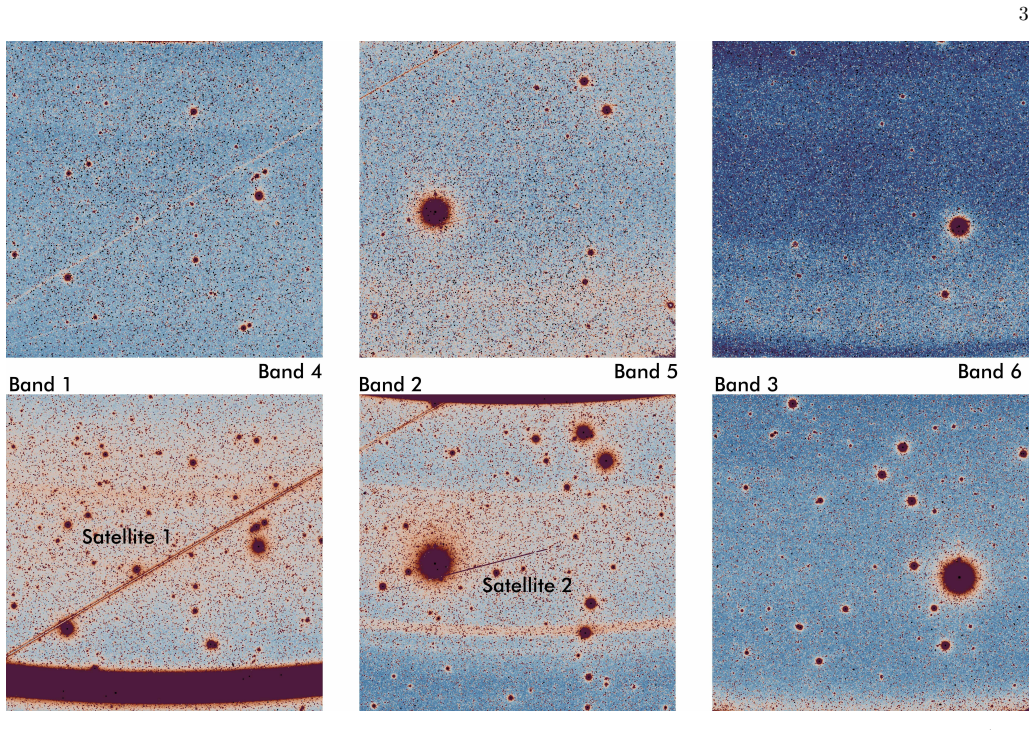
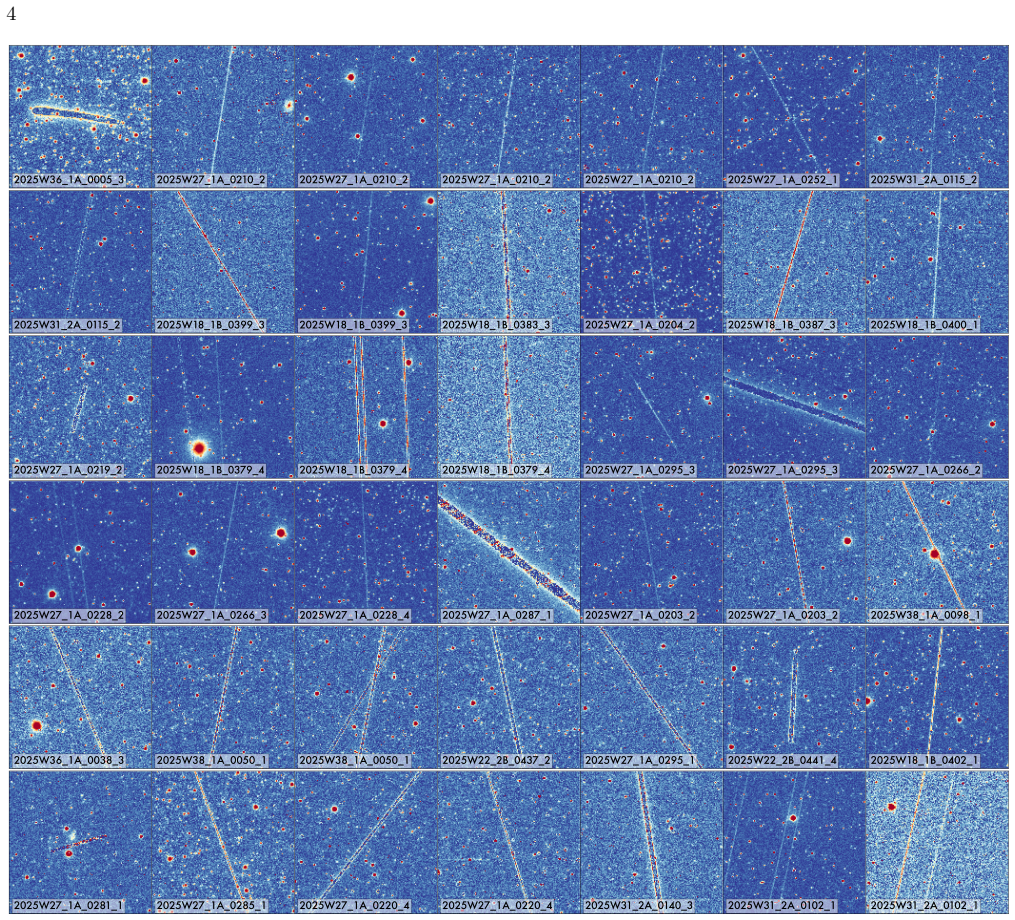
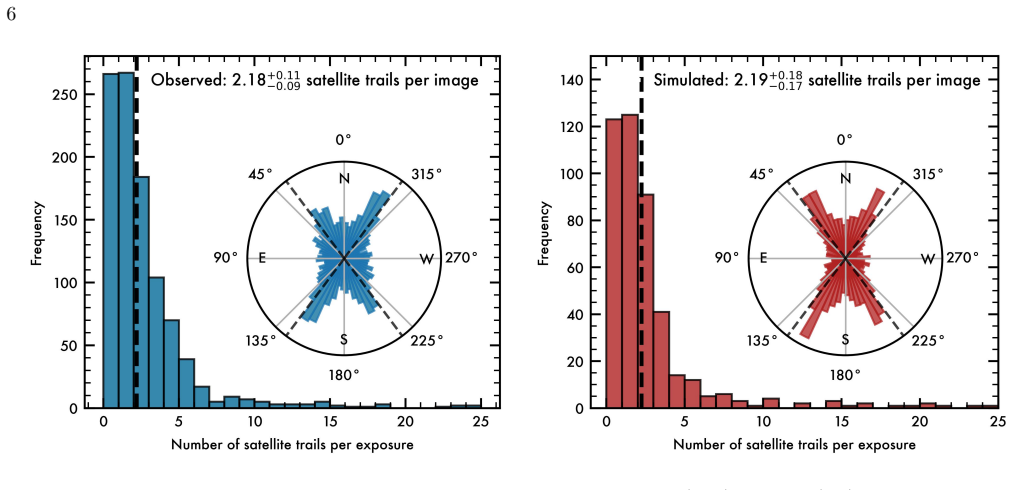
SPHEREx observations obtained between May and September 2025 indicate that 73.3^{+1.3}_{-1.2}% of the images already show satellite trail contamination, with an average number of N=2.18^{+0.11}_{-0.09} trails per exposure, providing observational validation of the published light contamination models. The observed satellite trails display highly inclined trajectories in agreement with the simulated ones.
What carries the argument
Statistical comparison of the fraction and number of satellite trails detected in SPHEREx images against predictions from published light-contamination simulations of LEO satellite constellations.
If this is right
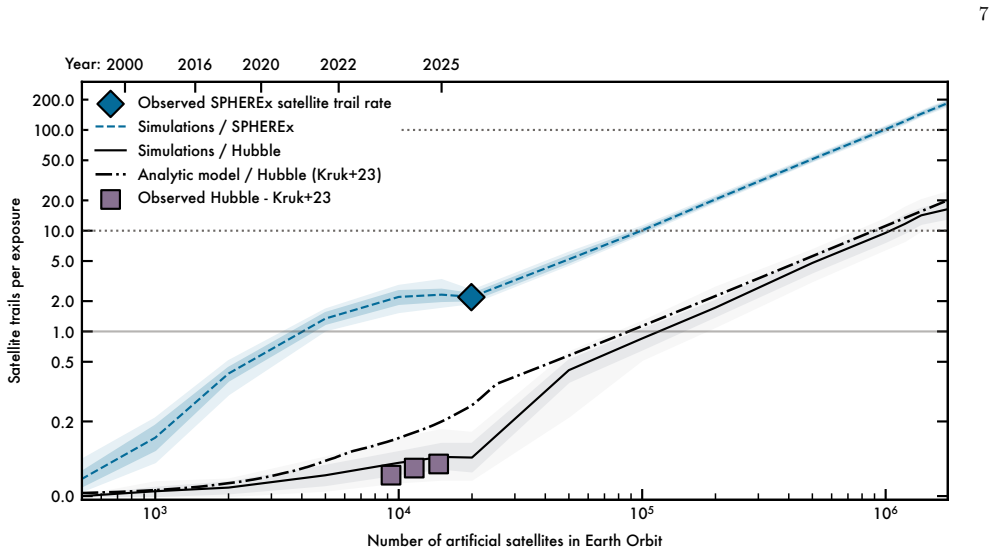
- If all satellite constellations in current launch manifests reach orbit, trails will appear in up to 96 percent of images from most space telescopes.
- Data reduction pipelines can apply mitigation methods to reduce the impact of some trails on science data.
- Updated forecasts for Hubble and SPHEREx that include 2026-proposed constellations show continued growth in contamination rates.
Where Pith is reading between the lines
- Space telescope scheduling algorithms may need to incorporate real-time avoidance of predicted satellite passes to protect critical exposures.
- Large-scale survey programs that rely on many short exposures could lose a substantial fraction of their data to trails unless mitigation improves.
- Ground-based wide-field surveys may experience analogous contamination on clear nights when low-Earth-orbit satellites cross the field of view.
Load-bearing premise
The bright linear features identified in the SPHEREx images are produced by artificial satellites and the sampled exposures represent the overall contamination rate across the mission.
What would settle it
An independent re-analysis of the same SPHEREx dataset that attributes most of the linear features to non-satellite sources and reports a contamination fraction below 50 percent would falsify the validation result.
Figures
read the original abstract
The number of artificial satellites in Low Earth Orbit (LEO) is increasing at an exponential rate since 2019. Satellites are visible to both ground and space telescopes, and their bright emission in optical, infrared, and radio-wavelengths contaminate astronomical observations, degrading the data's scientific value. Recent simulations forecast that if all satellite constellations listed in current launch manifests are deployed to LEO, satellite trails will appear in up to 96\% of the images obtained by most space telescopes. In this article, we use the recently launched SPHEREx space telescope to corroborate these models. SPHEREx observations obtained between May and September 2025 indicate that $73.3^{+1.3}_{-1.2}\%$ of the images already show satellite trail contamination, with an average number of $N=2.18^{+0.11}_{-0.09}$ trails per exposure, providing observational validation of the published light contamination models. The observed satellite trails display highly inclined trajectories in agreement with the simulated ones. We discuss potential data reduction mitigation methods, and provide an updated satellite light pollution forecast for \emph{Hubble} and SPHEREx including the newer satellite constellations proposed in early 2026.
Editorial analysis
A structured set of objections, weighed in public.
Referee Report
Summary. The paper reports SPHEREx observations from May–September 2025 showing satellite trail contamination in 73.3^{+1.3}_{-1.2}% of images with an average of N=2.18^{+0.11}_{-0.09} trails per exposure. These data are presented as direct observational validation of prior simulations forecasting up to 96% contamination for full LEO constellations, with additional discussion of mitigation strategies and updated forecasts for Hubble and SPHEREx incorporating 2026 launch manifests. The observed trails are stated to exhibit highly inclined trajectories matching the simulations.
Significance. If the trail identifications are robust and the sample is representative, the result supplies the first direct observational anchor for satellite-light-pollution models that have previously been simulation-only. This would be a high-impact datum for observatory planning, exposure-time calculators, and policy discussions on mega-constellations, especially given the explicit numerical agreement quoted with uncertainties.
major comments (2)
- [§3] §3 (Results) and abstract: the headline fractions (73.3% contaminated images, N=2.18 trails/exposure) are load-bearing for the validation claim, yet the text supplies no description of the linear-feature detection algorithm, its false-positive rate against cosmic rays, asteroids, or instrumental streaks, or any control-sample tests. Without these, the numerical match to the models cannot be evaluated as confirmatory.
- [§2.3] §2.3 (Data selection) and §4 (Discussion): the claim that the May–Sep 2025 SPHEREx pointing and wavelength sample is unbiased with respect to the model assumptions is stated but not demonstrated; no table or figure compares the observed orbital inclinations or exposure parameters against the simulation priors used for the 96% forecast.
minor comments (2)
- [Abstract] Abstract: the phrase “providing observational validation” is used before the methods for trail attribution are described; this phrasing should be qualified until the identification pipeline is shown.
- [Figure 2] Figure 2 (trajectory comparison): axis labels and legend entries are too small for print; the inclination histogram should include the model prediction as an overlaid curve with a quantitative Kolmogorov–Smirnov statistic.
Simulated Author's Rebuttal
We thank the referee for their thoughtful review and constructive comments, which have helped us strengthen the manuscript. We address each major comment below and have made revisions to incorporate the requested details.
read point-by-point responses
-
Referee: [§3] §3 (Results) and abstract: the headline fractions (73.3% contaminated images, N=2.18 trails/exposure) are load-bearing for the validation claim, yet the text supplies no description of the linear-feature detection algorithm, its false-positive rate against cosmic rays, asteroids, or instrumental streaks, or any control-sample tests. Without these, the numerical match to the models cannot be evaluated as confirmatory.
Authors: We agree that the absence of a detailed description of the linear-feature detection algorithm limits the ability to evaluate the robustness of the reported fractions. In the revised manuscript, we will add a dedicated subsection in §3 describing the algorithm, its implementation, and quantitative false-positive rate estimates obtained from control samples of SPHEREx exposures. These controls will explicitly test performance against cosmic rays, asteroids, and instrumental streaks, allowing readers to assess the reliability of the 73.3% and N=2.18 values in the context of the model validation. revision: yes
-
Referee: [§2.3] §2.3 (Data selection) and §4 (Discussion): the claim that the May–Sep 2025 SPHEREx pointing and wavelength sample is unbiased with respect to the model assumptions is stated but not demonstrated; no table or figure compares the observed orbital inclinations or exposure parameters against the simulation priors used for the 96% forecast.
Authors: We acknowledge that the manuscript states the sample is representative but does not provide a direct comparison. We will add a new figure and accompanying text in §2.3 (with reference in §4) that overlays the observed distributions of orbital inclinations and exposure parameters from the May–September 2025 SPHEREx data against the priors used in the simulation models for the 96% forecast. This will explicitly demonstrate the degree of agreement and support the unbiased sampling claim. revision: yes
Circularity Check
No significant circularity; new observations independently validate prior models
full rationale
The paper reports fresh SPHEREx telescope data (May–Sep 2025) yielding 73.3% contaminated images and N=2.18 trails/exposure, presented as direct observational corroboration of previously published simulation forecasts. These quantities are extracted from the new images rather than obtained by fitting parameters to the models or by any self-referential equation. No load-bearing self-citation chain, ansatz smuggling, or renaming of known results is visible; the validation step remains externally falsifiable by the telescope measurements themselves.
Axiom & Free-Parameter Ledger
Forward citations
Cited by 1 Pith paper
-
Streak detection in the VST/OmegaCAM archive using deep learning
A two-stage deep learning pipeline (HT-LCNN detector + VGG6 classifier) trained on augmented real and simulated data detects streaks in OmegaCAM frames with F1 > 0.95 on test sets and 0.99 precision on real 2023 data,...
Reference graph
Works this paper leans on
-
[1]
Ag¨ uera y Arcas, B., Beals, T., Biggs, M., et al. 2025, Towards a future space-based, highly scalable AI infrastructure system design,, Google Astropy Collaboration, Robitaille, T. P., Tollerud, E. J., et al. 2013, A&A, 558, A33, doi: 10.1051/0004-6361/201322068 Astropy Collaboration, Price-Whelan, A. M., Sip˝ ocz, B. M., et al. 2018, AJ, 156, 123, doi: ...
-
[2]
Bassa, C. G., Di Vruno, F., Winkel, B., et al. 2024, A&A, 689, L10, doi: 10.1051/0004-6361/202451856
-
[3]
Billot, N., Hellmich, S., Benz, W., et al. 2024, In-situ observations of resident space objects with the CHEOPS space telescope,, arXiv:2411.18326 doi: 10.48550/arXiv.2411.18326
-
[4]
Bock, J. J., Aboobaker, A. M., Adamo, J., et al. 2026, ApJ, 999, 139, doi: 10.3847/1538-4357/ae2be2
-
[5]
C., Wright, E., Lawler, S., Hickson, P., & Balam, D
Boley, A. C., Wright, E., Lawler, S., Hickson, P., & Balam, D. 2022, AJ, 163, 199, doi: 10.3847/1538-3881/ac5599
-
[6]
Borlaff, A. S., Marcum, P. M., & Howell, S. B. 2025, Nature, 648, 51, doi: 10.1038/s41586-025-09759-5
-
[7]
Borncamp, D., & Lim, P. L. 2016, Satellite Detection in Advanced Camera for Surveys/Wide Field Channel Images,, Instrument Science Report ACS 2016-01, 10 pages
2016
-
[8]
Corbett, H., Law, N. M., Soto, A. V., et al. 2020, ApJ, 903, L27, doi: 10.3847/2041-8213/abbee5
-
[9]
P., Werner, M., Akeson, R., et al
Crill, B. P., Werner, M., Akeson, R., et al. 2020, in Society of Photo-Optical Instrumentation Engineers (SPIE) Conference Series, Vol. 11443, Space Telescopes and Instrumentation 2020: Optical, Infrared, and Millimeter Wave, ed. M. Lystrup & M. D. Perrin, 114430I, doi: 10.1117/12.2567224 Di Vruno, F., Winkel, B., Bassa, C. G., et al. 2023, A&A, 676, A75,...
-
[10]
Feder, R. M., Masters, D. C., Lee, B., et al. 2024, ApJ, 972, 68, doi: 10.3847/1538-4357/ad596d
-
[11]
P., Huang, Z., Nomura, K.-i., & Wang, J
Ferreira, J. P., Huang, Z., Nomura, K.-i., & Wang, J. 2024, Geophys. Res. Lett., 51, e2024GL109280, doi: 10.1029/2024GL109280
-
[12]
Astronomy & Astrophysics , author =
Grigg, D., Tingay, S. J., & Sokolowski, M. 2025, A&A, 699, A307, doi: 10.1051/0004-6361/202554787
-
[13]
Grigg, D., Tingay, S. J., Sokolowski, M., et al. 2023, A&A, 678, L6, doi: 10.1051/0004-6361/202347654
-
[14]
Astronomy & Astrophysics , author =
Hainaut, O. R., & Williams, A. P. 2020, A&A, 636, A121, doi: 10.1051/0004-6361/202037501
-
[15]
2022, MNRAS, 516, 1502, doi: 10.1093/mnras/stac2080
Furfaro, R. 2022, MNRAS, 516, 1502, doi: 10.1093/mnras/stac2080
-
[16]
2021, SATCON2: Executive Summary
Hall, J., Walker, C., Rawls, M., et al. 2021, SATCON2: Executive Summary
2021
-
[17]
2020, ApJ, 905, 3, doi: 10.3847/1538-4357/abc695
Horiuchi, T., Hanayama, H., & Ohishi, M. 2020, ApJ, 905, 3, doi: 10.3847/1538-4357/abc695
-
[18]
2006, Air and Water Pollution: Burden and Strategies for Control,, https://www.ncbi.nlm.nih.gov/books/NBK11769/# Oxford University Press
Kjellstrom, T., Lodh, M., McMichael, T., et al. 2006, Air and Water Pollution: Burden and Strategies for Control,, https://www.ncbi.nlm.nih.gov/books/NBK11769/# Oxford University Press
2006
-
[19]
Kruk, S., Garcia-Martin, P., Popescu, M., et al. 2023, Nature, 7, 262, doi: 10.1038/s41550-023-01903-3
-
[20]
Rosenlof, K. H. 2025, NewA, 130, 2024JD042442, doi: 10.1029/2024JD042442
-
[21]
McDowell, J. C. 2020, ApJ, 892, L36, doi: 10.3847/2041-8213/ab8016
-
[22]
Observatory, S. A. 2000, SAOImage DS9: A utility for displaying astronomical images in the X11 window environment,, Astrophysics Source Code Library, record ascl:0003.002
2000
-
[23]
Office, E. S. D. 2025, ESA Space Environment Report 2025,, European Space Agency
2025
-
[24]
2025, AcA, 236, 770, doi: 10.1016/j.actaastro.2025.07.027
Pavanello, Z., De Maria, L., De Vittori, A., et al. 2025, AcA, 236, 770, doi: 10.1016/j.actaastro.2025.07.027
-
[25]
Revell, L. E., Bannister, M. T., Brown, T. F. M., et al. 2025, Science, 8, 212, doi: 10.1038/s41612-025-01098-6
-
[26]
2019, Skyfield: High precision research-grade positions for planets and Earth satellites generator, SPHEREx Team
Rhodes, B. 2019, Skyfield: High precision research-grade positions for planets and Earth satellites generator, SPHEREx Team. 2025a, SPHEREx Quick Release Spectral
2019
-
[27]
2025b, SPHEREx Quick Release Spectral Images - QR2, IPAC, doi: 10.26131/IRSA652
Images, IPAC, doi: 10.26131/IRSA629 SPHEREx Team. 2025b, SPHEREx Quick Release Spectral Images - QR2, IPAC, doi: 10.26131/IRSA652
-
[28]
V., Grogin, N., Ryon, J., & Lucas, R
Stark, D. V., Grogin, N., Ryon, J., & Lucas, R. 2022, Improved Identification of Satellite Trails in ACS/WFC Imaging Using a Modified Radon Transform,, Instrument Science Report ACS 2022-8, 25 pages
2022
-
[29]
Stoppa, F., Groot, P. J., Stuik, R., et al. 2024, A&A, 692, A199, doi: 10.1051/0004-6361/202451663 13 Row number Units Label Description 1· · ·ID Source identifier 2 deg ra Right Ascension in decimal degrees of the identified trail (J2000) 3 deg dec Declination in decimal degrees of the identified trail (J2000) 4 deg pa Position angle of the trail in equa...
-
[30]
2021, A&A, 647, A54, doi: 10.1051/0004-6361/202039364
Tregloan-Reed, J., Otarola, A., Unda-Sanzana, E., et al. 2021, A&A, 647, A54, doi: 10.1051/0004-6361/202039364
-
[31]
Anthony and Ivezić, Zeljko and Bradshaw, Andrew and Rawls, Meredith L
Tyson, J. A., Ivezi´ c, v., Bradshaw, A., et al. 2020, AJ, 160, 226, doi: 10.3847/1538-3881/abba3e
-
[32]
UNESCO, C. S. M. o. E. 1994, Human rights for future generations, Universidad de la Laguna
1994
-
[33]
Bulletin of the AAS , author =
Walker, C., Hall, J., Allen, L., et al. 2020, Impact of Satellite Constellations on Optical Astronomy and Recommendations Toward Mitigations, doi: 10.3847/25c2cfeb.346793b8
-
[34]
2022, NewA, 8, 011010, doi: 10.1117/1.JATIS.8.1.011010
Wayth, R., Sokolowski, M., Broderick, J., et al. 2022, NewA, 8, 011010, doi: 10.1117/1.JATIS.8.1.011010
-
[35]
2016, NewA, 5, 1650007, doi: 10.1142/S2251171716500070
Zemcov, M., Crill, B., Ryan, M., & Staniszewski, Z. 2016, NewA, 5, 1650007, doi: 10.1142/S2251171716500070
discussion (0)
Sign in with ORCID, Apple, or X to comment. Anyone can read and Pith papers without signing in.