Streak detection in the VST/OmegaCAM archive using deep learning
Pith reviewed 2026-06-30 03:43 UTC · model grok-4.3
The pith
A deep learning pipeline identifies 25,335 streaks in one year of VST/OmegaCAM frames, with more than 20 percent uncatalogued and 16.9 percent of images contaminated.
A machine-rendered reading of the paper's core claim, the machinery that carries it, and where it could break.
Core claim
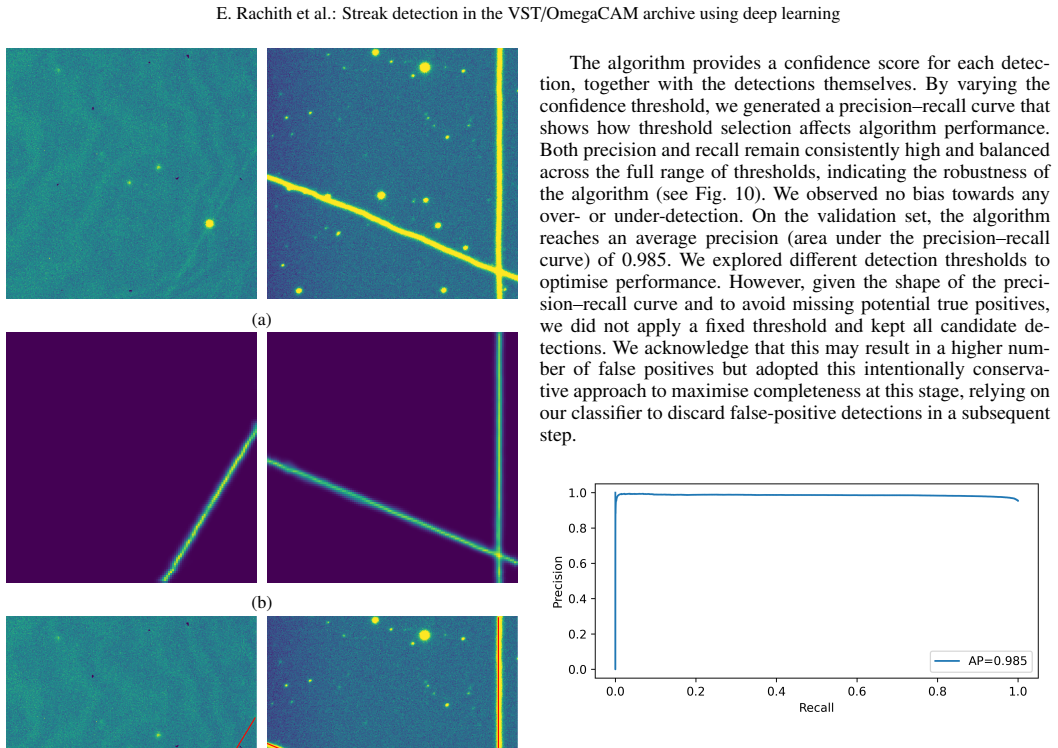
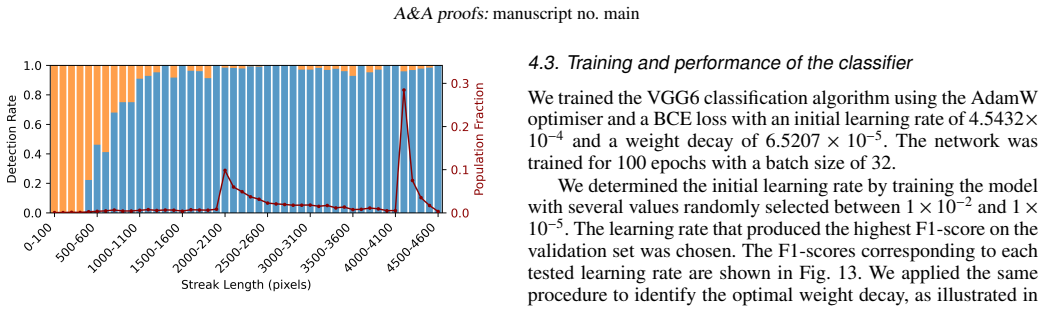
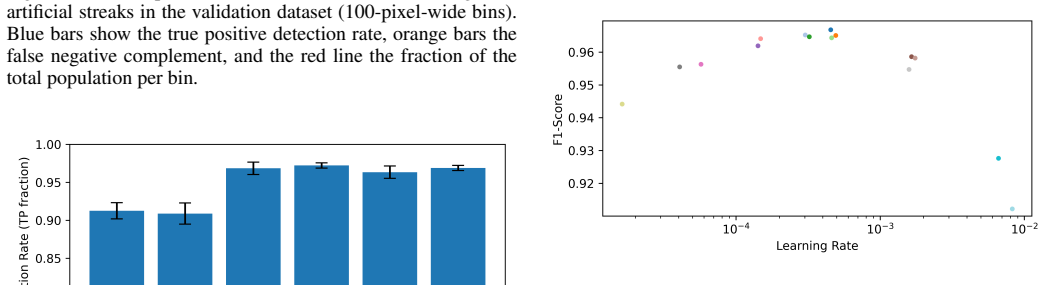
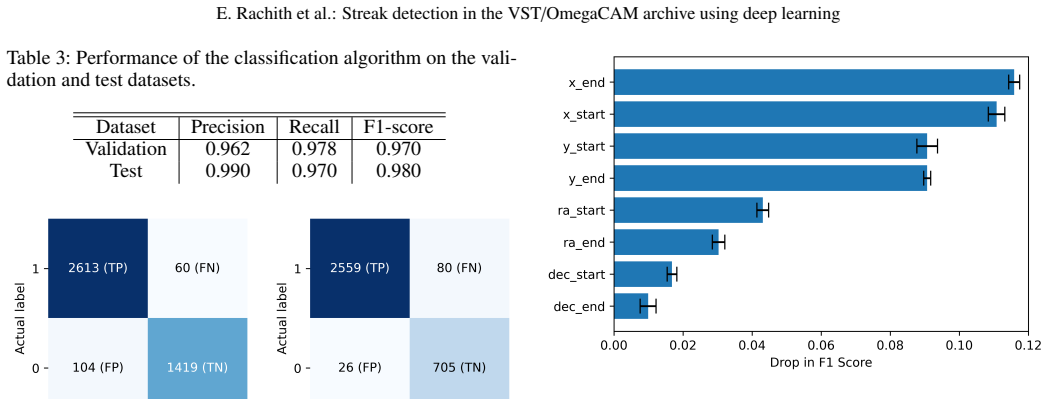
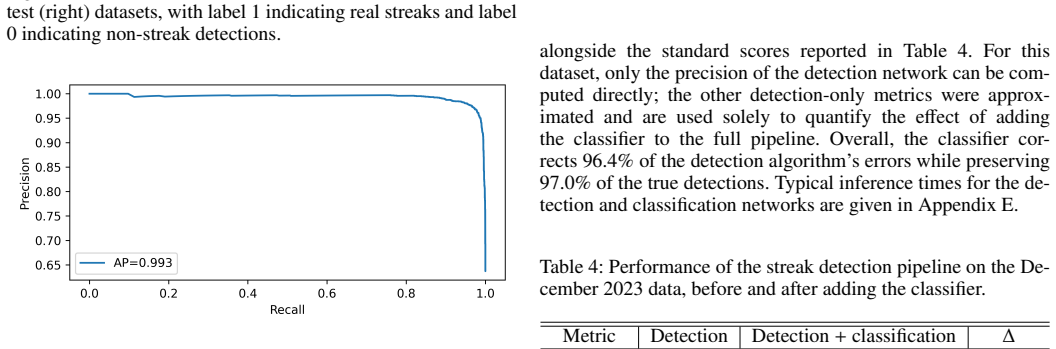
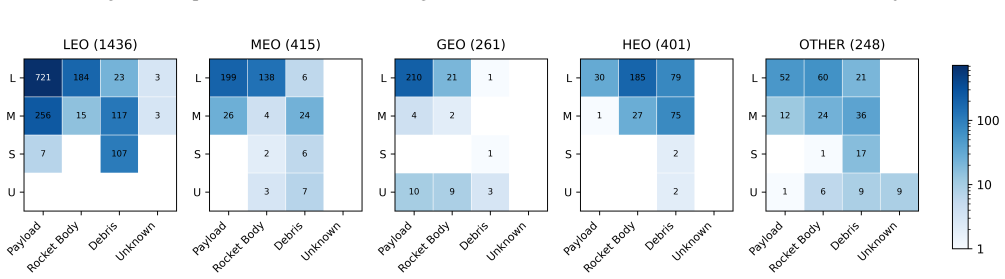
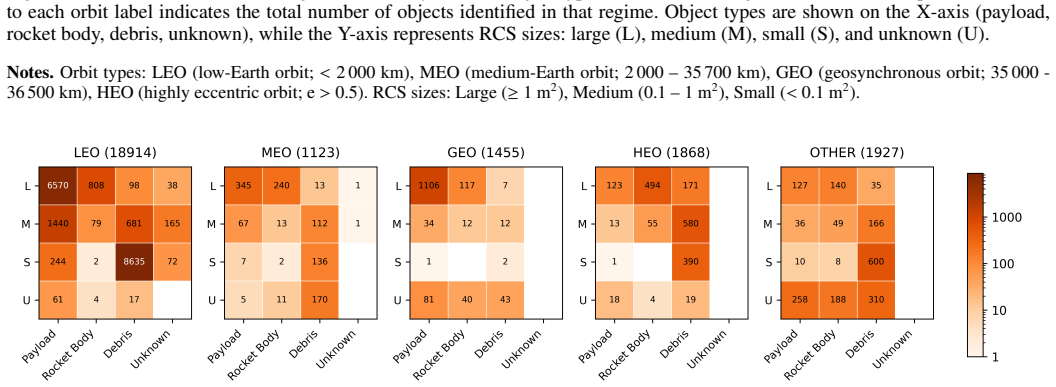
The HT-LCNN detector followed by the VGG6 classifier achieves F1 scores above 0.95 on augmented validation and test sets, detects more than 95 percent of artificial streaks above S/N of 4, and on real 2023 frames reaches 0.99 precision after classification while retaining 97 percent of true positives; when run on the full year of 1,246,048 frames it returns 25,335 streaks of which over 20 percent have no match in the space-track catalogue, and 16.9 percent of the images show some level of streak contamination.
What carries the argument
HT-LCNN detector for initial streak finding on raw images followed by VGG6-based CNN classifier that rejects false positives after astrometric calibration and catalogue cross-match.
If this is right
- The pipeline turns existing survey archives into a source of large-scale statistics on resident space objects without requiring new telescope time.
- More than one in six OmegaCAM images contains detectable streak contamination that can affect photometric or astrometric measurements.
- Over 20 percent of detected streaks lack catalogue counterparts, indicating that the method can locate previously unknown faint debris.
- Astrometric calibration performed after detection supplies positions that can be fed directly into orbit-determination routines for the uncatalogued objects.
Where Pith is reading between the lines
- The same two-stage architecture could be retrained on other wide-field instruments to produce comparable contamination statistics across multiple surveys.
- Repeated application to future archive releases would allow tracking of changes in streak density as satellite constellations grow.
- Cross-matching the detected streaks against independent optical or radar catalogues would quantify the fraction of objects missed by current tracking systems.
Load-bearing premise
Detection and classification performance measured on the augmented training patches and the 2023 test images will remain stable across the entire multi-year archive despite uncharacterized changes in image quality, background levels, and streak appearance.
What would settle it
A measured drop below 0.9 precision or below 0.9 recall when the same trained pipeline is applied to a new set of OmegaCAM frames taken under different observing conditions or in a different year.
Figures
read the original abstract
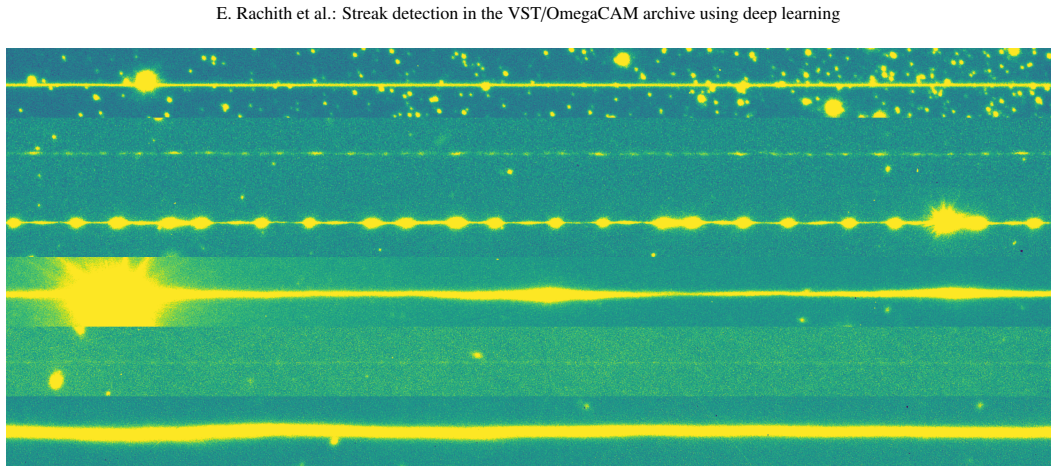
Ground-based astronomical surveys inadvertently capture streaks from satellites and space debris crossing their fields of view. These incidental observations from wide-field instruments such as OmegaCAM on the VST offer valuable opportunities to characterise resident space objects without the need for dedicated observing time. We developed an automated deep-learning pipeline to detect and classify streaks in the OmegaCAM archive, enabling large-scale analyses of space object populations and their impact on astronomical data. The pipeline combines an adapted Hough transform lookup-based convolutional neural network (HT-LCNN) for initial streak detection on raw images with a VGG6-based CNN classifier to reject false positives. We augmented a manually annotated dataset of 384 000 patches from archive images with physically simulated streaks. Following a detection, we applied astrometric calibration and cross-matched the results with the space-track catalogue. We find the detector achieves F1-scores of 0.966 (validation) and 0.958 (test) on the augmented dataset, detecting > 95% of artificial streaks with a signal-to-noise ratio of S/N > 4. On real 2023 data, the precision drops to 0.783 due to image variability, but the classifier boosts it to 0.990, while retaining 97% of true positives and rejecting > 96% of false positives. Applied to one year of VST observations (1 246 048 OmegaCAM CCD frames), the pipeline identified 25 335 streaks, including more than 20% uncorrelated with catalogue entries; finally, 16.9% of images revealed some level of contamination. The pipeline demonstrates robust performance on real archival data and successfully uncovers faint uncatalogued objects, highlighting the potential of survey archives for debris monitoring.
Editorial analysis
A structured set of objections, weighed in public.
Referee Report
Summary. The manuscript presents a deep-learning pipeline (HT-LCNN detector followed by VGG6 classifier) for identifying satellite and space-debris streaks in OmegaCAM/VST archival images. On an augmented dataset of 384000 patches it reports F1 scores of 0.966 (validation) and 0.958 (test), with >95% detection of artificial streaks at S/N>4. On real 2023 data the raw detector precision is 0.783 but rises to 0.990 after classification while retaining 97% of true positives. When applied to 1246048 frames from one year the pipeline yields 25335 streaks (>20% uncatalogued) and finds 16.9% of images contaminated.
Significance. If the reported generalization holds, the work supplies a practical, scalable method for mining existing wide-field archives for resident-space-object statistics without dedicated telescope time. The concrete numerical results on both augmented and real data, together with the large-scale application, constitute a useful empirical contribution to astro-imaging and space-situational-awareness studies.
major comments (2)
- [Abstract / archive application] Abstract and the section describing the archive application: the central claim that the pipeline reliably produces the archive-wide counts (25335 streaks, 16.9% contamination) rests on the untested assumption that performance measured on the 2023 test set generalizes to the full one-year dataset. No stratified evaluation, cross-validation by year/seeing/airmass/CCD, or performance breakdown on non-2023 subsets is reported, despite the explicit statement that image variability already lowers precision on real 2023 data.
- [Methods] Methods (dataset and augmentation description): the train/validation/test split ratios, exact augmentation parameters, and any quantitative comparison between the distribution of simulated streaks and real streaks (length, orientation, S/N histograms) are not provided. These details are load-bearing for interpreting the quoted F1 scores and the >95% detection claim for S/N>4 artificial streaks.
minor comments (2)
- [Abstract] The abstract states a manually annotated set of 384000 patches but does not indicate the fraction allocated to training versus testing or the number of real versus simulated examples; adding these numbers would improve reproducibility assessment.
- [Results] The S/N>4 threshold used for the detection-rate claim should be explicitly tied to the free parameter listed in the methods; its effect on the final catalogue statistics should be quantified.
Simulated Author's Rebuttal
We thank the referee for the constructive comments on our manuscript. We address the major points below, indicating where revisions will be made and where limitations prevent further analysis.
read point-by-point responses
-
Referee: [Abstract / archive application] Abstract and the section describing the archive application: the central claim that the pipeline reliably produces the archive-wide counts (25335 streaks, 16.9% contamination) rests on the untested assumption that performance measured on the 2023 test set generalizes to the full one-year dataset. No stratified evaluation, cross-validation by year/seeing/airmass/CCD, or performance breakdown on non-2023 subsets is reported, despite the explicit statement that image variability already lowers precision on real 2023 data.
Authors: We agree that the archive-wide statistics rely on the assumption that the 2023 real-data test performance is representative of the full year. The 2023 subset was chosen specifically to evaluate on recent, real observations where variability is present. Without ground-truth labels for the remaining data, stratified evaluation by year or observing conditions is not possible. We will revise the abstract and application section to explicitly caveat the generalization assumption, discuss the observed impact of variability, and note the limitation for future work. revision: partial
-
Referee: [Methods] Methods (dataset and augmentation description): the train/validation/test split ratios, exact augmentation parameters, and any quantitative comparison between the distribution of simulated streaks and real streaks (length, orientation, S/N histograms) are not provided. These details are load-bearing for interpreting the quoted F1 scores and the >95% detection claim for S/N>4 artificial streaks.
Authors: These details were inadvertently omitted. In the revised manuscript we will report the exact train/validation/test split ratios, list the precise augmentation parameters (including ranges for rotation, scaling, noise, etc.), and add quantitative comparisons (histograms and summary statistics) of streak length, orientation, and S/N between the simulated and real distributions to support the reported metrics. revision: yes
- Ground-truth labels exist only for the 2023 test subset; therefore no stratified performance evaluation or cross-validation on non-2023 portions of the archive is feasible.
Circularity Check
No circularity; purely empirical ML pipeline with held-out metrics
full rationale
The paper describes a standard supervised deep-learning pipeline (HT-LCNN detector + VGG6 classifier) trained on manually annotated plus simulated patches, with F1/precision numbers obtained from explicit validation and test splits on augmented data and 2023 real images. These metrics are measured outcomes, not quantities derived from equations that reduce to fitted parameters by construction. No self-citation chains, uniqueness theorems, or ansatzes are invoked to justify the architecture or results; the archive-wide counts follow directly from running the trained model on the target data. The derivation chain is therefore self-contained and externally falsifiable via the reported data splits.
Axiom & Free-Parameter Ledger
free parameters (1)
- S/N > 4 threshold
axioms (1)
- domain assumption Simulated streaks accurately capture the appearance and noise properties of real satellite streaks in OmegaCAM images
Reference graph
Works this paper leans on
-
[1]
A standardized catalogue of Fundamental Plane data
The effects of seeing on. MNRAS , author =. 2001 , keywords =. doi:10.1046/j.1365-8711.2001.04937.x , abstract =
-
[2]
The. ApJ , author =. 2012 , pages =. doi:10.1088/0004-637X/750/2/99 , abstract =
-
[3]
The. ApJ , author =. 2018 , pages =. doi:10.3847/1538-4357/aae386 , abstract =
-
[4]
Automated detection of satellite trails in ground-based observations using. A&A , author =. 2024 , pages =. doi:10.1051/0004-6361/202451663 , abstract =
-
[5]
The. MNRAS , author =. 2015 , pages =. doi:10.1093/mnras/stv1130 , abstract =
-
[6]
Schildknecht, Thomas and Pärli, Fiona and Vananti, Alessandro and Patole, Palash and Pessev, Peter and Flohrer, Tim and Siminski, Jan , year =. Recent. Proceedings of the 2024
2024
-
[7]
Optimal and. AJ , author =. 2018 , keywords =. doi:10.3847/1538-3881/aaddff , abstract =
-
[8]
Identification of. AJ , author =. 2025 , pages =. doi:10.3847/1538-3881/adb8ea , abstract =
-
[9]
Lin, Yancong and Pintea, Silvia L. and van Gemert, Jan C. , month = jul, year =. Deep. Proceedings of the. doi:10.48550/arXiv.2007.09493 , abstract =
-
[10]
Mulrooney, Mark K and Matney, Mark J and Hejduk, Matthew D and Barker, Edwin S , year =. An. Proceedings of the 2008
2008
-
[11]
Impact of satellite trails on. A&A , author =. 2023 , pages =. doi:10.1051/0004-6361/202347200 , abstract =
-
[12]
AJ , author =. 2010 , pages =. doi:10.1088/0004-6256/139/5/1782 , language =
-
[13]
Gravitational lensing analysis of the. MNRAS , author =. 2015 , pages =. doi:10.1093/mnras/stv2140 , abstract =
-
[14]
The impact of satellite trails on. Nat , author =. 2023 , pages =. doi:10.1038/s41550-023-01903-3 , abstract =
-
[15]
A&A , author =
Streak detection in the. A&A , author =. 2026 , note =
2026
-
[16]
A method for asteroid detection using convolutional neural networks on. A&A , author =. 2025 , pages =. doi:10.1051/0004-6361/202452756 , abstract =
-
[17]
Space-based surveillance of. Acta Astron. , author =. 2025 , pages =. doi:10.1016/j.actaastro.2025.10.064 , abstract =
-
[18]
, archivePrefix = "arXiv", eprint =
The. AJ , author =. 2015 , pages =. doi:10.1088/0004-6256/150/5/150 , abstract =
-
[19]
The Messenger , author =
Seeing is. The Messenger , author =
-
[20]
Flux comparison of
Horstmann, André and Wiedemann, Carsten and Lemmens, Stijn and Braun, Vitali and Manis, Alyssa and Matney, Mark and Gates, Drake and Seago, John and Vavrin, Andrew and Anz-Meador, Phillip , year =. Flux comparison of. 8th
-
[21]
Tails:. AJ , author =. 2021 , pages =. doi:10.3847/1538-3881/abea7b , abstract =
-
[22]
Impact of the. ApJ , author =. 2022 , keywords =. doi:10.3847/2041-8213/ac470a , abstract =
-
[23]
MNRAS , author =. 2019 , keywords =. doi:10.1093/mnras/stz1096 , abstract =
-
[24]
The Journal of the Astronautical Sciences , author =
Exploiting. The Journal of the Astronautical Sciences , author =. 2019 , pages =. doi:10.1007/s40295-019-00155-6 , abstract =
-
[25]
Chen, Xiaohan and Gu, Hongrui and Wang, Cunshi and Mu, Haiyang and Zheng, Jie and Du, Junju and Ren, Jing and Fan, Zhou and Li, Jing , month = sep, year =. Artificial. PASP , publisher =. doi:10.1088/1538-3873/ae051f , abstract =
-
[26]
Toward. PASP , author =. 2019 , pages =. doi:10.1088/1538-3873/ab1b18 , abstract =
-
[27]
The. PASP , author =. 2019 , keywords =. doi:10.1088/1538-3873/aaecbe , abstract =
-
[28]
The. PASP , author =. 2019 , pages =. doi:10.1088/1538-3873/aae8ac , language =
work page internal anchor Pith review doi:10.1088/1538-3873/aae8ac 2019
-
[29]
Space and
Bloom, Amelia and Wysack, Joshua and Griesbach, Jacob D and Lawitzke, Anna , year =. Space and. Proceedings of the 2022
2022
-
[30]
Unintended electromagnetic radiation from. A&A , author =. 2023 , pages =. doi:10.1051/0004-6361/202346374 , abstract =
-
[31]
Bright unintended electromagnetic radiation from second-generation. A&A , author =. 2024 , pages =. doi:10.1051/0004-6361/202451856 , abstract =
-
[32]
Analytical simulations of the effect of satellite constellations on optical and near-infrared observations , volume =. A&A , author =. 2022 , keywords =. doi:10.1051/0004-6361/202142101 , abstract =
-
[33]
The proliferation of space objects is a rapidly increasing source of artificial night sky brightness , volume =. MNRAS , author =. 2021 , keywords =. doi:10.1093/mnrasl/slab030 , abstract =
-
[34]
Aggregate effects of proliferating low-. Nat , author =. 2023 , pages =. doi:10.1038/s41550-023-01904-2 , language =
-
[35]
The. ApJ , author =. 2022 , keywords =. doi:10.3847/1538-4357/ac7c74 , abstract =
work page internal anchor Pith review doi:10.3847/1538-4357/ac7c74 2022
-
[36]
and Green, Richard and Rawls, Meredith L
Boley, Aaron C. and Green, Richard and Rawls, Meredith L. and Eggl, Siegfried , month = mar, year =. Research Notes of the AAS , publisher =. doi:10.3847/2515-5172/adc12f , abstract =
-
[37]
Distribution and. Aerospace , author =. 2026 , note =. doi:10.3390/aerospace13040303 , abstract =
-
[38]
SPHEREx confirms predictions for artificial satellite trail pollution in Low Earth Orbit
Borlaff, Alejandro S. and Marcum, Pamela M. and Howell, Steve B. and Sánchez-Alarcón, Pablo M. and Dubois, David and McDowell, Jonathan , month = may, year =. doi:10.48550/arXiv.2605.27501 , abstract =
work page internal anchor Pith review Pith/arXiv arXiv doi:10.48550/arxiv.2605.27501
-
[39]
DebrisWatch II: Digging deeper for geosynchronous debris
Blake, James A. and Cooke, Benjamin F. and Paragini, Cristina and Feline, William and Onken, Christopher A. and Pollacco, Don and Privett, Grant and Yanagisawa, Toshifumi and Airey, Robert and Apergis, Ioannis and Armellin, Roberto and Beesley, Lily and Chote, Paul and Cutolo, Anna-Maria and Eves, Stuart and Fujiwara, Tomoko and Kuroda, Daisuke and Lockle...
work page internal anchor Pith review Pith/arXiv arXiv doi:10.48550/arxiv.2605.27516
-
[40]
Proceedings of the Conference on Robots and Vision , author =. 2024 , keywords =. doi:10.21428/d82e957c.8ef38e6b , abstract =
-
[41]
Astronomy & Astrophysics , author =. 2026 , note =. doi:10.1051/0004-6361/202558754 , abstract =
-
[42]
Radiative. Earth's Future , author =. 2026 , keywords =. doi:10.1029/2025EF007229 , abstract =
-
[43]
Monthly Notices of the Royal Astronomical Society , author =
Linear feature detection algorithm for astronomical surveys -. Monthly Notices of the Royal Astronomical Society , author =. 2018 , note =. doi:10.1093/mnras/stx3085 , abstract =
-
[44]
Jankovic, Dimitrije , month = may, year =. How long can you trust a. doi:10.48550/arXiv.2605.19850 , abstract =
work page internal anchor Pith review Pith/arXiv arXiv doi:10.48550/arxiv.2605.19850
-
[45]
Ren, Jing and Fan, Zhou and Gu, Hong-rui and Zhang, Qi-qian and Xu, Yun-fei and Du, Jun-ju and Chen, Xiao-han and Mi, Lin-ying and Wu, Hong , month = may, year =. Impact of. doi:10.48550/arXiv.2605.17948 , abstract =
work page internal anchor Pith review Pith/arXiv arXiv doi:10.48550/arxiv.2605.17948
-
[46]
Mallama, Anthony , month = dec, year =. The. doi:10.48550/arXiv.2012.05100 , abstract =
-
[47]
Sarazin, Marc and Tokovinin, Andrei , year =. The. European
-
[48]
Bulletin of the AAS , author =
Impact of. Bulletin of the AAS , author =. doi:10.3847/25c2cfeb.346793b8 , language =
-
[49]
and Rangwala, Naqiya , month = feb, year =
Lemonwala, Murtuza and Taylor, Kayla D. and Rangwala, Naqiya , month = feb, year =. Classification of. doi:10.1109/SoutheastCon63549.2026.11476213 , abstract =
-
[50]
Communications Earth & Environment , author =
Measurement of a lithium plume from the uncontrolled re-entry of a. Communications Earth & Environment , author =. 2026 , keywords =. doi:10.1038/s43247-025-03154-8 , abstract =
-
[51]
Advances in Space Research , author =
Space waste:. Advances in Space Research , author =. 2026 , keywords =. doi:10.1016/j.asr.2026.03.026 , abstract =
-
[52]
and Malagón, Andrés Alejandro Plazas , month = mar, year =
Mendoza, Alexandra Serrano and Rawls, Meredith L. and Malagón, Andrés Alejandro Plazas , month = mar, year =. Identifying and. doi:10.48550/arXiv.2603.10790 , abstract =
-
[53]
Romero-Colmenares, María and Vieira, Katherine and Tregloan-Reed, Jeremy and Kim, Yonggi and Yoon, Joh-Na and Kim, Ha-eun and Jeon, Hyo-ri and Kim, Chae-rin and Adam, Christian and Hinse, Tobías C. and Soto, Mario and Unda-Sanzana, Eduardo and Longa-Peña, Penélope and Otarola, Ángel , year =. Diffuse and specular brightness models applied to. doi:10.48550...
work page internal anchor Pith review Pith/arXiv arXiv doi:10.48550/arxiv.2603.21859
-
[54]
Mallama, Anthony , month = apr, year =. Secular. doi:10.48550/arXiv.2604.13145 , abstract =
work page internal anchor Pith review Pith/arXiv arXiv doi:10.48550/arxiv.2604.13145
-
[55]
Hainaut, Olivier R. , month = apr, year =. Large or bright satellite constellations:. doi:10.48550/arXiv.2604.09427 , abstract =
work page internal anchor Pith review Pith/arXiv arXiv doi:10.48550/arxiv.2604.09427
-
[56]
doi:10.48550/arXiv.2504.10550 , abstract =
Kyselica, Daniel and Hrobár, Tomáš and Šilha, Jiří and Ďurikovič, Roman and Šuppa, Marek , month = apr, year =. doi:10.48550/arXiv.2504.10550 , abstract =
-
[57]
Flohrer, T and Lemmens, S and Virgili, B Bastida and Krag, H and Klinkrad, H and Parrilla, E and Sanchez, N and Oliveira, J and Pina, F , year =. 6th
-
[58]
Drolshagen, Gerhard , year =. In-situ. Advanced
-
[59]
Concerns about ground based astronomical observations: quantifying satellites' constellations damages , doi =
Gallozzi, Stefano and Paris, Diego and Scardia, Marco and Dubois, David , year =. Concerns about ground based astronomical observations: quantifying satellites' constellations damages , doi =
-
[60]
The Astronomical Journal , author =
astroquery:. The Astronomical Journal , author =. 2019 , keywords =. doi:10.3847/1538-3881/aafc33 , abstract =
-
[61]
Experimental Astronomy , author =
The. Experimental Astronomy , author =. 2013 , keywords =. doi:10.1007/s10686-012-9306-1 , abstract =
-
[62]
Journal of Geophysical Research: Space Physics , author =
Collision frequency of artificial satellites:. Journal of Geophysical Research: Space Physics , author =. 1978 , pages =. doi:10.1029/JA083iA06p02637 , abstract =
-
[63]
Adam: A Method for Stochastic Optimization
Kingma, Diederik P. and Ba, Jimmy Lei , year =. Adam:. Third. doi:10.48550/arXiv.1412.6980 , abstract =
work page internal anchor Pith review Pith/arXiv arXiv doi:10.48550/arxiv.1412.6980
-
[64]
Krantz, Harrison and Pearce, Eric C. and Block, Adam , year =. Characterizing the. Advanced. doi:10.48550/arXiv.2110.10578 , abstract =
-
[65]
Mallama, Anthony , month = nov, year =. Starlink. doi:10.48550/arXiv.2111.09735 , abstract =
-
[66]
Mallama, Anthony , month = jan, year =. The. doi:10.48550/arXiv.2101.00374 , abstract =
-
[67]
On the Convergence of Adam and Beyond
Reddi, Sashank J. and Kale, Satyen and Kumar, Sanjiv , year =. On the. The. doi:10.48550/arXiv.1904.09237 , abstract =
work page internal anchor Pith review Pith/arXiv arXiv doi:10.48550/arxiv.1904.09237 1904
-
[68]
Photometric monitoring of non-resolved space debris and databases of optical light curves , abstract =
Schildknecht, Thomas and Linder, Esther and Silha, Jiri and Hager, Monika and Koshkin, Nikolay and Korobeinikova, Elen and Melikiants, Seda and Shakun, Leonid and Strakhov, Svetlana , year =. Photometric monitoring of non-resolved space debris and databases of optical light curves , abstract =. Advanced
-
[69]
Wijnen, T. P. G. and Stuik, R. and Rodenhuis, M. and Langbroek, M. and Wijnja, P. , year =. Using all-sky optical observations for automated orbit determination and prediction for satellites in. 1st. doi:10.48550/arXiv.2004.08137 , abstract =
-
[70]
Kessler, Donald J and Johnson, Nicholas L , pages =. The
-
[71]
Matney, Mark and Vavrin, Andrew and Poehlmann, Michael and King, Austen and Seago, John H and Anz-Meador, Phillip and Liou, Jer-Chyi and Cruz, Corbin and Manis, Alyssa , year =. 9th
-
[72]
Advances in Space Research , author =
Optical observations of space debris with the. Advances in Space Research , author =. 1997 , pages =. doi:10.1016/S0273-1177(97)00004-5 , language =
-
[73]
Monthly Notices of the Royal Astronomical Society , author =
The. Monthly Notices of the Royal Astronomical Society , author =
-
[74]
Karpov, S and Beskin, G and Biryukov, A and Bondar, S and Ivanov, E and Katkova, E and Perkov, A and Sasyuk, V , year =. Mini-. Proceedings of the
-
[75]
Estimating the impact to astronomy from the
Adam, Christian and Tregloan-Reed, Jeremy and Unda-Sanzana, Eduardo , month = dec, year =. Estimating the impact to astronomy from the. Proceedings of the. doi:10.1017/S1743921324000620 , abstract =
-
[76]
Advances in Space Research , author =
Space debris spectroscopy:. Advances in Space Research , author =. 2023 , pages =. doi:10.1016/j.asr.2022.12.001 , abstract =
-
[77]
Advances in Space Research , author =
Modelling of spacecraft apparent brightness. Advances in Space Research , author =. 2024 , pages =. doi:10.1016/j.asr.2024.04.010 , abstract =
-
[78]
Recent developments in space debris environment modelling, verification and validation with
Braun, V and Horstmann, A and Lemmens, S and Wiedemann, C and Bottcher, L , year =. Recent developments in space debris environment modelling, verification and validation with. 8th
-
[79]
and Busko, Ivo and Donath, Axel and Günther, Hans Moritz and Cara, Mihai and Lim, P
Bradley, Larry and Sipőcz, Brigitta and Robitaille, Thomas and Tollerud, Erik and Vinícius, Zé and Deil, Christoph and Barbary, Kyle and Wilson, Tom J. and Busko, Ivo and Donath, Axel and Günther, Hans Moritz and Cara, Mihai and Lim, P. L. and Meßlinger, Sebastian and Burnett, Zach and Conseil, Simon and Droettboom, Michael and Bostroem, Azalee and Bray, ...
-
[80]
2011 , pages =
The Messenger , author =. 2011 , pages =
2011
discussion (0)
Sign in with ORCID, Apple, or X to comment. Anyone can read and Pith papers without signing in.