REVIEW 2 major objections 1 cited by
A curation pipeline turns web ophthalmology videos into a 500,000-example instruction dataset that trains an MLLM outperforming general medical models.
Reviewed by Pith at T0; open to challenge. T0 means a machine referee read the full paper against a public rubric. the ladder, T0–T4 →
2026-06-29 13:25 UTC pith:DZPPKFDL
load-bearing objection The paper's main output is a web-video curation pipeline and 500k-scale ophthalmic instruction dataset, but the abstract gives no metrics or validation to back the performance claims. the 2 major comments →
OphIn-500K: Curating Web-Scale Visual Instructions for Scaling Ophthalmic Multimodal Large Language Models
The pith
A machine-rendered reading of the paper's core claim, the machinery that carries it, and where it could break.
Core claim
Using OphIn-Engine to build OphIn-500K from web-scale videos allows development of OphIn-VL, an ophthalmology-specific MLLM with advanced visual understanding and conversational capabilities that achieves superior performance compared with state-of-the-art general medical and domain-specific MLLMs.
What carries the argument
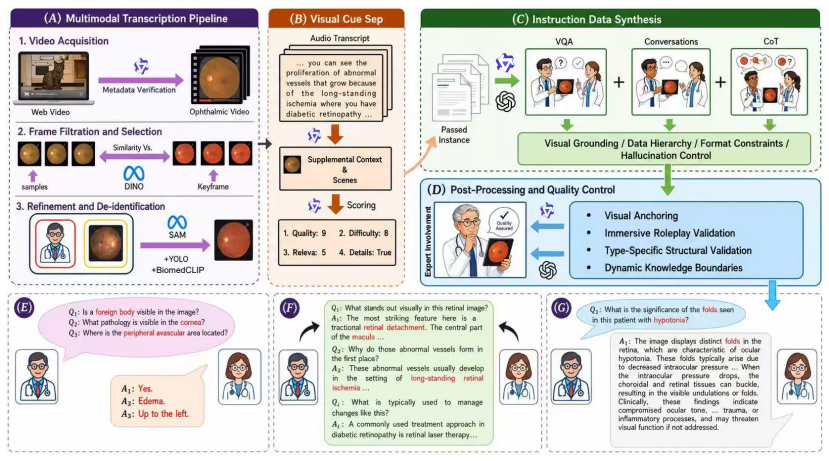
OphIn-Engine, the pipeline integrating multimodal transcription for image-transcript pairs, visual cue separation and scoring for clinically relevant descriptions, and instruction synthesis with quality control for clinical dialogues.
Load-bearing premise
The multimodal transcription, visual cue separation, scoring, and quality-control steps produce accurate, diverse, and clinically relevant instruction data that reflects real-world ophthalmic complexity.
What would settle it
A controlled study where ophthalmologists evaluate the accuracy and clinical relevance of a sample of the generated instructions, or direct performance comparison on a blinded set of real clinical cases where OphIn-VL does not outperform baselines.
If this is right
- Specialized ophthalmic MLLMs can be trained at larger scales using readily available web video data.
- The resulting models support multiple formats including VQA, multi-turn conversations, and chain-of-thought reasoning.
- OphIn-VL provides better adaptation to real-world clinical complexity in ophthalmology than models trained on limited datasets.
- Conversational assistants for eye care diagnosis can be improved through this data curation method.
Where Pith is reading between the lines
- Similar pipelines could extend to other medical fields with abundant online video content to create domain-specific datasets.
- The method may help address data scarcity for rare ophthalmic conditions by leveraging diverse web sources.
- Testing the pipeline on new video sources could validate its generalizability beyond the initial collection.
Editorial analysis
A structured set of objections, weighed in public.
Referee Report
Summary. The paper introduces OphIn-Engine, an automated pipeline that extracts image-transcript pairs from open-access ophthalmology web videos via multimodal transcription, separates and scores visual cues for clinical relevance, and synthesizes instruction data with quality control. This yields OphIn-500K, a dataset of >500K instances (VQA, multi-turn dialogues, CoT reasoning) spanning >151K unique images from >29K video clips. The authors then train OphIn-VL on this data and claim, via comprehensive experiments and case studies, that it outperforms state-of-the-art general medical and domain-specific MLLMs.
Significance. If the pipeline produces clinically accurate, diverse data and the reported gains are reproducible, the work would provide a scalable route to domain-specific instruction data for specialized medical MLLMs, addressing a clear data bottleneck in ophthalmology. The dataset scale is substantial, but significance is conditional on rigorous validation of data quality and transparent experimental reporting, neither of which is evidenced in the abstract.
major comments (2)
- [Abstract] Abstract: the central claim that 'OphIn-VL achieves superior performance compared with state-of-the-art general medical and domain-specific MLLMs' is asserted without any accompanying metrics, baselines, statistical tests, dataset splits, or evaluation protocols. This absence prevents evaluation of the empirical result against the paper's own evidence.
- [Abstract] Abstract (paragraph describing OphIn-Engine): the multimodal transcription, visual cue separation/scoring, instruction synthesis, and quality-control steps are presented as sufficient to produce accurate, diverse, clinically relevant data, yet no quantitative checks (ophthalmologist agreement rates, hallucination rates in CoT outputs, or comparison of generated dialogues to real clinical notes) are reported. Because the superior-performance claim rests on the assumption that the 500K instances genuinely reflect real-world ophthalmic complexity, the lack of such validation is load-bearing.
Simulated Author's Rebuttal
We thank the referee for the constructive feedback on the abstract. We agree that the abstract should more explicitly summarize the empirical evidence and any available validation of the data curation process. We address each major comment below and will revise the manuscript accordingly.
read point-by-point responses
-
Referee: [Abstract] Abstract: the central claim that 'OphIn-VL achieves superior performance compared with state-of-the-art general medical and domain-specific MLLMs' is asserted without any accompanying metrics, baselines, statistical tests, dataset splits, or evaluation protocols. This absence prevents evaluation of the empirical result against the paper's own evidence.
Authors: We agree that the abstract would be strengthened by including key quantitative results. In the revised version we will incorporate specific performance metrics (e.g., accuracy or BLEU scores on the main benchmarks), the primary baselines compared, and a concise statement of the evaluation protocol and dataset splits used. revision: yes
-
Referee: [Abstract] Abstract (paragraph describing OphIn-Engine): the multimodal transcription, visual cue separation/scoring, instruction synthesis, and quality-control steps are presented as sufficient to produce accurate, diverse, clinically relevant data, yet no quantitative checks (ophthalmologist agreement rates, hallucination rates in CoT outputs, or comparison of generated dialogues to real clinical notes) are reported. Because the superior-performance claim rests on the assumption that the 500K instances genuinely reflect real-world ophthalmic complexity, the lack of such validation is load-bearing.
Authors: The full manuscript details the pipeline steps and reports downstream task performance as evidence of data utility. However, we acknowledge that explicit quantitative validation metrics for the curation pipeline itself (such as ophthalmologist agreement rates or direct hallucination audits against clinical notes) are not currently reported in the abstract or main text. We will revise the abstract and methods to summarize any existing quality-control statistics and will add a limitations discussion clarifying the scope of validation performed. revision: partial
Circularity Check
No circularity detected; empirical data curation and performance evaluation
full rationale
The paper describes an empirical pipeline (OphIn-Engine) for curating instruction data from web videos, constructs the OphIn-500K dataset, trains OphIn-VL, and reports experimental performance gains. No equations, fitted parameters, self-citations, or derivations appear in the provided text. The central claim of superior performance is an external empirical statement on held-out benchmarks rather than a quantity forced by construction from the pipeline inputs. The derivation chain is self-contained against external evaluation and does not reduce to renaming or self-referential fitting.
Axiom & Free-Parameter Ledger
Cite this review
Pith. "Pith review of OphIn-500K: Curating Web-Scale Visual Instructions for Scaling Ophthalmic Multimodal Large Language Models." pith.science (2026). https://pith.science/paper/DZPPKFDL
@misc{pith2026260527916,
  author       = {Pith},
  title        = {Pith review of: OphIn-500K: Curating Web-Scale Visual Instructions for Scaling Ophthalmic Multimodal Large Language Models},
  year         = {2026},
  howpublished = {\url{https://pith.science/paper/DZPPKFDL}},
  note         = {Machine review of arXiv:2605.27916}
}
read the original abstract
The advancement of general medical Multimodal Large Language Models (MLLMs) has shown great potential for building conversational assistants to support clinical diagnosis. However, their adaptation to highly specialized domains such as ophthalmology remains underexplored, primarily due to the scarcity of large-scale, domain-specific instruction-tuning data. Existing ophthalmic datasets for conversational agents are often limited in scale and largely rely on images from established public benchmarks, limiting the scalability of ophthalmic MLLMs and their ability to capture real-world clinical complexity. To address this gap, we propose $\textbf{OphIn-Engine}$, an ophthalmology-specific instruction data curation pipeline that constructs high-quality instruction data from open-access ophthalmology web-scale videos. The pipeline integrates multimodal transcription for extracting image-transcript pairs, visual cue separation and scoring for identifying clinically relevant visual descriptions, and instruction synthesis with quality control for generating accurate and diverse clinical dialogues. Using this engine, we introduce $\textbf{OphIn-500K}$, a large-scale multimodal ophthalmology instruction-tuning dataset containing over 500,000 instruction instances and more than 151,000 unique images from over 29,000 video clips, formatted as visual question answering (VQA), multi-turn conversational interactions, and chain-of-thought (CoT) reasoning. Built upon this dataset, we further develop $\textbf{OphIn-VL}$, an ophthalmology-specific MLLM with advanced visual understanding and conversational capabilities. Comprehensive experiments and case studies demonstrate that OphIn-VL achieves superior performance compared with state-of-the-art general medical and domain-specific MLLMs.
Figures


Forward citations
Cited by 1 Pith paper
-
The Path to Self-Evolving Clinical Systems: Scaling Medical Agents from Assistance to Autonomy
Medical agents should be scaled mainly by richer clinical environments and self-evolution loops, not parameter growth alone, under a three-level autonomy taxonomy.
Reference graph
Works this paper leans on
-
[1]
Fundus-R1: Training a Fundus-Reading MLLM with Knowledge-Aware Reasoning on Public Data
Cracking instance jigsaw puzzles: An alter- native to multiple instance learning for whole slide image analysis. InProceedings of the IEEE/CVF International Conference on Computer Vision, pages 21353–21363. Zhe Chen, Jiannan Wu, Wenhai Wang, Weijie Su, Guo Chen, Sen Xing, Muyan Zhong, Qinglong Zhang, Xizhou Zhu, Lewei Lu, and 1 others. 2024b. Internvl: Sc...
work page internal anchor Pith review Pith/arXiv arXiv 2026
-
[2]
IEEE. Xinyao Liu and Diping Song. 2025. Constructing oph- thalmic mllm for positioning-diagnosis collaboration through clinical cognitive chain reasoning. InPro- ceedings of the IEEE/CVF International Conference on Computer Vision, pages 21547–21556. Alejandro Lozano, Min Woo Sun, James Burgess, Liangyu Chen, Jeffrey J Nirschl, Jeffrey Gu, Ivan Lopez, Jos...
work page internal anchor Pith review Pith/arXiv arXiv 2025
-
[3]
Bridging the gap in ophthalmic ai: Mm- retinal-reason dataset and ophthareason model to- ward dynamic multimodal reasoning.arXiv preprint arXiv:2508.16129. Ruiqi Wu, Chenran Zhang, Jianle Zhang, Yi Zhou, Tao Zhou, and Huazhu Fu. 2024. Mm-retinal: Knowledge-enhanced foundational pretraining with fundus image-text expertise. InInternational Confer- ence on ...
work page internal anchor Pith review arXiv 2024
-
[4]
- [fact]
as its core language backbone and uses the SWIFT (Zhao et al., 2024) training pipeline for efficient multimodal supervised fine-tuning. The vision encoder is kept frozen throughout training to preserve pretrained visual representations and reduce memory and computational cost. We apply LoRA (Hu et al., 2022) to all linear modules in both the vision-langua...
2024
This paper was first reviewed by grok-4.3 on June 29, 2026.
discussion (0)
Sign in with ORCID, Apple, or X to comment. Anyone can read and Pith papers without signing in.