REVIEW 3 major objections 1 references
A hybrid top-down/bottom-up framework improves synthetic tabular data by separating semantic rules from statistical texture.
Reviewed by Pith at T0; open to challenge. T0 means a machine referee read the full paper against a public rubric. the ladder, T0–T4 →
T0 review · grok-4.5
2026-07-15 11:03 UTC pith:IG6UZ4DE
load-bearing objection Sensible hybrid packaging for tabular synthesis, but the body we have is unreadable so the TSTR and consistency claims cannot be checked. the 3 major comments →
Hierarchical Synthetic Tabular Data Generation: A Hybrid Top-Down and Bottom-Up Framework
The pith
A machine-rendered reading of the paper's core claim, the machinery that carries it, and where it could break.
Core claim
Decoupling semantic structures from stochastic texture inside a hierarchical hybrid top-down and bottom-up (H-TDBU) framework—structure-driven logical constraints and cross-modal rules above, lightweight local generators below, joined by an iterative unified synthesis engine—improves train-synthetic-test-real performance over pure neural baselines on weak multimodal financial data while preserving semantic consistency.
What carries the argument
The H-TDBU framework: a top-down path that constructs structure-driven logical constraints and cross-modal alignment rules, a bottom-up path of lightweight tabular generators that capture local statistics, and a unified synthesis engine with iterative feedback that consolidates the two.
Load-bearing premise
That the needed logical constraints and cross-modal alignment rules can be built and kept stable enough to guide generation without collapsing into pure templates or pure noise, even when real data are scarce.
What would settle it
On the same weak multimodal financial benchmarks, measure whether H-TDBU’s train-synthetic-test-real accuracy and semantic-consistency scores remain higher than the neural baselines after the top-down rules are removed or replaced by randomly generated constraints; if the gains disappear, the hierarchical decoupling claim fails.
If this is right
- Synthetic data pipelines for finance (and similar heterogeneous domains) can trade pure generative capacity for explicit rule guidance without sacrificing downstream utility.
- Rare-event coverage and logical consistency become controllable design knobs rather than emergent side-effects of model capacity.
- Low-data regimes become more tractable because bottom-up generators only need to learn local texture once global structure is supplied top-down.
- Cross-modal settings that pair tables with text can enforce alignment rules that pure tabular or pure LLM generators cannot guarantee.
- Iterative feedback between structure and texture offers a reusable template for other hierarchical synthetic-data tasks.
Where Pith is reading between the lines
- If rule construction is the bottleneck, the framework’s practical reach will hinge on how cheaply domain experts or automated extractors can supply the top-down constraints.
- The same structure-versus-texture split may transfer to non-financial multimodal tables (healthcare, logistics) where logical invariants are known a priori.
- An open question left implicit is whether the iterative loop can discover missing rules from residual statistical errors rather than requiring them all up front.
- Comparisons against pure LLM generators on the same low-data financial suites would clarify how much of the gain is truly hierarchical rather than simply multi-source.
Editorial analysis
A structured set of objections, weighed in public.
Referee Report
Summary. The paper proposes H-TDBU, a hierarchical hybrid top-down/bottom-up framework for synthetic tabular data that decouples semantic structure from stochastic texture. Top-down construction supplies structure-driven logical constraints and cross-modal alignment rules; bottom-up lightweight tabular generators learn local statistical patterns from real data; the two are fused in a unified synthesis engine with an iterative feedback loop. Evaluation is claimed on weak multimodal financial benchmarks (tabular + sentiment text), with reported gains in train-synthetic-test-real (TSTR) performance over neural baselines while preserving semantic consistency. The abstract positions the method as addressing heterogeneity, logical consistency, rare-event coverage, and low-data robustness that pure generative models and LLMs struggle with.
Significance. If the claimed TSTR gains and semantic-consistency preservation hold under proper baselines and ablations, the work would offer a practical hybrid alternative to pure neural or LLM-based tabular synthesis, especially for regulated or low-data financial settings where controllability and logical constraints matter. The explicit structure/texture decoupling and iterative consolidation are a clear conceptual contribution relative to end-to-end generative baselines. However, significance cannot be assessed from the abstract alone: free parameters (rule inventory, generator hyperparameters, feedback schedule) and the load-bearing premise that top-down rules remain expressive and stable in low-data/rare-event regimes are not yet evidenced by inspectable methods, equations, or results.
major comments (3)
- The supplied full manuscript body is almost entirely corrupted (replacement characters / non-text). Consequently, no method section, rule-construction procedure, feedback-loop equations, baseline definitions, benchmark description, TSTR tables, consistency metrics, ablations, sample sizes, or error bars can be verified. The central claim (TSTR improvement + semantic consistency on weak multimodal financial data) is therefore unsupported by any inspectable evidence beyond the abstract assertion.
- Load-bearing premise (abstract): that structure-driven logical constraints and cross-modal alignment rules can be constructed and kept stable under the iterative loop in the low-data and rare-event regimes the paper targets. Without a readable account of how rules are obtained or validated when domain experts or labels are scarce, it is impossible to judge whether the top-down path is available or collapses into pure templates versus unconstrained noise.
- Evaluation design is uncheckable: named neural baselines, exact TSTR protocol, semantic-consistency measures, and any statistical significance of the claimed gains are absent from the readable text. Without these, the comparative claim over neural methods cannot be assessed for fairness or effect size.
Circularity Check
No circularity detectable; abstract-level claim is external TSTR evaluation, and the unreadable body supplies no equations or self-citations to reduce.
full rationale
The only inspectable content is the abstract. It proposes a hierarchical hybrid (top-down logical/cross-modal rules + bottom-up lightweight generators + iterative unified engine) and reports improved train-synthetic-test-real (TSTR) performance versus neural baselines on weak multimodal financial benchmarks while preserving semantic consistency. TSTR is an external hold-out protocol (train on synthetic, test on real), so the performance claim is not definitionally identical to any fitted objective visible in the abstract. No equations, uniqueness theorems, self-citations, fitted-then-predicted quantities, or ansatz-via-citation steps appear in readable form. The full manuscript body is corrupted into non-text replacement characters, so no load-bearing derivation chain can be walked or reduced by construction. Per the hard rules, circularity is claimed only when a specific quote exhibits the reduction; none exists. Residual risk that rules or the feedback loop were tuned on the same benchmarks is ordinary methods-paper practice and is not construction-by-definition. Score 0; steps empty.
Axiom & Free-Parameter Ledger
free parameters (3)
- Top-down rule/constraint inventory and thresholds
- Bottom-up generator hyperparameters
- Iterative feedback-loop schedule
axioms (4)
- domain assumption Semantic structure of tabular (and weak multimodal) data can be usefully decoupled from stochastic local texture for generation.
- domain assumption Structure-driven logical constraints and cross-modal alignment rules can be constructed for the target financial tabular+sentiment setting.
- domain assumption Train-synthetic-test-real (TSTR) utility plus semantic-consistency checks are adequate proxies for generator quality in this regime.
- ad hoc to paper Lightweight tabular generators can capture local statistical patterns sufficiently in low-data and rare-event regimes when guided by the top-down path.
invented entities (2)
-
H-TDBU hierarchical hybrid top-down/bottom-up framework
no independent evidence
-
Unified synthesis engine with iterative feedback loop
no independent evidence
read the original abstract
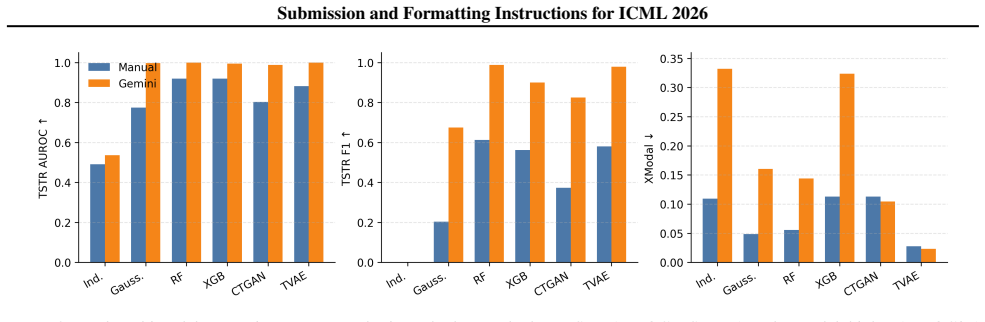
Existing approaches for synthetic tabular data generation are based on either purely generative models or LLMs, both of which struggle with data heterogeneity, logical consistency, rare-event coverage, and robustness in low-data regimes. In this paper, we propose a hierarchical hybrid top-down and bottom-up (H-TDBU) framework that decouples semantic structures from stochastic texture. In the top-down path, structure-driven logical constraints and cross-modal alignment rules are constructed, while in the bottom-up path, lightweight tabular generators are used to learn local statistical patterns from real data. The two paths are consolidated in a unified synthesis engine with an iterative feedback loop. We evaluate the framework on weak multimodal financial benchmarks combining tabular and sentiment-text data. Experimental results show that our H-TDBU approach improves train-synthetic-test-real performance over neural baseline methods while preserving semantic consistency. Our results suggest that hierarchical rule-guided synthesis provides an effective mechanism for combining controllability, semantic coherence, and statistical fidelity in synthetic data generation.
Figures



Reference graph
Works this paper leans on
-
[1]
������������ ��������� ������� ���� ����������� � ������ �������� ��� ��������� ��������� ������� ���� � ����� ���� � ������� ���� � � �������� �������� ���������� ��� ��������� ������� ���� ���� ������� ��� ����� �� ������ ������ ���������� ���� ��� �� ����� ���� �� ����� �������� ���� ���� �������������� ������� ������������ ���������� ���� ������ ��� �...
Pith/arXiv arXiv 2026
discussion (0)
Sign in with ORCID, Apple, or X to comment. Anyone can read and Pith papers without signing in.