Surface Contact Approximation for Magneto-Thermal Finite Element Analysis of No-Insulation HTS Coils
Pith reviewed 2026-06-29 09:09 UTC · model grok-4.3
The pith
Surface contact approximation models turn-to-turn contacts in no-insulation HTS coils without defining a layer thickness.
A machine-rendered reading of the paper's core claim, the machinery that carries it, and where it could break.
Core claim
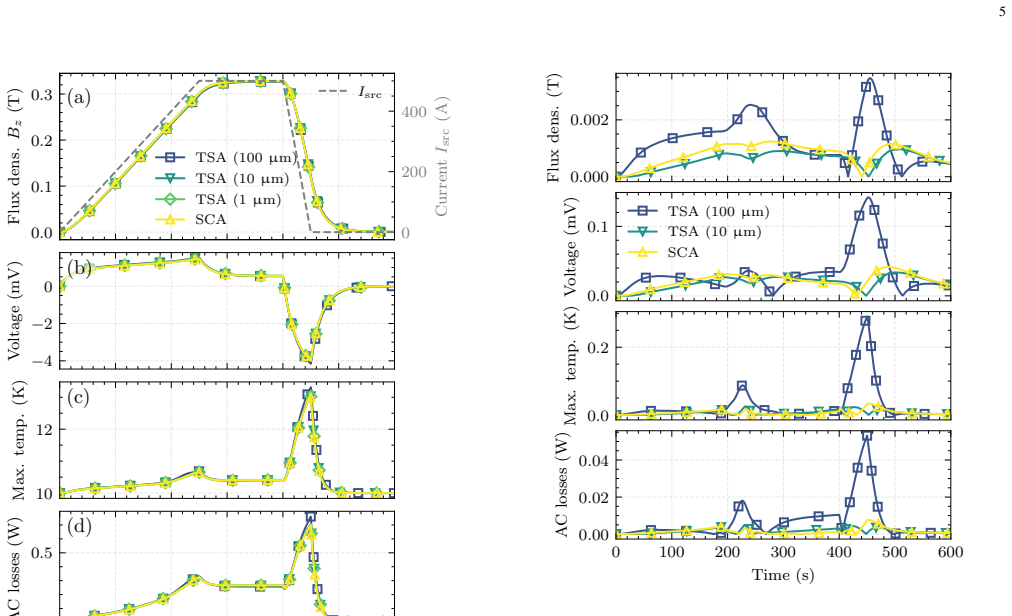
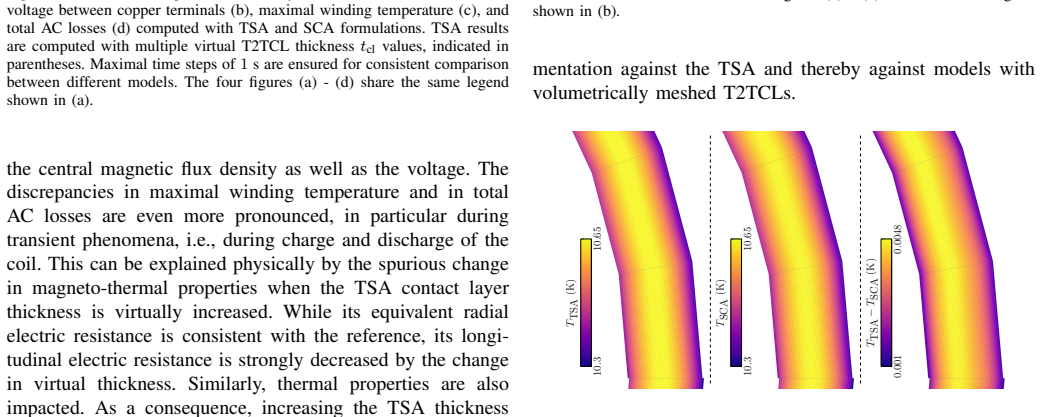
The SCA formulation replaces the thin volumetric contact layer with a dedicated surface weak formulation based on the electric contact resistance and thermal contact conductance. Transient magneto-thermal simulations of a model NI pancake coil show that the SCA accurately reproduces the relevant electromagnetic and thermal behavior. In contrast to the TSA, the SCA uses contact resistances and conductances directly without the necessity to define a thickness and is therefore easy to use and robust.
What carries the argument
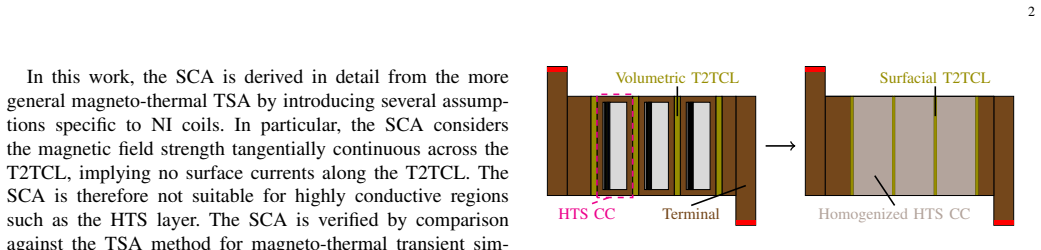
The surface contact approximation (SCA), derived from the thin shell approximation by setting tangential surface currents and eddy-current effects inside the T2TCL to negligible values, and implemented as a surface weak formulation using contact resistance and conductance.
If this is right
- Simulations of NI HTS coils can use measured contact resistance values directly rather than deriving equivalent volumetric properties.
- The linear system solver avoids conditioning problems that arise from very small layer thicknesses paired with high resistivities.
- Quench propagation and current sharing between turns can be modeled without artificial adjustments to contact layer geometry.
- The same surface formulation extends readily to full 3D coil geometries where multiple pancakes share contact interfaces.
Where Pith is reading between the lines
- The SCA could be tested on coils with varying contact pressures to check whether the direct use of measured resistances improves agreement with experiment over thickness-based models.
- Similar surface-based contact terms might simplify modeling of other thin interfaces in electromagnetic devices, such as joints in high-current busbars.
- Integration into open-source quench simulators could allow parametric studies of contact resistance as a design variable rather than a numerical tuning parameter.
Load-bearing premise
Negligible tangential surface currents and eddy-current effects hold inside the turn-to-turn contact layer.
What would settle it
Comparison of SCA-predicted voltage and temperature distributions against measurements from a physical no-insulation HTS pancake coil during a controlled quench event.
Figures
read the original abstract
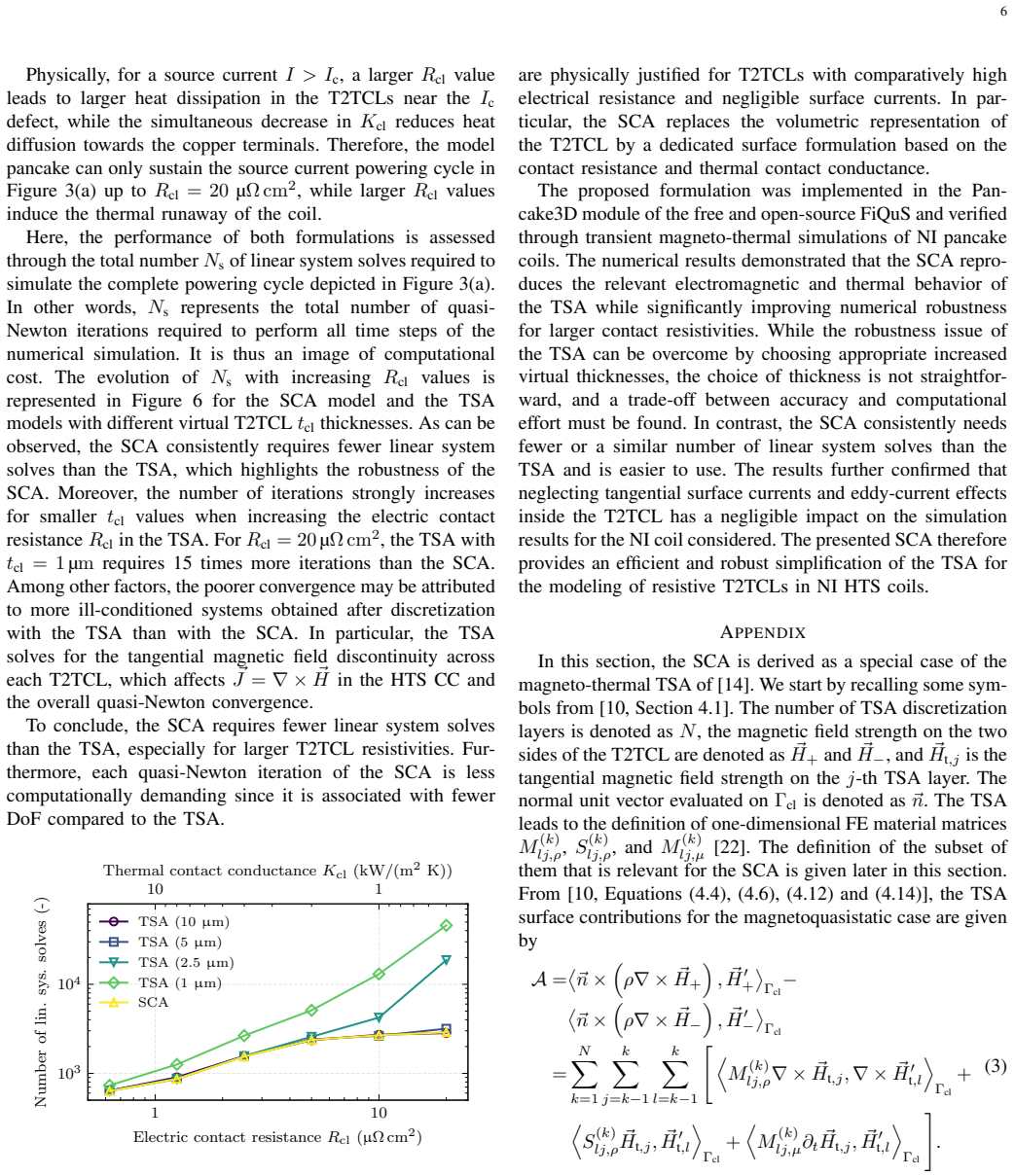
High-temperature superconducting (HTS) coated conductors (CCs) can be wound into no-insulation (NI) coils, in which electrical current can partially bypass local normal zones via turn-to-turn contact layers (T2TCLs). Accurate magneto-thermal simulation of such coils, therefore, requires an efficient representation of the electrical and thermal behavior of the T2TCLs. This paper introduces a magneto-thermal surface contact approximation (SCA) for finite element analysis of NI HTS coils. The formulation is derived as a special case of the more general thin shell approximation (TSA) by introducing suitable approximations such as negligible tangential surface currents and eddy-current effects inside the T2TCL. The resulting SCA formulation replaces the thin volumetric contact layer with a dedicated surface weak formulation based on the electric contact resistance and thermal contact conductance. In contrast, the TSA formulation requires the definition of electric resistivities and thermal conductivities as well as the thickness of the T2TCL. The SCA is implemented in the Pancake3D module of the free and open-source Finite Element Quench Simulator. It is verified through transient magneto-thermal simulations of a model NI pancake coil. Numerical results are compared against the established TSA formulation. The results show that the SCA accurately reproduces the relevant electromagnetic and thermal behavior. For the TSA, there is a trade-off between choosing large (potentially unphysical) thicknesses with low resistivities leading to inaccurate results, or small thicknesses with large resistivities making the linear system harder to solve, increasing the computational effort. In contrast, the SCA, thanks to using contact resistances and conductances directly without the necessity to define a thickness, is easy to use and robust.
Editorial analysis
A structured set of objections, weighed in public.
Referee Report
Summary. The paper introduces a magneto-thermal surface contact approximation (SCA) for finite-element modeling of no-insulation HTS coils. SCA is obtained by specializing the thin-shell approximation (TSA) under the assumptions of negligible tangential surface currents and negligible eddy currents inside the turn-to-turn contact layer (T2TCL). The resulting surface weak form is expressed directly in terms of electric contact resistance and thermal contact conductance, eliminating the need to prescribe an artificial thickness and associated resistivity/conductivity values. The method is implemented in the Pancake3D module of the open-source Finite Element Quench Simulator and is verified by transient magneto-thermal simulations of a model NI pancake coil, with direct numerical comparison to the parent TSA formulation.
Significance. If the reported numerical agreement holds, SCA removes a well-known practical difficulty in TSA-based NI-coil modeling—the trade-off between unphysical layer thickness and solver conditioning—while preserving the essential electromagnetic and thermal behavior. This would constitute a useful, readily implementable improvement for quench-protection studies of NI windings.
major comments (2)
- [Verification / Results] Verification section: the manuscript states that SCA 'accurately reproduces' the TSA results but supplies neither quantitative error measures (e.g., L2 norms of current or temperature fields, maximum pointwise differences) nor mesh-convergence or time-step data. Without these, the strength of the central reproducibility claim cannot be assessed.
- [Formulation] Derivation: the surface weak form is asserted to follow from the TSA under the stated approximations, yet the explicit steps that reduce the volumetric TSA integrals to the contact-resistance/conductance surface terms are not shown. This omission is load-bearing for readers who wish to confirm that the neglected terms are indeed negligible under the operating conditions of interest.
minor comments (2)
- The acronym T2TCL is introduced in the abstract but never expanded on first use in the main text.
- Boundary conditions and material parameters for the model pancake coil should be tabulated for reproducibility.
Simulated Author's Rebuttal
We thank the referee for the constructive comments on our manuscript. We address each major comment below and will revise the paper to incorporate the suggested improvements.
read point-by-point responses
-
Referee: [Verification / Results] Verification section: the manuscript states that SCA 'accurately reproduces' the TSA results but supplies neither quantitative error measures (e.g., L2 norms of current or temperature fields, maximum pointwise differences) nor mesh-convergence or time-step data. Without these, the strength of the central reproducibility claim cannot be assessed.
Authors: We agree that quantitative error metrics and convergence information would strengthen the verification. In the revised manuscript we will add L2 norms of the differences in current density and temperature, maximum pointwise differences between SCA and TSA solutions, and explicit statements on the meshes and time steps employed, together with a brief convergence study. revision: yes
-
Referee: [Formulation] Derivation: the surface weak form is asserted to follow from the TSA under the stated approximations, yet the explicit steps that reduce the volumetric TSA integrals to the contact-resistance/conductance surface terms are not shown. This omission is load-bearing for readers who wish to confirm that the neglected terms are indeed negligible under the operating conditions of interest.
Authors: We acknowledge that the explicit reduction steps were omitted. We will insert a concise derivation (either in the main text or as a short appendix) that starts from the TSA weak form and shows the simplifications leading to the SCA surface integrals under the stated assumptions of negligible tangential currents and eddy currents inside the T2TCL. revision: yes
Circularity Check
Derivation from established TSA with explicit approximations; no reduction to inputs or self-citation chains
full rationale
The paper derives SCA explicitly as a specialization of the more general TSA by introducing stated approximations (negligible tangential surface currents and eddy-current effects). It implements both formulations in the same Pancake3D module and verifies numerical agreement on a model NI pancake coil. No parameters are fitted to data and then relabeled as predictions; no load-bearing uniqueness theorem or ansatz is imported via self-citation; the central claim rests on the independent derivation plus direct comparison rather than any definitional equivalence or renaming of known results.
Axiom & Free-Parameter Ledger
axioms (1)
- domain assumption Negligible tangential surface currents and eddy-current effects inside the T2TCL
Forward citations
Cited by 1 Pith paper
-
Explicit Turn Resolution with Anisotropic Homogenisation for Efficient 3D Magneto-Thermal Finite-Element Simulation of Large-Scale No-Insulation HTS Magnets
The EXTRA method enables accurate 3D magneto-thermal FE simulations of large-scale NI HTS magnets by explicitly resolving critical turns while homogenizing others, reducing computation time by up to 13x on benchmarks.
Reference graph
Works this paper leans on
-
[1]
HTS pancake coils without turn-to-turn insulation,
S. Hahn, D. K. Park, J. Bascunan, and Y . Iwasa, “HTS pancake coils without turn-to-turn insulation,”IEEE Transactions on Applied Superconductivity, vol. 21, no. 3, pp. 1592–1595, 2011.DOI: 10.1109/ TASC.2010.2093492
-
[2]
T. Wang et al., “Analyses of transient behaviors of no-insulation REBCO pancake coils during sudden discharging and overcurrent,” IEEE Transactions on Applied Superconductivity, vol. 25, no. 3, pp. 1–9, 2015.DOI: 10.1109/TASC.2015.2393058
-
[3]
S. Hahn et al., “‘Defect-irrelevant’ behavior of a no-insulation pancake coil wound with REBCO tapes containing multiple defects,”Supercon- ductor Science and Technology, vol. 29, no. 10, 2016, 105017.DOI: 10.1088/0953-2048/29/10/105017
-
[4]
Y . Wang, W. K. Chan, and J. Schwartz, “Self-protection mechanisms in no-insulation (RE)Ba2Cu3Ox high temperature superconductor pan- cake coils,”Superconductor Science and Technology, vol. 29, no. 4, p. 045 007, 2016.DOI: 10.1088/0953-2048/29/4/045007
-
[5]
Quench behavior of a no-insulation coil wound with stainless steel cladding REBCO tape at 4.2 K,
K. Kim et al., “Quench behavior of a no-insulation coil wound with stainless steel cladding REBCO tape at 4.2 K,”Superconductor Science and Technology, vol. 30, no. 7, p. 075 001, May 2017.DOI: 10.1088/ 1361-6668/aa6a8b
2017
-
[6]
45.5-Tesla direct-current magnetic field generated with a high-temperature superconducting magnet,
S. Hahn et al., “45.5-Tesla direct-current magnetic field generated with a high-temperature superconducting magnet,”Nature, vol. 570, pp. 496–499, 2019.DOI: 10.1038/s41586-019-1293-1 8
-
[7]
Quench and self-protecting behaviour of an intra- layer no-insulation (LNI) REBCO coil at 31.4 T,
Y . Suetomi et al., “Quench and self-protecting behaviour of an intra- layer no-insulation (LNI) REBCO coil at 31.4 T,”Superconductor Science and Technology, vol. 34, no. 6, p. 064 003, 2021.DOI: 10. 1088/1361-6668/abf54e
2021
-
[9]
Contact resistance between two rebco tapes: The effects of cyclic loading and surface coating,
J. Lu, J. Levitan, D. McRae, and R. Walsh, “Contact resistance between two rebco tapes: The effects of cyclic loading and surface coating,” Superconductor Science and Technology, vol. 31, no. 8, p. 085 006, Jul. 2018.DOI: 10.1088/1361-6668/aacd2d
-
[10]
Models and methods for transient magneto-thermal finite element simulation of superconducting magnets,
E. Schnaubelt, “Models and methods for transient magneto-thermal finite element simulation of superconducting magnets,” Dissertation, Technische Universit¨at Darmstadt, Darmstadt, 2025
2025
-
[11]
S. Atalay et al., “An open-source 3D FE quench simulation tool for no-insulation HTS pancake coils,”Superconductor Science and Technology, vol. 37, no. 6, p. 065 005, May 2024.DOI: 10.1088/1361- 6668/ad3f83
-
[12]
An open-source finite element quench simulation tool for superconducting magnets,
A. Vitrano, M. Wozniak, E. Schnaubelt, T. Mulder, E. Ravaioli, and A. Verweij, “An open-source finite element quench simulation tool for superconducting magnets,”IEEE Transactions on Applied Superconductivity, vol. 33, no. 5, pp. 1–6, Aug. 2023.DOI: 10.1109/ TASC.2023.3259332
-
[13]
Thermal thin shell approx- imation towards finite element quench simulation,
E. Schnaubelt, M. Wozniak, and S. Sch ¨ops, “Thermal thin shell approx- imation towards finite element quench simulation,”Superconductor Science and Technology, vol. 36, no. 4, p. 044 004, Mar. 2023.DOI: 10.1088/1361-6668/acbeea
-
[14]
Magneto-thermal thin shell approximation for 3D finite element analysis of no-insulation coils,
E. Schnaubelt et al., “Magneto-thermal thin shell approximation for 3D finite element analysis of no-insulation coils,”IEEE Transactions on Applied Superconductivity, vol. 34, no. 3, pp. 1–6, May 2024.DOI: 10.1109/TASC.2023.3340648
-
[15]
Comparison of three eddy current formulations for superconductor hysteresis loss modelling,
V . Lahtinen, M. Lyly, A. Stenvall, and T. Tarhasaari, “Comparison of three eddy current formulations for superconductor hysteresis loss modelling,”Superconductor Science and Technology, vol. 25, no. 11, p. 115 001, Sep. 2012.DOI: 10.1088/0953-2048/25/11/115001
-
[16]
Fake conductivity or cohomology: Which to use when solving eddy current problems withh-formulations?
P. Dłotko, B. Kapidani, S. Pitassi, and R. Specogna, “Fake conductivity or cohomology: Which to use when solving eddy current problems withh-formulations?”IEEE Transactions on Magnetics, vol. 55, no. 6, pp. 1–4, 2019.DOI: 10.1109/TMAG.2019.2906099
-
[17]
Investigation on the electrical contact resistance of soldered metal insulation REBCO coil,
J. Lee, J. Mun, J. Kim, and S. Kim, “Investigation on the electrical contact resistance of soldered metal insulation REBCO coil,”IEEE Transactions on Applied Superconductivity, vol. 31, no. 5, pp. 1–5, 2021.DOI: 10.1109/TASC.2021.3063653
-
[18]
Overall thermal conductance and thermal contact resistance in no-insulation REBCO magnet,
J. Seok, D. Kim, and S. Kim, “Overall thermal conductance and thermal contact resistance in no-insulation REBCO magnet,”IEEE Transactions on Applied Superconductivity, vol. 28, no. 3, pp. 1–5, 2018.DOI: 10.1109/TASC.2017.2785825
-
[19]
S. Wang, H. Yong, and Y . Zhou, “Modeling of contact resistivity and simplification of 3D homogenization strategy for the H formulation,” Superconductor Science and Technology, vol. 37, no. 7, p. 075 019, Jun. 2024.DOI: 10.1088/1361-6668/ad541f
-
[20]
J. Dular, F. Magnus, E. Schnaubelt, A. Verweij, and M. Wozniak, “Simulation of Rutherford cable AC loss and magnetization with the coupled axial and transverse currents method,”IEEE Transactions on Applied Superconductivity, vol. 35, no. 5, pp. 1–5, 2025.DOI: 10.1109/ TASC.2024.3520941
-
[21]
STEAM SDK Analysis for ’Surface contact approximation (SCA) for magnetoquasistatic-thermal finite element analysis of no-insulation HTS coils’,
E. Schnaubelt and L. Denis. “STEAM SDK Analysis for ’Surface contact approximation (SCA) for magnetoquasistatic-thermal finite element analysis of no-insulation HTS coils’,” Accessed: May 27,
-
[22]
Available: https://gitlab.cern.ch/steam/analyses/sca- paper/-/tags/initial arxiv submission
[Online]. Available: https://gitlab.cern.ch/steam/analyses/sca- paper/-/tags/initial arxiv submission
-
[23]
Electromag- netic simulation of no-insulation coils using h-ϕthin shell approxima- tion,
E. Schnaubelt, M. Wozniak, S. Sch ¨ops, and A. Verweij, “Electromag- netic simulation of no-insulation coils using h-ϕthin shell approxima- tion,”IEEE Transactions on Applied Superconductivity, vol. 33, no. 5, pp. 1–6, Aug. 2023.DOI: 10.1109/TASC.2023.3258905
-
[24]
Homology and cohomology computation in finite element modeling,
M. Pellikka, S. Suuriniemi, L. Kettunen, and C. Geuzaine, “Homology and cohomology computation in finite element modeling,”SIAM Journal on Scientific Computing, vol. 35, no. 5, B1195–B1214, 2013. DOI: 10.1137/130906556
-
[25]
Thin-shell approach for modeling superconducting tapes in the h-ϕfinite-element formulation,
B. de Sousa Alves, V . Lahtinen, M. Laforest, and F. Sirois, “Thin-shell approach for modeling superconducting tapes in the h-ϕfinite-element formulation,”Superconductor Science and Technology, vol. 35, no. 2, p. 024 001, Dec. 2021.DOI: 10.1088/1361-6668/ac3f9e
-
[26]
3-D finite-element thin-shell model for high-temperature superconducting tapes,
B. de Sousa Alves, M. Laforest, and F. Sirois, “3-D finite-element thin-shell model for high-temperature superconducting tapes,”IEEE Transactions on Applied Superconductivity, vol. 32, no. 3, pp. 1–11, 2022.DOI: 10.1109/TASC.2022.3143076
-
[27]
Theory and practice of finite elements
A. Ern and J.-L. Guermond,Theory and Practice of Finite Elements. Springer New York, 2004.DOI: 10.1007/978-1-4757-4355-5
-
[28]
STEAM: A hierarchical co-simulation framework for superconducting accelerator magnet circuits,
L. Bortot et al., “STEAM: A hierarchical co-simulation framework for superconducting accelerator magnet circuits,”IEEE Transactions on Applied Superconductivity, vol. 28, no. 3, Apr. 2018.DOI: 10.1109/ TASC.2017.2787665 arXiv: 1801.08957
-
[29]
STEAM website,
STEAM Team at CERN. “STEAM website,” Accessed: May 13, 2026. [Online]. Available: https://cern.ch/steam
2026
-
[30]
C. Geuzaine and J.-F. Remacle, “Gmsh: A 3-D finite element mesh generator with built-in pre- and post-processing facilities,”Inter- national Journal for Numerical Methods in Engineering, vol. 79, pp. 1309–1331, 2009.DOI: 10.1002/nme.2579
-
[31]
P. Dular, C. Geuzaine, F. Henrotte, and W. Legros, “A general envi- ronment for the treatment of discrete problems and its application to the finite element method,”IEEE Transactions on Magnetics, vol. 34, no. 5, pp. 3395–3398, 1998.DOI: 10.1109/20.717799
-
[32]
MUMPS: A general purpose distributed memory sparse solver,
P. R. Amestoy, I. S. Duff, J.-Y . L’Excellent, and J. Koster, “MUMPS: A general purpose distributed memory sparse solver,” inApplied Parallel Computing. New Paradigms for HPC in Industry and Academia. Springer Berlin Heidelberg, 2001, pp. 121–130,ISBN: 978-3-540- 70734-9.DOI: 10.1007/3-540-70734-4 16
-
[33]
Challenges for quantum software engineering: An industrial application scenario perspective,
S. Balay, W. D. Gropp, L. C. McInnes, and B. F. Smith, “Efficient man- agement of parallelism in object-oriented numerical software libraries,” inModern Software Tools for Scientific Computing, Birkh¨auser Boston, 1997, pp. 163–202,ISBN: 978-1-4612-1986-6.DOI: 10.1007/978- 1- 4612-1986-6 8
-
[34]
STEAM material library,
STEAM Team at CERN. “STEAM material library,” Accessed: Jul. 15,
-
[35]
Available: https://cern.ch/smali
[Online]. Available: https://cern.ch/smali
-
[36]
CERNGetDP 2026.4.3,
E. Schnaubelt. “CERNGetDP 2026.4.3,” Accessed: Apr. 16, 2026. [Online]. Available: https://gitlab.cern.ch/steam/cerngetdp/-/releases/ 2026.4.3
2026
-
[37]
“FiQuS.” version 2026.5.1
STEAM Team at CERN. “FiQuS.” version 2026.5.1. PyPI package: https://pypi.org/project/fiqus/v2026.5.1, Accessed: May 27, 2026. [Online]. Available: https://gitlab.cern.ch/steam/fiqus/-/releases/2026. 5.1
2026
-
[38]
STEAM SDK
STEAM Team at CERN. “STEAM SDK.” version 2026.5.1. PyPI package: https://pypi.org/project/steam sdk/v2026.5.1, Accessed: May 21, 2026. [Online]. Available: https : / / gitlab . cern . ch / steam / steam sdk/-/tags/2026.5.1
2026
-
[39]
Mag- netic field and temperature scaling of the critical current of REBCO tapes,
G. Succi, A. Ballarino, S. C. Hopkins, C. Barth, and Y . Yang, “Mag- netic field and temperature scaling of the critical current of REBCO tapes,”IEEE Transactions on Applied Superconductivity, vol. 34, no. 3, pp. 1–7, 2024.DOI: 10.1109/TASC.2024.3370137
-
[40]
M. Wozniak et al., “Influence of critical current defect on operation, quench detection and protection of a conduction-cooled pancake rebco coil,”IEEE Transactions on Applied Superconductivity, vol. 35, no. 5, pp. 1–6, 2025.DOI: 10.1109/TASC.2025.3532246
-
[41]
A public database of high- temperature superconductor critical current data,
S. C. Wimbush and N. M. Strickland, “A public database of high- temperature superconductor critical current data,”IEEE Transactions on Applied Superconductivity, vol. 27, no. 4, pp. 1–5, 2017.DOI: 10. 1109/TASC.2016.2628700
-
[42]
Crit- ical current characterisation of Faraday Factory Japan YBCO 2G HTS superconducting wire,
High-temperature superconducting wire critical current database. “Crit- ical current characterisation of Faraday Factory Japan YBCO 2G HTS superconducting wire,” Accessed: Jul. 16, 2025. [Online]. Available: https://htsdb.wimbush.eu/dataset/23536374
-
[43]
RDE-418D4 4K Cryocooler Series capacity map,
SHI Cryogenics Group. “RDE-418D4 4K Cryocooler Series capacity map,” Accessed: Jun. 28, 2024. [Online]. Available: https : / / www. shicryogenics.com/product/rde-418d4-4k-cryocooler-series/
2024
-
[44]
Klingbeil,Grundlagen der elektromagnetischen Feldtheorie
H. Klingbeil,Grundlagen der elektromagnetischen Feldtheorie. Springer, 2018,ISBN: 978-3-662-56599-5.DOI: 10.1007/978-3-662- 56600-8
discussion (0)
Sign in with ORCID, Apple, or X to comment. Anyone can read and Pith papers without signing in.