REVIEW 1 major objections 1 minor 2 cited by
Executable Python world models induced from trajectories enable effective planning in POMDPs without internal LLM calls.
Reviewed by Pith at T0; open to challenge. T0 means a machine referee read the full paper against a public rubric. the ladder, T0–T4 →
T0 review · grok-4.3
2026-06-30 10:57 UTC pith:DJM62QHS
load-bearing objection PatchWorld shows a workable gradient-free code-repair method for turning trajectories into inspectable Python world models that support planning in text POMDPs, though the partial-observability handling needs closer checks. the 1 major comments →
PatchWorld: Gradient-Free Optimization of Executable World Models for Agent Environments
The pith
A machine-rendered reading of the paper's core claim, the machinery that carries it, and where it could break.
Core claim
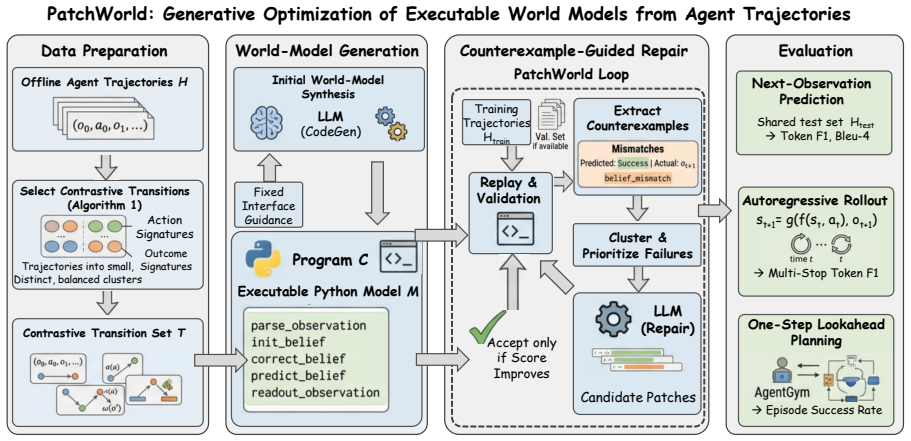
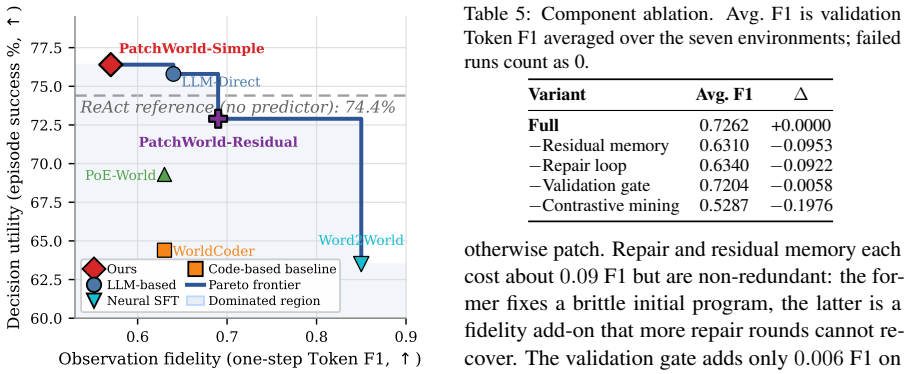
PatchWorld induces executable Python world models from offline trajectories using counterexample-guided code repair, resulting in symbolic belief-state programs whose action updates enable effective planning under partial observability, with the Simple variant reaching 76.4% macro success in live one-step lookahead across seven environments without LLM calls inside the prediction module.
What carries the argument
Counterexample-guided code repair for generating symbolic belief-state programs from trajectories.
Load-bearing premise
Offline trajectories contain enough information for counterexample-guided code repair to produce executable world models whose action updates support effective planning under partial observability.
What would settle it
If the induced executable models are deployed in planning and fail to achieve higher success rates than black-box alternatives in the AgentGym environments, the central claim would be falsified.
If this is right
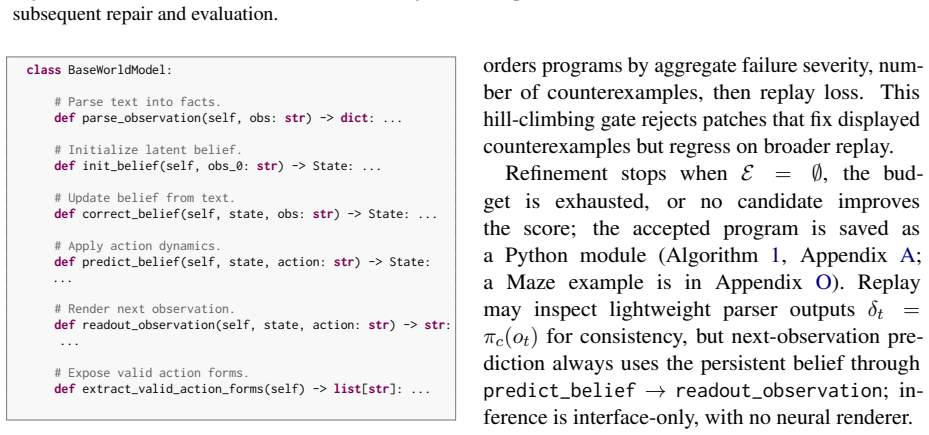
- Symbolic programs enable inspection, replay, and local patching of world models.
- Planning achieves high success rates with no internal LLM invocations.
- A residual-memory bias improves observation fidelity but reduces decision utility, exposing a fidelity-utility tradeoff.
- The method outperforms other evaluated approaches in code-based planning scores.
Where Pith is reading between the lines
- The approach could be tested in environments with more complex partial observability to see if code repair scales.
- Automated methods for selecting biases might resolve the observed tradeoff between fidelity and utility.
- This framework might connect to program synthesis techniques for other decision problems beyond text agents.
Editorial analysis
A structured set of objections, weighed in public.
Referee Report
Summary. The paper introduces PatchWorld, a gradient-free framework that induces executable Python world models from offline trajectories via counterexample-guided code repair for POMDP text-agent environments. PatchWorld-Simple is reported to achieve the highest code-based planning score, with 76.4% macro success in live one-step lookahead across seven AgentGym environments, without LLM calls inside the world-model prediction module. A human-specified residual-memory bias is shown to improve observation fidelity at the cost of decision utility, exposing a fidelity-utility tradeoff in executable world models.
Significance. If the central claims hold under rigorous validation, the work is significant for demonstrating that symbolic, inspectable belief-state programs can be induced for planning under partial observability, offering an alternative to black-box models with advantages in replayability and local patching. Code availability is a positive for reproducibility. The identified tradeoff between fidelity and utility is a useful conceptual contribution for future executable world-model research.
major comments (1)
- [Abstract] The headline 76.4% macro success claim (abstract) rests on the assumption that counterexample-guided repair from offline trajectories recovers action-conditioned latent dynamics sufficiently for planning. In POMDPs the same observation sequence can arise from multiple latent trajectories; without explicit analysis or experiments showing that the collected trajectories contain distinguishing counterexamples for decision-relevant quantities, it is unclear whether the repaired programs avoid matching surface observations while misrepresenting dynamics. This is load-bearing for the performance comparison.
minor comments (1)
- The abstract states that 'code is available' but provides no details on reproduction steps, environment versions, or exact data splits used for the 76.4% figure; adding these would improve clarity.
Simulated Author's Rebuttal
Thank you for your review and the recommendation for major revision. We address the major comment regarding the abstract claim as follows.
read point-by-point responses
-
Referee: [Abstract] The headline 76.4% macro success claim (abstract) rests on the assumption that counterexample-guided repair from offline trajectories recovers action-conditioned latent dynamics sufficiently for planning. In POMDPs the same observation sequence can arise from multiple latent trajectories; without explicit analysis or experiments showing that the collected trajectories contain distinguishing counterexamples for decision-relevant quantities, it is unclear whether the repaired programs avoid matching surface observations while misrepresenting dynamics. This is load-bearing for the performance comparison.
Authors: We agree that in POMDPs, observation sequences may not uniquely determine the latent trajectory, raising the possibility that programs could match observations without correctly capturing the underlying dynamics. Our approach mitigates this through counterexample-guided repair, where the program is iteratively corrected based on execution mismatches with the full trajectory data, including action effects on subsequent observations. This encourages the program to learn action-conditioned updates rather than mere surface matching. Furthermore, the evaluation involves live one-step lookahead planning, where the model's predictions directly influence action selection in the real environment; the high success rate of 76.4% suggests that the dynamics are captured at a level sufficient for planning. We did not include an explicit analysis of distinguishing counterexamples in the submitted manuscript. We will add a discussion of this point and any supporting experiments in the revision. revision: yes
Circularity Check
No significant circularity detected
full rationale
The paper describes PatchWorld as inducing executable symbolic belief-state programs from offline trajectories via counterexample-guided code repair, with performance evaluated on separate live one-step lookahead planning tasks (76.4% macro success). No equations, predictions, or claims in the abstract or description reduce the central results to fitted parameters by construction, self-definitional loops, or load-bearing self-citations. The method is presented as relying on external data and iterative repair without the reported planning utility being equivalent to the input trajectories. This is the most common honest finding for self-contained empirical frameworks.
Axiom & Free-Parameter Ledger
read the original abstract
World models for interactive text agents must typically be learned from observation-action trajectories alone. Specifically, the environment returns text observations after each action, but does not expose a ground-truth latent state nor an inspectable transition model.A research gap remains in how to induce executable code as a world model in this black-box setting for prediction and agent decision making. We introduce PatchWorld, a gradient-free framework that turns offline trajectories into executable Python world models through counterexample-guided code repair.Instead of predicting the next observation with a black-box model, PatchWorld induces symbolic belief-state programs whose action updates can be inspected, replayed, and locally patched. Across seven AgentGym environments, PatchWorld-Simple achieves the highest code-based decision-making score among evaluated methods (76.4% macro success in live one-step lookahead), matching or exceeding LLM-based lookahead while invoking no LLM calls inside the world-model prediction module itself. We further find that a human-specified residual-memory bias improves surface observation fidelity but weakens agent decision-making utility. This reveals a tradeoff in executable world models, since improving observation fidelity can come at the expense of action-discriminative dynamics, and vice versa. Code is available at https://github.com/HKBU-KnowComp/PatchWorld.
Figures
Forward citations
Cited by 2 Pith papers
-
Scaling GUI Agents with Visual State Transitions
A joint inverse-forward pretraining stage on visual screen transitions improves GUI-agent fine-tuning by 0.6–6.2 percentage points across three benchmarks.
-
VisualPatchWorld: Code World Models as Latent Structured Representations for Planning
A two-level induction procedure—active-probe sketch selection plus multi-step rollout fitting—recovers executable code world models that improve CEM planning over prior code baselines on four LeWM tasks.
discussion (0)
Sign in with ORCID, Apple, or X to comment. Anyone can read and Pith papers without signing in.