REVIEW 2 major objections 3 minor 2 cited by
Heavy-element paleodetectors using ancient minerals with lead nuclei can detect inelastic Higgsino dark matter up to mass splittings of 920 keV.
Reviewed by Pith at T0; open to challenge. T0 means a machine referee read the full paper against a public rubric. the ladder, T0–T4 →
T0 review · grok-4.3
2026-06-28 05:21 UTC pith:JYOI5E7Z
load-bearing objection The paper's new angle is using heavy-element minerals from geothermal brines to reach inelastic Higgsino splittings up to 920 keV, but the reach and relaxed depth claims rest on untested assumptions about those minerals. the 2 major comments →
Heavy-element paleodetectors for Higgsino dark matter
The pith
A machine-rendered reading of the paper's core claim, the machinery that carries it, and where it could break.
Core claim
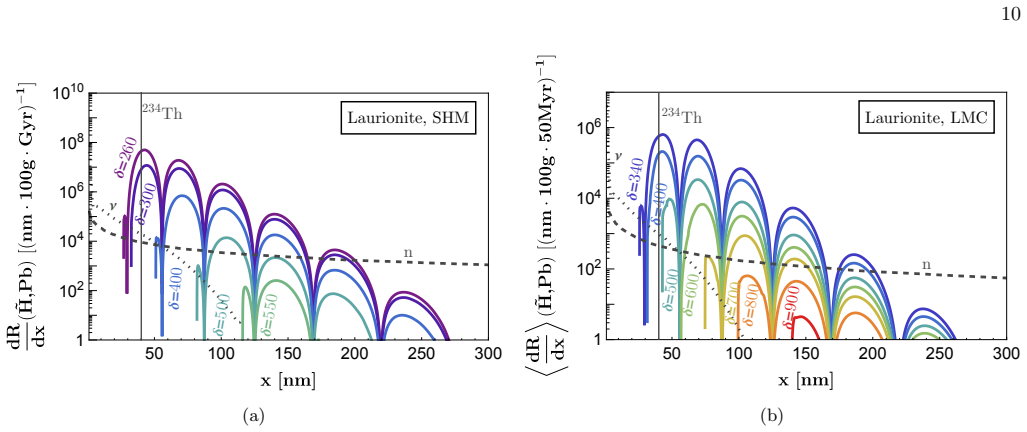
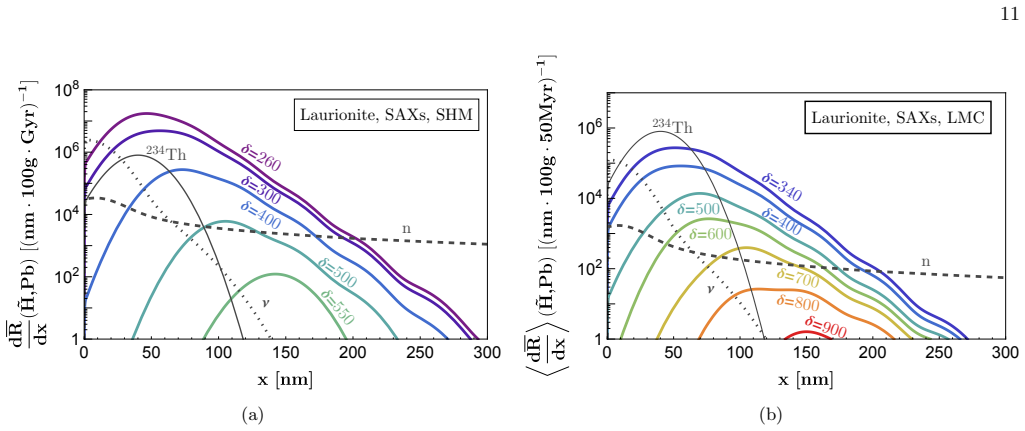
We propose heavy-element paleodetectors as a new probe of inelastic dark matter, using ancient, radiopure minerals containing heavy elements such as lead. We identify brine precipitates from deep geothermal aquifers as a possible geological source of such minerals. This method can probe Higgsino mass splittings up to δ ≃ 920 keV. Due to the large Higgsino-nucleon cross section, even suboptimal mineral samples with ordinary radioactivity from depths of only 2 km can probe new parameter space, thus partially relaxing the stringent requirements on radiopurity and depth.
What carries the argument
Heavy-element paleodetectors: ancient minerals with heavy nuclei such as lead that record permanent damage tracks from WIMP-nucleon scattering, overcoming the kinematic threshold for inelastic scattering.
Load-bearing premise
Suitable quantities of ancient minerals containing heavy elements like lead with sufficiently low radioactivity exist and can be obtained from geological sources such as brine precipitates.
What would settle it
No excess damage tracks observed in lead-rich ancient mineral samples from 2 km depth that would be expected for Higgsino parameters with mass splittings below 920 keV, after subtracting known backgrounds.
If this is right
- Can probe Higgsino mass splittings up to approximately 920 keV.
- Suboptimal mineral samples from depths of only 2 km with ordinary radioactivity can still probe new parameter space.
- Paleodetectors become sensitive to the history of the dark matter high-velocity tail, including effects from the Large Magellanic Cloud's close approach 50 million years ago.
- Younger minerals may be favored in scenarios with fast dark matter populations.
- Requirements for radiopurity and depth are partially relaxed compared to standard paleodetector targets.
Where Pith is reading between the lines
- Similar heavy-element targets could be applied to other inelastic dark matter candidates beyond the Higgsino.
- Geological surveys for brine precipitates could identify more candidate minerals for paleodetection.
- The method might complement direct detection experiments by providing historical information on dark matter velocities.
- Verification would require confirming that damage tracks from Higgsino scattering are distinguishable from background tracks in these minerals.
Editorial analysis
A structured set of objections, weighed in public.
Referee Report
Summary. The manuscript proposes heavy-element paleodetectors using ancient, radiopure minerals containing heavy nuclei such as lead (e.g., brine precipitates from deep geothermal aquifers) to detect inelastic WIMP-nucleon scattering from Higgsino dark matter. It claims this overcomes kinematic thresholds in existing paleodetector targets, enabling probes of Higgsino mass splittings up to δ ≃ 920 keV; due to the large cross section, even suboptimal samples with ordinary radioactivity from only 2 km depth can access new parameter space. The work also highlights unique sensitivity to the DM high-velocity tail, including possible effects from the Large Magellanic Cloud's passage ~50 Myr ago, which may favor younger minerals.
Significance. If the target minerals exist with the required properties and track detection is feasible, the proposal would extend paleodetector methods to inelastic DM scenarios that are otherwise kinematically inaccessible, while relaxing stringent radiopurity and depth requirements that limit the approach. It provides a concrete geological candidate and notes sensitivity to non-standard velocity distributions, which could distinguish this method from conventional direct detection. The idea is novel within the paleodetector literature but rests on external geological assumptions rather than new derivations or data.
major comments (2)
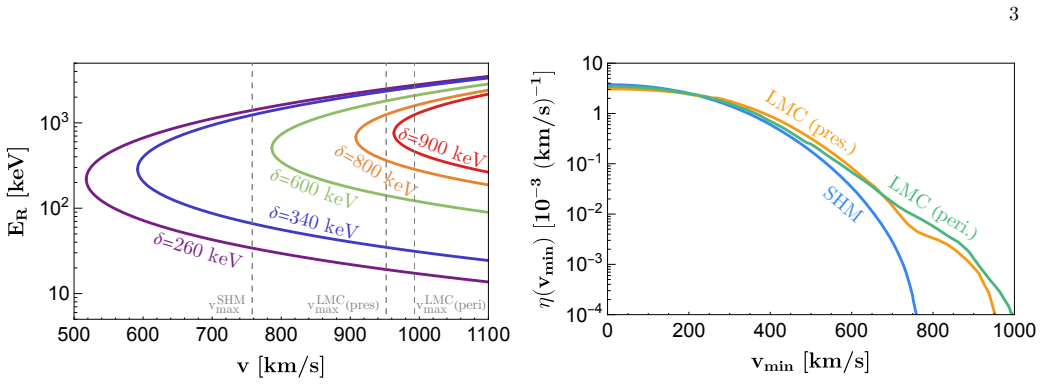
- [Abstract, §3] Abstract and §3 (kinematics section): the headline claim that the method reaches δ ≃ 920 keV is stated without an explicit derivation, velocity-distribution assumptions, recoil-energy threshold calculation, or error budget; the number appears to follow from standard inelastic kinematics and the Higgsino-nucleon cross section, but the manuscript supplies no equations or numerical steps that would allow independent verification of how 920 keV is obtained or its sensitivity to the high-velocity tail.
- [§4–5] §4–5 (mineral-target discussion): the assertion that ordinary-radioactivity samples from 2 km depth suffice relies on the unverified existence of >10 Myr-old, U/Th ≪ 1 ppb Pb-rich brine precipitates that preserve distinguishable nm-scale damage tracks from inelastic recoils; no mineralogical characterization, age/radiopurity data, or track-formation simulations in such matrices are provided, making the relaxation of radiopurity/depth requirements a load-bearing but unsubstantiated claim.
minor comments (3)
- [§2] Notation for the mass splitting δ is introduced without a clear definition equation or comparison to the standard inelastic DM parameter space.
- [Introduction] References to prior paleodetector work on radiopurity requirements and track etching are cited but not quantitatively compared to the proposed 2 km / ordinary-radioactivity scenario.
- Figure captions (if present) should explicitly state the assumed DM velocity distribution and mineral density used for the reach estimate.
Simulated Author's Rebuttal
We thank the referee for their thoughtful review and positive assessment of the proposal's novelty. We address each major comment below and will revise the manuscript to improve clarity and add appropriate caveats.
read point-by-point responses
-
Referee: [Abstract, §3] Abstract and §3 (kinematics section): the headline claim that the method reaches δ ≃ 920 keV is stated without an explicit derivation, velocity-distribution assumptions, recoil-energy threshold calculation, or error budget; the number appears to follow from standard inelastic kinematics and the Higgsino-nucleon cross section, but the manuscript supplies no equations or numerical steps that would allow independent verification of how 920 keV is obtained or its sensitivity to the high-velocity tail.
Authors: We agree that an explicit derivation is needed for independent verification. In the revised manuscript we will expand §3 to include the inelastic scattering kinematics (maximum mass splitting δ_max = μ v_max²/2 − E_R^th, with reduced mass μ for Higgsino-lead), the assumed standard halo velocity distribution (truncated Maxwellian with v_esc = 544 km/s and v_0 = 220 km/s), the recoil threshold corresponding to nm-scale track registration in lead, and the numerical evaluation yielding δ ≃ 920 keV. We will also add a short discussion of sensitivity to the high-velocity tail, including the possible LMC-induced component. revision: yes
-
Referee: [§4–5] §4–5 (mineral-target discussion): the assertion that ordinary-radioactivity samples from 2 km depth suffice relies on the unverified existence of >10 Myr-old, U/Th ≪ 1 ppb Pb-rich brine precipitates that preserve distinguishable nm-scale damage tracks from inelastic recoils; no mineralogical characterization, age/radiopurity data, or track-formation simulations in such matrices are provided, making the relaxation of radiopurity/depth requirements a load-bearing but unsubstantiated claim.
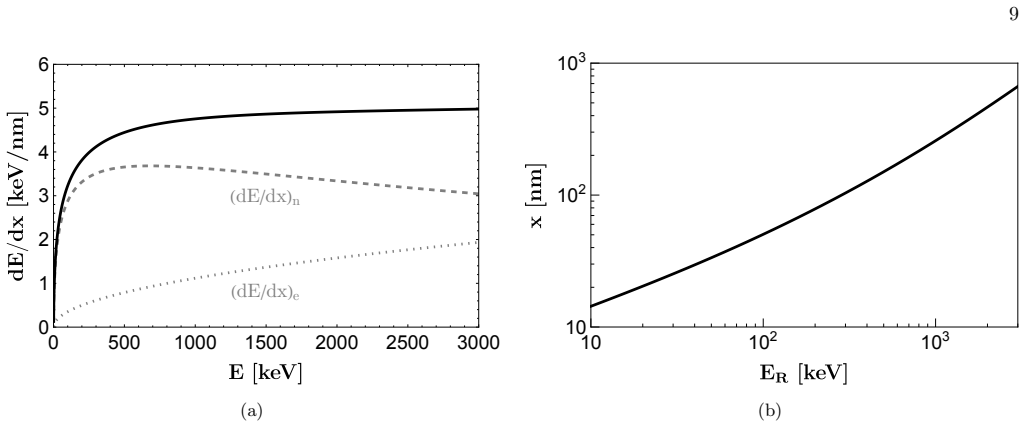
Authors: The work is a theoretical proposal that identifies Pb-rich brine precipitates from deep geothermal aquifers as a candidate target on the basis of published geological literature. We do not provide new mineralogical data or simulations. In revision we will (i) expand the citations to relevant geological studies on radiopurity and age of such precipitates, (ii) add explicit caveats stating that the relaxation of depth and radiopurity requirements is conditional on the existence of suitable samples, and (iii) reference existing track-formation literature for heavy-element matrices while noting that dedicated simulations for these specific minerals remain future work. The large Higgsino-nucleon cross section is the quantitative basis for the claim that even higher-background samples can still probe new parameter space. revision: partial
- Empirical confirmation of the existence, age, radiopurity (U/Th ≪ 1 ppb), and nm-scale track preservation properties of the proposed Pb-rich brine precipitates, which lies outside the scope of this theoretical paper and would require dedicated geological sampling and materials characterization.
Circularity Check
No significant circularity; claims rest on standard kinematics and external geological assumptions.
full rationale
The paper's central results—the reach δ ≃ 920 keV and the viability of 2 km depth samples—are obtained from standard inelastic scattering kinematics and Higgsino-nucleon cross sections applied to heavy nuclei (Pb). These are independent of any quantities defined or fitted inside the paper. The suggestion of brine precipitates as targets is presented as an external hypothesis without any internal derivation, fitting, or self-referential modeling that would reduce the claimed sensitivity back to paper-defined inputs. No equations, ansatze, or uniqueness theorems are shown to loop back to the paper's own results or prior self-citations in a load-bearing way. The derivation chain is therefore self-contained against external benchmarks.
Axiom & Free-Parameter Ledger
axioms (2)
- domain assumption Paleodetectors can register and identify damage tracks produced by WIMP-nucleon scattering in ancient minerals.
- domain assumption Brine precipitates from deep geothermal aquifers constitute a viable geological source of ancient, heavy-element-bearing, sufficiently radiopure minerals.
read the original abstract
Paleodetectors have been proposed as a new approach to direct detection of weakly interacting massive particles (WIMPs), through the search for damage tracks in ancient minerals induced by WIMP-nucleon scattering. However, for inelastic dark matter such as the Higgsino, existing paleodetector targets lack sufficiently heavy nuclei to overcome the kinematic threshold for scattering. We propose heavy-element paleodetectors as a new probe of inelastic dark matter, using ancient, radiopure minerals containing heavy elements such as lead. We identify brine precipitates from deep geothermal aquifers as a possible geological source of such minerals. Additionally, paleodetectors are uniquely sensitive to the history of the dark matter high-velocity tail, including a possible fast population induced by the Large Magellanic Cloud's close approach 50 Myr ago. Such a scenario would favor younger minerals than usually assumed in the paleodetector literature. This method can probe Higgsino mass splittings up to $\delta \simeq 920$ keV. Due to the large Higgsino-nucleon cross section, we find that even suboptimal mineral samples with ordinary radioactivity from depths of only 2 km can probe new parameter space, thus partially relaxing the stringent requirements on radiopurity and depth that constitute two significant challenges for the paleodetector program.
Figures
Forward citations
Cited by 2 Pith papers
-
Searching for heavy charged relics in the Earth
Galactic CHAMPs of mass 1–10^{12} TeV can be discovered by mining their accumulation in monitored water/ice and ancient rocks, enriching via gravity or centrifuges, and identifying them with mass spectrometry down to ...
-
Probing large mass-splitting inelastic Dark Matter with RES-NOVA
A 32.4 g·d PbWO4 cryogenic detector reports the first direct limits on inelastic dark matter at mass splittings up to ~510 keV (SHM) and ~780 keV (LMC).
Reference graph
Works this paper leans on
-
[1]
First Dark Matter Search Results from the LUX-ZEPLIN (LZ) Experiment
J. Aalberset al.(LZ), First Dark Matter Search Results from the LUX-ZEPLIN (LZ) Experiment, Phys. Rev. Lett.131, 041002 (2023), arXiv:2207.03764 [hep-ex]
work page internal anchor Pith review Pith/arXiv arXiv 2023
-
[2]
P. Agneset al.(DarkSide-50), Search for low-mass dark matter WIMPs with 12 ton-day exposure of DarkSide- 50, Phys. Rev. D107, 063001 (2023), arXiv:2207.11966 [hep-ex]
-
[3]
E. Aprileet al.(XENON), First Dark Matter Search with Nuclear Recoils from the XENONnT Experiment, Phys. Rev. Lett.131, 041003 (2023), arXiv:2303.14729 [hep-ex]
-
[4]
Dark Matter Search Results from 1.54 Tonne$\cdot$Year Exposure of PandaX-4T
Z. Boet al.(PandaX), Dark Matter Search Results from 1.54 Tonne·Year Exposure of PandaX-4T, Phys. Rev. Lett.134, 011805 (2025), arXiv:2408.00664 [hep-ex]
work page Pith review arXiv 2025
- [5]
-
[6]
A. K. Drukier, S. Baum, K. Freese, M. G´ orski, and P. Stengel, Paleo-detectors: Searching for Dark Matter with Ancient Minerals, Phys. Rev. D99, 043014 (2019), arXiv:1811.06844 [astro-ph.CO]
work page internal anchor Pith review Pith/arXiv arXiv 2019
-
[7]
T. D. P. Edwards, B. J. Kavanagh, C. Weniger, S. Baum, A. K. Drukier, K. Freese, M. G´ orski, and P. Stengel, Digging for dark matter: Spectral analysis and discovery potential of paleo-detectors, Phys. Rev. D99, 043541 (2019), arXiv:1811.10549 [hep-ph]
work page internal anchor Pith review Pith/arXiv arXiv 2019
- [8]
-
[9]
Baumet al., Mineral detection of neutrinos and dark matter
S. Baumet al., Mineral detection of neutrinos and dark matter. A whitepaper, Phys. Dark Univ.41, 101245 (2023), arXiv:2301.07118 [astro-ph.IM]
- [10]
-
[11]
A. Calabrese-Day, E. LaVoie-Ingram, K. Ream, H. Ross, J. Spitz, P. Stengel, K. Sun, and A. Takla, Toward Neu- trino and Dark Matter Detection with Ancient Miner- als: TEM Study of Heavy-Ion Tracks in Olivine, (2026), arXiv:2604.09732 [physics.ins-det]
work page internal anchor Pith review Pith/arXiv arXiv 2026
-
[12]
D. P. Snowden-Ifft, E. S. Freeman, and P. B. Price, Lim- its on dark matter using ancient mica, Phys. Rev. Lett. 74, 4133 (1995)
1995
-
[13]
Last Electroweak WIMP Standing: Pseudo-Dirac Higgsino Status and Compact Stars as Future Probes
R. Krall and M. Reece, Last Electroweak WIMP Stand- ing: Pseudo-Dirac Higgsino Status and Compact Stars as Future Probes, Chin. Phys. C42, 043105 (2018), arXiv:1705.04843 [hep-ph]
work page internal anchor Pith review Pith/arXiv arXiv 2018
-
[14]
D. Tucker-Smith and N. Weiner, Inelastic dark matter, Phys. Rev. D64, 043502 (2001), arXiv:hep-ph/0101138
work page internal anchor Pith review Pith/arXiv arXiv 2001
- [15]
-
[16]
A. Smith-Orliket al., The impact of the Large Mag- ellanic Cloud on dark matter direct detection signals, JCAP10, 070, arXiv:2302.04281 [astro-ph.GA]
-
[17]
P. W. Graham, H. Ramani, and S. S. Y. Wong, Enhanc- ing direct detection of Higgsino dark matter, Phys. Rev. D111, 055030 (2025), arXiv:2409.07768 [hep-ph]
work page internal anchor Pith review arXiv 2025
-
[18]
Aaboud, G
M. Aaboud, G. Aad, B. Abbott, O. Abdinov, B. Abe- loos, S. H. Abidi, O. AbouZeid, N. L. Abraham, H. Abramowicz, H. Abreu,et al., Search for electroweak production of supersymmetric states in scenarios with compressed mass spectra at s= 13 tev with the atlas detector, Physical Review D97, 052010 (2018)
2018
-
[19]
Neutralino Dark Matter at 14 and 100 TeV
M. Low and L.-T. Wang, Neutralino dark matter at 14 TeV and 100 TeV, JHEP08, 161, arXiv:1404.0682 [hep- ph]
work page internal anchor Pith review Pith/arXiv arXiv
-
[20]
L. Rinchiuso, O. Macias, E. Moulin, N. L. Rodd, and T. R. Slatyer, Prospects for detecting heavy WIMP dark matter with the Cherenkov Telescope Array: The Wino and Higgsino, Phys. Rev. D103, 023011 (2021), arXiv:2008.00692 [astro-ph.HE]
- [21]
- [22]
-
[23]
Design Concepts for the Cherenkov Telescope Array
M. Actiset al.(CTA Consortium), Design concepts for the Cherenkov Telescope Array CTA: An advanced fa- cility for ground-based high-energy gamma-ray astron- omy, Exper. Astron.32, 193 (2011), arXiv:1008.3703 [astro-ph.IM]
work page internal anchor Pith review Pith/arXiv arXiv 2011
-
[24]
Andreev, D
V. Andreev, D. G. Ang, D. DeMille, J. M. Doyle, G. Gabrielse, J. Haefner, N. R. Hutzler, Z. Lasner, C. Meisenhelder, B. R. O’Leary, C. D. Panda, A. D. West, E. P. West, and X. Wu (ACME Collaboration), Improved limit on the electric dipole moment of the elec- tron, Nature562, 355 (2018)
2018
- [25]
-
[26]
Menget al.(PandaX-4T Collaboration), Dark mat- ter search results from the pandax-4t commissioning run, Phys
Y. Menget al.(PandaX-4T Collaboration), Dark mat- ter search results from the pandax-4t commissioning run, Phys. Rev. Lett.127, 261802 (2021)
2021
- [28]
-
[29]
B. Feldstein, P. W. Graham, and S. Rajendran, Lu- minous dark matter, Phys. Rev. D82, 075019 (2010), arXiv:1008.1988 [hep-ph]
work page internal anchor Pith review Pith/arXiv arXiv 2010
-
[30]
Z. Djurcicet al.(JUNO), JUNO Conceptual Design Re- port (2015), arXiv:1508.07166 [physics.ins-det]
work page internal anchor Pith review Pith/arXiv arXiv 2015
-
[31]
A. K. Drukier, K. Freese, and D. N. Spergel, Detect- ing cold dark-matter candidates, Phys. Rev. D33, 3495 (1986)
1986
- [32]
-
[33]
Donaldson, M
K. Donaldson, M. S. Petersen, and J. Pe˜ narrubia, Ef- fects on the local dark matter distribution due to the large magellanic cloud, Monthly Notices of the Royal Astronomical Society: Letters513, 46–51 (2022)
2022
-
[34]
Patel, N
E. Patel, N. Kallivayalil, N. Garavito-Camargo, G. Besla, D. R. Weisz, R. P. van der Marel, M. Boylan- Kolchin, M. S. Pawlowski, and F. A. G´ omez, The orbital histories of magellanic satellites using gaia dr2 proper motions, The Astrophysical Journal893, 121 (2020)
2020
-
[35]
R. J. J. Grand, F. A. G´ omez, F. Marinacci, R. Pakmor, V. Springel, D. J. R. Campbell, C. S. Frenk, A. Jenkins, and S. D. M. White, The Auriga Project: the properties and formation mechanisms of disc galaxies across cos- mic time, Mon. Not. Roy. Astron. Soc.467, 179 (2017), arXiv:1610.01159 [astro-ph.GA]
work page internal anchor Pith review Pith/arXiv arXiv 2017
-
[36]
M. Vogelsberger, A. Helmi, V. Springel, S. D. M. White, J. Wang, C. S. Frenk, A. Jenkins, A. D. Ludlow, and J. F. Navarro, Phase-space structure in the local dark matter distribution and its signature in direct detec- tion experiments, Mon. Not. Roy. Astron. Soc.395, 797 (2009), arXiv:0812.0362 [astro-ph]
work page internal anchor Pith review Pith/arXiv arXiv 2009
-
[37]
Y.-Y. Mao, L. E. Strigari, R. H. Wechsler, H.-Y. Wu, and O. Hahn, Halo-to-Halo Similarity and Scatter in the Velocity Distribution of Dark Matter, Astrophys. J. 764, 35 (2013), arXiv:1210.2721 [astro-ph.CO]
work page internal anchor Pith review Pith/arXiv arXiv 2013
-
[38]
Y.-Y. Mao, L. E. Strigari, and R. H. Wechsler, Con- necting Direct Dark Matter Detection Experiments to Cosmologically Motivated Halo Models, Phys. Rev. D 89, 063513 (2014), arXiv:1304.6401 [astro-ph.CO]
work page internal anchor Pith review Pith/arXiv arXiv 2014
-
[39]
Empirical Determination of Dark Matter Velocities using Metal-Poor Stars
J. Herzog-Arbeitman, M. Lisanti, P. Madau, and L. Necib, Empirical Determination of Dark Matter Ve- locities using Metal-Poor Stars, Phys. Rev. Lett.120, 041102 (2018), arXiv:1704.04499 [astro-ph.GA]
work page internal anchor Pith review Pith/arXiv arXiv 2018
-
[40]
2019, ApJ, 883, 27, doi: 10.3847/1538-4357/ab3afc
L. Necib, M. Lisanti, S. Garrison-Kimmel, A. Wet- zel, R. Sanderson, P. F. Hopkins, C.-A. Faucher- Gigu` ere, and D. Kereˇ s, Under the Firelight: Stellar Tracers of the Local Dark Matter Velocity Distribution in the Milky Way 10.3847/1538-4357/ab3afc (2018), arXiv:1810.12301 [astro-ph.GA]
- [41]
- [42]
-
[43]
The discreet charm of higgsino dark matter - a pocket review
K. Kowalska and E. M. Sessolo, The discreet charm of higgsino dark matter - a pocket review, Adv. High Energy Phys.2018, 6828560 (2018), arXiv:1802.04097 [hep-ph]
work page internal anchor Pith review Pith/arXiv arXiv 2018
-
[44]
Higgsino Dark Matter in High-Scale Supersymmetry
N. Nagata and S. Shirai, Higgsino Dark Matter in High- Scale Supersymmetry, JHEP01, 029, arXiv:1410.4549 [hep-ph]
work page internal anchor Pith review Pith/arXiv arXiv
-
[45]
N. Arkani-Hamed and S. Dimopoulos, Supersymmet- ric unification without low energy supersymmetry and signatures for fine-tuning at the LHC, JHEP06, 073, arXiv:hep-th/0405159
work page internal anchor Pith review Pith/arXiv arXiv
-
[46]
G. F. Giudice and A. Romanino, Split supersymmetry, Nucl. Phys. B699, 65 (2004), [Erratum: Nucl.Phys.B 706, 487–487 (2005)], arXiv:hep-ph/0406088
work page internal anchor Pith review Pith/arXiv arXiv 2004
-
[47]
J. D. Wells, Implications of supersymmetry breaking with a little hierarchy between gauginos and scalars (2003), arXiv:hep-ph/0306127
work page internal anchor Pith review Pith/arXiv arXiv 2003
- [48]
-
[49]
Ellis, J
J. Ellis, J. Hagelin, D. Nanopoulos, K. Olive, and M. Srednicki, Supersymmetric relics from the big bang, Nuclear Physics B238, 453 (1984)
1984
-
[50]
S. Bottaro, D. Buttazzo, M. Costa, R. Franceschini, P. Panci, D. Redigolo, and L. Vittorio, The last com- plex WIMPs standing, Eur. Phys. J. C82, 992 (2022), arXiv:2205.04486 [hep-ph]
-
[51]
Direct Detection of Electroweak-Interacting Dark Matter
J. Hisano, K. Ishiwata, N. Nagata, and T. Takesako, Di- rect Detection of Electroweak-Interacting Dark Matter, JHEP07, 005, arXiv:1104.0228 [hep-ph]
work page internal anchor Pith review Pith/arXiv arXiv
-
[52]
Direct Search of Dark Matter in High-Scale Supersymmetry
J. Hisano, K. Ishiwata, and N. Nagata, Direct Search of Dark Matter in High-Scale Supersymmetry, Phys. Rev. D87, 035020 (2013), arXiv:1210.5985 [hep-ph]
work page internal anchor Pith review Pith/arXiv arXiv 2013
-
[53]
Dark Matter Search Results from a One Tonne$\times$Year Exposure of XENON1T
E. Aprileet al.(XENON), Dark Matter Search Results from a One Ton-Year Exposure of XENON1T, Phys. Rev. Lett.121, 111302 (2018), arXiv:1805.12562 [astro- ph.CO]
work page internal anchor Pith review Pith/arXiv arXiv 2018
- [54]
-
[55]
Guo, B.-L
S.-L. Guo, B.-L. Chen, and S. A. Durrani, Solid-state 18 nuclear track detectors, inHandbook of Radioactivity Analysis, edited by M. F. L’Annunziata (Academic Press, Amsterdam, 2012) 3rd ed., pp. 233–298
2012
-
[56]
R. L. Fleischer, P. B. Price, R. M. Walker, and E. L. Hubbard, Track registration in various solid-state nu- clear track detectors, Physical Review133, A1443 (1964)
1964
-
[57]
R. L. Fleischer, P. B. Price, and R. M. Walker, Tracks of charged particles in solids, Science149, 383 (1965)
1965
-
[58]
R. L. Fleischer, P. B. Price, and R. M. Walker, Solid- state track detectors: Applications to nuclear science and geophysics, Annual Review of Nuclear Science15, 1 (1965)
1965
-
[59]
R. Hill, J. A. Notte, and L. Scipioni, inAdvances in Imaging and Electron Physics, Vol. 170, edited by P. W. Hawkes (Elsevier, 2012) pp. 65–148
2012
-
[60]
Schaff, M
F. Schaff, M. Bech, P. Zaslansky, C. Jud, M. Liebi, M. Guizar-Sicairos, and F. Pfeiffer, Six-dimensional real and reciprocal space small-angle x-ray scattering tomog- raphy, Nature527, 353 (2015)
2015
-
[61]
Holler, A
M. Holler, A. Diaz, M. Guizar-Sicairos, P. Karvinen, E. F¨ arm, E. H¨ ark¨ onen, M. Ritala, A. Menzel, J. Raabe, and O. Bunk, X-ray ptychographic computed tomogra- phy at 16 nm isotropic 3D resolution, Scientific Reports 4, 3857 (2014)
2014
- [62]
-
[63]
J. Aalberset al.(LZ), First constraints on WIMP- nucleon effective field theory couplings in an extended energy region from LUX-ZEPLIN, Phys. Rev. D109, 092003 (2024), arXiv:2312.02030 [hep-ex]
-
[64]
P. W. Graham, J. P. Luengas Medina, H. Ramani, D. A. Tinoco Villalba, and S. S. Y. Wong, (forthcom- ing), (2026)
2026
-
[65]
F. H. Stewart,Marine Evaporites, Tech. Rep. 440-Y (U.S. Geological Survey, 1963)
1963
-
[66]
P. J. Wyllie, Ultramafic rocks and the upper mantle (1970)
1970
-
[67]
de Marcillac, N
P. de Marcillac, N. Coron, G. Dambier, J. Leblanc, and J.-P. Moalic, Experimental detection ofα-particles from the radioactive decay of natural bismuth, Nature422, 876 (2003)
2003
-
[68]
M. G. Mayer, On closed shells in nuclei, Phys. Rev.74, 235 (1948)
1948
-
[69]
L. Sajkowski, R. Turnbull, and K. Rogers, A review of critical element concentrations in high enthalpy geother- mal fluids in new zealand, Resources12, 10.3390/re- sources12060068 (2023)
work page doi:10.3390/re- 2023
-
[70]
Ralph, D
J. Ralph, D. Von Bargen, P. Martynov, J. Zhang, X. Que, A. Prabhu, S. M. Morrison, W. Li, W. Chen, and X. Ma, Mindat.org: The open access mineralogy database to accelerate data-intensive geoscience re- search, American Mineralogist110, 833 (2025), eprint: https://pubs.geoscienceworld.org/msa/ammin/article- pdf/110/6/833/7209752/ammin-2024-9486.1.pdf
2025
-
[71]
Accessed April 1, 2026
Mindat.org, Laurionite: Mineral information, data and localities (2026), page updated March 2, 2026. Accessed April 1, 2026
2026
-
[72]
M. Natarajan and E. A. Secco, Studies on metal hydroxy compounds. xv. electrical conductivity measurements on cd(oh)cl, cu(oh)cl, and pbohcl, Canadian Journal of Chemistry55, 3377 (1977), https://doi.org/10.1139/v77-474
-
[73]
Regenspurg, T
S. Regenspurg, T. Wiersberg, W. Brandt, E. Huenges, A. Saadat, K. Schmidt, and G. Zimmermann, Geochem- ical properties of saline geothermal fluids from the in- situ geothermal laboratory groß sch¨ onebeck (germany), Chemie der Erde - Geochemistry70, 3 (2010)
2010
-
[74]
Y. K. Kharaka and J. S. Hanor, Deep fluids in the con- tinents: I. sedimentary basins, inTreatise on Geochem- istry(2003) Chap. 5.16, pp. 1–48
2003
-
[75]
Regenspurg, D
S. Regenspurg, D. L. Driba, and C. Zorn, Formation and significance of laurionite in geothermal brine, Envi- ronmental Earth Sciences75, 865 (2016)
2016
-
[76]
Regenspurg, J
S. Regenspurg, J. Dilling, J. Mielcarek, F. Korte, and U.-K. Schkade, Naturally occurring radionuclides and their geochemical interactions at a geothermal site in the north german basin, Environmental Earth Sciences 72, 4131 (2014)
2014
-
[77]
M. A. McKibben, A. E. Williams, W. A. Elders, and C. S. Eldridge, Saline brines and metallogenesis in a modern sediment-filled rift: the salton sea geothermal system, california, u.s.a., Applied Geochemistry2, 563 (1987)
1987
-
[78]
Scheiber, A
J. Scheiber, A. Seibt, J. Birner, A. Genter, and W. Moeckes, Application of a scaling inhibitor system at the geothermal power plant in soultz-sous-forˆ ets: Lab- oratory and on-site studies, inEuropean Geothermal Congress EGC(2013)
2013
-
[79]
Hassani and W
K. Hassani and W. Zheng, A review of recent advances in mineral scaling in geothermal energy systems: mech- anisms, mitigation, and case studies, Environmental Earth Sciences84, 418 (2025)
2025
-
[80]
Bl¨ ocher, T
G. Bl¨ ocher, T. Reinsch, J. Henninges, H. Milsch, S. Re- genspurg, J. Kummerow, H. Francke, S. Kranz, A. Saa- dat, G. Zimmermann, and E. Huenges, Hydraulic his- tory and current state of the deep geothermal reservoir groß sch¨ onebeck, Geothermics63, 27 (2016), enhanced Geothermal Systems: State of the Art
2016
-
[81]
Pauwels, S
J. Pauwels, S. Salah, M. Vasile, B. Laenen, and V. Cap- puyns, Characterization of scaling material obtained from the geothermal power plant of the balmatt site, mol, Geothermics94, 102090 (2021)
2021
discussion (0)
Sign in with ORCID, Apple, or X to comment. Anyone can read and Pith papers without signing in.