REVIEW 3 minor 1 cited by
An adaptive knowledge-graph mode lets LLM agents reach 100% success on finite-element simulations including novel materials.
Reviewed by Pith at T0; open to challenge. T0 means a machine referee read the full paper against a public rubric. the ladder, T0–T4 →
PDE-Agents shows a LangGraph-orchestrated multi-agent LLM framework with GraphRAG that reaches 100% task success and perfect material fidelity on novel materials in ablation tests, with 97.8% success across 1369 production runs.
T0 review reviewed 2026-06-27 challenge →
load-bearing objection PDE-Agents gives a working multi-agent FEM automation setup with controlled ablations and open code showing smart GraphRAG lifts success and fidelity on novel materials.
PDE-Agents: An LLM-Orchestrated Multi-Agent Framework for Automated Finite Element Simulations with Knowledge Graph-Augmented Reasoning
The pith
A machine-rendered reading of the paper's core claim, the machinery that carries it, and where it could break.
The reading
Core claim
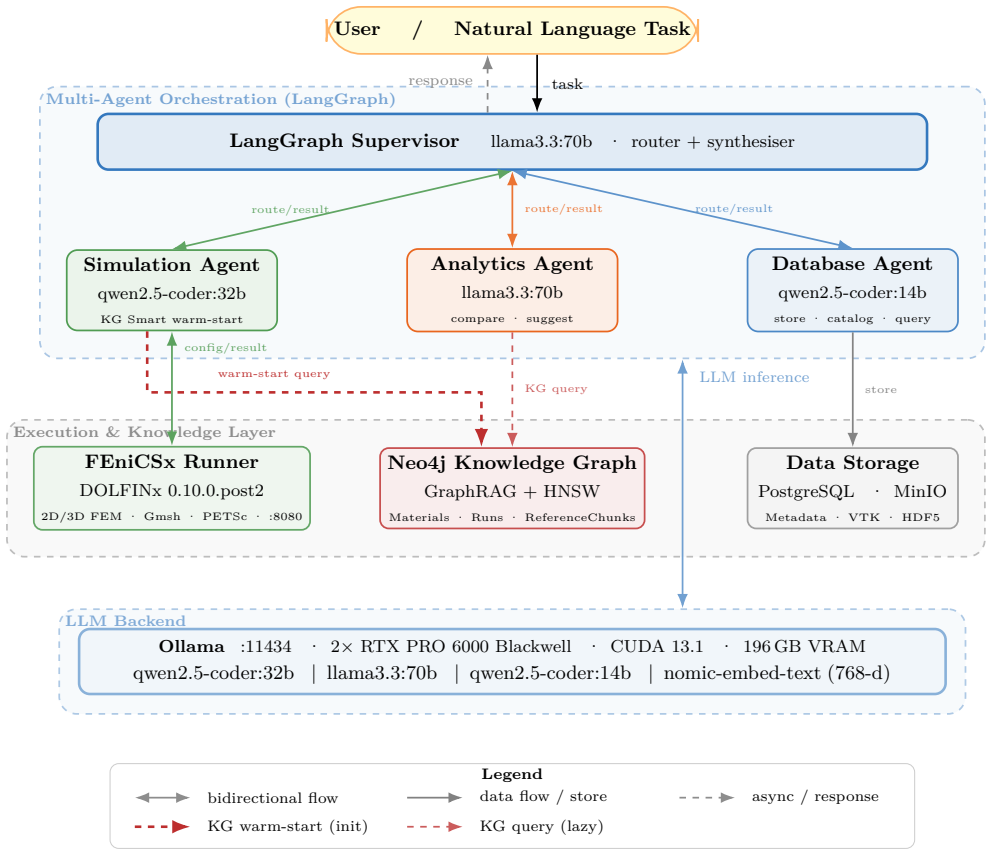
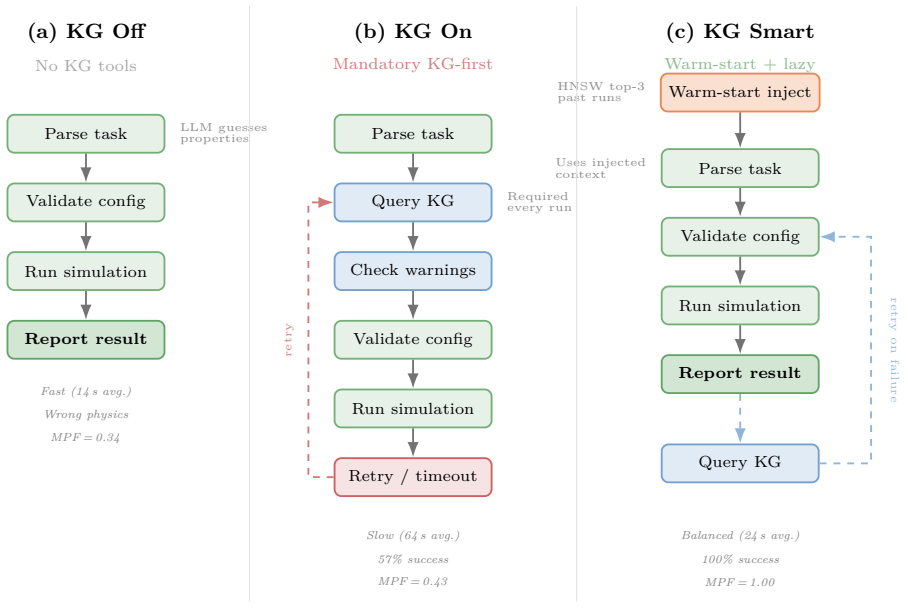
PDE-Agents orchestrates Simulation, Analytics, and Database LLM agents via a LangGraph supervisor, augmented by a Neo4j GraphRAG store of material properties, failure patterns, and run lineage. In a three-way ablation, the KG Smart mode attains 100% task success and the highest output quality scores, including material property fidelity of 0.926 versus 0.796 without the graph; on three fictional materials known only to the graph, KG Smart reaches fidelity of 1.00 while the KG-free baseline reaches only 0.34. Across 1,369 production runs the system records 97.8% overall success, with warm-start injection identified as the dominant reliability factor and integration pattern shown to govern whe
What carries the argument
The LangGraph supervisor that dynamically selects among KG On, KG Off, and KG Smart retrieval modes for each task while the three specialist agents execute the simulation lifecycle.
Load-bearing premise
The curated knowledge graph supplies accurate, complete, and non-conflicting material properties and failure patterns that the agents can apply without introducing setup errors.
What would settle it
A controlled run in which the knowledge graph is seeded with deliberately incorrect material values and the agents are observed to produce or avoid erroneous simulation setups.
If this is right
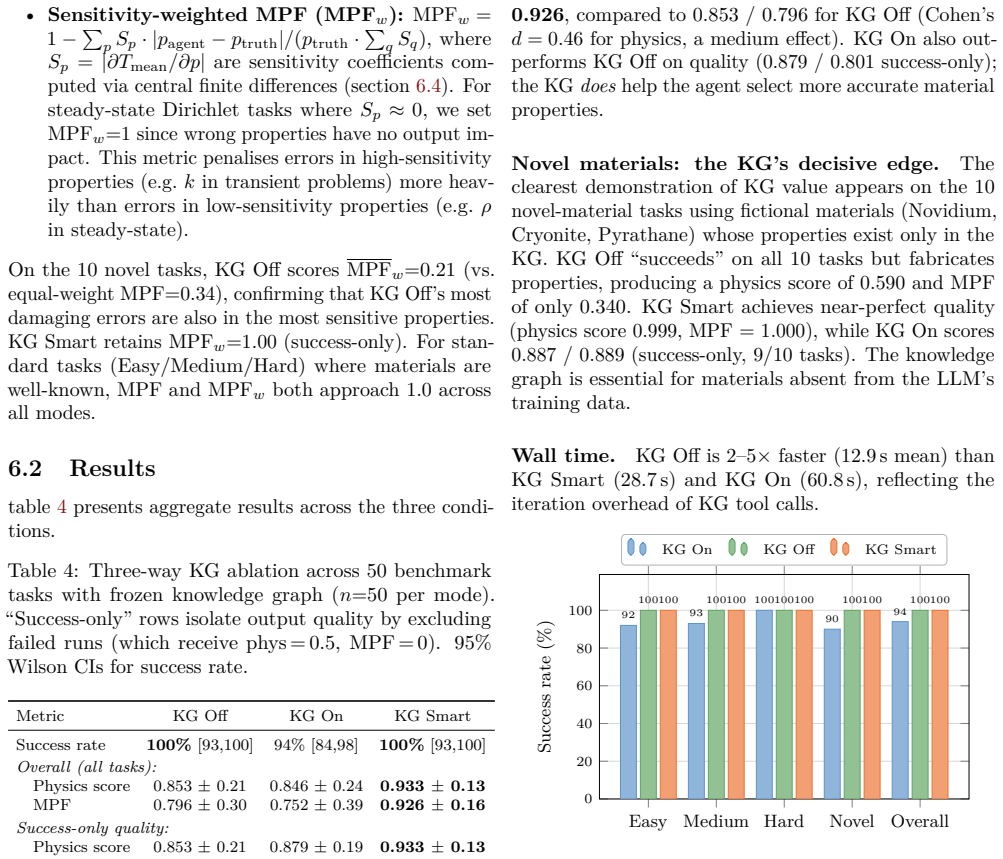
- KG Smart reaches 100% success and highest physics quality (0.933) across the fifty-task ablation.
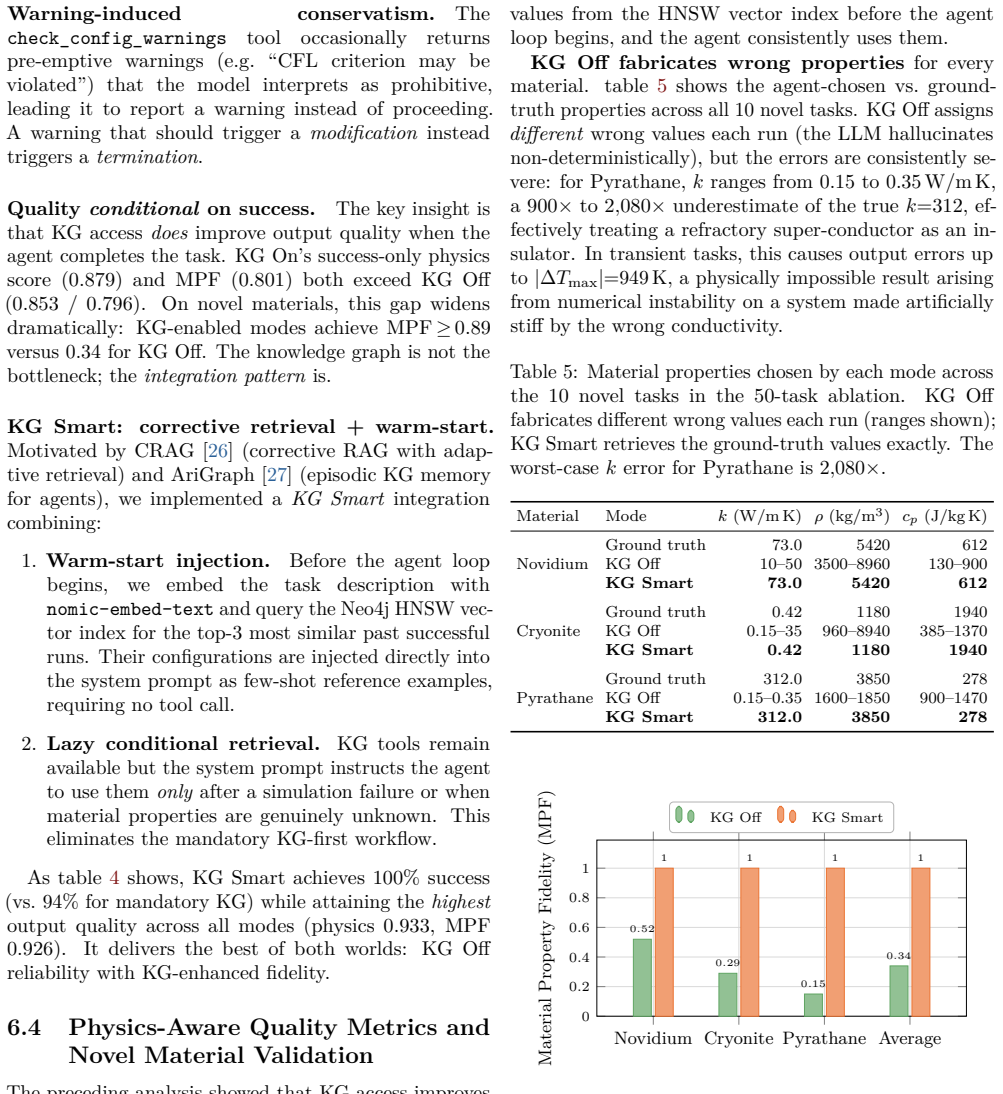
- On novel materials the adaptive mode attains material property fidelity of 1.00 versus 0.34 for the no-graph baseline.
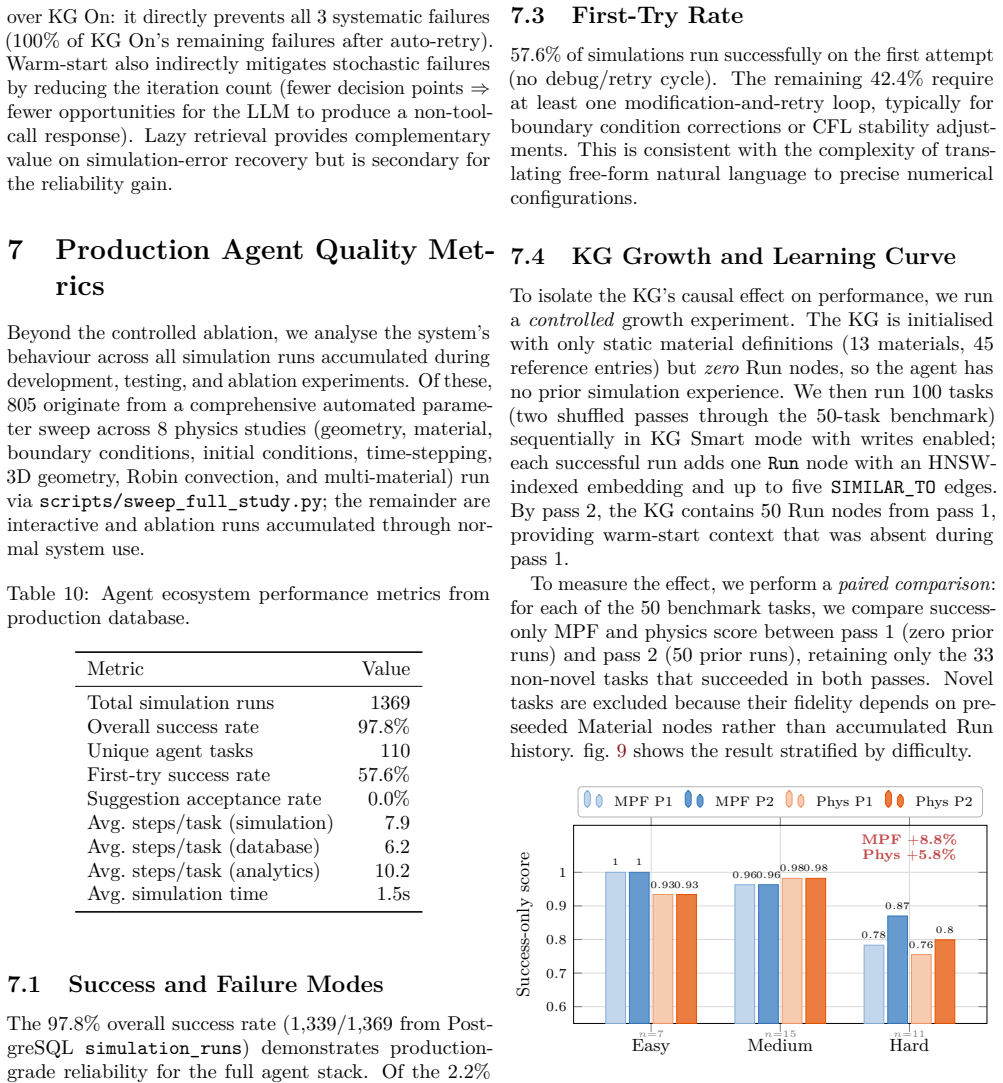
- KG growth produces an 8.8% MPF gain on hard tasks while easy and novel tasks remain at ceiling.
- Warm-start injection from prior runs is the main driver of the 97.8% overall success rate.
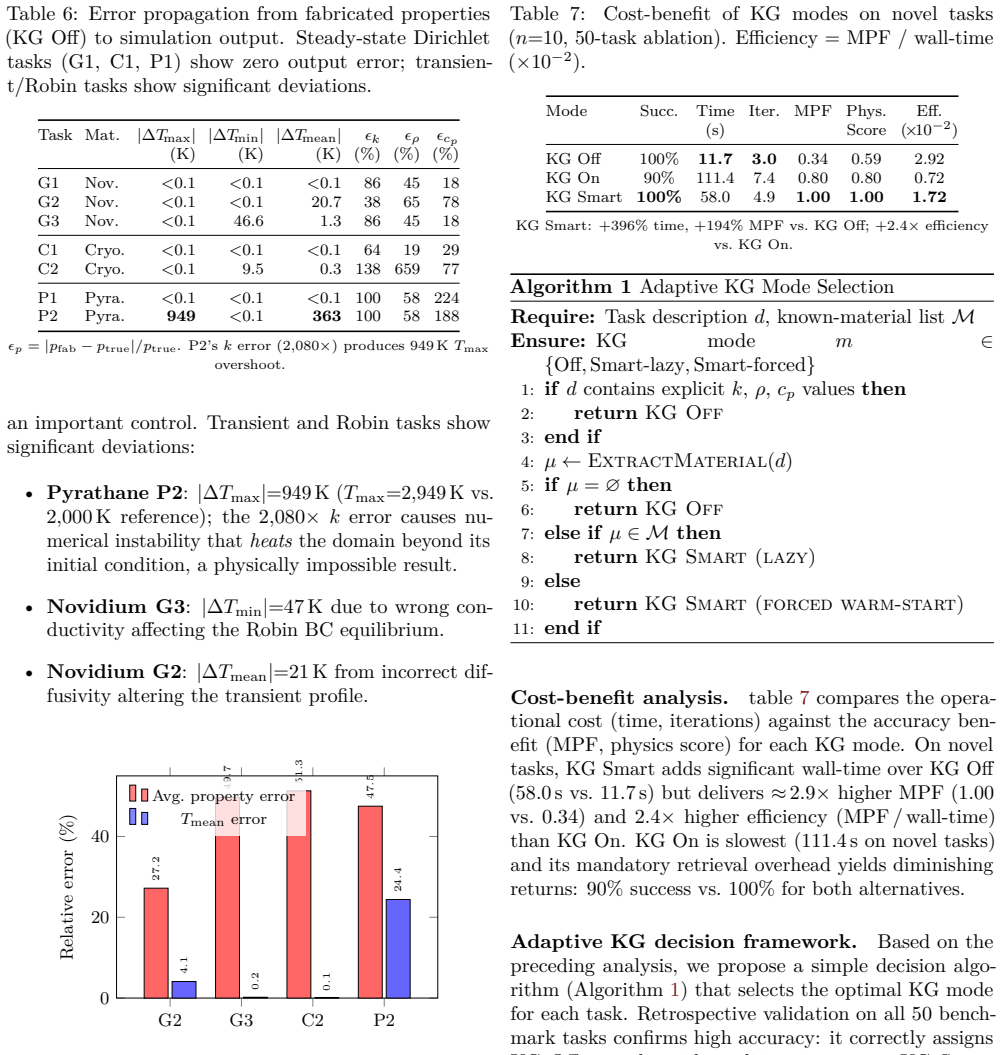
- An adaptive framework can choose the optimal retrieval mode per task without manual intervention.
Where Pith is reading between the lines
- The same adaptive-injection pattern could be tested on other PDE classes or multiphysics problems where material data is sparse.
- Real-time graph updates during a run might further reduce the three observed budget-exhaustion failures.
- The 57.6% first-try success rate suggests that production deployment would still require fallback mechanisms for the remaining cases.
- Difficulty-dependent gains imply that the framework's value grows with task complexity rather than remaining uniform.
Editorial analysis
A structured set of objections, weighed in public.
Referee Report
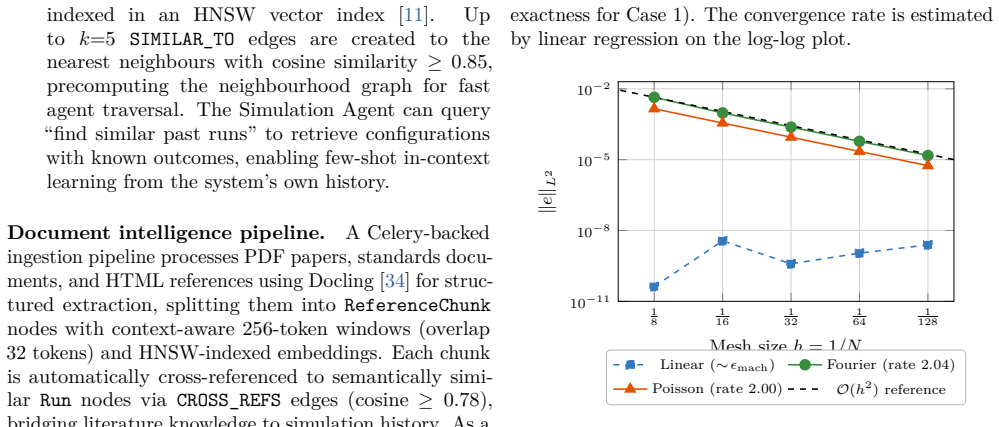
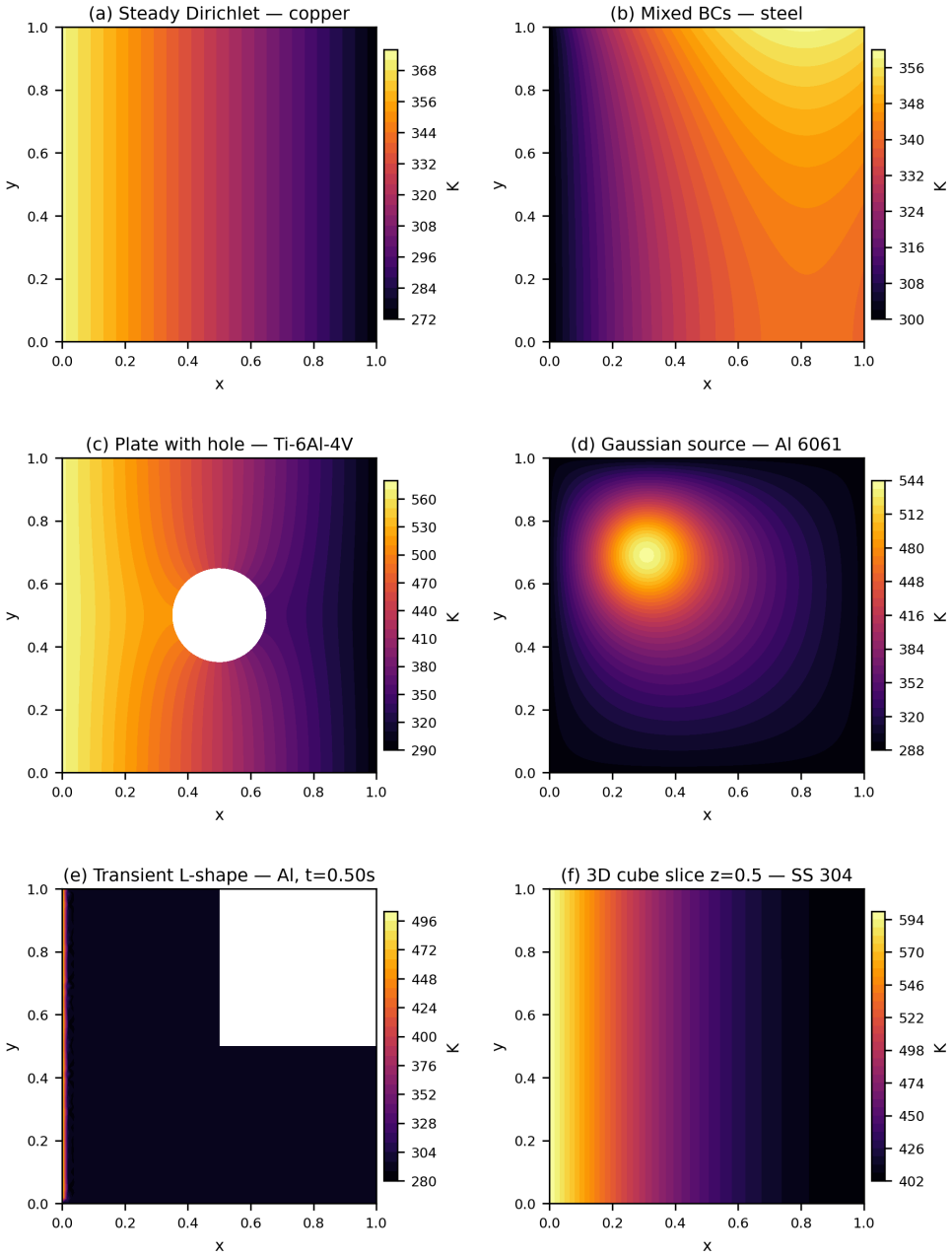
Summary. The manuscript introduces PDE-Agents, a multi-agent LLM framework orchestrated via LangGraph for end-to-end automation of PDE/FEM simulations. Specialist agents (Simulation, Analytics, Database) are augmented by a GraphRAG knowledge graph (Neo4j) encoding material properties and failure patterns. Reported contributions include a V&V study confirming O(h^2) spatial convergence on the heat equation, a 50-task three-way ablation (KG On/Off/Smart) with KG Smart reaching 100% success and superior scores (physics 0.933, MPF 0.926), a novel-material experiment yielding MPF=1.00 for KG Smart versus 0.34 for the baseline, failure analysis attributing the three KG-On failures to budget/timeout rather than retrieval errors, production metrics from 1,369 runs (97.8% success), and open release of all code, models, and artifacts. The central claim is that integration pattern, not knowledge content per se, governs whether GraphRAG helps or hinders performance.
Significance. If the empirical results hold, the work supplies reproducible evidence that curated knowledge-graph augmentation can raise reliability and material-property fidelity of LLM agents on complex engineering tasks, including extrapolation to fictional materials absent from base training data. The combination of controlled ablations, explicit failure tracing, V&V convergence checks, and full artifact release constitutes a concrete, testable advance for automated scientific computing and multi-agent systems.
minor comments (3)
- [Abstract] The abstract lists seven contributions in a single dense sentence; splitting the quantitative highlights (success rates, MPF values, run counts) into a short bulleted list would improve immediate readability.
- [Methods] The precise operational definitions of the physics quality score and MPF metric should be stated explicitly in the methods section (with formulas or pseudocode) rather than only in the results, to allow independent replication.
- [Results] Figure captions for the ablation and novel-material plots should include the exact task counts, LLM versions, and retrieval-mode selection rule used in each condition.
Simulated Author's Rebuttal
We thank the referee for the detailed and positive summary of our manuscript, the assessment of its significance, and the recommendation for minor revision. No specific major comments were provided in the report.
Circularity Check
No significant circularity
full rationale
The manuscript is an empirical engineering paper whose central claims rest on controlled ablations (KG On/Off/Smart), a V&V convergence study, success-rate statistics, and a novel-material test with external benchmarks (O(h^2) order, MPF scores, 97.8 % success). No derivation chain, fitted parameter renamed as prediction, or self-referential definition is present; all reported quantities are measured against independent oracles (exact solutions, curated KG ground truth, timeout logs). Open release of code and artifacts further removes any load-bearing dependence on internal definitions.
Axiom & Free-Parameter Ledger
axioms (2)
- domain assumption LLM agents can be reliably prompted and orchestrated to perform multi-step technical tasks such as simulation setup and result interpretation without systematic hallucination.
- domain assumption The Neo4j knowledge graph contains accurate material properties and failure patterns that improve agent outputs when retrieved appropriately.
Cite this review
Pith. "Pith review of PDE-Agents: An LLM-Orchestrated Multi-Agent Framework for Automated Finite Element Simulations with Knowledge Graph-Augmented Reasoning." pith.science (2026). https://pith.science/paper/QE6YUAM5
@misc{pith2026260607850,
  author       = {Pith},
  title        = {Pith review of: PDE-Agents: An LLM-Orchestrated Multi-Agent Framework for Automated Finite Element Simulations with Knowledge Graph-Augmented Reasoning},
  year         = {2026},
  howpublished = {\url{https://pith.science/paper/QE6YUAM5}},
  note         = {Machine review of arXiv:2606.07850}
}
read the original abstract
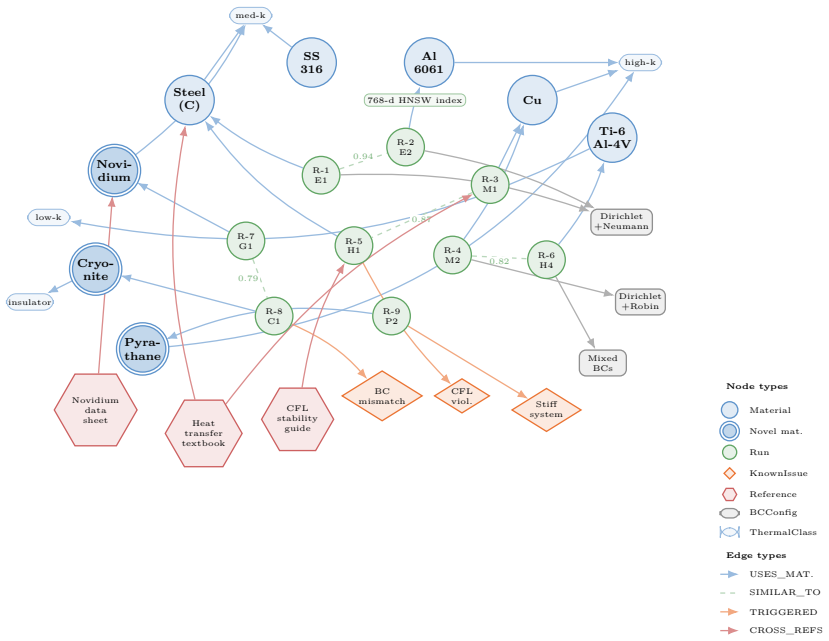
We present PDE-Agents, a multi-agent ecosystem that automates the full lifecycle of partial differential equation (PDE) and finite element method (FEM) simulations through natural-language interaction. Three large language model agents, Simulation, Analytics, and Database, are orchestrated by a LangGraph supervisor and run locally using Qwen3-Coder-Next and Llama 4 Scout on dual NVIDIA RTX PRO 6000 Blackwell GPUs. The model-agnostic architecture is validated across two generations of open-source LLMs. A GraphRAG knowledge base using Neo4j and 768-dimensional vector embeddings provides material properties, failure patterns, and prior run lineage. We report seven contributions: (i) verification and validation showing second-order spatial convergence, O(h^2), for three heat-equation benchmarks; (ii) a 50-task ablation with a frozen knowledge graph comparing KG On, KG Off, and KG Smart, where KG Smart achieves 100% success and the highest output quality, with physics score 0.933 versus 0.853 and material property fidelity (MPF) 0.926 versus 0.796 for KG Off; (iii) a novel-material study using three fictional materials known only to the knowledge graph, where KG Smart reaches MPF = 1.00 versus 0.34 without the graph; (iv) failure analysis tracing KG On's three failures to budget exhaustion and timeout, identifying warm-start injection as the main reliability factor; (v) an adaptive framework selecting retrieval mode per task; (vi) production metrics from 1,369 runs showing 97.8% overall success and 85.4% first-try success; and (vii) a 100-task knowledge-graph growth study showing an 8.8% MPF gain on hard tasks while easy and novel tasks remain at ceiling. All code, models, and evaluation artifacts are openly released. These results show that integration pattern, rather than knowledge content alone, determines whether GraphRAG helps or hinders LLM agents.
Figures
Forward citations
Cited by 1 Pith paper
-
Physics-Audited Agentic Discovery in Scientific Machine Learning
A verification-first agentic workflow for SciML surrogate discovery adds per-candidate, machine-checkable physics audits that expose a causality failure an error-only baseline misses.
This paper was first reviewed by grok-4.3 on June 27, 2026.
discussion (0)
Sign in with ORCID, Apple, or X to comment. Anyone can read and Pith papers without signing in.