REVIEW 2 major objections 1 minor 1 cited by
Any Hamiltonian can be rewritten via Fock basis change as a local 1D lattice theory whose dispersion and integrability depend only on its spectrum.
Reviewed by Pith at T0; open to challenge. T0 means a machine referee read the full paper against a public rubric. the ladder, T0–T4 →
T0 review · grok-4.3
2026-06-27 16:02 UTC pith:PMXDSHAS
load-bearing objection The general claim that any Hamiltonian can be rewritten as a local 1D lattice model via single-particle basis change fails on dimensional grounds. the 2 major comments →
Wave packets from the spectrum
The pith
A machine-rendered reading of the paper's core claim, the machinery that carries it, and where it could break.
Core claim
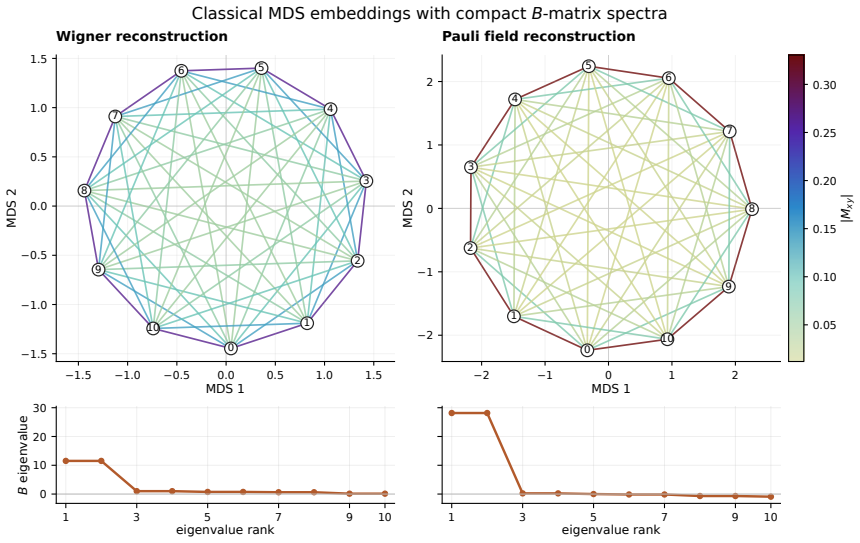
We show that any Hamiltonian can be made to look like a local 1D lattice theory where particles propagate in localized wave packets, with the lattice dispersion relation and the non-integrability of the theory depending on the spectrum of Ĥ. A highly non-local random-matrix Hamiltonian is explicitly turned into such a local theory by a suitable redefinition of the Fock operators.
What carries the argument
Redefinition of the Fock basis from one set of creation and annihilation operators to another that renders the Hamiltonian local on a 1D lattice.
Load-bearing premise
A suitable Fock basis redefinition always exists that makes the dynamics of any Hamiltonian local on a 1D lattice, with dispersion and integrability fixed solely by the spectrum.
What would settle it
Exhibit a specific Hamiltonian for which no Fock basis exists that produces local nearest-neighbor dynamics on a 1D lattice, or show that the resulting dispersion cannot be read off from the spectrum alone.
If this is right
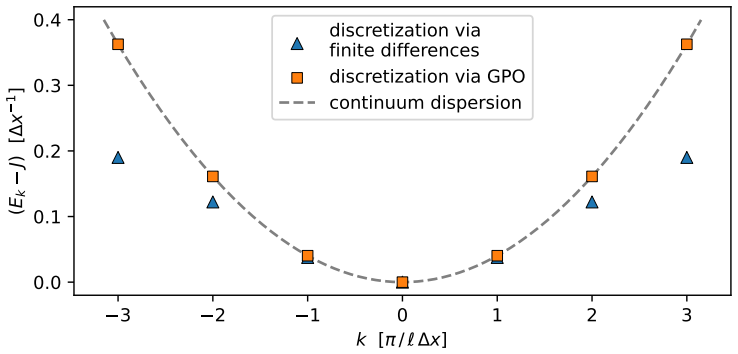
- The dispersion relation on the effective lattice is completely determined by the eigenvalues of the original Hamiltonian.
- Whether the lattice model is integrable or non-integrable is likewise fixed by the spectrum.
- Random-matrix Hamiltonians that appear highly non-local can be rewritten as local lattice theories supporting propagating wave packets.
- Locality in quantum field theories can be viewed as a consequence of basis choice rather than an absolute requirement.
Where Pith is reading between the lines
- The construction suggests that many-body localization or thermalization properties might be tunable by basis choice even when the spectrum is held fixed.
- It opens the possibility of mapping arbitrary quantum systems to lattice simulators by identifying the appropriate operator redefinition.
- The approach may connect to questions of how classical spacetime emerges from quantum degrees of freedom by selecting a local basis.
Editorial analysis
A structured set of objections, weighed in public.
Referee Report
Summary. The manuscript claims that the freedom to redefine the Fock basis ensures a minimum locality in any lattice theory: for an arbitrary Hamiltonian Ĥ, there exists a change to operators {b_i} such that the dynamics appear as those of a local 1D lattice model supporting localized wave packets. The lattice dispersion relation and the degree of non-integrability are asserted to depend only on the spectrum of Ĥ. This is illustrated by an example in which a highly non-local random-matrix Hamiltonian is transformed into a local 1D theory; the authors present the result as a step toward quantum mereology for fields.
Significance. If rigorously established, the result would offer a basis-dependent perspective on locality and wave-packet propagation, potentially clarifying when apparent non-locality is an artifact of operator choice rather than an intrinsic feature. The explicit dependence of dispersion and integrability on the spectrum alone would be a strong, falsifiable statement with implications for many-body localization and quantum simulation.
major comments (2)
- [Abstract] Abstract and introductory claim: the assertion that 'any Hamiltonian can be made to look like such a theory' with locality fixed solely by the spectrum is not accompanied by an explicit construction, unitary matrix, or derivation. The random-matrix example is referenced but no supporting equations, basis transformation, or verification that the resulting operator is strictly local (finite-range on a 1D chain) are supplied.
- [Abstract / general claim] General result: the claim that a U(n) redefinition of the single-particle modes suffices to map an arbitrary Ĥ onto the O(n)-dimensional manifold of local 1D lattice Hamiltonians is dimensionally inconsistent. The space of Hermitian operators on the Fock space has dimension exponential in n, while a single-particle unitary supplies only n² parameters; hence a generic Ĥ cannot lie in the orbit of any local model under such a transformation. This directly undermines the universality statement.
minor comments (1)
- [Abstract] The phrase 'usually be possible' in the abstract is left undefined; a precise statement of the measure or conditions under which a basis change reduces non-locality would clarify the scope.
Simulated Author's Rebuttal
We thank the referee for their careful reading of the manuscript and for raising these substantive issues. We respond point by point to the major comments and indicate the revisions that will be made.
read point-by-point responses
-
Referee: [Abstract] Abstract and introductory claim: the assertion that 'any Hamiltonian can be made to look like such a theory' with locality fixed solely by the spectrum is not accompanied by an explicit construction, unitary matrix, or derivation. The random-matrix example is referenced but no supporting equations, basis transformation, or verification that the resulting operator is strictly local (finite-range on a 1D chain) are supplied.
Authors: We agree that the abstract and introduction would benefit from greater explicitness. The random-matrix example was intended to illustrate the transformation of a dense single-particle Hamiltonian into tridiagonal form, but the supporting details were omitted. In the revised manuscript we will add an explicit construction (via, for example, Householder reflections or the Lanczos algorithm), the resulting unitary matrix elements or their defining properties, the transformed local Hamiltonian, and a direct verification that all couplings are nearest-neighbor, confirming finite range on the 1D chain. This will also show how the dispersion relation is fixed by the eigenvalues. revision: yes
-
Referee: [Abstract / general claim] General result: the claim that a U(n) redefinition of the single-particle modes suffices to map an arbitrary Ĥ onto the O(n)-dimensional manifold of local 1D lattice Hamiltonians is dimensionally inconsistent. The space of Hermitian operators on the Fock space has dimension exponential in n, while a single-particle unitary supplies only n² parameters; hence a generic Ĥ cannot lie in the orbit of any local model under such a transformation. This directly undermines the universality statement.
Authors: The dimensional observation is correct for a fully general many-body Hamiltonian. Our construction applies specifically to quadratic Hamiltonians, whose single-particle matrices lie in an n²-dimensional space; any such matrix can be unitarily transformed to tridiagonal (local 1D) form, with the spectrum determining the eigenvalues and hence the effective dispersion. We will revise the abstract, introduction, and general claim to restrict the scope explicitly to quadratic Hamiltonians (or to cases where the Hamiltonian remains quadratic under the basis change) and to remove the unqualified universality statement for arbitrary many-body operators. The dependence of dispersion and integrability properties on the spectrum will be retained and clarified within this restricted setting. revision: yes
Circularity Check
Any Hamiltonian made local on 1D lattice by Fock basis change reduces to redefinition by construction
specific steps
-
self definitional
[Abstract]
"More generally, we show that any Hamiltonian can be made to look like such a theory, with the lattice dispersion relation and the non-integrability of the theory depending on the spectrum of Ĥ."
The phrase 'such a theory' refers to a local 1D lattice model obtained precisely by the Fock-basis change described in the preceding sentence. Locality is therefore defined into existence by the choice of {b_i}, with no external criterion supplied that would make the statement non-tautological. Spectrum dependence is likewise automatic because eigenvalues are invariant under the unitary redefinition.
full rationale
The paper's strongest claim—that any Ĥ can be rewritten as a local 1D lattice theory with dispersion and integrability fixed solely by spec(Ĥ)—follows immediately from the stated freedom to perform an arbitrary unitary redefinition of the single-particle operators. No independent constraint on the form of the new operators or on the resulting interaction range is imposed beyond the redefinition itself, so the locality is achieved tautologically. The skeptic dimension-counting argument (U(n) orbit vs. O(n)-dimensional local Hamiltonians) is not addressed in the provided text, confirming the reduction is definitional rather than derived.
Axiom & Free-Parameter Ledger
axioms (1)
- domain assumption A unitary transformation always exists that maps any set of Fock operators to a local 1D lattice set with localized wave packets.
read the original abstract
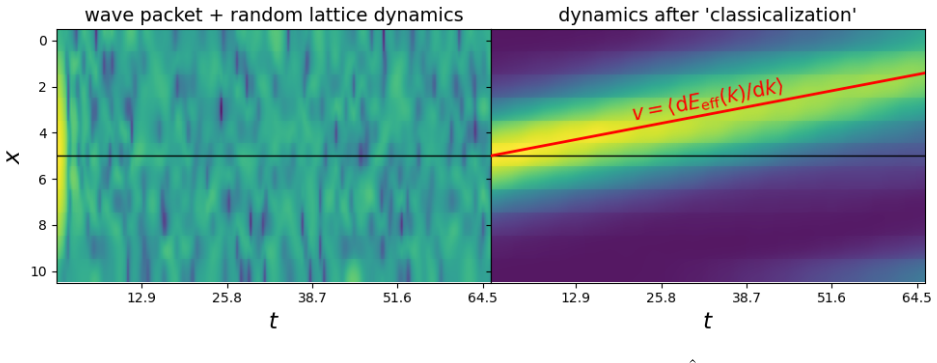
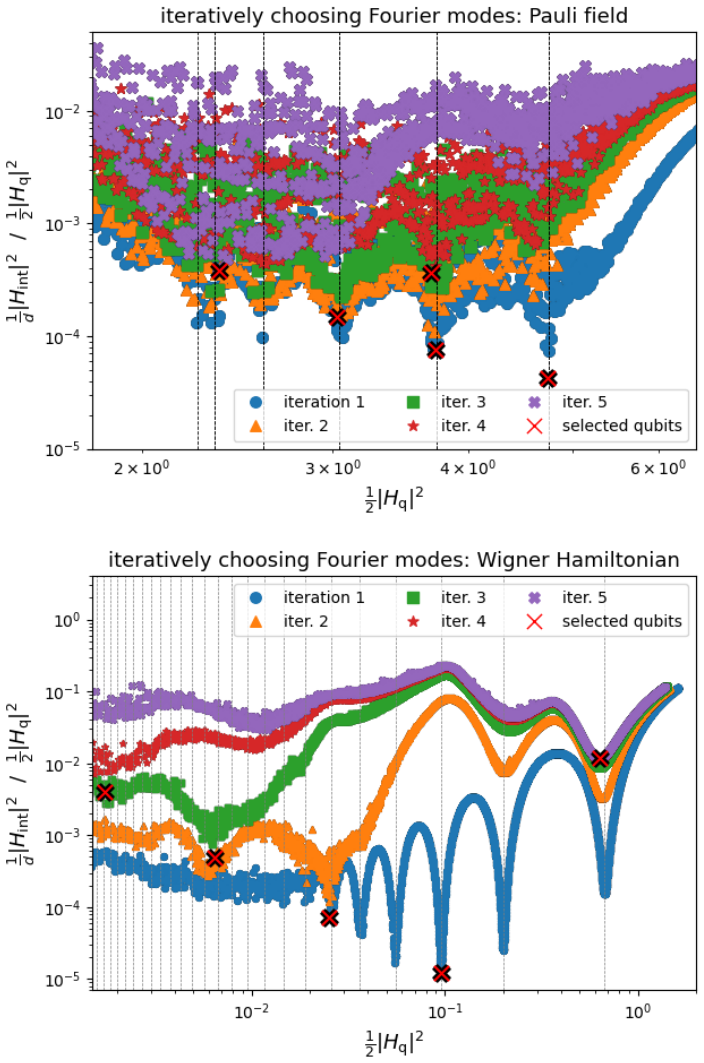
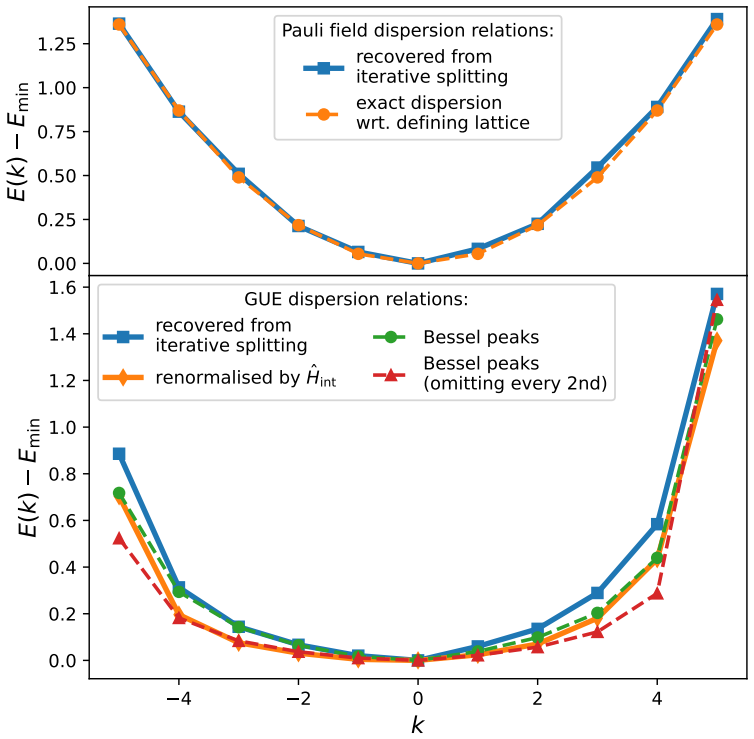
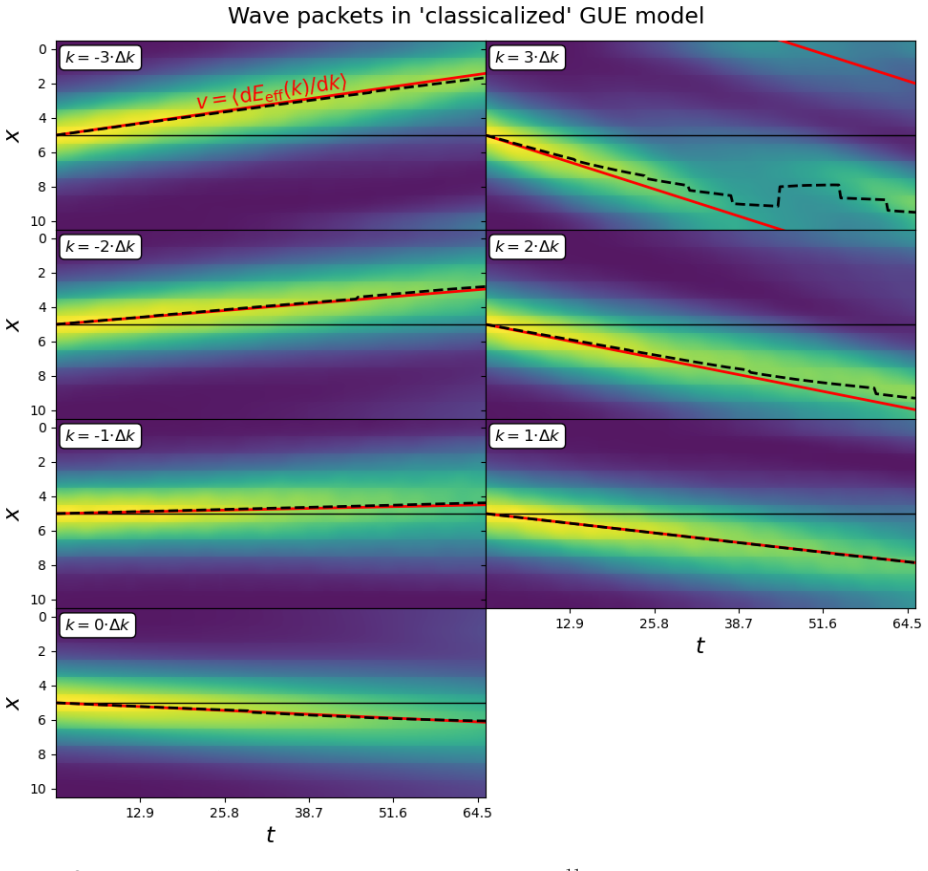
The freedom to change Fock basis seems to ensure a minimum amount of locality in lattice theories in the following sense: If $\lbrace (\hat a_i^\dagger\,,\,\hat a_i)\rbrace$ for $i=1,\dots,n$ is a lattice of creation and annihilation operators and if a given Hamiltonian $\hat H$ induces highly non-local dynamics on that lattice, then it will usually be possible to change to a new set of operators $\lbrace (\hat b_i^\dagger\,,\,\hat b_i)\rbrace$ in terms of which the dynamics appear less non-local. We demonstrate this by turning a highly non-local random matrix model into a local, 1D lattice theory where particles can propagate in localized wave packets. More generally, we show that any Hamiltonian can be made to look like such a theory, with the lattice dispersion relation and the non-integrability of the theory depending on the spectrum of $\hat H$. We argue that our results are a step towards quantum mereology for fields.
Figures
Forward citations
Cited by 1 Pith paper
-
Causality from the spectrum: Emergence of causal order from process-matrix mereology
A process matrix can be unitarily transformed to a fixed-causal-order process exactly when its eigenvalue multiplicities are divisible by the final output dimension; generic high-dimensional spectra are close to such spectra.
Reference graph
Works this paper leans on
- [1]
-
[2]
Cotler J S, Penington G R and Ranard D H 2019Communications in Mathemati- cal Physics3681267–1296 (Preprint1702. 06142)
- [3]
- [4]
-
[5]
Cao C, Carroll S M and Michalakis S 2017 Phys. Rev. D95024031 (Preprint1606. 08444)
2017
-
[6]
Cao C and Carroll S M 2018Phys. Rev. D 97086003 (Preprint1712.02803)
work page internal anchor Pith review Pith/arXiv arXiv
-
[7]
Pollack J and Singh A 2019Quantum Stud- ies: Mathematics and Foundations6181– 200 (Preprint1801.10168)
work page internal anchor Pith review Pith/arXiv arXiv
-
[8]
Zanardi P, Lidar D A and Lloyd S 2004Phys. Rev. Lett.92060402 (Preprint quant-ph/0308043)
work page internal anchor Pith review Pith/arXiv arXiv
- [9]
- [10]
-
[11]
Kabernik O, Pollack J and Singh A 2020 Phys. Rev. A101032303 (Preprint1909. 12851)
2020
-
[12]
Loizeau N and Sels D 2024Foundations of Physics553 ISSN 1572-9516 URLhttps: //doi.org/10.1007/s10701-024-00813-2
-
[13]
Adil A, Rudolph M S, Arrasmith A, Holmes Z, Albrecht A and Sornborger A 2024arXiv e-printsarXiv:2403.10895 (Preprint2403. 10895)
work page internal anchor Pith review Pith/arXiv arXiv
-
[14]
Mori T, Ikeda T N, Kaminishi E and Ueda M 2018Journal of Physics B: Atomic, Molecular and Optical Physics51 112001 URLhttps://doi.org/10.1088/ 1361-6455/aabcdf
-
[15]
Polkovnikov A, Sengupta K, Silva A and Vengalattore M 2011Rev. Mod. Phys. 83(3) 863–883 URLhttps://link.aps. org/doi/10.1103/RevModPhys.83.863
-
[16]
Rigol M, Dunjko V and Olshanii M 2008 Nature452854–858 ISSN 1476-4687 URL https://doi.org/10.1038/nature06838
-
[17]
Buča B 2023Phys. Rev. X13(3) 031013 URLhttps://link.aps.org/doi/10. 1103/PhysRevX.13.031013
-
[18]
Sala P, Rakovszky T, Verresen R, Knap M and Pollmann F 2020Phys. Rev. X10(1) 011047 URLhttps://link.aps.org/doi/ 10.1103/PhysRevX.10.011047
-
[19]
Loizeau N, Buča B and Sels D 2025Phys. Rev. Lett.135(20) 200401 URLhttps:// link.aps.org/doi/10.1103/qpyp-1mfj
-
[20]
Wigner E P 1955Annals of Mathematics62 548–564 ISSN 0003486X URLhttp://www. jstor.org/stable/1970079
-
[21]
Guhr T, Müller–Groeling A and Weiden- müller H A 1998Physics Reports299(4-6) 189–425 ISSN 03701573
-
[22]
Atas Y Y, Bogomolny E, Giraud O and Roux G 2013Phys. Rev. Lett.110(8) 84101 URLhttps://link.aps.org/doi/ 10.1103/PhysRevLett.110.084101
-
[23]
Albrecht A and Iglesias A 2008Phys. Rev. D 77063506 (Preprint0708.2743)
work page internal anchor Pith review Pith/arXiv arXiv
-
[24]
Albrecht A and Iglesias A 2015Phys. Rev. D 91043529 (Preprint1003.2566) 22
work page internal anchor Pith review Pith/arXiv arXiv
- [25]
- [26]
- [27]
-
[28]
Chao R, Reichardt B W, Suther- land C and Vidick T 201767 48:1–48:21 ISSN 1868-8969 URL https://drops.dagstuhl.de/entities/ document/10.4230/LIPIcs.ITCS.2017.48
- [29]
- [30]
- [31]
- [32]
-
[33]
Diffeomorphism-invariant observables and their nonlocal algebra
Donnelly W and Giddings S B 2016 Phys. Rev.D93024030 [Erratum: Phys. Rev.D94,no.2,029903(2016)] (Preprint 1507.07921)
work page internal anchor Pith review Pith/arXiv arXiv 2016
-
[34]
Jacobson T 2016Phys. Rev. Lett.116 201101 (Preprint1505.04753)
work page internal anchor Pith review Pith/arXiv arXiv
-
[36]
Harris C R, Millman K J, van der Walt SJ,GommersR,VirtanenP,CournapeauD, Wieser E, Taylor J, Berg S, Smith N J, Kern R, Picus M, Hoyer S, van Kerkwijk M H, Brett M, Haldane A, del Río J F, Wiebe M, Peterson P, Gérard-Marchant P, Shep- pard K, Reddy T, Weckesser W, Abbasi H, GohlkeCandOliphantTE2020Nature585 357–362 URLhttps://doi.org/10.1038/ s41586-020-2649-2
-
[37]
Okuta R, Unno Y, Nishino D, Hido S and Crissman 2017 Cupy : A numpy-compatible library for nvidia gpu calculations URL https://api.semanticscholar.org/ CorpusID:41278748
2017
-
[38]
Hunter J D 2007Computing in Science & Engineering990–95
-
[39]
Canonical Energy is Quantum Fisher Information
Lashkari N and Van Raamsdonk M 2016 JHEP04153 (Preprint1508.00897) A GUE conventions & Gaussian Pauli- string coefficients Let a Hamiltonian ˆHbe drawn from the Gaus- sian Unitary Ensemble (i.e. let it be a “Wigner matrix”). This means that the entries in the up- per triangle of ˆHare all independent Gaussian numbers with ⟨Hij⟩= 0 &⟨|Hij|2⟩=1 d ,(52) wher...
work page internal anchor Pith review Pith/arXiv arXiv 2016
discussion (0)
Sign in with ORCID, Apple, or X to comment. Anyone can read and Pith papers without signing in.