Bouncing Geodesics, Singularities, and the Cavity Thermal Product Formula in Asymptotically Flat and de Sitter Black Holes
Reviewed by Pith T0 review T1 audit T2 compute T3 formal T4 kernel 2026-06-27 12:09 UTCgrok-4.3pith:33LLTJPVrecord.jsonopen to challenge →
The pith
Black holes inside reflecting cavities obey a thermal product formula relating bouncing singularities to the quasinormal mode spectrum.
A machine-rendered reading of the paper's core claim, the machinery that carries it, and where it could break.
Core claim
For black holes enclosed in a reflecting cavity, the locations of the bouncing singularities are connected to the spectrum of cavity quasinormal modes by a cavity version of the thermal product formula. This holds for asymptotically flat and de Sitter cases and allows extraction of information about the black hole interior from the asymptotic QNM spectrum measured at a reflecting hypersurface.
What carries the argument
The cavity thermal product formula, derived by combining the local Hadamard form with the global propagation of singularities theorem to locate bouncing singularities and then relating their critical times to the cavity QNM spectrum.
If this is right
- The quasinormal mode spectrum measured at the cavity directly determines the times at which the retarded correlator becomes singular due to bouncing geodesics.
- Interior information, including near the black hole singularity, becomes accessible from boundary data even when the cosmological constant is zero or positive.
- The same cavity thermal product formula applies to scalar, electromagnetic, and gravitational perturbations.
- Explicit QNM computations in flat and de Sitter cases serve as verification of the derived relation.
Where Pith is reading between the lines
- The cavity construction may extend the thermal product formula to other asymptotically flat geometries that admit a reflecting boundary.
- It provides a concrete route to test whether singularity information can be recovered from boundary spectra without relying on anti-de Sitter asymptotics.
- Numerical evolution of waves inside a cavity could directly measure the predicted singularity times and compare them to the QNM-derived formula.
Load-bearing premise
The local Hadamard form together with the global propagation of singularities theorem still accurately locates the bouncing singularities after the spacetime is truncated by a reflecting cavity boundary.
What would settle it
Explicitly compute the cavity QNM frequencies for scalar or gravitational perturbations on a Schwarzschild black hole inside a reflecting cavity at a chosen radius and check whether the resulting product formula reproduces the critical times of the bouncing singularities obtained from null geodesic analysis.
Figures
read the original abstract
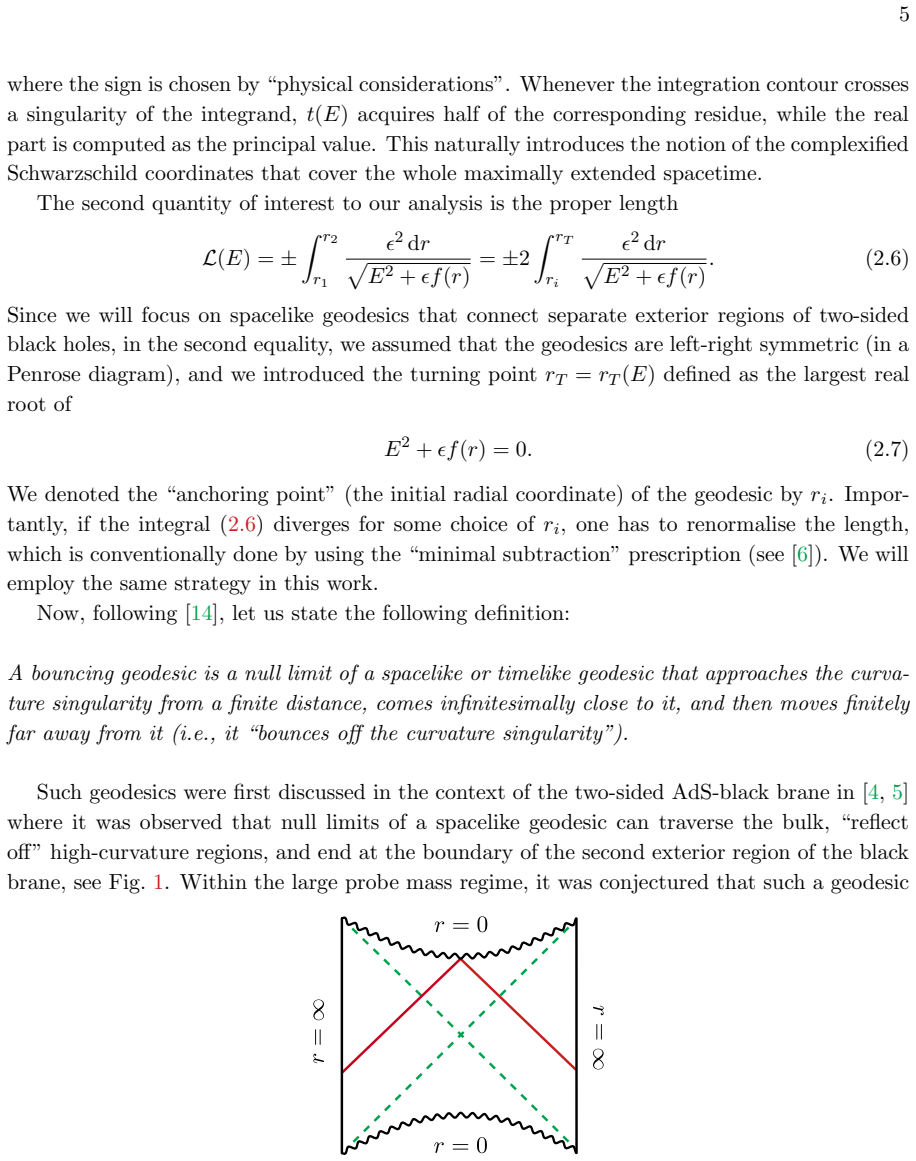
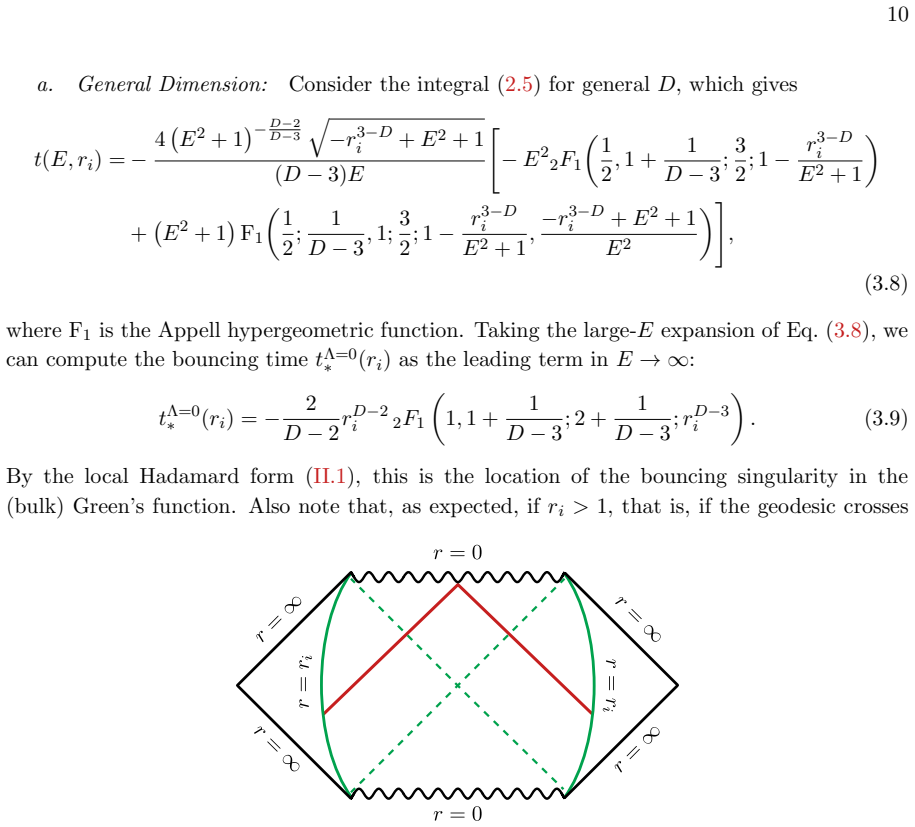
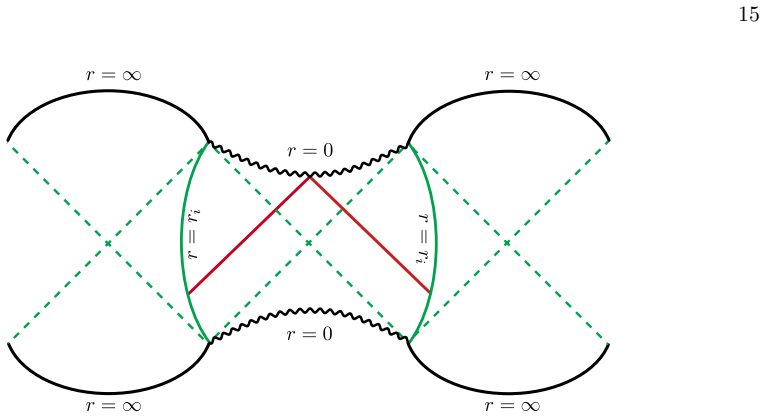
We investigate the existence and implications of ``bouncing geodesics'' in asymptotically flat Schwarzschild and Schwarzschild--de Sitter black holes. These trajectories, which probe the high-curvature regions near the black hole singularity, correspond to specific ``bouncing singularities'' in the bulk retarded Green's function. We provide a precise description of these singularities by combining the local Hadamard form with the global propagation of singularities theorem. We then derive the critical times at which the bulk retarded correlator becomes singular, considering all possible anchorings of the bouncing geodesics, including null infinity and the cosmological horizon. Finally, for black holes enclosed in a reflecting cavity, we establish a universal connection between the locations of the bouncing singularities and the spectrum of cavity quasinormal modes (QNMs) by deriving a cavity version of the thermal product formula, analogous to the one known for anti-de Sitter black holes. This relation allows one to extract information about the black hole interior from the asymptotic QNM spectrum measured at a reflecting hypersurface, even when the cosmological constant is zero or positive. We confirm this prediction through explicit examples by computing the cavity QNMs of scalar and electromagnetic fields, as well as gravitational waves, in spacetimes with asymptotically flat and de Sitter black holes.
Editorial analysis
A structured set of objections, weighed in public.
Referee Report
Summary. The paper investigates bouncing geodesics in asymptotically flat Schwarzschild and Schwarzschild-de Sitter black holes. These correspond to singularities in the bulk retarded Green's function, located via the local Hadamard form combined with the global propagation of singularities theorem. Critical times are derived for various anchorings (including null infinity and cosmological horizon). For black holes inside a reflecting cavity, a cavity version of the thermal product formula is derived, relating bouncing singularity locations to the cavity QNM spectrum; this is verified by explicit computations of cavity QNMs for scalar, electromagnetic, and gravitational perturbations.
Significance. If the derivation is valid, the result extends the thermal product formula (previously known in AdS) to asymptotically flat and de Sitter cases with reflecting cavities. This would allow extraction of black hole interior information from boundary QNM spectra without AdS asymptotics, providing a concrete link between geodesic singularities and observable QNM poles.
major comments (1)
- [Derivation of cavity formula] The central derivation of the cavity thermal product formula relies on applying the propagation of singularities theorem to locate bouncing singularities after imposing reflecting boundary conditions at finite radius. The cavity truncates the manifold and introduces new reflected null geodesics, altering the global causal structure; the manuscript must explicitly show that the theorem continues to isolate the original bouncing singularities without modification or additional poles induced by the boundary (see the paragraph on derivation of critical times and cavity formula).
Simulated Author's Rebuttal
We thank the referee for their careful reading of the manuscript and for highlighting the need for explicit justification in the cavity setting. We address the single major comment below and have revised the manuscript to strengthen the presentation of the derivation.
read point-by-point responses
-
Referee: The central derivation of the cavity thermal product formula relies on applying the propagation of singularities theorem to locate bouncing singularities after imposing reflecting boundary conditions at finite radius. The cavity truncates the manifold and introduces new reflected null geodesics, altering the global causal structure; the manuscript must explicitly show that the theorem continues to isolate the original bouncing singularities without modification or additional poles induced by the boundary (see the paragraph on derivation of critical times and cavity formula).
Authors: We agree that the interaction between the propagation of singularities theorem and the reflecting cavity boundary requires explicit clarification to avoid any ambiguity regarding the global causal structure. The theorem is applied to the bulk spacetime using the local Hadamard form to identify the singular support along null geodesics; the reflecting boundary conditions at finite radius are imposed subsequently and generate additional reflected geodesics that contribute to the cavity QNM spectrum. However, the specific bouncing singularities associated with geodesics that probe the black hole interior remain isolated by the theorem, as their locations are determined solely by the interior geodesic segments and are unaffected by the outer boundary. In the revised manuscript we have expanded the relevant paragraph (now a dedicated subsection) to demonstrate this explicitly: we show that the critical times for the original bouncing singularities are unchanged, that the boundary-induced geodesics produce distinct contributions to the QNM poles, and that no additional poles appear at the interior bouncing times. This separation follows from the fact that the wave operator characteristics propagate independently of the boundary until reflection occurs. We believe this addition resolves the concern while preserving the validity of the cavity thermal product formula. revision: yes
Circularity Check
No significant circularity: derivation from Hadamard form + propagation theorem plus independent QNM computations
full rationale
The paper's central derivation identifies bouncing singularities via the local Hadamard form combined with the global propagation of singularities theorem, then derives critical times and a cavity thermal product formula relating those locations to cavity QNM poles. This is followed by explicit, independent computations of cavity QNMs for scalar, electromagnetic, and gravitational perturbations in asymptotically flat and de Sitter spacetimes to confirm the relation. No quoted step reduces a prediction to a fitted parameter, self-definition, or self-citation chain; the verification step is external to the analytic derivation and uses direct solution of the wave equation on the truncated manifold.
Axiom & Free-Parameter Ledger
axioms (2)
- standard math Local Hadamard form combined with global propagation of singularities theorem accurately locates bouncing singularities in the bulk retarded Green's function
- domain assumption Reflecting cavity boundary allows a universal thermal product formula analogous to the AdS case
Forward citations
Cited by 1 Pith paper
-
Thermal two-point functions in SYK and complex-time singularities
The large-N SYK thermal two-point function exhibits complex-time singularities—an effective-temperature pole and a subleading bouncing-geodesic-like singularity—that persist from infinite to zero temperature.
Reference graph
Works this paper leans on
-
[1]
Boundary
The “Boundary” Correlator The bulk two-sided correlator (5.25) itself contains the relevant spectral information for linear response in a reflecting cavity. Indeed, for a fixed homogeneous wall condition, its poles are the zeros ofF(ω) (or, more generally, ofF κ(ω)). These zeros are precisely the cavity QNM frequencies. The numerator factorsg(ω, z)g(ω, z ...
-
[2]
Boundary
Cavity Thermal Product Formula for the “Boundary” Correlator We now show that imposing reflecting boundary conditions at a timelike surface, and thereby enclosing the black hole in a reflecting cavity, allows us to generalise the AdS/CFT thermal product formula of [22]. As discussed above, to avoid potential issues with additional zeros, we derive the sta...
-
[3]
After separating the angular dependence in spherical harmonics and rescaling the field (see Eq
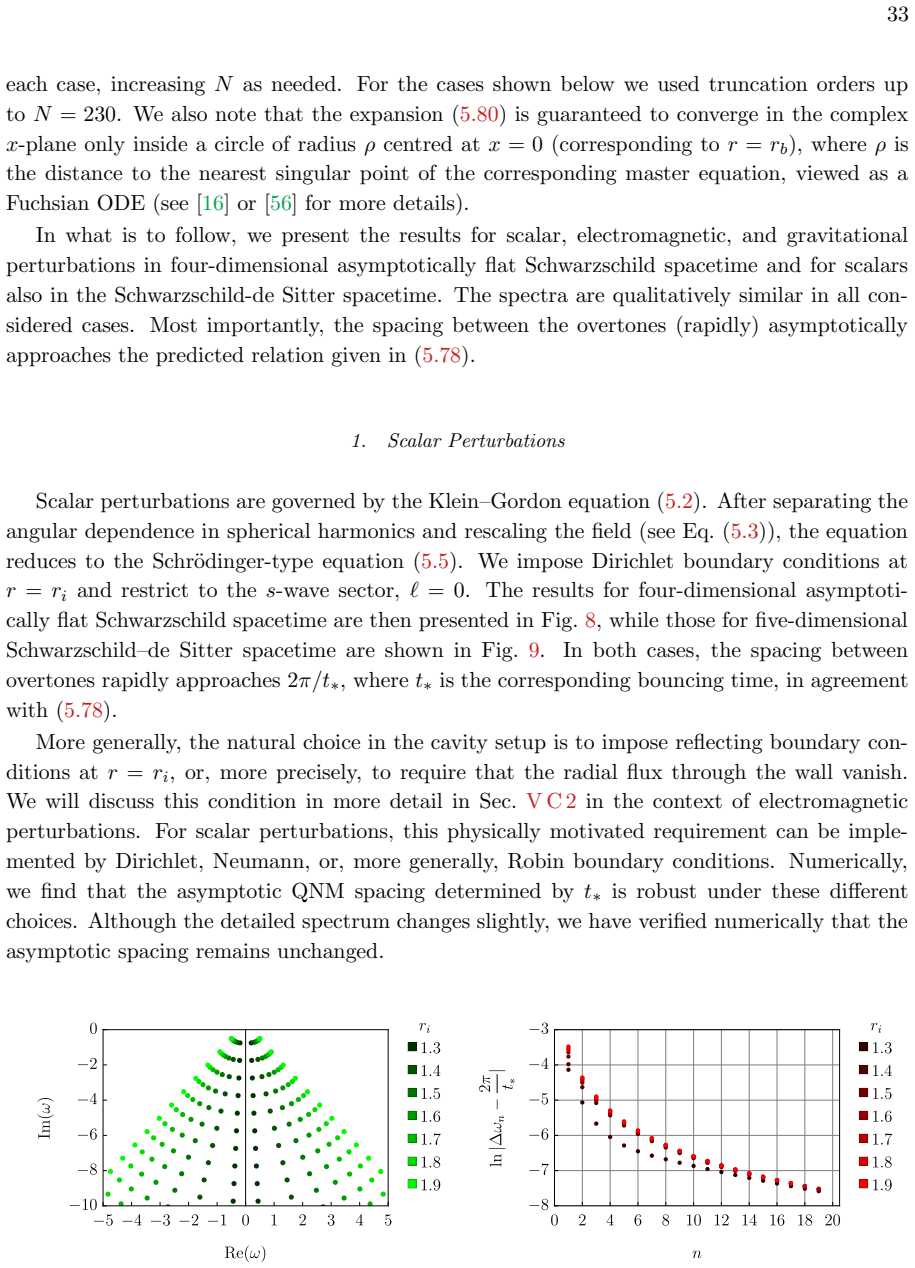
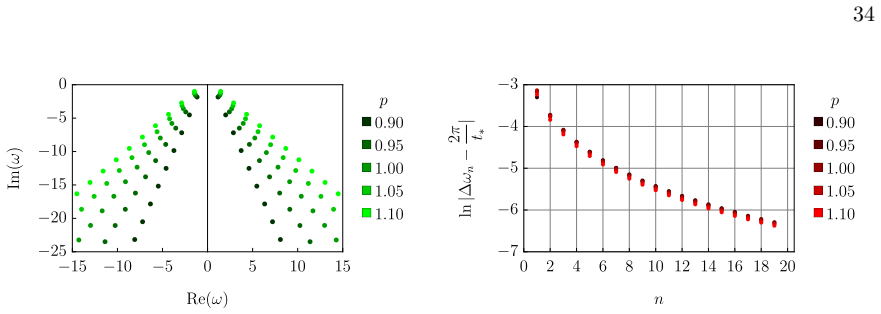
Scalar Perturbations Scalar perturbations are governed by the Klein–Gordon equation (5.2). After separating the angular dependence in spherical harmonics and rescaling the field (see Eq. (5.3)), the equation reduces to the Schr¨ odinger-type equation (5.5). We impose Dirichlet boundary conditions at r=r i and restrict to thes-wave sector,ℓ= 0. The results...
-
[4]
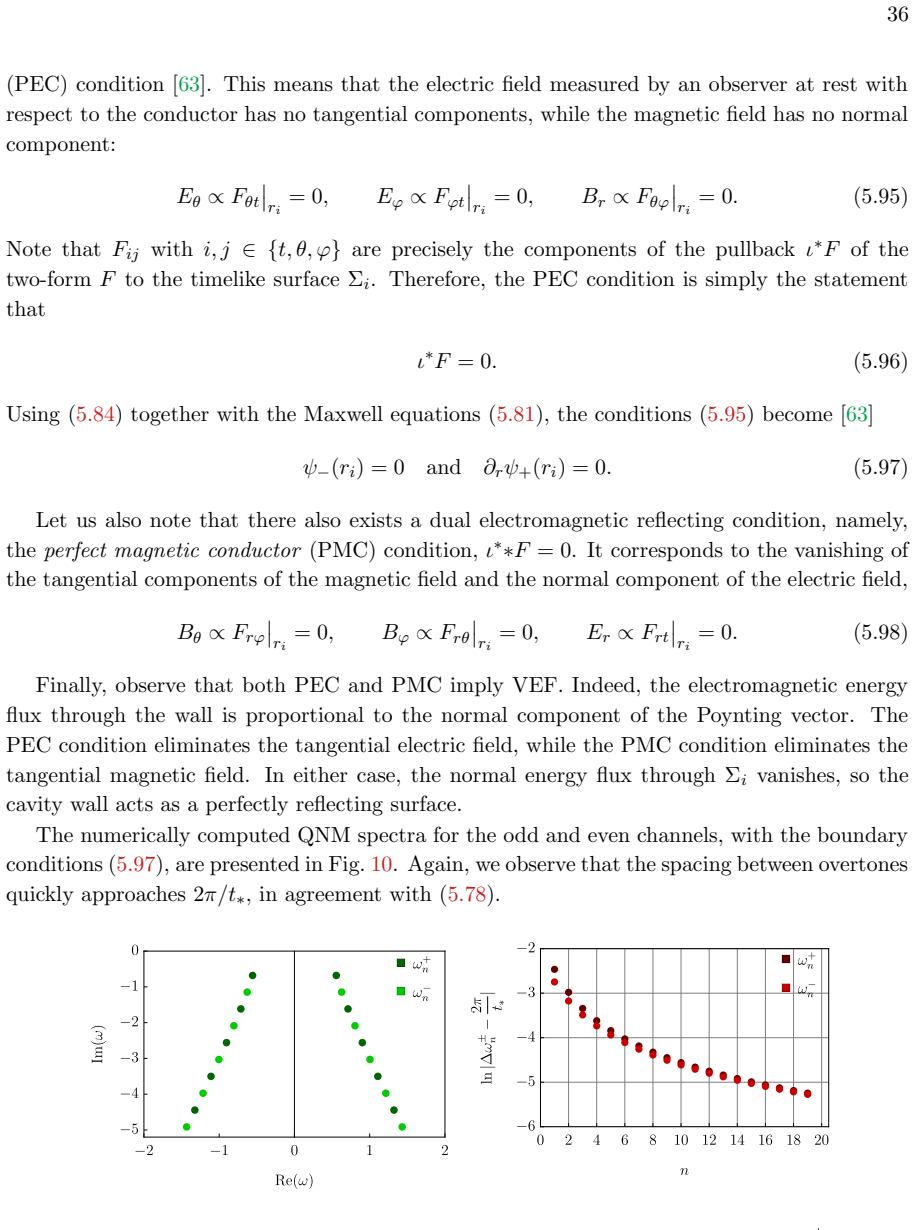
Electromagnetic Perturbations Next, we consider electromagnetic perturbations of an uncharged four-dimensional asymp- totically flat Schwarzschild black hole, which are governed by the Maxwell equations, ∇νF µν = 0,(5.81) withF µν =∂ µAν −∂ νAµ. Using the fact that the background is spherically symmetric, we can work in the Regge-Wheeler-Zerilli formalism...
-
[5]
bouncing times
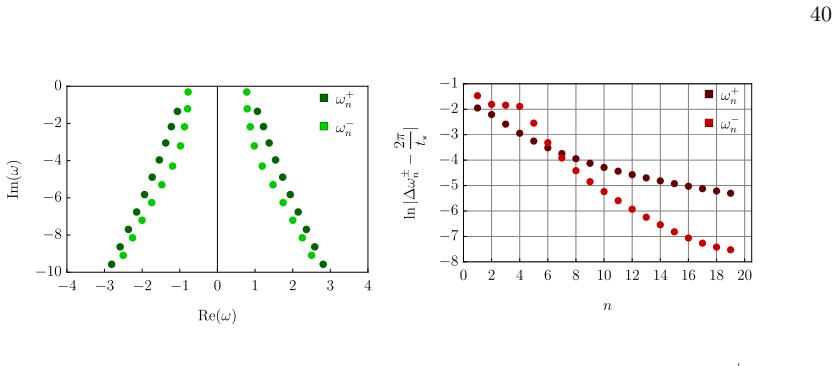
Gravitational Perturbations We continue with gravitational perturbations, again considering the case of a four-dimensional asymptotically flat Schwarzschild black hole in a cavity. We now write its metric as ds2 =g abdxadxb +r 2γABdxAdxB,(5.99) so that the coordinatesx a span the (t, r)-plane of Schwarzschild spacetime, with lower-case Latin indicesa, b∈ ...
-
[6]
J. M. Maldacena, Adv. Theor. Math. Phys.2, 231 (1998), arXiv:hep-th/9711200
work page internal anchor Pith review Pith/arXiv arXiv 1998
- [7]
-
[8]
Anti De Sitter Space And Holography
E. Witten, Adv. Theor. Math. Phys.2, 253 (1998), arXiv:hep-th/9802150
work page internal anchor Pith review Pith/arXiv arXiv 1998
-
[9]
The Black Hole Singularity in AdS/CFT
L. Fidkowski, V. Hubeny, M. Kleban, and S. Shenker, JHEP02, 014 (2004), arXiv:hep-th/0306170
work page internal anchor Pith review Pith/arXiv arXiv 2004
-
[10]
Excursions beyond the horizon: Black hole singularities in Yang-Mills theories (I)
G. Festuccia and H. Liu, JHEP04, 044 (2006), arXiv:hep-th/0506202
work page internal anchor Pith review Pith/arXiv arXiv 2006
-
[11]
Black Hole Singularity from OPE
N. ˇCeplak, H. Liu, A. Parnachev, and S. Valach, JHEP10, 105 (2024), arXiv:2404.17286 [hep-th]
work page Pith review arXiv 2024
-
[12]
Imprint of the black hole singularity on thermal two-point functions
N. Afkhami-Jeddi, S. Caron-Huot, J. Chakravarty, and A. Maloney, (2025), arXiv:2510.21673 [hep-th]
work page internal anchor Pith review Pith/arXiv arXiv 2025
-
[13]
N. ˇCeplak, H. Liu, A. Parnachev, and S. Valach, JHEP05, 001 (2026), arXiv:2511.09638 [hep-th]
-
[14]
M. Dodelson, C. Iossa, and R. Karlsson, (2025), arXiv:2511.09616 [hep-th]
- [15]
-
[16]
S. Ali Ahmad, A. Almheiri, and S. Lin, (2026), arXiv:2601.02354 [hep-th]
- [17]
-
[18]
Bouncing singularities and thermal correlators on line defects
S. Giombi, Y.-Z. Li, and J. Shan, (2026), arXiv:2603.11012 [hep-th]
work page internal anchor Pith review Pith/arXiv arXiv 2026
-
[19]
S. Grozdanov, S. Valach, and M. Vrbica, (2026), arXiv:2603.15598 [hep-th]
-
[20]
H. F. Jia and M. Rangamani, (2026), arXiv:2604.10803 [hep-th]
work page internal anchor Pith review Pith/arXiv arXiv 2026
-
[21]
P. K. Kovtun and A. O. Starinets, Phys. Rev. D72, 086009 (2005), arXiv:hep-th/0506184
work page internal anchor Pith review Pith/arXiv arXiv 2005
-
[22]
S. A. Hartnoll and S. P. Kumar, JHEP12, 036 (2005), arXiv:hep-th/0508092
work page internal anchor Pith review Pith/arXiv arXiv 2005
-
[23]
From strong to weak coupling in holographic models of thermalization
S. Grozdanov, N. Kaplis, and A. O. Starinets, JHEP07, 151 (2016), arXiv:1605.02173 [hep-th]
work page internal anchor Pith review Pith/arXiv arXiv 2016
-
[24]
J. Casalderrey-Solana, S. Grozdanov, and A. O. Starinets, Phys. Rev. Lett.121, 191603 (2018), arXiv:1806.10997 [hep-th]. 52
work page internal anchor Pith review Pith/arXiv arXiv 2018
-
[25]
Adding new branches to the "Christmas tree" of the quasinormal spectrum of black branes
S. Grozdanov and A. O. Starinets, JHEP04, 080 (2019), arXiv:1812.09288 [hep-th]
work page internal anchor Pith review Pith/arXiv arXiv 2019
-
[26]
Dodelson,Ringdown in the SYK model,SciPost Phys.19(2025) 081, [arXiv:2408.05790]
M. Dodelson, SciPost Phys.19, 081 (2025), arXiv:2408.05790 [hep-th]
-
[27]
M. Dodelson, C. Iossa, R. Karlsson, and A. Zhiboedov, JHEP01, 036 (2024), arXiv:2304.12339 [hep-th]
-
[28]
Thermal field theory correlators in the large-$N$ limit and the spectral duality relation
S. Grozdanov and M. Vrbica, JHEP02, 106 (2026), arXiv:2509.18074 [hep-th]
work page internal anchor Pith review Pith/arXiv arXiv 2026
-
[29]
Valach, (2025), arXiv:2508.17139 [hep-th]
S. Valach, (2025), arXiv:2508.17139 [hep-th]
- [30]
- [31]
-
[32]
R. Karlsson, A. Parnachev, V. Prilepina, and S. Valach, JHEP09, 234 (2022), arXiv:2206.05544 [hep-th]
- [33]
-
[34]
C. Esper, K.-W. Huang, R. Karlsson, A. Parnachev, and S. Valach, JHEP11, 107 (2023), arXiv:2306.00787 [hep-th]
-
[35]
Thermal holographic correlators and KMS condition
I. Buri´ c, I. Gusev, and A. Parnachev, JHEP09, 053 (2025), arXiv:2505.10277 [hep-th]
work page Pith review arXiv 2025
-
[36]
I. Buri´ c, I. Gusev, and A. Parnachev, JHEP05, 059 (2026), arXiv:2508.08373 [hep-th]
- [37]
- [38]
- [39]
-
[40]
Bouncing singularities in Schwarzschild: a geometric origin of the QNM convergence region
P. Arnaudo and B. Withers, (2026), arXiv:2605.16489 [gr-qc]
work page internal anchor Pith review Pith/arXiv arXiv 2026
-
[41]
Hadamard,Lectures on Cauchy’s problem in linear partial differential equations(Dover, 1923)
J. Hadamard,Lectures on Cauchy’s problem in linear partial differential equations(Dover, 1923)
1923
-
[42]
F. G. Friedlander,The Wave Equation on a Curved Space-Time(Cambridge University Press, 2010)
2010
-
[43]
J. J. Duistermaat and L. H¨ ormander, Acta Math.128, 183–269 (1972)
1972
-
[44]
Bousso and S
R. Bousso and S. W. Hawking, Phys. Rev. D54, 6312 (1996), arXiv:9606052 [gr-qc]
1996
-
[45]
M. Grewal and Y. T. A. Law, JHEP10, 052 (2025), arXiv:2403.06006 [hep-th]
-
[46]
AdS black holes as reflecting cavities
I. Amado and C. Hoyos-Badajoz, JHEP09, 118 (2008), arXiv:0807.2337 [hep-th]
work page internal anchor Pith review Pith/arXiv arXiv 2008
-
[47]
A Bohr-Sommerfeld quantization formula for quasinormal frequencies of AdS black holes
G. Festuccia and H. Liu, Adv. Sci. Lett.2, 221 (2009), arXiv:0811.1033 [gr-qc]
work page internal anchor Pith review Pith/arXiv arXiv 2009
-
[48]
Mathematical Methods, Lecture notes,
D. Skinner, “Mathematical Methods, Lecture notes,”https://www.damtp.cam.ac.uk/user/ dbs26/1BMethods/All.pdf(2014), Department of Applied Mathematics and Theoretical Physics, University of Cambridge
2014
-
[49]
D. T. Son and A. O. Starinets, JHEP09, 042 (2002), arXiv:hep-th/0205051
work page internal anchor Pith review Pith/arXiv arXiv 2002
-
[50]
S. N. Solodukhin, Nucl. Phys. B539, 403 (1999), arXiv:hep-th/9806004
work page internal anchor Pith review Pith/arXiv arXiv 1999
-
[51]
Scalar Field Theory in the AdS/CFT Correspondence Revisited
P. Minces and V. O. Rivelles, Nucl. Phys. B572, 651 (2000), arXiv:hep-th/9907079
work page internal anchor Pith review Pith/arXiv arXiv 2000
-
[52]
Multi-Trace Operators, Boundary Conditions, And AdS/CFT Correspondence
E. Witten, (2001), arXiv:hep-th/0112258
work page internal anchor Pith review Pith/arXiv arXiv 2001
-
[53]
Multi-Trace Operators and the Generalized AdS/CFT Prescription
P. Minces, Phys. Rev. D68, 024027 (2003), arXiv:hep-th/0201172
work page internal anchor Pith review Pith/arXiv arXiv 2003
-
[54]
Holography from Conformal Field Theory
I. Heemskerk, J. Penedones, J. Polchinski, and J. Sully, JHEP10, 079 (2009), arXiv:0907.0151 [hep-th]
work page internal anchor Pith review Pith/arXiv arXiv 2009
-
[55]
Integrating out geometry: Holographic Wilsonian RG and the membrane paradigm
T. Faulkner, H. Liu, and M. Rangamani, JHEP08, 051 (2011), arXiv:1010.4036 [hep-th]
work page internal anchor Pith review Pith/arXiv arXiv 2011
-
[56]
Wilsonian renormalisation and the exact cut-off scale from holographic duality
S. Grozdanov, JHEP06, 079 (2012), arXiv:1112.3356 [hep-th]
work page internal anchor Pith review Pith/arXiv arXiv 2012
-
[57]
Robin holography in AdS and BTZ: double-trace RG flow and exceptional points
Y. Wang and J. Yang, (2026), arXiv:2605.27641 [hep-th]
work page internal anchor Pith review Pith/arXiv arXiv 2026
-
[58]
Stein and R
E. Stein and R. Shakarchi,Complex Analysis(Princeton University Press, 2003)
2003
-
[59]
R. G. Newton,Scattering theory of waves and particles.(Springer-Verlag New York, 1982)
1982
-
[60]
Festuccia,Black hole singularities in the framework of gauge/string duality, Ph.D
G. Festuccia,Black hole singularities in the framework of gauge/string duality, Ph.D. thesis, Mas- sachusetts Institute of Technology (2007)
2007
-
[61]
G. T. Horowitz and V. E. Hubeny, Phys. Rev. D62, 024027 (2000), arXiv:hep-th/9909056
work page internal anchor Pith review Pith/arXiv arXiv 2000
-
[62]
Regge and J
T. Regge and J. A. Wheeler, Phys. Rev.108, 1063 (1957)
1957
-
[63]
F. J. Zerilli, Phys. Rev. Lett.24, 737 (1970)
1970
-
[64]
DeWitt-Morette and B
Universit´ e de Grenoble.´Ecole d’´ et´ e de physique th´ eorique,Black Holes: Les Astres Occlus, edited by C. DeWitt-Morette and B. S. DeWitt (Gordon and Breach Science Publishers, 1973)
1973
-
[65]
V. Cardoso and J. P. S. Lemos, Phys. Rev. D64, 084017 (2001), arXiv:gr-qc/0105103
work page internal anchor Pith review Pith/arXiv arXiv 2001
- [66]
-
[67]
M. Wang, C. Herdeiro, and M. O. P. Sampaio, Phys. Rev. D92, 124006 (2015), arXiv:1510.04713 53 [gr-qc]
work page internal anchor Pith review Pith/arXiv arXiv 2015
-
[68]
Superradiance -- the 2020 Edition
R. Brito, V. Cardoso, and P. Pani, Lect. Notes Phys.906, pp.1 (2015), arXiv:1501.06570 [gr-qc]
work page internal anchor Pith review Pith/arXiv arXiv 2015
-
[69]
K. Martel and E. Poisson, Phys. Rev. D71, 104003 (2005), arXiv:gr-qc/0502028
work page internal anchor Pith review Pith/arXiv arXiv 2005
-
[70]
S. Grozdanov and M. Vrbica, Eur. Phys. J. C83, 1103 (2023), arXiv:2303.15921 [hep-th]
-
[71]
S. Grozdanov and M. Vrbica, Phys. Rev. Lett.133, 211601 (2024), arXiv:2406.19790 [hep-th]
-
[72]
S. Grozdanov and M. Vrbica, Phys. Rev. D112, 066019 (2025), arXiv:2505.14229 [hep-th]
-
[73]
Black hole scrambling from hydrodynamics
S. Grozdanov, K. Schalm, and V. Scopelliti, Phys. Rev. Lett.120, 231601 (2018), arXiv:1710.00921 [hep-th]
work page internal anchor Pith review Pith/arXiv arXiv 2018
-
[74]
A quantum hydrodynamical description for scrambling and many-body chaos
M. Blake, H. Lee, and H. Liu, JHEP10, 127 (2018), arXiv:1801.00010 [hep-th]
work page internal anchor Pith review Pith/arXiv arXiv 2018
-
[75]
Many-body chaos and energy dynamics in holography
M. Blake, R. A. Davison, S. Grozdanov, and H. Liu, JHEP10, 035 (2018), arXiv:1809.01169 [hep-th]
work page internal anchor Pith review Pith/arXiv arXiv 2018
-
[76]
S. Grozdanov, JHEP01, 048 (2019), arXiv:1811.09641 [hep-th]
work page internal anchor Pith review Pith/arXiv arXiv 2019
-
[77]
S. Grozdanov, Phys. Rev. Lett.126, 051601 (2021), arXiv:2008.00888 [hep-th]
-
[78]
S. Grozdanov, T. Lemut, and J. F. Pedraza, Phys. Rev. D108, L101901 (2023), arXiv:2308.01371 [hep-th]
- [79]
-
[80]
J. Bhattacharya, N. Padhi, A. Sharma, and S. Singha, JHEP08, 170 (2025), arXiv:2504.17781 [hep-th]
discussion (0)
Sign in with ORCID, Apple, or X to comment. Anyone can read and Pith papers without signing in.