Quantum repeater segment with free-space coupled co-trapped ions using telecom photon interference
Pith reviewed 2026-06-27 09:41 UTC · model grok-4.3
The pith
Two co-trapped calcium ions produce an entangled Bell state after their photons convert to telecom wavelengths and interfere following 440 meters of fiber transmission.
A machine-rendered reading of the paper's core claim, the machinery that carries it, and where it could break.
Core claim
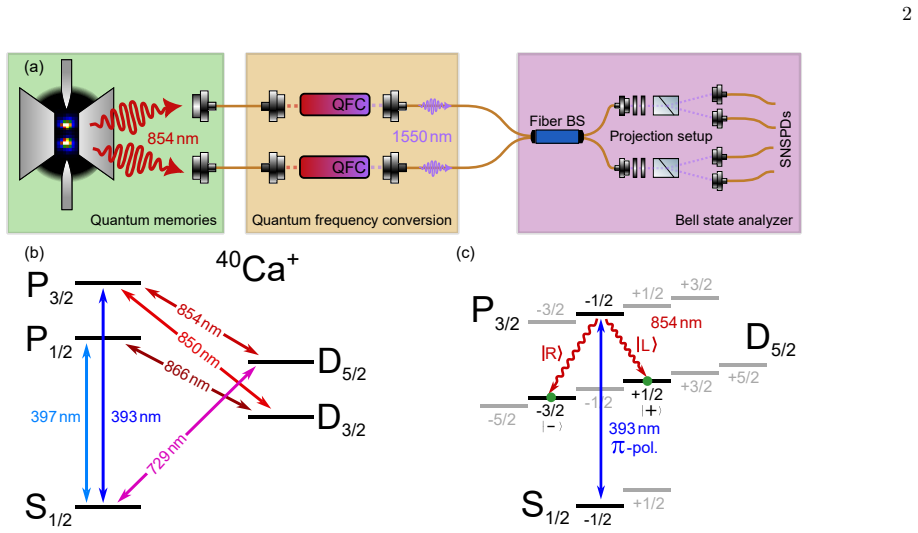
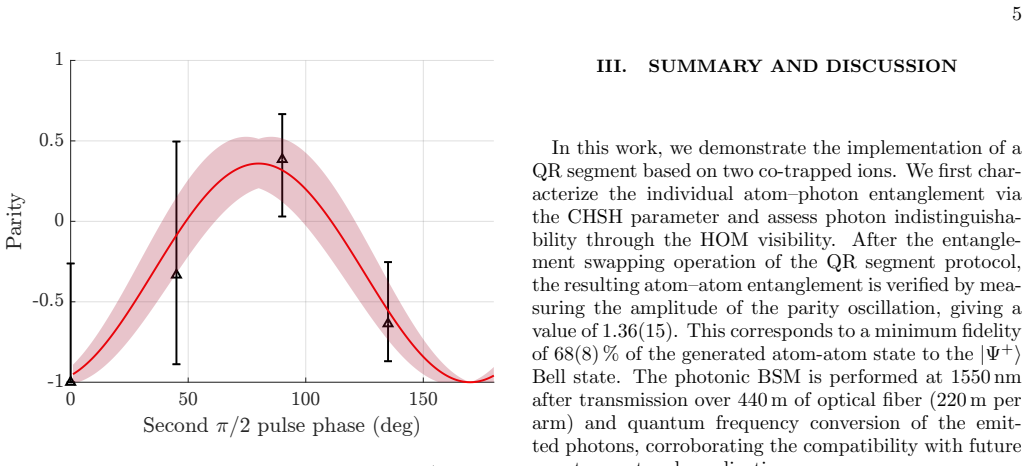
Photons emitted from two free-space coupled co-trapped 40Ca+ ions are converted to the telecom-C band and sent over 440 m of optical fiber where they interfere; a photonic Bell measurement on those photons then creates an entangled |Ψ+⟩ state between the ions with fidelity of at least 68(8) percent.
What carries the argument
Photonic Bell measurement performed on wavelength-converted photons from the two ions after fiber transmission, which projects the ions into the entangled state.
If this is right
- Buffered entanglement is created between two ion-based quantum memories.
- The segment can serve as a basic building block to link quantum repeater cells.
- The same method can connect separate quantum computers.
- Trapped 40Ca+ ions function as a viable hardware platform for repeater segments.
Where Pith is reading between the lines
- Multiple such segments could be chained to distribute entanglement over longer distances using existing fiber networks.
- The free-space coupling approach may simplify scaling to larger numbers of ions within one trap.
- Improving photon collection or conversion efficiency would directly raise the observed fidelity.
Load-bearing premise
The photons must stay sufficiently indistinguishable after conversion and fiber travel for their interference to reliably create the claimed ion entanglement.
What would settle it
Repeated trials in which the measured fidelity of the ion state falls below 50 percent would show that the photonic Bell measurement is not producing the reported entanglement.
Figures
read the original abstract
A quantum repeater segment is a basic building block of a quantum repeater, generating buffered entanglement of quantum memories to connect quantum repeater cells. It also enables the connection between quantum computers. In the implementation we present here, photons emitted from two co-trapped free-space coupled $^{40}$Ca$^+$ ions are converted to the telecom-C band and interfered after transmission over 440$\,$m of optical fiber (220$\,$m per arm), where a photonic Bell measurement is performed to create entanglement between the memories. With this scheme we generate an entangled $\left|\Psi^+\right\rangle$ Bell state with $\ge 68(8)\,$% fidelity, highlighting trapped $^{40}$Ca$^+$ ions as a promising quantum repeater hardware platform.
Editorial analysis
A structured set of objections, weighed in public.
Referee Report
Summary. The manuscript reports an experimental demonstration of a quantum repeater segment in which photons emitted from two co-trapped free-space-coupled 40Ca+ ions are converted to the telecom C band, transmitted over 440 m of fiber (220 m per arm), and subjected to a linear-optic Bell measurement to generate entanglement between the ion memories, yielding a |Ψ+⟩ state with fidelity ≥68(8)%.
Significance. If the central fidelity claim is robustly supported by the required photon-indistinguishability data, the result would constitute a concrete experimental step toward telecom-compatible ion-based quantum repeaters and would strengthen the case for trapped ions as a hardware platform that can interface with both quantum memories and long-distance fiber links.
major comments (2)
- [Abstract] Abstract (final paragraph): the claim that a |Ψ+⟩ Bell state with ≥68(8)% fidelity has been generated between the ions rests on the unverified assumption that the two telecom photons remain sufficiently indistinguishable (temporal, spectral, spatial, polarization) after wavelength conversion and 440 m fiber transmission. No two-photon interference visibility, Hong-Ou-Mandel dip depth, or quantitative bound on residual distinguishability is supplied; without these data the observed ion-ion correlations could arise from classical distinguishability rather than entanglement.
- [Abstract] Abstract: the fidelity figure is presented without any description of the measurement protocol, error budget, data-selection criteria, or statistical analysis used to obtain the 68(8)% value and its uncertainty. These details are required to convert the raw correlation data into a certified entanglement fidelity.
Simulated Author's Rebuttal
We thank the referee for their careful review and constructive comments. We address the two major points below and will revise the abstract to better reference the supporting data and protocols already present in the main text.
read point-by-point responses
-
Referee: [Abstract] Abstract (final paragraph): the claim that a |Ψ+⟩ Bell state with ≥68(8)% fidelity has been generated between the ions rests on the unverified assumption that the two telecom photons remain sufficiently indistinguishable (temporal, spectral, spatial, polarization) after wavelength conversion and 440 m fiber transmission. No two-photon interference visibility, Hong-Ou-Mandel dip depth, or quantitative bound on residual distinguishability is supplied; without these data the observed ion-ion correlations could arise from classical distinguishability rather than entanglement.
Authors: The main text and supplementary information characterize the converted telecom photons, including measured temporal profiles, spectral linewidths after conversion, and spatial/polarization matching at the fiber output. These provide quantitative bounds on distinguishability. The ion-ion correlations are obtained after the linear-optic Bell measurement, and the fidelity above the classical limit is reported from the reconstructed density matrix. We will revise the abstract to explicitly reference these photon characterization results and the interference visibility implicit in the Bell measurement. revision: yes
-
Referee: [Abstract] Abstract: the fidelity figure is presented without any description of the measurement protocol, error budget, data-selection criteria, or statistical analysis used to obtain the 68(8)% value and its uncertainty. These details are required to convert the raw correlation data into a certified entanglement fidelity.
Authors: The full manuscript details the Bell-state measurement protocol (coincidence detection after the fiber link and beam splitter), post-selection on detection events, the error budget (including Poissonian statistics and finite sampling), and the fidelity calculation from the two-qubit density matrix. We agree the abstract is too concise on these points and will expand it with a brief description of the protocol and analysis to make the fidelity claim self-contained. revision: yes
Circularity Check
No circularity: experimental demonstration only
full rationale
The manuscript is an experimental report of ion-ion entanglement generation via telecom-photon interference after wavelength conversion and 440 m fiber transmission. The central result is a measured fidelity ≥68(8)% for the |Ψ+⟩ state. No derivation chain, parameter fitting, ansatz, uniqueness theorem, or self-citation load-bearing step exists in the provided text or abstract. The fidelity is obtained directly from ion-state readout after the photonic Bell measurement; it is not reduced to any input by construction. The indistinguishability precondition is an experimental assumption whose validity is tested by the observed correlations, not a definitional or fitted circularity. Score 0 is the appropriate finding for a self-contained experimental paper.
Axiom & Free-Parameter Ledger
Reference graph
Works this paper leans on
-
[1]
in distant traps and a single experiment with trapped ions [33] have used conversion of the emitted photons to telecom wavelength. In this manuscript a proof-of-principle implementa- tion of a QR segment is presented, in which two ions are co-trapped in a Paul trap and their emitted pho- tons are individually collected in free space. A pho- tonic Bell sta...
Pith/arXiv arXiv 2026
-
[2]
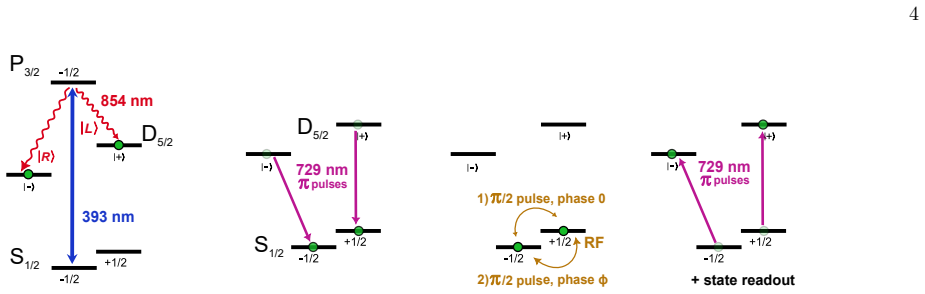
/2 pulse, phase ϕ FIG. 3. Schematic of the sequence for verification of atom-atom entanglement. Generation of atom-photon entanglement. Population transfer from D 5/2 to S1/2. Basis rotation by the use of twoπ/2 RF pulses. Population transfer back from S 1/2 to D5/2 followed by state readout. also observed in [24]. As this birefringence is compen- sated b...
-
[3]
The contributions of the individual components to detection are listed in Table I
Detection efficiencies The total detection efficiency per excitation attempted of 1.61·10−4 and 1.58·10−4 for ion 1 and ion 2 is derivated from an independent measurement. The contributions of the individual components to detection are listed in Table I. TABLE I. Contributions to the detection efficiency of photons emitted by the two ions. The table inclu...
-
[4]
(next→(2)) (2) [Duration: 4µs] 854 nm photon generation of both atoms with the a train of 15 16.6(1)nsπ-polarized 393 nm laser pulses
Complete sequence In the following the complete sequential implementa- tion of the protocol is listed: (1) [Duration: 3µs] Doppler cooling with 397 nm, 866 nm, in combination with repumping to S 1/2 with 854 nm. (next→(2)) (2) [Duration: 4µs] 854 nm photon generation of both atoms with the a train of 15 16.6(1)nsπ-polarized 393 nm laser pulses. The sequen...
-
[5]
Polarization control Because of around 200 m of fiber from the ions to the FBS and the polarization detection setup mainly going through non-air-conditioned rooms the polarization must be corrected regularly. The polarization of one ion’s pho- ton is corrected using motorized wave plates in one QFC and the polarization of the other ion’s photons with mo- ...
-
[6]
A single-photon wave packet with fifteen peaks was generated by excitation with a train of 15 pulses at 393 nm, each with a duration of 16.6(1) ns
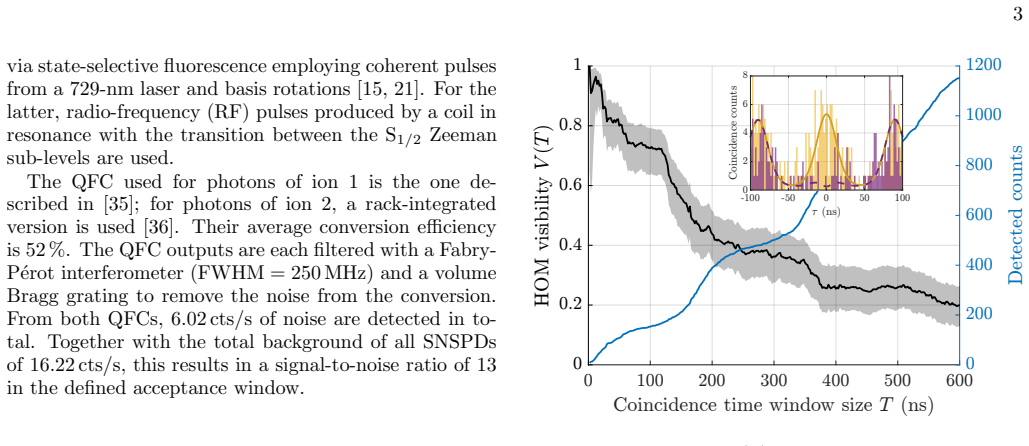
Signal to noise ratio The arrival-time distribution of the summed events of all detectors was analyzed. A single-photon wave packet with fifteen peaks was generated by excitation with a train of 15 pulses at 393 nm, each with a duration of 16.6(1) ns. From both QFCs, a total noise count rate of only 6.02 cts/s is detected. Including the total back- ground...
-
[7]
1Photon1Det
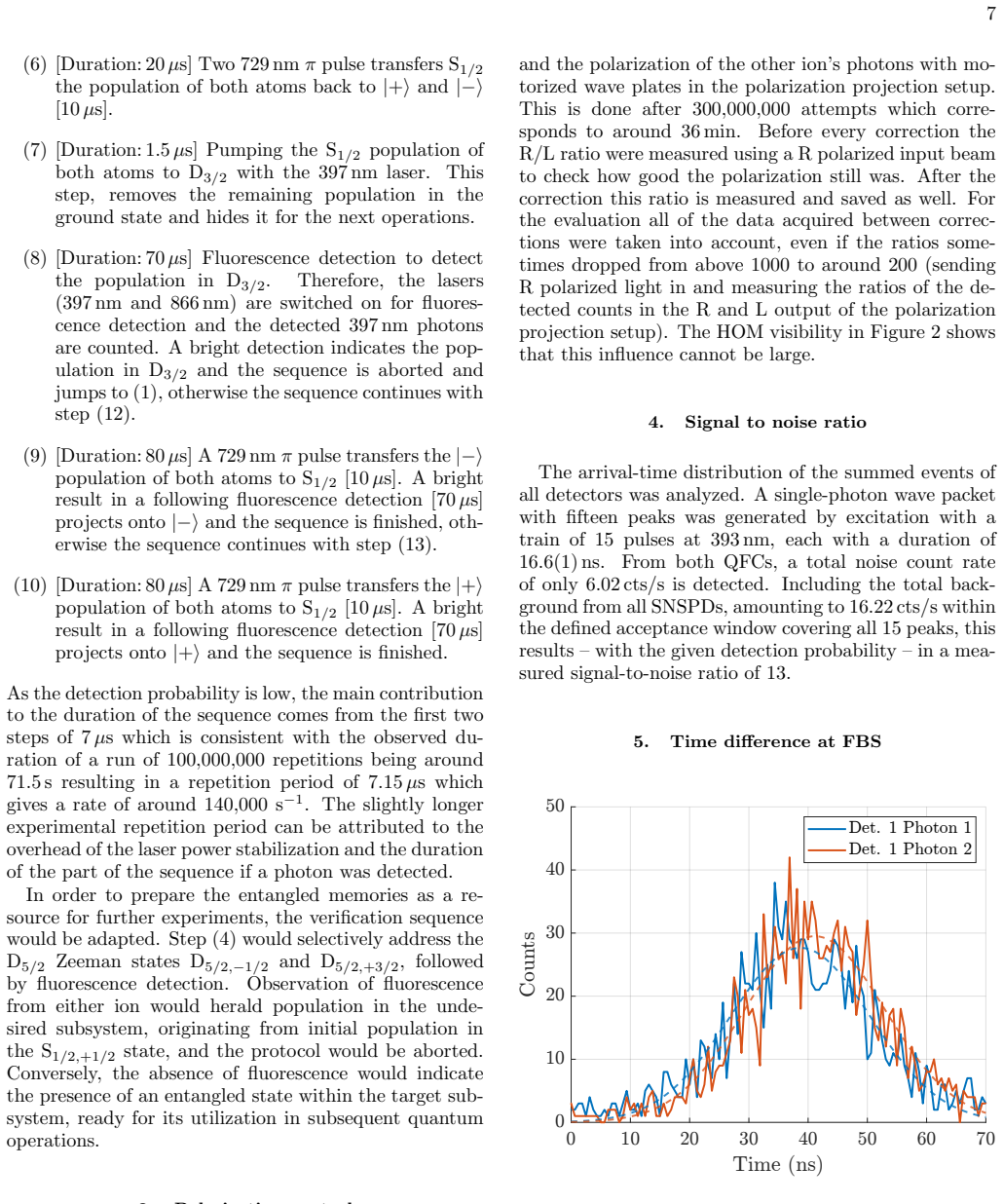
Time difference at FBS 0 10 20 30 40 50 60 70 Time(ns) 0 10 20 30 40 50Counts Det. 1Photon1Det. 1Photon2 FIG. 5. One of the fifteen peaks in the single-photon wave packets from both ions for one selected detector to measure the time difference at the FBS with the fit as dashed line. Photon 1 (2) refers to the photon emitted by Ion 1 (2). To assess the tem...
-
[8]
For this purpose, ion–photon entanglement is analyzed individu- ally for each ion
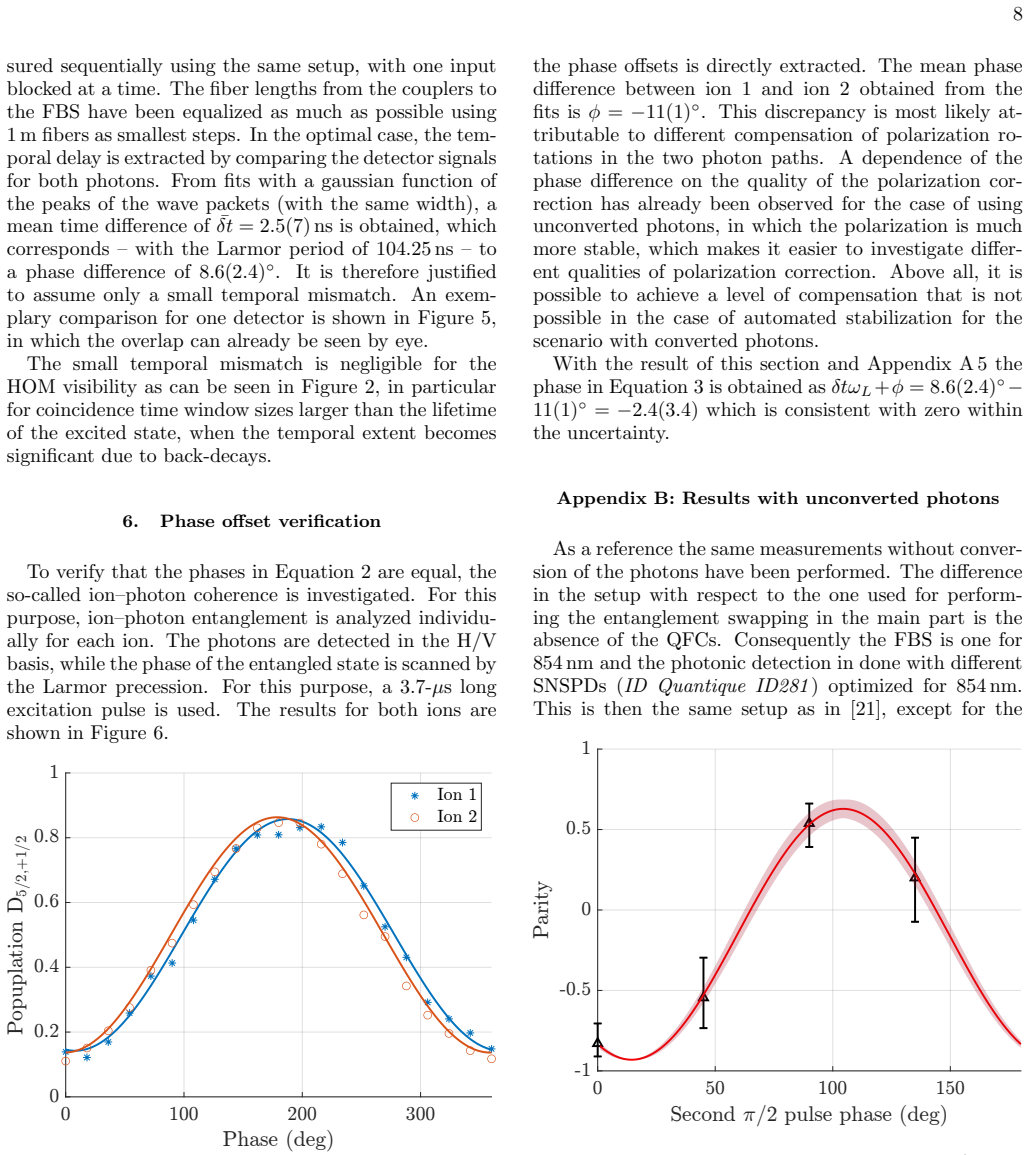
Phase offset verification To verify that the phases in Equation 2 are equal, the so-called ion–photon coherence is investigated. For this purpose, ion–photon entanglement is analyzed individu- ally for each ion. The photons are detected in the H/V basis, while the phase of the entangled state is scanned by the Larmor precession. For this purpose, a 3.7-µs...
-
[9]
H. J. Kimble, The quantum internet, Nature453, 1023 (2008)
2008
-
[10]
D. P. DiVincenzo, The physical implementation of quan- tum computation, Fortschritte der Physik48, 771 (2000)
2000
-
[11]
Nigmatullin, C
R. Nigmatullin, C. J. Ballance, N. d. Beaudrap, and S. C. Benjamin, Minimally complex ion traps as modules for quantum communication and computing, New Journal of Physics18, 103028 (2016)
2016
-
[12]
Jiang, J
L. Jiang, J. M. Taylor, A. S. Sørensen, and M. D. Lukin, Distributed quantum computation based on small quan- tum registers, Phys. Rev. A76, 062323 (2007)
2007
-
[13]
J. I. Cirac, A. K. Ekert, S. F. Huelga, and C. Mac- chiavello, Distributed quantum computation over noisy channels, Phys. Rev. A59, 4249 (1999)
1999
-
[14]
Monroe, R
C. Monroe, R. Raussendorf, A. Ruthven, K. R. Brown, P. Maunz, L.-M. Duan, and J. Kim, Large-scale mod- ular quantum-computer architecture with atomic mem- ory and photonic interconnects, Phys. Rev. A89, 022317 (2014)
2014
-
[15]
Briegel, W
H.-J. Briegel, W. D¨ ur, J. I. Cirac, and P. Zoller, Quan- tum Repeaters: The Role of Imperfect Local Operations in Quantum Communication, Phys. Rev. Lett.81, 5932 (1998)
1998
-
[16]
Strobel, M
T. Strobel, M. Vyvlecka, I. Neureuther, T. Bauer, M. Sch¨ afer, S. Kazmaier, N. L. Sharma, R. Joos, J. H. Weber, C. Nawrath, W. Nie, G. Bhayani, 10 C. Hopfmann, C. Becher, P. Michler, and S. L. Por- talupi, Telecom-wavelength quantum teleportation using frequency-converted photons from remote quantum dots, Nature Communications16(2025)
2025
-
[17]
A. J. Stolk, K. L. van der Enden, M.-C. Slater, I. te Raa- Derckx, P. Botma, J. van Rantwijk, J. J. B. Biemond, R. A. J. Hagen, R. W. Herfst, W. D. Koek, A. J. H. Meskers, R. Vollmer, E. J. van Zwet, M. Markham, A. M. Edmonds, J. F. Geus, F. Elsen, B. Jungbluth, C. Haefner, C. Tresp, J. Stuhler, S. Ritter, and R. Han- son, Metropolitan-scale heralded enta...
2024
-
[18]
van Leent, M
T. van Leent, M. Bock, F. Fertig, R. Garthoff, S. Eppelt, Y. Zhou, P. Malik, M. Seubert, T. Bauer, W. Rosenfeld, W. Zhang, C. Becher, and H. Weinfurter, Entangling sin- gle atoms over 33 km telecom fibre, Nature607, 69–73 (2022)
2022
-
[19]
Krutyanskiy, M
V. Krutyanskiy, M. Canteri, M. Meraner, J. Bate, V. Kr- cmarsky, J. Schupp, N. Sangouard, and B. P. Lanyon, Telecom-Wavelength Quantum Repeater Node Based on a Trapped-Ion Processor, Phys. Rev. Lett.130, 213601 (2023)
2023
-
[20]
van Loock, W
P. van Loock, W. Alt, C. Becher, O. Benson, H. Boche, C. Deppe, J. Eschner, S. H¨ ofling, D. Meschede, P. Mich- ler, F. Schmidt, and H. Weinfurter, Extending Quantum Links: Modules for Fiber- and Memory-Based Quantum Repeaters, Advanced Quantum Technologies3, 1900141 (2020)
2020
-
[21]
Luong, L
D. Luong, L. Jiang, J. Kim, and N. L¨ utkenhaus, Over- coming lossy channel bounds using a single quantum re- peater node, Applied Physics B122, 96 (2016)
2016
-
[22]
C. D. Bruzewicz, J. Chiaverini, R. McConnell, and J. M. Sage, Trapped-ion quantum computing: Progress and challenges, Applied Physics Reviews6, 021314 (2019)
2019
-
[23]
M. Bock, P. Eich, S. Kucera, M. Kreis, A. Lenhard, C. Becher, and J. Eschner, High-fidelity entanglement be- tween a trapped ion and a telecom photon via quantum frequency conversion, Nature Communications9(2018)
2018
-
[24]
L¨ oschnauer, J
C. L¨ oschnauer, J. Mosca Toba, A. Hughes, S. King, M. Weber, R. Srinivas, R. Matt, R. Nourshargh, D. All- cock, C. Ballance, C. Matthiesen, M. Malinowski, and T. Harty, Scalable, high-fidelity all-electronic control of trapped-ion qubits, PRX Quantum6, 040313 (2025)
2025
-
[25]
D. Main, P. Drmota, D. P. Nadlinger, E. M. Ainley, A. Agrawal, B. C. Nichol, R. Srinivas, G. Araneda, and D. M. Lucas, Distributed quantum computing across an optical network link, Nature638, 383–388 (2025)
2025
-
[26]
Bluvstein, H
D. Bluvstein, H. Levine, G. Semeghini, T. T. Wang, S. Ebadi, M. Kalinowski, A. Keesling, N. Maskara, H. Pichler, M. Greiner, V. Vuleti´ c, and M. D. Lukin, A quantum processor based on coherent transport of en- tangled atom arrays, Nature604, 451–456 (2022)
2022
-
[27]
N.-C. Chiu, E. C. Trapp, J. Guo, M. H. Abobeih, L. M. Stewart, S. Hollerith, P. L. Stroganov, M. Kalinowski, A. A. Geim, S. J. Evered, S. H. Li, X. Lyu, L. M. Peters, D. Bluvstein, T. T. Wang, M. Greuner, V. Vuleti´ c, and M. D. Lukin, Continuous operation of a coherent 3,000- qubit system, Nature646, 1075–1080 (2025)
2025
-
[28]
Langenfeld, P
S. Langenfeld, P. Thomas, O. Morin, and G. Rempe, Quantum Repeater Node Demonstrating Uncondition- ally secure key distribution, Phys. Rev. Lett.126, 230506 (2021)
2021
-
[29]
Bergerhoff, O
M. Bergerhoff, O. Elshehy, S. Kucera, M. Kreis, and J. Eschner, Quantum repeater node with free-space cou- pled trapped ions, Phys. Rev. A110, 032603 (2024)
2024
-
[30]
D. L. Moehring, P. Maunz, S. Olmschenk, K. C. Younge, D. N. Matsukevich, L.-M. Duan, and C. Monroe, En- tanglement of single-atom quantum bits at a distance, Nature449, 68 (2007)
2007
-
[31]
L. J. Stephenson, D. P. Nadlinger, B. C. Nichol, S. An, P. Drmota, T. G. Ballance, K. Thirumalai, J. F. Good- win, D. M. Lucas, and C. J. Ballance, High-rate, high- fidelity entanglement of qubits across an elementary quantum network, Phys. Rev. Lett.124, 110501 (2020)
2020
-
[32]
O’Reilly, G
J. O’Reilly, G. Toh, I. Goetting, S. Saha, M. Sha- laev, A. L. Carter, A. Risinger, A. Kalakuntla, T. Li, A. Verma, and C. Monroe, Fast photon-mediated entan- glement of continuously cooled trapped ions for quantum networking, Phys. Rev. Lett.133, 090802 (2024)
2024
-
[33]
B. C. Nichol, R. Srinivas, D. P. Nadlinger, P. Drmota, D. Main, G. Araneda, C. J. Ballance, and D. M. Lu- cas, An elementary quantum network of entangled opti- cal atomic clocks, Nature609, 689–694 (2022)
2022
-
[34]
T. A. Wright, R. J. A. Francis-Jones, C. B. E. Gawith, J. N. Becker, P. M. Ledingham, P. G. R. Smith, J. Nunn, P. J. Mosley, B. Brecht, and I. A. Walmsley, Two-Way Photonic Interface for Linking the Sr + Transition at 422 nm to the TelecommunicationCBand, Phys. Rev. Appl. 10, 044012 (2018)
2018
-
[35]
Hannegan, U
J. Hannegan, U. Saha, J. D. Siverns, J. Cassell, E. Waks, and Q. Quraishi, C-band single photons from a trapped ion via two-stage frequency conversion, Applied Physics Letters119, 084001 (2021)
2021
-
[36]
S. Yu, K. Lee, S. Park, K. Kim, J. Goo, J. Park, and T. Kim, Efficient quantum frequency conversion of ultra- violet single photons from a trapped ytterbium ion, Ap- plied Physics Letters126(2025)
2025
-
[37]
Hofmann, M
J. Hofmann, M. Krug, N. Ortegel, L. G´ erard, M. Weber, W. Rosenfeld, and H. Weinfurter, Heralded entanglement between widely separated atoms, Science337, 72 (2012)
2012
-
[38]
Zhang, T
W. Zhang, T. van Leent, K. Redeker, R. Garthoff, R. Schwonnek, F. Fertig, S. Eppelt, W. Rosenfeld, V. Scarani, C. C.-W. Lim, and H. Weinfurter, A device- independent quantum key distribution system for distant users, Nature607, 687–691 (2022)
2022
-
[39]
Krutyanskiy, M
V. Krutyanskiy, M. Galli, V. Krcmarsky, S. Baier, D. A. Fioretto, Y. Pu, A. Mazloom, P. Sekatski, M. Canteri, M. Teller, J. Schupp, J. Bate, M. Meraner, N. San- gouard, B. P. Lanyon, and T. E. Northup, Entanglement of trapped-ion qubits separated by 230 meters, Phys. Rev. Lett.130, 050803 (2023)
2023
-
[40]
Z. B. Cui, Z. Q. Wang, P. Y. Liu, Y. Wang, P. C. Lai, J. X. Shi, Y. D. Sun, Z. C. Tian, H. S. Sun, Y. B. Liang, B. X. Qi, Y. Y. Huang, Z. C. Zhou, Y. K. Wu, Y. Xu, Y. F. Pu, and L. M. Duan, Multiplexed ion-ion entangle- ment over 1.2 kilometer fibers (2025), arXiv:2510.20392 [quant-ph]
arXiv 2025
-
[41]
W. Z. Liu, Y. B. Zhou, J. P. Chen, and et al., Long- lived remote ion-ion entanglement for scalable quantum repeaters, Nature 10.1038/s41586-026-10177-4 (2026)
-
[42]
Slodiˇ cka, G
L. Slodiˇ cka, G. H´ etet, N. R¨ ock, P. Schindler, M. Hen- nrich, and R. Blatt, Atom-atom entanglement by single- photon detection, Phys. Rev. Lett.110, 083603 (2013)
2013
-
[43]
Arensk¨ otter, T
E. Arensk¨ otter, T. Bauer, S. Kucera, and et al., Tele- com quantum photonic interface for a 40Ca+ single-ion quantum memory, npj Quantum Inf9, 34 (2023)
2023
-
[44]
Bauer and C
T. Bauer and C. Becher, Polarization-preserving quan- tum frequency conversion for entanglement distribution 11 in trapped-atom based urban area quantum networks, in Optica Quantum 2.0 Conference and Exhibition(Optica Publishing Group, 2023) p. QW4A.4
2023
-
[45]
Quantum repeaters based on concatenated bosonic and discrete-variable quantum codes,
S. Kucera, C. Haen, E. Arensk¨ otter, T. Bauer, J. Meiers, M. Sch¨ afer, R. Boland, M. Yahyapour, M. Lessing, R. Holzwarth, C. Becher, and J. Eschner, Demonstra- tion of quantum network protocols over a 14-km urban fiber link, npj Quantum Information10, 10.1038/s41534- 024-00886-x (2024)
-
[46]
Zippilli, G
S. Zippilli, G. A. Olivares-Renter´ ıa, G. Morigi, C. Schuck, F. Rohde, and J. Eschner, Entanglement of distant atoms by projective measurement: the role of detection effi- ciency, New Journal of Physics10, 103003 (2008)
2008
-
[47]
Dhara, D
P. Dhara, D. Englund, and S. Guha, Entangling quantum memories via heralded photonic bell measurement, Phys. Rev. Res.5, 033149 (2023)
2023
-
[48]
P. Baumgart, M. Bergerhoff, J. Meiers, S. Kucera, and J. Eschner, Indistinguishability of photonic qubits emit- ted from trapped 40Ca+ ions via pulsed excitation (2026), arXiv:2605.29825 [quant-ph]
Pith/arXiv arXiv 2026
-
[49]
Baumgart, M
P. Baumgart, M. Bergerhoff, J. Meiers, and J. Eschner, Entanglement swapping with two co-trapped 40Ca+ ions for quantum repeater application, inOptica Quantum 2.0 Conference and Exhibition(Optica Publishing Group,
-
[50]
M. Bock, P. Sekatski, J.-D. Bancal, S. Kucera, T. Bauer, N. Sangouard, C. Becher, and J. Eschner, Calibration- independent bound on the unitarity of a quantum chan- nel with application to a frequency converter, npj Quan- tum Information10, 10.1038/s41534-024-00859-0 (2024)
-
[51]
C. A. Sackett, D. Kielpinski, B. E. King, C. Langer, V. Meyer, C. J. Myatt, M. Rowe, Q. A. Turchette, W. M. Itano, D. J. Wineland, and et al., Experimental entan- glement of four particles, Nature404, 256–259 (2000)
2000
-
[52]
A. N. Craddock, J. Hannegan, D. P. Ornelas-Huerta, J. D. Siverns, A. J. Hachtel, E. A. Goldschmidt, J. V. Porto, Q. Quraishi, and S. L. Rolston, Quantum inter- ference between photons from an atomic ensemble and a remote atomic ion, Phys. Rev. Lett.123, 213601 (2019)
2019
-
[53]
J. M. Brevoord, J. F. Geus, T. Turan, M. G. Romero, D. B. Rodr´ ıguez, N. Codreanu, A. M. Stramma, R. Han- son, F. Elsen, and B. Jungbluth, Quantum frequency conversion of single photons from a tin-vacancy center in diamond, Optica Quantum3, 583 (2025)
2025
-
[54]
Herrmann and et al
D. Herrmann and et al. (2026), manuscript in prepara- tion
2026
-
[55]
C. M. Knaut, A. Suleymanzade, Y.-C. Wei, D. R. As- sumpcao, P.-J. Stas, Y. Q. Huan, B. Machielse, E. N. Knall, M. Sutula, G. Baranes, and et al., Entanglement of nanophotonic quantum memory nodes in a telecom network, Nature629, 573–578 (2024)
2024
-
[56]
Sch¨ afer, B
M. Sch¨ afer, B. Kambs, D. Herrmann, T. Bauer, and C. Becher, Two-stage, low noise quantum frequency con- version of single photons from silicon-vacancy centers in diamond to the telecom c-band, Advanced Quantum Technologies8, 2300228 (2023)
2023
-
[57]
C. Haen, J. Groß-Funk, M. Bergerhoff, P. Baumgart, T. bauer, C. Becher, and J. Eschner, Conversion of spin- polarization entanglement to spin-time-bin entanglement (2025), manuscript in preparation
2025
discussion (0)
Sign in with ORCID, Apple, or X to comment. Anyone can read and Pith papers without signing in.