REVIEW 4 major objections 3 minor 1 cited by
Keep Policy Gradient in Charge: Sibling-Guided Credit Distillation for Long-Horizon Tool-Use Agents
T0 review · 4 major / 3 minor · reviewed 2026-07-15 · grok-4.5
Pith's one-line read Distillation only reshapes credit for tool-use RL; the policy gradient still owns the actor update.
desk verdict Abstract-only SGCD pitch: sensible credit-only distillation rule for GRPO tool-use agents, modest held-out gains, but unverified external-LLM credit step and no stats. read the letter →
The pith
A machine-rendered reading of the paper's core claim, the machinery that carries it, and where it could break.
The reading
What carries the argument
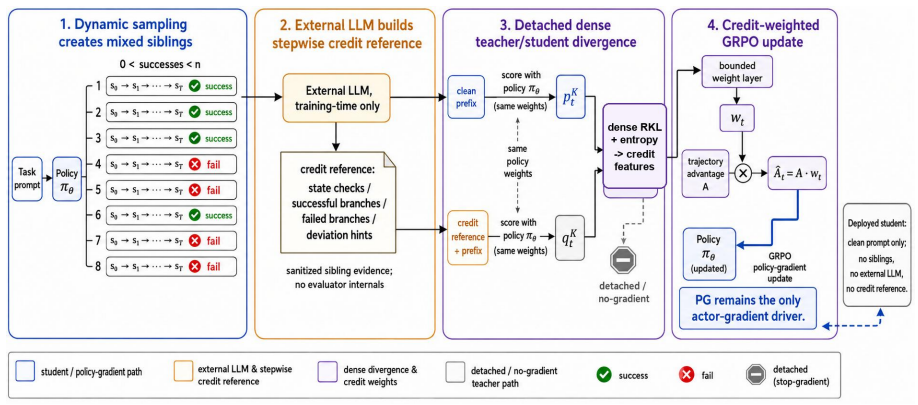
Sibling-Guided Credit Distillation (SGCD): dynamic sampling of mixed successful and failed sibling rollouts, external-LLM contrast summarized into a training-only credit reference, and detached teacher/student divergence that reweights GRPO token advantages while the policy-gradient actor update stays primary.
What would settle it
Replace the external LLM credit summary with a noisy or systematically inverted reference and check whether the reported AppWorld TGC and τ³-airline gains over GRPO disappear or reverse.
Extended reading notes
Core claim
Sibling-Guided Credit Distillation uses distillation solely for bounded credit weighting: mixed successful/failed sibling rollouts are contrasted by an external LLM into a training-only credit reference, and a detached teacher/student divergence reshapes GRPO token advantages, while the policy gradient alone updates the actor. This yields higher held-out scores than GRPO-family methods on AppWorld and τ³-airline without rehearsing teacher behavior at deployment.
Load-bearing premise
An external LLM’s free-form contrast of successful versus failed sibling rollouts is a reliable training-only credit reference that correctly identifies which actions the outcome verifier rewards rather than spurious correlates of success.
Editorial analysis
A structured set of objections, weighed in public.
Referee Report
Summary. The manuscript proposes Sibling-Guided Credit Distillation (SGCD) for long-horizon tool-use RL under outcome verification. Trajectory-level advantages are broadcast over reasoning, API, and answer tokens; the authors report that direct self-distillation can destroy tool use by rehearsing teacher behavior without isolating verifier-rewarded actions. SGCD instead uses distillation only for bounded credit weighting: dynamic sampling yields mixed successful/failed sibling rollouts; an external LLM summarizes their contrast into a training-only credit reference; and detached teacher/student divergence reshapes GRPO token advantages while the actor update remains pure policy gradient. The deployed student sees only the clean task prompt. Held-out point estimates improve over GRPO-family comparators: AppWorld TGC 42.9→45.6 (test_normal) and 24.7→27.0 (test_challenge); τ³-airline evaluator score 0.583→0.602. The abstract frames a narrow design rule: use distillation to guide credit assignment while keeping policy gradient in charge of the actor.
Significance. If the design rule holds, the paper offers a concrete, actionable separation of roles for distillation versus policy gradient in long-horizon tool-use agents—an area where sparse outcome rewards and long trajectories make credit assignment a first-order bottleneck. The method is conceptually clean: the external-LLM credit reference is training-only, the divergence is detached, and the deployed policy is not conditioned on teacher scaffolding. The reported gains are modest but on held-out AppWorld and τ³-airline splits against GRPO-family baselines. Significance is conditional on (i) the external LLM contrast actually identifying verifier-rewarded actions rather than success correlates, and (ii) the gains being statistically reliable and attributable to the claimed components rather than free parameters or sampling effects.
major comments (4)
- [Abstract] Abstract: The central attribution claim—that held-out gains arise because the external-LLM sibling contrast supplies a credit reference that identifies actions the outcome verifier rewards—is not supported by any validation of that mapping. No human agreement study, correlation with token-level returns, or ablation that replaces the LLM summary with a random, null, or success-only credit reference is reported. Without this, the modest gains cannot be attributed to correct credit assignment rather than spurious correlates of success—the same failure mode the abstract attributes to self-distillation.
- [Abstract] Abstract: Results are held-out point estimates only (AppWorld TGC 42.9→45.6 / 24.7→27.0; τ³-airline 0.583→0.602), with no run counts, error bars, variance, or statistical tests. Gains of ~2.7 TGC points and ~0.019 evaluator score may lie within run-to-run noise for long-horizon tool-use RL; without reliability evidence the comparison to GRPO-family baselines is not load-bearing for the design-rule claim.
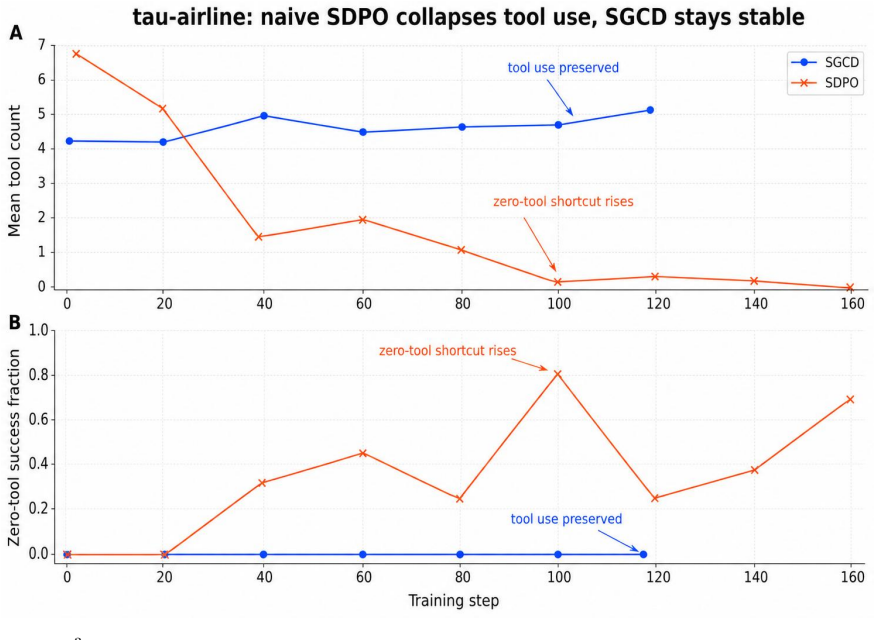
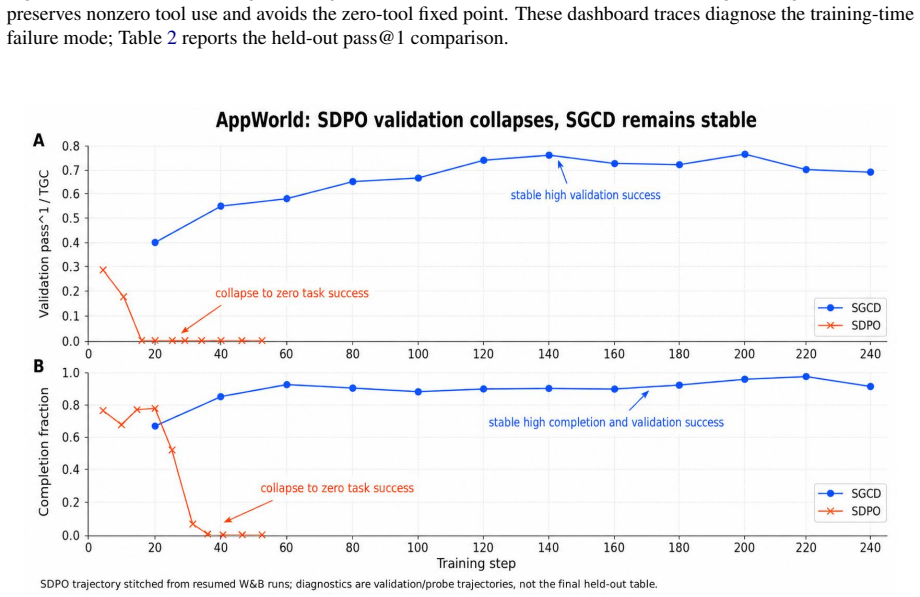
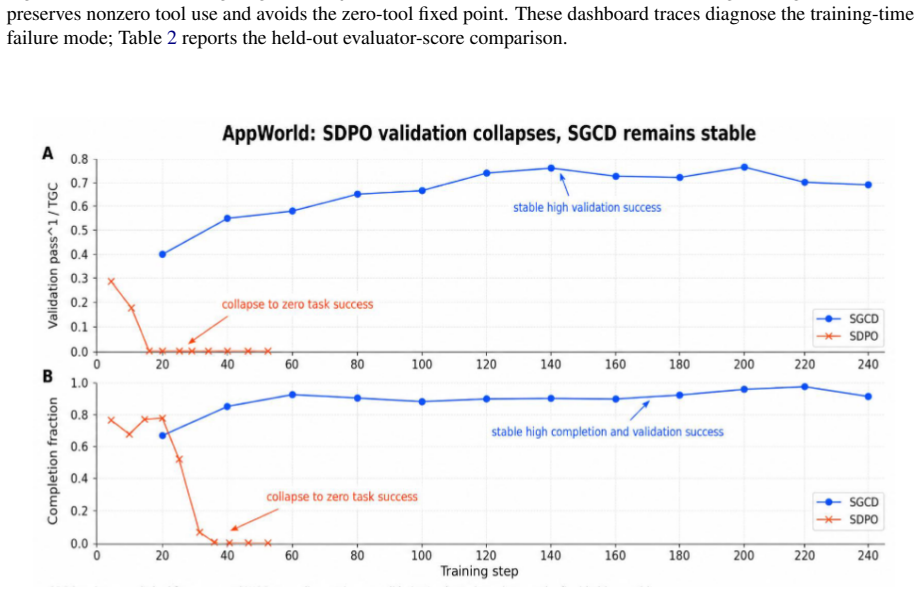
- [Abstract] Abstract: The claim that direct self-distillation “can also destroy tool use by rehearsing teacher behavior without identifying which actions the verifier rewards” is load-bearing motivation for SGCD’s bounded-credit design, but the abstract supplies no quantitative evidence (tool-call rates, success rates, or trajectory diagnostics under self-distillation). That failure mode must be documented if it is to justify the architectural choice.
- [Abstract] Abstract: Free parameters of the method—advantage-reshape / divergence weighting strength, sibling rollout count, and success/fail mix—are not characterized. Sensitivity of the reported gains to these knobs is unknown; without ablations that isolate sibling sampling, the external LLM summarizer, and detached divergence, the design rule is under-supported relative to the GRPO baseline.
minor comments (3)
- [Abstract] Benchmark name is written inconsistently as “tau^3-airline” and “τ³-airline” in the abstract; standardize notation.
- [Abstract] A one-sentence statement of the GRPO baseline configuration (model scale, sampling budget, reward definition) would make the held-out comparisons more interpretable in the abstract.
- [Abstract] Clarify whether the external LLM used for sibling-contrast summarization is held fixed across training and is distinct from the student policy, and whether any of its outputs leak into the deployed prompt (the abstract asserts they do not, but a explicit non-leakage statement would help).
Circularity Check
No circularity: SGCD reshapes GRPO advantages via external-LLM sibling contrast while the actor update remains policy gradient; held-out gains are empirical, not definitional.
full rationale
Abstract-only review finds no self-definitional loop, no fitted parameter renamed as prediction, and no load-bearing self-citation or uniqueness theorem. The method samples mixed successful/failed sibling rollouts, obtains a training-only credit reference from an external LLM contrast summary, and uses detached teacher/student divergence only to reweight GRPO token advantages; the deployed student is updated by policy gradient on the clean task prompt and evaluated on held-out AppWorld TGC and τ³-airline scores. Those scores are independent external benchmarks, not quantities recovered by construction from the credit reference. Residual risk that the LLM summary tracks spurious correlates rather than verifier-rewarded actions is a correctness/validity concern, not circularity of the derivation chain. No equation or claim in the abstract reduces the reported improvements to an input by definition. Score 0 with empty steps is therefore the warranted finding.
Assumptions & free parameters
free parameters (2)
- advantage reshape / divergence weighting strength
- sibling rollout count and success/fail mix
assumptions (4)
- domain assumption Trajectory-level outcome verification is the correct training signal for long-horizon tool use; token-level credit should align with that verifier.
- domain assumption GRPO-style group-relative policy optimization is a valid base actor update for multi-token tool trajectories.
- ad hoc to paper An external LLM can summarize success/fail sibling contrast into a credit reference that identifies verifier-rewarded actions.
- ad hoc to paper Detached (stop-gradient) teacher/student divergence can reweight advantages without becoming a competing actor loss.
invented entities (1)
-
training-only sibling-contrast credit reference (external LLM summary)
Cite this review
Pith. "Pith review of Keep Policy Gradient in Charge: Sibling-Guided Credit Distillation for Long-Horizon Tool-Use Agents." pith.science (2026). https://pith.science/paper/QIY24QT3
@misc{pith2026260612634,
  author       = {Pith},
  title        = {Pith review of: Keep Policy Gradient in Charge: Sibling-Guided Credit Distillation for Long-Horizon Tool-Use Agents},
  year         = {2026},
  howpublished = {\url{https://pith.science/paper/QIY24QT3}},
  note         = {Machine review of arXiv:2606.12634}
}
read the original abstract
Long-horizon tool-use reinforcement learning learns from outcome verification, but trajectory-level advantages are broadcast over reasoning, API, and answer tokens. Direct self-distillation can supply a denser signal, but in our experiments it can also destroy tool use by rehearsing teacher behavior without identifying which actions the verifier rewards. We introduce Sibling-Guided Credit Distillation (SGCD), which uses distillation for bounded credit weighting rather than as a competing actor loss. Dynamic sampling produces mixed successful and failed sibling rollouts; an external LLM summarizes their contrast into a training-only credit reference; and detached teacher/student divergence reshapes GRPO token advantages. The deployed student receives only the clean task prompt. Across AppWorld and tau^3-airline, SGCD reports higher held-out point estimates than GRPO-family comparators: AppWorld TGC improves from 42.9 to 45.6 on test_normal and from 24.7 to 27.0 on test_challenge, and tau^3-airline held-out evaluator score improves from 0.583 to 0.602. These results support a narrow design rule for long-horizon tool-use agents: use distillation to guide credit assignment while keeping policy gradient in charge of the actor update.
Figures
Figures from the paper (2 more)
Forward citations
Cited by 1 Pith paper
-
TurnSight: Turn-Level Hindsight Self-Distillation for Tool-Integrated Reasoning
TurnSight uses a frozen reference model plus future tool outputs to score each reasoning turn, then uses those scores to fine-tune an RL agent's credit assignment, beating existing methods on three benchmarks.
Reviewed July 15, 2026 · model on record in the stance chip above.
Discussion (0). Sign in to comment.