REVIEW 2 major objections 5 minor 1 cited by
A calibration-aware graph reinforcement-learning router can improve simulated quantum-circuit fidelity by roughly 0.25–0.29 absolute over gate-count-driven baselines, by deliberately choosing more two-qubit gates to avoid poorly calibrated
Reviewed by Pith at T0; open to challenge. T0 means a machine referee read the full paper against a public rubric. the ladder, T0–T4 →
A calibration-aware graph reinforcement-learning router improves exact simulated fidelity by ~0.25-0.29 over SABRE baselines on 5-8 qubit MQT Bench circuits, while 10-qubit circuits still favor SABRE.
T0 review reviewed 2026-08-02 challenge →
load-bearing objection The reported 0.25–0.29 fidelity gain is an in-sample estimate: hyperparameters and the terminal reward are tuned on the same circuits and snapshots used for final evaluation, so the headline needs held-out validation before it can be taken as predictive. the 2 major comments →
Graph Reinforcement Learning for Calibration-Aware Quantum Circuit Routing
The pith
A machine-rendered reading of the paper's core claim, the machinery that carries it, and where it could break.
The reading
Core claim
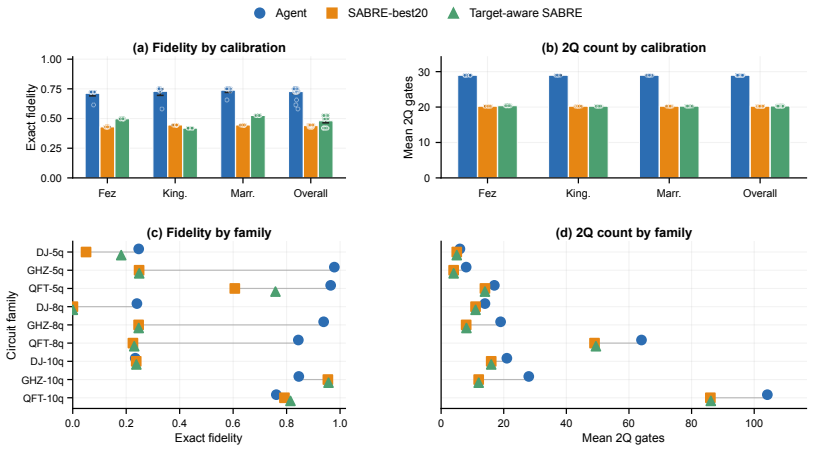
On nine benchmark circuits and three same-day calibration snapshots of a superconducting processor, the learned calibration-aware router achieves a pooled mean exact simulated state fidelity of 0.727, compared with 0.440 for the SABRE-best20 baseline and 0.481 for a target-aware SABRE variant. The gains are concentrated in the 5-qubit and 8-qubit circuit families and coincide with additional routed two-qubit gates; on the fixed tree action graph used for 10-qubit circuits, every family favors SABRE-best20. The paper concludes that calibration can justify longer routes when the hardware graph provides useful alternatives, and that gate count alone is an incomplete fidelity proxy on calibrated
What carries the argument
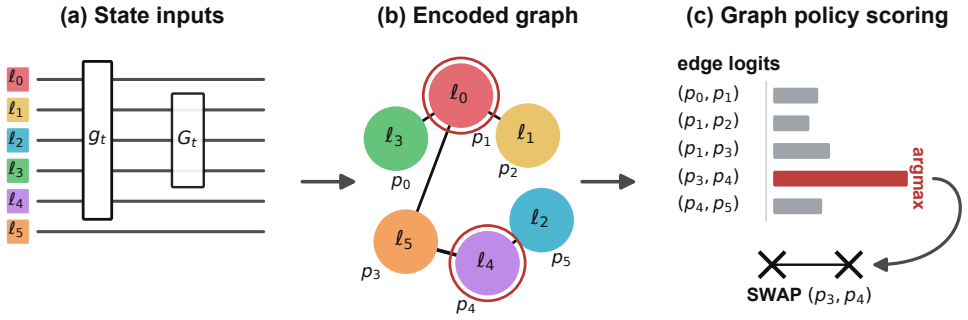
The central object is the calibrated backend graph, whose nodes carry per-qubit calibration features (readout error, coherence, incident two-qubit error) plus placement and lookahead information from the remaining program. Two message-passing layers produce node embeddings, and a multilayer perceptron scores each legal hardware-edge SWAP from the embeddings and edge attributes; the resulting masked softmax defines the policy, trained with proximal policy optimization. The reward includes a low-cost estimated-success-probability proxy for fidelity (used during training) and a terminal term that compares the agent's proxy fidelity against a SABRE baseline's, while final evaluation uses exact d
Load-bearing premise
The entire comparison rests on the simulator's noise model faithfully representing real processor behavior; the paper does not validate the model against hardware, so the measured gains are guaranteed only in simulation.
What would settle it
Run the same compiled routes (learned and SABRE) directly on the actual 156-qubit processor using the same three calibration snapshots and measure output-state fidelity; if the learned routes do not outperform the baselines by a comparable margin on real hardware, the central claim fails. Alternatively, a simulation using a different noise model that adds crosstalk or correlated errors could reverse the ranking if the current model omits a dominant error source.
If this is right
- Calibration-aware routing can improve exact simulated state fidelity by roughly 0.25–0.29 absolute over gate-count-driven baselines on small circuits.
- Fidelity gains are accompanied by measurably higher routed two-qubit counts and depth, so gate count is useful for overhead but not sufficient as a fidelity proxy.
- The benefit depends on the action graph: under a fixed tree connectivity, 10-qubit circuits favor the baselines, implying that richer (cyclic) connectivity is needed for learned routing to help at larger scales.
- Evaluation protocols for routing should report fidelity and calibration context alongside gate-count overhead, since routes with similar overhead can differ substantially in calibrated performance.
Where Pith is reading between the lines
- If the simulated noise model transfers to real hardware, compiler default behavior could shift from gate-count minimization to calibration-aware learned routing on small-to-medium circuits with connected action graphs.
- The 10-qubit reversal suggests a testable hypothesis: a policy trained on a cyclic hardware subgraph would recover the fidelity benefit at larger qubit counts, because the action space offers alternative paths around bad couplers.
- The same formulation could be extended to other noise-sensitive decisions in the compilation pipeline, such as qubit layout and gate synthesis, where calibration data could similarly justify extra operations.
- The proxy used during training (estimated success probability) is cheap but crude; a future extension could train directly with a differentiable lower bound on exact fidelity, or use a learned surrogate that is recalibrated against the exact simulator.
Editorial analysis
A structured set of objections, weighed in public.
Referee Report
Summary. The paper proposes a calibration-aware graph reinforcement-learning router for quantum circuit routing. The policy is trained with PPO and takes as input the remaining circuit, the current placement, and same-day calibration data on a hardware graph, then selects SWAPs on calibrated edges. Training uses a low-cost proxy reward; final evaluation uses exact density-matrix fidelity with a Qiskit Aer noise model on nine MQT Bench circuits and three IBM Heron r2 calibration snapshots. The paper reports pooled mean exact fidelity of 0.727 for the learned policy versus 0.440 for SABRE-best20 and 0.481 for target-aware SABRE, with gains concentrated in 5q and 8q families and every 10q family favoring SABRE-best20 under the fixed tree action graph. The conclusion explicitly defers held-out circuits, hardware runs, and matched learned-router baselines to future work.
Significance. If the reported result holds, the paper provides a useful existence proof that calibration-aware learned routing can improve exact simulated fidelity over gate-count-driven SABRE families on small circuits, at the cost of additional two-qubit gates. The evaluation has several genuine strengths: the final metric is exact simulated fidelity rather than a proxy; comparisons are paired across three calibration snapshots with bootstrap intervals; the authors provide a code/data link; and the paper is transparent about the 10q reversal and about the need for future hardware validation. The central quantitative claim, however, is currently an in-sample estimate: hyperparameters are selected with Optuna TPE on the same nine-circuit benchmark, and the terminal reward in Eq. (2) explicitly trains the policy to beat SABRE-best20 on the same circuits and snapshots used in the final evaluation. No held-out circuit family, calibration snapshot, or independent validation set is reserved. In addition, the Qiskit Aer noise model is not validated against the real Heron r2 device, so the reported 0.25–0.29 gain may not transfer outside the simulator. The paper's significance is therefore conditional:
major comments (2)
- [Section III, Table I and Section IV, Table II] The hyperparameters in Table I come from a 50-trial Optuna TPE search 'followed by exact-evaluation selection' on the same nine MQT circuits and three Heron snapshots used for the final exact-fidelity evaluation. No held-out circuit family, snapshot, or independent validation set is mentioned anywhere in the protocol. Moreover, the terminal reward in Eq. (2) includes the difference between agent and SABRE-best20 proxy fidelity and cost score on the same circuits and snapshots. The policy is therefore explicitly optimized against the baseline on the evaluation distribution, and the 0.2867/0.2461 mean differences and the Wilcoxon p-values in Table II are computed on data that already shaped both the hyperparameters and the reward. These p-values do not support a predictive claim. The authors should either add a genuine held-out evaluation (e.g., held-out circuit families, held-out calibrat
- [Section III, noise model] The Qiskit Aer simulator uses symmetric readout error, averaged one-qubit depolarizing error, two-qubit depolarizing error clipped at 0.30, a single-coupling SWAP depolarizing channel, and thermal relaxation with clamped min(T1,T2) in [1,300] microseconds. The paper never validates this simplified noise model against real Heron r2 behavior, and the conclusion itself defers hardware runs to future work. Since the paper's abstract and introduction frame the contribution as using same-day calibration data from real IBM Heron r2 processors, the unvalidated noise model is a load-bearing limitation: the exact simulated fidelity may not reflect actual device error structure (e.g., crosstalk, temporal correlations, or calibration drift). At minimum, the authors should state clearly that all fidelity claims are about this particular simulator model, not about the real device, and they should temp
minor comments (5)
- [Section II, related work] The statement that published checkpoints, Heron-compatible evaluation harnesses, and action spaces differ from the present protocol is vague. Specify concretely which learned-router baselines could not be re-run and what exact differences prevented a matched comparison. This is also relevant because the paper's title says 'learned routing' but the experiments only compare against SABRE-family heuristics.
- [Section III, Eq. (3)] The ESP proxy definition is nonstandard: F_hat_raw is a product of per-gate success probabilities, but F_hat is computed from the geometric mean of those probabilities via (1 - clip(1 - F_raw^{1/|R|},0,1))^{|R|}. With k=1 this does not reduce to the raw product. The authors should motivate this transformation or use a simpler quantity, otherwise the proxy's 'calibration-aligned' interpretation is unclear.
- [Section III, benchmark protocol] The description of the ten PPO runs is ambiguous: are the same trained policy weights used across all three calibration snapshots, or is the policy retrained per snapshot? If per snapshot, specify how many training episodes are used per snapshot and whether the Optuna search is repeated. This detail is needed to understand whether the policy is actually calibration-adaptive or merely re-trained on each calibration.
- [Data and code availability] The GitHub link is appreciated, but for reproducibility please provide a versioned release/DOI, the exact circuit file names, the seed values, and a description of the software environment (Qiskit version, Aer version, Python versions). The current text gives only a bare URL.
- [Figure 1 and Figure 2] Figure 1's subfigure labels and legends are small; the distinction between the red logit and the selected SWAP edge is hard to see. In Figure 2, the bootstrap intervals are shown but their meaning (e.g., 95% over what resampling unit) is not defined in the caption. Clarify these for the reader.
Circularity Check
Headline fidelity gain is in-sample: reward shaping and hyperparameter selection use the same nine-circuit, three-snapshot benchmark that later supplies the exact-fidelity comparison.
specific steps
-
fitted input called prediction
[Section III, Eq. (2); Section IV, pooled exact-fidelity results]
"At route completion, the terminal reward adds r_T←r_T+λ_f( F̂_A−F̂_S)−λ_c(J_A−J_S), (2) where F̂_A and F̂_S are agent and SABRE-best20 proxy fidelities for the same circuit and snapshot... Across all matched conditions, pooled mean exact fidelity is 0.7269 for the learned policy, compared with 0.4402 for SABRE-best20 and 0.4807 for target-aware SABRE."
The policy is explicitly trained to maximize a terminal reward consisting of the proxy-fidelity advantage F̂_A−F̂_S and cost advantage J_A−J_S against SABRE-best20 on the very circuits and snapshots used for final evaluation. The reported headline is then the exact-fidelity advantage over SABRE-best20 on those same circuits. The only independent content is the gap between the ESP proxy and exact density-matrix fidelity; the comparison itself is built into the training objective, so the gain is an in-sample optimization outcome rather than an independent prediction.
-
fitted input called prediction
[Section III, hyperparameter selection; Section IV, Table II]
"The hyperparameters in Table I come from a 50-trial Optuna tree-structured Parzen estimator (TPE) search with 300 proxy-reward episodes per trial, followed by exact-evaluation selection that covers the main PPO routing terms without repeated density-matrix evaluations."
Hyperparameters are selected by exact-evaluation on the same nine MQT circuits and three Heron snapshots that later produce the pooled mean exact fidelity and the Wilcoxon p-values in Table II. The final ten PPO runs are then evaluated on this same benchmark. Thus the reported gain and significance are post-selection statistics on the tuning set; the evaluation data have already influenced both the reward-trained policy and the model-selection procedure, weakening the claim that the numbers measure predictive improvement.
full rationale
There is no formal derivation-chain circularity: exact simulated fidelity is computed by an independent Qiskit Aer density-matrix simulation and is not directly used as the PPO reward, so the central result is not equivalent to its inputs by construction. No self-citation chain or imported uniqueness theorem is load-bearing. However, the paper's headline comparison is partially circular as an evaluation protocol: the terminal reward explicitly includes the proxy-fidelity and cost difference versus SABRE-best20 for the same circuits and snapshots used in the final evaluation, and the hyperparameters are selected by exact-evaluation on that same benchmark. The paper itself acknowledges this limited scope by listing 'held-out circuits, hardware runs, and matched learned-router baselines' as future work. These issues make the 0.25–0.29 gain an in-sample, reward-shaped estimate rather than an independent predictive result, but they do not reduce the exact-fidelity calculation to the training objective.
Axiom & Free-Parameter Ledger
free parameters (6)
- PPO hyperparameters (learning_rate, gamma, GAE lambda, clip, entropy coefficient, hidden_dim, layers) =
lr=3e-4, gamma=0.98, GAE lambda=0.99, clip=0.28, entropy=0.37/0.02, hidden=64, layers=2
- Reward weights lambda_d, lambda_rho, lambda_g, lambda_s, lambda_i, lambda_f, lambda_c =
0.05, 2.0, 0.01, 0.02, 0.2, 10.0, 0.01
- Jitter magnitudes for evaluation calibration =
10% readout/coherence; 15% one-/two-qubit error
- Two-qubit depolarizing error clip =
0.30
- Cost score coefficient in J =
0.01 for depth tie-breaker
- Coherence clamp range =
min(T1,T2) clamped to [1,300] microseconds
axioms (5)
- domain assumption Qiskit Aer noise model (symmetric readout, averaged 1Q depolarizing, clipped 2Q depolarizing, single-coupling SWAP channel, min(T1,T2) thermal relaxation) accurately represents Heron r2 for fidelity estimation.
- domain assumption Jittering calibration by 10-15% per episode preserves the validity of paired same-day comparisons.
- ad hoc to paper The fixed 10-qubit tree action graph with nine couplers is a meaningful abstraction of Heron r2 routing constraints.
- domain assumption ESP proxy fidelity is a sufficient training signal for exact fidelity optimization.
- standard math Standard RL/PPO convergence assumptions (GAE, clipped surrogate) apply as usual.
Cite this review
Pith. "Pith review of Graph Reinforcement Learning for Calibration-Aware Quantum Circuit Routing." pith.science (2026). https://pith.science/paper/CFJHE2TQ
@misc{pith2026260612816,
  author       = {Pith},
  title        = {Pith review of: Graph Reinforcement Learning for Calibration-Aware Quantum Circuit Routing},
  year         = {2026},
  howpublished = {\url{https://pith.science/paper/CFJHE2TQ}},
  note         = {Machine review of arXiv:2606.12816}
}
read the original abstract
Quantum circuit routing is a key step in compiling programs for noisy intermediate-scale quantum processors, particularly superconducting devices whose sparse fixed coupling makes routing a central compilation cost. Routes that appear efficient by standard overhead metrics such as SWAP count, routed two-qubit count, and depth can still lose fidelity when they pass through poorly calibrated couplers. We study a calibration-aware graph reinforcement-learning router that uses same-day calibration data from superconducting IBM Heron r2 processors to choose hardware-edge SWAPs. We train the policy with proximal policy optimization and evaluate it with exact simulated fidelity across nine Munich Quantum Toolkit (MQT) Bench circuits and three calibration snapshots. Across these evaluations, pooled mean exact fidelity is 0.727, compared with 0.440 for SWAP-based bidirectional heuristic search (SABRE)-best20 and 0.481 for target-aware SABRE. We observe that fidelity gains come with higher routed two-qubit counts and are concentrated in 5 qubit and 8 qubit circuit families; under the fixed tree action graph, all 10 qubit families favor SABRE-best20. Overall, our results show that calibration-aware learned routing can improve fidelity beyond gate-count-driven compilation, by roughly 0.25 to 0.29 in absolute mean fidelity over the SABRE-family baselines.
Figures
Forward citations
Cited by 1 Pith paper
-
Shielded RL for Route-Charged Parity-Term Ordering in QEDA Phase Components
Shielded RL reordering of commuting phase terms cuts routed CNOT counts by 5.7–12.2% over search baselines on parity-walk QEDA components, but the proxy does not transfer to extraction-heavy or token/permutation circuits.
Reference graph
Works this paper leans on
-
[1]
Quantum Computing in the NISQ Era and Beyond,
J. Preskill, “Quantum Computing in the NISQ Era and Beyond,”Quantum, vol. 2, art. 79, 2018
2018
-
[2]
Qubit Allocation,
M. Y. Siraichiet al., “Qubit Allocation,”Proc. ACM Program. Lang., vol. 3, OOPSLA, 2019
2019
-
[3]
Mapping Quantum Circuits to IBM QX Architectures,
A. Zulehneret al., “Mapping Quantum Circuits to IBM QX Architectures,”IEEE TCAD, vol. 38, no. 7, pp. 1226–1236, 2019
2019
-
[4]
On the Qubit Routing Problem,
A. Cowtanet al., “On the Qubit Routing Problem,” inProc. TQC, 2019
2019
-
[5]
Tackling the Qubit Mapping Problem for NISQ-Era Quantum Devices,
G. Li, Y. Ding, and Y. Xie, “Tackling the Qubit Mapping Problem for NISQ-Era Quantum Devices,” inProc. ASPLOS, 2019
2019
-
[6]
Qiskit:AnOpen-sourceFrameworkforQuantumComputing,
Qiskitcontributors,“Qiskit:AnOpen-sourceFrameworkforQuantumComputing,” version 2.4.1, 2026
2026
-
[7]
Noise-Adaptive Compiler Mappings for NISQ Computers,
P. Muraliet al., “Noise-Adaptive Compiler Mappings for NISQ Computers,” in Proc. ASPLOS, 2019
2019
-
[8]
ExtractingSuccessfromIBM’s20-QubitMachines,
S.Nishioetal.,“ExtractingSuccessfromIBM’s20-QubitMachines,”ACMJETC, vol. 16, no. 3, 2020
2020
-
[9]
EnsembleofDiverseMappings,
S.S.TannuandM.K.Qureshi,“EnsembleofDiverseMappings,”inProc.MICRO, 2019
2019
-
[10]
MQT Bench,
N. Quetschlichet al., “MQT Bench,”Quantum, vol. 7, art. 1062, 2023
2023
-
[11]
FIDDLE: Reinforcement Learning for Quantum Fidelity Enhancement,
H. M. Ngo, T. Kahveci, and M. T. Thai, “FIDDLE: Reinforcement Learning for Quantum Fidelity Enhancement,”ACM Trans. Quantum Comput., vol. 7, no. 1, art. 7, 2026
2026
-
[12]
ProximalPolicyOptimizationAlgorithms,
J.Schulmanetal.,“ProximalPolicyOptimizationAlgorithms,”arXiv:1707.06347, 2017
Pith/arXiv arXiv 2017
-
[13]
NeuralMessagePassingforQuantumChemistry,
J.Gilmeretal.,“NeuralMessagePassingforQuantumChemistry,”inProc.ICML, 2017
2017
-
[14]
Semi-Supervised Classification with Graph Convolutional Networks,
T. N. Kipf and M. Welling, “Semi-Supervised Classification with Graph Convolutional Networks,” inProc. ICLR, 2017
2017
-
[15]
Reinforcement Learning for Qubit Routing,
M. G. Pozziet al., “Reinforcement Learning for Qubit Routing,”ACM Trans. Quantum Comput., vol. 3, no. 2, 2022
2022
-
[16]
Qubit Routing Using GNN-Aided MCTS,
A. Sinha, U. Azad, and H. Singh, “Qubit Routing Using GNN-Aided MCTS,” in Proc. AAAI, 2022
2022
-
[17]
DeepRLStrategiesforNoise-Adaptive Qubit Routing,
G.Pascoal,J.P.Fernandes,andR.Abreu,“DeepRLStrategiesforNoise-Adaptive Qubit Routing,” inProc. IEEE QSW, pp. 146–156, 2024
2024
- [18]
-
[19]
Noise-Adaptive Mapping with GNNs,
V. Saravanan and S. M. Saeed, “Noise-Adaptive Mapping with GNNs,”IEEE TCAD, 2024
2024
-
[20]
H. T. Nguyenet al., “QFOR,” arXiv:2508.04974, 2025
Pith/arXiv arXiv 2025
-
[21]
Improving and Benchmarking NISQ Qubit Routers,
V. Pina-Canelles, A. Auer, and I. de Vega, “Improving and Benchmarking NISQ Qubit Routers,” arXiv:2502.03908, 2025
Pith/arXiv arXiv 2025
-
[22]
Qubit Mapping and Routing Tailored to Advanced Quantum ISAs: Not as Costly as You Think,
Z. Yanget al., “Qubit Mapping and Routing Tailored to Advanced Quantum ISAs: Not as Costly as You Think,” arXiv:2511.04608, 2025
Pith/arXiv arXiv 2025
This paper was first reviewed by deepseek-v4-flash on August 2, 2026.
discussion (0)
Sign in with ORCID, Apple, or X to comment. Anyone can read and Pith papers without signing in.