REVIEW 2 major objections 2 minor 1 cited by
Augmenting one reference spin to two large quantum spins lets group averaging recover the full standard quantum state of a target spin.
Reviewed by Pith at T0; open to challenge. T0 means a machine referee read the full paper against a public rubric. the ladder, T0–T4 →
T0 review · grok-4.3
2026-07-01 07:49 UTC pith:XLQUOU3F
load-bearing objection Two reference spins fix the mixture problem in Poulin's group averaging and recover the pure target state in the large-j limit, but the result likely requires coherent-state references rather than arbitrary ones. the 2 major comments →
Complete Relational Description of Spin in a Quantum Background
The pith
A machine-rendered reading of the paper's core claim, the machinery that carries it, and where it could break.
Core claim
When the quantum reference system is augmented to two large spins, the standard quantum mechanical description of a spin is recovered in the limit of large quantum numbers for the reference system through group averaging over rotations of the joint state.
What carries the argument
Group averaging over rotations applied to the joint state of a target spin and two reference spins with large angular momentum.
Load-bearing premise
Group averaging the joint state of the target spin with two large reference spins produces the exact standard quantum state without needing extra structure or special initial conditions on the references.
What would settle it
An explicit calculation of the averaged state for finite but large reference angular momenta that deviates from the standard quantum state by more than a vanishingly small amount.
If this is right
- The target spin's state can be specified without any external classical reference frame.
- All standard quantum predictions for spin measurements, including interference, are recovered exactly in the large-reference limit.
- The construction uses only the quantum systems themselves and the rotation group action.
- A single reference spin is insufficient and yields only a classical mixture instead.
Where Pith is reading between the lines
- The same two-reference construction might be tested numerically for moderate angular momenta to see how quickly the standard state is approached.
- Extending the method to other degrees of freedom such as position or momentum could address relational descriptions in broader quantum settings.
- If the limit works for two references, one might ask whether three or more references produce corrections that vanish even faster.
Editorial analysis
A structured set of objections, weighed in public.
Referee Report
Summary. The manuscript claims that augmenting a single large-spin reference to two large-spin references allows group averaging over SU(2) rotations on the joint state of a target spin plus the two references to recover the standard pure-state density operator of the target spin (including coherences) in the large-j limit, thereby providing a fully relational quantum-mechanical description without an external classical background.
Significance. If the central derivation holds without hidden assumptions on reference-state preparation, the result would strengthen the quantum reference frame program by showing how two quantum systems suffice to recover the full quantum description of a third, moving beyond the classical-bit outcome obtained with one reference. This bears on foundational questions in quantum mechanics and quantum gravity.
major comments (2)
- [Main derivation (group-averaging construction)] The central claim (abstract and main derivation) requires that group averaging the joint state of target spin + two arbitrary large-j references yields the standard reduced density operator on the target. The skeptic note correctly identifies that, for generic product states |j,m⟩⊗|j,m⟩ (or thermal states), the SU(2)-invariant projector typically produces a mixture whose off-diagonal elements vanish in the computational basis; recovery of coherences appears to require the references to be prepared in spin-coherent states sharing a common direction. The manuscript must explicitly state the class of reference states for which the result holds and supply the step that selects a direction when the references are not coherent.
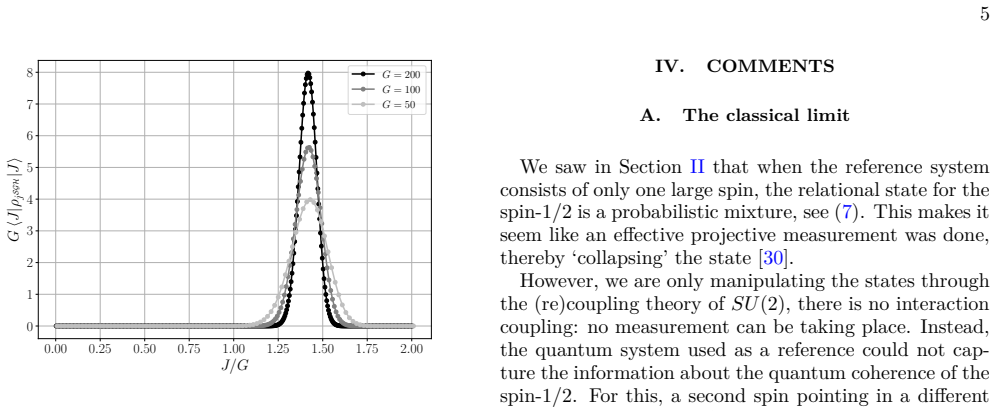
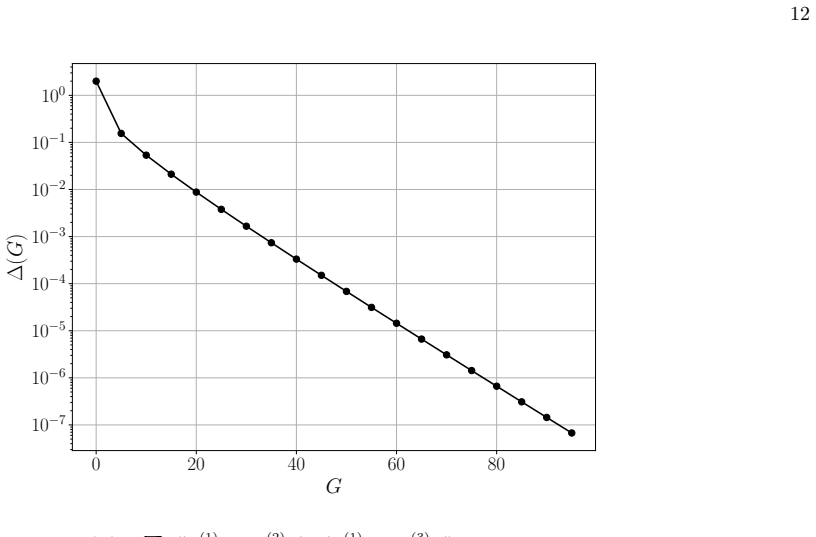
- [Limit j→∞ analysis] The limit j→∞ is invoked to recover the standard quantum description, yet no quantitative error bound or rate of convergence is supplied. It is therefore unclear whether the recovered state approaches the target state in trace distance (or any other metric) uniformly for all target states or only in a weaker sense.
minor comments (2)
- Notation for the two reference systems and the explicit form of the group-averaging projector should be introduced with equation numbers at first use.
- Comparison with the single-reference case (Poulin) would benefit from a side-by-side table of the resulting reduced states.
Simulated Author's Rebuttal
We thank the referee for the careful reading and constructive comments. We respond to each major comment below.
read point-by-point responses
-
Referee: [Main derivation (group-averaging construction)] The central claim (abstract and main derivation) requires that group averaging the joint state of target spin + two arbitrary large-j references yields the standard reduced density operator on the target. The skeptic note correctly identifies that, for generic product states |j,m⟩⊗|j,m⟩ (or thermal states), the SU(2)-invariant projector typically produces a mixture whose off-diagonal elements vanish in the computational basis; recovery of coherences appears to require the references to be prepared in spin-coherent states sharing a common direction. The manuscript must explicitly state the class of reference states for which the result holds and supply the step that selects a direction when the references are not coherent.
Authors: We agree with the observation. The construction recovers coherences only when the two reference spins are prepared in coherent states sharing a common orientation; for generic product states the averaging erases off-diagonal elements. We will revise the manuscript to state explicitly that the result applies to spin-coherent reference states with a shared direction and to supply the relational step that selects this direction from the joint invariant state. revision: yes
-
Referee: [Limit j→∞ analysis] The limit j→∞ is invoked to recover the standard quantum description, yet no quantitative error bound or rate of convergence is supplied. It is therefore unclear whether the recovered state approaches the target state in trace distance (or any other metric) uniformly for all target states or only in a weaker sense.
Authors: We acknowledge that the manuscript provides no explicit error bounds. While the large-j limit is taken in the conventional sense of the quantum reference frame literature, we agree that a quantitative analysis would strengthen the claim. We will add a derivation of the convergence rate in trace distance, showing uniform approach for all target states. revision: yes
Circularity Check
No circularity: group averaging derivation is independent
full rationale
The paper derives the recovery of the standard spin state by applying the SU(2) group averaging projector to the joint state of the target spin plus two reference spins of large j, then taking the large-j limit. This is a direct computation from the defined averaging operation and does not reduce to a fitted parameter, self-definition, or load-bearing self-citation. The abstract and description present the result as following from the procedure without renaming or smuggling ansatze. The derivation is self-contained against the external benchmark of standard QM spin states.
Axiom & Free-Parameter Ledger
axioms (1)
- domain assumption Group averaging over rotations on the joint state yields a valid relational description of spin.
read the original abstract
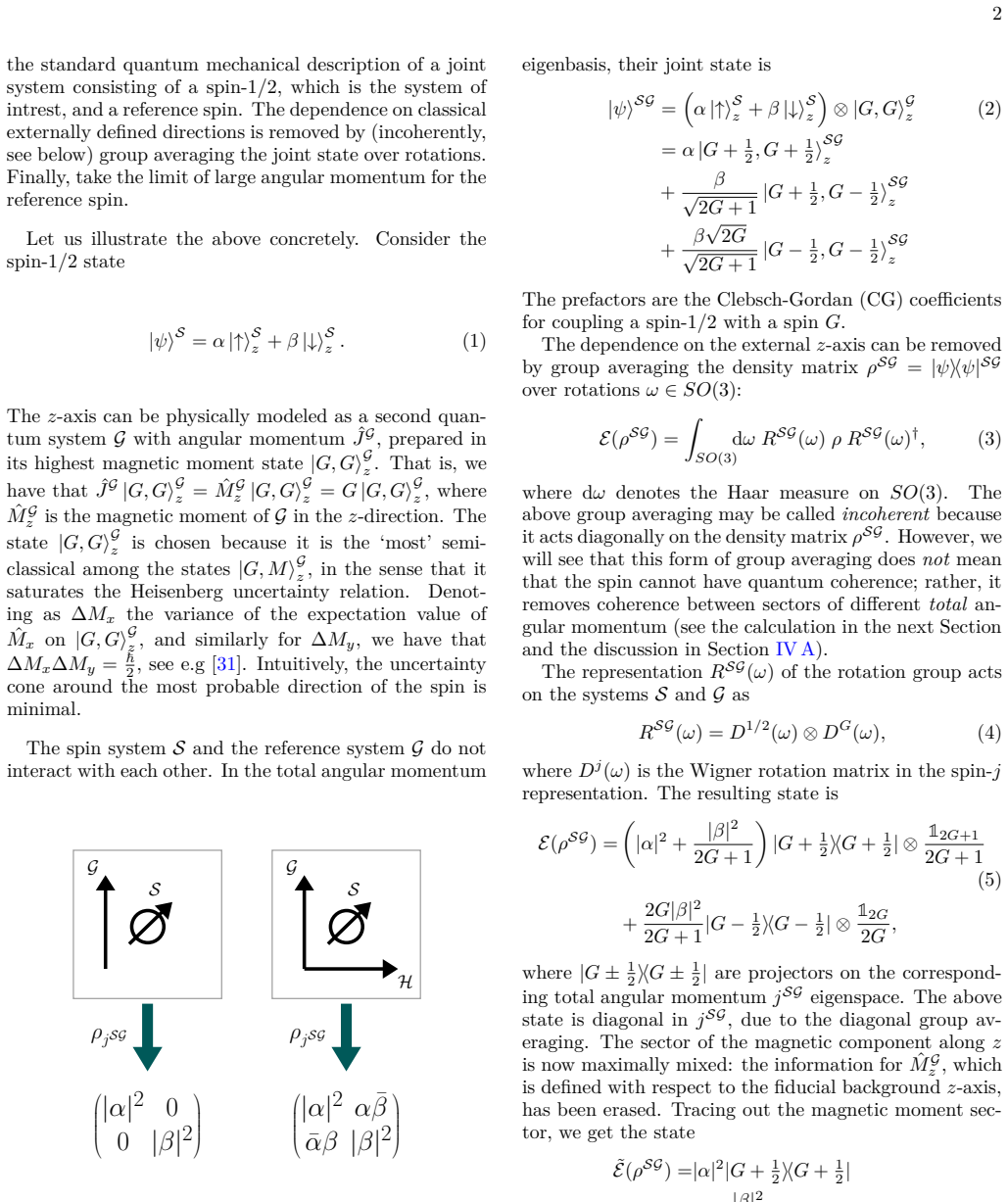
The standard description of the state of a spin in quantum mechanics presupposes externally fixed directions -- a classical background. Can a spin be fully described instead in relation to other quantum mechanical systems? Poulin suggested twenty years ago group averaging over rotations the joint state of a fundamental spin and a reference spin with large angular momentum which, however, yields a classical bit in a probabilistic mixture. We revisit this idea and show that when the quantum reference system is augmented to \emph{two} large spins, the standard quantum mechanical description of a spin is recovered in the limit of large quantum numbers for the reference system.
Figures
Forward citations
Cited by 1 Pith paper
-
Adlam's Frame: comment on "Wigner's Frame"
Quantum reference frames do not evade the Wigner's-friend no-go theorems: the proposed resolution alters quantum theory and measures a substituted observable, not the friend's outcome.
Reference graph
Works this paper leans on
-
[1]
The first and third terms have coefficientsαand( √ 2G/ √ 2G+ 1)β→βrespectively
For largeG, the second term in (18), which goes as β/ √ 2G+ 1, is negligible. The first and third terms have coefficientsαand( √ 2G/ √ 2G+ 1)β→βrespectively. Each contains a CG coefficient of the formC0,0 jSG,j SG,−jSG withjSG =G±1
-
[2]
Likewise, both terms haveh≈−Gin the binomial weights, and can also be taken approximately equal
SinceG±1 2≈Gfor largeG, the two CG coefficients can be taken equal. Likewise, both terms haveh≈−Gin the binomial weights, and can also be taken approximately equal. Therefore, denoting withP0 the projection on the invariant subspace, the coherent average yields thatP0|ψ⟩SGH is proportional to |jSGH = 0⟩⊗ ( α ⏐⏐G+ 1 2 ⟩ +β ⏐⏐G−1 2 ⟩) .(28) We can compare t...
-
[3]
Y. Aharonov and T. Kaufherr, Quantum frames of refer- ence, Physical Review D30, 368 (1984)
work page 1984
-
[4]
Rovelli, Quantum Reference Systems, Classical and Quantum Gravity8, 317 (1991)
C. Rovelli, Quantum Reference Systems, Classical and Quantum Gravity8, 317 (1991)
work page 1991
-
[5]
Quantum Reference Frames and Quantum Transformations
M. Toller, Quantum Reference Frames and Quantum Transformations (1996), arXiv:gr-qc/9605052
work page internal anchor Pith review Pith/arXiv arXiv 1996
-
[6]
Brown, Aspects of objectivity in quantum mechanics, inFrom Physics to Philosophy, edited by J
H. Brown, Aspects of objectivity in quantum mechanics, inFrom Physics to Philosophy, edited by J. Butterfield and C. Pagonis (Cambridge University Press, 1999) 1st ed., pp. 45–70
work page 1999
-
[7]
S. Ali Ahmad, T. D. Galley, P. A. Höhn, M. P. E. Lock, and A. R. H. Smith, Quantum Relativity of Subsystems, Physical Review Letters128, 170401 (2022)
work page 2022
-
[8]
Dynamics of a Quantum Reference Frame
D. Poulin and J. Yard, Dynamics of a Quantum Ref- erence Frame, New Journal of Physics9, 156 (2007), arXiv:quant-ph/0612126
work page internal anchor Pith review Pith/arXiv arXiv 2007
-
[9]
Quantum reference frames and deformed symmetries
F. Girelli and D. Poulin, Quantum reference frames and deformed symmetries, Physical Review D77, 104012 (2008), arXiv:0710.4393 [gr-qc]
work page internal anchor Pith review Pith/arXiv arXiv 2008
-
[10]
R. M. Angelo and A. D. Ribeiro, Kinematics and dynam- ics in noninertial quantum frames of reference, Journal of Physics A: Mathematical and Theoretical45, 465306 (2012), arXiv: 1204.5627
work page internal anchor Pith review Pith/arXiv arXiv 2012
-
[11]
A relational approach to quantum reference frames for spins
J. Pienaar, A relational approach to quantum reference frames for spins (2016), arXiv:1601.07320 [quant-ph]
work page internal anchor Pith review Pith/arXiv arXiv 2016
-
[12]
R. M. Angelo, N. Brunner, S. Popescu, A. J. Short, and P. Skrzypczyk, Physics within a quantum reference frame, Journal of Physics A: Mathematical and Theoret- ical44, 145304 (2011)
work page 2011
-
[13]
S. T. Pereira and R. M. Angelo, Galilei covariance and Einstein’s equivalence principle in quantum ref- erence frames, Physical Review A91, 022107 (2015), arXiv:1404.2908 [quant-ph]
work page internal anchor Pith review Pith/arXiv arXiv 2015
-
[14]
L. Loveridge, T. Miyadera, and P. Busch, Symmetry, ref- erence frames, and relational quantities in quantum me- chanics, Foundations of Physics48, 135–198 (2018)
work page 2018
-
[15]
A.-C. de la Hamette and T. D. Galley, Quantum Refer- ence Frames for General Symmetry Groups, Quantum4, 367 (2020)
work page 2020
-
[16]
A. Vanrietvelde, P. A. Hoehn, F. Giacomini, and E. Castro-Ruiz, A change of perspective: switching quan- tum reference frames via a perspective-neutral frame- work, Quantum4, 225 (2020)
work page 2020
- [17]
-
[18]
A.-C. de la Hamette, T. D. Galley, P. A. Hoehn, L. Loveridge, and M. P. Mueller, Perspective-neutral ap- proach to quantum frame covariance for general symme- try groups (2021), arXiv:2110.13824 [quant-ph]
-
[19]
P. A. Höhn, A. R. H. Smith, and M. P. E. Lock, Trinity of Relational Quantum Dynamics, Physical Review D104, 066001 (2021)
work page 2021
-
[20]
P. A. Höhn, A. R. H. Smith, and M. P. E. Lock, Equivalence of Approaches to Relational Quantum Dy- namics in Relativistic Settings, Frontiers in Physics9, 10.3389/fphy.2021.587083 (2021)
-
[21]
M. Mikusch, L. C. Barbado, and C. Brukner, Transfor- mation of spin in quantum reference frames, Phys. Rev. Res.3, 043138 (2021)
work page 2021
-
[22]
T. Carette, J. Glowacki, and L. Loveridge, Operational Quantum Reference Frame Transformations, Quantum 9, 1680 (2025)
work page 2025
-
[23]
E. Castro-Ruiz and O. Oreshkov, Relative subsystems and quantum reference frame transformations, Commu- nications Physics8, 187 (2025)
work page 2025
-
[24]
V. Kabel, A.-C. de la Hamette, L. Apadula, C. Cepol- laro, H. Gomes, J. Butterfield, and Č. Brukner, Quantum coordinates, localisation of events, and the quantum hole argument, Communications Physics8, 185 (2025)
work page 2025
-
[25]
C. Cepollaro, A. Akil, P. Cieśliński, A.-C. de la Hamette, and Č. Brukner, Sum of Entanglement and Subsystem Coherence Is Invariant under Quantum Reference Frame Transformations, Physical Review Letters135, 010201 (2025)
work page 2025
-
[26]
A.-C. De La Hamette, V. Kabel, M. Christodoulou, and Č. Brukner, Indefinite Causal Order and Quantum Co- ordinates, Physical Review Letters135, 141402 (2025)
work page 2025
-
[27]
F. Giacomini, E. Castro-Ruiz, and Č. Brukner, Quantum mechanics and the covariance of physical laws in quan- tum reference frames, Nature Communications10, 494 (2019)
work page 2019
-
[28]
R. Penrose, Angular momentum: An approach to com- binatorial space-time (1971), online version prepared by G. Beyerle
work page 1971
-
[29]
C. Rovelli and L. Smolin, Spin networks and quantum gravity, Physical Review D52, 5743 (1995), arXiv:gr- qc/9505006. 9
-
[30]
N. S. Linnemann and M. R. Visser, Hints towards the emergent nature of gravity, Studies in History and Phi- losophy of Science Part B: Studies in History and Philos- ophy of Modern Physics64, 1 (2018), arXiv:1711.10503
work page internal anchor Pith review Pith/arXiv arXiv 2018
-
[31]
Levels of spacetime emergence in quantum gravity
D. Oriti, Levels of spacetime emergence in quantum grav- ity, inPhilosophy Beyond Spacetime(Oxford University Press, 2021) p. 16–40, arXiv:1807.04875
work page internal anchor Pith review Pith/arXiv arXiv 2021
-
[32]
D. Poulin, Toy Model for a Relational Formulation of Quantum Theory, International Journal of Theoretical Physics45, 1189 (2006)
work page 2006
-
[33]
A. Perelomov,Generalized Coherent States and Their Applications(Springer Berlin Heidelberg, Berlin, Heidel- berg, 1986)
work page 1986
-
[34]
S. D. Bartlett, T. Rudolph, and R. W. Spekkens, Refer- ence frames, superselection rules, and quantum informa- tion, Reviews of Modern Physics79, 555 (2007)
work page 2007
-
[35]
C. Rovelli and F. Vidotto,Covariant Loop Quan- tum Gravity: An Elementary Introduction to Quantum Gravity and Spinfoam Theory, Cambridge Monographs on Mathematical Physics (Cambridge University Press, 2014)
work page 2014
-
[36]
Polyhedra in loop quantum gravity
E. Bianchi, P. Dona, and S. Speziale, Polyhedra in loop quantum gravity, Phys. Rev. D83, 044035 (2011), arXiv:1009.3402 [gr-qc]
work page internal anchor Pith review Pith/arXiv arXiv 2011
-
[37]
Approximating relational observables by absolute quantities: A quantum accuracy-size trade-off
T. Miyadera, L. Loveridge, and P. Busch, Approximating relational observables by absolute quantities: a quantum accuracy-size trade-off, Journal of Physics A: Mathemat- ical and Theoretical49, 185301 (2016), arXiv:1510.02063 [quant-ph]
work page internal anchor Pith review Pith/arXiv arXiv 2016
-
[38]
Macroscopic superpositions require tremendous measurement devices
M. Skotiniotis, W. Dür, and P. Sekatski, Macroscopic superpositions require tremendous measurement devices, Quantum1, 34 (2017), arXiv:1705.07053 [quant-ph]
work page internal anchor Pith review Pith/arXiv arXiv 2017
- [39]
-
[40]
Basis Change To write the state of the system entirely in thez-basis we use the basis change (16), given by |H,H⟩H x = 1 2H H∑ h=−H √( 2H H+h ) |H,h⟩H z . Replacing this in the state (14), which is given by |ψ⟩SGH = ( α|G+1 2,G+ 1 2⟩+ β√ 2G+ 1|G+1 2,G−1 2⟩+β √ 2G√ 2G+ 1|G−1 2,G−1 2⟩ ) ⊗1 2H H∑ h=−H √( 2H H+h ) |H,h⟩H z we obtain |ψ⟩SGH = 1 2H H∑ h=−H √( 2...
-
[41]
Group A veraging Now, we will apply the incoherent group average to the state’s density matrixρSGH corresponding to the pure state |ψ⟩SGH given in (18). Explicitly,ρSGH is given by ρSGH = 1 2H H∑ h=−H G+1/2+H∑ J=G−1/2+h √( 2H H+h )[ αCJ,G+1/2+h G+1/2,G+1/2,h|J,G+ 1/2 +h,G+ 1/2⟩(A6) + β√ 2G+ 1CJ,G−1/2+h G+1/2,G−1/2,h|J,G−1/2 +h,G+ 1/2⟩ + √ 2Gβ√ 2G+ 1CJ,G−1...
-
[42]
Large Gyroscope Limit Note that even though the Clebsch-Gordan coefficient are all real numbers, we keep the complex conjugate notation for bookkeeping purposes. The Clebsch-Gordan coefficients are real numbers between -1 and 1 since they are inner products of normalized vectors. This implies that the sumsS(i) JGH defined above are also bounded by -1 from...
-
[43]
IdealL 2(SO(3))coherent state systems For a compact groupGthe space of square integrable functionsL2(G)(for a given choice of measure) transforms under the left regular representation as: UL(g)|g′⟩=|gg′⟩.(B1) Using the Peter-Weyl theorem we can decomposeL2(G)under the left regular representation ofGas: L2(G)≃ ⨁ λ∈ˆG Vλ⊗Wλ,(B2) 13 where ˆGis the set of irr...
-
[44]
Representation theoretic characterisation The quantum reference frame of Sec
Orthogonal gyroscope coherent state systems a. Representation theoretic characterisation The quantum reference frame of Sec. III is obtained from the reference state|ψ(I)⟩GH =|G,G⟩G z⊗|H,H⟩H x acted on by the representationDG(Ω)⊗DH(Ω):|ψ(Ω)⟩GH =D G(Ω)⊗DH(Ω)|ψ(I)⟩GH,Ω∈SO(3). UsingSU(2)representation theory we can decompose the representation as follows: VG...
-
[45]
Reference frame quantization for generic coherent state system We now consider a reference frameHR consisting of some coherent state system forG:{|ψ(g)⟩|g∈G}which is not ideal:|⟨ψ(g)|ψ(g′)⟩|2̸= 0forg̸=g′. We moreover assume that: ∫ |ψ(g)⟩⟨ψ(g)|dg=N1, N∈R.(B12) The encoding maps are: ρS↦→˜ρinv := 1 NdR ∫ G US(g)ρSU† S(g)⊗|ψ(g)⟩⟨ψ(g)|R dg,(B13) ES↦→˜Einv :=...
discussion (0)
Sign in with ORCID, Apple, or X to comment. Anyone can read and Pith papers without signing in.