Reconstruction of detector error model for quantum error correction
Pith reviewed 2026-06-27 04:14 UTC · model grok-4.3
The pith
CAHR reconstructs the exact fault hypergraph from quantum syndrome statistics without false positives.
A machine-rendered reading of the paper's core claim, the machinery that carries it, and where it could break.
Core claim
By coupling exact algebraic correlation equations with a top-down concurrent-pruning strategy, the CAHR algorithm inverts experimental syndrome statistics directly into discrete physical hypergraphs and recovers the fault topology without false positives for both d=5 rotated surface codes and dense 8-body 2D color codes.
What carries the argument
The CAHR algorithm, which performs globally consistent inversion of syndrome statistics into hypergraphs by solving algebraic correlation equations followed by concurrent pruning.
If this is right
- The recovered fault topology can be used as input for subsequent continuous probability optimization.
- Exact continuous parameter extraction remains limited by a variance cascade that accumulates from high- to low-degree mechanisms.
- The two-stage paradigm of topology extraction followed by probability fitting applies to highly correlated noise in realistic hardware.
- The method works for both rotated surface codes and dense 2D color codes.
Where Pith is reading between the lines
- The variance-cascade observation implies that topology recovery should be performed before any probability fitting step in inference pipelines.
- If the algebraic equations remain invertible, the approach could be tested on additional code families or experimental data sets.
- Successful topology recovery opens the possibility of feeding the hypergraph directly into existing decoder software for improved performance.
Load-bearing premise
Syndrome statistics can be exactly inverted using algebraic correlation equations coupled with top-down concurrent pruning to recover true physical mechanisms without introducing unphysical false positives.
What would settle it
Running the algorithm on the d=5 rotated surface code or 8-body color code benchmarks and finding any false-positive faults in the output hypergraph would falsify the no-false-positives claim.
Figures
read the original abstract
Fault-tolerant quantum computing fundamentally relies on the accurate characterization of circuit-level noise to optimize decoding algorithms. However, extracting complex multi-body error correlations remains challenging. Contemporary greedy inference algorithms can suffer from statistical distortion, discarding true physical mechanisms while introducing many unphysical false positives. Here, we introduce the Correlation-Analysis-based Hypergraph Reconstruction (CAHR) algorithm, a globally consistent framework to invert experimental syndrome statistics directly into discrete physical hypergraphs. By coupling exact algebraic correlation equations with a top-down concurrent-pruning strategy, CAHR recovers the fault topology without false positives for both $d=5$ rotated surface codes and dense 8-body 2D color codes in our benchmark settings. Furthermore, we show that exact continuous parameter extraction in dense codes is limited by a \textit{variance cascade}, where absolute statistical variance accumulates linearly from high- to low-degree mechanisms. This motivates a two-stage inference paradigm: utilizing CAHR to extract the fault topology, followed by continuous probability optimization. This provides a practical approach for characterizing and decoding highly correlated noise in realistic quantum hardware.
Editorial analysis
A structured set of objections, weighed in public.
Referee Report
Summary. The manuscript introduces the Correlation-Analysis-based Hypergraph Reconstruction (CAHR) algorithm, which inverts experimental syndrome statistics into discrete physical hypergraphs representing fault topologies in quantum error correction. It claims that coupling exact algebraic correlation equations with a top-down concurrent-pruning strategy recovers the fault topology without false positives for both d=5 rotated surface codes and dense 8-body 2D color codes in the reported benchmarks. The work further identifies a variance cascade that limits exact continuous parameter extraction in dense codes and motivates a two-stage inference paradigm (topology recovery via CAHR followed by continuous probability optimization).
Significance. If the central claims hold, the work supplies a globally consistent inversion method that avoids the statistical distortions and false positives of greedy algorithms, offering a practical route to characterizing complex multi-body correlations in realistic quantum hardware. The explicit benchmarks on two distinct code families and the variance-cascade observation that grounds the two-stage paradigm are concrete strengths.
minor comments (2)
- [Abstract] Abstract: the phrase 'in our benchmark settings' is used without enumerating the underlying noise models, number of syndrome samples, or exact code distances beyond the stated d=5; adding these details would strengthen the reproducibility of the zero-false-positive claim.
- The term 'variance cascade' is introduced as a limiting phenomenon but would benefit from an explicit equation or short derivation showing how absolute statistical variance accumulates linearly from high- to low-degree mechanisms.
Simulated Author's Rebuttal
We thank the referee for their positive summary, significance assessment, and recommendation of minor revision. The report highlights the strengths of the CAHR algorithm in providing globally consistent inversion without false positives and the variance-cascade observation motivating the two-stage paradigm. No specific major comments are listed in the report.
Circularity Check
No significant circularity detected in derivation chain
full rationale
The paper introduces the CAHR algorithm that couples exact algebraic correlation equations with top-down concurrent pruning to invert syndrome statistics into discrete hypergraphs representing fault topology. The central claim of zero false positives on d=5 rotated surface codes and dense 8-body 2D color codes is presented as an empirical benchmark outcome rather than a definitional reduction, and the variance cascade observation is used only to motivate the subsequent continuous optimization stage. No self-definitional equations, fitted inputs renamed as predictions, load-bearing self-citations, or imported uniqueness theorems appear in the abstract or described method; the derivation remains self-contained against the stated external benchmarks.
Axiom & Free-Parameter Ledger
axioms (1)
- domain assumption Syndrome statistics admit exact algebraic correlation equations that map directly to discrete physical hypergraphs
Reference graph
Works this paper leans on
-
[1]
Introduction The realization of fault-tolerant quantum computing relies on Quantum Error Correction (QEC) to actively protect quan- tum information from environmental decoherence and opera- tional imperfections [1–3]. A central bottleneck in this pur- suit is the precise characterization of complex, circuit-level noise to provide high-quality prior inform...
Pith/arXiv arXiv 2026
-
[2]
ghost cliques
Methodology In realistic fault-tolerant quantum computing, conventional qubit-level Pauli error models are often insufficient to capture the intricate, correlated fault dynamics introduced by noisy syndrome extraction circuits. To accurately characterize these processes, the Detector Error Model (DEM) is widely adopted [5, 18, 19]. A DEM formalizes the pr...
-
[3]
Given DEM Topology
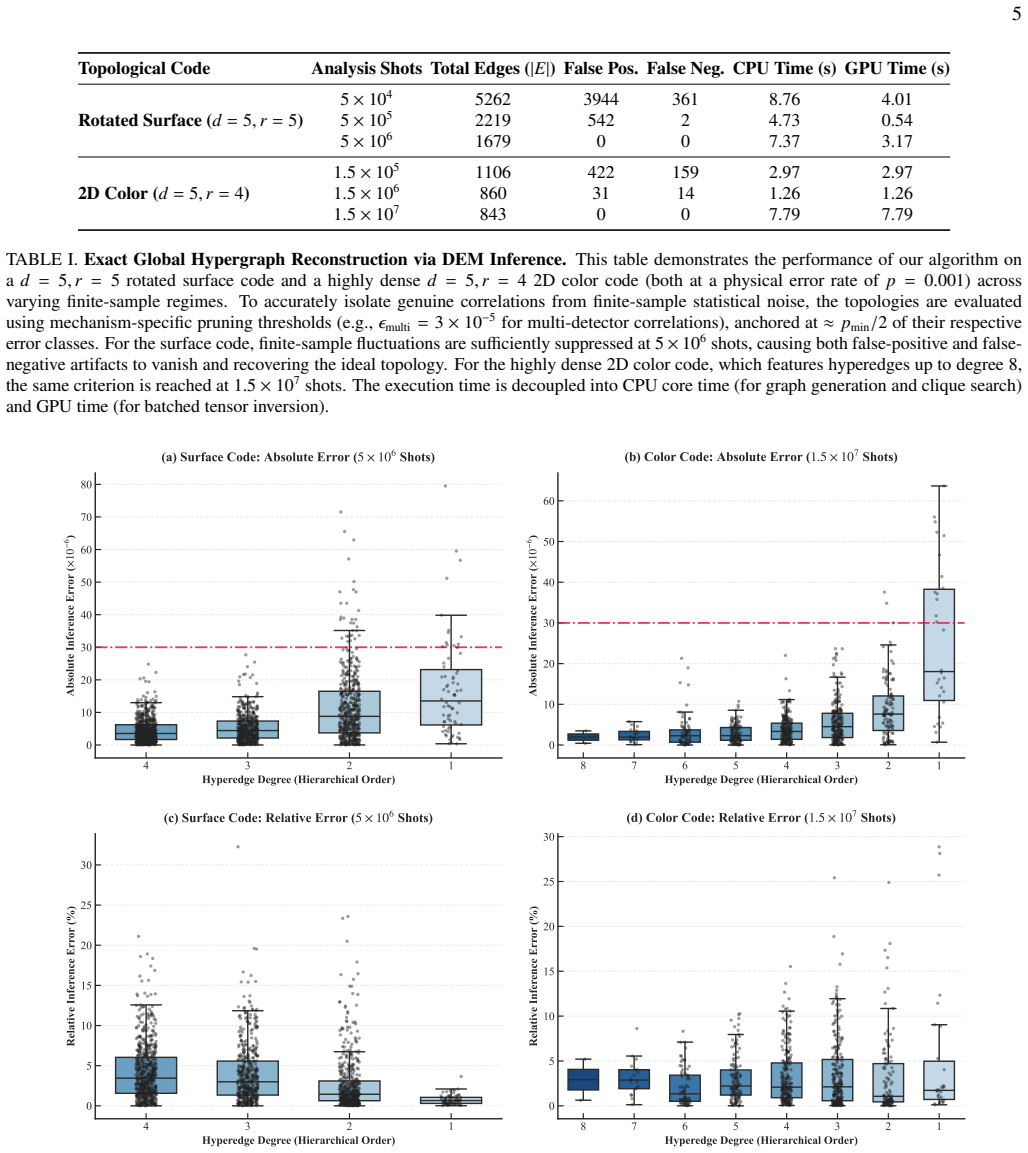
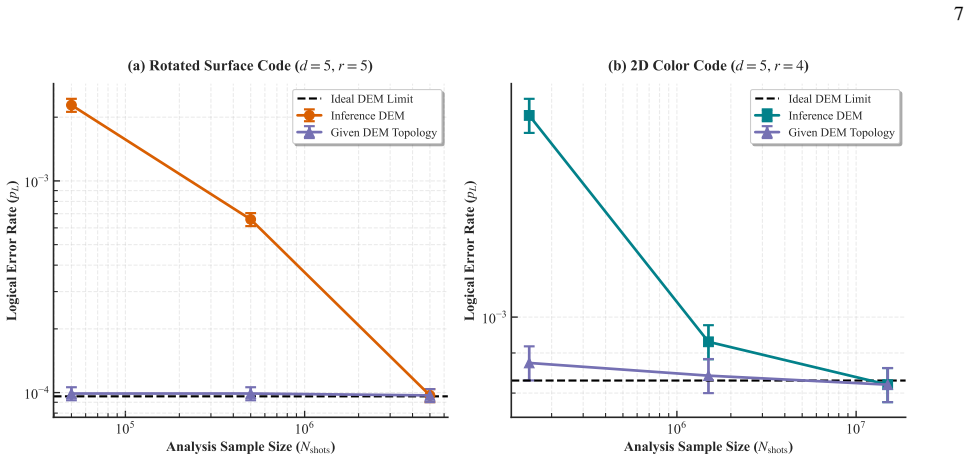
Results 3.1. Global Topological Reconstruction via Correlation Analysis To establish the structural exactness of our framework, we first evaluate its capacity to reconstruct the complete phys- ical hypergraphs of distinct topological codes from raw ex- perimental statistics, which are efficiently generated using the high-performance stabilizer simulator S...
-
[4]
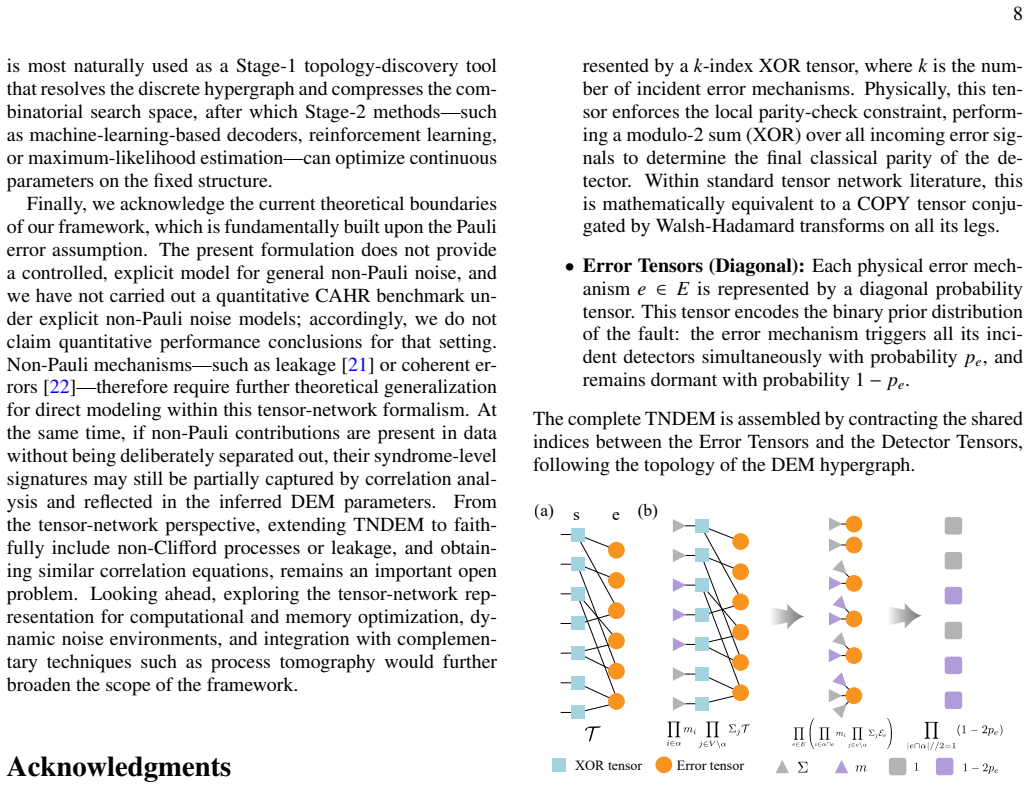
Discussion In this work, we use a Tensor Network Detector Er- ror Model (TNDEM) representation as a structured frame- work for organizing DEM correlation equations and intro- duce the Correlation-Analysis-based Hypergraph Reconstruc- tion (CAHR) algorithm for topology discovery, which is a top-down workflow that combines permissive candidate gen- eration ...
2071
-
[5]
M. A. Nielsen and I. L. Chuang,Quantum Computation and Quantum Information, 10th ed. (Cambridge University Press, 2010)
2010
-
[6]
B. M. Terhal, Rev. Mod. Phys.87, 307 (2015)
2015
-
[7]
E. T. Campbell, B. M. Terhal, and C. Vuillot, Nature549, 172 (2017)
2017
-
[8]
S. T. Spitz, B. Tarasinski, C. W. J. Beenakker, and T. E. O’Brien, Advanced Quantum Technologies1, 1800012 (2018)
2018
-
[9]
Gidney, Quantum5, 497 (2021)
C. Gidney, Quantum5, 497 (2021)
2021
-
[10]
Dennis, A
E. Dennis, A. Kitaev, A. Landahl, and J. Preskill, Journal of Mathematical Physics43, 4452 (2002)
2002
-
[11]
A. G. Fowler, M. Mariantoni, J. M. Martinis, and A. N. Cleland, Phys. Rev. A86, 032324 (2012)
2012
-
[12]
Bombin and M
H. Bombin and M. A. Martin-Delgado, Phys. Rev. Lett.97, 180501 (2006)
2006
-
[13]
Harper, S
R. Harper, S. T. Flammia, and J. J. Wallman, Nature Physics16, 1184 (2020)
2020
-
[14]
Takou and K
E. Takou and K. R. Brown, Phys. Rev. A112, 052414 (2025)
2025
-
[15]
A. Remm, N. Lacroix, L. B ¨odeker, E. Genois, C. Hellings, F. m. c. Swiadek, G. J. Norris, C. Eichler, A. Blais, M. M ¨uller, S. Krinner, and A. Wallraff, Phys. Rev. Res.8, 013044 (2026)
2026
-
[16]
R. Blume-Kohout and K. C. Young, arXiv preprint (2025), arXiv:2504.14643 [quant-ph]
arXiv 2025
-
[17]
K. E. Arms, M. J. McHugh, J. E. Nyhan, W. F. Reus, and J. L. Ulrich, arXiv preprint (2026), arXiv:2512.10814 [quant-ph]
arXiv 2026
-
[18]
Panteleev and G
P. Panteleev and G. Kalachev, Quantum5, 585 (2021)
2021
-
[19]
Roffe, D
J. Roffe, D. R. White, S. Burton, and E. Campbell, Phys. Rev. Res.2, 043423 (2020)
2020
-
[20]
Wagner, H
T. Wagner, H. Kampermann, D. Bruß, and M. Kliesch, Phys. Rev. Lett.130, 200601 (2023)
2023
-
[21]
V . Sivak, A. Morvan, M. Broughton, R. G. Corti˜nas, J. Bausch, A. W. Senior, M. Neeley, A. Eickbusch, N. Shutty, L. A. Beni, J. S. Spencer, F. J. H. Heras, T. Edlich, D. Abanin, A. Abbas, R. Acharya, G. Aigeldinger, R. Alcaraz, S. Alcaraz, T. I. Ander- sen, M. Ansmann, F. Arute, K. Arya, W. Askew, N. Astrakhant- sev, J. Atalaya, B. Ballard, J. C. Bardin,...
Pith/arXiv arXiv 2026
-
[22]
Higgott and C
O. Higgott and C. Gidney, Quantum9, 1600 (2025)
2025
-
[23]
McEwen, D
M. McEwen, D. Bacon, and C. Gidney, Quantum7, 1172 (2023)
2023
-
[24]
Higgott, stimbposd (2024)
O. Higgott, stimbposd (2024)
2024
-
[25]
McEwen, D
M. McEwen, D. Kafri, Z. Chen, J. Atalaya, K. J. Satzinger, C. Quintana, P. V . Klimov, D. Sank, C. Gidney, A. G. Fowler, F. Arute, K. Arya, B. Buckley, B. Burkett, N. Bushnell, B. Chiaro, R. Collins, S. Demura, A. Dunsworth, C. Erickson, B. Foxen, M. Giustina, T. Huang, S. Hong, E. Jeffrey, S. Kim, K. Kechedzhi, F. Kostritsa, P. Laptev, A. Megrant, X. Mi,...
2021
-
[26]
A. S. Darmawan and D. Poulin, Phys. Rev. Lett.119, 040502 (2017)
2017
-
[27]
Ye, Source code for Correlation-Analysis-based Hypergraph Reconstruction (CAHR) (2026)
C. Ye, Source code for Correlation-Analysis-based Hypergraph Reconstruction (CAHR) (2026)
2026
-
[28]
Piveteau, C
C. Piveteau, C. T. Chubb, and J. M. Renes, PRX Quantum5, 040303 (2024)
2024
discussion (0)
Sign in with ORCID, Apple, or X to comment. Anyone can read and Pith papers without signing in.