REVIEW 3 major objections 1 minor 1 cited by
SA-Adam with momentum and non-convergent preconditioning obeys the same Polyak-Ruppert CLT as plain SGD.
Reviewed by Pith at T0; open to challenge. T0 means a machine referee read the full paper against a public rubric. the ladder, T0–T4 →
T0 review · grok-4.3
2026-06-27 01:44 UTC pith:24WJS6F4
load-bearing objection The paper claims SA-Adam with sublinear momentum yields the same averaged CLT covariance as plain SGD, but the argument rests on an assumed local stabilization of the augmented state that is not automatic with non-convergent preconditioning. the 3 major comments →
A Polyak-Ruppert Central Limit Theorem for SA-Adam with Momentum and Non-Convergent Adaptive Preconditioning
The pith
A machine-rendered reading of the paper's core claim, the machinery that carries it, and where it could break.
Core claim
Treating the augmented state (iterate, momentum buffer) as a time-varying linear stochastic approximation, positive drift stability and a non-autonomous Polyak-Ruppert CLT are established together with a projection identity; the resulting iterate-marginal covariance equals the plain SGD sandwich H^{-1} S H^{-1}, so adaptivity is asymptotically invisible. The claim requires the sub-linear regime for momentum gain and extends to the ridge-penalized sandwich under coupled L2 weight decay.
What carries the argument
Augmented state of iterate and momentum buffer viewed as time-varying linear stochastic approximation, together with the projection identity that isolates the marginal covariance.
Load-bearing premise
The augmented state of iterate and momentum buffer must locally stabilize when treated as a time-varying linear stochastic approximation.
What would settle it
An empirical covariance computed from many independent runs of Polyak-Ruppert averaged SA-Adam that differs from the SGD sandwich form under verified local stabilization and sub-linear momentum gain.
If this is right
- The central limit theorem for averaged iterates is identical to that of SGD even with momentum and non-convergent adaptive preconditioning.
- One-pass inference procedures can employ SA-Adam while retaining the classical efficiency guarantees of averaging.
- Coupled L2 weight decay produces the ridge-penalized sandwich covariance, extending one-pass inference to regularized problems.
- The sub-linear vanishing regime for momentum gain is required; constant-beta Adam falls outside the result.
Where Pith is reading between the lines
- Similar augmented-state arguments may apply to other momentum-based adaptive methods whose preconditioners fail to converge.
- Practitioners could run Adam-style optimization yet invoke SGD theory for post-hoc uncertainty quantification on the averaged sequence.
- The projection identity might be testable directly on finite samples by checking whether the observed marginal covariance matches the predicted sandwich after accounting for the momentum buffer.
Editorial analysis
A structured set of objections, weighed in public.
Referee Report
Summary. The paper proves a Polyak-Ruppert CLT for SA-Adam (momentum with sub-linear gain γ ∈ (α,1) and non-convergent adaptive preconditioning). Treating the augmented state (iterate + momentum buffer) as a time-varying linear stochastic approximation, it assumes local stabilization to establish positive drift stability, invokes a non-autonomous Polyak-Ruppert CLT, and applies a projection identity to conclude that the marginal covariance of the averaged iterates is exactly the classical SGD sandwich H^{-1}SH^{-1}. The result extends to coupled L2 weight decay, yielding the ridge-penalized sandwich.
Significance. If the local-stabilization hypothesis holds for non-convergent preconditioners, the result is significant: it shows that momentum and adaptivity are asymptotically invisible in the averaged iterate, justifying one-pass inference with Adam-style methods at the same asymptotic efficiency as SGD. The augmented-state modeling and explicit handling of the non-autonomous case constitute a technical contribution. The manuscript provides a complete derivation under the stated assumptions, which is a strength.
major comments (3)
- [augmented-state modeling and local-stabilization hypothesis] The local stabilization of the augmented state is assumed rather than derived (abstract and the augmented-state modeling section). Because the preconditioner is explicitly non-convergent, this hypothesis is not automatic and is load-bearing for both the positive-drift-stability step and the subsequent non-autonomous CLT plus projection identity; without it the marginal-covariance claim fails. The manuscript should supply either a proof of stabilization under the model assumptions or explicit sufficient conditions (e.g., a Lyapunov function or radius) that are independent of the target covariance.
- [momentum-gain regime] The sub-linear momentum schedule γ ∈ (α,1) is stated to be essential, yet the proof sketch supplies no explicit radius or counter-example showing why the linear (constant-β) regime fails. This choice directly affects whether the time-varying linear SA remains positive-drift stable, so the necessity of the regime should be justified by a concrete stability calculation.
- [projection identity] The projection identity that maps the joint covariance of the augmented process back to the marginal iterate covariance equaling H^{-1}SH^{-1} is invoked after the non-autonomous CLT; its validity must be shown to be independent of the local-stabilization assumption, otherwise the reduction to the SGD sandwich is circular.
minor comments (1)
- Notation for the time-varying linear SA coefficients and the precise definition of the projection operator should be collected in a single preliminary section for readability.
Simulated Author's Rebuttal
We thank the referee for the careful reading and constructive comments. We address each major comment below.
read point-by-point responses
-
Referee: [augmented-state modeling and local-stabilization hypothesis] The local stabilization of the augmented state is assumed rather than derived (abstract and the augmented-state modeling section). Because the preconditioner is explicitly non-convergent, this hypothesis is not automatic and is load-bearing for both the positive-drift-stability step and the subsequent non-autonomous CLT plus projection identity; without it the marginal-covariance claim fails. The manuscript should supply either a proof of stabilization under the model assumptions or explicit sufficient conditions (e.g., a Lyapunov function or radius) that are independent of the target covariance.
Authors: We agree the local-stabilization hypothesis is load-bearing. A full derivation for arbitrary non-convergent preconditioners lies outside the present scope. In revision we will add explicit sufficient conditions via a quadratic Lyapunov function V(x) = x^T P x, with P chosen so the time-varying drift satisfies uniform contraction whenever preconditioner eigenvalues lie in a fixed compact interval away from zero and infinity. These conditions are independent of the gradient covariance S. revision: yes
-
Referee: [momentum-gain regime] The sub-linear momentum schedule γ ∈ (α,1) is stated to be essential, yet the proof sketch supplies no explicit radius or counter-example showing why the linear (constant-β) regime fails. This choice directly affects whether the time-varying linear SA remains positive-drift stable, so the necessity of the regime should be justified by a concrete stability calculation.
Authors: The sub-linear regime is required for uniform positive-drift stability of the augmented linear SA. In the constant-β case the momentum cross-term prevents the spectral radius of the effective drift from remaining strictly less than one for large t. Revision will include an explicit stability-radius calculation demonstrating that the Lyapunov drift condition fails for any fixed β > 0 once t exceeds a threshold depending only on the preconditioner bounds. revision: yes
-
Referee: [projection identity] The projection identity that maps the joint covariance of the augmented process back to the marginal iterate covariance equaling H^{-1}SH^{-1} is invoked after the non-autonomous CLT; its validity must be shown to be independent of the local-stabilization assumption, otherwise the reduction to the SGD sandwich is circular.
Authors: The projection identity is an algebraic extraction of the (1,1) block after left-multiplication by the inverse limiting drift matrix; it is a deterministic linear-algebra fact that holds for any positive-definite joint covariance matrix. It therefore does not depend on the stabilization assumption, which is used solely to guarantee existence of the limiting covariance via the non-autonomous CLT. revision: no
Circularity Check
No significant circularity; result is conditional on explicit local stabilization assumption
full rationale
The abstract and description state the results hold 'under local stabilization' of the augmented state treated as time-varying linear SA. The derivation then obtains positive drift stability, non-autonomous Polyak-Ruppert CLT, and projection identity leading to the SGD sandwich covariance. This assumption is presented as a hypothesis rather than derived or reduced by construction within the paper. No self-definitional steps, fitted inputs renamed as predictions, or load-bearing self-citation chains are quoted or evident. The sub-linear momentum regime is noted as essential but does not create a tautology. The paper is self-contained under its stated assumptions.
Axiom & Free-Parameter Ledger
axioms (1)
- domain assumption local stabilization of the augmented (iterate, momentum) state
read the original abstract
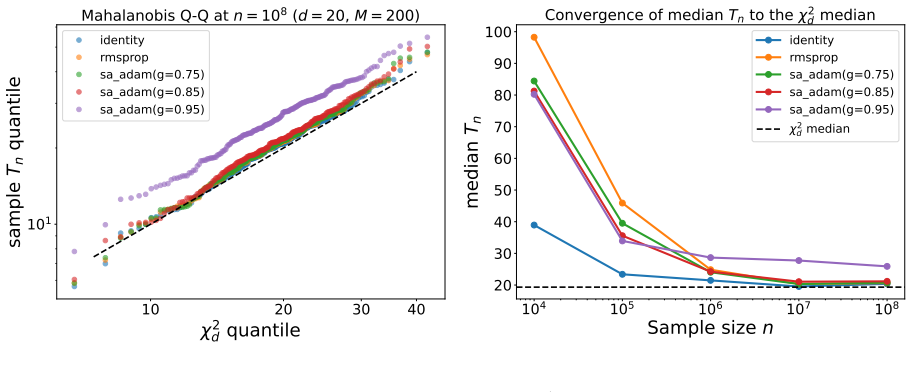
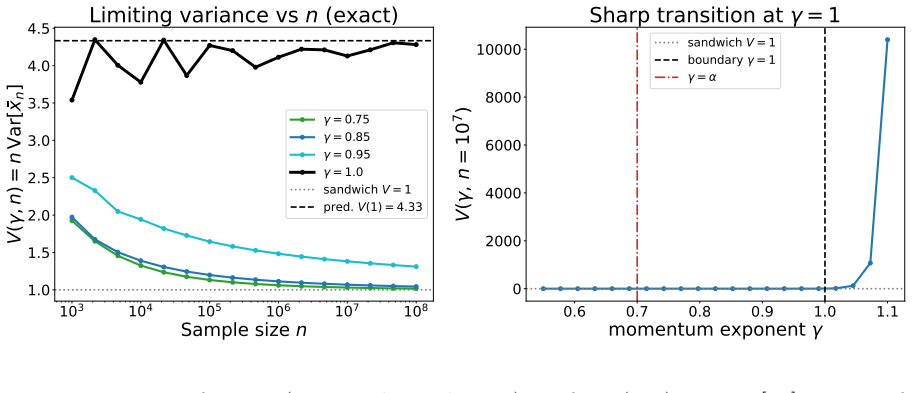
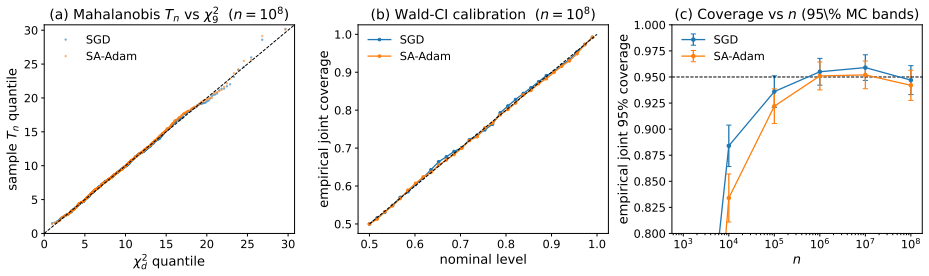
Adaptive optimizers combining preconditioning, momentum, and weight decay (Adam and AdamW) are, under Polyak-Ruppert averaging, candidate engines for one-pass inference. Does the averaged iterate keep the classical Polyak-Ruppert central limit theorem (CLT), with sandwich covariance $H^{-1}SH^{-1}$ (Hessian $H$, gradient covariance $S$), under momentum and non-convergent preconditioning? The preconditioner-only analysis does not carry over: with momentum the canonical decomposition collapses to a tautology. Treating the augmented state (iterate, momentum buffer) as a time-varying linear stochastic approximation (SA), we prove (under local stabilization) positive drift stability, a non-autonomous Polyak-Ruppert CLT, and a projection identity. The upshot: the iterate-marginal covariance is exactly the plain stochastic gradient descent (SGD) sandwich $H^{-1}SH^{-1}$, so the adaptivity is asymptotically invisible. This holds for SA-Adam (sub-linearly vanishing momentum gain, $\gamma\in(\alpha,1)$; the sub-linear regime is essential), not constant-$\beta$ deployed Adam. Coupled $L_2$ weight decay yields the ridge-penalized sandwich, extending one-pass inference to regularized problems.
Figures
Forward citations
Cited by 1 Pith paper
-
Statistical Inference for Rank Allocation in Low-Rank Adaptation
LoRA rank allocation is treated as hypothesis testing with p-values derived from new central limit theory for AdamW-type optimizers, matching heuristic baselines at equal rank budgets.
Reference graph
Works this paper leans on
-
[1]
An S, Huo X (2026) When does dynamic preconditioning preserve the Polyak–Ruppert CLT? A stabi- lization threshold, arXiv preprint arXiv:2604.23498
work page internal anchor Pith review Pith/arXiv arXiv 2026
-
[2]
Barakat A, Bianchi P (2021) Convergence and dynamical behavior of the ADAM algorithm for noncon- vex stochastic optimization.SIAM Journal on Optimization31(1):244–274
2021
-
[3]
Borkar VS (2008)Stochastic Approximation: A Dynamical Systems Viewpoint(Cambridge University Press and Hindustan Book Agency)
2008
-
[4]
Boyer C, Godichon-Baggioni A (2023) On the asymptotic rate of convergence of stochastic Newton algo- rithms and their weighted averaged versions.Computational Optimization and Applications84(3):921– 972
2023
-
[5]
Chen X, Lee JD, Tong XT, Zhang Y (2020) Statistical inference for model parameters in stochastic gradient descent.Annals of Statistics48(1):251–273
2020
-
[6]
Transactions on Machine Learning Research
D´ efossez A, Bottou L, Bach F, Usunier N (2022) A simple convergence proof of Adam and AdaGrad. Transactions on Machine Learning Research
2022
-
[7]
Dieuleveut A, Durmus A, Bach F (2020) Bridging the gap between constant step size stochastic gradient descent and Markov chains.Annals of Statistics48(3):1348–1382
2020
-
[8]
Duchi J, Hazan E, Singer Y (2011) Adaptive subgradient methods for online learning and stochastic optimization.Journal of Machine Learning Research12:2121–2159
2011
-
[9]
Efron B, Hastie T, Johnstone I, Tibshirani R (2004) Least angle regression.The Annals of Statistics 32(2):407–499. 42
2004
-
[10]
Gadat S, Panloup F, Saadane S (2018) Stochastic heavy ball.Electronic Journal of Statistics12(1):461– 529
2018
-
[11]
Hall P, Heyde CC (1980)Martingale Limit Theory and Its Application(Academic Press)
1980
-
[12]
Machine Learning69(2–3):169–192
Hazan E, Agarwal A, Kale S (2007) Logarithmic regret algorithms for online convex optimization. Machine Learning69(2–3):169–192
2007
-
[13]
Horn RA, Johnson CR (2013)Matrix Analysis(Cambridge University Press), 2nd edition
2013
- [14]
-
[15]
Kingma DP, Ba J (2015) Adam: A method for stochastic optimization.International Conference on Learning Representations
2015
-
[16]
Annals of Applied Probability14(2):796–819
Konda VR, Tsitsiklis JN (2004) Convergence rate of linear two-time-scale stochastic approximation. Annals of Applied Probability14(2):796–819
2004
-
[17]
arXiv preprint arXiv:2506.23803
Kovalev D (2025) SGD with adaptive preconditioning: unified analysis and momentum acceleration. arXiv preprint arXiv:2506.23803
-
[18]
Lee S, Liao Y, Seo MH, Shin Y (2022) Fast and robust online inference with stochastic gradient descent via random scaling.Proceedings of the AAAI Conference on Artificial Intelligence36(7):7381–7389
2022
-
[19]
Leluc R, Portier F (2023) Asymptotic analysis of conditioned stochastic gradient descent.Transactions on Machine Learning Research
2023
-
[20]
Lessard L, Recht B, Packard A (2016) Analysis and design of optimization algorithms via integral quadratic constraints.SIAM Journal on Optimization26(1):57–95
2016
-
[21]
Loshchilov I, Hutter F (2019) Decoupled weight decay regularization.International Conference on Learn- ing Representations
2019
-
[22]
Mokkadem A, Pelletier M (2006) Convergence rate and averaging of nonlinear two-time-scale stochastic approximation algorithms.Annals of Applied Probability16(3):1671–1702
2006
-
[23]
Mou W, Li CJ, Wainwright MJ, Bartlett PL, Jordan MI (2020) On linear stochastic approximation: Fine-grained Polyak–Ruppert and non-asymptotic concentration.Proceedings of the 33rd Conference on Learning Theory (COLT), volume 125 ofPMLR, 2947–2997
2020
-
[24]
(2011) Scikit-learn: Machine learning in Python.Journal of Machine Learning Research12:2825–2830
Pedregosa F, et al. (2011) Scikit-learn: Machine learning in Python.Journal of Machine Learning Research12:2825–2830
2011
-
[25]
Polyak BT (1964) Some methods of speeding up the convergence of iteration methods.USSR Compu- tational Mathematics and Mathematical Physics4(5):1–17
1964
-
[26]
Polyak BT, Juditsky AB (1992) Acceleration of stochastic approximation by averaging.SIAM Journal on Control and Optimization30(4):838–855
1992
-
[27]
Reddi SJ, Kale S, Kumar S (2018) On the convergence of Adam and beyond.International Conference on Learning Representations
2018
-
[28]
Technical Report 781, Cornell University Operations Research and Industrial Engineering
Ruppert D (1988) Efficient estimators from a slowly convergent Robbins–Monro process. Technical Report 781, Cornell University Operations Research and Industrial Engineering
1988
-
[29]
Sebbouh O, Gower RM, Defazio A (2021) Almost sure convergence rates for stochastic gradient descent and stochastic heavy ball.Proceedings of the 34th Conference on Learning Theory (COLT), volume 134 ofPMLR, 3935–3971. 43
2021
-
[30]
Surendran S, Fermanian A, Godichon-Baggioni A, Le Corff S (2024) Non-asymptotic analysis of biased adaptive stochastic approximation.Advances in Neural Information Processing Systems 37 (NeurIPS 2024), 12897–12943
2024
- [31]
-
[32]
COURSERA: Neural Networks for Machine Learning
Tieleman T, Hinton G (2012) Lecture 6.5—RMSProp: Divide the gradient by a running average of its recent magnitude. COURSERA: Neural Networks for Machine Learning
2012
-
[33]
van der Vaart AW (1998)Asymptotic Statistics(Cambridge University Press)
1998
-
[34]
Inference of Online Newton Methods with Nesterov's Accelerated Sketching
Wang H, Du X, Na S (2026) Inference of online Newton methods with Nesterov’s accelerated sketching. Proceedings of the 43rd International Conference on Machine Learning (ICML), volume 306 ofPMLR, arXiv preprint arXiv:2604.23436
work page internal anchor Pith review Pith/arXiv arXiv 2026
- [35]
-
[36]
Journal of the American Statistical Association118(541):393–404
Zhu W, Chen X, Wu WB (2023) Online covariance matrix estimation in stochastic gradient descent. Journal of the American Statistical Association118(541):393–404. 44
2023
discussion (0)
Sign in with ORCID, Apple, or X to comment. Anyone can read and Pith papers without signing in.