REVIEW 3 major objections 5 minor 1 cited by
Pathology image understanding improves when a model is trained to answer questions that require integrating evidence from multiple magnifications, and the same training also lifts performance on single-image pathology questions.
Reviewed by Pith at T0; open to challenge. T0 means a machine referee read the full paper against a public rubric. the ladder, T0–T4 →
T0 review · deepseek-v4-flash
2026-08-02 11:01 UTC pith:4R4F4N7E
load-bearing objection A genuinely new cross-scale pathology VQA benchmark and an RL-trained model that transfers to single-scale benchmarks, but the headline cross-scale number rests on an unmeasured residual-leakage assumption. the 3 major comments →
Enhancing Pathological VLMs with Cross-scale Reasoning
The pith
A machine-rendered reading of the paper's core claim, the machinery that carries it, and where it could break.
Core claim
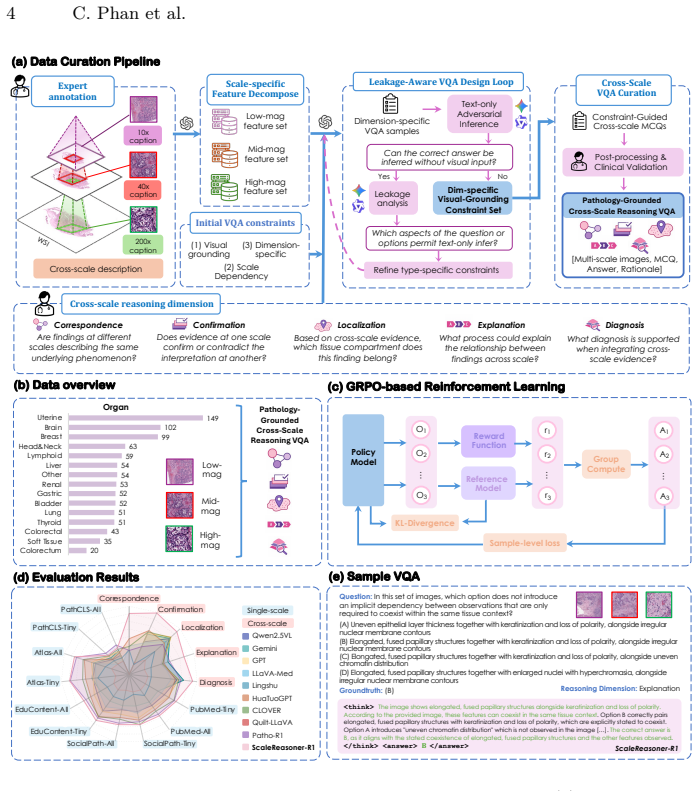
The central discovery is that explicit cross-scale reasoning objectives, enforced through a leakage-aware benchmark and outcome-driven reinforcement learning, produce a pathology VLM that genuinely integrates evidence across magnifications rather than relying on single-scale recognition or text-only cues. The paper's Scale-VQA benchmark instantiates five reasoning dimensions — correspondence, confirmation, localization, explanation, and diagnosis — with questions designed so that the correct answer depends on at least two magnification levels. Adversarial screening by text-only models iteratively removes questions with shortcut answers. Trained on this data with GRPO, ScaleReasoner-R1 achiev
What carries the argument
The load-bearing mechanism is the leakage-aware curation pipeline: scale-specific feature decomposition splits expert captions into evidence sets per magnification; constraint-guided question design requires visual grounding, scale dependency, and dimension diversity; and an iterative text-only adversarial screening loop uses strong language models to detect and eliminate questions whose answers can be guessed without visual input. This yields Scale-VQA, a benchmark where high accuracy demands integrating at least two magnification views. The companion training mechanism is GRPO reinforcement learning, which rewards correct option selection with sparse accuracy and format rewards, steering t
Load-bearing premise
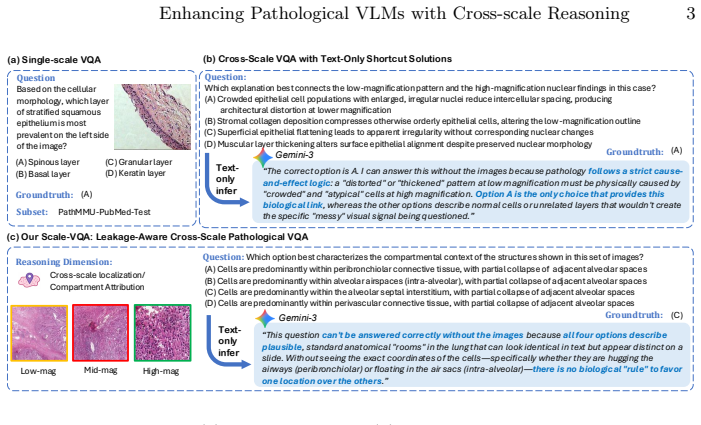
The main load-bearing assumption is that the text-only adversarial screening loop catches every multiple-choice question that can be answered without visual evidence; if any shortcut survives, the reported cross-scale accuracy may not require true integration across magnifications.
What would settle it
Run the Scale-VQA test set with one magnification removed or heavily distorted (e.g., replacing the high-magnification image with noise) and check whether ScaleReasoner-R1 accuracy stays near 82.89%; any large accuracy drop would confirm dependence on all scales, whereas a small drop would indicate remaining text-only shortcuts. Alternatively, screen the test set with a larger, independently trained text-only adversary and count how many questions it answers correctly.
If this is right
- If cross-scale reasoning is learned, models can support tasks like confirming a low-power suspicion with high-power cellular findings and localizing tissue compartments, which single-scale models handle poorly.
- Cross-scale supervision transfers: a model trained only on multi-image questions also improves on single-image pathology VQA, suggesting that single-scale benchmarks understate what pathology VLMs can learn.
- RL with outcome rewards outperforms both supervised fine-tuning and SFT-plus-RL in this low-data setting, because SFT-style rationale imitation causes catastrophic forgetting of pretrained single-scale knowledge.
- The benchmark and pipeline provide a reusable testbed for measuring whether a pathology VLM is genuinely integrating visual evidence across scales.
Where Pith is reading between the lines
- Editorial inference: the residual-leakage question is unresolved — the screening loop uses a finite set of text-only adversaries and reports no residual leakage rate on the test set, so a stronger or differently biased text-only model might still answer some questions without images.
- Editorial inference: the data-efficiency result suggests a scaling path — if 177 whole-slide images with expert cross-scale captions yield this gain, larger expert-curated collections could push the same approach further; this is an extrapolation the paper does not test.
- Editorial inference: the same leakage-aware, multi-view formulation could transfer to other diagnostic domains where doctors integrate evidence across views, such as radiology (CT + MRI) or dermatology (dermoscopic + clinical), though the paper does not claim this.
- Editorial inference: the five reasoning dimensions could serve as a taxonomy for evaluating the explainability of pathology VLMs beyond accuracy, connecting to the broader goal of interpretable medical AI.
Editorial analysis
A structured set of objections, weighed in public.
Referee Report
Summary. The paper introduces Scale-VQA, a pathology VQA benchmark for multi-magnification ('cross-scale') reasoning, built from 177 TCGA WSIs with pathologist annotations and a three-step curation pipeline that includes text-only adversarial screening against Gemini 3 Pro and Qwen3-Max. The authors also present ScaleReasoner-R1, a 7B VLM initialized from Patho-R1 and trained with GRPO on Scale-VQA, and report 82.89% average accuracy on the proposed test set, far above existing baselines. They additionally report improved results on several PathMMU subsets, suggesting partial transfer to single-image pathology VQA. Code, data, and the curation pipeline are released.
Significance. If the benchmark is genuinely free of text-only shortcuts, this is a useful practice contribution: it is among the first attempts to formulate pathological VQA as explicit multi-magnification reasoning, and the leakage-aware curation protocol is reusable by the community. The expert annotation design (three junior pathologists plus senior review, with zoom-in rationales) is a clear strength, as is the decision to release the dataset and pipeline. The PathMMU transfer results provide an independent, albeit single-image, sanity check that the trained model gains general pathology understanding rather than only memorizing a benchmark. However, the central claim currently rests on a self-constructed benchmark whose residual leakage rate is unmeasured, and the single-scale 'SOTA' claim is supported by a single run with no variance reporting. With the requested residual-leakage quantification and statistical grounding, the paper would be a solid contribution; as submitted, the headline accuracy should be interpreted with caution.
major comments (3)
- [§2.2, Step 2; Table 1] The leak-free status of Scale-VQA-Test is not established. The screening loop uses only two text-only adversaries (Gemini 3 Pro, Qwen3-Max) and stops when they 'can no longer reliably infer'; no residual leakage rate is reported on the final 1,005 test questions, and no justification is given for why those two models are sufficient to detect all shortcut-solvable MCQs. Since the test split is produced by the same GPT-5.2 pipeline and the same 177-WSI cohort as training, a surviving template or linguistic artifact could explain the 22-point gap over Gemini 3 Flash. Please add text-only baselines on the final test set, report per-dimension residual accuracy, and state the fraction of questions answerable without image input. Without this, the central 'cross-scale reasoning' claim is not distinguishable from format overfitting.
- [§3.2, Table 2] The single-scale SOTA claim rests on a single run with no error bars or significance tests. On validation overall, the gain over Patho-R1 is 0.1 point (62.4 vs. 62.3), and on test overall it is 1.4 points, with a clear regression on PathCLS (41.8/42.7 → 37.9/38.5). Report multiple seeds, confidence intervals, and/or paired statistical tests, or temper the claim. The cross-scale results in Table 1 should also include variance, since no multi-run or bootstrap estimates are provided.
- [§3.1–3.2] The only cross-scale evaluation is the authors' own Scale-VQA-Test. PathMMU is a single-image benchmark and therefore does not validate multi-magnification evidence integration by itself. The generalization claim is a transfer result, not independent evidence of cross-scale reasoning. If no external multi-image pathology benchmark exists, add a human evaluation, a correctness analysis of the model's reasoning traces with respect to all three magnification inputs, or explicitly limit the claim to the proposed benchmark.
minor comments (5)
- [§3.3] The relationship between the SFT set (4,475 samples from 93 WSIs) and the RL training split (3,230 samples from 177 WSIs) is unclear. Is the SFT set a subset of Scale-VQA? Why does it contain more samples than the RL train split while using fewer WSIs? Please clarify the split construction.
- [Table 2] The table header is very hard to parse: 'V al overall', 'T est overall', and the Tiny/All columns for each subset lack clear separators. Please reformat with explicit column groupings.
- [Figure 2(b)] The organ-distribution numbers are typeset in a garbled, unreadable line; use a legible histogram or table instead.
- [Table 1] Report sample counts per reasoning dimension in addition to percentages, so readers can assess the reliability of per-dimension comparisons.
- [Throughout] Several spacing/rendering issues appear in the text, e.g., 'ScaleReasoner-R1achieves', 'Scale-VQAand', and 'onScale-VQA-Test'. A careful proofread is needed.
Circularity Check
No central circularity; one minor non-load-bearing self-citation (UnPuzzle infrastructure) and a benchmark-validity leakage risk, not a circular derivation.
full rationale
The paper's central claims are empirical and do not reduce to their inputs by construction. ScaleReasoner-R1 is trained on a patient-wise split (3,230/450/1,005) of Scale-VQA and evaluated on the held-out 1,005-sample test split, so the reported 82.89% accuracy is a conventional supervised-evaluation result rather than a quantity fixed by the training objective. Benchmark labels are anchored by pathologist annotation and clinical validation (§2.1, §2.2 Step 3), and the two-adversary text-only screening (§2.2 Step 2) is a filtering step designed to suppress shortcuts; it does not by itself define the test answers. The strongest generalization claim — that cross-scale supervision improves pathological VLM understanding — is tested on the external PathMMU benchmark (10,387 public samples), which is independent of the authors' curation pipeline and fitted values. The only self-citation of note is the UnPuzzle Pipeline [16] (cited in §3.1 and acknowledged in the Acknowledgments); several present authors overlap with that reference, and the platform is also acknowledged as a commercial supporter. However, no theorem, uniqueness claim, or empirical result is justified by that citation; it is used as training software infrastructure. A genuine validity risk remains: the paper does not measure a residual text-only leakage rate on Scale-VQA-Test, so if Gemini 3 Pro and Qwen3-Max miss shortcut artifacts, the cross-scale numbers could be inflated. This is an experimental limitation, not a circular step: no equation or fitted parameter is shown to equal its input by construction. Hence no significant circularity; the score reflects one minor, non-load-bearing self-citation.
Axiom & Free-Parameter Ledger
free parameters (2)
- Reward mixing weight λ =
0.8
- GRPO training steps =
500
axioms (5)
- domain assumption The five clinical reasoning dimensions (Correspondence, Confirmation, Localization, Explanation, Diagnosis) adequately span cross-scale pathology reasoning.
- ad hoc to paper Text-only adversaries Gemini 3 Pro and Qwen3-Max are sufficient to identify all shortcut-solvable MCQs.
- domain assumption GPT-5.2-generated cross-scale captions, after pathologist refinement, are faithful to the visual content of the images.
- domain assumption Patho-R1-7B is a valid base model for cross-scale adaptation.
- domain assumption Outcome-based RL (GRPO) generalizes better than SFT in this low-data setting.
read the original abstract
Pathological images are inherently multi-scale, requiring pathologists to integrate evidence from global tissue architecture at low magnification to cellular morphology at higher magnification for accurate diagnosis. While existing pathological datasets for vision-language models (VLMs) include various scales, they often lack explicit cross-scale reasoning objectives. This limitation prevents VLMs from capturing essential cross-scale representations and learning evidence-based reasoning. To bridge this gap, we introduce the first cross-scale training and evaluation paradigm that formulates pathology interpretation as multi-magnification reasoning. However, creating such a task reveals a critical challenge: multi-image visual question answering (VQA) is prone to text-only shortcuts, which allow models to guess answers using magnification-dependent artifacts rather than visual evidence. To address this, we propose a leakage-aware curation pipeline that combines adversarial text-only screening with constraint-guided question design. Using this pipeline, we construct Scale-VQA, a high-quality benchmark with 4,685 multiple-choice questions grounded in 2,537 pathology images across multiple magnification levels. Finally, we present ScaleReasoner-R1, a model trained via reinforcement learning to optimize performance on cross-scale VQA tasks. ScaleReasoner-R1 achieves state-of-the-art performance on our cross-scale reasoning benchmark and generalizes to SOTA performance on established single-scale benchmarks. Findings suggest that even the limited cross-scale supervision can significantly improve pathological understanding. Code is available at https://github.com/iMVR-PL/ScaleReasoner-R1.
Figures
Forward citations
Cited by 1 Pith paper
-
PathScale-R1: Cross-scale Reasoning for Pathological Image Analysis
PathScale-R1 and PathScale-VQA raise cross-scale pathology VQA accuracy to 83% by training on expert multi-magnification paths with anti-shortcut curation and scale-aware RL.
Reference graph
Works this paper leans on
-
[1]
The Journal of pathol- ogy249(3), 286–294 (2019)
Abels, E., Pantanowitz, L., Aeffner, F., Zarella, M.D., Van der Laak, J., Bui, M.M., Vemuri, V.N., Parwani, A.V., Gibbs, J., Agosto-Arroyo, E., et al.: Computational pathology definitions, best practices, and recommendations for regulatory guid- ance: a white paper from the digital pathology association. The Journal of pathol- ogy249(3), 286–294 (2019)
2019
-
[2]
In: Proceedings of the IEEE conference on computer vision and pattern recognition
Agrawal, A., Batra, D., Parikh, D., Kembhavi, A.: Don’t just assume; look and an- swer: Overcoming priors for visual question answering. In: Proceedings of the IEEE conference on computer vision and pattern recognition. pp. 4971–4980 (2018). https://doi.org/10.1109/CVPR.2018.00522
arXiv 2018
-
[3]
Bai, S., Chen, K., Liu, X., Wang, J., Ge, W., Song, S., Dang, K., Wang, P., Wang, S., Tang, J., et al.: Qwen2. 5-vl technical report. arXiv preprint arXiv:2502.13923 (2025)
Pith/arXiv arXiv 2025
-
[4]
Nature Computational Science (2025)
Chen, K., Liu, M., Yan, F., et al.: Cost-effective instruction learning for pathology vision and language analysis. Nature Computational Science (2025). https://doi.org/10.1038/s43588-025-00818-5
-
[5]
In: European Conference on Com- puter Vision
Chen, P., Zhu, C., Zheng, S., Li, H., Yang, L.: Wsi-vqa: Interpreting whole slide images by generative visual question answering. In: European Conference on Com- puter Vision. pp. 401–417. Springer (2025)
2025
-
[6]
arXiv preprint arXiv:2410.11761 (2024) 10 C
Chen, Y., Wang, G., Ji, Y., Li, Y., Ye, J., Li, T., , Ming, H., Yu, R., Qiao, Y., He, J.: Slidechat: A large vision-language assistant for whole-slide pathology image understanding. arXiv preprint arXiv:2410.11761 (2024) 10 C. Phan et al
Pith/arXiv arXiv 2024
-
[7]
In: Proceedings of the IEEE/CVF Conference on Computer Vision and Pattern Recognition (CVPR)
Chen, Y., Wang, G., Ji, Y., Li, Y., Ye, J., Li, T., Hu, M., Yu, R., Qiao, Y., He, J.: Slidechat: A large vision-language assistant for whole-slide pathology image understanding. In: Proceedings of the IEEE/CVF Conference on Computer Vision and Pattern Recognition (CVPR). pp. 5134–5143 (Jun 2025)
2025
-
[8]
arXiv preprint arXiv:2501.17161 (2025)
Chu, T., Zhai, Y., Yang, J., Tong, S., Xie, S., Schuurmans, D., Le, Q.V., Levine, S., Ma, Y.: Sft memorizes, rl generalizes: A comparative study of foundation model post-training. arXiv preprint arXiv:2501.17161 (2025)
Pith/arXiv arXiv 2025
-
[9]
Nucleic acids research 44(8), e71–e71 (2016)
Colaprico, A., Silva, T.C., Olsen, C., Garofano, L., Cava, C., Garolini, D., Sabedot, T.S., Malta, T.M., Pagnotta, S.M., Castiglioni, I., et al.: Tcgabiolinks: an r/bioconductor package for integrative analysis of tcga data. Nucleic acids research 44(8), e71–e71 (2016)
2016
-
[10]
In: Proceedings of the IEEE conference on computer vision and pattern recognition
Goyal,Y.,Khot,T.,Summers-Stay,D.,Batra,D.,Parikh,D.:MakingthevinVQA matter: Elevating the role of image understanding in visual question answering. In: Proceedings of the IEEE conference on computer vision and pattern recognition. pp. 6904–6913 (2017). https://doi.org/10.1109/CVPR.2017.670
-
[11]
arXiv preprint arXiv:2501.12948 (2025)
Guo, D., Yang, D., Zhang, H., Song, J., Zhang, R., Xu, R., Zhu, Q., Ma, S., Wang, P., Bi, X., et al.: Deepseek-r1: Incentivizing reasoning capability in llms via reinforcement learning. arXiv preprint arXiv:2501.12948 (2025)
Pith/arXiv arXiv 2025
-
[12]
In: Proceedings of the IEEE/CVF conference on computer vision and pattern recognition
Hashimoto, N., Fukushima, D., Koga, R., Takagi, Y., Ko, K., Kohno, K., Nakaguro, M., Nakamura, S., Hontani, H., Takeuchi, I.: Multi-scale domain- adversarial multiple-instance cnn for cancer subtype classification with unanno- tated histopathological images. In: Proceedings of the IEEE/CVF conference on computer vision and pattern recognition. pp. 3852–38...
2020
-
[13]
arXiv preprint arXiv:2003.10286 (2020)
He, X., Zhang, Y., Mou, L., Xing, E., Xie, P.: Pathvqa: 30000+ questions for medical visual question answering. arXiv preprint arXiv:2003.10286 (2020)
Pith/arXiv arXiv 2003
-
[14]
Advances in Neural Information Processing Systems36, 28541–28564 (2023)
Li, C., Wong, C., Zhang, S., Usuyama, N., Liu, H., Yang, J., Naumann, T., Poon, H., Gao, J.: Llava-med: Training a large language-and-vision assistant for biomedicine in one day. Advances in Neural Information Processing Systems36, 28541–28564 (2023)
2023
-
[15]
In: Proceedings of the IEEE/CVF International Conference on Computer Vision
Liang, Y., Lyu, X., Chen, W., Ding, M., Zhang, J., He, X., Wu, S., Xing, X., Yang, S., Wang, X., et al.: Wsi-llava: A multimodal large language model for whole slide image. In: Proceedings of the IEEE/CVF International Conference on Computer Vision. pp. 22718–22727 (2025)
2025
-
[16]
Liao, D., Chen, S., Xi, N., Xue, Q., Li, J., Hou, L., Liu, Z., Low, C.H., Wu, Y., Liu, Y., Jiang, Y., Li, D., Lyu, S.: Unpuzzle: A unified framework for pathology image analysis (2025), https://arxiv.org/abs/2503.03152
Pith/arXiv arXiv 2025
-
[17]
Nature634(8033), 466–473 (Oct 2024)
Lu, M.Y., Chen, B., Williamson, D.F.K., Chen, R.J., Zhao, M., Chow, A.K., Ike- mura, K., Kim, A., Pouli, D., Patel, A., Soliman, A., Chen, C., Ding, T., Wang, J.J., Gerber, G., Liang, I., Le, L.P., Parwani, A.V., Weishaupt, L.L., Mahmood, F.: A multimodal generative ai copilot for human pathology. Nature634(8033), 466–473 (Oct 2024). https://doi.org/10.10...
-
[18]
arXiv e-prints pp
Saygin Seyfioglu, M., Ikezogwo, W.O., Ghezloo, F., Krishna, R., Shapiro, L.: Quilt- llava: Visual instruction tuning by extracting localized narratives from open-source histopathology videos. arXiv e-prints pp. arXiv–2312 (2023)
2023
-
[19]
In: Proceedings of the 58th annual meet- ing of the association for computational linguistics
Shrestha, R., Kafle, K., Kanan, C.: A negative case analysis of visual grounding methods for VQA. In: Proceedings of the 58th annual meet- ing of the association for computational linguistics. pp. 8172–8181 (2020). https://doi.org/10.18653/v1/2020.acl-main.727
-
[20]
arXiv preprint arXiv:2601.03267 (2025) Enhancing Pathological VLMs with Cross-scale Reasoning 11
Singh, A., Fry, A., Perelman, A., Tart, A., Ganesh, A., El-Kishky, A., McLaughlin, A., Low, A., Ostrow, A., Ananthram, A., et al.: Openai gpt-5 system card. arXiv preprint arXiv:2601.03267 (2025) Enhancing Pathological VLMs with Cross-scale Reasoning 11
Pith/arXiv arXiv 2025
-
[21]
In: European Conference on Computer Vision
Sun, Y., Wu, H., Zhu, C., Zheng, S., Chen, Q., Zhang, K., Zhang, Y., Wan, D., Lan, X., Zheng, M., et al.: Pathmmu: A massive multimodal expert-level benchmark for understanding and reasoning in pathology. In: European Conference on Computer Vision. pp. 56–73. Springer (2024)
2024
-
[22]
arXiv preprint arXiv:2312.11805 (2023)
Team, G., Anil, R., Borgeaud, S., Wu, Y., Alayrac, J.B., Yu, J., Soricut, R., Schalk- wyk, J., Dai,A.M.,Hauth, A., et al.:Gemini: a family ofhighlycapable multimodal models. arXiv preprint arXiv:2312.11805 (2023)
Pith/arXiv arXiv 2023
-
[23]
arXiv preprint arXiv:2506.07044 (2025)
Xu, W., Chan, H.P., Li, L., Aljunied, M., Yuan, R., Wang, J., Xiao, C., Chen, G., Liu,C.,Li, Z.,etal.:Lingshu: Ageneralistfoundationmodelforunifiedmultimodal medical understanding and reasoning. arXiv preprint arXiv:2506.07044 (2025)
Pith/arXiv arXiv 2025
-
[24]
arXiv preprint arXiv:2507.17303 (2025)
Xu, Z., Liu, Z., Hou, J., Ma, J., Jin, C., Wang, Y., Chen, Z., Zhang, Z., Huang, F., Guo, Z., et al.: A versatile pathology co-pilot via reasoning enhanced multimodal large language model. arXiv preprint arXiv:2507.17303 (2025)
Pith/arXiv arXiv 2025
-
[25]
arXiv preprint arXiv:2305.15075 (2023)
Zhang, H., Chen, J., Jiang, F., Yu, F., Chen, Z., Li, J., Chen, G., Wu, X., Zhang, Z., Xiao, Q., Wan, X., Wang, B., Li, H.: Huatuogpt, towards taming language models to be a doctor. arXiv preprint arXiv:2305.15075 (2023)
Pith/arXiv arXiv 2023
-
[26]
arXiv preprint arXiv:2505.11404 (2025)
Zhang, W., Zhang, P., Guo, J., Cheng, T., Chen, J., Zhang, S., Zhang, Z., Yi, Y., Bu, H.: Patho-r1: A multimodal reinforcement learning-based pathology expert reasoner. arXiv preprint arXiv:2505.11404 (2025)
arXiv 2025
-
[27]
Nature Machine Intelligence1(5), 236–245 (2019)
Zhang, Z., Chen, P., McGough, M., Xing, F., Wang, C., Bui, M., Xie, Y., Sapkota, M., Cui, L., Dhillon, J., et al.: Pathologist-level interpretable whole-slide cancer diagnosis with deep learning. Nature Machine Intelligence1(5), 236–245 (2019)
2019
discussion (0)
Sign in with ORCID, Apple, or X to comment. Anyone can read and Pith papers without signing in.