REVIEW 1 major objections 2 minor 1 cited by
Short sequences of legitimate MAVLink commands can degrade ArduPilot UAV stability and cause crashes by changing controller parameters.
Reviewed by Pith at T0; open to challenge. T0 means a machine referee read the full paper against a public rubric. the ladder, T0–T4 →
T0 review · grok-4.3
2026-06-26 10:53 UTC pith:H6E5SHCJ
load-bearing objection The paper catalogs six MAVLink parameter attacks on ArduPilot that degrade control and cause crashes in both simulation and Pixhawk hardware, with the experiments appearing to match the claims. the 1 major comments →
Control-Aware Manipulation of ArduPilot via Legitimate MAVLink Commands: Simulation and Hardware Validation
The pith
A machine-rendered reading of the paper's core claim, the machinery that carries it, and where it could break.
Core claim
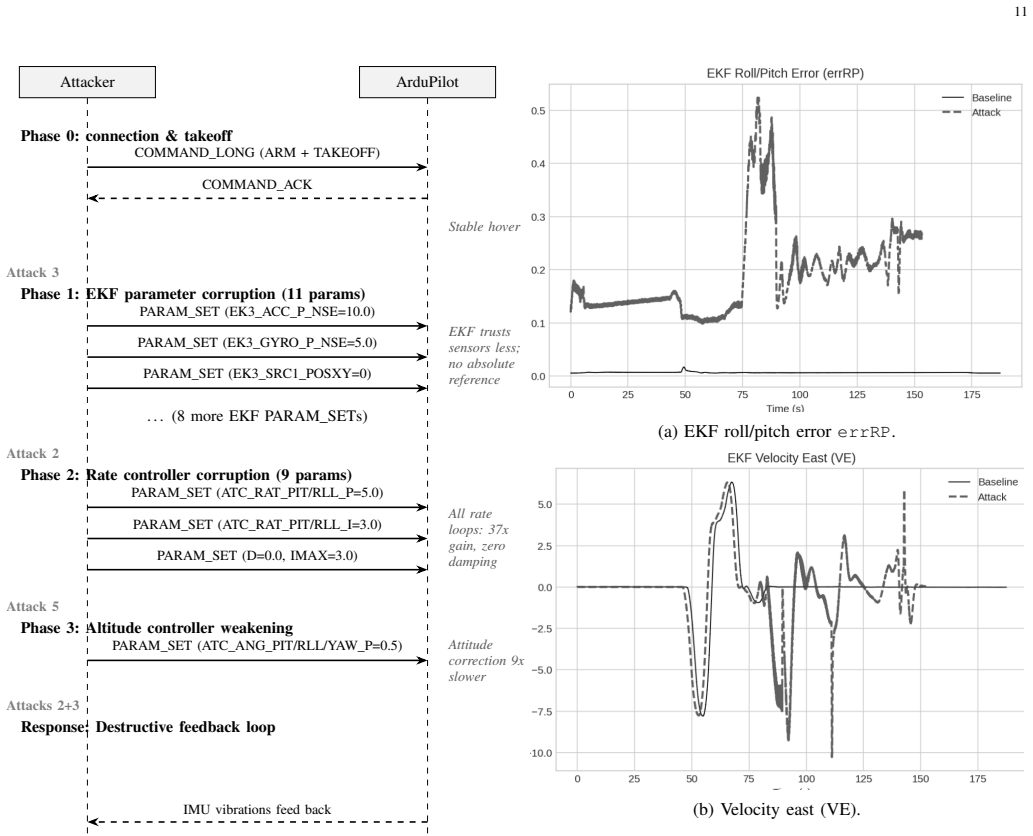
The paper claims that six specific attacks, each using short sequences of MAVLink parameter-change commands, can force ArduPilot into unsafe operating conditions by modifying interactions among its multi-layer controllers. These attacks target PID gains, EKF estimation configuration, and failsafe assumptions, and their combined effects result in loss of control and vehicle crashes, as validated in both SITL simulation and Pixhawk hardware experiments.
What carries the argument
The six attacks that modify PID gains, alter EKF estimation configuration, and violate failsafe assumptions to exploit controller sensitivities to parameter values and update frequency.
Load-bearing premise
The ArduPilot flight controller accepts and immediately applies MAVLink parameter-change commands without additional runtime validation of their effect on closed-loop stability or estimator health.
What would settle it
Running the described sequences of MAVLink parameter commands in ArduPilot SITL simulation or on Pixhawk hardware and observing whether attitude stability, angular rates, trajectory tracking, and estimator health degrade as claimed, or if the vehicle crashes.
If this is right
- Modifying PID gains degrades attitude stability and angular-rate behavior.
- Altering EKF estimation configuration affects estimator health.
- Violating failsafe assumptions allows the vehicle to enter unsafe operating conditions.
- Combining multiple parameter changes causes trajectory tracking failure and vehicle crashes.
- These outcomes occur from short sequences of well-formed MAVLink messages without code changes.
Where Pith is reading between the lines
- Other flight controllers that accept MAVLink parameter commands without stability checks may share similar vulnerabilities.
- Adding runtime validation of parameter effects on closed-loop dynamics could block these attacks but would change how controllers process trusted inputs.
- The same parameter-manipulation approach could be tested on different UAV hardware platforms to determine if the issues extend beyond ArduPilot.
- Security for UAVs may need to treat parameter updates as potential control inputs rather than benign configuration.
Editorial analysis
A structured set of objections, weighed in public.
Referee Report
Summary. The paper claims that short sequences of well-formed MAVLink parameter-set commands can exploit ArduPilot's multi-layer controllers (PID gains, EKF configuration, failsafe assumptions) to degrade attitude stability, angular-rate behavior, trajectory tracking, and estimator health, ultimately causing loss of control and crashes when effects are combined. The central results are direct experimental observations from SITL simulation and Pixhawk 2.4.8 hardware runs demonstrating six specific attacks.
Significance. If the results hold, the work is significant for highlighting practical security gaps in input-parameter handling and command trust within a widely deployed open-source flight controller. The combination of SITL traces and hardware validation on real Pixhawk hardware, together with the absence of fitted parameters or circular derivations, provides concrete, falsifiable evidence of controller sensitivity to legitimate commands.
major comments (1)
- [Evaluation section] Evaluation section: the abstract states concrete degradation metrics, but full data tables, run counts, success rates, and exclusion criteria are not visible; this is load-bearing for assessing reproducibility of the hardware validation and the claim that combined effects produce crashes.
minor comments (2)
- [Abstract] Abstract: 'inwhich' is a typographical error and should be 'in which'.
- The six attacks are described at a high level; adding a table summarizing the exact MAVLink message sequences, targeted parameters, and observed effects per attack would improve clarity without altering the central claim.
Simulated Author's Rebuttal
Thank you for the opportunity to respond to the referee's report. We appreciate the referee's recognition of the significance of our work and the recommendation for minor revision. We address the single major comment below.
read point-by-point responses
-
Referee: [Evaluation section] Evaluation section: the abstract states concrete degradation metrics, but full data tables, run counts, success rates, and exclusion criteria are not visible; this is load-bearing for assessing reproducibility of the hardware validation and the claim that combined effects produce crashes.
Authors: We agree with the referee that additional details on the experimental data would improve the reproducibility of our results. The current manuscript presents key observations from SITL and hardware experiments but does not include comprehensive tables summarizing all runs. In the revised version, we will expand the Evaluation section to include tables reporting the number of experimental runs performed for each attack, success rates, observed degradation metrics with statistics where applicable, and any exclusion criteria applied during hardware validation. This will provide stronger support for the claims that combined effects can lead to crashes. revision: yes
Circularity Check
No significant circularity; results are direct experimental observations
full rationale
The manuscript contains no derivations, equations, fitted parameters, or load-bearing self-citations. Its central claims consist of direct SITL and Pixhawk hardware observations that short MAVLink parameter-set sequences degrade attitude stability, rates, trajectory tracking, and EKF health, culminating in loss of control when combined. The attack surface (acceptance of parameter changes without runtime stability validation) is both the premise and the demonstrated mechanism, with no reduction of any result to its own inputs by construction. This is the expected non-finding for an experimental security paper.
Axiom & Free-Parameter Ledger
axioms (1)
- domain assumption MAVLink commands are processed without additional security checks beyond protocol compliance
read the original abstract
This paper investigates control-aware attacks against ArduPilot-based Unmanned Aerial Vehicles (UAVs), inwhich an adversary exploits the sensitivity of flight-controller dynamics to parameter changes to cause loss of control and crashes. It describes six attacks that exploit interactions among multi-layer controllers by modifying Proportional-Integral-Derivative (PID) gains, altering Extended Kalman Filter (EKF) estimation configuration, and violating failsafe assumptions, thereby forcing ArduPilot into unsafe operating conditions. We evaluate the attacks in Software-in-the-Loop (SITL) simulation and validate them on a Pixhawk 2.4.8 hardware platform. The results show that short sequences of well-formed MAVLink messages can exploit controller sensitivity to parameter values and updates frequency, affecting controller states and degrading attitude stability, angular-rate behavior, trajectory tracking, and estimator health. We demonstrate that when multiple effects are combined, the vehicle can enter an unsafe state and crashes. These findings show that security gaps in input-parameter handling, command trust, and controller-state validation can be exploited to cause loss of control and crashes in UAVs.
Figures




Forward citations
Cited by 1 Pith paper
-
RT-SHCUA: Real-Time Self-Hosted Computer-Use Agent for UAV Control
An architecture that mediates LLM computer-use agents for UAV control by compiling agent decisions into validated, time-bounded, evidence-logged skill invocations, with a prototype on OpenClaw/PX4/OP-TEE.
Reference graph
Works this paper leans on
-
[1]
Drone Market (2026 - 2033),
“Drone Market (2026 - 2033),” https://www.grandviewresearch.com/ industry-analysis/drone-market-report, [Accessed 21-05-2026]
2026
-
[2]
Vulnerability analysis of the MA VLink protocol for command and control of unmanned aircraft,
J. A. Marty, “Vulnerability analysis of the MA VLink protocol for command and control of unmanned aircraft,” Master’s thesis, Air Force Institute of Technology, Wright-Patterson AFB, Ohio, 2014
2014
-
[3]
Empirical analysis of MA VLink protocol vulnerability for attacking unmanned aerial vehicles,
Y .-M. Kwon, J. Yu, B.-M. Cho, Y . Eun, and K.-J. Park, “Empirical analysis of MA VLink protocol vulnerability for attacking unmanned aerial vehicles,”IEEE Access, vol. 6, pp. 43 203–43 212, 2018
2018
-
[4]
MA VLink protocol: A survey of security threats and countermeasures,
M. A. Hamza, M. Mohsin, M. Khalil, and S. M. K. A. Kazmi, “MA VLink protocol: A survey of security threats and countermeasures,” inProceedings of the 4th International Conference on Digital Futures and Transformative Technologies (ICoDT2), 2024, pp. 1–8
2024
-
[5]
Rocking drones with intentional sound noise on gyroscopic sensors,
Y . Son, H. Shin, D. Kim, Y . Park, J. Noh, K. Choi, J. Choi, and Y . Kim, “Rocking drones with intentional sound noise on gyroscopic sensors,” in 24th USENIX Security Symposium (USENIX Security 15). Washington, D.C.: USENIX Association, 2015, pp. 881–896
2015
-
[6]
Injected and delivered: Fabricating implicit control over actuation systems by spoofing inertial sensors,
Y . Tu, Z. Lin, I. Lee, and X. Hei, “Injected and delivered: Fabricating implicit control over actuation systems by spoofing inertial sensors,” in 27th USENIX Security Symposium (USENIX Security 18). Baltimore, MD: USENIX Association, 2018, pp. 1545–1562
2018
-
[7]
W ALNUT: Waging doubt on the integrity of MEMS accelerometers with acoustic injection attacks,
T. Trippel, O. Weisse, W. Xu, P. Honeyman, and K. Fu, “W ALNUT: Waging doubt on the integrity of MEMS accelerometers with acoustic injection attacks,” in2017 IEEE European Symposium on Security and Privacy (EuroS&P). IEEE, 2017, pp. 3–18
2017
-
[8]
MUVIDS: False MA VLink injection attack detection in communication for unmanned vehicles,
S. Jeong, E. Park, K. U. Seo, J. D. Yoo, and H. K. Kim, “MUVIDS: False MA VLink injection attack detection in communication for unmanned vehicles,” inWorkshop on Automotive and Autonomous V ehicle Security (AutoSec), 2021
2021
-
[9]
Intrusion detection system for drones,
B. Tufekci, “Intrusion detection system for drones,” Ph.D. dissertation, University of North Texas, Denton, Texas, 2024
2024
-
[10]
A lightweight and efficient intrusion detec- tion system for drone networks,
F. J. Alruwaili and C. Tunc, “A lightweight and efficient intrusion detec- tion system for drone networks,” in2025 5th Intelligent Cybersecurity Conference (ICSC), 2025, pp. 219–226
2025
-
[11]
Run- time anomaly detection for drones: An integrated rule-mining and unsupervised-learning approach,
I. Tan, W. Minn, C. M. Poskitt, L. K. Shar, and L. Jiang, “Run- time anomaly detection for drones: An integrated rule-mining and unsupervised-learning approach,” 2025
2025
-
[12]
A secure communication protocol for unmanned aerial vehicles,
N. A. Khan, N. Z. Jhanjhi, S. N. Brohi, and A. A. Almazroi, “A secure communication protocol for unmanned aerial vehicles,”Computers, Materials & Continua, vol. 70, no. 1, pp. 601–618, 2022
2022
-
[13]
Enhancing the security of the MA VLink with symmetric authenticated encryption for drones,
B. Tufekci, A. Arslan, C. Tunc, and K. Morozov, “Enhancing the security of the MA VLink with symmetric authenticated encryption for drones,” in Proceedings of the 11th International Conference on Internet of Things: Systems, Management and Security (IOTSMS), 2024, pp. 58–65
2024
-
[14]
Ardupilot,
“Ardupilot,” https://ardupilot.org/, accessed in Oct. 2025
2025
-
[15]
A. D. Team, https://ardupilot.org/dev/docs/security-landing-page.html, 2026
2026
-
[16]
Reverse engineering and control-aware security analysis of the ardupi- lot uav framework,
Y . Konapalli, L. B. Othmane, C. Tunc, F. Benchellal, and L. Mudagere, “Reverse engineering and control-aware security analysis of the ardupi- lot uav framework,” in8th International Workshop on Software Engi- neering Research and Practices for the IoT, Rio De Janeiro, April 2026
2026
-
[17]
Complete parameter list — Copter documentation,
ArduPilot Development Team, “Complete parameter list — Copter documentation,” https://ardupilot.org/copter/docs/parameters.html, 2025, accessed: 2026-03-30
2025
-
[18]
A new approach to linear filtering and prediction problems,
R. E. Kalman, “A new approach to linear filtering and prediction problems,”Journal of Basic Engineering, vol. 82, no. 1, pp. 35–45, 03 1960
1960
-
[19]
Directional stability of automatically steered bodies,
N. Minorsky, “Directional stability of automatically steered bodies,” Journal of the American Society for Naval Engineers, vol. 34, no. 2, pp. 280–309, 1922
1922
-
[20]
F. L. Lewis, D. Vrabie, and V . L. Syrmos,Optimal Control, 3rd ed. Hoboken, NJ: Wiley, 2012
2012
-
[21]
Reinforcement learning and adaptive dynamic programming for feedback control,
F. L. Lewis and D. Vrabie, “Reinforcement learning and adaptive dynamic programming for feedback control,”IEEE Circuits and Systems Magazine, vol. 9, no. 3, pp. 32–50, 2009
2009
-
[22]
Drift with devil: Security of multi-sensor fusion based localization in high-level autonomous driving under GPS spoofing,
J. Shen, J. Y . Won, Z. Chen, and Q. A. Chen, “Drift with devil: Security of multi-sensor fusion based localization in high-level autonomous driving under GPS spoofing,” in29th USENIX Security Symposium, 2020, pp. 931–948
2020
-
[23]
Flight recovery of mavs with compromised imu,
Z. Tu, F. Fei, M. Eagon, D. Xu, and X. Deng, “Flight recovery of mavs with compromised imu,” in2019 IEEE/RSJ International Conference on Intelligent Robots and Systems (IROS). Macau, China: IEEE, November 2019, pp. 3638–3644
2019
-
[24]
Sensor deprivation attacks for stealthy UA V manipulation,
A. Erba, N. O. Tippenhauer, and D. Balzarotti, “Sensor deprivation attacks for stealthy UA V manipulation,” inProceedings of the 33rd USENIX Security Symposium, 2024, pp. 1–18
2024
-
[25]
ArduPilot coverity scan results,
ArduPilot Development Team, “ArduPilot coverity scan results,” https: //scan.coverity.com/projects/ardupilot-ardupilot, 2019, accessed: 2024
2019
-
[26]
An exploratory study of autopilot software bugs in unmanned aerial vehicles,
D. Wang, S. Li, G. Xiao, Y . Liu, and Y . Sui, “An exploratory study of autopilot software bugs in unmanned aerial vehicles,” inProceedings of the 29th ACM Joint Meeting on European Software Engineering Conference and Symposium on the F oundations of Software Engineering (ESEC/FSE), 2021, pp. 20–31
2021
-
[27]
AP_NavEKF3.cpp — ArduPilot source code,
ArduPilot Development Team, “AP_NavEKF3.cpp — ArduPilot source code,” https://github.com/ArduPilot/ardupilot/blob/master/libraries/AP_ NavEKF3/AP_NavEKF3.cpp, 2025, accessed: 2026-03-30
2025
-
[28]
Mavlink developer guide,
“Mavlink developer guide,” https://mavlink.io/en/, accessed in oct. 2025
2025
-
[29]
Control-aware attacks against ArduPilot drone sys- tems,
Feras Benchellal, “Control-aware attacks against ArduPilot drone sys- tems,” https://github.com/CopterRecon/CopterManipulation, 2026, ac- cessed: 2026
2026
-
[30]
Mission planner home,
Michael Oborne, “Mission planner home,” https://ardupilot.org/planner/ #mission-planner-home, 2026, accessed: 2026
2026
-
[31]
Exception for limited recreational operations of unmanned aircraft,
D. o. T. D. Federal Aviation Administration (FAA), “Exception for limited recreational operations of unmanned aircraft,” https://www.federalregister.gov/documents/2019/05/17/2019-10169/ exception-for-limited-recreational-operatio\ns-of-unmanned-aircraft# h-7, 2019
2019
-
[32]
DUDE-IDS: A frame- work for efficiently detecting network-related drone cyberattacks,
B. Tufekci, V . Quach, C. Tunc, and R. Dantu, “DUDE-IDS: A frame- work for efficiently detecting network-related drone cyberattacks,” in Proceedings of the 2024 11th International Conference on Internet of Things: Systems, Management and Security (IOTSMS). IEEE, 2024, pp. 240–247
2024
-
[33]
Intrusion detection for unmanned aerial vehicles security: A tiny machine learning model,
Y . Wu, L. Yang, L. Zhang, L. Nie, and L. Zheng, “Intrusion detection for unmanned aerial vehicles security: A tiny machine learning model,” IEEE Internet of Things Journal, vol. 11, no. 12, pp. 20 970–20 982, Jun. 2024
2024
-
[34]
Drone- Guard: An explainable and efficient machine learning framework for intrusion detection in drone networks,
V . U. Ihekoronye, S. O. Ajakwe, J. M. Lee, and D.-S. Kim, “Drone- Guard: An explainable and efficient machine learning framework for intrusion detection in drone networks,”IEEE Internet of Things Journal, pp. 1–1, 2024
2024
discussion (0)
Sign in with ORCID, Apple, or X to comment. Anyone can read and Pith papers without signing in.