REVIEW 1 major objections 5 minor 2 cited by
A third giant planet has been directly imaged in the β Pictoris system after eleven years of multi-instrument data.
Reviewed by Pith at T0; open to challenge. T0 means a machine referee read the full paper against a public rubric. the ladder, T0–T4 →
2026-07-14 17:25 UTC pith:GNV2UYNH
load-bearing objection Solid multi-epoch discovery of a third, low-mass planet in β Pic; binding and coplanarity are clean, mass/Teff carry the usual hot-start caveats the authors already flag. the 1 major comments →
Direct Imaging Discovery of Giant Exoplanet β Pictoris d: A Decade-Long Game of Hide-and-Seek
The pith
A machine-rendered reading of the paper's core claim, the machinery that carries it, and where it could break.
Core claim
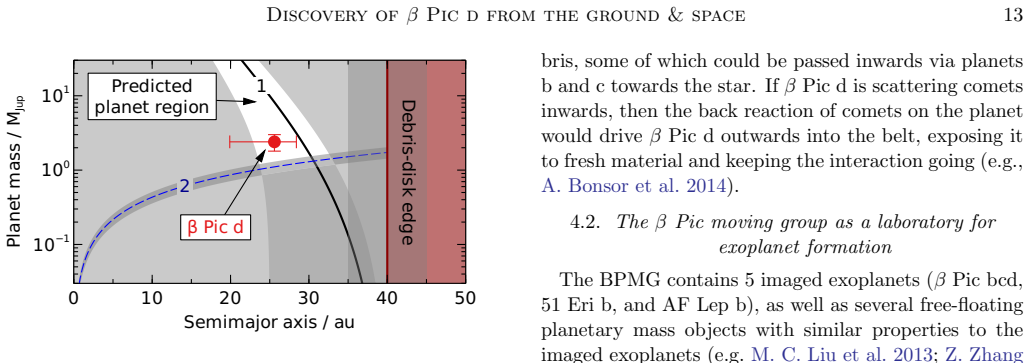
β Pictoris d is a gravitationally bound third giant planet whose multi-epoch astrometry yields a semi-major axis of 26.0+2.2−6.1 au and inclination 89.0+0.7−0.6 deg after non-crossing orbits are retained; its mid-infrared contrast and colors give a mass of 2.4±0.6 MJup and Teff of 600+45−60 K under ATMO hot-start models, making it coplanar with planets b and c and consistent with sculpting the debris-disk inner edge.
What carries the argument
Joint multi-planet orbit fitting of eleven-year relative astrometry for planet d together with literature data for b and c, followed by photometric comparison to ATMO hot-start evolutionary models after a bolometric correction transferred from the analog 51 Eri b.
Load-bearing premise
The mass, radius and temperature rest on a bolometric correction taken from 51 Eri b and on hot-start evolutionary models at the adopted system age; a colder start or different age would change the mass substantially.
What would settle it
A new epoch of high-precision relative astrometry that places the source off the predicted non-crossing orbital track, or a spectrum that shows no CO2 absorption and colors inconsistent with a mid-T object of the claimed luminosity.
If this is right
- The β Pic system now hosts three coplanar giant planets whose outermost member can explain the observed inner edge of the debris disk.
- Mid-infrared non-coronagraphic imaging on 8-m-class telescopes can reach ~2 MJup planets at young ages and separations of tens of au.
- Comparative spectroscopy of β Pic d and 51 Eri b can test whether metal enhancement and CO2 absorption are common among mid-T exoplanets of the same moving group.
- Long time baselines remain essential for confirming companions that spend years near the star or behind brighter siblings.
Where Pith is reading between the lines
- If the luminosity is eventually shown to require a cold-start entropy, β Pic becomes the first system known to host both hot-start and cold-start giant planets.
- The same non-coronagraphic mid-IR strategy should recover additional low-mass planets in other edge-on debris-disk systems once multi-year baselines exist.
- Dynamical mass measurements of d will decide whether the ATMO-derived mass is accurate or whether the models systematically under- or over-estimate mass at these temperatures.
Editorial analysis
A structured set of objections, weighed in public.
Referee Report
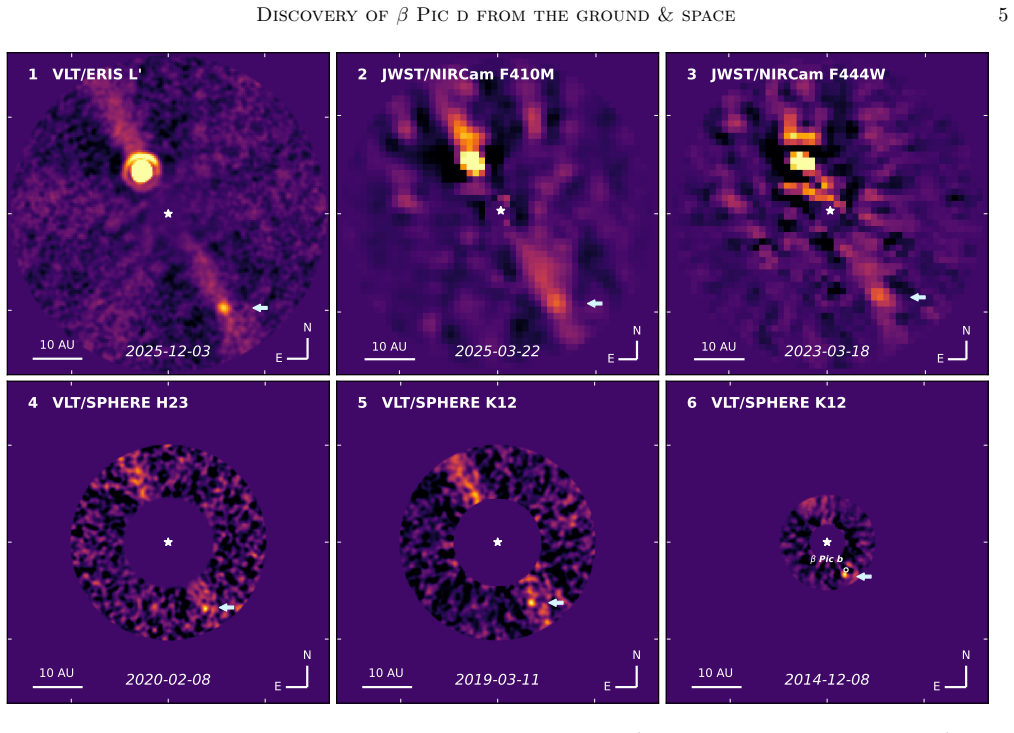
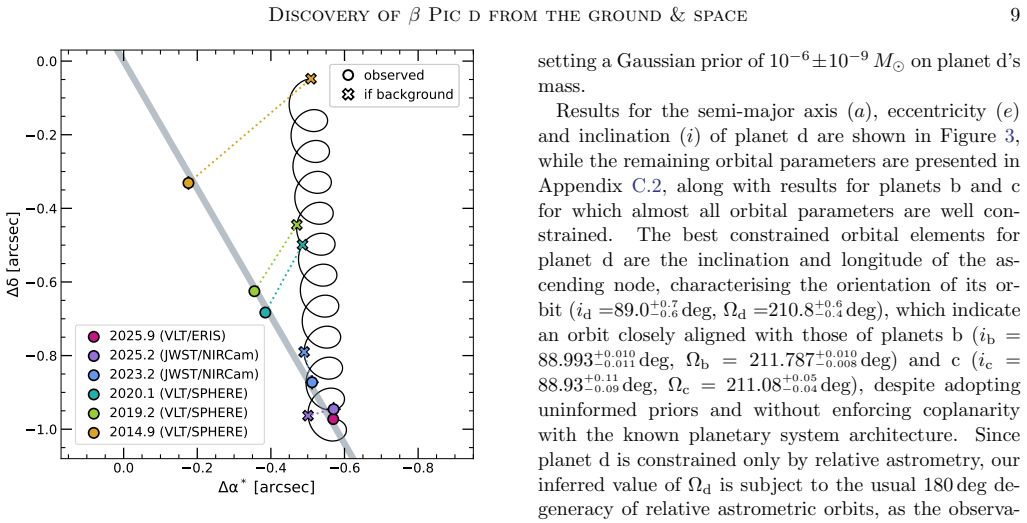
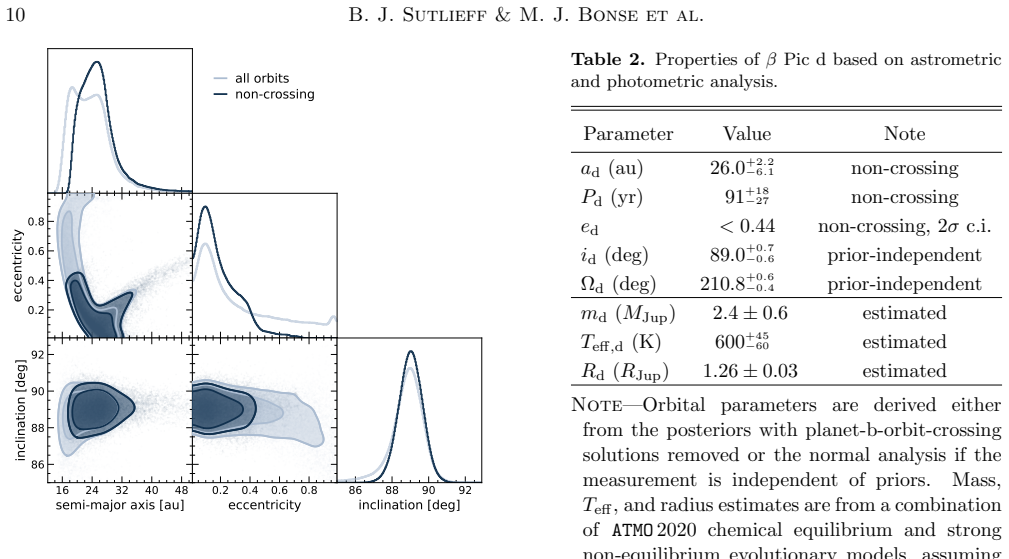
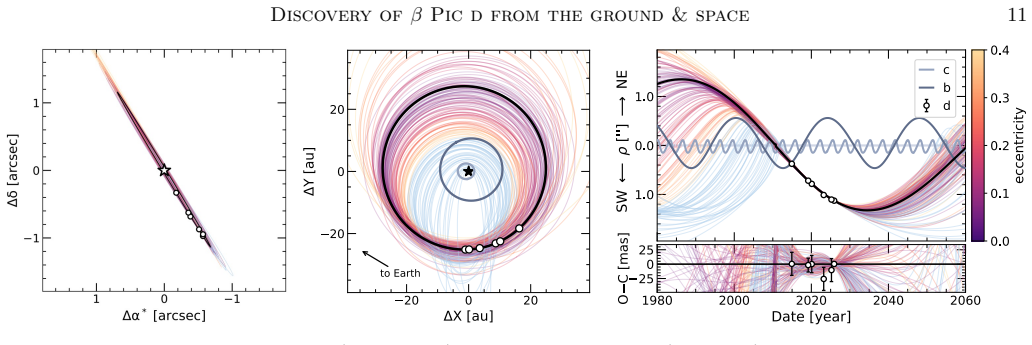
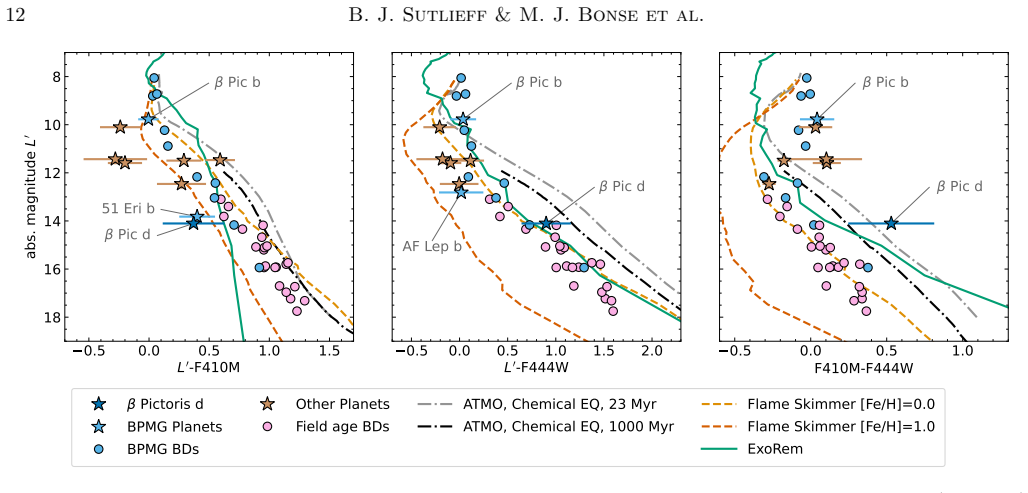
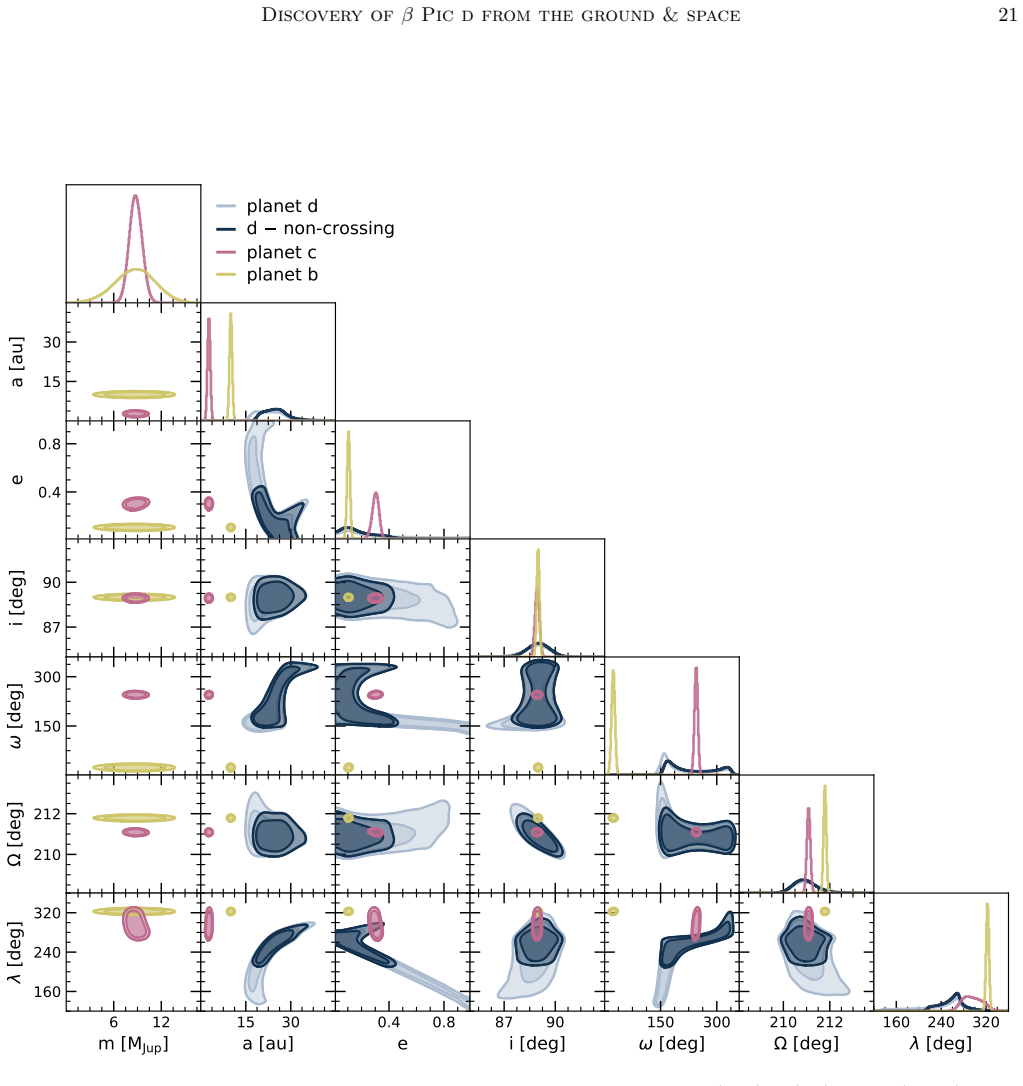
Summary. The manuscript reports the direct-imaging discovery of β Pictoris d, a third giant planet in the β Pic system. The source is detected in non-coronagraphic VLT/ERIS L' imaging and recovered in multi-epoch JWST/NIRCam and VLT/SPHERE data spanning 11 years (Table 1, Fig. 1). Relative astrometry rules out a stationary background object at >24σ and is inconsistent with the Gaia proper-motion track; NaCo non-detections at the expected background locus further support binding (§3.3, Fig. 2). Joint multi-planet orbit fits with orvara yield a prior-independent inclination and ascending node coplanar with planets b and c, and, after discarding orbit-crossing solutions, a semi-major axis of 26.0^{+2.2}_{-6.1} au and e_d < 0.44 (2σ) (§3.4, Tables 2, 4, 5, Figs. 3–4). Photometry gives ΔL' = 12.11 ± 0.15 mag; colors and luminosity closely match 51 Eri b, and ATMO2020 hot-start models plus a bolometric correction transferred from 51 Eri b give T_eff ≈ 600 K and mass 2.4 ± 0.6 M_Jup (§3.5). The orbit is consistent with sculpting the debris-disk inner edge (§4.1, Fig. 6).
Significance. If the result holds, this is a high-impact discovery: a third, coplanar giant planet in the benchmark β Pic system, among the lowest-mass planets imaged from the ground, and a close mid-T analog of 51 Eri b. The multi-facility, multi-epoch confirmation, careful NegFC/MCMC error budgets, explicit flagging of prior-dependent orbital elements, and dynamical consistency with the disk edge are clear strengths. The work also demonstrates the discovery potential of non-coronagraphic mid-IR imaging with ERIS and, by extension, ELT/METIS. The mass and T_eff inherit standard hot-start and bolometric-correction systematics that the paper itself flags; those do not undermine the binding, orbit, or disk-sculpting claims.
major comments (1)
- No load-bearing technical objections. The common-proper-motion rejection (§3.3, Fig. 2), multi-instrument detections (Table 1), and prior-independent i_d and Ω_d (§3.4, Tables 2/4/5) solidly support the central discovery and orbital claims. The mass/T_eff values rest on the usual ATMO hot-start + 51 Eri b BC assumptions (§3.5); the paper already notes that the luminosity is also consistent with lower initial entropy, so this is a systematic caveat rather than an internal inconsistency.
minor comments (5)
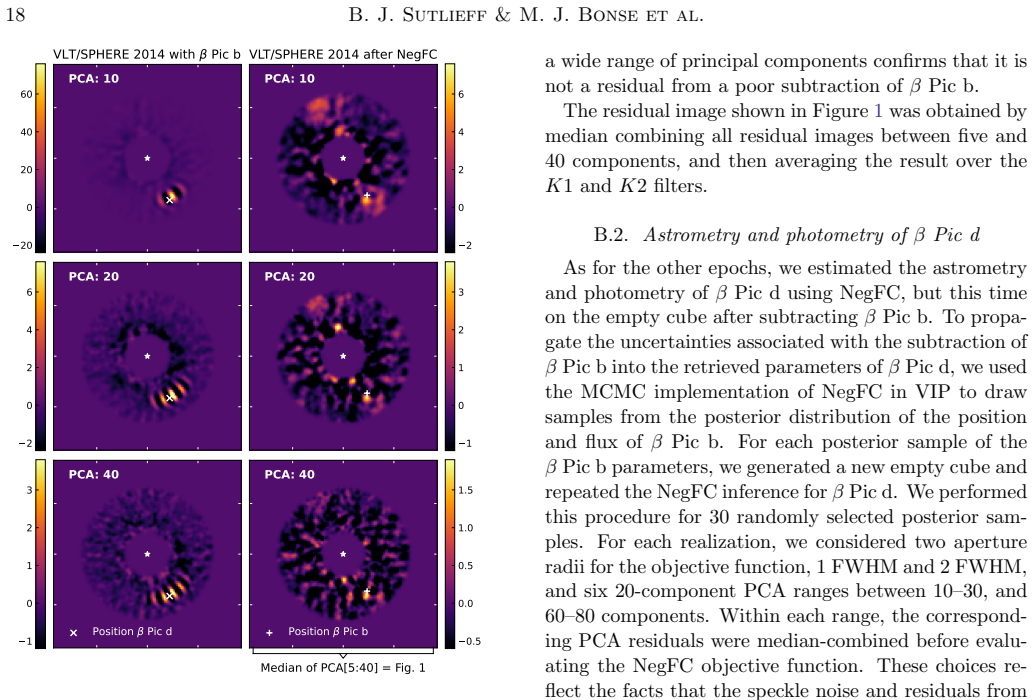
- §3.2.3 / Table 1: For the 2019 and 2020 SPHERE epochs, only lower limits on flux (upper limits on magnitude) are reported because of SDI self-subtraction. A short explicit statement in the table note that a dedicated two-channel forward model is deferred would help readers avoid treating those limits as detections.
- §3.4 / Appendix C: The massless prior on planet d (10^{-6} ± 10^{-9} M_⊙) is justified, but a one-sentence quantitative estimate of the expected stellar acceleration from a ~2.4 M_Jup body at ~26 au would make the approximation more transparent.
- Fig. 1 caption: Clarify that the 2014 panel shows planet b subtracted (open circle) so that the much fainter d (arrow) is visible; the main text already states this, but the figure should stand alone.
- §3.5: The bolometric correction BC(L') = 0.06 ± 0.27 mag is transferred from 51 Eri b. Propagating the large BC uncertainty more explicitly into the final mass/T_eff error bars (or stating that the ±0.6 M_Jup already includes it) would strengthen the photometric section.
- Typographical consistency: the draft mixes β Pic / β Pictoris and occasional missing spaces after periods; a light copy-edit pass would clean these.
Circularity Check
No significant circularity: multi-epoch astrometry, common-proper-motion rejection, and joint orbit fits are independent of the model-dependent mass/Teff estimates.
full rationale
This is an observational discovery paper. The load-bearing claims (detection of a point source at consistent positions across VLT/ERIS, JWST/NIRCam and VLT/SPHERE; >24σ rejection of the stationary-background track from Gaia proper motion/parallax over an 11-year baseline; joint multi-planet orvara fits recovering prior-independent i_d ≈ 89° and Ω_d aligned with b and c without enforcing coplanarity; non-crossing a_d = 26.0^{+2.2}_{-6.1} au) rest on measured relative astrometry, literature RVs/absolute astrometry for the inner planets, and standard MCMC sampling. The mass/Teff (2.4 ± 0.6 M_Jup, 600^{+45}_{-60} K) are obtained by transferring a bolometric correction from the photometrically similar 51 Eri b and interpolating ATMO2020 hot-start isochrones at the adopted BPMG age; the paper itself flags that the luminosity is also consistent with lower-entropy (cold-start) tracks. Disk-sculpting consistency is a post-hoc comparison to an independent ALMA edge location via the SculptingPlanet geometric criterion, not an input that forces the orbit. Self-citations are limited to reduction pipelines (eristools, 4S, spaceKLIP, VIP) that do not close any scientific loop. No equation equates a claimed prediction to a fitted input by construction, no uniqueness theorem is imported from the authors, and no ansatz is smuggled via self-citation. Score 0 is therefore required.
Axiom & Free-Parameter Ledger
free parameters (4)
- orbital elements of planet d (a, e, i, Ω, ω, λ) =
a=26.0^{+2.2}_{-6.1} au, e<0.44 (2σ), i=89.0^{+0.7}_{-0.6} deg
- system age =
23±8 Myr
- bolometric correction BC(L') transferred from 51 Eri b =
0.06±0.27 mag
- planet-d mass prior in orbit fit =
~0
axioms (4)
- domain assumption Hot-start ATMO2020 evolutionary models correctly map (Lbol, age) to mass, radius and Teff for this object.
- domain assumption Non-crossing coplanar orbits are the only physically allowed subset of the posterior.
- domain assumption Standard ADI/SDI/PCA/KLIP/NegFC reductions recover unbiased astrometry and photometry once self-subtraction is modeled.
- standard math Gaia DR3 parallax and proper motion of β Pic correctly predict the background track.
Cite this review
Pith. "Pith review of Direct Imaging Discovery of Giant Exoplanet $\beta$ Pictoris d: A Decade-Long Game of Hide-and-Seek." pith.science (2026). https://pith.science/paper/GNV2UYNH
@misc{pith2026260623801,
  author       = {Pith},
  title        = {Pith review of: Direct Imaging Discovery of Giant Exoplanet $\beta$ Pictoris d: A Decade-Long Game of Hide-and-Seek},
  year         = {2026},
  howpublished = {\url{https://pith.science/paper/GNV2UYNH}},
  note         = {Machine review of arXiv:2606.23801}
}
read the original abstract
We report the direct imaging discovery of a third exoplanet in the $\beta$ Pictoris system. We detect $\beta$ Pictoris d ($\beta$ Pic d) in non-coronagraphic observations obtained with VLT/ERIS as well as multi-epoch archival datasets from JWST/NIRCam and VLT/SPHERE. Astrometric measurements over an 11-year baseline demonstrate that it is consistent with a gravitationally-bound source with orbital motion. Joint multi-planet orbit fits of all three planets in the system yield a semi-major axis of $26.0^{+2.2}_{-6.1}$ au and inclination $89.0^{+0.7}_{-0.6}$ deg for planet d. $\beta$ Pic d has a larger orbital semi-major axis than the other known planets in the system, but is coplanar with the inner two planets, and its orbit is consistent with sculpting the inner edge of the debris disk. $\beta$ Pic d has a contrast of $\Delta L^{\prime}=12.11\pm0.15$ mag, with colors and luminosity that closely match those of 51 Eri b, another exoplanet in the $\beta$ Pictoris moving group. Its VLT/ERIS and JWST/NIRCam colors are distinct from those of free-floating planetary-mass objects of a similar age and temperature. Its red $F410M-F444W$ color indicates strong CO$_2$ absorption in its atmosphere and suggests significant enhancement in metals compared to free-floating objects. From the ATMO hot-start evolutionary models, we estimate an effective temperature of $600^{+45}_{-60}$ K and mass of $2.4\pm0.6$ $M_{\rm Jup}$, which also closely matches similar estimates for 51 Eri b. $\beta$ Pic d is among the lowest-mass exoplanets imaged from the ground. This discovery highlights the deep sensitivity achievable with ground-based imaging in the mid-infrared and the discovery potential of future high-contrast observations with the Extremely Large Telescope.
Figures
Forward citations
Cited by 2 Pith papers
-
Photometric Variability and Rotation of Beta Pictoris b from JWST NIRCam Coronagraphic Imaging
β Pic b shows coherent sub-percent brightness cycles with a 9.00 ± 0.13 hr period in two JWST bands — interpreted as its rotation — with a spin axis consistent with edge-on viewing and spin-orbit alignment.
-
Vector Apodizing Phase Plates for the ELT: From prototype to final optics for METIS and MICADO
Manufactured METIS and MICADO vAPPs achieve <1–2% polarization leakage and expected raw contrasts of a few ×10^{-5} after accounting for realistic coating and write defects.
Reference graph
Works this paper leans on
-
[1]
Amara, A., & Quanz, S. P. 2012, MNRAS, 427, 948, doi: 10.1111/j.1365-2966.2012.21918.x Astropy Collaboration, Robitaille, T. P., Tollerud, E. J., et al. 2013, A&A, 558, A33, doi: 10.1051/0004-6361/201322068 Astropy Collaboration, Price-Whelan, A. M., Sip˝ ocz, B. M., et al. 2018, AJ, 156, 123, doi: 10.3847/1538-3881/aabc4f Astropy Collaboration, Price-Whe...
-
[2]
Balmer, W. O., Otten, G. P. P. L., & Stolker, T. 2025a, backtracks: a python package to compare relative astrometry with background helical motion: v0.6, v0.6 Zenodo, doi: 10.5281/zenodo.14838369
-
[3]
O., Kammerer, J., Pueyo, L., et al
Balmer, W. O., Kammerer, J., Pueyo, L., et al. 2025b, AJ, 169, 209, doi: 10.3847/1538-3881/adb1c6
-
[4]
O., Pueyo, L., Messier, A., et al
Balmer, W. O., Pueyo, L., Messier, A., et al. 2026, ApJL, 1001, L26, doi: 10.3847/2041-8213/ae374a Bardalez Gagliuffi, D. C., Balmer, W. O., Pueyo, L., et al. 2025, ApJL, 988, L18, doi: 10.3847/2041-8213/ade30f
-
[5]
2015, A&A, 582, A83, doi: 10.1051/0004-6361/201526332
Baudino, J.-L., B´ ezard, B., Boccaletti, A., et al. 2015, A&A, 582, A83, doi: 10.1051/0004-6361/201526332
-
[6]
Beiler, S. A., Cushing, M. C., Kirkpatrick, J. D., et al. 2024, ApJ, 973, 107, doi: 10.3847/1538-4357/ad6301
-
[7]
Best, W. M. J., Dupuy, T. J., Liu, M. C., et al. 2025, The UltracoolSheet: Photometry, Astrometry, Spectroscopy, and Multiplicity for 4000+ Ultracool Dwarfs and Imaged Exoplanets, 2.1.0 Zenodo, doi: 10.5281/zenodo.15802304
-
[8]
2024, A&A, 683, A89, doi: 10.1051/0004-6361/202348203
Beust, H., Milli, J., Morbidelli, A., et al. 2024, A&A, 683, A89, doi: 10.1051/0004-6361/202348203
-
[9]
2019, A&A, 631, A155, doi: 10.1051/0004-6361/201935251
Beuzit, J.-L., Vigan, A., Mouillet, D., et al. 2019, A&A, 631, A155, doi: 10.1051/0004-6361/201935251
-
[10]
Blunt, S., Wang, J. J., Angelo, I., et al. 2020, AJ, 159, 89, doi: 10.3847/1538-3881/ab6663
-
[11]
2024, The Journal of Open Source Software, 9, 6756, doi: 10.21105/joss.06756
Blunt, S., Wang, J., Hirsch, L., et al. 2024, The Journal of Open Source Software, 9, 6756, doi: 10.21105/joss.06756
-
[12]
Bock, J. J., Aboobaker, A. M., Adamo, J., et al. 2026, ApJ, 999, 139, doi: 10.3847/1538-4357/ae2be2
-
[13]
Bohn, A. J., Kenworthy, M. A., Ginski, C., et al. 2020, ApJL, 898, L16, doi: 10.3847/2041-8213/aba27e
-
[14]
2013, A&A, 555, A107, doi: 10.1051/0004-6361/201220838
Bonnefoy, M., Boccaletti, A., Lagrange, A.-M., et al. 2013, A&A, 555, A107, doi: 10.1051/0004-6361/201220838
-
[15]
Bonse, M. J., Garvin, E. O., Gebhard, T. D., et al. 2023, AJ, 166, 71, doi: 10.3847/1538-3881/acc93c
-
[16]
Bonse, M. J., Gebhard, T. D., Dannert, F. A., et al. 2025, AJ, 169, 194, doi: 10.3847/1538-3881/adab79
-
[17]
N., Augereau, J.-C., & Ormel, C
Bonsor, A., Raymond, S. N., Augereau, J.-C., & Ormel, C. W. 2014, MNRAS, 441, 2380, doi: 10.1093/mnras/stu721 Discovery ofβPic d from the ground & space23
-
[18]
2021, The Messenger, 182, 22, doi: 10.18727/0722-6691/5218
Brandl, B., Bettonvil, F., van Boekel, R., et al. 2021, The Messenger, 182, 22, doi: 10.18727/0722-6691/5218
-
[19]
2021, AJ, 161, 179, doi: 10.3847/1538-3881/abdc2e
Michalik, D. 2021, AJ, 161, 179, doi: 10.3847/1538-3881/abdc2e
-
[20]
Brandt, T. D. 2021, ApJS, 254, 42, doi: 10.3847/1538-4365/abf93c
-
[21]
Brandt, T. D., Dupuy, T. J., Li, Y., et al. 2021, AJ, 162, 186, doi: 10.3847/1538-3881/ac042e
-
[22]
B., Maire, A.-L., Molli` ere, P., et al
Brown-Sevilla, S. B., Maire, A.-L., Molli` ere, P., et al. 2023, A&A, 673, A98, doi: 10.1051/0004-6361/202244826
-
[23]
Bryden, G., Llop-Sayson, J., Beichman, C. A., et al. 2026, AJ, 171, 301, doi: 10.3847/1538-3881/ae43e8
-
[24]
J., Krist, J
Burrows, C. J., Krist, J. E., Stapelfeldt, K. R., & WFPC2 Investigation Definition Team. 1995, in American Astronomical Society Meeting Abstracts, Vol. 187, American Astronomical Society Meeting Abstracts, 32.05
1995
-
[25]
2024, in Society of Photo-Optical Instrumentation Engineers (SPIE) Conference Series, Vol
Cantalloube, F., Christiaens, V., Cantero, C., et al. 2024, in Society of Photo-Optical Instrumentation Engineers (SPIE) Conference Series, Vol. 13097, Adaptive Optics Systems IX, ed. K. J. Jackson, D. Schmidt, & E. Vernet, 1309713, doi: 10.1117/12.3020278
-
[26]
L., Hinkley, S., Kammerer, J., et al
Carter, A. L., Hinkley, S., Kammerer, J., et al. 2023, ApJL, 951, L20, doi: 10.3847/2041-8213/acd93e
-
[27]
2018, ApJ, 854, 172, doi: 10.3847/1538-4357/aaac7d
Charnay, B., B´ ezard, B., Baudino, J.-L., et al. 2018, ApJ, 854, 172, doi: 10.3847/1538-4357/aaac7d
-
[28]
2012, A&A, 542, A41, doi: 10.1051/0004-6361/201118346
Chauvin, G., Lagrange, A.-M., Beust, H., et al. 2012, A&A, 542, A41, doi: 10.1051/0004-6361/201118346
-
[29]
Cheetham, A. C., Samland, M., Brems, S. S., et al. 2019, A&A, 622, A80, doi: 10.1051/0004-6361/201834112
-
[30]
Chilcote, J., Pueyo, L., De Rosa, R. J., et al. 2017, AJ, 153, 182, doi: 10.3847/1538-3881/aa63e9
-
[31]
2019, MNRAS, 486, 5819
Christiaens, V., Casassus, S., Absil, O., et al. 2019, MNRAS, 486, 5819
2019
-
[32]
Christiansen, J. L., McElroy, D. L., Harbut, M., et al. 2025, PSJ, 6, 186, doi: 10.3847/PSJ/ade3c2
-
[33]
U., Turatto, M., Gratton, R
Claudi, R. U., Turatto, M., Gratton, R. G., et al. 2008, in Proc. SPIE, Vol. 7014, Ground-based and Airborne Instrumentation for Astronomy II, 70143E
2008
-
[34]
Close, L. M., van Capelleveen, R. F., Weible, G., et al. 2025, ApJL, 990, L9, doi: 10.3847/2041-8213/adf7a5
-
[35]
Crotts, K. A., Carter, A. L., Lawson, K., et al. 2025, ApJL, 987, L41, doi: 10.3847/2041-8213/ade798
-
[36]
2023a, in Astronomical Society of the Pacific Conference Series, Vol
Currie, T., Biller, B., Lagrange, A., et al. 2023a, in Astronomical Society of the Pacific Conference Series, Vol. 534, Protostars and Planets VII, ed. S. Inutsuka, Y. Aikawa, T. Muto, K. Tomida, & M. Tamura, 799, doi: 10.48550/arXiv.2205.05696
-
[37]
Currie, T., Lada, C. J., Plavchan, P., et al. 2009, ApJ, 698, 1, doi: 10.1088/0004-637X/698/1/1
-
[38]
2011, ApJL, 736, L33, doi: 10.1088/2041-8205/736/2/L33
Currie, T., Thalmann, C., Matsumura, S., et al. 2011, ApJL, 736, L33, doi: 10.1088/2041-8205/736/2/L33
-
[39]
2013, ApJ, 776, 15, doi: 10.1088/0004-637X/776/1/15
Currie, T., Burrows, A., Madhusudhan, N., et al. 2013, ApJ, 776, 15, doi: 10.1088/0004-637X/776/1/15
-
[40]
Currie, T., Brandt, G. M., Brandt, T. D., et al. 2023b, Science, 380, 198, doi: 10.1126/science.abo6192
-
[41]
2023, A&A, 674, A207, doi: 10.1051/0004-6361/202346559 De Rosa, R
Davies, R., Absil, O., Agapito, G., et al. 2023, A&A, 674, A207, doi: 10.1051/0004-6361/202346559 De Rosa, R. J., Nielsen, E. L., Wahhaj, Z., et al. 2023, A&A, 672, A94, doi: 10.1051/0004-6361/202345877
-
[42]
2026, A&A, 707, L13, doi: 10.1051/0004-6361/202658862
Denis, A., Vigan, A., Chauvin, G., et al. 2026, A&A, 707, L13, doi: 10.1051/0004-6361/202658862
-
[43]
Dent, W. R. F., Wyatt, M. C., Roberge, A., et al. 2014, Science, 343, 1490, doi: 10.1126/science.1248726
-
[44]
Doelman, D. S., Snik, F., Por, E. H., et al. 2021, ApOpt, 60, D52, doi: 10.1364/AO.422155
-
[45]
2008, in Society of Photo-Optical Instrumentation Engineers (SPIE) Conference Series, Vol
Dohlen, K., Langlois, M., Saisse, M., et al. 2008, in Society of Photo-Optical Instrumentation Engineers (SPIE) Conference Series, Vol. 7014, Ground-based and Airborne Instrumentation for Astronomy II, ed. I. S. McLean & M. M. Casali, 70143L, doi: 10.1117/12.789786
-
[46]
Dupuy, T. J., Brandt, G. M., & Brandt, T. D. 2022, MNRAS, 509, 4411, doi: 10.1093/mnras/stab3148
-
[47]
Dupuy, T. J., Liu, M. C., Evans, E. L., et al. 2023, MNRAS, 519, 1688, doi: 10.1093/mnras/stac3557
-
[48]
Durisen, R. H., Boss, A. P., Mayer, L., et al. 2007, in Protostars and Planets V, ed. B. Reipurth, D. Jewitt, & K. Keil, 607, doi: 10.48550/arXiv.astro-ph/0603179
-
[49]
2014, A&A, 563, A72, doi: 10.1051/0004-6361/201322469
Faramaz, V., Beust, H., Th´ ebault, P., et al. 2014, A&A, 563, A72, doi: 10.1051/0004-6361/201322469
-
[50]
M., & Vidal-Madjar, A
Ferlet, R., Hobbs, L. M., & Vidal-Madjar, A. 1987, A&A, 185, 267
1987
-
[51]
Foreman-Mackey, D., Hogg, D. W., Lang, D., & Goodman, J. 2013, PASP, 125, 306, doi: 10.1086/670067
doi:10.1086/670067 2013
-
[52]
Franson, K., Bowler, B. P., Zhou, Y., et al. 2023, ApJL, 950, L19, doi: 10.3847/2041-8213/acd6f6
-
[53]
Franson, K., Balmer, W. O., Bowler, B. P., et al. 2024, ApJL, 974, L11, doi: 10.3847/2041-8213/ad736a Gagn´ e, J., Mamajek, E. E., Malo, L., et al. 2018, ApJ, 856, 23, doi: 10.3847/1538-4357/aaae09 Gagn´ e, J., Faherty, J. K., Ruiz Diaz, A., et al. 2026, arXiv e-prints, arXiv:2604.22012, doi: 10.48550/arXiv.2604.22012 24B. J. Sutlieff & M. J. Bonse et al....
-
[54]
Gardner, J. P., Mather, J. C., Clampin, M., et al. 2006, SSRv, 123, 485, doi: 10.1007/s11214-006-8315-7
-
[55]
Gardner, J. P., Mather, J. C., Abbott, R., et al. 2023, PASP, 135, 068001, doi: 10.1088/1538-3873/acd1b5
-
[56]
Gebhard, T. D., Bonse, M. J., Quanz, S. P., & Sch¨ olkopf, B. 2022, A&A, 666, A9, doi: 10.1051/0004-6361/202142529
-
[57]
Ginsburg, A., Sip˝ ocz, B. M., Brasseur, C. E., et al. 2019, AJ, 157, 98, doi: 10.3847/1538-3881/aafc33
-
[58]
H., Leisenring, J., Kammerer, J., et al
Girard, J. H., Leisenring, J., Kammerer, J., et al. 2022, in Society of Photo-Optical Instrumentation Engineers (SPIE) Conference Series, Vol. 12180, Space Telescopes and Instrumentation 2022: Optical, Infrared, and Millimeter Wave, ed. L. E. Coyle, S. Matsuura, & M. D. Perrin, 121803Q, doi: 10.1117/12.2629636
-
[59]
Girard, J. H. V., O’Neal, J., Mawet, D., et al. 2012, in Society of Photo-Optical Instrumentation Engineers (SPIE) Conference Series, Vol. 8447, Adaptive Optics Systems III, ed. B. L. Ellerbroek, E. Marchetti, & J.-P. V´ eran, 84470L, doi: 10.1117/12.925660
-
[60]
Golimowski, D. A., Ardila, D. R., Krist, J. E., et al. 2006, AJ, 131, 3109, doi: 10.1086/503801 Gomez Gonzalez, C. A., Wertz, O., Absil, O., et al. 2017, AJ, 154, 7 GRAVITY Collaboration, Nowak, M., Lacour, S., et al. 2020, A&A, 633, A110, doi: 10.1051/0004-6361/201936898
doi:10.1086/503801 2006
-
[61]
Haffert, S. Y., Bohn, A. J., de Boer, J., et al. 2019, Nature Astronomy, 3, 749, doi: 10.1038/s41550-019-0780-5
-
[62]
Han, Y., Wyatt, M. C., & Dent, W. R. F. 2023, MNRAS, 519, 3257, doi: 10.1093/mnras/stac3769
-
[63]
2026, A&A, 705, A196, doi: 10.1051/0004-6361/202556450
Han, Y., Mansell, E., Jennings, J., et al. 2026, A&A, 705, A196, doi: 10.1051/0004-6361/202556450
-
[64]
Harris, C. R., Millman, K. J., van der Walt, S. J., et al. 2020, Nature, 585, 357, doi: 10.1038/s41586-020-2649-2
-
[65]
Heap, S. R., Lindler, D. J., Lanz, T. M., et al. 2000, ApJ, 539, 435, doi: 10.1086/309188
doi:10.1086/309188 2000
-
[66]
2023, A&A, 671, L5, doi: 10.1051/0004-6361/202244727 Houll´ e, M., Millour, F., Berio, P., et al
Hinkley, S., Lacour, S., Marleau, G.-D., et al. 2023, A&A, 671, L5, doi: 10.1051/0004-6361/202244727 Houll´ e, M., Millour, F., Berio, P., et al. 2025, A&A, 704, A182, doi: 10.1051/0004-6361/202453323
-
[67]
Hunter, J. D. 2007, Computing in Science & Engineering, 9, 90, doi: 10.1109/MCSE.2007.55
-
[68]
A., & Mandel, E
Joye, W. A., & Mandel, E. 2003, in Astronomical Society of the Pacific Conference Series, Vol. 295, Astronomical Data Analysis Software and Systems XII, ed. H. E
2003
-
[69]
Kammerer, J., Girard, J., Carter, A. L., et al. 2022, in Society of Photo-Optical Instrumentation Engineers (SPIE) Conference Series, Vol. 12180, Space Telescopes and Instrumentation 2022: Optical, Infrared, and Millimeter Wave, ed. L. E. Coyle, S. Matsuura, & M. D. Perrin, 121803N, doi: 10.1117/12.2628865
-
[70]
Kammerer, J., Lawson, K., Perrin, M. D., et al. 2024, AJ, 168, 51, doi: 10.3847/1538-3881/ad4ffe
-
[71]
Kammerer, J., Winterhalder, T. O., Lacour, S., et al. 2025, A&A, 704, A318, doi: 10.1051/0004-6361/202556860
-
[72]
2025, A&A, 701, A104, doi: 10.1051/0004-6361/202556170
Kenworthy, M., Stolker, T., Kammerer, J., et al. 2025, A&A, 701, A104, doi: 10.1051/0004-6361/202556170
-
[73]
Kenworthy, M. A., Mellon, S. N., Bailey, J. I., et al. 2021, A&A, 648, A15, doi: 10.1051/0004-6361/202040060
-
[74]
Kenworthy, M. A., Dannert, F. A., Hayoz, J., et al. 2026, A&A, 708, A239, doi: 10.1051/0004-6361/202558510
-
[75]
2018, A&A, 617, A44, doi: 10.1051/0004-6361/201832957
Keppler, M., Benisty, M., M¨ uller, A., et al. 2018, A&A, 617, A44, doi: 10.1051/0004-6361/201832957
-
[76]
Kirkpatrick, J. D., Gelino, C. R., Faherty, J. K., et al. 2021, ApJS, 253, 7, doi: 10.3847/1538-4365/abd107
-
[77]
Krist, J. E., Golimowski, D. A., Schroeder, D. J., & Henry, T. J. 1998, PASP, 110, 1046, doi: 10.1086/316221
doi:10.1086/316221 1998
-
[78]
Lacour, S., Wang, J. J., Rodet, L., et al. 2021, A&A, 654, L2, doi: 10.1051/0004-6361/202141889
-
[79]
2025, A&A, 694, A236, doi: 10.1051/0004-6361/202452632
Lacquement, A., Beust, H., Faramaz-Gorka, V., & Duchˆ ene, G. 2025, A&A, 694, A236, doi: 10.1051/0004-6361/202452632
-
[80]
2009, A&A, 493, L21, doi: 10.1051/0004-6361:200811325
Lagrange, A.-M., Gratadour, D., Chauvin, G., et al. 2009, A&A, 493, L21, doi: 10.1051/0004-6361:200811325
This paper was first reviewed by grok-4.5 on July 14, 2026.
discussion (0)
Sign in with ORCID, Apple, or X to comment. Anyone can read and Pith papers without signing in.