REVIEW 3 major objections 2 minor 1 cited by
Chiral effective field theory at N2LO overestimates the tritium Gamow-Teller reduced matrix element when the short-range axial current is fixed from nucleon-deuteron scattering.
Reviewed by Pith at T0; open to challenge. T0 means a machine referee read the full paper against a public rubric. the ladder, T0–T4 →
T0 review · grok-4.3
2026-06-26 02:05 UTC pith:4CRJUJ43
load-bearing objection They fix D from Nd scattering and get a parameter-free N2LO overestimation of the tritium GT matrix element that holds under gA and cutoff changes. the 3 major comments →
Challenging chiral EFT with tritium beta decay
The pith
A machine-rendered reading of the paper's core claim, the machinery that carries it, and where it could break.
Core claim
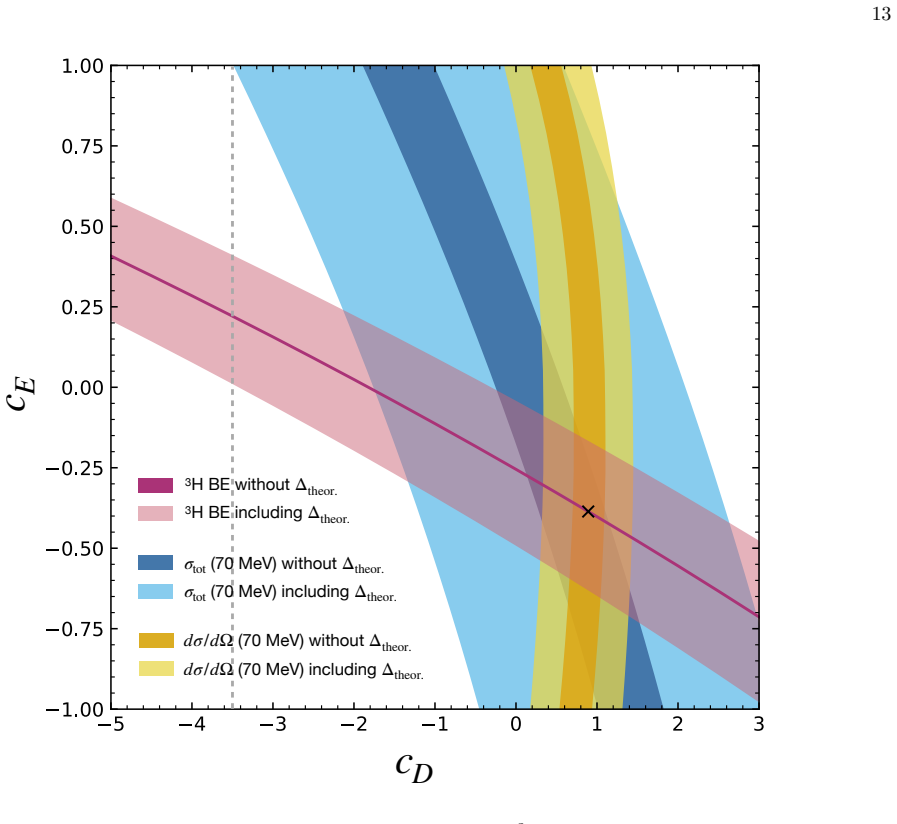
Using nucleon-deuteron scattering observables to fix the low-energy constant D that controls short-range two-body axial currents, chiral EFT at N2LO produces parameter-free predictions for the tritium Gamow-Teller reduced matrix element that considerably overestimate the empirical value, a result robust to reasonable changes in pion-nucleon couplings and regularization.
What carries the argument
The low-energy constant D in the short-range part of the exchange axial current operator, fixed from nucleon-deuteron scattering observables.
Load-bearing premise
The low-energy constant D fixed from nucleon-deuteron scattering observables correctly captures the short-range contributions to the axial current operator inside the tritium nucleus.
What would settle it
A complete N3LO calculation of nucleon-deuteron scattering observables together with the tritium Gamow-Teller matrix element that brings the prediction into agreement with the empirical value.
If this is right
- The Gamow-Teller matrix element in tritium exhibits fine-tuned cancellations between long-range and short-range contributions at N2LO.
- There is considerable N2LO truncation uncertainty for tritium beta decay.
- Large higher-order two-body corrections to the axial current are expected.
- More definite conclusions require a full fourth-order analysis of both nucleon-deuteron scattering and the tritium half-life.
Where Pith is reading between the lines
- If the discrepancy survives at N3LO, the method of fixing short-range currents from scattering data may need to be revisited for consistency across few-body systems.
- Similar overestimations could appear in other weak processes in light nuclei that rely on the same axial current operators.
- The observed fine-tuning implies that tritium beta decay may be unusually sensitive to the balance of contributions that are treated perturbatively in chiral EFT.
Editorial analysis
A structured set of objections, weighed in public.
Referee Report
Summary. The manuscript calculates the tritium Gamow-Teller reduced matrix element in chiral EFT up to N2LO with LENPIC interactions. The LEC D governing short-range two-body axial currents and 3NF is fixed from nucleon-deuteron scattering observables, yielding parameter-free predictions that considerably overestimate the empirical value. The overestimation is reported as robust to variations in g_A and regularization scheme; the authors attribute part of the discrepancy to fine-tuning in the long-range two-body contributions and conclude that N2LO truncation uncertainty is large, calling for a full N3LO analysis.
Significance. If the central result holds, the work provides a concrete, parameter-free test of chiral EFT convergence for a weak observable in the A=3 system, highlighting both the fine-tuned cancellation between one- and two-body currents and the potential size of higher-order two-body corrections. The use of independent scattering data to determine D is a methodological strength that lowers circularity.
major comments (3)
- [axial current operator and Nd fit procedure] The central claim that the N2LO prediction is parameter-free and diagnostic of truncation error rests on the assumption that the single LEC D, determined from Nd scattering, correctly parametrizes the short-range axial current contribution in tritium beta decay. The manuscript does not demonstrate that the linear combination of short-range operators appearing in the tritium Gamow-Teller matrix element is the same combination constrained by the Nd observables used in the fit (see the section on the axial current operator and the Nd fit procedure).
- [robustness analysis] The robustness analysis varies g_A and the regularization scheme but does not test sensitivity to the precise set of Nd scattering observables or to possible additional short-range axial LECs that might enter at this order in the A=3 system. This directly affects whether the observed overestimation can be attributed to missing long-range higher-order terms.
- [discussion of long-range two-body contributions] The discussion of fine-tuning in the long-range two-body contributions is presented as partial explanation for the deviation, yet no quantitative decomposition (e.g., separate one-body, long-range two-body, and short-range two-body contributions with uncertainties) is provided to show how large the cancellation must be to reach the empirical value.
minor comments (2)
- [Abstract] Notation for chiral orders should be stated explicitly once (LO, NLO, N2LO) to avoid any ambiguity with the phrase 'third order (N2LO)'.
- Figure captions and table headings should include the precise definition of the Gamow-Teller reduced matrix element used (including any normalization factors) for direct comparison with experimental extractions.
Simulated Author's Rebuttal
We thank the referee for the careful reading of our manuscript and the constructive comments. We respond to each major comment below.
read point-by-point responses
-
Referee: [axial current operator and Nd fit procedure] The central claim that the N2LO prediction is parameter-free and diagnostic of truncation error rests on the assumption that the single LEC D, determined from Nd scattering, correctly parametrizes the short-range axial current contribution in tritium beta decay. The manuscript does not demonstrate that the linear combination of short-range operators appearing in the tritium Gamow-Teller matrix element is the same combination constrained by the Nd observables used in the fit (see the section on the axial current operator and the Nd fit procedure).
Authors: In the standard formulation of chiral EFT at N2LO, the LEC D multiplies the single short-range two-body axial current operator that enters both Nd scattering and the tritium Gamow-Teller matrix element; the same linear combination therefore appears in both cases. We will add an explicit statement of this operator equivalence (with reference to the relevant chiral Lagrangian terms) to the revised manuscript to make the connection unambiguous. revision: yes
-
Referee: [robustness analysis] The robustness analysis varies g_A and the regularization scheme but does not test sensitivity to the precise set of Nd scattering observables or to possible additional short-range axial LECs that might enter at this order in the A=3 system. This directly affects whether the observed overestimation can be attributed to missing long-range higher-order terms.
Authors: At N2LO only a single short-range axial LEC (D) appears, so no additional LECs enter the A=3 system at this order. We agree, however, that the dependence on the precise choice of Nd observables used to determine D should be quantified. We will add a sensitivity study that refits D to different subsets of the Nd data and reports the resulting variation in the tritium matrix element. revision: yes
-
Referee: [discussion of long-range two-body contributions] The discussion of fine-tuning in the long-range two-body contributions is presented as partial explanation for the deviation, yet no quantitative decomposition (e.g., separate one-body, long-range two-body, and short-range two-body contributions with uncertainties) is provided to show how large the cancellation must be to reach the empirical value.
Authors: We agree that an explicit numerical decomposition would strengthen the argument. The present manuscript only quotes the magnitude of the long-range two-body piece; we will add a table (or figure) that separates the one-body, long-range two-body, and short-range two-body contributions together with chiral-EFT truncation uncertainties for each term. revision: yes
Circularity Check
No significant circularity: LEC fixed from independent Nd scattering, tritium GT is genuine prediction
full rationale
The derivation fixes LEC D from nucleon-deuteron scattering observables (independent data) and then computes the tritium Gamow-Teller matrix element without further adjustment, yielding a parameter-free prediction. No step reduces by construction to the target observable, no self-definitional loops, and no load-bearing self-citation chains are evident. The result is an honest out-of-sample test whose discrepancy is interpreted as truncation uncertainty, consistent with the paper's own framing.
Axiom & Free-Parameter Ledger
free parameters (1)
- D
axioms (2)
- domain assumption Chiral EFT expansion up to N2LO is applicable to tritium beta decay
- domain assumption The Gamow-Teller reduced matrix element is computed from the axial current operator within this EFT
read the original abstract
We present a detailed investigation of tritium beta decay up to third order (N2LO) in chiral effective field theory (EFT) using the LENPIC interactions. Unlike existing studies, we use nucleon-deuteron scattering observables to fix the low-energy constant D that governs the strength of the short-range contributions to the exchange axial current operator and three-nucleon forces. Surprisingly, the resulting parameter-free predictions for the tritium Gamow-Teller reduced matrix element are found to considerably overestimate its empirical value. This result remains robust against reasonable variations of the pion-nucleon coupling constants and regularization scheme. A closer look at the size of the parameter-free long-range two-body contributions to the Gamow-Teller matrix element reveals the fine-tuned nature this observable in chiral EFT, which may partially explain the observed deviation. Our results indicate a considerable N2LO truncation uncertainty for tritium beta decay and point towards large higher-order two-body corrections. More definite conclusions await a complete fourth-order analysis of nucleon-deuteron scattering observables and tritium half-life.
Figures
Forward citations
Cited by 1 Pith paper
-
Spectroscopic basis for short-range three-nucleon forces
A spectroscopic reparametrization of N4LO contact three-nucleon forces lets nine of thirteen LECs be determined from elastic nucleon-deuteron scattering via an RBF emulator.
Reference graph
Works this paper leans on
-
[1]
Treatment of the single-nucleon current In order to calculate the single-nucleon matrix elements 3He, m3He,P f J µ,+ 1N,(1) +J µ,+ 1N,(2) +J µ,+ 1N,(3) 3H, m3H,P i , where both the spinJ b of 3H and the spinJof 3He are assumed to be 1/2,m 3H andm 3He denote the spin projections of 3H and 3He, whileP i,P f are, respectively, the total momenta of 3H and 3He...
-
[2]
Treatment of the two-nucleon current For two-nucleon matrix elements ⟨3He, m3He,P f |J µ,+ 2N,(2,3) +J µ,+ 2N,(3,1) +J µ,+ 2N,(1,2) |3H, m3H,P i⟩, the same symmetry argument holds, and it is sufficient to calculate⟨pqα,P f |J µ,+ 2N,(2,3) |3H, m3He,P i⟩. We assume a general form of the two-body current operator ⟨p′ 1p′ 2p′ 3|J µ,+ 2N,(2,3) |p1p2p3⟩=δ(p ′ ...
-
[3]
Comparison with the results by Baroni et al. To reduce the possibility of errors in the treatment of the MEC, the most computationally involved part of our calculations, it is instructive to compare the individual contributions∝c 3,4,D with the values quoted in the literature. We stress that given the different regularization schemes for the current opera...
-
[4]
V C using the expressions for the 2N axial current and 3NF without additional subtractions, i.e., by settingC= 0
Removing subtractions To verify the robustness of our predictions for the GT ME, we have redone the calculations described in sec. V C using the expressions for the 2N axial current and 3NF without additional subtractions, i.e., by settingC= 0. As already 5 The quoted N3LO(CT) values take into account not only thec D contribution, but also the short-range...
-
[5]
effective
Effectivec i’s Since the long-range components of the MEC generate the bulk ofδGT MEC (especially for hard cutoff choices), one may speculate that the observed overestimation of the GT ME might be related to the inappropriate choice of numerical values of the subleadingπN LECsc 3,4. Indeed, from matching chiral perturbation theory (ChPT) to the Roy-Steine...
-
[6]
All results presented above are obtained using the static approximation for the single-nucleon axial current by neglecting the last term in Eq
Relativistic corrections to the single-nucleon current We have also estimated the size of the leading relativistic corrections. All results presented above are obtained using the static approximation for the single-nucleon axial current by neglecting the last term in Eq. (3.6), and assuming that the 3He nucleus in the final state has vanishing momentum. F...
-
[7]
Sensitivity to the NN off-shell short-range interactions at N 3LO Finally, to probe the impact of (some of the) truncated short-range contributions at N3LO, we have redone the analysis using phase-equivalent but off-shell different N4LO+ NN potentials introduced in Ref. [27]. These interactions employ different choices for the off-shell behavior of the NN...
2024
-
[8]
M. J. Dolinski, A. W. P. Poon and W. Rodejohann, Ann. Rev. Nucl. Part. Sci.69, 219-251 (2019) [arXiv:1902.04097 [nucl-ex]]
work page Pith review arXiv 2019
-
[9]
I. S. Towner, Phys. Rept.155, 263-377 (1987)
1987
-
[10]
J. T. Suhonen, Front. in Phys.5, 55 (2017) [arXiv:1712.01565 [nucl-th]]
work page internal anchor Pith review Pith/arXiv arXiv 2017
-
[11]
P. Gysbers, G. Hagen, J. D. Holt, G. R. Jansen, T. D. Morris, P. Navr´ atil, T. Papenbrock, S. Quaglioni, A. Schwenk and S. R. Stroberg,et al.Nature Phys.15, no.5, 428-431 (2019) [arXiv:1903.00047 [nucl-th]]
-
[12]
Chiral Three-Nucleon Forces from p-wave Pion Production
C. Hanhart, U. van Kolck and G. A. Miller, Phys. Rev. Lett.85, 2905-2908 (2000) [arXiv:nucl-th/0004033 [nucl-th]]. 24
work page internal anchor Pith review Pith/arXiv arXiv 2000
-
[13]
A. Gardestig and D. R. Phillips, Phys. Rev. C73, 014002 (2006) [arXiv:nucl-th/0501049 [nucl-th]]
work page internal anchor Pith review Pith/arXiv arXiv 2006
-
[14]
A. Gardestig and D. R. Phillips, Phys. Rev. Lett.96, 232301 (2006) [arXiv:nucl-th/0603045 [nucl-th]]
work page internal anchor Pith review Pith/arXiv arXiv 2006
-
[15]
V. Lensky, V. Baru, E. Epelbaum, C. Hanhart, J. Haidenbauer, A. E. Kudryavtsev and U.-G. Meißner, Eur. Phys. J. A 33, 339-348 (2007) [arXiv:0704.0443 [nucl-th]]
work page internal anchor Pith review Pith/arXiv arXiv 2007
-
[16]
T. S. Park, D. P. Min and M. Rho, Phys. Rept.233, 341-395 (1993) [arXiv:hep-ph/9301295 [hep-ph]]
work page internal anchor Pith review Pith/arXiv arXiv 1993
-
[17]
J. L. Friar, Annals Phys.104, 380-426 (1977)
1977
-
[18]
Nuclear electromagnetic currents to fourth order in chiral effective field theory
H. Krebs, E. Epelbaum and U.-G. Meißner, Few Body Syst.60, no.2, 31 (2019) [arXiv:1902.06839 [nucl-th]]
work page internal anchor Pith review Pith/arXiv arXiv 2019
-
[19]
L. E. Marcucci, R. Schiavilla, M. Viviani, A. Kievsky, S. Rosati and J. F. Beacom, Phys. Rev. C63, 015801 (2001) [arXiv:nucl-th/0006005 [nucl-th]]
work page internal anchor Pith review Pith/arXiv arXiv 2001
-
[20]
Nuclear axial current operators to fourth order in chiral effective field theory
H. Krebs, E. Epelbaum and U.-G. Meißner, Annals Phys.378, 317 (2017), [arXiv:1610.03569 [nucl-th]]
work page internal anchor Pith review Pith/arXiv arXiv 2017
-
[21]
Nuclear forces from chiral Lagrangians using the method of unitary transformation I: Formalism
E. Epelbaum, W. Gl¨ ockle and U.-G. Meißner, Nucl. Phys. A637, 107-134 (1998) [arXiv:nucl-th/9801064 [nucl-th]]
work page internal anchor Pith review Pith/arXiv arXiv 1998
-
[22]
E. Epelbaum, W. Gl¨ ockle and U. G. Meißner, Nucl. Phys. A671, 295-331 (2000) [arXiv:nucl-th/9910064 [nucl-th]]
work page internal anchor Pith review Pith/arXiv arXiv 2000
-
[23]
Nuclear forces in the chiral limit
E. Epelbaum, U.-G. Meißner and W. Gl¨ ockle, Nucl. Phys. A714, 535-574 (2003) [arXiv:nucl-th/0207089 [nucl-th]]
work page internal anchor Pith review Pith/arXiv arXiv 2003
-
[24]
Isospin-violating nucleon-nucleon forces using the method of unitary transformation
E. Epelbaum and U.-G. Meißner, Phys. Rev. C72, 044001 (2005) [arXiv:nucl-th/0502052 [nucl-th]]
work page internal anchor Pith review Pith/arXiv arXiv 2005
-
[25]
Four-nucleon force in chiral effective field theory
E. Epelbaum, Phys. Lett. B639, 456-461 (2006) [arXiv:nucl-th/0511025 [nucl-th]]
work page internal anchor Pith review Pith/arXiv arXiv 2006
-
[26]
Four-nucleon force using the method of unitary transformation
E. Epelbaum, Eur. Phys. J. A34, 197-214 (2007) [arXiv:0710.4250 [nucl-th]]
work page internal anchor Pith review Pith/arXiv arXiv 2007
-
[27]
Subleading contributions to the chiral three-nucleon force I: long-range terms
V. Bernard, E. Epelbaum, H. Krebs and U.-G. Meißner, Phys. Rev. C77, 064004 (2008) [arXiv:0712.1967 [nucl-th]]
work page internal anchor Pith review Pith/arXiv arXiv 2008
-
[28]
V. Bernard, E. Epelbaum, H. Krebs and U.-G. Meißner, Phys. Rev. C84, 054001 (2011) [arXiv:1108.3816 [nucl-th]]
work page internal anchor Pith review Pith/arXiv arXiv 2011
-
[29]
Chiral three-nucleon force at N^4LO I: Longest-range contributions
H. Krebs, A. Gasparyan and E. Epelbaum, Phys. Rev. C85, 054006 (2012) [arXiv:1203.0067 [nucl-th]]
work page internal anchor Pith review Pith/arXiv arXiv 2012
-
[30]
Chiral three-nucleon force at N^4LO II: Intermediate-range contributions
H. Krebs, A. Gasparyan and E. Epelbaum, Phys. Rev. C87, no.5, 054007 (2013) [arXiv:1302.2872 [nucl-th]]
work page internal anchor Pith review Pith/arXiv arXiv 2013
-
[31]
V. Springer, H. Krebs and E. Epelbaum, Phys. Rev. C112, no.3, 034004 (2025) [arXiv:2505.02034 [nucl-th]]
-
[32]
Nuclear Axial Currents in Chiral Effective Field Theory
A. Baroni, L. Girlanda, S. Pastore, R. Schiavilla and M. Viviani, Phys. Rev. C93, no.1, 015501 (2016) [erratum: Phys. Rev. C93, no.4, 049902 (2016); erratum: Phys. Rev. C95, no.5, 059901 (2017)] [arXiv:1509.07039 [nucl-th]]
work page internal anchor Pith review Pith/arXiv arXiv 2016
-
[33]
Tritium $\beta$-decay in chiral effective field theory
A. Baroni, L. Girlanda, A. Kievsky, L. E. Marcucci, R. Schiavilla and M. Viviani, Phys. Rev. C94, no.2, 024003 (2016) [erratum: Phys. Rev. C95, no.5, 059902 (2017)] [arXiv:1605.01620 [nucl-th]]
work page internal anchor Pith review Pith/arXiv arXiv 2016
-
[34]
Can the strong interactions between hadrons be determined using femtoscopy?
E. Epelbaum, S. Heihoff, U.-G. Meißner and A. Tscherwon, Phys. Rev. Lett.136, no.21, 212301 (2026) [arXiv:2504.08631 [nucl-th]]
work page internal anchor Pith review Pith/arXiv arXiv 2026
- [35]
-
[36]
H. Krebs, Eur. Phys. J. A56, no.9, 234 (2020) [arXiv:2008.00974 [nucl-th]]
-
[37]
High-precision nuclear forces from chiral EFT: State-of-the-art, challenges and outlook
E. Epelbaum, H. Krebs and P. Reinert, Front. in Phys.8, 98 (2020) [arXiv:1911.11875 [nucl-th]]
work page Pith review arXiv 2020
-
[38]
Krebs, PoSCD2018, 098 (2019) [arXiv:1908.01538 [nucl-th]]
H. Krebs, PoSCD2018, 098 (2019) [arXiv:1908.01538 [nucl-th]]
-
[39]
H. Krebs and E. Epelbaum, Phys. Rev. C110, no.4, 044004 (2024) [arXiv:2312.13932 [nucl-th]]
-
[40]
H. Krebs and E. Epelbaum, Phys. Rev. C110, no.4, 044003 (2024) [arXiv:2311.10893 [nucl-th]]
-
[41]
D. Gazit, S. Quaglioni and P. Navratil, Phys. Rev. Lett.103, 102502 (2009) [erratum: Phys. Rev. Lett.122, no.2, 029901 (2019)] [arXiv:0812.4444 [nucl-th]]
work page internal anchor Pith review Pith/arXiv arXiv 2009
-
[42]
S. Wesolowski, I. Svensson, A. Ekstr¨ om, C. Forss´ en, R. J. Furnstahl, J. A. Melendez and D. R. Phillips, Phys. Rev. C104, no.6, 064001 (2021) [arXiv:2104.04441 [nucl-th]]
- [43]
-
[44]
Effective-field-theory predictions of the muon-deuteron capture rate
B. Acharya, A. Ekstr¨ om and L. Platter, Phys. Rev. C98, no.6, 065506 (2018) [arXiv:1806.09481 [nucl-th]]
work page internal anchor Pith review Pith/arXiv arXiv 2018
-
[45]
L. Ceccarelli, A. Gnech, L. E. Marcucci, M. Piarulli and M. Viviani, Front. Phys.10, 1049919 (2023) [arXiv:2209.09762 [nucl-th]]
- [46]
-
[47]
T. S. Park, L. E. Marcucci, R. Schiavilla, M. Viviani, A. Kievsky, S. Rosati, K. Kubodera, D. P. Min and M. Rho, Phys. 25 Rev. C67, 055206 (2003) [arXiv:nucl-th/0208055 [nucl-th]]
work page internal anchor Pith review Pith/arXiv arXiv 2003
-
[48]
B. Acharya and S. Bacca, Phys. Rev. C101, no.1, 015505 (2020) [arXiv:1911.12659 [nucl-th]]
-
[49]
A. Baroni, R. Schiavilla, L. E. Marcucci, L. Girlanda, A. Kievsky, A. Lovato, S. Pastore, M. Piarulli, S. C. Pieper and M. Viviani,et al.Phys. Rev. C98, no.4, 044003 (2018) [arXiv:1806.10245 [nucl-th]]
work page internal anchor Pith review Pith/arXiv arXiv 2018
-
[50]
E. Epelbaumet al.[LENPIC], Phys. Rev. C99, no.2, 024313 (2019) [arXiv:1807.02848 [nucl-th]]
work page internal anchor Pith review Pith/arXiv arXiv 2019
- [51]
-
[52]
P. Mariset al.[LENPIC], Phys. Rev. C106, no.6, 064002 (2022) [arXiv:2206.13303 [nucl-th]]
-
[53]
Semilocal momentum-space regularized chiral two-nucleon potentials up to fifth order
P. Reinert, H. Krebs and E. Epelbaum, Eur. Phys. J. A54, no.5, 86 (2018) [arXiv:1711.08821 [nucl-th]]
work page internal anchor Pith review Pith/arXiv arXiv 2018
-
[54]
Raman, C
S. Raman, C. A. Houser, T. A. Walkiewicz and I. S. Towner, Atom. Data Nucl. Data Tabl.21, 567-620 (1978) [erratum: Atom. Data Nucl. Data Tabl.22, 369-369 (1978)]
1978
-
[55]
J. J. Simpson, Phys. Rev. C35, 752-754 (1987)
1987
-
[56]
I. S. Towner and J. C. Hardy, Phys. Rev. C91, no.1, 015501 (2015) [arXiv:1412.0727 [nucl-th]]
work page internal anchor Pith review Pith/arXiv arXiv 2015
-
[57]
Exact relativistic tritium beta-decay endpoint spectrum in a hadron model
F. Simkovic, R. Dvornicky and A. Faessler, Phys. Rev. C77, 055502 (2008) [arXiv:0712.3926 [hep-ph]]
work page internal anchor Pith review Pith/arXiv arXiv 2008
- [58]
-
[59]
R. B. Wiringa, V. G. J. Stoks and R. Schiavilla, Phys. Rev. C51, 38-51 (1995) [arXiv:nucl-th/9408016 [nucl-th]]
work page internal anchor Pith review Pith/arXiv arXiv 1995
- [60]
-
[61]
P. A. Zylaet al.[Particle Data Group], PTEP2020, no.8, 083C01 (2020)
2020
-
[62]
M. Gorchtein and C. Y. Seng, JHEP10, 053 (2021) [arXiv:2106.09185 [hep-ph]]
-
[63]
Modern Theory of Nuclear Forces
E. Epelbaum, H. W. Hammer and U.-G. Meißner, Rev. Mod. Phys.81, 1773-1825 (2009) [arXiv:0811.1338 [nucl-th]]
work page internal anchor Pith review Pith/arXiv arXiv 2009
-
[64]
Chiral effective field theory and nuclear forces
R. Machleidt and D. R. Entem, Phys. Rept.503, 1-75 (2011) [arXiv:1105.2919 [nucl-th]]
work page internal anchor Pith review Pith/arXiv arXiv 2011
-
[65]
S. K¨ olling, E. Epelbaum, H. Krebs and U.-G. Meißner, Phys. Rev. C80, 045502 (2009) [arXiv:0907.3437 [nucl-th]]
work page internal anchor Pith review Pith/arXiv arXiv 2009
-
[66]
S. K¨ olling, E. Epelbaum, H. Krebs and U.-G. Meißner, Phys. Rev. C84, 054008 (2011) [arXiv:1107.0602 [nucl-th]]
work page internal anchor Pith review Pith/arXiv arXiv 2011
-
[67]
Electromagnetic two-body currents of one- and two-pion range
S. Pastore, R. Schiavilla and J. L. Goity, Phys. Rev. C78, 064002 (2008) [arXiv:0810.1941 [nucl-th]]
work page internal anchor Pith review Pith/arXiv arXiv 2008
-
[68]
Electromagnetic Currents and Magnetic Moments in $\chi$EFT
S. Pastore, L. Girlanda, R. Schiavilla, M. Viviani and R. B. Wiringa, Phys. Rev. C80, 034004 (2009) [arXiv:0906.1800 [nucl-th]]
work page internal anchor Pith review Pith/arXiv arXiv 2009
-
[69]
S. Pastore, L. Girlanda, R. Schiavilla and M. Viviani, Phys. Rev. C84, 024001 (2011) [arXiv:1106.4539 [nucl-th]]
work page internal anchor Pith review Pith/arXiv arXiv 2011
-
[70]
T. S. Park, D. P. Min and M. Rho, Nucl. Phys. A596, 515-552 (1996) [arXiv:nucl-th/9505017 [nucl-th]]
work page internal anchor Pith review Pith/arXiv arXiv 1996
-
[71]
E. G. Myers, A. Wagner, H. Kracke and B. A. Wesson, Phys. Rev. Lett.114, no.1, 013003 (2015)
2015
-
[72]
P. Reinert, H. Krebs and E. Epelbaum, Phys. Rev. Lett.126, no.9, 092501 (2021) [arXiv:2006.15360 [nucl-th]]
-
[73]
Golak, R
J. Golak, R. Skibi´ nski, H. Wita la, W. Gl¨ ockle, A. Nogga, and H. Kamada, Phys. Rep.415, 89 (2005)
2005
-
[74]
Golak, D
J. Golak, D. Rozp ιedzik, R. Skibi´ nski, K. Topolnicki, H. Wita la, W. Gl¨ ockle, A. Nogga, E. Epelbaum, H. Kamada, Ch. Elster, and I. Fachruddin, Eur. Phys. J. A43, 241 (2010)
2010
-
[75]
Skibi´ nski, J
R. Skibi´ nski, J. Golak, K. Topolnicki, H. Wita la, H. Kamada, W. Gl¨ ockle, and A. Nogga, Eur. Phys. J. A47, 48 (2011)
2011
-
[76]
D. R. Entem and R. Machleidt, Phys. Rev. C68, 041001 (2003) [arXiv:nucl-th/0304018 [nucl-th]]
work page internal anchor Pith review Pith/arXiv arXiv 2003
-
[77]
Matching pion-nucleon Roy-Steiner equations to chiral perturbation theory
M. Hoferichter, J. Ruiz de Elvira, B. Kubis and U.-G. Meißner, Phys. Rev. Lett.115, no.19, 192301 (2015) [arXiv:1507.07552 [nucl-th]]
work page internal anchor Pith review Pith/arXiv arXiv 2015
-
[78]
Three-Nucleon Forces from Chiral Effective Field Theory
E. Epelbaum, A. Nogga, W. Gl¨ ockle, H. Kamada, U.-G. Meißner and H. Wita la, Phys. Rev. C66, 064001 (2002) [arXiv:nucl-th/0208023 [nucl-th]]
work page internal anchor Pith review Pith/arXiv arXiv 2002
-
[79]
Spectra and binding energy predictions of chiral interactions for 7Li
A. Nogga, P. Navratil, B. R. Barrett and J. P. Vary, Phys. Rev. C73, 064002 (2006) [arXiv:nucl-th/0511082 [nucl-th]]
work page internal anchor Pith review Pith/arXiv arXiv 2006
-
[80]
Light-nuclei spectra from chiral dynamics
M. Piarulli, A. Baroni, L. Girlanda, A. Kievsky, A. Lovato, E. Lusk, L. E. Marcucci, S. C. Pieper, R. Schiavilla and M. Viviani,et al.Phys. Rev. Lett.120, no.5, 052503 (2018) [arXiv:1707.02883 [nucl-th]]. 26
work page internal anchor Pith review Pith/arXiv arXiv 2018
discussion (0)
Sign in with ORCID, Apple, or X to comment. Anyone can read and Pith papers without signing in.