REVIEW 3 major objections 6 minor 70 references
Rewriting short-range three-nucleon forces in a spectroscopic basis lets nine of thirteen low-energy constants be fixed from elastic nucleon-deuteron data.
Reviewed by Pith at T0; open to challenge. T0 means a machine referee read the full paper against a public rubric. the ladder, T0–T4 →
T0 review · grok-4.5
2026-07-30 15:49 UTC pith:RXHNRDTI
load-bearing objection The spectroscopic basis and emulator are genuinely useful; the “9 of 13 reliably determined” claim is softer than the abstract suggests once you look at Table V’s progressive shifts. the 3 major comments →
Spectroscopic basis for short-range three-nucleon forces
The pith
A machine-rendered reading of the paper's core claim, the machinery that carries it, and where it could break.
Core claim
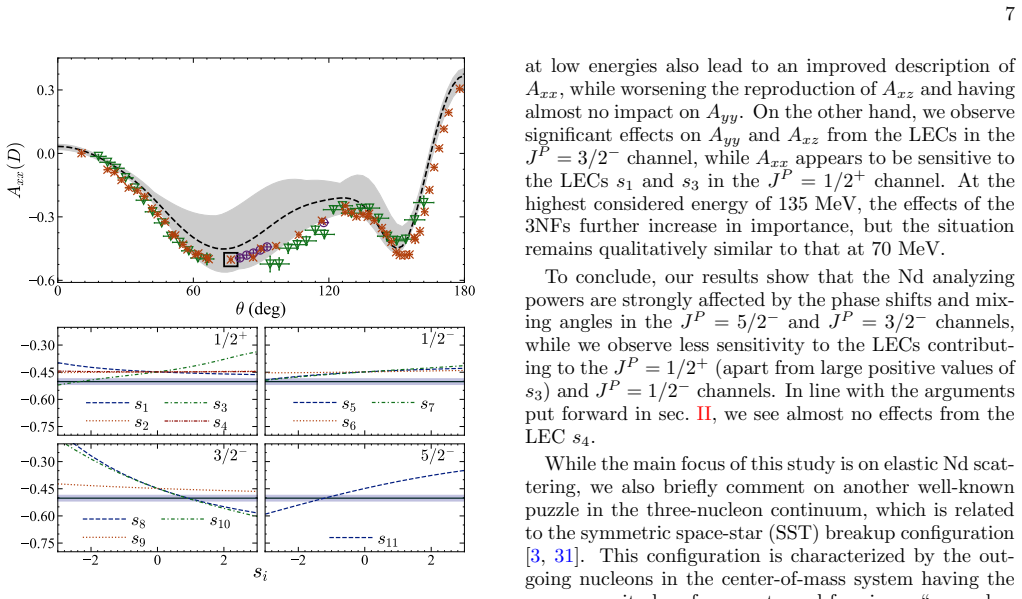
Once the thirteen subleading contact three-nucleon operators are linearly transformed into the spectroscopic basis S1…S13, each Si contributes to a single JP channel (or vanishes) in elastic nucleon-deuteron scattering. With that basis the authors build an RBF emulator and demonstrate that nine of the thirteen dimensionless coefficients can be extracted from elastic Nd data at 10, 70 and 135 MeV, while s2 and s4 remain essentially unconstrained by elastic observables and s12, s13 are invisible in the T=1/2 system.
What carries the argument
The spectroscopic basis: an invertible linear map from the original Ei operators onto new constants Si that each act in only one JP partial-wave sector of Nd scattering (Table II and Eqs. 3–5), collapsing the fit space enough for radial-basis-function interpolation.
Load-bearing premise
That the nine constants remain determinable and of roughly natural size after the still-missing longer-range three-nucleon pieces beyond N2LO are restored to the Hamiltonian.
What would settle it
Repeat the same elastic Nd fits after the symmetry-preserving N3LO (and N4LO long-range) three-nucleon contributions are included; if several of the nine Si then become unconstrained or wildly unnatural, the claim fails.
If this is right
- Elastic Nd data alone can fix the isospin-1/2 short-range 3NF sector once the spectroscopic rewrite is used.
- The Ay puzzle at low energy is at least half-resolved by a natural-size s11 together with the 3/2− LECs.
- The N2LO contact cD shifts negative once N4LO contacts are free, moving closer to the value preferred by tritium beta decay.
- s2 and s4 must be constrained by breakup or four-body data; s12 and s13 require systems with T=3/2 components.
- A complete N3LO Nd analysis can reuse the same spectroscopic emulator after the enhanced linear combinations of Si and Fi are restored.
Where Pith is reading between the lines
- The same spectroscopic map should make eigenvector-continuation or Woodbury emulators for three-nucleon scattering dramatically cheaper, because each channel now depends on only a handful of LECs.
- Once s12 and s13 are fixed from A=4 or neutron-matter calculations, the full contact 3NF can be frozen and used as a controlled input for medium-mass structure, testing whether the remaining discrepancies are truly long-range.
- The opposite impact of the 3/2− LECs on nucleon versus deuteron Ay suggests a clean experimental program that measures both analyzing powers at the same energy to isolate mixing angles.
Editorial analysis
A structured set of objections, weighed in public.
Referee Report
Summary. The paper introduces a spectroscopic basis for the 13 subleading contact three-nucleon operators of chiral EFT at N4LO, reparametrizing the standard Ei LECs into Si combinations that each act in a single JP(T) channel (or a single Nd partial-wave/mixing sector). Explicit partial-wave decompositions, triton expectation-value benchmarks, and the inverse transformation are supplied. Using this basis the authors map the sensitivity of elastic Nd analyzing powers, build a low-dimensional RBF emulator of the Nd transfer matrix, and perform progressive exploratory fits of cD, cE and the isospin-1/2 spectroscopic LECs to selected pd data at 10, 70 and 135 MeV. They conclude that nine of the thirteen LECs (cD, cE, s1, s3, s5–s11) can be constrained by elastic Nd scattering, while s2 and s4 are largely redundant for elastic observables and s12, s13 live only in T=3/2.
Significance. A transparent spectroscopic organization of the N4LO contact 3NF is a genuine and reusable contribution: it clarifies which LECs control which Nd waves, reduces parameter-space dimension enough for a simple RBF emulator, and supplies analytic partial-wave formulae and triton benchmarks that the community can adopt. The emulator validation (App. D) and held-out predictions at 200 MeV and for Cij are concrete strengths. If the determinability claim survives once longer-range 3NF pieces are restored, the work would materially ease the LEC-fitting bottleneck for precision chiral 3NFs. Even as an exploratory study the basis and methodology are immediately useful to LENPIC-style analyses.
major comments (3)
- [Abstract; Sec. III C; Table V] Abstract and Sec. III C / Table V: the central claim that “9 of 13 LECs can be reliably determined” is stronger than the internal evidence supports. Progressive columns of Table V show order-one and sign-flipping shifts that exceed the quoted 1σ errors (e.g. s6: −6.461±0.487 → +6.294±0.472; s5: −0.505 → +1.464; s10: −1.343 → +0.823 when the 1/2− sector is opened). The authors themselves note that changes typically exceed statistical errors and that systematics are unquantified, and the full-fit χ²/datum = 4.44 implies the covariance used for “statistical errors” is mis-scaled under an incomplete model. The language should be softened to “constrainable / determinable within the present incomplete Hamiltonian,” with an explicit caveat that values will shift once N3LO/N4LO long- and intermediate-range 3NFs are restored (already flagged in Secs. III A, III C, IV).
- [Sec. II; Sec. III C; Table V; Sec. IV] Sec. II and Table V full fit: the adopted natural window |si| ≲ 2 (motivated by Table I and NN experience) is violated by s6 ≈ 6 (and, in intermediate fits, |s9| ≈ 3.5–4). While the authors correctly state that naturalness cannot be judged until longer-range 3NFs are included, the abstract and summary still present the nine LECs as “reliably” fixed of natural size. Either the naturalness discussion should be moved into the main claim language, or the fit should be repeated with a soft naturalness prior / penalty so that the reader can see how much of the χ² improvement is purchased by unnaturally large si.
- [Sec. III C; Table III; Eq. (7)] Sec. III C data selection and Eq. (7): fits omit Coulomb, restrict θcm ∈ [60°, 160°], drop 200 MeV and Cij from the χ², and retain a database that has not been cleaned for mutual inconsistencies (the KVI vs RIKEN 135 MeV cross-section tension is discussed but not resolved by a 3σ-style rejection). With χ²/N ≈ 4.4 it is unclear how much of the remaining discrepancy is model incompleteness versus outlier data. A short robustness check—refitting after a transparent outlier cut or after inflating experimental errors to force χ²/N ≈ 1—would make the “9 of 13” count more credible even inside the exploratory setup.
minor comments (6)
- [Table I; Sec. II] Table I: the text notes that ⟨VE5,6,9…13⟩ differ from Ref. [26]; a one-sentence remark on whether the discrepancy is traced to antisymmetrization, regulator, or a typographical issue in [26] would help readers who rely on both papers.
- [Sec. III A; Figs. 1–8] Figs. 1–8 lower panels: the fixed-angle slices are useful, but the chosen angle (open square) is not always near the maximum sensitivity; a brief note on the selection criterion would avoid the impression of cherry-picking.
- [Sec. II; Sec. III C] Eq. (5) and the discussion of s2 redundancy: the Born-level argument that s2 is absorbable into E and s3 is clear; stating explicitly that s2 was fixed to zero only after verifying Δ(χ²/datum) ≲ 1% for |s2| = 2 would make the exclusion fully reproducible.
- [Appendix A] Appendix A is long and valuable; a compact machine-readable supplement (or a note that the expressions are available on request / in a repository) would increase uptake.
- [Sec. III] Minor typography: “APPLICA TIONS”, “SCA TTERING” (Sec. III heading) and occasional missing spaces around math in the arXiv text should be cleaned in production.
- [Fig. 16; Sec. III C] Fig. 16 correlation matrix: the strongest correlation (cD–s11 ≈ 0.71) is mentioned in the text; adding the numerical value in the caption would help skimmers.
Circularity Check
No load-bearing circularity: spectroscopic basis is an explicit linear reparametrization; fits constrain LECs and out-of-sample observables are genuine checks, not tautologies.
specific steps
-
self definitional
[Sec. II, Eqs. (3)–(5), Table II]
"Accordingly, we define a new set of LECs Si via the relations [Eq. 3]... In contrast to Ei’s, the new LECs Si contribute to single JP(T)-channels as shown in Table II... the matrix elements of the short-range 3NFs contributing to elastic Nd scattering take the form [Eq. 5]."
Si are defined as the linear combinations that isolate single JP channels; the subsequent statement that each Si affects only those partial waves is true by that definition, not an independent dynamical result. This is ordinary spectroscopic reparametrization and does not force the fit values or the ‘9 of 13’ claim.
full rationale
The paper’s central construction is a one-to-one linear map Ei ↔ Si (Eqs. 3 and C.1) chosen so each Si feeds a single JP(T) Nd channel (Table II, Eq. 5). That is definitional bookkeeping of the known contact operator set, not a claim that physics forces the map. Sensitivity plots and the RBF emulator then vary those independent parameters; nothing is predicted from a quantity that was defined to equal it. The exploratory fits (Sec. III C, Table V) determine cD, cE, s1, s3, s5–s11 from a stated elastic-Nd subset (10/70/135 MeV, θcm∈[60°,160°]), with cE fixed by the external 3H binding energy—standard practice, not self-definition. Spin correlations and 200 MeV observables (Sec. III D) are held out and compared after the fit; they are not forced by the fitted inputs. Progressive-fit LEC sign flips and χ²/datum≈4.44 undermine the rhetoric of “reliably determined,” but that is a robustness/overclaim issue, not a reduction of the result to its inputs by construction. Self-citations (SMS NN, LENPIC N2LO 3NF, prior Ei work) supply the Hamiltonian baseline and are not used as uniqueness theorems that forbid alternatives. Score 1 only for the mild definitional character of the spectroscopic labels themselves.
Axiom & Free-Parameter Ledger
free parameters (6)
- s1, s3, s5–s11 (spectroscopic N4LO contact LECs in full fit) =
Full fit Table V: s1=-0.146±0.373, s3=-1.654±0.234, s5=1.464±0.582, s6=6.294±0.472, s7=-0.810±0.472, s8=-0.263±0.130, s9
- cD, cE (N2LO short-range 3NF LECs) =
Full fit: cD=-2.510±0.385, cE=0.329±0.052
- s2, s4 fixed to zero =
0
- Naturalness / sampling ranges |si| and cD interval =
si natural target |si|≲2; sampling as above
- Cutoff Λ=450 MeV and regulator form =
Λ=450 MeV
- Data selection cuts (energies, angles, observables) =
Ndat=493 primary fit points
axioms (7)
- domain assumption Weinberg chiral power counting with contact 3NF operator basis of Girlanda et al. (13 Ei operators at N4LO)
- domain assumption SMS N4LO+ NN potential of Reinert et al. is an adequate two-body input
- ad hoc to paper Long- and intermediate-range 3NF beyond parameter-free N2LO 2π exchange can be omitted for an exploratory assessment of contact-LEC determinability
- domain assumption Momentum-space Faddeev equation in partial waves (j≤5 NN, J≤25/2 3N, 3NF to J≤7/2) converges for the quoted observables
- domain assumption Coulomb effects are negligible in the fitted mid-angle region or can be ignored for nd-equivalent comparison after 10 MeV correction of Ref. [12]
- domain assumption RBF interpolation on LHS grids of ~10^3–10^4 points per channel/energy reproduces Faddeev U-matrix elements to accuracy far below 3NF signal
- standard math Standard angular-momentum algebra and antisymmetrization for three-nucleon partial waves
invented entities (1)
-
Spectroscopic LECs S1,...,S13 (si)
independent evidence
read the original abstract
We introduce a spectroscopic basis for the subleading contact three-nucleon forces, which allows one to classify these interactions according to the total angular momentum and parity quantum numbers in a transparent way. Using this new basis, we explore the sensitivity of nucleon-deuteron observables to the three-nucleon short-range interactions. The low dimensionality of the variable-parameter space in the spectroscopic basis allows us to build a simple nucleon-deuteron scattering emulator using radial basis function interpolation. We perform exploratory fits of the subleading contact three-nucleon interactions and demonstrate that 9 of 13 low-energy constants can be reliably determined from elastic nucleon-deuteron scattering data.
Figures




Reference graph
Works this paper leans on
-
[1]
H. W. Hammer, A. Nogga and A. Schwenk, Rev. Mod. Phys.85(2013), 197. [arXiv:1210.4273 [nucl-th]]
Pith/arXiv arXiv 2013
-
[2]
S. Endo, E. Epelbaum, P. Naidon, Y. Nishida, K. Sekiguchi and Y. Takahashi, Eur. Phys. J. A61(2025) no.1, 9. [arXiv:2405.09807 [nucl-th]]
Pith/arXiv arXiv 2025
-
[3]
N. Kalantar-Nayestanaki, E. Epelbaum, J. G. Messchen- dorp and A. Nogga, Rept. Prog. Phys.75(2012), 016301. [arXiv:1108.1227 [nucl-th]]
Pith/arXiv arXiv 2012
-
[4]
K. Hebeler, J. M. Lattimer, C. J. Pethick and A. Schwenk, Astrophys. J.773(2013), 11. [arXiv:1303.4662 [astro-ph.SR]]
Pith/arXiv arXiv 2013
-
[5]
Weinberg, Phys
S. Weinberg, Phys. Lett. B251(1990), 288-292
1990
-
[6]
van Kolck, Phys
U. van Kolck, Phys. Rev. C49(1994), 2932-2941
1994
-
[7]
E. Epelbaum, H.-W. Hammer and U.-G. Meißner, Rev. Mod. Phys.81(2009), 1773-1825. [arXiv:0811.1338 [nucl- th]]
Pith/arXiv arXiv 2009
-
[8]
P. Reinert, H. Krebs and E. Epelbaum, Phys. Rev. Lett. 126(2021) no.9, 092501. [arXiv:2006.15360 [nucl-th]]
Pith/arXiv arXiv 2021
-
[9]
P. Reinert,Precision studies in the two-nucleon sys- tem using chiral effective field theory, PhD thesis, Ruhr- Universit¨ at Bochum, 2022, doi:10.13154/294-9501
-
[10]
P. Reinert, H. Krebs and E. Epelbaum, Eur. Phys. J. A 54(2018) no.5, 86. [arXiv:1711.08821 [nucl-th]]
Pith/arXiv arXiv 2018
-
[11]
E. Epelbaum, H. Krebs and P. Reinert,Semi-local Nuclear Forces from Chiral EFT: State-of-the-Art and Challenges.In: Tanihata, I., Toki, H., Kajino, T. (eds) Handbook of Nuclear Physics. Springer, Singapore. [arXiv:2206.07072 [nucl-th]]
-
[12]
E. Epelbaum, A. Nogga, W. Gl¨ ockle, H. Kamada, U.- G. Meißner and H. Wita la, Phys. Rev. C66(2002), 064001. [arXiv:nucl-th/0208023 [nucl-th]]
Pith/arXiv arXiv 2002
-
[13]
S. Ishikawa and M. R. Robilotta, Phys. Rev. C76(2007), 014006. [arXiv:0704.0711 [nucl-th]]
Pith/arXiv arXiv 2007
-
[14]
V. Bernard, E. Epelbaum, H. Krebs and U.-G. Meißner, Phys. Rev. C77(2008), 064004. [arXiv:0712.1967 [nucl- th]]
Pith/arXiv arXiv 2008
-
[15]
V. Bernard, E. Epelbaum, H. Krebs and U.-G. Meißner, Phys. Rev. C84(2011), 054001. [arXiv:1108.3816 [nucl- th]]
Pith/arXiv arXiv 2011
-
[16]
H. Krebs, A. Gasparyan and E. Epelbaum, Phys. Rev. C 85(2012), 054006. [arXiv:1203.0067 [nucl-th]]
Pith/arXiv arXiv 2012
-
[17]
H. Krebs, A. Gasparyan and E. Epelbaum, Phys. Rev. C 87(2013) no.5, 054007. [arXiv:1302.2872 [nucl-th]]
Pith/arXiv arXiv 2013
-
[18]
H. Krebs, A. M. Gasparyan and E. Epelbaum, Phys. Rev. C98(2018) no.1, 014003. [arXiv:1803.09613 [nucl-th]]
Pith/arXiv arXiv 2018
-
[19]
H. P. Huesmann, H. Krebs and E. Epelbaum, Nucl. Phys. A1075(2026), 123474. [arXiv:2602.12879 [nucl-th]]
arXiv 2026
-
[20]
L. Girlanda, A. Kievsky and M. Viviani, Phys. Rev. C84 (2011) no.1, 014001 [erratum: Phys. Rev. C102(2020) no.1, 019903]. [arXiv:1102.4799 [nucl-th]]
arXiv 2011
-
[21]
E. Epelbaum, H. Krebs and P. Reinert, Front. in Phys. 8(2020), 98. [arXiv:1911.11875 [nucl-th]]
Pith/arXiv arXiv 2020
-
[22]
H. Krebs, PoSCD2018, 098 (2019). [arXiv:1908.01538 [nucl-th]]
Pith/arXiv arXiv 2019
-
[23]
H. Krebs and E. Epelbaum, Phys. Rev. C110(2024) no.4, 044003. [arXiv:2311.10893 [nucl-th]]
Pith/arXiv arXiv 2024
-
[24]
H. Krebs and E. Epelbaum, Phys. Rev. C110(2024) no.4, 044004. [arXiv:2312.13932 [nucl-th]]
Pith/arXiv arXiv 2024
-
[25]
L. Girlanda, A. Kievsky, M. Viviani and L. E. Marcucci, Phys. Rev. C99(2019) no.5, 054003. [arXiv:1811.09398 [nucl-th]]
Pith/arXiv arXiv 2019
-
[26]
H. Wita la, J. Golak and R. Skibi´ nski, Phys. Rev. C105 (2022) no.5, 054004. [arXiv:2203.08499 [nucl-th]]
Pith/arXiv arXiv 2022
-
[27]
A. Margaryan, R. P. Springer and J. Vanasse, Phys. Rev. C93(2016) no.5, 054001. [arXiv:1512.03774 [nucl-th]]
Pith/arXiv arXiv 2016
- [28]
-
[29]
E. Epelbaum, J. Golak, K. Hebeler, H. Kamada, H. Krebs, U.-G. Meißner, A. Nogga, P. Reinert, R. Skibi´ nski and K. Topolnicki,et al.Eur. Phys. J. A 56(2020) no.3, 92. [arXiv:1907.03608 [nucl-th]]
Pith/arXiv arXiv 2020
-
[30]
R. G. Seyler, Nucl. Phys. A124(1969), 253-272
1969
-
[31]
Gl¨ ockle, H
W. Gl¨ ockle, H. Wita la, D. H¨ uber, H. Kamada and J. Go- lak, Phys. Rept.274(1996), 107-285. 26
1996
-
[32]
E. Epelbaumet al.[LENPIC], Phys. Rev. C99(2019) no.2, 024313. [arXiv:1807.02848 [nucl-th]]
Pith/arXiv arXiv 2019
-
[33]
P. Maris, E. Epelbaum, R. J. Furnstahl, J. Golak, K. Hebeler, T. H¨ uther, H. Kamada, H. Krebs, U.- G. Meißner and J. A. Melendez,et al.Phys. Rev. C103 (2021) no.5, 054001. [arXiv:2012.12396 [nucl-th]]
Pith/arXiv arXiv 2021
-
[34]
P. Mariset al.[LENPIC], Phys. Rev. C106(2022) no.6, 064002. [arXiv:2206.13303 [nucl-th]]
Pith/arXiv arXiv 2022
-
[35]
Sperisen, W
F. Sperisen, W. Gr¨ uebler, V. K¨ onig, P. A. Schmelzbach, K. Elsener, B. Jenny, C. Schweizer, J. Ulbricht and P. Do- leschall, Nucl. Phys. A422(1984), 81-102
1984
-
[36]
Sekiguchi, H
K. Sekiguchi, H. Sakai, H. Wita la, W. Gl¨ ockle, J. Go- lak, M. Hatano, H. Kamada, H. Kato, Y. Maeda and J. Nishikawa,et al.Phys. Rev. C65(2002), 034003
2002
-
[37]
K. Suda, H. Okamura, T. Uesaka, J. Nishikawa, H. Ku- masaka, R. Suzuki, H. Sakai, A. Tamii, T. Ohnishi, K. Sekiguchi, K. Yako, S. Sakoda, H. Kato, M. Hatano, Y. Maeda, T. Saito, T. Ishida, N. Sakamoto, Y. Satou, K. Hatanaka, T. Wakasa, J. Kamiya,et al.Nucl. Instrum. Methods Phys. Res. A572(2) (2007) 745-753
2007
-
[38]
K. Sekiguchi, H. Sakai, H. Wita la, W. Gl¨ ockle, J. Go- lak, K. Hatanaka, M. Hatano, K. Itoh, H. Kamada and H. Kuboki,et al.Phys. Rev. Lett.95(2005), 162301. [arXiv:nucl-ex/0510005 [nucl-ex]]
Pith/arXiv arXiv 2005
-
[39]
Ermisch, H
K. Ermisch, H. R. Amir-Ahmadi, A. M. vanden Berg, R. Castelijns, B. Davids, A. Deltuva, E. Epelbaum, W. Gl¨ ockle, J. Golak and M. N. Harakeh,et al.Phys. Rev. C71(2005), 064004
2005
-
[40]
B. von Przewoski, H. O. Meyer, J. T. Balewski, W. W. Daehnick, J. Doskow, W. Haeberli, R. Ibald, B. Lorentz, R. E. Pollock and P. V. Pancella,et al.Phys. Rev. C74(2006), 064003. [arXiv:nucl-ex/0411019 [nucl- ex]]
Pith/arXiv arXiv 2006
-
[41]
Kievsky, M
A. Kievsky, M. Viviani and L. E. Marcucci, Few Body Syst.54(2013), 2395-2406
2013
-
[42]
S. Ishikawa, Phys. Rev. C59(1999), 1247-1251. [arXiv:nucl-th/9902035 [nucl-th]]
Pith/arXiv arXiv 1999
-
[43]
Ishikawa, Few Body Syst.32(2003), 229
S. Ishikawa, Few Body Syst.32(2003), 229. [arXiv:nucl- th/0206064 [nucl-th]]
arXiv 2003
-
[44]
Strate, K
J. Strate, K. Geissd¨ orfer, R. Lin, W. Bielmeier, J. Cub, A. Ebneth, E. Finckh, H. Friess, G. Fuchs and K. Geb- hardt,et al.Nucl. Phys. A501(1989), 51-85
1989
-
[45]
H. R. Setze, C. R. Howell, W. Tornow, R. T. Braun, D. E. Gonzalez Trotter, A. H. Hussein, R. S. Pedroni, C. D. Roper, F. Salinas and I. Slaus,et al.Phys. Rev. C 71(2005), 034006
2005
-
[46]
data differ from each other by a factor of∼1.5, with theoretical predictions lying between the nd and pd data sets [3, 31, 47], see Fig. 9. Theoretical predictions for the SST cross section are known to be very robust, and the 3NF models considered so far were found to have almost no impact on this observable at low energies, see Ref. [47] and references ...
2020
-
[47]
Rauprich, S
G. Rauprich, S. Lema ˆ ıtre, P. Niessen, K. R. Nyga, R. Reckenfelderbaumer, L. Sydow, H. Paetz Gen. Schieck, H. Wita la and W. Gl¨ ockle, Nucl. Phys. A535(1991), 313-330
1991
-
[48]
H. Wita la, J. Golak, R. Skibi´ nski, K. Topolnicki, E. Epel- baum, H. Krebs and P. Reinert, Phys. Rev. C104(2021) no.1, 014002. [arXiv:2102.09863 [nucl-th]]
Pith/arXiv arXiv 2021
-
[49]
A. Deltuva, A. C. Fonseca and P. U. Sauer, Phys. Rev. C72(2005), 054004 [erratum: Phys. Rev. C72(2005), 059903]. [arXiv:nucl-th/0509034 [nucl-th]]
Pith/arXiv arXiv 2005
-
[50]
H. Wita la, J. Golak, R. Skibi´ nski and K. Topolnicki, Few Body Syst.62(2021) no.2, 23. [arXiv:2102.13408 [nucl- th]]
Pith/arXiv arXiv 2021
-
[51]
H. Wita la, J. Golak and R. Skibi´ nski, Eur. Phys. J. A57 (2021) no.7, 241. [arXiv:2103.13237 [nucl-th]]
Pith/arXiv arXiv 2021
-
[52]
X. Zhang and R. J. Furnstahl, Phys. Rev. C105(2022) no.6, 064004. [arXiv:2110.04269 [nucl-th]]
Pith/arXiv arXiv 2022
- [53]
- [54]
-
[55]
Hardy Journal of Geophysical Research76(8) (1971) 1905
R.L. Hardy Journal of Geophysical Research76(8) (1971) 1905
1971
-
[56]
E. J. Kansa, Computers & Mathematics with Applica- tions19(8-9) (1990) 147
1990
-
[57]
M. D. McKay, R. J. Beckman, and W. J. Conover, Tech- nometrics,21, 2 (1979) 239
1979
-
[58]
Virtanenet al., Nature Methods,17(2020), 261-272
P. Virtanenet al., Nature Methods,17(2020), 261-272
2020
-
[59]
Orear, Least squares when both variables have uncer- tainties, Am
J. Orear, Least squares when both variables have uncer- tainties, Am. J. Phys.50(10) (1982) 912–916
1982
-
[60]
D. F. R. Jimenez, S. Heihoff, J. Golak, E. Epelbaum, H. Krebs, P. Reinert, R. Skibi´ nski, K. Topolnicki and H. Wita la, [arXiv:2606.26926 [nucl-th]]
-
[61]
V. G. J. Stoks, R. A. M. Klomp, M. C. M. Rentmeester and J. J. de Swart, Phys. Rev. C48(1993), 792-815
1993
-
[62]
F. Gross and A. Stadler, Phys. Rev. C78(2008), 014005. [arXiv:0802.1552 [nucl-th]]
Pith/arXiv arXiv 2008
-
[63]
R. Navarro P´ erez, J. E. Amaro and E. Ruiz Arriola, Phys. Rev. C88(2013) no.6, 064002 [erratum: Phys. Rev. C 91(2015) no.2, 029901]. [arXiv:1310.2536 [nucl-th]]
Pith/arXiv arXiv 2013
-
[64]
R. Navarro P´ erez, J. E. Amaro and E. Ruiz Arriola, Phys. Rev. C95(2017) no.6, 064001. [arXiv:1606.00592 [nucl- th]]
Pith/arXiv arXiv 2017
-
[65]
R. B. Wiringa, V. G. J. Stoks and R. Schiavilla, Phys. Rev. C51(1995), 38-51. [arXiv:nucl-th/9408016 [nucl- th]]
Pith/arXiv arXiv 1995
-
[66]
B. S. Pudliner, V. R. Pandharipande, J. Carlson, S. C. Pieper and R. B. Wiringa, Phys. Rev. C56(1997), 1720-1750. [arXiv:nucl-th/9705009 [nucl-th]]
Pith/arXiv arXiv 1997
-
[67]
Saito, K
Y. Saito, K. Sekiguchi, A. Watanabe, K. Suzuki, H. Sug- ahara, D. Takahashi, K. Tateishi, S. Otsuka, H. Sakai and N. Sakamoto,et al.Eur. Phys. J. A62(2026) no.7, 134
2026
-
[68]
L. Zuo, H. Yang and B. Long, Phys. Rev. C113(2026) no.1, 014002. [arXiv:2505.12793 [nucl-th]]
arXiv 2026
-
[69]
L. Girlanda, A. Kievsky, L. E. Marcucci and M. Viviani, Phys. Rev. C102(2020), 064003. [arXiv:2007.04161 [nucl-th]]
Pith/arXiv arXiv 2020
-
[70]
Dick, J.W
F. Dick, J.W. Norbury, Eur. J. Phys.30(2009), 403; [erratum: Eur. J. Phys.32(2011), 1731]
2009
discussion (0)
Sign in with ORCID, Apple, or X to comment. Anyone can read and Pith papers without signing in.