REVIEW 3 major objections 6 minor 2 cited by
Test-Input Generation for Tensor Programs: What Actually Finds Kernel Bugs
T0 review · 3 major / 6 minor · reviewed 2026-08-02 · deepseek-v4-flash
Pith's one-line read Boundary-only shape sampling finds 78% of seeded tensor-kernel bugs with zero false positives, while conventional fixed-shape checks miss an entire bug class.
desk verdict Worth a serious look for the tail-mask bug finding, but the 'boundary wins' headline over-reads a noisy 5-case difference. read the letter →
The pith
A machine-rendered reading of the paper's core claim, the machinery that carries it, and where it could break.
The reading
What carries the argument
The central object is the strategy triple—(shape candidate set, dtype list, value distribution)—and a reference implementation that swaps these knobs on a schema-aware tensor-kernel fuzzer. The load-bearing idea is the shape boundary: dimension values like 1, 3, 7 that sit at the edges of an operator's valid input domain, where tail-mask and accumulator-overwrite bugs live. The argument is the ablation itself: seven strategies × 26 kernels × 8 iterations = 1,456 cases, with per-strategy recall on 10 buggy kernels and false-positive rate on 16 controls. The validator's NaN check is the mechanism that explains why non-finite-value strategies inflate false positives.
What would settle it
Independent verification of the ground-truth labels: take the 16 controls and 10 buggy kernels, have them reviewed by a human or an independent oracle without knowledge of the author's labels, then rerun the seven strategies. If any control is actually buggy, the boundary strategy's 0% false-positive rate would not be precision but a missed detection, and if any seeded bug does not reproduce, the recall ordering changes. A second, cheaper check: apply the proposed validator change (pass NaN-output when the reference produces the same NaN on the same input) and see whether adversarial control F
Extended reading notes
Core claim
On the paper's own terms: the central discovery is that test-input generation for tensor kernels has three independent knobs—shape candidate set, dtype mix, and value distribution—and the choices measurably change both bug recall and control false-positive rate. The paper's headline result is that a boundary-only shape set (dimension values such as 1, 3, 7 instead of 128, 256, 512) achieves 78% recall on the seeded buggy kernels with 0% false positives on the 16 correct kernels, while the default 'regular' shapes achieve 64% recall and fail to catch the two softmax tail-mask bugs at all. The high-recall adversarial strategy (99%) is explained as largely a validator artefact: its injected NaN
Load-bearing premise
The load-bearing premise is that the 16 control kernels are truly correct and the 10 buggy kernels really contain the seeded transcription bugs; both labels come from the companion paper's oracle rather than from independent verification in this study.
Editorial extensions
If this is right
- Flipping the shape candidate set to include boundary values costs nothing and changes softmax tail-mask bug recall from 0% to up to 100%.
- The ranking of strategies is not universal; it splits by bug family: uniform-magnitude bugs are caught by every strategy, shape-dependent bugs need boundary shapes, and magnitude-sensitive bugs need value diversity.
- A safe CI pipeline should use boundary shape sampling as the pass/fail gate because it produces zero false alarms on correct kernels.
- Adversarial value sampling should not be a default gate until the validator is changed to ignore NaN output when the reference produces NaN on the same input; after that change its true recall can be measured without the 94% false-positive inflation.
- Raising iteration count from 8 would tighten the per-bug recall estimates; the current numbers are point estimates on a modest sample.
Reading between the lines
- If the validator change the paper proposes is implemented, the adversarial strategy's control FP rate should collapse toward 0 while its bug recall stays near 99%; that prediction is directly testable from the existing corpus.
- The same boundary-shape logic likely extends to other dimension-sensitive operators beyond the corpus, such as convolution with stride/padding boundaries or reduction axes at non-multiples of vector width, suggesting the 78% recall may be a lower bound with a more complete boundary schema.
- For LLM-kernel benchmark pipelines, the practical implication is that a fixed-shape allclose check is not a correctness oracle; benchmark rankings could shift if shape diversity were adopted as a standard evaluation dimension.
- The paper's framing suggests test-input generation should be reported as part of kernel benchmarks, much like tolerances are; without it, bug-discovery comparisons between kernels or models are not apples-to-apples.
Editorial analysis
A structured set of objections, weighed in public.
Referee Report
Summary. The paper evaluates seven test-input-generation strategies for tensor kernels on a 26-op corpus (16 correct controls, 10 author-seeded buggy variants), using 8 iterations per (strategy, kernel) for a total of 1,456 runs. Strategies vary the shape candidate set (boundary, regular, default), dtype mix, and value distribution (Uniform, NaNInjected, Adversarial). The main claims are: (i) boundary-only shape sampling is the 'operationally safe winner' with 78% recall on buggy kernels and 0% false positives on controls; (ii) regular shape sampling misses an entire class of shape-dependent softmax tail-mask bugs; (iii) adversarial value sampling reaches higher recall (99%) but inflates control false positives to 94% because the validator flags NaN outputs on non-finite inputs even when the reference kernel produces the same NaN. The paper recommends a two-stage recipe: boundary shapes as the CI gate, adversarial sampling as a triage pass.
Significance. If the findings hold, the paper would provide a cheap, practical improvement to kernel testing: include boundary shapes in the per-op schema. The controlled ablation and publicly released artifact links are strengths, and the specific observation that regular shapes miss softmax tail-mask bugs while boundary shapes catch them is credible and worth reporting. However, the headline ranking of boundary as the overall 'safe winner' is not statistically supported by the reported counts: the aggregate edge over default is small (62/80 vs 57/80), disappears when the two softmax kernels are excluded, and the ground-truth labels are inherited from the author's own companion oracle. The paper's own limitations section acknowledges the modest 8-iteration count and the inability to separate NaN-propagation from genuine divergence, yet the abstract and conclusion state the winner and the NaN-artifact explanation without these caveats.
major comments (3)
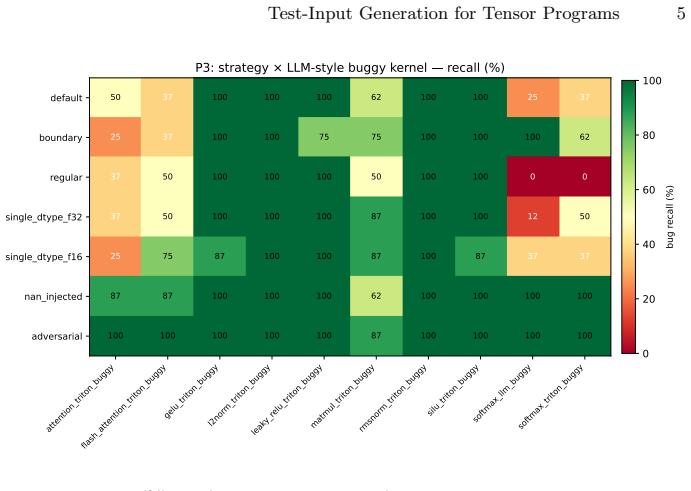
- [Table 2, Table 3, Fig. 1] The central claim that boundary-only sampling is the 'operationally safe winner' is not established by the aggregate data. Table 2 gives boundary 62/80 (78%) vs default 57/80 (71%); a difference of 5 successes out of 80. Under independent binomial sampling this has a standard error of roughly 5 percentage points, so the gap is well within noise (z≈1.5, p≈0.13). More importantly, Table 3 and Fig. 1 show the edge is entirely concentrated in softmax_llm_buggy (100% vs 25%) and softmax_triton_buggy (62% vs 37%). Excluding those two kernels, boundary is 49/64 (76.6%) while default is 52/64 (81.3%), and boundary also underperforms on attention_triton_buggy (25 vs 50) and leaky_relu_triton_buggy (75 vs 100). The paper should either report confidence intervals and a paired test, or reframe the conclusion to the defensible claim that boundary shapes uniquely cover the tail-mask bug class, rather
- [§3.4, Assumption 1] The 0% FP claim for boundary depends entirely on Assumption 1: that the 16 controls are correct kernels, with correctness established by the companion paper [7] using the author's own gpuemu oracle. The current paper does not independently verify these labels. If any control is in fact incorrect, the 0% FP rate would reflect missed bugs, not precision, and the strategy ranking would shift. Since the FP axis is load-bearing for the 'operationally safe' recommendation, the authors should either provide independent validation of the control labels (e.g., compare against a second oracle or a hand-check of the 16 kernels) or explicitly characterize the FP result as conditional on the companion paper's oracle.
- [§4 and §6] There is an internal inconsistency between the explanation of the adversarial and NaN-injected false positives and the stated limitation. §4 asserts that the 120/128 adversarial FPs and 93/128 NaN-injected FPs 'are therefore validator artefacts of strict NaN handling ... not genuine output divergence,' while §6 says 'We are not yet able to separate true output divergence on a buggy kernel from non-finite input propagated to output and flagged by the validator inside the existing fail signal.' The causal explanation is asserted, not measured. This matters because the paper's contribution (4) claims a 'measured explanation' of the recall-FP trade-off. Without splitting the fail signal by failure kind, the characterization of adversarial as a 'high-recall complement' rather than a false-positive-prone strategy remains conjectural.
minor comments (6)
- [Table 3] Percentages based on 8 iterations are misleading in a small table; e.g., 62% is 5/8 and 37% is 3/8. Report raw counts (e.g., 5/8) alongside or instead of percentages so the uncertainty is visible.
- [Fig. 1] The caption should specify the exact kernel ordering in the matrix and clarify that each cell is based on 8 iterations. The reader should not have to infer the mapping from the text.
- [§3.3] Time-to-first-failure is recorded but never analyzed in the evaluation. Either report it or remove the bookkeeping mention to avoid promising an unfulfilled metric.
- [§4] The 'single dtype f16' strategy is said to register 3 FPs 'all on the same fp16-borderline operator.' Name that operator; otherwise the claim is unverifiable.
- [References] Reference [8] is 'manuscript in preparation' and not publicly available; it should be marked as such in the reference list or removed from the citation.
- [§3.4, Assumption 4] Assumption 4 about layout is confusing: it says layout-only strategies are 'nominal at the client boundary' and that 'the kernel sees contiguous data.' This seems to nullify the layout dimension before evaluation; clarify whether any non-contiguous layout strategies were actually run.
Circularity Check
Headline ranking is partly carried by the author's own oracle and by shape-set/seed definitions; the ablation itself is not a fitted tautology.
-
self citation load bearing
[Sec. 3.4, Assumption 1; Abstract / Table 2 (0% FP claim)]
"The 16 controls are correct kernels (human-written Triton or numpy stand-ins). The companion paper [7] establishes their correctness on the gpuemu oracle."
The abstract's '0% FP on the 16 controls' is the safety half of the headline that boundary-only sampling is the operationally safe winner. That number is meaningful only if the 16 controls actually are correct, and the only support offered is the author's own companion paper using the author's gpuemu oracle. No independent ground truth (external benchmark, machine-checked proof, or third-party annotation) is supplied in this paper. The buggy labels are likewise author-seeded (Assumption 2). Thus both axes of the strategy ranking depend on the same self-authored infrastructure whose verdicts the paper is measuring, so the ranking is load-bearing on a self-citation rather than on an independently verifiable oracle.
-
self definitional
[Abstract and Sec. 3.1/Table 1 (softmax tail-mask 'killer finding')]
"On the two softmax tail-mask bugs the 'regular' strategy (no boundary shapes) catches 0%, while boundary raises recall to 100% and 62% respectively. ... For example boundary restricts H to {1, 3, 7} and regular restricts H to {128, 256, 512}."
The paper's Sec. 1 says tail-mask leaks 'only surface at specific boundary shapes (e.g., H = 3, K = 1)', and the buggy variants are author-seeded. Regular's H set is {128, 256, 512}, so it never samples H=3; boundary's H set is {1, 3, 7}, so it does. Given the seeded bugs' known boundary-only trigger shapes, regular's 0% and boundary's 100%/62% are fixed by the candidate-set definitions plus the author's seed choice. The 'clearest single signal' is therefore a direct consequence of how the strategies and the bug corpus were defined, not an independent empirical prediction that could have gone the other way.
full rationale
This is an empirical ablation, not an analytic derivation: no free parameters are fitted to force the reported recall/FP numbers, and the paper publishes the full seven-strategy table rather than only the preferred strategy. The central comparison is therefore not circular in the 'prediction equals fitted input' sense. The main circularity-adjacent issue is load-bearing self-citation: the ground-truth correctness labels come from the author's own companion paper and gpuemu oracle, the bug corpus is author-seeded, and the paper itself states it has not yet fuzzed real LLM-generated kernels. The 0% FP claim is only as credible as those self-supplied labels. A second issue is the softmax tail-mask result: because the seed bugs are boundary-dependent and the regular/boundary shape sets are defined to include/exclude the triggering shapes, the headline 'killer finding' is partly definitional. The adversarial FP inflation is also validator-defined, though the paper explicitly acknowledges it as an artifact rather than as genuine kernel divergence. The statistical fragility of the 78%-vs-71% recall gap is a correctness/risk concern, not a circularity, and I did not score it. Net: some self-citation and one partial by-construction reduction, but the per-strategy ablation across 26 ops retains independent content, so this is moderate, partial circularity rather than a fully forced derivation.
Assumptions & free parameters
free parameters (4)
- boundary shape candidate set H ∈ {1,3,7} =
H ∈ {1,3,7}
- regular shape candidate set H ∈ {128,256,512} =
H ∈ {128,256,512}
- adversarial value distribution buckets =
equal-weight five buckets (0, subnormal, large, wide-uniform, non-finite)
- iterations per (strategy,kernel) =
8
assumptions (5)
- domain assumption The gpuemu oracle's reference computations and pass/fail verdicts are correct for all kernels.
- domain assumption The 16 control kernels are genuinely correct and the 10 variants are genuinely buggy, as labeled by the companion paper [7].
- domain assumption Tolerances fixed per (op, dtype) are identical across strategies and do not bias the comparison.
- domain assumption The Python client decodes received tensors as contiguous, so layout-only strategy effects are not measured.
- domain assumption The adversarial FP inflation is fully attributable to the validator's NaN check, not to genuine control divergences.
Cite this review
Pith. "Pith review of Test-Input Generation for Tensor Programs: What Actually Finds Kernel Bugs." pith.science (2026). https://pith.science/paper/RWFRE7JI
@misc{pith2026260627396,
  author       = {Pith},
  title        = {Pith review of: Test-Input Generation for Tensor Programs: What Actually Finds Kernel Bugs},
  year         = {2026},
  howpublished = {\url{https://pith.science/paper/RWFRE7JI}},
  note         = {Machine review of arXiv:2606.27396}
}
read the original abstract
Test-input generation for tensor kernels is folkloric. Most projects pick a representative shape and dtype, run a fixed-shape allclose-style check, and ship. We make the choices explicit and measure them. Using the gpuemu op-schema-aware seeded fuzzer (arXiv:2606.20128), we evaluate seven test-generation strategies across a 26-op corpus (16 correct controls and 10 LLM-style buggy variants seeded with documented transcription patterns) on an RTX 3060 GPU instance. Strategies vary the shape candidate set, the dtype mix, and the input value distribution. We report each strategy on two axes: bug recall and control false-positive (FP) rate. Boundary-only shape sampling is the operationally safe winner: 78% recall on the 10 buggy kernels with 0% FP on the 16 controls. Adversarial value sampling reaches higher recall (99%) but inflates control FP to 94% because the strategy injects NaN and Inf inputs and the validator's NaN check fires on every kernel that propagates them, not only on buggy kernels. On the two softmax tail-mask bugs the "regular" strategy (no boundary shapes) catches 0%, while boundary raises recall to 100% and 62% respectively. That gap is the clearest single signal in the data. The corpus result is about which seeded bug patterns each strategy catches, not about the bug rate of any specific deployed LLM.
Figures
Forward citations
Cited by 2 Pith papers
-
Static PTX Metrics Track Structural Kernel Regressions but Miss Semantic Ones
For this Triton corpus, static PTX deltas separate structural from semantic kernel changes portably across five GPU classes while measured runtime deltas do not.
-
Operator-Aware Mixed-Precision Tolerance Calibration for Tensor Kernels
Per-operator tolerances calibrated from the correct kernel's own error distribution catch 229 more seeded bugs on the gpuemu corpus at the cost of 20 false positives.
Reference graph
Works this paper leans on
-
[7]
arXiv preprint (2026),https://arxiv.org/abs/2606.20128
Sarkar, D.: The correctness illusion in LLM-generated GPU kernels. arXiv preprint (2026),https://arxiv.org/abs/2606.20128
arXiv 2026
- [1]
-
[2]
arXiv preprint (2025), https://arxiv.org/abs/2510.16996
Dong, J., Yang, Y., Liu, T., Wang, Y., Qi, F., Tarokh, V., Rangadurai, K., Yang, S.: STARK: Strategic team of agents for refining kernels. arXiv preprint (2025), https://arxiv.org/abs/2510.16996
arXiv 2025
-
[3]
Wiley (1979)
Myers, G.J.: The Art of Software Testing. Wiley (1979)
1979
-
[4]
Ouyang, A., Guo, S., Arora, S., Zhang, A.L., Hu, W., R´ e, C., Mirhoseini, A.: KernelBench: Can LLMs write efficient GPU kernels? arXiv preprint (2025), https: //arxiv.org/abs/2502.10517
arXiv 2025
-
[5]
arXiv preprint (2025),https://arxiv.org/abs/2509.14626
Qin, F., Naziri, M.M.A., Ai, H., Dutta, S., d’Amorim, M.: Evaluating the effec- tiveness of coverage-guided fuzzing for testing deep learning library APIs. arXiv preprint (2025),https://arxiv.org/abs/2509.14626
arXiv 2025
-
[6]
arXiv preprint (2025), https://arxiv.org/ abs/2511.18868 8 D
Ran, D., Xie, S., Ji, M., Liu, A., Wu, M., Cao, Y., Guo, Y., Yu, H., Li, L., Hu, Y., Yang, W., Xie, T.: KernelBand: Steering LLM-based kernel optimization via hardware-aware multi-armed bandits. arXiv preprint (2025), https://arxiv.org/ abs/2511.18868 8 D. Sarkar
arXiv 2025
-
[8]
Draft source at https://github.com/sarkar-d ipankar/gpuemu-arxiv-paper/tree/main/p2
Sarkar, D.: Operator-aware mixed-precision tolerance calibration for tensor kernels (2026), manuscript in preparation. Draft source at https://github.com/sarkar-d ipankar/gpuemu-arxiv-paper/tree/main/p2
2026
Show all 13 references
-
[9]
arXiv preprint (2026),https://arxiv.org/abs/2605.04956
Wang, H., Zhang, J., Jiang, K., Wang, H., Chen, J., Zhu, J.: KernelBenchX: A comprehensive benchmark for evaluating LLM-generated GPU kernels. arXiv preprint (2026),https://arxiv.org/abs/2605.04956
2026 arXiv
-
[10]
arXiv preprint (2025),https://arxiv.org/abs/2507.23194
Wang, J., Joshi, V., Majumder, S., Xu Chao, Ding, B., Liu, Z., Brahma, P.P., Li, D., Liu, Z., Barsoum, E.: GEAK: Introducing Triton kernel AI agent & evaluation benchmarks. arXiv preprint (2025),https://arxiv.org/abs/2507.23194
2025 arXiv
-
[11]
In: Proc
Wei, A., Deng, Y., Yang, C., Zhang, L.: Free lunch for testing: Fuzzing deep- learning libraries from open source. In: Proc. 44th Int. Conf. Software Engineering (ICSE). pp. 995–1007 (2022). https://doi.org/10.1145/3510003.3510041 , https://arxiv.org/abs/2201.06589
2022
-
[12]
In: Proc
Xie, D., Li, Y., Kim, M., Pham, H.V., Tan, L., Zhang, X., Godfrey, M.W.: DocTer: Documentation-guided fuzzing for testing deep learning API functions. In: Proc. 31st ACM SIGSOFT Int. Symp. Software Testing and Analysis (ISSTA). pp. 176– 188 (2022). https://doi.org/10.1145/3533...
2022
-
[13]
In: Proc
Yang, C., Deng, Y., Yao, J., Tu, Y., Li, H., Zhang, L.: Fuzzing automatic differen- tiation in deep-learning libraries. In: Proc. 45th Int. Conf. Software Engineering (ICSE). pp. 1174–1186 (2023). https://doi.org/10.1109/ICSE48619.2023.00105, https://arxiv.org/abs/2302.04351
2023
Reviewed August 2, 2026 · model on record in the stance chip above.
Discussion (0). Sign in to comment.