REVIEW 4 major objections 5 minor 1 cited by
Architecture-level search can improve perceptual embodied agents on simulator tasks, but rollout noise, local edit basins, and weak episode credit assignment constrain the transfer from text-domain AAS.
Reviewed by Pith at T0; open to challenge. T0 means a machine referee read the full paper against a public rubric. the ladder, T0–T4 →
T0 review · grok-4.5
2026-07-12 10:44 UTC pith:NWOITNOZ
load-bearing objection First careful transfer of AAS to embodied simulators with real rollouts—honest diagnostics and a useful failure taxonomy, but several headline gains remain soft under the noise the paper itself documents. the 4 major comments →
Automating the Design of Embodied Agent Architectures
The pith
A machine-rendered reading of the paper's core claim, the machinery that carries it, and where it could break.
Core claim
Method-seeded architecture search over typed embodied-agent graphs can produce deployable or directional success-rate gains on vision-language navigation, embodied question answering, and language-conditioned manipulation when candidates are scored by multi-episode simulator rollouts, yet the same regime reveals evaluation noise, trapping in local edit basins, and only partial use of episode-level logs for credit assignment—constraints largely muted in text-domain AAS.
What carries the argument
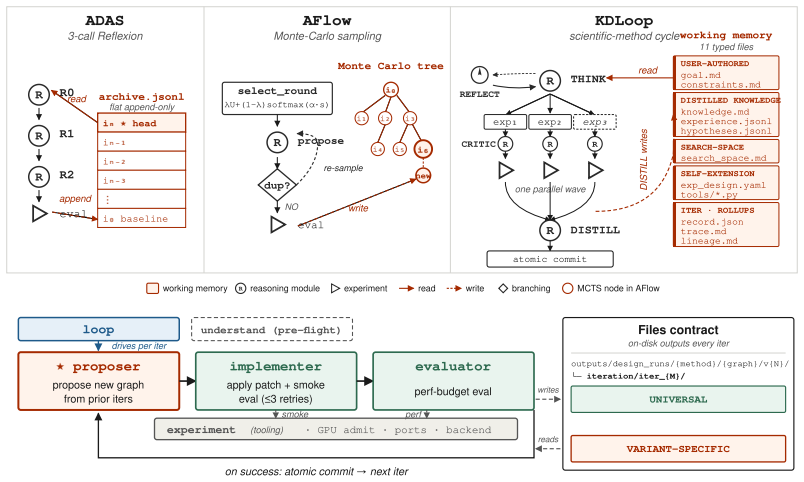
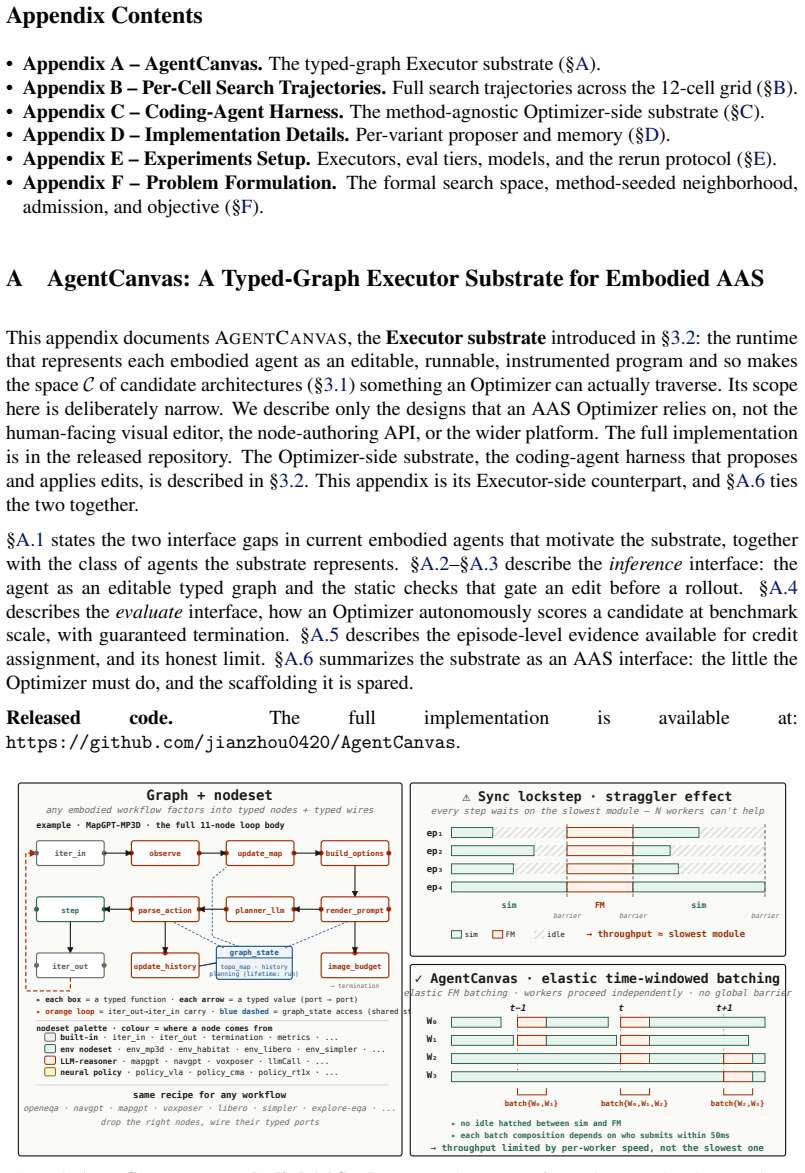
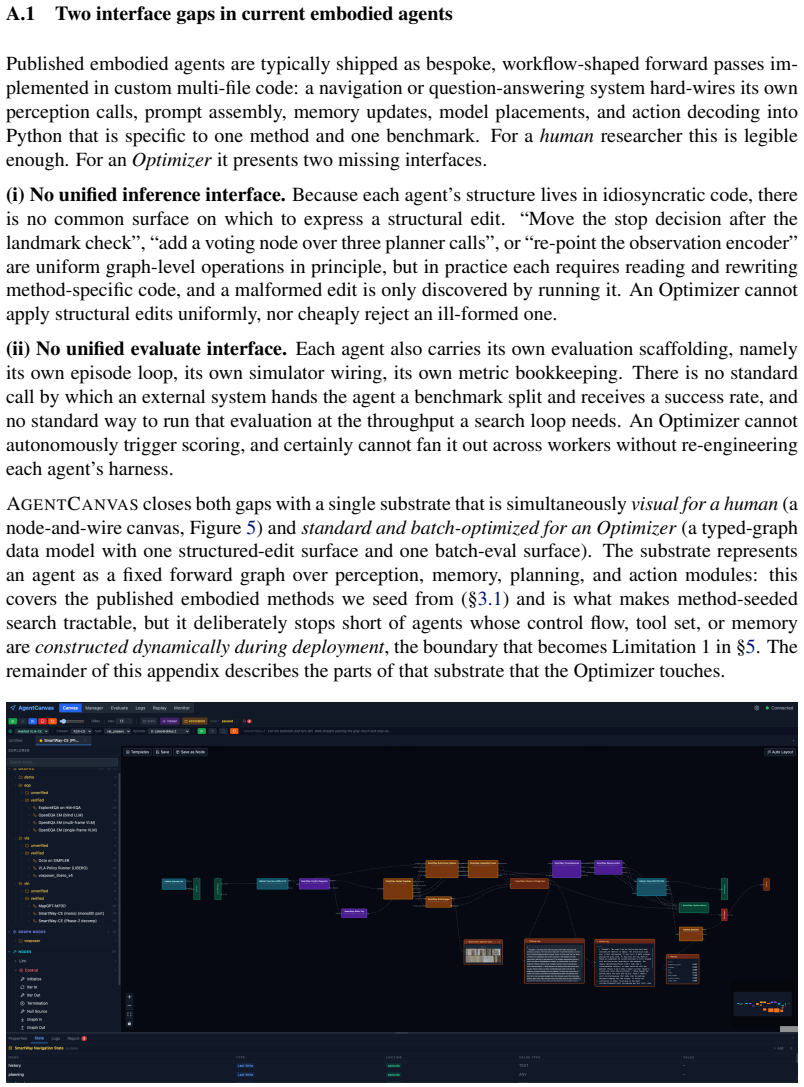
AgentCanvas, a typed node-and-wire runtime that turns an embodied executor into an editable, simulator-runnable graph with episode logs, paired with a shared coding-agent harness that hosts three search policies (including KDLoop’s propose–critique–experiment–distill cycle with stall-triggered reflection) over a fixed method-seeded neighborhood.
Load-bearing premise
The main improvable failures of published embodied agents sit inside nearby editable graph and code patches around a fixed seed method and backbone, so modest search under that setup is a fair test of automated architecture design.
What would settle it
Re-run the same 3×4 matrix with independent multi-seed search, stricter multi-pass selection during search, and no evaluator-side signals: if confirmed success-rate gains vanish or every optimizer remains trapped on one intervention axis with no usable log-driven credit, the transfer claim fails.
Editorial analysis
A structured set of objections, weighed in public.
Referee Report
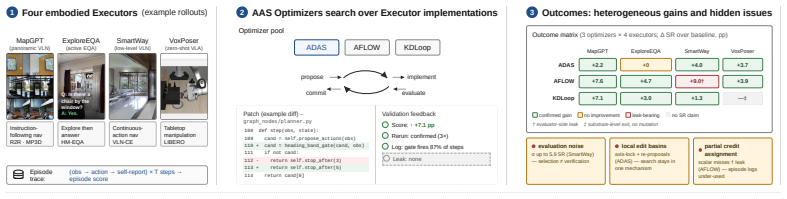
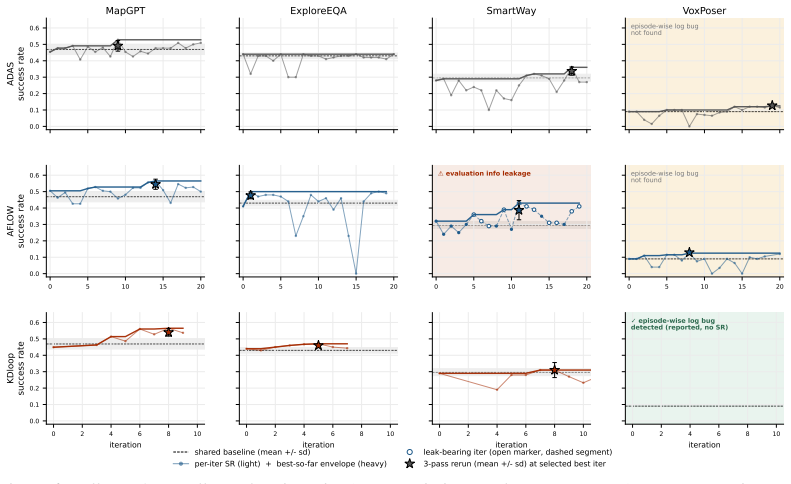
Summary. The paper studies whether Agent Architecture Search (AAS), previously developed for text-domain LLM workflows, transfers to perceptual embodied agents evaluated by simulator rollouts. It introduces AgentCanvas, a typed node-and-wire executor substrate with simulator-aware batch evaluation and episode logs, and KDLoop, a coding-agent search loop with typed memory, multi-axis proposals, critique, and stall-triggered reflection. Three optimizers (ADAS, AFlow, KDLoop) are compared on four method-seeded executors (MapGPT, SmartWay, ExploreEQA, VoxPoser) spanning VLN, EQA, and manipulation. The 3×4 matrix reports several success-rate gains over seeded baselines after post-selection reruns, rejects one leak-bearing SmartWay–AFlow candidate, and diagnoses a shared VoxPoser logging fault. The authors argue that embodied AAS can yield deployable or directional gains while being constrained by rollout noise, local edit basins, and only partial episode-level credit assignment.
Significance. If the empirical characterization holds, this is a useful first systematic study of AAS under simulator-based embodied evaluation rather than text-only workflow benchmarks. The shared coding-agent harness, explicit leak rejection, injected logging-fault diagnostic, and transparent separation of search-time selection from three-pass verification are stronger experimental hygiene than is common in agent-systems papers. AgentCanvas and the method-seeded formulation also give the community a concrete substrate and problem statement for subsequent work. The paper’s main value is as much negative as positive: it documents evaluation noise, basin trapping, and incomplete log use as first-class obstacles for embodied AAS. Those constraints, if robust, should shape how the field designs optimizers and evaluation protocols. The contribution is systems-and-characterization rather than a decisive new SOTA architecture family.
major comments (4)
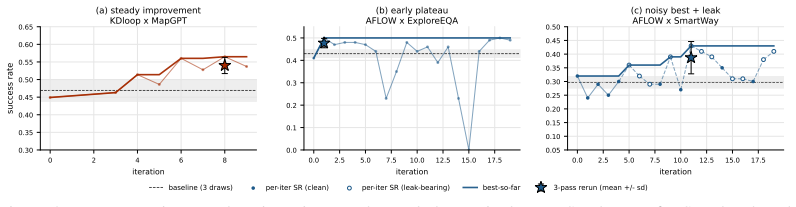
- Table 1 and §4.2 / Appendix E.3: the central claim that architecture-level search produces deployable or directional gains “across” embodied tasks rests on a single search trajectory per cell with no multi-seed averaging. Search-time fitness for ADAS/AFlow is largely single-pass, and several reported Δs remain variance-overlapping after only three post-selection reruns (e.g., SmartWay–ADAS +4.0 with Best 33.7±2.5 vs Baseline 29.7±2.1; ExploreEQA–KDLoop +3.0 from 43.0±1.7 to 46.0±1.0; VoxPoser gains on a near-deterministic 9.0 baseline). §4.2 correctly notes that max-over-noisy-estimates can overstate quality, and SmartWay σ reaches 5.9 SR. As written, the abstract and §4.1 generalize beyond the one clearly separated MapGPT ~+7 pp pair. Please either (i) add multi-seed or multi-trajectory evidence for the cells used to support “deployable” gains, or (ii) substantially tighten the claim la
- Table 1 “Surviving change (axis)” and §4.1: the paper frames results as architecture-level / graph-level search, but several winning edits are prompt rewrites, model swaps, or control thresholds (e.g., ExploreEQA–AFlow “VLM single-letter prompt rewrite”; VoxPoser–AFlow “GPT-4o composer swap”; MapGPT stop-after 3→5). Topology and state-memory edits appear in some cells, but the matrix mixes mechanism classes. Without a clearer taxonomy and ablation of which axes drive certified gains, it is hard to credit “architecture search” rather than local prompt/config optimization under a coding agent. Please stratify results by intervention axis (as in Table 2) against certified ΔSR, and state which claims require structural graph edits versus any editable component of the seed executor.
- §3.1 method-seeded formulation and §4 setup (fixed GPT-5-mini backbone except VoxPoser composer): the evaluation tests nearby edits around one published seed per task with a fixed backbone and modest iteration budgets. That is a legitimate engineering-matched setting, but the abstract’s transfer claim (“AAS … has not been systematically evaluated on perceptual embodied agents”) can be read as broader than the tested neighborhood. If dominant failure modes are below-graph substrate faults (as KDLoop finds on VoxPoser), dynamic control flow (Limitation 1), or model choice, the measured gains and failure modes may not characterize embodied AAS in general. Please state the claim scope more sharply in the abstract and introduction: method-seeded local search over typed workflow graphs with fixed backbones, not open-ended architecture discovery from scratch.
- §4.3–§4.4 and the 3×4 design: optimizer comparisons are confounded by unequal iteration semantics and evaluation policies (ADAS/AFlow 20 iters with full perf scoring vs KDLoop 10 iters with custom ≥30-episode subsets and escalation on ≥0.05 lift; Appendix E.2–E.3). The paper argues compute is roughly matched, but parent selection, memory, and scoring floors differ enough that “no optimizer dominates” is under-identified. For the comparative statements in §4.1 and §4.3, either equalize the evaluation budget/protocol for head-to-head claims or restrict comparative language to qualitative search dynamics (basin concentration, leak detection) rather than relative SR quality.
minor comments (5)
- Figure 1 outcome matrix and Table 1: make the deployable / directional / leak / no-claim legend identical in both places and mark variance-overlapping cells consistently so readers do not treat all positive Δ as equivalent.
- §4.3 “Tt shifts the exploration–exploitation balance” appears to be a typo for “It”.
- Appendix B vs main text: iteration axes differ (0–20 vs 0–10 for KDLoop); state once in the main text that KDLoop’s multi-spec waves are intended to match ADAS/AFlow wall-clock, with the actual compute accounting in Appendix E.
- Related Work: briefly situate against concurrent coding-agent / workflow optimization platforms beyond the cited AAS line so the substrate novelty boundary is clearer for non-AAS readers.
- VoxPoser baseline SR 9.0±0.0 is striking; one sentence on why that split is effectively deterministic under the pinned setup would help interpret the +3.7/+3.9 gains.
Circularity Check
Empirical systems paper with external simulator fitness; no derivation that reduces predictions to fitted inputs or self-citation chains.
full rationale
The paper’s load-bearing claim is empirical: method-seeded graph edits under three AAS optimizers can raise (or directionally raise) task success rate on four published embodied executors, as measured by multi-episode simulator rollouts, with one high-scoring SmartWay candidate rejected as evaluator-leak. Fitness f(c) is external SR on held benchmark splits (R2R/MP3D, VLN-CE, HM-EQA, LIBERO), not a quantity defined from the search policy or from parameters fitted to the same target. Selected candidates are re-evaluated on three post-selection passes; baselines are shared three-draw means; and the authors explicitly separate search-time selection from verification (§4.2, Table 1, App. E.4). AgentCanvas and KDLoop are the authors’ own substrate and optimizer, which is normal for a systems contribution and does not make SR gains circular: ADAS and AFlow are independently ported into the same harness, and gains/failures are reported against seeded published methods. Overlap of some co-authors with seed systems (e.g., SmartWay, NavGPT lineage) is citation of prior engineering artifacts used as c0, not a uniqueness theorem or ansatz that forces the reported ΔSR. Method-seeding and fixed backbones are scope choices (§3.1, §4), not self-definitional reductions. No fitted-input-as-prediction, no load-bearing self-citation uniqueness claim, and no renaming of a known closed-form result. Under the circularity criteria, the work is self-contained against external benchmarks; residual concerns about single-run noise and variance-overlapping deltas are statistical power issues, not circularity.
Axiom & Free-Parameter Ledger
free parameters (5)
- iteration budget (ADAS/AFlow 20, KDLoop 10)
- performance-tier episode counts (e.g., MapGPT 216, SmartWay 100, ExploreEQA 100, VoxPoser 200)
- AFlow parent-selection hyperparameters α=0.2, λ=0.3, K=4
- KDLoop evaluation floor / escalation thresholds (custom ≥30 episodes; escalate on ≥0.05 SR lift)
- backbone model choice (GPT-5-mini; VoxPoser composer GPT-4o) and temperature 1
axioms (5)
- domain assumption Published embodied agents can be faithfully represented as fixed typed node-and-wire forward graphs with simulator nodes and declared memory cells.
- domain assumption Task success rate over multi-episode simulator splits is an adequate primary fitness for architecture quality.
- ad hoc to paper Method-seeded local graph edits around one published seed per task are a valid test of embodied AAS transfer.
- domain assumption Holding implementation/evaluation harness fixed while varying only proposer/memory isolates search-policy effects.
- domain assumption Static type/connectivity validation plus smoke tests sufficiently filter invalid candidates before expensive rollouts.
invented entities (2)
-
AgentCanvas typed-graph executor substrate
no independent evidence
-
KDLoop (Knowledge Distill Loop)
no independent evidence
read the original abstract
Embodied agents are typically built as hand-designed compositions of perception, memory, planning, and action modules. This modularity exposes a large architectural design space, but current systems still rely on researcher intuition to choose where information is stored, how observations are processed, and how model calls are connected. Agent Architecture Search (AAS) automates such design for text-domain agents, but has not been systematically evaluated on perceptual embodied agents through simulator rollouts. We study this transfer. We introduce AgentCanvas, a typed-graph runtime that hosts embodied executors as editable node-and-wire programs with simulator-aware execution and episode-level logs, and KDLoop, a coding-agent search procedure that cycles through proposal, critique, experiment, and distillation, with triggered reflection after stalls. We evaluate three AAS variants across four embodied executors spanning vision-language navigation, embodied question answering, and language-conditioned manipulation. The resulting 3x4 matrix shows that architecture-level search can produce deployable and directional success-rate gains on embodied tasks, while one apparent high-scoring candidate is rejected as leak-bearing. At the same time, the experiments expose constraints that are muted in text-domain AAS: optimization signals can be masked by rollout noise, search can become trapped in local edit basins, and episode-level credit assignment only partially emerges even when detailed logs are available. These results characterize both the promise and the current limits of automated architecture search for embodied agents.
Figures
Forward citations
Cited by 1 Pith paper
-
Embodied Agents Take Control: Minimal-Interface Zero-Shot Agents Rival Industrial-Scale Policies in Vision-and-Language Navigation
Unmodified software-agent harnesses, given only a monocular RGB camera and four discrete actions, achieve 68–78% success on zero-shot R2R-CE navigation, rivaling trained and workflow-based systems.
Reference graph
Works this paper leans on
-
[1]
Anderson, Q
P. Anderson, Q. Wu, D. Teney, J. Bruce, M. Johnson, N. S ¨underhauf, I. Reid, S. Gould, and A. Van Den Hengel. Vision-and-language navigation: Interpreting visually-grounded naviga- tion instructions in real environments. InProceedings of the IEEE conference on computer vision and pattern recognition, pages 3674–3683, 2018
2018
-
[2]
G. Zhou, Y . Hong, and Q. Wu. Navgpt: Explicit reasoning in vision-and-language navigation with large language models. InProceedings of the AAAI Conference on Artificial Intelligence, 2024
2024
-
[3]
J. Chen, B. Lin, R. Xu, Z. Chai, X. Liang, and K.-Y . Wong. Mapgpt: Map-guided prompting with adaptive path planning for vision-and-language navigation. InProceedings of the 62nd Annual Meeting of the Association for Computational Linguistics (Volume 1: Long Papers), pages 9796–9810, 2024
2024
-
[4]
A. Das, S. Datta, G. Gkioxari, S. Lee, D. Parikh, and D. Batra. Embodied question answering. InProceedings of the IEEE conference on computer vision and pattern recognition, pages 1–10, 2018
2018
-
[5]
A. Z. Ren, J. Clark, A. Dixit, M. Itkina, A. Majumdar, and D. Sadigh. Explore until confident: Efficient exploration for embodied question answering.arXiv preprint arXiv:2403.15941, 2024
Pith/arXiv arXiv 2024
- [6]
-
[7]
Liang, W
J. Liang, W. Huang, F. Xia, P. Xu, K. Hausman, B. Ichter, P. Florence, and A. Zeng. Code as policies: Language model programs for embodied control. In2023 IEEE International conference on robotics and automation (ICRA), pages 9493–9500. IEEE, 2023
2023
-
[8]
W. Huang, C. Wang, R. Zhang, Y . Li, J. Wu, and L. Fei-Fei. V oxposer: Composable 3d value maps for robotic manipulation with language models.arXiv preprint arXiv:2307.05973, 2023
Pith/arXiv arXiv 2023
-
[9]
S. Hu, C. Lu, and J. Clune. Automated design of agentic systems. InInternational Conference on Learning Representations, 2025
2025
-
[10]
Zhang, J
J. Zhang, J. Xiang, Z. Yu, F. Teng, X. Chen, J. Chen, M. Zhuge, X. Cheng, S. Hong, J. Wang, et al. Aflow: Automating agentic workflow generation. InInternational Conference on Learn- ing Representations, 2025
2025
-
[11]
Shang, Y
Y . Shang, Y . Li, K. Zhao, L. Ma, J. Liu, F. Xu, and Y . Li. Agentsquare: Automatic llm agent search in modular design space. InInternational Conference on Learning Representations, 2025
2025
-
[12]
G. Zhang, L. Niu, J. Fang, K. Wang, L. Bai, and X. Wang. Multi-agent architecture search via agentic supernet.arXiv preprint arXiv:2502.04180, 2025
Pith/arXiv arXiv 2025
-
[13]
X. Shi, Z. Li, W. Lyu, J. Xia, F. Dayoub, Y . Qiao, and Q. Wu. Smartway: Enhanced waypoint prediction and backtracking for zero-shot vision-and-language navigation. In2025 IEEE/RSJ International Conference on Intelligent Robots and Systems (IROS). IEEE, 2025
2025
-
[14]
J. Xu, A. Koesdwiady, S. Bei, Y . Han, B. Huang, D. Wang, Y . Chen, Z. Wang, P. Wang, P. Li, et al. Rethinking the value of multi-agent workflow: A strong single agent baseline.arXiv preprint arXiv:2601.12307, 2026
arXiv 2026
-
[15]
Shridhar, J
M. Shridhar, J. Thomason, D. Gordon, Y . Bisk, W. Han, R. Mottaghi, L. Zettlemoyer, and D. Fox. Alfred: A benchmark for interpreting grounded instructions for everyday tasks. In Proceedings of the IEEE/CVF conference on computer vision and pattern recognition, pages 10740–10749, 2020. 9
2020
-
[16]
Brohan, Y
A. Brohan, Y . Chebotar, C. Finn, K. Hausman, A. Herzog, D. Ho, J. Ibarz, A. Irpan, E. Jang, R. Julian, et al. Do as i can, not as i say: Grounding language in robotic affordances. In Conference on robot learning, pages 287–318. PMLR, 2023
2023
-
[17]
W. Huang, C. Wang, Y . Li, R. Zhang, and L. Fei-Fei. Rekep: Spatio-temporal reasoning of relational keypoint constraints for robotic manipulation.arXiv preprint arXiv:2409.01652, 2024
Pith/arXiv arXiv 2024
-
[18]
M. Zhai, H. Liang, X. Fan, Z. Gao, C. Li, C. Sun, X. Bin, Y . Wu, and Y . Jia. Multi-step reason- ing for embodied question answering via tool augmentation.arXiv preprint arXiv:2510.20310, 2025
arXiv 2025
-
[19]
D. Driess, F. Xia, M. S. M. Sajjadi, C. Lynch, A. Chowdhery, B. Ichter, A. Wahid, J. Tompson, Q. Vuong, T. Yu, W. Huang, Y . Chebotar, P. Sermanet, D. Duckworth, S. Levine, V . Vanhoucke, K. Hausman, M. Toussaint, K. Greff, A. Zeng, I. Mordatch, and P. Florence. Palm-e: An embodied multimodal language model, 2023. URLhttps://arxiv.org/abs/2303.03378
Pith/arXiv arXiv 2023
-
[20]
A. Brohan, N. Brown, J. Carbajal, Y . Chebotar, J. Dabis, C. Finn, K. Gopalakrishnan, K. Haus- man, A. Herzog, J. Hsu, J. Ibarz, B. Ichter, A. Irpan, T. Jackson, S. Jesmonth, N. J. Joshi, R. Julian, D. Kalashnikov, Y . Kuang, I. Leal, K.-H. Lee, S. Levine, Y . Lu, U. Malla, D. Man- junath, I. Mordatch, O. Nachum, C. Parada, J. Peralta, E. Perez, K. Pertsc...
Pith/arXiv arXiv 2023
-
[21]
Zitkovich, T
B. Zitkovich, T. Yu, S. Xu, P. Xu, T. Xiao, F. Xia, J. Wu, P. Wohlhart, S. Welker, A. Wahid, et al. Rt-2: Vision-language-action models transfer web knowledge to robotic control. In Conference on Robot Learning, pages 2165–2183. PMLR, 2023
2023
-
[22]
M. J. Kim, K. Pertsch, S. Karamcheti, T. Xiao, A. Balakrishna, S. Nair, R. Rafailov, E. Foster, G. Lam, P. Sanketi, et al. Openvla: An open-source vision-language-action model.arXiv preprint arXiv:2406.09246, 2024
Pith/arXiv arXiv 2024
-
[23]
K. Black, N. Brown, D. Driess, A. Esmail, M. Equi, C. Finn, N. Fusai, L. Groom, K. Haus- man, B. Ichter, S. Jakubczak, T. Jones, L. Ke, S. Levine, A. Li-Bell, M. Mothukuri, S. Nair, K. Pertsch, L. X. Shi, J. Tanner, Q. Vuong, A. Walling, H. Wang, and U. Zhilinsky.π 0: A vision-language-action flow model for general robot control, 2024. URLhttps://arxiv. o...
Pith/arXiv arXiv 2024
-
[24]
G. Wang, Y . Xie, Y . Jiang, A. Mandlekar, C. Xiao, Y . Zhu, L. Fan, and A. Anandku- mar. V oyager: An open-ended embodied agent with large language models.arXiv preprint arXiv:2305.16291, 2023
Pith/arXiv arXiv 2023
-
[25]
Shinn, F
N. Shinn, F. Cassano, A. Gopinath, K. Narasimhan, and S. Yao. Reflexion: Language agents with verbal reinforcement learning.Advances in neural information processing systems, 36: 8634–8652, 2023
2023
-
[26]
Zhuge, W
M. Zhuge, W. Wang, L. Kirsch, F. Faccio, D. Khizbullin, and J. Schmidhuber. Gptswarm: Language agents as optimizable graphs. InForty-first International Conference on Machine Learning, 2024
2024
-
[27]
Cheng, A
C.-A. Cheng, A. Nie, and A. Swaminathan. Trace is the next autodiff: Generative optimization with rich feedback, execution traces, and llms.Advances in Neural Information Processing Systems, 37:71596–71642, 2024
2024
-
[28]
Y . Wang, S. Liu, J. Fang, and Z. Meng. Evoagentx: An automated framework for evolving agentic workflows. InProceedings of the 2025 Conference on Empirical Methods in Natural Language Processing: System Demonstrations, pages 643–655, 2025. 10
2025
-
[29]
O. Khattab, A. Singhvi, P. Maheshwari, Z. Zhang, K. Santhanam, S. Vardhamanan, S. Haq, A. Sharma, T. T. Joshi, H. Moazam, H. Miller, M. Zaharia, and C. Potts. Dspy: Compiling declarative language model calls into self-improving pipelines, 2023. URLhttps://arxiv. org/abs/2310.03714
Pith/arXiv arXiv 2023
-
[30]
C. Yang, X. Wang, Y . Lu, H. Liu, Q. V . Le, D. Zhou, and X. Chen. Large language models as optimizers. InInternational Conference on Learning Representations, 2024
2024
-
[31]
M. Yuksekgonul, F. Bianchi, J. Boen, S. Liu, Z. Huang, C. Guestrin, and J. Zou. Textgrad: Automatic” differentiation” via text.arXiv preprint arXiv:2406.07496, 2024
Pith/arXiv arXiv 2024
-
[32]
S. Xu, J. Zhang, S. Di, Y . Luo, L. Yao, H. Liu, J. Zhu, F. Liu, and M.-L. Zhang. Robustflow: Towards robust agentic workflow generation.arXiv preprint arXiv:2509.21834, 2025
arXiv 2025
-
[33]
J. Yang, C. E. Jimenez, A. Wettig, K. Lieret, S. Yao, K. Narasimhan, and O. Press. Swe- agent: Agent-computer interfaces enable automated software engineering.Advances in Neural Information Processing Systems, 37:50528–50652, 2024
2024
-
[34]
X. Wang, B. Li, Y . Song, F. F. Xu, X. Tang, M. Zhuge, J. Pan, Y . Song, B. Li, J. Singh, et al. Openhands: An open platform for ai software developers as generalist agents. InInternational Conference on Learning Representations, volume 2025, 2025
2025
-
[35]
Claude code, 2025.https://www.anthropic.com/product/claude-code
Anthropic. Claude code, 2025.https://www.anthropic.com/product/claude-code
2025
-
[36]
LangGraph, 2024.https://github.com/langchain-ai/langgraph
LangChain. LangGraph, 2024.https://github.com/langchain-ai/langgraph
2024
-
[37]
Move the stop decision after the landmark check
Q. Wu, G. Bansal, J. Zhang, Y . Wu, B. Li, E. Zhu, L. Jiang, X. Zhang, S. Zhang, J. Liu, et al. Autogen: Enabling next-gen llm applications via multi-agent conversations. InFirst conference on language modeling, 2024. 11 Appendix Contents •Appendix A – AgentCanvas.The typed-graph Executor substrate (§A). •Appendix B – Per-Cell Search Trajectories.Full sea...
2024
discussion (0)
Sign in with ORCID, Apple, or X to comment. Anyone can read and Pith papers without signing in.