REVIEW 3 major objections 6 minor 1 cited by
ECHO trains long-horizon agents by selecting source-indexed turn memories for bounded context and routing outcome credit only through those same traces.
Reviewed by Pith at T0; open to challenge. T0 means a machine referee read the full paper against a public rubric. the ladder, T0–T4 →
T0 review · grok-4.5
2026-07-13 07:10 UTC pith:6GJISB6C
load-bearing objection Clean joint design that couples source-indexed turn memory with positive-outcome credit routing, and the BrowseComp-Plus curves actually show the accuracy–efficiency trade-off people want from rolling summaries. the 3 major comments →
ECHO: Prune To Act, Trace To Learn With Selective Turn Memory In Agentic RL
The pith
A machine-rendered reading of the paper's core claim, the machinery that carries it, and where it could break.
Core claim
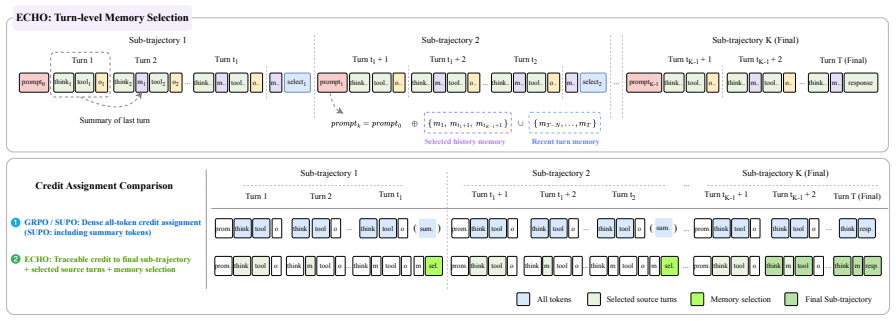
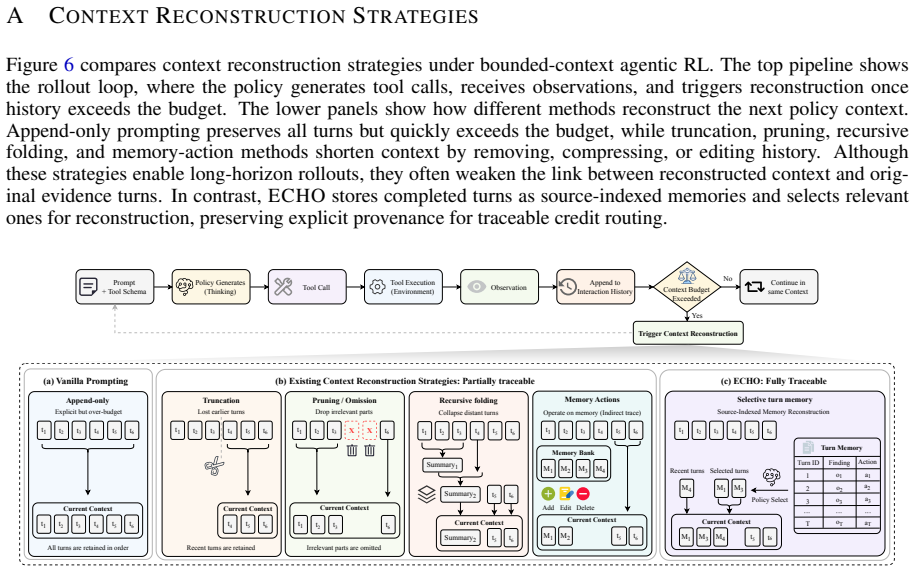
Context-managed agentic reinforcement learning improves when reconstruction stays source-addressable: store each completed tool turn as a compact indexed memory, rebuild the policy context by selecting useful records rather than folding the whole prefix into one summary, and attach positive final-outcome advantage only to the final segment, the selected historical source turns, their findings, and the memory-selection actions that exposed them. That single provenance trace aligns pruning for acting with credit for learning.
What carries the argument
Source-indexed selective turn memory with provenance-guided credit: after each tool turn a local finding is written with its source index; at budget boundaries the policy selects a subset of these records to reconstruct the next context; those same indices define a token-level hard mask that multiplies only positive group-relative advantages onto final-answer tokens, selected historical action and finding tokens, and all selection spans.
Load-bearing premise
The method assumes that the turns selected into the very last reconstructed context are a reliable enough proxy for the evidence that caused success, so earlier enabling turns that were never re-selected at the end can safely receive no positive credit.
What would settle it
On BrowseComp-Plus, compare ECHO’s final-trace credit mask against a recursive version that expands credit to every intermediate selected turn that causally led into the final selected set; if recursive credit does not raise held-out accuracy or further cut turn volume, the final-trace approximation is sufficient for this regime.
If this is right
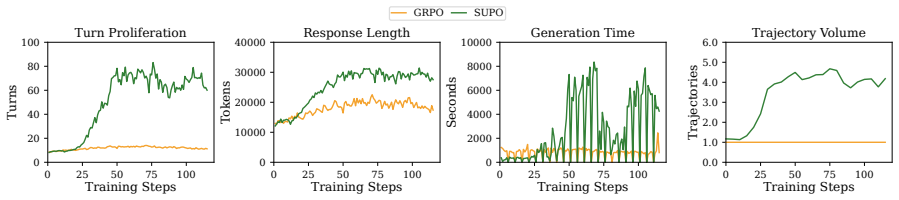
- Bounded-context agent training can raise accuracy while reducing average turns and trajectory volume relative to rolling summarization.
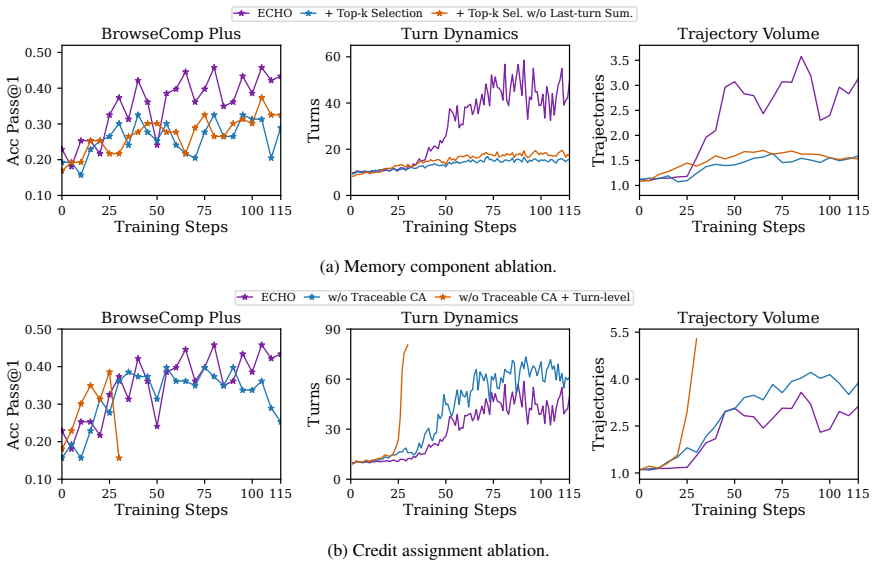
- Learned source selection outperforms static semantic top-k retrieval for long-horizon search under the same budget.
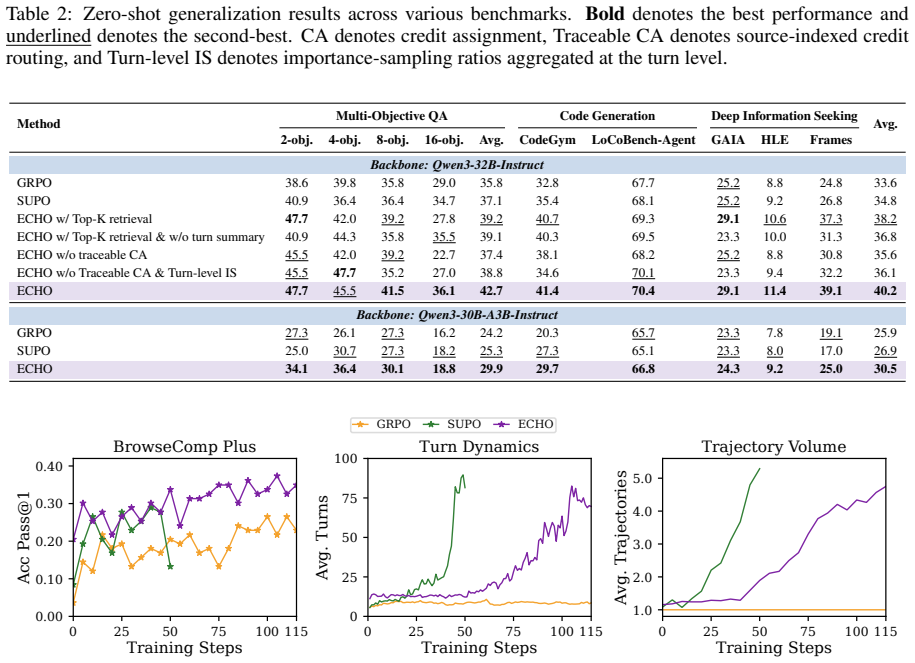
- Dense all-token credit or turn-level importance sampling, without the provenance mask, lowers accuracy and encourages turn proliferation.
- The same source-indexed reconstruction transfers zero-shot to multi-objective QA, interactive code, and deep information-seeking on both dense and MoE models.
- Context managers should be judged not only by length savings but by whether reconstructed information remains addressable at original environment-turn level.
Where Pith is reading between the lines
- In tasks with deep nested dependencies, final-trace credit may systematically under-credit early enabling turns; recursive provenance expansion is a natural next lever the authors already flag as future work.
- The same index-and-select pattern could be applied to hierarchical subgoal or page-level memories, not only single tool turns.
- If selection itself becomes a latency bottleneck, cheaper learned indexes or retrieval-plus-rerank that still expose source IDs could keep most of the credit-routing benefit.
- Many existing memory-augmented agents could be retrofitted for outcome RL simply by logging which memories entered each reconstructed context, without inventing new temporal advantage estimators.
Editorial analysis
A structured set of objections, weighed in public.
Referee Report
Summary. The paper proposes ECHO, a selective turn-memory framework for long-horizon agentic RL under bounded contexts. After each tool-use turn, ECHO writes a compact source-indexed memory record; when the context budget binds, the policy selects useful records to reconstruct the next bounded context. The same selected source indices define a hard credit mask that routes positive group-relative outcome advantage only to final-segment tokens, selected historical source turns, their last-turn findings, and memory-selection spans (Eqs. 13–14). Under a unified (M, Φ) reconstruction interface, the authors contrast this source-indexed design with append-only, truncation, recursive folding (SUPO), pruning, and memory-action strategies. On BrowseComp-Plus with Qwen3-32B-Instruct, ECHO reports 43.4% held-out pass@1 versus GRPO 28.9% and SUPO 36.1%, with fewer turns and lower trajectory volume than SUPO; ablations isolate learned selection and traceable credit, and zero-shot gains appear across multi-objective QA, code generation, and deep information-seeking on dense and MoE backbones.
Significance. If the empirical claims hold, the paper makes a useful and timely contribution at the intersection of context management and credit assignment for multi-turn tool agents. Framing reconstruction and provenance under a single (M, Φ) interface is clarifying for the field, and the dual use of source indices for both acting and learning is a clean design idea that is complementary to temporal or hierarchical credit methods. Strengths include matched training dynamics against GRPO and SUPO, two-component ablations (selection vs. top-k; findings vs. full observations; with/without traceable CA; turn-level IS), a second MoE backbone, multi-domain zero-shot transfer, an explicit limitations discussion of the final-trace approximation, and a public code link. The work is primarily empirical rather than theoretical; its significance rests on whether the accuracy–efficiency frontier is robust under stronger statistical reporting and under stress tests of the final-trace credit rule.
major comments (3)
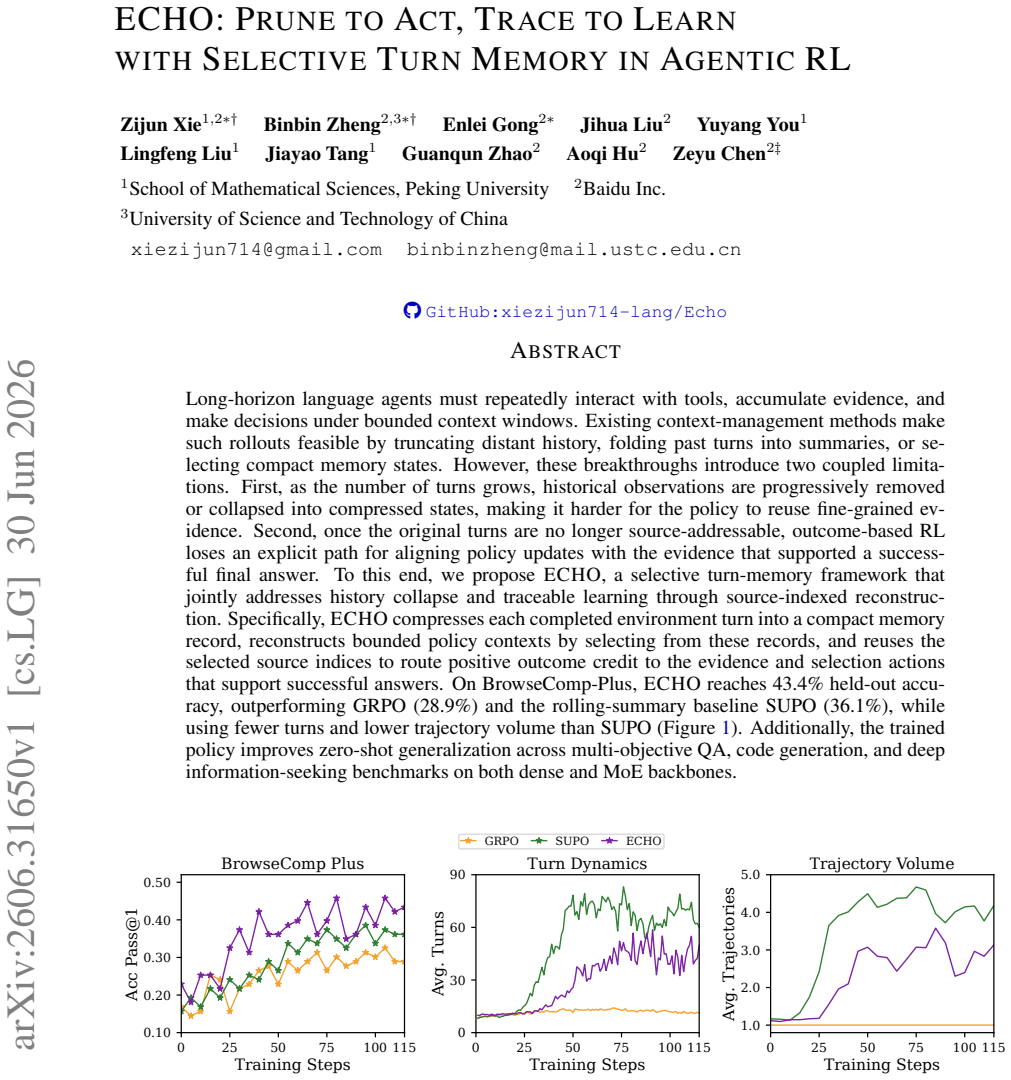
- Primary evaluation uses a held-out BrowseComp-Plus set of only 83 examples (§5.1). The headline claim (43.4% vs. 36.1% SUPO and 28.9% GRPO) is therefore sensitive to sampling noise, yet the manuscript reports point estimates without confidence intervals, bootstrap intervals, or multi-seed variance. For a load-bearing accuracy claim that also underpins the efficiency frontier in Figure 1, please report uncertainty (e.g., binomial CIs or multi-seed means) and, if feasible, enlarge or re-split the held-out set so that the ranking is not driven by a small validation sample.
- Credit assignment uses a final-trace hard mask: source-token credit is restricted to turns selected into the last reconstructed context I_src = bI_sel_Jn, plus findings and all selection spans, and only when A^(n) > 0 (Eqs. 13–14; §4.3). Limitations §7 correctly notes that this omits the recursive dependency chain of intermediate selections. On ~45-turn BrowseComp-Plus rollouts, nested enabling turns are plausible, so the causal attribution of the accuracy–efficiency gains to “trace to learn” rests on an untested sufficiency assumption. The “w/o Traceable CA” ablation (Fig. 4b) shows that some masking helps relative to dense assignment, but does not test whether expanding credit to ancestor selections (or a soft multi-hop provenance set) would further improve accuracy or reduce residual turn growth. Please either (i) add a recursive/ancestor-credit ablation or diagnostic of intermediate
- Several free design choices that define ECHO’s learning signal are fixed without sensitivity analysis: selection cap S=8, automatic recent turns K=3, at most 5 compression rounds / 192k effective budget, and the positive-part rule A_+ = max(A,0) that zeros updates for below-baseline and tied groups including all-correct/all-incorrect groups (§4.3, §5.1, Appendix D). The positive-part rule in particular is load-bearing for the provenance story, because incorrect-rollout traces are discarded by construction. A short sensitivity study (or at least multi-seed stability under modest S/K changes) would make the central claim more convincing and reduce the risk that the frontier is tuned to a narrow hyperparameter island.
minor comments (6)
- Figure 1 and Figure 5 captions refer to “trajectory volume” and “Avg. Trajectories”; the main text also uses “trajectory split rate.” A single precise definition (what constitutes a split/segment vs. a full rollout) early in §5 would help readers interpret the efficiency plots.
- Table 1’s “Traceability” column is useful, but “Partial” / “Indirect” / “Collapsed” are qualitative. A one-sentence operational criterion (e.g., whether original turn indices remain recoverable after reconstruction) would make the taxonomy more falsifiable.
- Notation: both R(τ) for reward and H^loc for local history are carefully reserved (§3.2), but c_sum_i, c_sel_j, and Φ_local appear with slightly different rendering conventions across §4.2 and Algorithm 1; aligning symbol names between the algorithm and the equations would reduce friction.
- In §5.5 / Figure 5, SUPO is shown only to step 50 after collapse. Please state explicitly in the caption or text whether training was stopped early for SUPO only, and whether ECHO/GRPO used the same wall-clock or step budget for the final reported MoE numbers.
- Related work cites MemPO, SAM, Agent-Omit, and Memory-R1 appropriately; a brief sentence on how ECHO’s hard mask differs from MemPO’s memory-level advantages would further situate the credit contribution.
- Typos / polish: title line breaks (“PRUNE TOACT”, “SELECTIVETURNMEMORY”), “Y ou” in the author list, and occasional missing spaces in section headers (RELATEDWORK, CONTEXTMANAGEMENT) should be cleaned in the camera-ready version.
Circularity Check
No circularity: external verifier rewards and ablations make ECHO’s claims empirical, not definitional.
full rationale
ECHO is an empirical agentic-RL methods paper. Success is defined by an external BrowseComp-Plus (and zero-shot) verifier reward R(τ)∈{0,1}, not by the memory indices or the credit mask. Source-indexed reconstruction (Eqs. 8–12) and the provenance mask (Eqs. 13–14) are design choices that route an already-computed group-relative advantage; they do not redefine the outcome or force the reported accuracy by construction. Ablations (Fig. 4, Table 2) remove learned selection or traceable CA and show degradation, which is independent evidence rather than a tautology. There is no fitted parameter renamed as a prediction, no load-bearing self-citation uniqueness theorem, and no renaming of a known result as a derivation. The final-trace approximation (Limitations §7) is a modeling sufficiency assumption, not circularity. The derivation chain is self-contained against external benchmarks.
Axiom & Free-Parameter Ledger
free parameters (5)
- selection_max_turns S
- echo_recent_turns K
- context_budget_B_and_max_compression_rounds
- group_size_N_rollouts
- positive_part_advantage_rule
axioms (4)
- domain assumption Sparse final verifier rewards and GRPO-style group-relative advantages are valid primary learning signals for multi-turn tool agents.
- ad hoc to paper Turns selected into the final reconstructed context are a practical proxy for evidence that supported a successful answer.
- ad hoc to paper Routing positive credit only on correct/above-baseline rollouts, and not through traces of incorrect rollouts, improves learning.
- domain assumption Bounded context |c_t| ≤ B is required and reconstructed contexts may replace full history without changing the environment dynamics.
invented entities (2)
-
Source-indexed turn memory record e_i = (i, α_i, m_i)
no independent evidence
-
Provenance-guided hard credit mask μ_q
no independent evidence
read the original abstract
Long-horizon language agents must repeatedly interact with tools, accumulate evidence, and make decisions under bounded context windows. Context-management methods make such rollouts feasible by simplifying past interactions through deletion, folding, or memory editing. However, when useful history is collapsed into compressed states, the reconstructed context may no longer reveal which earlier observations support a successful final answer. This creates a mismatch between bounded-context acting and outcome-based reinforcement learning: the policy acts on reconstructed context, while the learner lacks source-level provenance for assigning credit to the evidence that mattered. We propose ECHO, a selective turn-memory framework for traceable context reconstruction in Agentic RL. ECHO compresses each completed environment turn into a compact source-indexed memory record, reconstructs bounded policy contexts by selecting useful records, and reuses the selected source indices to route positive outcome credit to the final trajectory segment, reused evidence turns, memory findings, and memory-selection actions. On BrowseComp-Plus, ECHO reaches 43.4% held-out accuracy, outperforming GRPO at 28.9% and the rolling-summary baseline SUPO at 36.1%, while using fewer turns and lower trajectory volume than SUPO. The trained policy also improves zero-shot generalization across multi-objective QA, code generation, and deep information-seeking benchmarks on both dense and MoE backbones.
Figures
Forward citations
Cited by 1 Pith paper
-
Group-Reflective Self-Distillation for Agentic Reinforcement Learning
Contrasting a policy’s own success and failure reflections yields turn-level credit that beats GRPO and skill-based self-distillation on agentic tasks.
discussion (0)
Sign in with ORCID, Apple, or X to comment. Anyone can read and Pith papers without signing in.