REVIEW 2 major objections 1 cited by
A Transformer-based reinforcement learning agent identifies line bundle sums on Calabi-Yau threefolds that satisfy the constraints for heterotic SU(5) standard models.
Reviewed by Pith at T0; open to challenge. T0 means a machine referee read the full paper against a public rubric. the ladder, T0–T4 →
T0 review · grok-4.3
2026-07-02 18:31 UTC pith:PVU35HBK
load-bearing objection LB-Explorer is a Transformer-RL search tool for line bundle SU(5) models on CICYs with CP-SAT post-processing, but its generalization claim to arbitrary CYs lacks supporting tests. the 2 major comments →
Exploring Line Bundle Standard Models with Transformers
The pith
A machine-rendered reading of the paper's core claim, the machinery that carries it, and where it could break.
Core claim
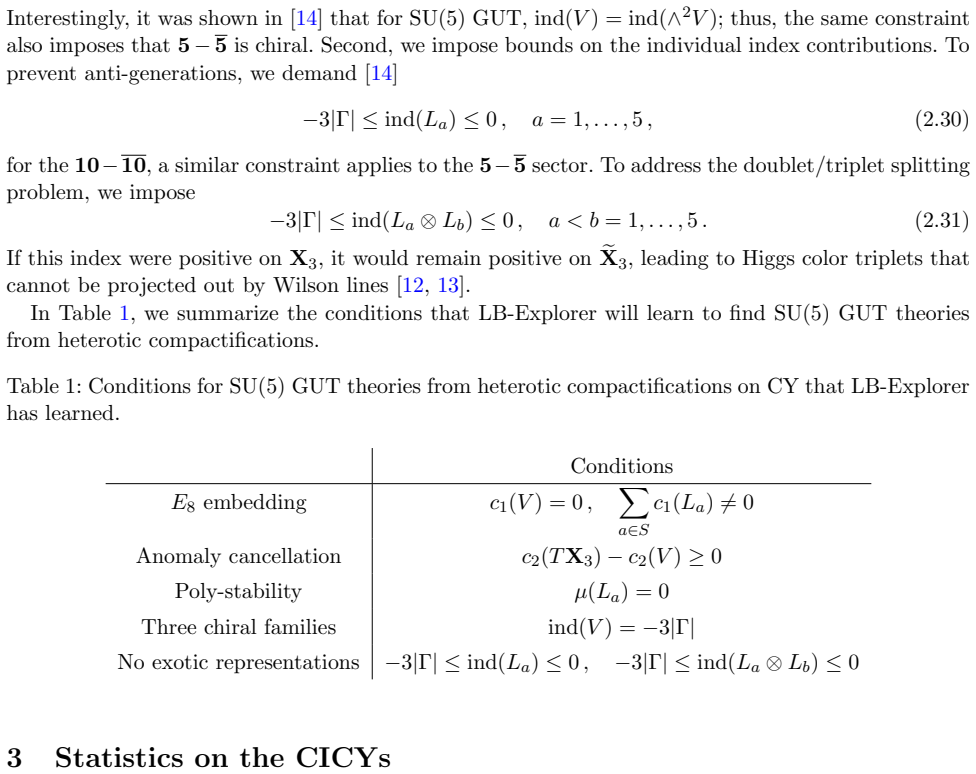
The LB-Explorer efficiently learns constraints on the line bundle sums, guaranteeing the E8 gauge embedding, anomaly cancellation, poly-stability (supersymmetry), chirality of the spectrum, and the absence of exotic matter.
What carries the argument
LB-Explorer, a Transformer-based reinforcement learning environment that searches line bundle configurations on Calabi-Yau threefolds while satisfying multiple physical constraints through policy learning.
Load-bearing premise
The reinforcement learning architecture trained on specific Calabi-Yau examples will generalize its constraint satisfaction to any Calabi-Yau admitting a smooth, simplicial Mori cone and a freely-acting discrete symmetry.
What would settle it
Running LB-Explorer on a Calabi-Yau threefold outside the tested complete intersection set and checking whether all output configurations satisfy E8 embedding, anomaly cancellation, poly-stability, correct chirality, and absence of exotics without further manual adjustment.
If this is right
- Configurations discovered by the agent can be further filtered by equivariant structure of the line bundle sum and detailed particle spectrum requirements.
- A hybrid setup with CP-SAT solvers can perturb RL solutions to impose selected conditions exactly.
- The method extends to any Calabi-Yau threefold with a smooth simplicial Mori cone and freely acting discrete symmetry.
- Such agents provide a tool for systematic exploration of the heterotic string landscape at large numbers of moduli.
Where Pith is reading between the lines
- The learned constraint policies could be transferred to search problems on non-complete-intersection Calabi-Yau threefolds.
- Integration with other machine learning or optimization techniques might enable automated generation of full particle spectra.
- Similar reinforcement learning setups could be adapted to locate standard model vacua in different string theory constructions.
Editorial analysis
A structured set of objections, weighed in public.
Referee Report
Summary. The manuscript proposes LB-Explorer, a Transformer-based reinforcement learning architecture to search for heterotic line bundle standard models on Calabi-Yau threefolds. It constructs E8 imes E8 vacua with SU(5) symmetry (broken to the Standard Model via discrete Wilson lines), tests the method on CICY manifolds, and asserts that the architecture naturally generalizes to any CY with a smooth simplicial Mori cone and freely-acting discrete symmetry. The approach is claimed to efficiently learn constraints guaranteeing E8 gauge embedding, anomaly cancellation, poly-stability, chirality, and absence of exotics, with a hybrid CP-SAT solver component for additional exact constraints; code is provided for reproducibility.
Significance. If the efficiency, constraint-learning guarantees, and generalization claims hold, the work would offer a scalable ML tool for navigating high-dimensional regions of the heterotic string landscape, complementing traditional algebraic geometry searches. The open-sourcing of code and tools is a clear strength that supports reproducibility.
major comments (2)
- [Abstract] Abstract: The assertion that 'the neural network architecture naturally generalizes to any CY admitting a smooth, simplicial Mori cone and a freely-acting discrete symmetry' is unsupported by transfer experiments, ablations on varying Mori cone generators or cohomology rings, or an argument establishing that the state representation (line-bundle integers plus intersection data) and reward formulation remain well-defined and trainable under changes to the discrete group action or cone structure. This extrapolation is load-bearing for the versatility and scalability claims.
- [Abstract] Abstract: No training curves, success rates, explicit formulations of the learned constraints, or validation against known line bundle models are visible, preventing assessment of whether the RL policy actually satisfies the claimed guarantees on E8 embedding, anomaly cancellation, poly-stability, chirality, and absence of exotics.
Simulated Author's Rebuttal
We thank the referee for their careful reading and constructive comments. We address the major comments point by point below.
read point-by-point responses
-
Referee: [Abstract] Abstract: The assertion that 'the neural network architecture naturally generalizes to any CY admitting a smooth, simplicial Mori cone and a freely-acting discrete symmetry' is unsupported by transfer experiments, ablations on varying Mori cone generators or cohomology rings, or an argument establishing that the state representation (line-bundle integers plus intersection data) and reward formulation remain well-defined and trainable under changes to the discrete group action or cone structure. This extrapolation is load-bearing for the versatility and scalability claims.
Authors: The state representation is defined in terms of line-bundle integers together with the intersection numbers of the threefold, quantities that are well-defined for any smooth Calabi-Yau with a simplicial Mori cone. The reward function likewise encodes the physical constraints directly in these data. While the manuscript demonstrates the approach only on CICYs, the architecture itself does not encode manifold-specific features beyond these inputs. We agree that the generalization statement in the abstract is stated too strongly without supporting experiments and will revise it to a more qualified claim, adding a short discussion of the representation’s expected domain of applicability. revision: partial
-
Referee: [Abstract] Abstract: No training curves, success rates, explicit formulations of the learned constraints, or validation against known line bundle models are visible, preventing assessment of whether the RL policy actually satisfies the claimed guarantees on E8 embedding, anomaly cancellation, poly-stability, chirality, and absence of exotics.
Authors: The abstract is necessarily brief. Training curves, success rates, explicit constraint formulations, and comparisons to known line-bundle models appear in Sections 3 and 4 of the main text. To improve immediate visibility of these results we will add a concise performance summary to the abstract and ensure the constraint equations are stated explicitly in the revised introduction. revision: yes
Circularity Check
No circularity: search procedure with empirically tested constraints on CICYs
full rationale
The paper describes an RL-based search algorithm (LB-Explorer) whose reward is constructed to enforce the listed physical constraints (E8 embedding, anomaly cancellation, etc.). Finding valid configurations is therefore the intended output of the method rather than a derived prediction that reduces to its inputs. No mathematical derivation chain, self-citation load-bearing steps, or fitted-input-called-prediction patterns appear. The generalization claim to arbitrary CYs is an untested assertion but does not create circularity in any claimed result. The work is self-contained as a computational tool whose performance is evaluated directly on the manifolds used for training.
Axiom & Free-Parameter Ledger
read the original abstract
We propose a Transformer-based Reinforcement Learning architecture, "LB-Explorer", to search for heterotic line bundle standard models arising from compactifications on smooth Calabi-Yau (CY) threefolds. We focus on $E_8\times E_8$ heterotic string theory compactifications on CY with abelian line bundles to produce $\text{SU}(5)\times \text{S}(\text{U}(1)^5)$ symmetry, whose $\text{SU}(5)$ can be further broken to an MSSM-like gauge group using appropriate discrete Wilson lines. We test the LB-Explorer environment on complete intersection Calabi-Yau (CICY) manifolds, though the neural network architecture naturally generalizes to any CY admitting a simplicial Mori cone and a freely-acting discrete symmetry. The LB-Explorer efficiently learns constraints on the line bundle sums, guaranteeing the $E_8$ gauge embedding, anomaly cancellation, poly-stability (supersymmetry), chirality of the spectrum, and the absence of exotic matter. Valid configurations can be subsequently filtered by imposing the missing constraints, such as the equivariant structure of the line bundle sum and further requirements on the particle spectrum. In this direction, we introduce a hybrid architecture incorporating CP-SAT solvers that aims to impose some of the conditions exactly by perturbing solutions found by the LB-Explorer. The versatility and scalability of the LB-Explorer make it a powerful tool for navigating the string landscape with a large number of moduli. The code and tools necessary to reproduce our findings are available at https://github.com/alexmininno/LB-Explorer
Figures







Forward citations
Cited by 1 Pith paper
-
Learning to Trace Seiberg Dualities
Hybrid graph-transformer networks guiding A* and beam search find Seiberg-duality paths between ~10-node quivers more efficiently than BFS or pure physics heuristics, with a measured complexity breaking point.
discussion (0)
Sign in with ORCID, Apple, or X to comment. Anyone can read and Pith papers without signing in.