SPARCLE: SPeaker-aware Aligned Representations via Contrastive Language Embeddings
Pith reviewed 2026-07-04 01:18 UTC · model grok-4.3
The pith
SPARCLE uses contrastive training to embed speaker-specific acoustics directly into graphemes for low-resource TTS.
A machine-rendered reading of the paper's core claim, the machinery that carries it, and where it could break.
Core claim
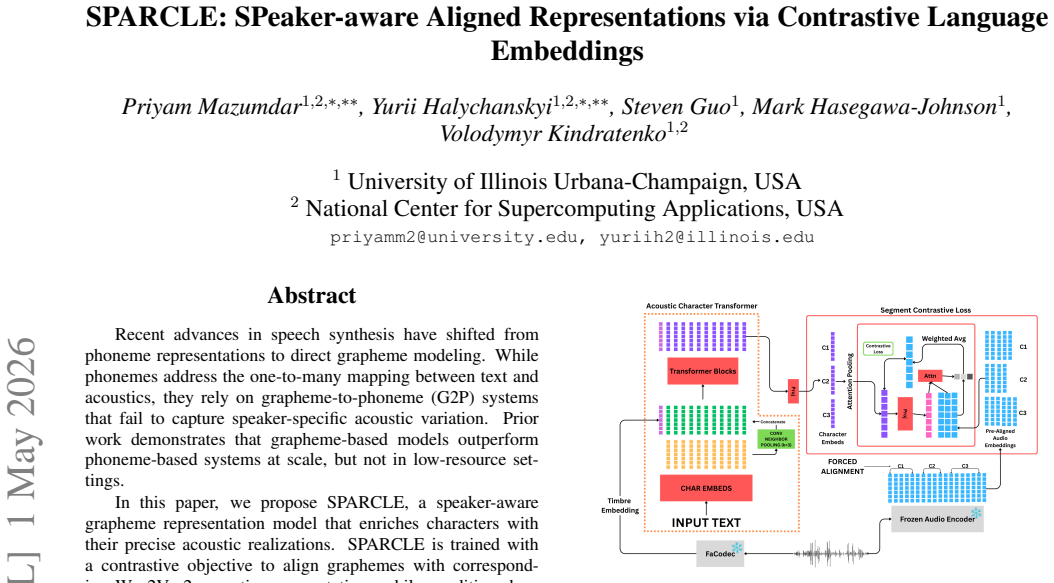
SPARCLE trains grapheme embeddings via contrastive loss to match corresponding speaker-conditioned acoustic representations from Wav2Vec2. The aligned embeddings are then used in place of G2P outputs for downstream TTS, allowing models to generate speech that reflects precise speaker acoustics while preserving linguistic content from the text. Experiments show this yields substantially better generation quality than plain grapheme baselines, specifically halving word error rates under extreme low-resource data constraints.
What carries the argument
Contrastive alignment of graphemes to speaker-conditioned Wav2Vec2 acoustic representations, which injects speaker-specific sound details into character embeddings.
If this is right
- Grapheme-based TTS models can reach usable quality with far less data when inputs already encode speaker acoustics.
- Speaker identity information transfers into text representations without requiring separate pronunciation rules or phoneme inventories.
- The same contrastive alignment process can serve as a drop-in upgrade for any grapheme-input TTS pipeline.
- Performance advantages appear largest precisely when training data is scarcest.
Where Pith is reading between the lines
- The approach might extend to other modalities where discrete symbols must capture variable physical realizations, such as handwriting or music notation.
- It could lower the cost of building TTS for new speakers or languages by reducing dependence on large aligned audio-text corpora.
- Combining SPARCLE with existing speaker adaptation techniques might further improve results in zero-shot or few-shot speaker scenarios.
Load-bearing premise
The contrastive alignment adds precise speaker acoustics to graphemes without discarding linguistic content or creating misalignments that would hurt TTS performance.
What would settle it
An experiment where TTS systems using SPARCLE embeddings show no reduction in word error rate compared to standard grapheme models across multiple low-resource datasets would falsify the central performance claim.
Figures
read the original abstract
Recent advances in speech synthesis have shifted from phoneme representations to direct grapheme modeling. While phonemes address the one-to-many mapping between text and acoustics, they rely on grapheme-to-phoneme (G2P) systems that fail to capture speaker-specific acoustic variation. Prior work demonstrates that grapheme-based models outperform phoneme-based systems at scale, but not in low-resource settings. In this paper, we propose SPARCLE, a speaker-aware grapheme representation model that enriches characters with their precise acoustic realizations. SPARCLE is trained with a contrastive objective to align graphemes with corresponding Wav2Vec2 acoustic representations while conditioned on speaker identity. The resulting model serves as a replacement to G2P systems for downstream text-to-speech (TTS) tasks. We demonstrate that SPARCLE improves generation quality, reducing word error rates by half in extreme low-resource settings compared to standard grapheme-based models.
Editorial analysis
A structured set of objections, weighed in public.
Referee Report
Summary. The paper proposes SPARCLE, a speaker-aware grapheme representation model trained via a contrastive objective to align graphemes with speaker-conditioned Wav2Vec2 acoustic representations. It positions the resulting embeddings as a G2P replacement for downstream TTS and claims that this yields improved generation quality, specifically halving word error rates in extreme low-resource settings relative to standard grapheme-based models.
Significance. If the performance claims hold under rigorous evaluation, the work would provide a concrete method for injecting speaker-specific acoustic detail into grapheme embeddings without relying on explicit phoneme conversion, potentially benefiting low-resource TTS pipelines where G2P systems underperform.
major comments (2)
- [Abstract] Abstract: the central claim that SPARCLE 'reduc[es] word error rates by half in extreme low-resource settings' is asserted without any accompanying experimental protocol, dataset sizes, speaker counts, baseline implementations, statistical tests, or ablation results. This omission is load-bearing because the soundness of the contrastive-alignment approach cannot be assessed from the given text.
- [Abstract] Abstract: no alignment diagnostics, temporal correspondence checks, or probes confirming retention of linguistic content (versus introduction of new misalignment errors) are described, leaving the weakest assumption in the stress-test note unaddressed despite being required for the downstream WER claim to be credible.
Simulated Author's Rebuttal
We thank the referee for the constructive comments on the abstract. The concerns highlight opportunities to improve clarity and provide additional validation. We address each point below and will make corresponding revisions to strengthen the manuscript.
read point-by-point responses
-
Referee: [Abstract] Abstract: the central claim that SPARCLE 'reduc[es] word error rates by half in extreme low-resource settings' is asserted without any accompanying experimental protocol, dataset sizes, speaker counts, baseline implementations, statistical tests, or ablation results. This omission is load-bearing because the soundness of the contrastive-alignment approach cannot be assessed from the given text.
Authors: We agree the abstract would benefit from more context on the evaluation. The full manuscript details the experimental protocol in Sections 3-4, including the extreme low-resource datasets (specific speaker counts and audio hours), baseline grapheme-based TTS models, WER computation, multiple-run statistical assessment, and ablations on the contrastive objective. To address the concern directly in the abstract, we will revise it to briefly note the low-resource evaluation setting, dataset characteristics, and comparison to standard grapheme baselines. revision: yes
-
Referee: [Abstract] Abstract: no alignment diagnostics, temporal correspondence checks, or probes confirming retention of linguistic content (versus introduction of new misalignment errors) are described, leaving the weakest assumption in the stress-test note unaddressed despite being required for the downstream WER claim to be credible.
Authors: The manuscript relies on the contrastive loss and downstream TTS WER as primary validation of alignment quality. We acknowledge that explicit diagnostics (e.g., similarity metrics between grapheme and acoustic embeddings, temporal alignment checks, or linguistic probes) are not currently described. We will add a new analysis subsection with these diagnostics in the revised version to directly address retention of linguistic content and rule out misalignment artifacts. revision: yes
Circularity Check
No circularity: empirical downstream evaluation of contrastive alignment
full rationale
The paper trains SPARCLE via an independent contrastive objective that aligns grapheme tokens to speaker-conditioned Wav2Vec2 embeddings, then measures success on a separate downstream TTS task using word error rate. The reported halving of WER is an observed empirical outcome on held-out data, not a quantity that is definitionally identical to the training loss or to any fitted parameter. No equations, self-citations, or uniqueness claims are shown that would reduce the central result to its own inputs by construction. The derivation chain therefore remains self-contained against external benchmarks.
Axiom & Free-Parameter Ledger
axioms (2)
- domain assumption Wav2Vec2 acoustic representations contain speaker-specific information that can be aligned to graphemes via contrastive learning.
- domain assumption Conditioning the alignment on speaker identity enables capture of speaker-dependent acoustic variation.
Reference graph
Works this paper leans on
-
[1]
Introduction Generative modeling has recently achieved remarkable progress across multiple modalities [1, 2, 3, 4], with speech synthesis benefiting substantially [5, 6]. Phonemes have long been a popular input choice, as they explicitly encode pronunciation and mitigate the one-to-many mapping problem where a single grapheme sequence can yield multiple a...
-
[2]
SPARCLE: SPeaker-aware Aligned Representations via Contrastive Language Embeddings
Related Work Contrastive Learning has emerged as a powerful paradigm for learning joint embedding spaces across different modalities. The main task is to directly optimize representations such that semantically corresponding inputs from different modalities are mapped close together. One influential work from which we take inspiration from is Contrastive ...
work page internal anchor Pith review Pith/arXiv arXiv 2026
-
[3]
Many languages, such as as English, have inconsistent spelling-to-sound mappings
Method The main limitation of using graphemes in TTS systems is pro- nunciation ambiguity [13]. Many languages, such as as English, have inconsistent spelling-to-sound mappings. For example, the wordreadcan be phonetically spelled as/ri:d/or/rE:d/, de- pending on the tense even with the same grapheme sequence. This inconsistency motivates the use of G2P c...
-
[4]
Experiment Details We evaluate SPARCLE as a drop-in replacement for character embeddings in two TTS backends: (i) ParrotTTS [19], a modu- lar system that predicts discrete self-supervised units from text and synthesizes waveforms with a separate neural vocoder; and (ii) VITS [20], an end-to-end TTS model. Our goal is to as- sess whetherspeaker-aware, acou...
-
[5]
The gains are largest in the lowest-resource regimes
Results SPARCLE consistently improves low-resource pronuncia- tion.Table 1 shows that replacing character embeddings with SPARCLE improves WER over the character-only baseline across all budgets. The gains are largest in the lowest-resource regimes. At 10 minutes, the character baseline WER is 85.7%, while SPARCLE reduces WER to 42.2% (timbre,K=7). At 1 h...
-
[6]
Remarkably, with as little as 30 minutes of audio across all speakers, the model produces coherent and intelligible speech
Conclusions and Future Work We have demonstrated that SPARCLE encodes sufficiently rich acoustic information to support high-quality downstream TTS, even in low-resource conditions. Remarkably, with as little as 30 minutes of audio across all speakers, the model produces coherent and intelligible speech. This suggests that SPAR- CLE captures robust, trans...
-
[7]
Hierarchical text-conditional image generation with clip latents,
A. Ramesh, P. Dhariwal, A. Nichol, C. Chu, and M. Chen, “Hierarchical text-conditional image generation with clip latents,”
-
[8]
Hierarchical Text-Conditional Image Generation with CLIP Latents
[Online]. Available: https://arxiv.org/abs/2204.06125
work page internal anchor Pith review Pith/arXiv arXiv
-
[9]
Photorealistic Text-to-Image Diffusion Models with Deep Language Understanding
C. Saharia, W. Chan, S. Saxena, L. Li, J. Whang, E. Denton, S. K. S. Ghasemipour, B. K. Ayan, S. S. Mahdavi, R. G. Lopes, T. Salimans, J. Ho, D. J. Fleet, and M. Norouzi, “Photorealistic text-to-image diffusion models with deep language understand- ing,” 2022. [Online]. Available: https://arxiv.org/abs/2205.11487
work page internal anchor Pith review Pith/arXiv arXiv 2022
-
[10]
Language Models are Few-Shot Learners
T. B. Brown, B. Mann, N. Ryder, M. Subbiah, J. Kaplan, P. Dhariwal, A. Neelakantan, P. Shyam, G. Sastry, A. Askell, S. Agarwal, A. Herbert-V oss, G. Krueger, T. Henighan, R. Child, A. Ramesh, D. M. Ziegler, J. Wu, C. Winter, C. Hesse, M. Chen, E. Sigler, M. Litwin, S. Gray, B. Chess, J. Clark, C. Berner, S. McCandlish, A. Radford, I. Sutskever, and D. Amo...
work page internal anchor Pith review Pith/arXiv arXiv 2020
-
[11]
MusicLM: Generating Music From Text
A. Agostinelli, T. I. Denk, Z. Borsos, J. Engel, M. Verzetti, A. Caillon, Q. Huang, A. Jansen, A. Roberts, M. Tagliasacchi, M. Sharifi, N. Zeghidour, and C. Frank, “Musiclm: Generating music from text,” 2023. [Online]. Available: https://arxiv.org/abs/ 2301.11325
work page internal anchor Pith review Pith/arXiv arXiv 2023
-
[12]
F5-TTS: A Fairytaler that Fakes Fluent and Faithful Speech with Flow Matching
Y . Chen, Z. Niu, Z. Ma, K. Deng, C. Wang, J. Zhao, K. Yu, and X. Chen, “F5-tts: A fairytaler that fakes fluent and faithful speech with flow matching,” 2025. [Online]. Available: https://arxiv.org/abs/2410.06885
work page internal anchor Pith review Pith/arXiv arXiv 2025
-
[14]
A survey of grapheme-to- phoneme conversion methods,
S. Cheng, P. Zhu, J. Liu, and Z. Wang, “A survey of grapheme-to- phoneme conversion methods,”Applied Sciences, vol. 14, no. 24,
-
[15]
Available: https://www.mdpi.com/2076-3417/14/ 24/11790
[Online]. Available: https://www.mdpi.com/2076-3417/14/ 24/11790
2076
-
[16]
Massively Multilingual Adversarial Speech Recognition
O. Adams, M. Wiesner, S. Watanabe, and D. Yarowsky, “Massively multilingual adversarial speech recognition,” 2019. [Online]. Available: https://arxiv.org/abs/1904.02210
work page internal anchor Pith review Pith/arXiv arXiv 2019
-
[17]
Speak, read and prompt: High-fidelity text-to-speech with minimal supervision,
E. Kharitonov, D. Vincent, Z. Borsos, R. Marinier, S. Girgin, O. Pietquin, M. Sharifi, M. Tagliasacchi, and N. Zeghidour, “Speak, read and prompt: High-fidelity text-to-speech with minimal supervision,” 2023. [Online]. Available: https://arxiv. org/abs/2302.03540
-
[18]
Clap: Learning audio concepts from natural language supervision,
B. Elizalde, S. Deshmukh, M. A. Ismail, and H. Wang, “Clap: Learning audio concepts from natural language supervision,”
-
[19]
Available: https://arxiv.org/abs/2206.04769
[Online]. Available: https://arxiv.org/abs/2206.04769
-
[20]
Byt5 model for massively multilingual grapheme-to-phoneme conversion,
J. Zhu, C. Zhang, and D. Jurgens, “Byt5 model for massively multilingual grapheme-to-phoneme conversion,” 2022. [Online]. Available: https://arxiv.org/abs/2204.03067
-
[21]
Towards a quantitative analysis of coarticulation with a phoneme-to-articulatory model,
C. Fan, J. M. Henderson, C. Manning, and F. R. Willett, “Towards a quantitative analysis of coarticulation with a phoneme-to-articulatory model,” 2024. [Online]. Available: https://arxiv.org/abs/2408.05641
-
[22]
D. Han, M. Cui, J. Kang, X. Wu, X. Liu, and H. Meng, “Improv- ing grapheme-to-phoneme conversion through in-context knowl- edge retrieval with large language models,” in2024 IEEE 14th International Symposium on Chinese Spoken Language Process- ing (ISCSLP). IEEE, Nov. 2024, p. 631–635. [Online]. Available: http://dx.doi.org/10.1109/ISCSLP63861.2024.10800392
-
[23]
Charac- terizing phonetic transformations and acoustic differences across english dialects,
N. F. Chen, S. W. Tam, W. Shen, and J. P. Campbell, “Charac- terizing phonetic transformations and acoustic differences across english dialects,”IEEE/ACM Transactions on Audio, Speech, and Language Processing, vol. 22, no. 1, pp. 110–124, 2014
2014
-
[24]
Available: https://arxiv.org/abs/2006.11477
A. Baevski, H. Zhou, A. Mohamed, and M. Auli, “wav2vec 2.0: A framework for self-supervised learning of speech representations,” 2020. [Online]. Available: https://arxiv.org/abs/ 2006.11477
-
[25]
Lib- rispeech: An asr corpus based on public domain audio books,
V . Panayotov, G. Chen, D. Povey, and S. Khudanpur, “Lib- rispeech: An asr corpus based on public domain audio books,” in2015 IEEE International Conference on Acoustics, Speech and Signal Processing (ICASSP), 2015, pp. 5206–5210
2015
-
[26]
Naturalspeech 3: Zero-shot speech synthesis with factorized codec and diffusion models,
Z. Ju, Y . Wang, K. Shen, X. Tan, D. Xin, D. Yang, Y . Liu, Y . Leng, K. Song, S. Tang, Z. Wu, T. Qin, X.-Y . Li, W. Ye, S. Zhang, J. Bian, L. He, J. Li, and S. Zhao, “Naturalspeech 3: Zero-shot speech synthesis with factorized codec and diffusion models,”
-
[27]
Naturalspeech 3: Zero-shot speech synthesiswith factorized codec and diffusion models,
[Online]. Available: https://arxiv.org/abs/2403.03100
-
[28]
Amphion: An open-source audio, music and speech generation toolkit,
X. Zhang, L. Xue, Y . Gu, Y . Wang, H. He, C. Wang, X. Chen, Z. Fang, H. Chen, J. Zhang, T. Y . Tang, L. Zou, M. Wang, J. Han, K. Chen, H. Li, and Z. Wu, “Amphion: An open-source audio, music and speech generation toolkit,”arXiv, vol. abs/2312.09911, 2024
-
[29]
Parrottts: Text-to-speech synthesis by exploiting self-supervised representations,
N. Shah, S. Kosgi, V . Tambrahalli, N. Sahipjohn, N. Pedanekar, and V . Gandhi, “Parrottts: Text-to-speech synthesis by exploiting self-supervised representations,” 2023. [Online]. Available: https://arxiv.org/abs/2303.01261
-
[30]
Conditional variational autoencoder with adversarial learning for end-to-end text-to-speech,
J. Kim, J. Kong, and J. Son, “Conditional variational autoencoder with adversarial learning for end-to-end text-to-speech,” 2021. [Online]. Available: https://arxiv.org/abs/2106.06103
-
[31]
CSTR VCTK Cor- pus: English Multi-speaker Corpus for CSTR V oice Cloning Toolkit,
C. Veaux, J. Yamagishi, and K. MacDonald, “CSTR VCTK Cor- pus: English Multi-speaker Corpus for CSTR V oice Cloning Toolkit,” 2017, version 0.92
2017
-
[32]
W. Wang, Y . Song, and S. Jha, “Globe: A high-quality english corpus with global accents for zero-shot speaker adaptive text-to-speech,” 2024. [Online]. Available: https: //arxiv.org/abs/2406.14875
-
[33]
Robust Speech Recognition via Large-Scale Weak Supervision
A. Radford, J. W. Kim, T. Xu, G. Brockman, C. McLeavey, and I. Sutskever, “Robust speech recognition via large- scale weak supervision,” 2022. [Online]. Available: https: //arxiv.org/abs/2212.04356
work page internal anchor Pith review Pith/arXiv arXiv 2022
-
[34]
B. Desplanques, J. Thienpondt, and K. Demuynck, “Ecapa-tdnn: Emphasized channel attention, propagation and aggregation in tdnn based speaker verification,” inInterspeech 2020. ISCA, Oct. 2020, p. 3830–3834. [Online]. Available: http: //dx.doi.org/10.21437/Interspeech.2020-2650
-
[35]
Park and J
K. Park and J. Kim, “g2pe,” https://github.com/Kyubyong/g2p, 2019
2019
-
[36]
RoBERTa: A Robustly Optimized BERT Pretraining Approach
Y . Liu, M. Ott, N. Goyal, J. Du, M. Joshi, D. Chen, O. Levy, M. Lewis, L. Zettlemoyer, and V . Stoyanov, “Roberta: A robustly optimized BERT pretraining approach,” CoRR, vol. abs/1907.11692, 2019. [Online]. Available: http: //arxiv.org/abs/1907.11692
work page internal anchor Pith review Pith/arXiv arXiv 1907
-
[37]
Neural Codec Language Models are Zero-Shot Text to Speech Synthesizers
C. Wang, S. Chen, Y . Wu, Z. Zhang, L. Zhou, S. Liu, Z. Chen, Y . Liu, H. Wang, J. Li, L. He, S. Zhao, and F. Wei, “Neural codec language models are zero-shot text to speech synthesizers,” 2023. [Online]. Available: https://arxiv.org/abs/2301.02111
work page internal anchor Pith review Pith/arXiv arXiv 2023
discussion (0)
Sign in with ORCID, Apple, or X to comment. Anyone can read and Pith papers without signing in.