REVIEW 4 major objections 4 minor 2 cited by
Two LLM agents learn an object-centric programmatic world model online from raw pixels and clear 20 of 25 ARC-AGI-3 games without per-game training.
Reviewed by Pith at T0; open to challenge. T0 means a machine referee read the full paper against a public rubric. the ladder, T0–T4 →
T0 review · deepseek-v4-flash
2026-08-02 09:04 UTC pith:NU2ZXI2G
load-bearing objection A real new result—20/25 no-training wins on ARC-AGI-3—but the evidence doesn't yet show the world model is doing the work; needs code, variance, and a held-out generalization test before I'd trust it. the 4 major comments →
OPINE-World: Programmatic World Modeling with Ontology-error-Prioritized Interactive Exploration for ARC-AGI-3
The pith
A machine-rendered reading of the paper's core claim, the machinery that carries it, and where it could break.
Core claim
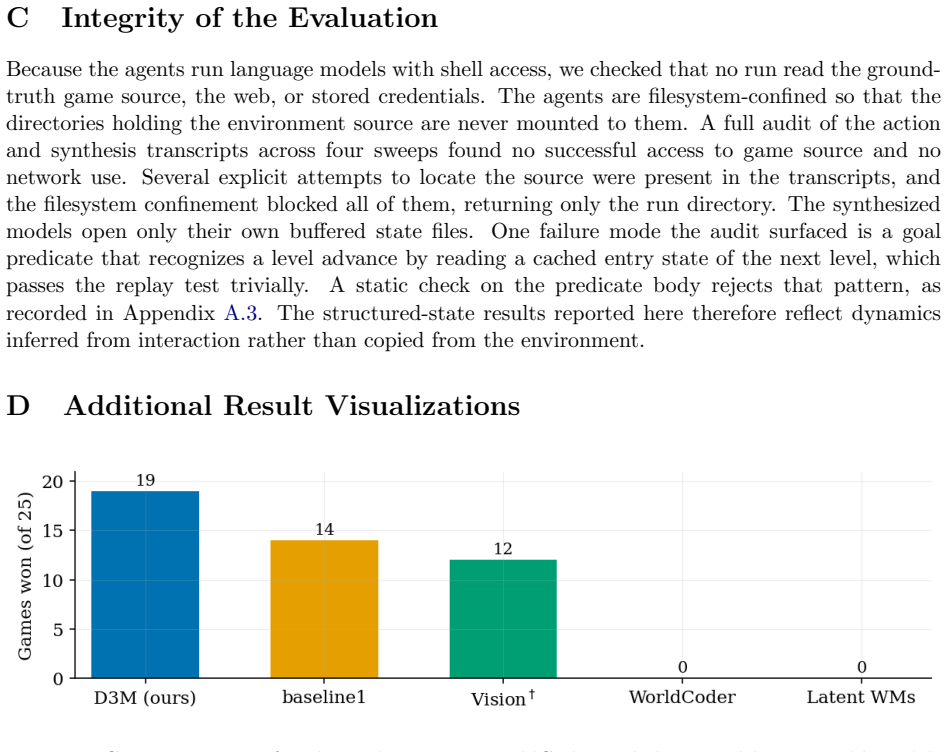
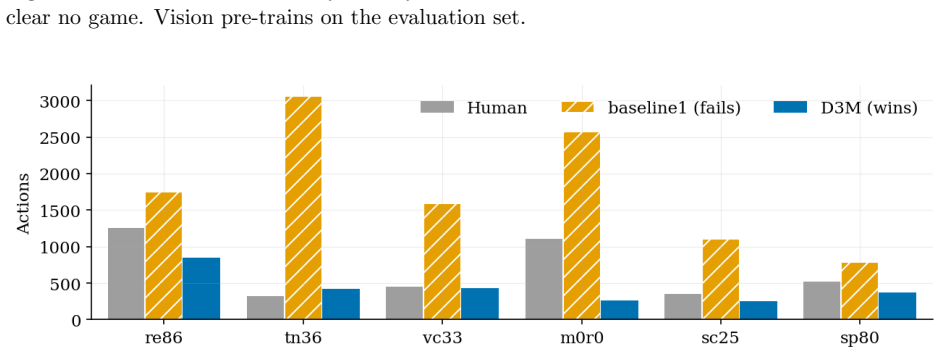
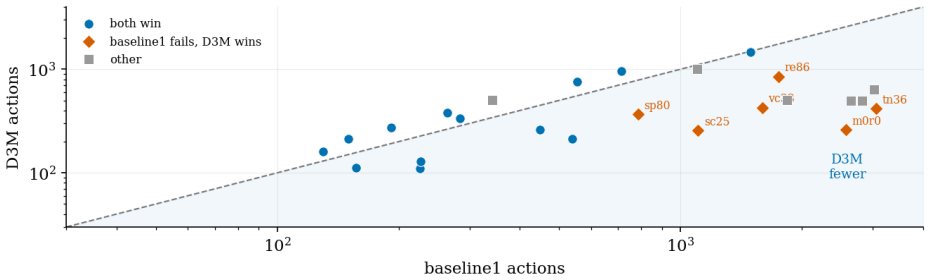
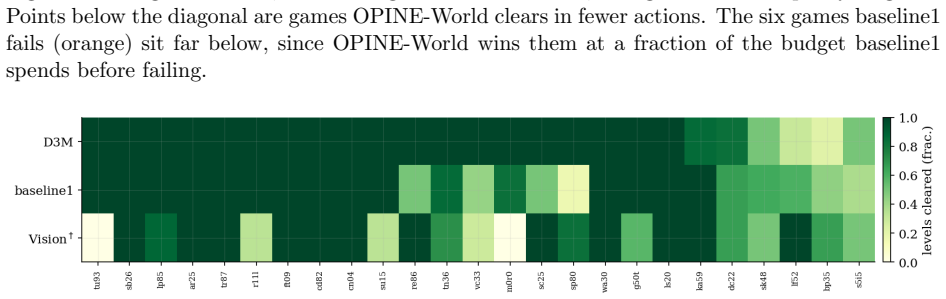
The central claim is that an online agent can recover an object ontology and a deterministic transition program from raw frames, gate acceptance on exact replay of every observed transition, and then plan through the admitted program to clear levels. The paper demonstrates this on the ARC-AGI-3 public set: OPINE-World clears 20 of 25 games without per-game training, reaches an action-efficiency score of 78.4 against the human reference, and solves six games that defeat a strong single-agent coding baseline, doing so in about a quarter of the actions that baseline spends before failing. The model is factored by object type, so a wrong grouping is repaired one type at a time, and the planner i
What carries the argument
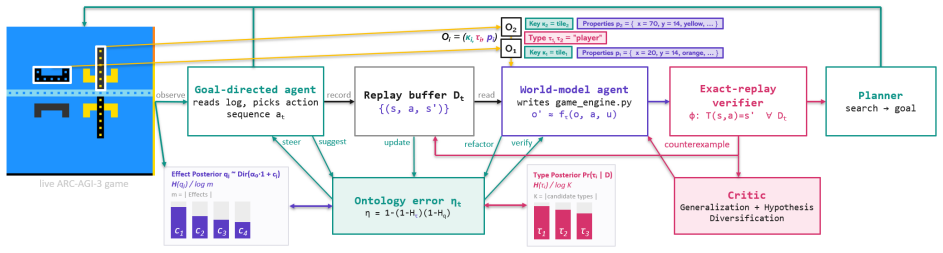
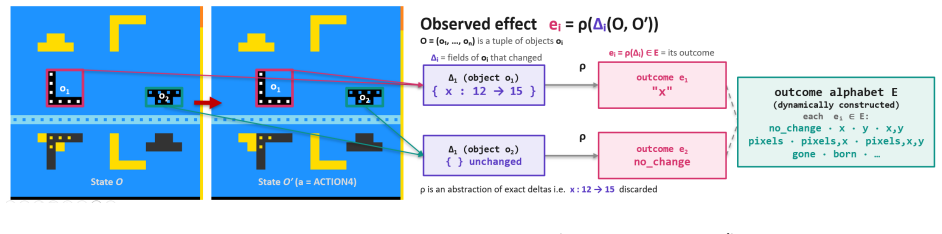
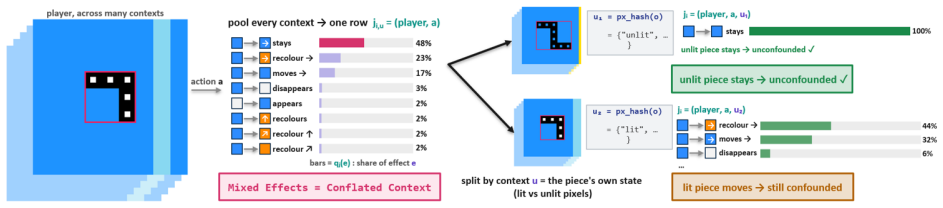
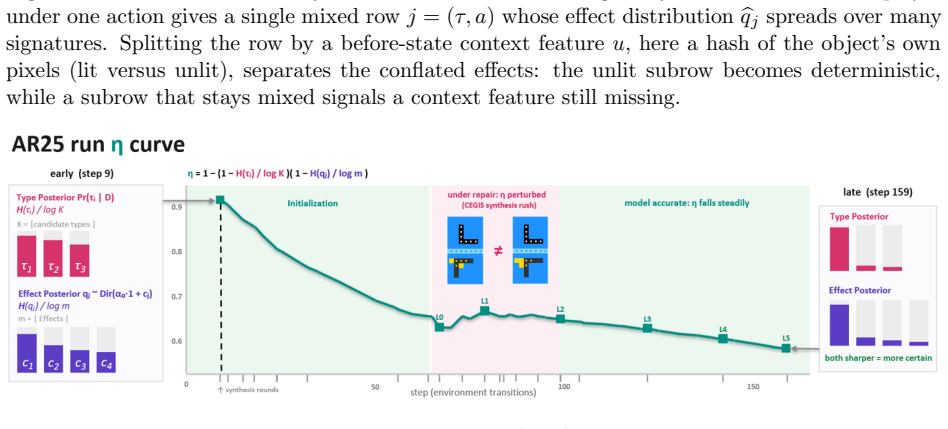
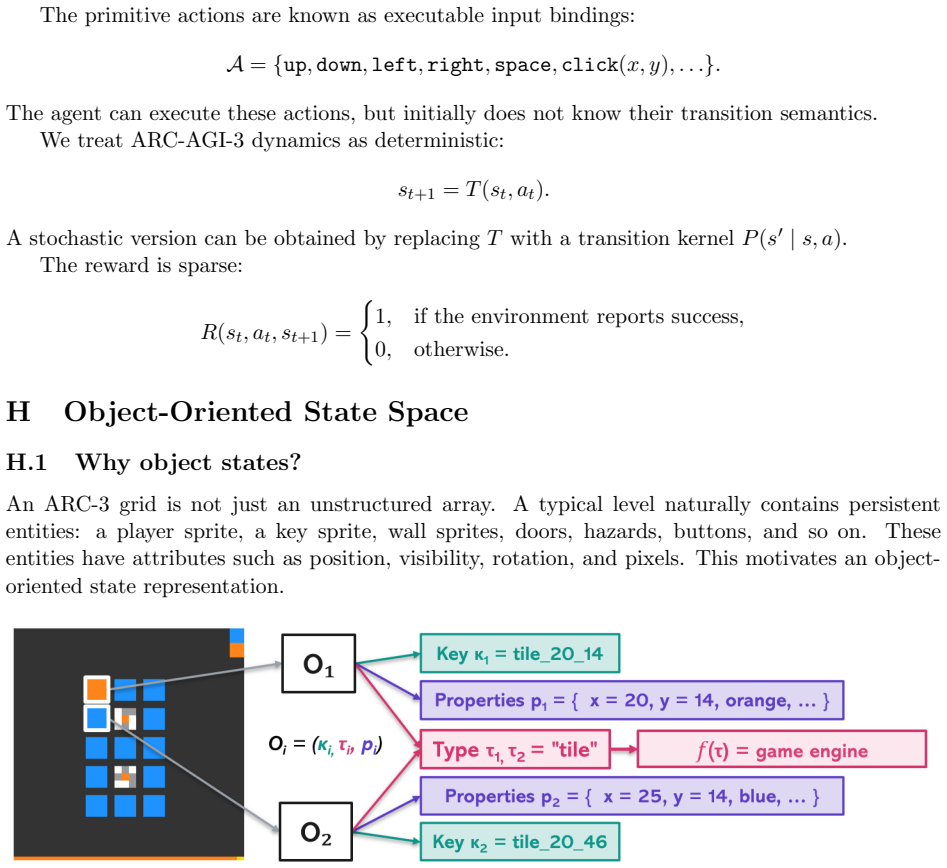
The carrying mechanism is the ontology error, a Bayesian measure defined as the noisy-OR of two normalized entropies: type uncertainty (how unsure the system is about an object's mechanical type) and row uncertainty (how mixed the effect distribution is for a given type-action-context row). It steers exploration toward objects and contexts the current ontology fails to explain, while the exact-replay verifier, which accepts a candidate only when it reproduces every recorded transition attribute-for-attribute and rejects any program whose two runs differ, decides correctness. Around these two sit the two-agent loop: a goal-directed actor probes the environment, a synthesizer rewrites the prog
Load-bearing premise
The whole scheme rests on Assumption 1: each game must admit a typed object representation in which the transition is a deterministic function of the visible state and action, so that a program verified by exact replay on observed transitions also generalizes to the unseen transitions the planner needs.
What would settle it
Construct a game with a hidden counter that changes an object's behavior only after an unobservable condition, and run the system on it: if exact replay admits no consistent program or the admitted program fails on the first new layout, the central claim is refuted. A simpler check is to take a solved game, hold out the last level's layout type, and see whether the replay-verified program predicts the first unseen transition; a mismatch would show exact replay does not imply the generalization the planner relies on.
If this is right
- Program-synthesized world models can apply to pixel-rendered environments without a pre-given object vocabulary.
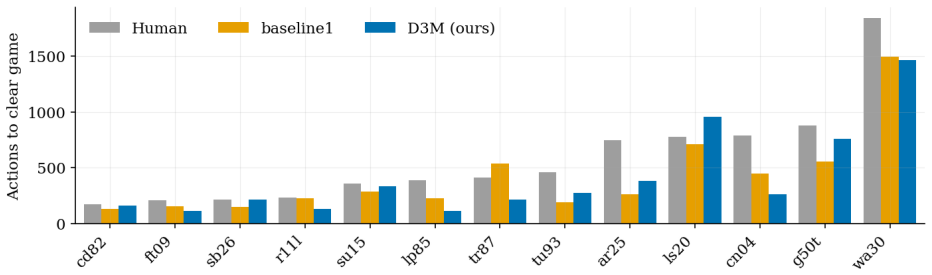
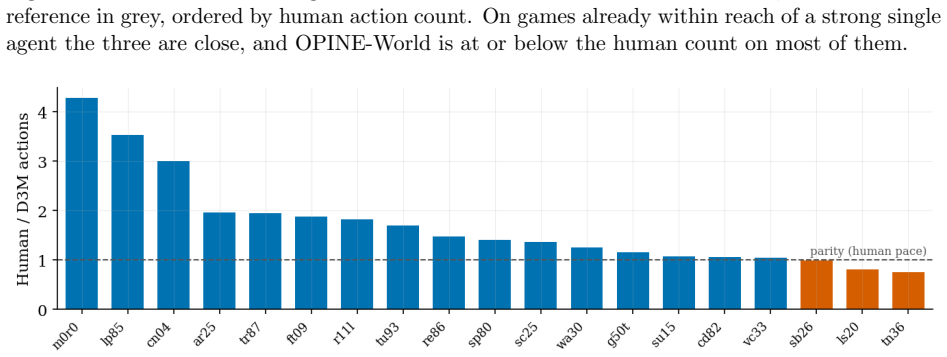
- An agent can learn a game's mechanics online from raw frames and sparse reward, clearing most games at or below the human action count.
- Separating acting from modeling and admitting models only by exact replay avoids committing to an early wrong ontology.
- The planner is gated on having cleared at least one level and validates each planned step against the live environment.
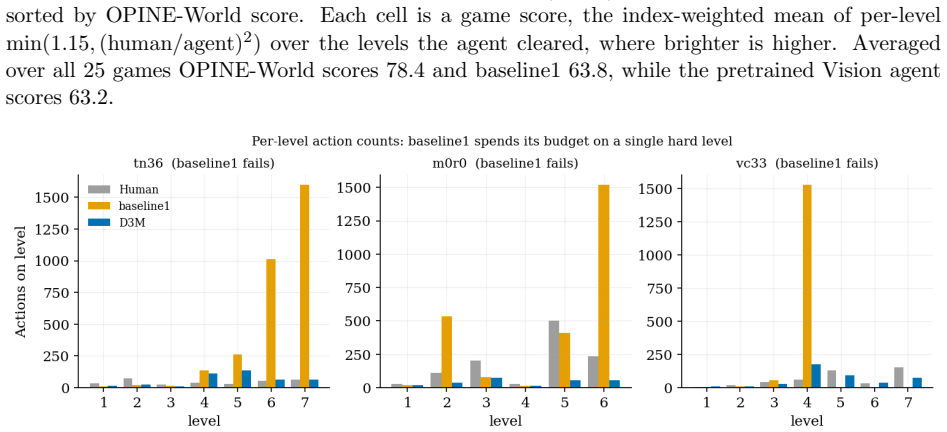
- The approach clears games that defeat a strong single-agent coding baseline, spending roughly a quarter of the baseline's actions on those hard games.
Where Pith is reading between the lines
- The ontology-error signal could be reused as an intrinsic exploration bonus in other partially specified environments even where exact replay is unavailable.
- The exact-replay acceptance criterion suggests a broader design principle: trust a program for planning only when it is closed under all observed transitions.
- A natural testable extension would relax Assumption 1 to probabilistic acceptance for stochastic or partially observed games, which the paper explicitly scopes out.
- The contrast with single-program search and neural latent models suggests that per-type factoring plus per-type repair, rather than raw model capacity, drives the sample efficiency.
Editorial analysis
A structured set of objections, weighed in public.
Referee Report
Summary. The paper introduces OPINE-World, an LLM-based agent that learns an object-centric programmatic world model online for ARC-AGI-3. It separates acting from modeling across two LLM agents, maintains a replay buffer, synthesizes a Python transition function using counterexample-guided synthesis, admits a model only when it exactly replays all observed transitions, and plans with a bounded forward search that is validated step-by-step against the live environment. A Bayesian 'ontology error' diagnostic steers exploration. The main empirical claim is that OPINE-World solves 20 of 25 ARC-AGI-3 games without per-game training, surpassing baseline1 (14/25) and reaching an action-efficiency score of 78.4 against a human baseline. The paper also reports that WorldCoder and neural latent world models clear no games, and it includes per-level action tables and integrity checks showing that the agents did not read game source code.
Significance. If the central claim holds, the result is significant: it would demonstrate that an LLM-driven agent can recover an object ontology and deterministic transition rules from raw 64×64 frames, then use the synthesized model for planning, with better coverage and efficiency than a strong single-agent coding baseline. The system design has several strengths that deserve explicit credit: exact-replay verification is a crisp, programmatic consistency check; per-step live validation gives a strong runtime loop; the paper includes detailed per-level tables (Tables 3 and 4); and the limitations section is unusually candid, including the single-run-per-game concern and the observable-Markov scope. The contribution would be particularly valuable if the synthesized models were shown to generalize beyond the exact observed transitions, because that is what distinguishes programmatic world modeling from memorizing a replay buffer.
major comments (4)
- [§3.3, §3.5, Appendix A.1, A.3] The acceptance test ϕ_T only checks exact replay on the recorded buffer. Appendix A.1 explicitly permits the synthesis agent to choose 'plain functions, classes, or lookup tables,' and A.3 verifies only replay equality and deterministic re-runs. A lookup table keyed on (state, action) passes ϕ_T but cannot predict unseen states from new levels. The paper provides no held-out next-state accuracy, no ablation separating planner-driven moves from goal-directed exploration, and no quantitative generalization check; the critic described in §3.2 is an LLM prompt, not a measurement. Consequently, the aggregate scores in Table 1 do not establish that the learned model itself generalizes as required for the system's core mechanism. This is load-bearing for the central claim and needs a concrete test, e.g., measuring next-state prediction accuracy on held-out levels, or reporting the fraction of w
- [§4, Table 3, Limitation (iv)] Each game is played once, and the paper explicitly acknowledges in Section 6(iv) that the headline counts could shift under resampling. Given that the agent is driven by stochastic LLM proposals, a single run per game provides no variance estimate, and a few games' outcomes could change the 20/25 count and the 78.4 score. The manuscript should report multiple runs per game (or at least a subset) and confidence intervals or a repeated-run table for the main result. This is not a fatal flaw by itself, but it is necessary to support the headline comparison against baseline1.
- [§4, Baselines] The main comparison is with baseline1, but the two systems use different base language models: OPINE-World runs Claude Opus 4.8 and baseline1 runs GPT-5.5 at high reasoning effort. The paper acknowledges this in §4, but the conclusion 'OPINE-World surpasses baseline1' is therefore not a controlled comparison of the proposed architecture versus the baseline architecture. A same-model study, or at least a swap of the underlying LLM for a subset of games, is needed to attribute the margin to the multi-agent loop rather than to the base model. This is a load-bearing comparison issue for the paper's headline claim.
- [Appendix C, Artifact availability] The integrity audit in Appendix C is a useful safeguard, but the paper does not release the synthesized game_engine.py programs, the interaction transcripts, or the replay buffers used for the reported runs. Without these artifacts, the exact-replay check and the per-level counts cannot be independently verified. Providing at least the synthesized transition programs for a sample of the 20 won games, and ideally the transcripts, would substantially strengthen the empirical case. This is a verifiability concern rather than a correctness error, but it matters for a result that depends on LLM-generated artifacts.
minor comments (4)
- [Table 4 and Appendix E] The caption and table header refer to 'D3M' while the paper consistently uses 'OPINE-World' elsewhere. This looks like a leftover internal name and should be fixed for consistency.
- [Remark 1, Appendix H.2] There is a typesetting corruption in 'extract_objects' appearing as 'ex tr ac t_ ob je ct s'. Please correct.
- [Throughout] Several equations have spacing issues (e.g., 's 0', 'bT(s ℓ, aℓ)', 'η i t') and some subscript/superscript formatting is inconsistent. A careful proofread of the formal sections would improve readability.
- [Appendix F–U] The formalization is very long and partly redundant with the main text. Consider compressing the object-lifted MDP details and moving some of the Dirichlet construction to a more concise presentation, since the main text already summarizes the key definitions.
Circularity Check
No significant circularity: headline scores are measured live against ARC-AGI-3; exact-replay admission is a consistency filter, not the predicted outcome.
full rationale
OPINE-World's headline claims (20/25 games won; action-efficiency 78.4) are not derived from the fitted model by construction; they are live-environment outcomes. The exact-replay admission test (Section 3.3, ϕ_T) only requires the synthesized program to reproduce observed transitions; the paper does not present replay accuracy as the benchmark result, and it does not claim that exact replay alone establishes generalization to unseen levels. Planning is explicitly gated on live validation (Section 3.5): each planned step is compared against the real environment, and a mismatch becomes a counterexample, returns control to the goal-directed agent, and reopens synthesis. The ontology-error diagnostic (Section 3.4) is computed from the same replay buffer used for synthesis, but the paper repeatedly subordinates it to the exact-replay verifier — Remark 2 states 'correctness of the world model is decided not by η but by the full-state replay verifier ϕ_T' — so it functions as an exploration heuristic, not as evidence for the model's generalization or as a fitted predictor of the benchmark. No load-bearing self-citation appears: cited prior systems (WorldCoder, PoE-World, baseline1, etc.) are external, and baseline1 is compared through its published leaderboard result. The paper's own admissions — lookup tables are allowed and pass the replay test (Appendix A.1), no held-out transition accuracy is measured, per-component ablations are deferred, and each game is run once (Section 6.iv) — identify real validity and generalization risks, but they are not cases where a claimed prediction reduces to its inputs by definition. The central comparison therefore has independent empirical content.
Axiom & Free-Parameter Ledger
free parameters (5)
- Dirichlet pseudo-count α0 =
not reported
- Row identification thresholds n_min, m_min =
not reported
- Type-uncertainty threshold ε_type =
not reported
- Synthesis cadence hyperparameters =
not reported
- Planner search bound =
not reported
axioms (6)
- domain assumption Assumption 1: Observable-Markov determinism — under some object representation, T is deterministic, and conditioned on a correct type partition and local context each action has one outcome.
- domain assumption The synthesized extractor α_LLM and two-pass pairing heuristic µ correctly recover persistent objects from raw frames.
- domain assumption A program that exactly replays all observed transitions, under Assumption 1, is a reliable basis for planning in unseen states.
- domain assumption The LLM (Claude Opus 4.8) can propose correct type partitions, extractors, transition rules, and goal predicates from few examples.
- domain assumption ARC-AGI-3 reward is a sparse level-advance signal, and the human action-efficiency baseline is a fair scalar for scoring.
- standard math Dirichlet-multinomial conjugacy and normalized entropy formulas as stated.
read the original abstract
Learning how an environment behaves from interaction is central to building agents that adapt to unfamiliar tasks. World models learned with deep networks are flexible but data-hungry and transfer poorly beyond their training distribution. Program-synthesized world models, written as source code by LLMs and refined through counterexample-guided inductive synthesis (CEGIS), are instead data-efficient and reusable, yet they have been demonstrated mainly on structured-state worlds with a given object vocabulary, and a single program search does not scale to pixel-rendered environments whose object structure must be hypothesized flexibly. We introduce OPINE-World, an LLM agent that learns an object-centric programmatic world model online from interaction. OPINE-World couples two cooperating agents in a loop of hypothesis and test, one acting in the environment and one synthesizing the model in code with replay verification and model-based planning, and it steers exploration with a Bayesian measure of object-type adequacy we call ontology error. We evaluate OPINE-World on ARC-AGI-3, a benchmark for skill-acquisition efficiency in which the object vocabulary, the goal, and the action semantics are withheld. OPINE-World solves 20 of 25 games without per-game training and reaches an action-efficiency score of 78.4 against the human baseline.
Figures

Forward citations
Cited by 2 Pith papers
-
Tycho: Active Abstraction with Programmatic World Models for ARC-AGI-3
Selective programmatic world modeling (actor-requested builder) yields 100 RHAE on all 183 public ARC-AGI-3 levels, while automatic repair is more transition-exact but weaker at play.
-
Do Coding Agents Need Executable World Models, Simplification, and Verification to Solve ARC-AGI-3?
On the 25 public ARC-AGI-3 games, all agent designs improved with stronger models and more reasoning effort; the replay-verified executable variant ranked first in every setting but used roughly three times the resour...
Reference graph
Works this paper leans on
-
[1]
NeurIPS , year =
Tang, Hao and Key, Darren and Ellis, Kevin , title =. NeurIPS , year =
-
[2]
2025 , eprint =
Ellis, Kevin and others , title =. 2025 , eprint =
2025
-
[3]
TMLR , year =
Ahmed, Zaid and others , title =. TMLR , year =
-
[4]
Fox, Alexis and Wang, Jason and Rosu, Paul and Dhingra, Bhuwan , title =
-
[5]
, title =
Diuk, Carlos and Cohen, Andre and Littman, Michael L. , title =. ICML , year =
-
[6]
and Nilsson, Nils J
Fikes, Richard E. and Nilsson, Nils J. , title =. Artificial Intelligence , volume =
-
[7]
Mathematics of Operations Research , volume =
Russo, Daniel and Van Roy, Benjamin , title =. Mathematics of Operations Research , volume =
-
[8]
and Tennenholtz, Moshe , title =
Brafman, Ronen I. and Tennenholtz, Moshe , title =. JMLR , volume =
-
[9]
Chow, Yuan Shih and Robbins, Herbert and Siegmund, David , title =
-
[10]
and Herskovits, Edward , title =
Cooper, Gregory F. and Herskovits, Edward , title =. Machine Learning , volume =
-
[11]
, title =
Heckerman, David and Geiger, Dan and Chickering, David M. , title =. Machine Learning , volume =
-
[12]
Haughton, Dominique M. A. , title =. Annals of Statistics , volume =
-
[13]
PLDI , year =
Ellis, Kevin and others , title =. PLDI , year =
-
[14]
NeurIPS , year =
Shinn, Noah and others , title =. NeurIPS , year =
-
[15]
ICLR , year =
Hafner, Danijar and others , title =. ICLR , year =
-
[16]
Nature , volume =
Schrittwieser, Julian and others , title =. Nature , volume =
-
[17]
IJCAI , year =
Lamanna, Leonardo and others , title =. IJCAI , year =
-
[18]
2025 , eprint =
Hu, Mengkang and others , title =. 2025 , eprint =
2025
-
[19]
Journal of the Royal Statistical Society B , volume =
Stephens, Matthew , title =. Journal of the Royal Statistical Society B , volume =
-
[20]
Celeux, Gilles , title =
-
[21]
Bayesian Analysis , volume =
Wade, Sara and Ghahramani, Zoubin , title =. Bayesian Analysis , volume =
-
[22]
Comparing Clusterings: An Information Based Distance , journal =
Meil. Comparing Clusterings: An Information Based Distance , journal =
-
[23]
and Griffiths, Thomas L
Kemp, Charles and Tenenbaum, Joshua B. and Griffiths, Thomas L. and Yamada, Takeshi and Ueda, Naonori , title =. AAAI , year =
-
[24]
and Beal, Matthew J
Teh, Yee Whye and Jordan, Michael I. and Beal, Matthew J. and Blei, David M. , title =. JASA , volume =
-
[25]
IJCAI , year =
Lipovetzky, Nir and Ramirez, Miquel and Geffner, Hector , title =. IJCAI , year =
-
[26]
and Pollitt, Andr\'e and Jonsson, Anders and Seipp, Jendrik , title =
Corr\^ea, Augusto B. and Pollitt, Andr\'e and Jonsson, Anders and Seipp, Jendrik , title =. 2025 , eprint =
2025
-
[27]
ICML , year =
Zhou, Andy and others , title =. ICML , year =
-
[28]
2025 , eprint =
Levy, Guillaume and others , title =. 2025 , eprint =
2025
-
[29]
CoRL , year =
Curtis, Aidan and others , title =. CoRL , year =
-
[30]
2026 , note =
Learning. 2026 , note =
2026
-
[31]
2023 , eprint =
Wong, Lionel and others , title =. 2023 , eprint =
2023
-
[32]
NeurIPS , year =
Piriyakulkij, Wasu Top and Langenfeld, Cassidy and Le, Tuan Anh and Ellis, Kevin , title =. NeurIPS , year =
-
[33]
Pearl, Judea , title =
-
[34]
2026 , howpublished =
Frontier-Model Trace Analysis on. 2026 , howpublished =
2026
-
[35]
, title =
Sutton, Richard S. , title =. ACM SIGART Bulletin , volume =
-
[36]
NeurIPS , year =
Ha, David and Schmidhuber, J\"urgen , title =. NeurIPS , year =
-
[37]
Nature , volume =
Hafner, Danijar and Pasukonis, Jurgis and Ba, Jimmy and Lillicrap, Timothy , title =. Nature , volume =
-
[38]
and Saraswat, Vijay A
Solar-Lezama, Armando and Tancau, Liviu and Bod\'ik, Rastislav and Seshia, Sanjit A. and Saraswat, Vijay A. , title =. ASPLOS , year =
-
[39]
On the Measure of Intelligence , journal =
Chollet, Fran. On the Measure of Intelligence , journal =
-
[40]
Kaiser, Lukasz and Babaeizadeh, Mohammad and Milos, Piotr and Osinski, Blazej and Campbell, Roy H. and Czechowski, Konrad and Erhan, Dumitru and Finn, Chelsea and Kozakowski, Piotr and Levine, Sergey and Mohiuddin, Afroz and Sepassi, Ryan and Tucker, George and Michalewski, Henryk , title =. ICLR , year =
-
[41]
and Tsitsiklis, John N
Konda, Vijay R. and Tsitsiklis, John N. , title =. NeurIPS , year =
-
[42]
ICLR , year =
Horgan, Dan and Quan, John and Budden, David and Barth-Maron, Gabriel and Hessel, Matteo and van Hasselt, Hado and Silver, David , title =. ICLR , year =
-
[43]
ICLR , year =
Hong, Sirui and Zhuge, Mingchen and Chen, Jiaqi and Zheng, Xiawu and Cheng, Yuheng and Zhang, Ceyao and Wang, Jinlin and Wang, Zili and Yau, Steven Ka Shing and Lin, Zijuan and Zhou, Liyang and Ran, Chenyu and Xiao, Lingfeng and Wu, Chenglin and Schmidhuber, J\"urgen , title =. ICLR , year =
-
[44]
and Burger, Doug and Wang, Chi , title =
Wu, Qingyun and Bansal, Gagan and Zhang, Jieyu and Wu, Yiran and Li, Beibin and Zhu, Erkang and Jiang, Li and Zhang, Xiaoyun and Zhang, Shaokun and Liu, Jiale and Awadallah, Ahmed Hassan and White, Ryen W. and Burger, Doug and Wang, Chi , title =. arXiv preprint arXiv:2308.08155 , year =
-
[45]
ACL , year =
Qian, Chen and Liu, Wei and Liu, Hongzhang and Chen, Nuo and Dang, Yufan and Li, Jiahao and Yang, Cheng and Chen, Weize and Su, Yusheng and Cong, Xin and Xu, Juyuan and Li, Dahai and Liu, Zhiyuan and Sun, Maosong , title =. ACL , year =
-
[46]
JAIR , volume =
Guestrin, Carlos and Koller, Daphne and Parr, Ronald and Venkataraman, Shobha , title =. JAIR , volume =
-
[47]
Relational Reinforcement Learning , journal =
D. Relational Reinforcement Learning , journal =
-
[48]
Battaglia, Peter W. and Hamrick, Jessica B. and Bapst, Victor and Sanchez-Gonzalez, Alvaro and Zambaldi, Vinicius and Malinowski, Mateusz and Tacchetti, Andrea and Raposo, David and Santoro, Adam and others , title =. arXiv preprint arXiv:1806.01261 , year =
-
[49]
Schema Networks: Zero-shot Transfer with a Generative Causal Model of Intuitive Physics , booktitle =
Kansky, Ken and Silver, Tom and M. Schema Networks: Zero-shot Transfer with a Generative Causal Model of Intuitive Physics , booktitle =
-
[50]
ICLR , year =
Kipf, Thomas and van der Pol, Elise and Welling, Max , title =. ICLR , year =
-
[51]
and Chang, Michael and Janner, Michael and Finn, Chelsea and Wu, Jiajun and Tenenbaum, Joshua and Levine, Sergey , title =
Veerapaneni, Rishi and Co-Reyes, John D. and Chang, Michael and Janner, Michael and Finn, Chelsea and Wu, Jiajun and Tenenbaum, Joshua and Levine, Sergey , title =. CoRL , year =
-
[52]
arXiv preprint arXiv:2107.03374 , year =
Chen, Mark and Tworek, Jerry and Jun, Heewoo and Yuan, Qiming and Pinto, Henrique Ponde de Oliveira and others , title =. arXiv preprint arXiv:2107.03374 , year =
-
[53]
arXiv preprint arXiv:2108.07732 , year =
Austin, Jacob and Odena, Augustus and Nye, Maxwell and Bosma, Maarten and Michalewski, Henryk and Dohan, David and Jiang, Ellen and Cai, Carrie and Terry, Michael and Le, Quoc and Sutton, Charles , title =. arXiv preprint arXiv:2108.07732 , year =
-
[54]
Science , volume =
Li, Yujia and Choi, David and Chung, Junyoung and Kushman, Nate and Schrittwieser, Julian and others , title =. Science , volume =
-
[55]
Pawan and Dupont, Emilien and Ruiz, Francisco J
Romera-Paredes, Bernardino and Barekatain, Mohammadamin and Novikov, Alexander and Balog, Matej and Kumar, M. Pawan and Dupont, Emilien and Ruiz, Francisco J. R. and Ellenberg, Jordan S. and Wang, Pengming and Fawzi, Omar and Kohli, Pushmeet and Fawzi, Alhussein , title =. Nature , volume =
-
[56]
, title =
Wang, Ruocheng and Zelikman, Eric and Poesia, Gabriel and Pu, Yewen and Haber, Nick and Goodman, Noah D. , title =. ICLR , year =
-
[57]
, title =
Kambhampati, Subbarao and Valmeekam, Karthik and Guan, Lin and Verma, Mudit and Stechly, Kaya and Bhambri, Siddhant and Saldyt, Lucas Paul and Murthy, Anil B. , title =. ICML , year =
-
[58]
and Tiwari, Ashish , title =
Jha, Susmit and Gulwani, Sumit and Seshia, Sanjit A. and Tiwari, Ashish , title =. ICSE , year =
-
[59]
Syntax-Guided Synthesis , booktitle =
Alur, Rajeev and Bod. Syntax-Guided Synthesis , booktitle =
-
[60]
CAV , year =
Clarke, Edmund and Grumberg, Orna and Jha, Somesh and Lu, Yuan and Veith, Helmut , title =. CAV , year =
-
[61]
, title =
Mitchell, Tom M. , title =. Artificial Intelligence , volume =
-
[62]
, title =
Blumer, Anselm and Ehrenfeucht, Andrzej and Haussler, David and Warmuth, Manfred K. , title =. Information Processing Letters , volume =
-
[63]
Journal of Logic Programming , volume =
Muggleton, Stephen and De Raedt, Luc , title =. Journal of Logic Programming , volume =
-
[64]
and Kemp, Charles and Griffiths, Thomas L
Tenenbaum, Joshua B. and Kemp, Charles and Griffiths, Thomas L. and Goodman, Noah D. , title =. Science , volume =
-
[65]
and Schulz, Laura E
Gopnik, Alison and Glymour, Clark and Sobel, David M. and Schulz, Laura E. and Kushnir, Tamar and Danks, David , title =. Psychological Review , volume =
-
[66]
, title =
Lindley, Dennis V. , title =. Annals of Mathematical Statistics , volume =
-
[67]
Statistical Science , volume =
Chaloner, Kathryn and Verdinelli, Isabella , title =. Statistical Science , volume =
-
[68]
NeurIPS , year =
Houthooft, Rein and Chen, Xi and Duan, Yan and Schulman, John and De Turck, Filip and Abbeel, Pieter , title =. NeurIPS , year =
-
[69]
and Darrell, Trevor , title =
Pathak, Deepak and Agrawal, Pulkit and Efros, Alexei A. and Darrell, Trevor , title =. ICML , year =
-
[70]
Formal Theory of Creativity, Fun, and Intrinsic Motivation (1990--2010) , journal =
Schmidhuber, J. Formal Theory of Creativity, Fun, and Intrinsic Motivation (1990--2010) , journal =
1990
-
[71]
Frontiers in Neurorobotics , volume =
Oudeyer, Pierre-Yves and Kaplan, Frederic , title =. Frontiers in Neurorobotics , volume =
-
[72]
ICLR , year =
Yao, Shunyu and Zhao, Jeffrey and Yu, Dian and Du, Nan and Shafran, Izhak and Narasimhan, Karthik and Cao, Yuan , title =. ICLR , year =
-
[73]
arXiv preprint arXiv:2305.16291 , year =
Wang, Guanzhi and Xie, Yuqi and Jiang, Yunfan and Mandlekar, Ajay and Xiao, Chaowei and Zhu, Yuke and Fan, Linxi and Anandkumar, Anima , title =. arXiv preprint arXiv:2305.16291 , year =
-
[74]
CoRL , year =
Ahn, Michael and Brohan, Anthony and Brown, Noah and Chebotar, Yevgen and Cortes, Omar and others , title =. CoRL , year =
-
[75]
and Prett, David M
Garcia, Carlos E. and Prett, David M. and Morari, Manfred , title =. Automatica , volume =
-
[76]
and Rawlings, James B
Mayne, David Q. and Rawlings, James B. and Rao, Christopher V. and Scokaert, Pierre O. M. , title =. Automatica , volume =
-
[77]
and Boots, Byron and Theodorou, Evangelos A
Williams, Grady and Wagener, Nolan and Goldfain, Brian and Drews, Paul and Rehg, James M. and Boots, Byron and Theodorou, Evangelos A. , title =. ICRA , year =
-
[78]
Width and Serialization of Classical Planning Problems , booktitle =
Lipovetzky, Nir and Geffner, H. Width and Serialization of Classical Planning Problems , booktitle =
-
[79]
Pednault, Edwin P. D. , title =. KR , year =
-
[80]
McDermott, Drew and Ghallab, Malik and Howe, Adele and Knoblock, Craig and Ram, Ashwin and Veloso, Manuela and Weld, Daniel and Wilkins, David , title =
discussion (0)
Sign in with ORCID, Apple, or X to comment. Anyone can read and Pith papers without signing in.