REVIEW 4 minor 3 cited by
Local laws and ETH hold for arbitrary deformations of Wigner matrices, uniformly down to vanishing noise.
Reviewed by Pith at T0; open to challenge. T0 means a machine referee read the full paper against a public rubric. the ladder, T0–T4 →
T0 review · grok-4.5
2026-07-14 16:38 UTC pith:OCWY4C7I
load-bearing objection Solid, fully general local laws for arbitrary deformations of Wigner matrices, with clean mobility-edge and ETH consequences; the zigzag streamlining is the real technical advance.
On a Rosenzweig-Porter-type model
The pith
A machine-rendered reading of the paper's core claim, the machinery that carries it, and where it could break.
Core claim
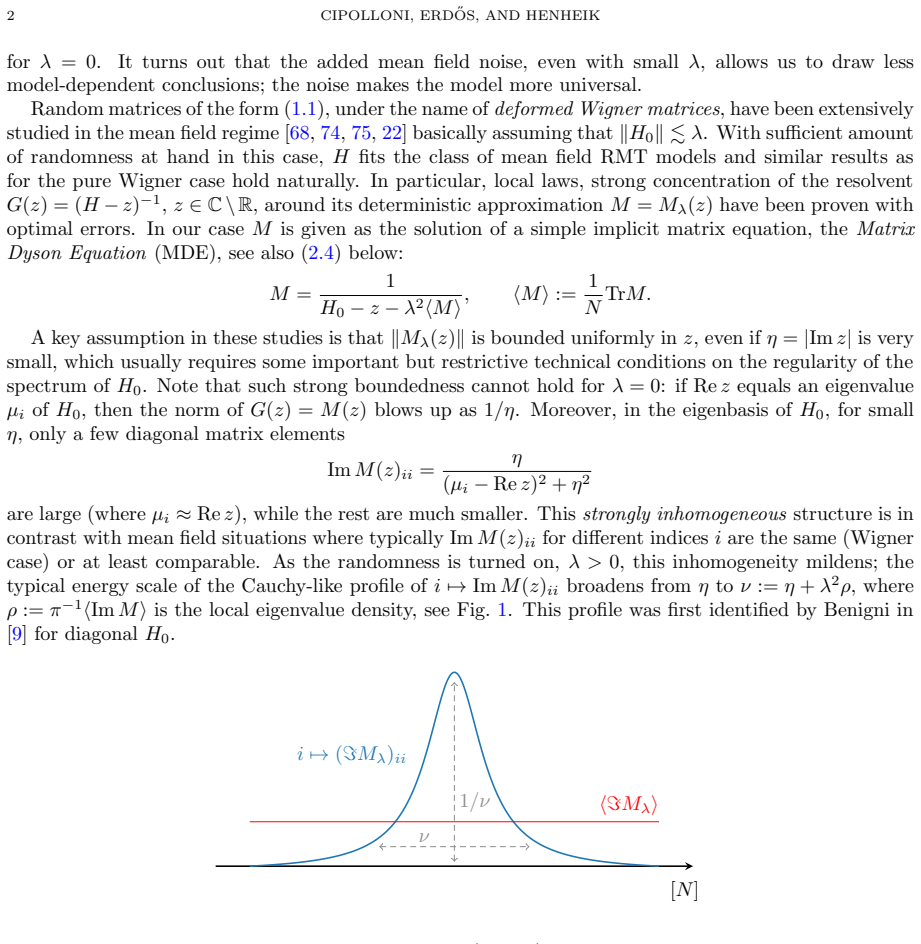
For every Hermitian H0 and every coupling λ > 0 (subject only to λ⁻¹‖H0‖ ≲ N^κ⁰), the resolvent G(z) of H = H0 + λ W obeys averaged and isotropic local laws with respect to the solution M of the matrix Dyson equation, with error terms that correctly track the spatial inhomogeneity of Im M. The same analysis yields a two-resolvent bound that implies the ETH estimate |⟨ui, A uj⟩ − δij heta ij ⟨Γi A⟩| ≺ s2(i,j;A)/√N uniformly in the spectrum.
What carries the argument
The zigzag strategy: an inductive tandem of an Ornstein–Uhlenbeck flow (the zig step) that adds a Gaussian component while the spectral parameter follows a characteristic ODE, followed by a Green-function comparison flow (the zag step) that removes the Gaussian component, all performed exclusively with averaged quantities.
Load-bearing premise
Every moment of the Wigner matrix entries must be finite; if only a few moments exist the cumulant expansions that close the local-law estimates break down.
What would settle it
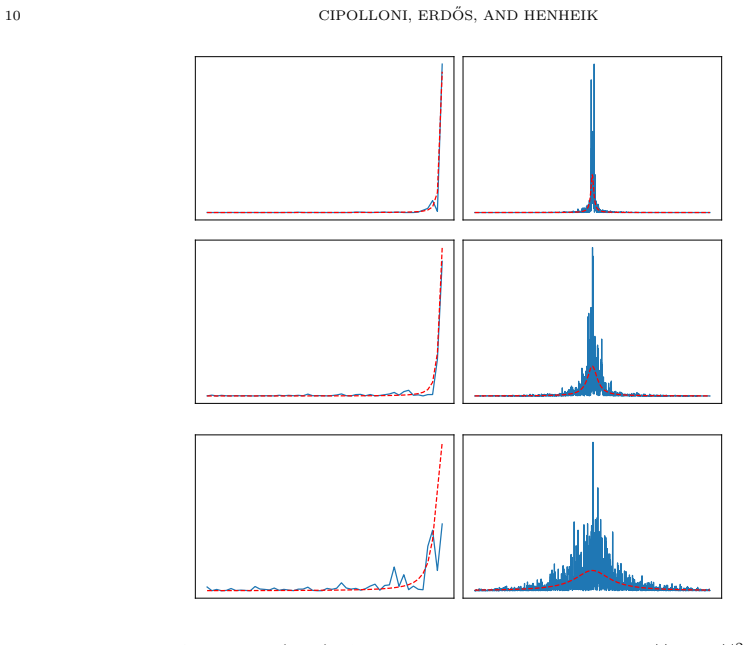
Compute the resolvent of a concrete deformed ensemble (for example diagonal H0 with semicircle eigenvalues plus a Wigner matrix at small λ) on a large N and check whether the observed deviation from M scales as claimed in the averaged and isotropic local laws of Theorem 2.3.
Editorial analysis
A structured set of objections, weighed in public.
Referee Report
Summary. The paper studies the deformed Wigner ensemble H_λ = H_0 + λW with completely arbitrary Hermitian H_0 and a standard Wigner matrix W (all moments finite, |σ| < 1). It proves single-resolvent averaged and isotropic local laws (Theorem 2.3) that hold uniformly in H_0 and λ (subject only to the technical size bound (2.2)), with error terms that correctly capture the strongly inhomogeneous profile of the deterministic approximation M through the operator Γ = Im M / ⟨Im M⟩. From these laws the authors deduce eigenvector delocalization bounds (Corollary 2.4) and a two-resolvent bound that yields the Eigenstate Thermalization Hypothesis (Theorem 2.5) with a regularized control parameter s₂. As applications they identify a mobility edge for a semicircle-deformed model and rigorously recover the re-entrant localization phase diagram of a fractal Rosenzweig–Porter Hamiltonian. The proofs rely on an inductive zigzag strategy (global law → characteristic flow + BDG → Green-function comparison via cumulant expansion) that operates exclusively with averaged quantities.
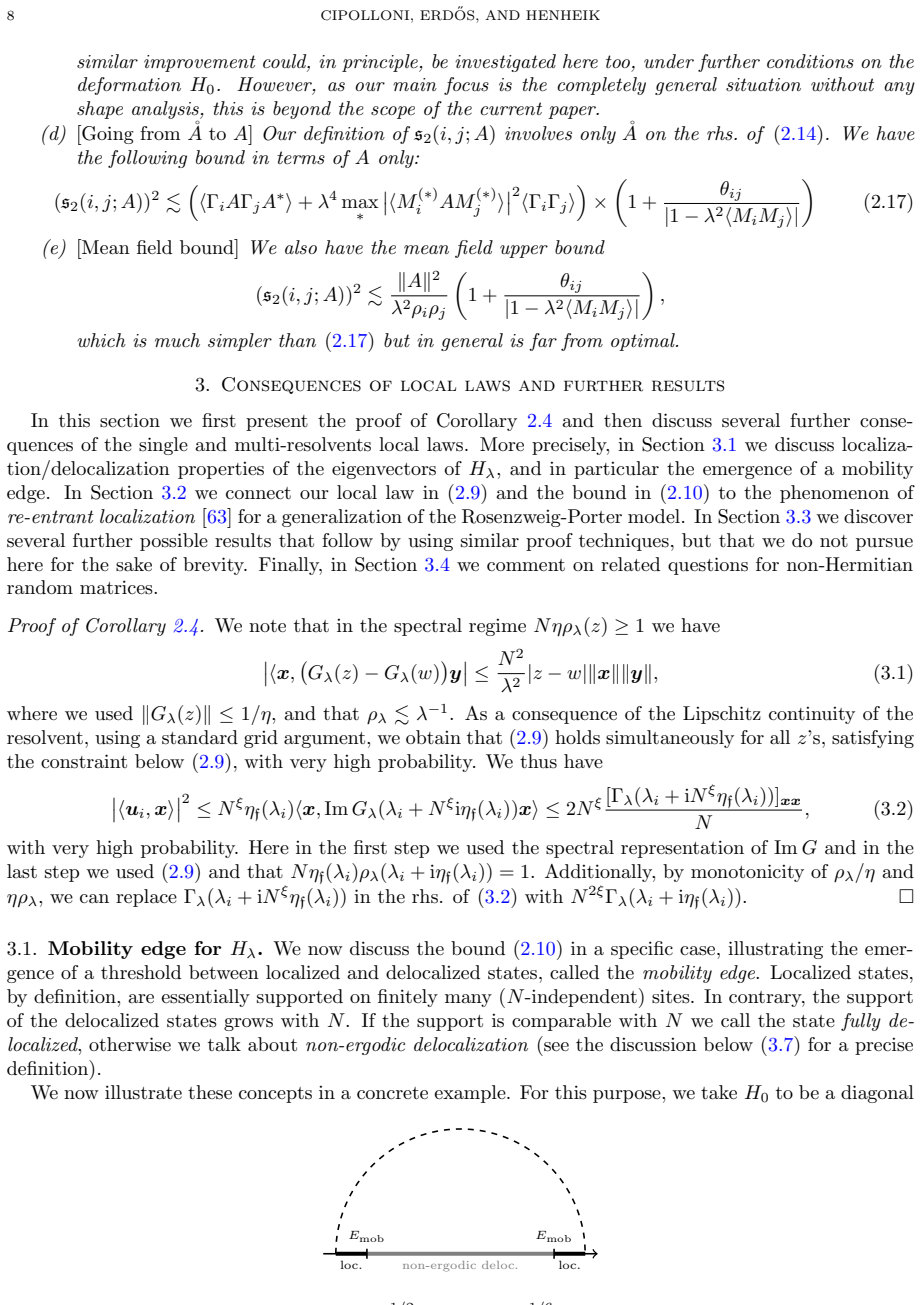
Significance. The work removes the two classical restrictions that have limited all previous local laws for deformed Wigner matrices: a lower bound on λ relative to ∥H_0∥ and a uniform bound on ∥M∥ (or an a-priori shape analysis of the density). The resulting statements are therefore the first that apply uniformly across the entire strongly inhomogeneous regime, including small λ and singular spectral regions. The streamlined zigzag that avoids isotropic intermediate steps is a methodological advance of independent interest. Concrete physical consequences—mobility edge, re-entrant localization, and ETH for arbitrary deformations—are obtained as direct corollaries, making the paper relevant both to random-matrix theory and to the mathematical physics of localization transitions.
minor comments (4)
- The definition of the regularization cutoff θ_ij (Eq. (2.13)) and of the control s₂ (Eq. (2.14)) is somewhat dense; a short paragraph explaining why the Heaviside threshold is placed at 1/2 would help the non-specialist reader.
- In Section 3.1 the mobility-edge discussion is restricted to a semicircular H_0; a one-sentence remark that the same profile analysis applies verbatim to any H_0 whose density is known would clarify the scope.
- A few typographical inconsistencies appear (e.g., “tfinal” vs. “t_fin”, occasional missing subscripts on ρ_λ). A careful copy-edit would remove them.
- The comparison with Benigni [9] and von Soosten–Warzel [92] in the introduction could be sharpened by a short table listing which assumptions each work requires.
Circularity Check
No circularity: local laws and ETH are concentration statements around an independently defined MDE solution M; control parameters are explicit functionals of M.
full rationale
The deterministic approximation M_λ(z) is defined as the unique solution of the Matrix Dyson Equation (2.4) under the Im M Im z > 0 condition, independently of the random resolvent G. Lemma 2.2 bounds on M follow by elementary algebra from (2.4). Theorems 2.3 and 2.5 (and the two-resolvent bound Theorem 4.2) are high-probability concentration statements of G (and products of G) around this M, proved by a self-contained zigzag induction: global law on D_glob (Proposition 5.3 / 5.8) → characteristic flow (Propositions 5.4 / 5.9) → Green-function comparison (Propositions 5.5 / 5.10), with all cumulant expansions, Gronwall estimates, and stability-operator bounds written out in Sections 6–7. The profile factor Γ = Im M / ⟨Im M⟩ and the ETH control s₂(i,j;A) are explicit functionals of M (and of the regularized observable ˚A); they are not fitted to data. Self-citations (e.g. to prior zigzag works) supply technique, not load-bearing uniqueness or ansatz that would force the present claims. No parameter is fitted and then re-presented as a prediction; no result reduces by construction to its own input. Score 0 is therefore warranted.
Axiom & Free-Parameter Ledger
free parameters (2)
- κ0 (size exponent of H0)
- ε, δ, ξ (small positive exponents)
axioms (4)
- domain assumption Wigner entries possess all moments E|χ|^p ≤ Cp and |E χ_od²| < 1 (Assumption 2.1).
- standard math Existence and uniqueness of the solution M of the Matrix Dyson Equation with positive imaginary part.
- standard math Pathwise Burkholder–Davis–Gundy inequality for continuous martingales.
- standard math Stochastic domination calculus and high-probability grid arguments for resolvents.
read the original abstract
We consider a very general Rosenzweig-Porter-type model, $H=H_0+\lambda W$, where $H_0$ is an arbitrary Hermitian matrix and $W$ is a standard Wigner matrix. We precisely trace the localization properties of the eigenvectors and the eigenstate thermalisation hypothesis (ETH) as the coupling constant $\lambda$ interpolates between the trivial $\lambda=0$ case and the fully mean field regime of large $\lambda$. Our results hold uniformly in $H_0$ and $\lambda$, substantially generalising all previous local laws on deformed Wigner matrices even in the mean field regime. Our proof precisely captures the deterministic approximation to the resolvent which exhibits a strongly inhomogeneous structure. As a byproduct, we conclude the emergence of a mobility edge and study the phenomenon of re-entrant localization.
Figures

Forward citations
Cited by 3 Pith papers
-
Anomalous rate of eigenstate thermalisation at singularities of the density of states
ETH holds with optimal N^{-1} fluctuations for correlated mean-field random matrices in bulk and at regular edges (Haar-like), but N^{-1/2} at cusps, invalidating the Feingold-Peres density-based prediction via multi-...
-
Anomalous rate of eigenstate thermalisation at singularities of the density of states
For correlated mean-field random matrices, eigenvector overlaps fluctuate at the Haar scale 1/N in the bulk and at regular edges, and at N^{-1/2} variance near cubic-root cusps, disproving the Feingold–Peres inverse-d...
-
Level statistics in the fractal phase of generalized Rosenzweig--Porter models
Full counting statistics of generalized Rosenzweig-Porter models collapse onto a universal scaling function of E/E_T in the fractal phase, confirmed by free-probability/replica analytics and large-deviation numerics, ...
Reference graph
Works this paper leans on
-
[1]
Adhikari and J
A. Adhikari and J. Huang. Dyson Brownian motion for general β and potential at the edge. In: Probab. Theory Related Fields 178 (2020), pp. 893–950
2020
-
[2]
Adhikari and B
A. Adhikari and B. Landon. Local law and rigidity for unitary Brownian motion. In: Probab. Theory Related Fields 187 (2023), pp. 753–815
2023
-
[3]
Aggarwal and J
A. Aggarwal and J. Huang. Edge rigidity of Dyson Brownian motion with general initial data. In: Electron. J. Probab. 29 (2024), pp. 1–62
2024
-
[4]
O. H. Ajanki, L. Erd˝ os, and T. Kr¨ uger. Stability of the matrix Dyson equation and random matrices with correlations. In: Probab. Theory Related Fields 173 (2019), pp. 293–373
2019
-
[5]
J. Alt, L. Erd˝ os, and T. Kr¨ uger. Spectral radius of random matrices with independent entries. In: Probab. Math. Phys. 2 (2021), pp. 221–280
2021
-
[6]
J. Alt, L. Erd˝ os, T. Kr¨ uger, and D. Schr¨ oder. Correlated random matrices: band rigidity and edge universality. In: Ann. Probab. 48 (2020), pp. 963–1001
2020
-
[7]
J. Alt, L. Erd˝ os, and T. Kr¨ uger. The Dyson equation with linear self-energy: spectral bands, edges and cusps. In: Doc. Math. 25 (2020), pp. 1421–1539
2020
-
[8]
Z. Bao, L. Erd˝ os, and K. Schnelli. Equipartition principle for Wigner matrices. In: Forum Math. Sigma 9 (2021), e44
2021
-
[9]
L. Benigni. Eigenvectors distribution and quantum unique ergodicity for deformed Wigner matrices. In: Ann. Inst. Henri Poincar´ e Probab. Stat.56 (2020), pp. 2822–2867
2020
-
[10]
L. Benigni. Quantitative eigenvector universality for generalized Wigner matrices. In: arXiv:2606.06419 (2026)
Pith/arXiv arXiv 2026
-
[11]
Benigni and G
L. Benigni and G. Cipolloni. Fluctuations of eigenvector overlaps and the Berry conjecture for Wigner matrices. In: Electron. J. Probab. 29 (2024), pp. 1–19
2024
-
[12]
Benigni and P
L. Benigni and P. Lopatto. Optimal delocalization for generalized Wigner matrices. In: Adv. Math. 396 (2022), p. 108109
2022
-
[13]
Bourgade
P. Bourgade. Extreme gaps between eigenvalues of Wigner matrices. In: J. Eur. Math. Soc. 24 (2021), pp. 2823–2873
2021
-
[14]
P. Bourgade and H. Falconet. Liouville quantum gravity from random matrix dynamics. In: arXiv:2206.03029 (2022)
Pith/arXiv arXiv 2022
-
[15]
Bourgade, J
P. Bourgade, J. Huang, and H.-T. Yau. Eigenvector statistics of sparse random matrices. In: Electron. J. Probab. 22 (2017)
2017
-
[16]
Bourgade and H.-T
P. Bourgade and H.-T. Yau. The eigenvector moment flow and local quantum unique ergodicity. In: Comm. Math. Phys. 350 (2017), pp. 231–278
2017
-
[17]
Byun and P
S.-S. Byun and P. J. Forrester. Progress on the Study of the Ginibre Ensembles. Springer Nature, 2025
2025
-
[18]
Campbell, G
A. Campbell, G. Cipolloni, L. Erd˝ os, and H. C. Ji. On the spectral edge of non-Hermitian random matrices. In: Ann. Probab. 53 (2025), pp. 2256–2308
2025
-
[19]
N. Chen and C. K. Smart. Random band matrix localization by scalar fluctuations. In: arXiv:2206.06439 (2022)
Pith/arXiv arXiv 2022
-
[20]
Cipolloni, R
G. Cipolloni, R. Peled, J. Schenker, and J. Shapiro. Dynamical Localization for Random Band Matrices Up to W ≪ N 1/4. In: Comm. Math. Phys. 405 (2024), p. 82
2024
-
[21]
Cipolloni, L
G. Cipolloni, L. Erd˝ os, and Y. Xu. Optimal decay of eigenvector overlap for non-Hermitian random matrices. In: J. Func. Anal. 290 (1 2026), p. 111180
2026
-
[22]
Cipolloni, L
G. Cipolloni, L. Erd˝ os, and J. Henheik. Out-of-time-ordered correlators for Wigner matrices. In: Adv. Theor. Math. Phys. 28 (2024), pp. 2025–2083
2024
-
[23]
Cipolloni, L
G. Cipolloni, L. Erd˝ os, J. Henheik, and O. Kolupaiev. Gaussian fluctuations in the equipartition principle for Wigner matrices. In: Forum Math. Sigma 11 (2023), e74
2023
-
[24]
Cipolloni, L
G. Cipolloni, L. Erd˝ os, J. Henheik, and D. Schr¨ oder. Optimal lower bound on eigenvector overlaps for non-Hermitian random matrices. In: J. Func. Anal. 287 (2024), p. 110495
2024
-
[25]
Cipolloni, L
G. Cipolloni, L. Erd˝ os, and H. C. Ji. Non–Hermitian spectral universality at critical points. In: Probab. Theory Related Fields (2025), pp. 1–52
2025
-
[26]
Cipolloni, L
G. Cipolloni, L. Erd˝ os, T. Kr¨ uger, and D. Schr¨ oder. Cusp universality for random matrices, II: The real symmetric case. In: Pure Appl. Anal. 1 (2019), pp. 615–707
2019
-
[27]
Cipolloni, L
G. Cipolloni, L. Erd˝ os, and D. Schr¨ oder. Edge universality for non-Hermitian random matrices. In: Probab. Theory and Related Fields 179 (2021), pp. 1–28
2021
-
[28]
Cipolloni, L
G. Cipolloni, L. Erd˝ os, and D. Schr¨ oder. Eigenstate thermalization hypothesis for Wigner matrices. In: Comm. Math. Phys. 388 (2021), pp. 1005–1048
2021
-
[29]
Cipolloni, L
G. Cipolloni, L. Erd˝ os, and D. Schr¨ oder. Mesoscopic central limit theorem for non-Hermitian random matrices. In: Probab. Theory Related Fields 188 (2024), pp. 1131–1182
2024
-
[30]
Cipolloni, L
G. Cipolloni, L. Erd˝ os, and D. Schr¨ oder. Normal fluctuation in quantum ergodicity for Wigner matrices. In: Ann. Probab. 50 (2022), pp. 984–1012
2022
-
[31]
Cipolloni, L
G. Cipolloni, L. Erd˝ os, and D. Schr¨ oder. On the spectral form factor for random matrices. In: Comm. Math. Phys. 401 (2023), pp. 1665–1700
2023
-
[32]
Cipolloni, L
G. Cipolloni, L. Erd˝ os, and D. Schr¨ oder. Optimal multi-resolvent local laws for Wigner matrices. In: Electron. J. Probab. 27 (2022), pp. 1–38
2022
-
[33]
Cipolloni, L
G. Cipolloni, L. Erd˝ os, and D. Schr¨ oder. Rank-uniform local law for Wigner matrices. In: Forum Math. Sigma 10 (2022), e96
2022
-
[34]
Cipolloni, L
G. Cipolloni, L. Erd˝ os, and D. Schr¨ oder. Thermalisation for Wigner matrices. In: J. Funct. Anal. 282 (8 2022)
2022
-
[35]
Cipolloni, L
G. Cipolloni, L. Erd˝ os, D. Schr¨ oder, and Y. Xu. On the rightmost eigenvalue of non-Hermitian random matrices. In: Ann. Probab. 51 (2023), pp. 2192–2242. 54 REFERENCES
2023
-
[36]
G. Cipolloni, L. Erd˝ os, J. Henheik, and O. Kolupaiev. Eigenvector decorrelation for random matrices. In:arXiv:2410.10718, to appear in Ann. Appl. Probab. (2026+)
arXiv 2026
-
[37]
G. Cipolloni, L. Erd˝ os, and J. Henheik. Eigenstate thermalisation at the edge for Wigner matrices. In:arXiv:2309.05488, to appear in Ann. Inst. Henri Poincar´ e Probab. Stat.(2026+)
Pith/arXiv arXiv 2026
-
[38]
Cipolloni and B
G. Cipolloni and B. Landon. Maximum of the characteristic polynomial of iid matrices. In: Comm. Pure Appl. Math. (2025)
2025
-
[39]
G. Cipolloni and B. Landon. Optimal Delocalization for Non–Hermitian Eigenvectors. In: arXiv:2509.15189 (2025)
arXiv 2025
-
[40]
N. Cook, W. Hachem, J. Najim, and D. Renfrew. Non-Hermitian random matrices with a variance profile (I): deterministic equivalents and limiting ESDs. In: Electron. J. Probab 23 (2018), pp. 1–61
2018
-
[41]
De Tomasi and I
G. De Tomasi and I. M. Khaymovich. Non-Hermitian Rosenzweig-Porter random-matrix ensemble: Obstruction to the fractal phase. In: Phys. Rev. B 106 (2022), p. 094204
2022
-
[42]
V. Delapalme, L. F. Cugliandolo, G. Schehr, M. Tarzia, and D. Venturelli. The Wishart–Rosenzweig–Porter random matrix ensemble. In: arXiv:2510.15764 (2025)
arXiv 2025
-
[43]
R. Drogin. Localization of One-Dimensional Random Band Matrices. In: arXiv:2508.05802 (2025)
Pith/arXiv arXiv 2025
- [44]
-
[45]
S. Dubova, F. Yang, H.-T. Yau, and J. Yin. Delocalization of two-dimensional random band matrices. In:arXiv:2503.07606 (2025)
Pith/arXiv arXiv 2025
-
[46]
Dubova and K
S. Dubova and K. Yang. Quantum diffusion and delocalization in one-dimensional band matrices via the flow method. In: J. Math. Phys. 67 (2026)
2026
-
[47]
L. Erd˝ os and V. Riabov. The Zigzag Strategy for Random Band Matrices. In: arXiv:2506.06441 (2025)
Pith/arXiv arXiv 2025
-
[48]
Erd˝ os, J
L. Erd˝ os, J. Henheik, and O. Kolupaiev. Loschmidt echo for deformed Wigner matrices. In: Lett. Math. Phys. 115 (2025), p. 14
2025
-
[49]
Erd˝ os, J
L. Erd˝ os, J. Henheik, J. Reker, and V. Riabov. Prethermalization for Deformed Wigner Matrices. In: Ann. Henri Poincar´ e26 (2025), pp. 1991–2033
2025
-
[50]
Erd˝ os, J
L. Erd˝ os, J. Henheik, and V. Riabov. Cusp Universality for Correlated Random Matrices. In: Comm. Math. Phys. 406 (2025), p. 253
2025
-
[51]
Erd˝ os and H
L. Erd˝ os and H. C. Ji. Wegner estimate and upper bound on the eigenvalue condition number of non-Hermitian random matrices. In: Comm. Pure Appl. Math. 77 (2024), pp. 3785–3840
2024
-
[52]
Erd˝ os and A
L. Erd˝ os and A. Knowles. Quantum diffusion and eigenfunction delocalization in a random band matrix model. In: Comm. Math. Phys. 303 (2011), pp. 509–554
2011
-
[53]
Erd˝ os, A
L. Erd˝ os, A. Knowles, H.-T. Yau, and J. Yin. Delocalization and diffusion profile for random band matrices. In: Comm. Math. Phys. 323 (2013), pp. 367–416
2013
-
[54]
Erd˝ os, B
L. Erd˝ os, B. Schlein, and H.-T. Yau. Local semicircle law and complete delocalization for Wigner random matrices. In: Comm. Math. Phys. 287 (2009), pp. 641–655
2009
-
[55]
Erd˝ os, B
L. Erd˝ os, B. Schlein, and H.-T. Yau. Universality of random matrices and local relaxation flow. In: Inv. Math. 185 (2011), pp. 75–119
2011
-
[56]
Erd˝ os, H.-T
L. Erd˝ os, H.-T. Yau, and J. Yin. Bulk universality for generalized Wigner matrices. In: Probab. Theory Related Fields 154 (2012), pp. 341–407
2012
-
[57]
Erd˝ os, H.-T
L. Erd˝ os, H.-T. Yau, and J. Yin. Rigidity of eigenvalues of generalized Wigner matrices. In: Adv. Math. 229 (2012), pp. 1435–1515
2012
-
[58]
L. Erd˝ os, J. Henheik, and V. Riabov. Anomalous rate of eigenstate thermalisation at singularities of the density of states. In: arXiv:2607.03546 (2026)
Pith/arXiv arXiv 2026
-
[59]
Erd˝ os, A
L. Erd˝ os, A. Knowles, H.-T. Yau, and J. Yin. The local semicircle law for a general class of random matrices. In: Electron. J. Probab. 18(59) (2013), pp. 1–58
2013
-
[60]
Erd˝ os, T
L. Erd˝ os, T. Kr¨ uger, and D. Schr¨ oder. Random matrices with slow correlation decay. In:For. Math., Sigma 7 (2019)
2019
-
[61]
Erd˝ os and H.-T
L. Erd˝ os and H.-T. Yau. A dynamical approach to random matrix theory. Vol. 28. American Mathematical Soc., 2017
2017
-
[62]
Y. V. Fyodorov. Kac-Rice inspired approach to non-Hermitian random matrices. In: arXiv:2506.21058 (2025)
arXiv 2025
-
[63]
Y. V. Fyodorov and A. D. Mirlin. Scaling properties of localization in random band matrices: a σ-model approach. In: Phys. Rev. Lett. 67 (1991), p. 2405
1991
-
[64]
Ghosh, M
R. Ghosh, M. Sarkar, and I. M. Khaymovich. Reentrant localization induced by short-range hopping in the fractal Rosenzweig-Porter model. In: Phys. Rev. B 111 (2025), p. L220102
2025
-
[65]
J. W. Helton, R. Rashidi Far, and R. Speicher. Operator-valued semicircular elements: solving a quadratic matrix equation with positivity constraints. In: Int. Math. Res. Not. IMRN 22 (2007), Art. ID rnm086, 15
2007
-
[66]
J. Huang. Mesoscopic perturbations of large random matrices. In: Random Matrices: Theory and Appl. 7 (2018), p. 1850004
2018
-
[67]
Huang and B
J. Huang and B. Landon. Rigidity and a mesoscopic central limit theorem for Dyson Brownian motion for general β and potentials. In: Probab. Theory Related Fields 175 (2019), pp. 209–253
2019
-
[68]
Knowles and J
A. Knowles and J. Yin. Eigenvector distribution of Wigner matrices. In: Probab. Theory Related Fields 155 (2013), pp. 543–582
2013
-
[69]
Knowles and J
A. Knowles and J. Yin. The outliers of a deformed Wigner matrix. In: Ann. Probab. 42 (2014), pp. 1980–2031
2014
-
[70]
Landon, P
B. Landon, P. Lopatto, and P. Sosoe. Single eigenvalue fluctuations of general Wigner-type matrices. In: Probab. Theory Related Fields 188 (2024), pp. 1–62
2024
-
[71]
B. Landon and P. Sosoe. Almost-optimal bulk regularity conditions in the CLT for Wigner matrices. In: arXiv:2204.03419 (2022). REFERENCES 55
Pith/arXiv arXiv 2022
-
[72]
Landon, P
B. Landon, P. Sosoe, and H.-T. Yau. Fixed energy universality of Dyson Brownian motion. In: Adv. Math. 346 (2019), pp. 1137–1332
2019
-
[73]
Landon and H.-T
B. Landon and H.-T. Yau. Convergence of local statistics of Dyson Brownian motion. In: Comm. Math. Phys. 355 (2017), pp. 949–1000
2017
-
[74]
B. Landon and H.-T. Yau. Edge statistics of Dyson Brownian motion. In: arXiv:1712.03881 (2017)
Pith/arXiv arXiv 2017
-
[75]
J. O. Lee and K. Schnelli. Edge universality for deformed Wigner matrices. In: Rev. Math. Phys. 27 (2015), p. 1550018
2015
-
[76]
J. O. Lee, K. Schnelli, B. Stetler, and H.-T. Yau. Bulk universality for deformed Wigner matrices. In: Ann. Probab. 44 (2016), pp. 2349–2425
2016
-
[77]
D.-Z. Liu and G. Zou. Edge statistics for random band matrices. In: arXiv:2401.00492 (2024)
Pith/arXiv arXiv 2024
-
[78]
Marcinek and H.-T
J. Marcinek and H.-T. Yau. High dimensional normality of noisy eigenvectors. In: Comm. Math. Phys. 395 (2022), pp. 1007–1096
2022
-
[79]
M. L. Mehta. Random matrices. In: Pure and Applied Mathematics (Amsterdam) 142 (2004)
2004
-
[80]
M. Osman. Bulk Universality for Sparse Complex non-Hermitian Random Matrices. In: arXiv:2508.03631 (2025)
Pith/arXiv arXiv 2025
discussion (0)
Sign in with ORCID, Apple, or X to comment. Anyone can read and Pith papers without signing in.