REVIEW 4 major objections 1 cited by
Video deep research can be done as one closed loop: localize frames, zoom, search the open web, and answer—trained so tool use and correctness improve together.
Reviewed by Pith at T0; open to challenge. T0 means a machine referee read the full paper against a public rubric. the ladder, T0–T4 →
T0 review · grok-4.5
2026-07-12 06:02 UTC pith:OJPL3T7K
load-bearing objection A real multi-tool VDR systems paper with a clean dual-branch RL idea and a useful new benchmark; the engineering story holds, but the headline score jumps sit on LLM judges and live search noise. the 4 major comments →
VideoSearcher: Empowering Video Deep Research with Multi-Tool Agentic Reasoning via Reinforcement Learning
The pith
A machine-rendered reading of the paper's core claim, the machinery that carries it, and where it could break.
Core claim
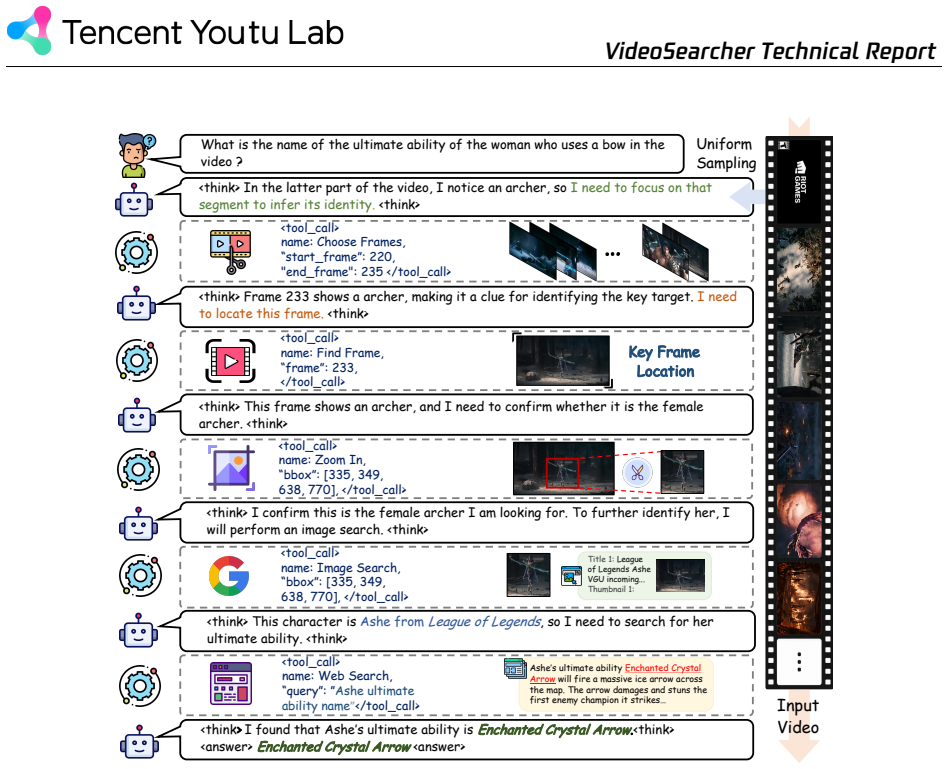
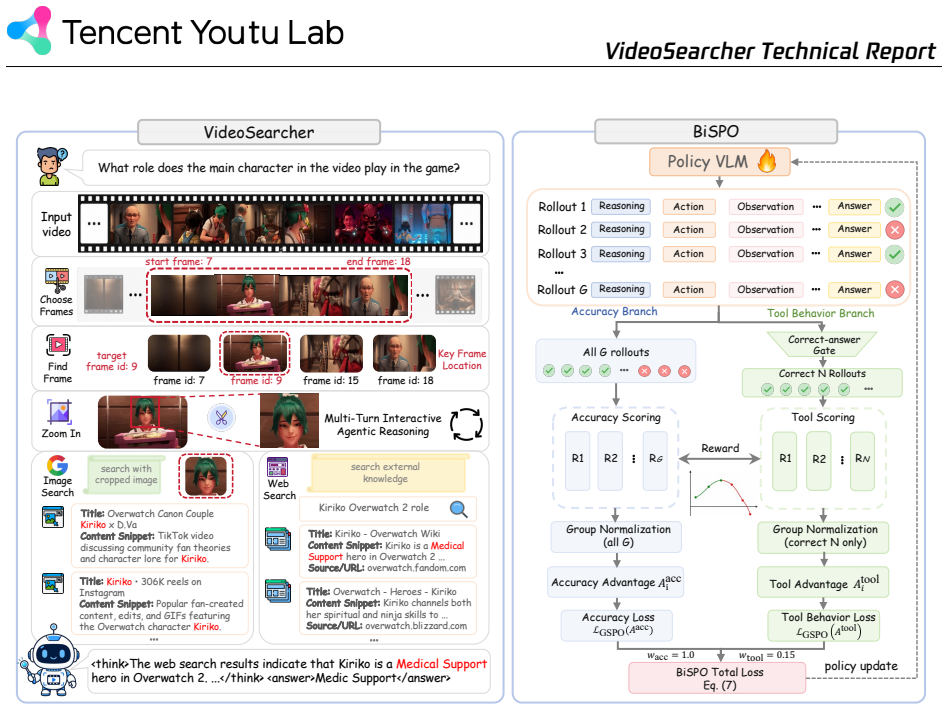
A vision-language agent can solve Video Deep Research by unifying choose-frames, find-frame, zoom-in, image search, and web search in a single closed-loop trajectory, and BiSPO—sequence-level policy optimization that decouples answer-accuracy rewards from correctness-gated, bell-shaped tool-use rewards—makes that multi-tool behavior learnable and more effective than answer-only or single-branch training.
What carries the argument
Bi-branch Sequence Policy Optimization (BiSPO): sequence-level importance sampling that optimizes an accuracy branch over all rollouts and a separate tool-behavior branch only among correct answers, with a gated bell-shaped tool reward that rewards enough video grounding and unique useful searches while penalizing excess or empty calls.
Load-bearing premise
Final correctness and training signals depend on live web or image search results and an automatic language-model judge; if those are wrong or noisy, measured gains may not reflect truly grounded reasoning.
What would settle it
Hold the model fixed and replace live search with controlled oracles that inject known identity errors (as in the diving-gondola failure), then re-score VideoDR and VideoSearch-QA with human judges: if gains vanish or reverse when retrieval and judging noise are removed, the central claim about reliable multi-tool VDR does not hold.
If this is right
- Open-world video QA should be scored on joint frame grounding and multimodal retrieval, not text-only conversion of visual cues.
- Decoupling tool-use rewards from answer rewards is a practical recipe for long-horizon multi-tool video agents.
- VideoSearch-QA becomes a reference test for whether agents capture dynamic visual anchors before searching.
- Search-trained video agents can transfer to static multimodal search benchmarks without image-only training data.
- Localization and search tools are complementary: either alone is weak; both together drive the reported VDR gains.
Where Pith is reading between the lines
- Error propagation from reverse image search will remain a first-order failure mode unless agents add cross-source verification or retrieval-confidence checks.
- The same bi-branch idea could transfer to other tool-heavy settings (code, maps, sensors) where intermediate actions are sparse relative to final answers.
- 1-fps frame pipelines will under-serve short motion events; denser temporal tools or event detectors are a natural next pressure test.
- Human-calibrated judges or retrieval-audited subsets would tighten claims that gains come from evidence grounding rather than lucky tool feedback.
Editorial analysis
A structured set of objections, weighed in public.
Referee Report
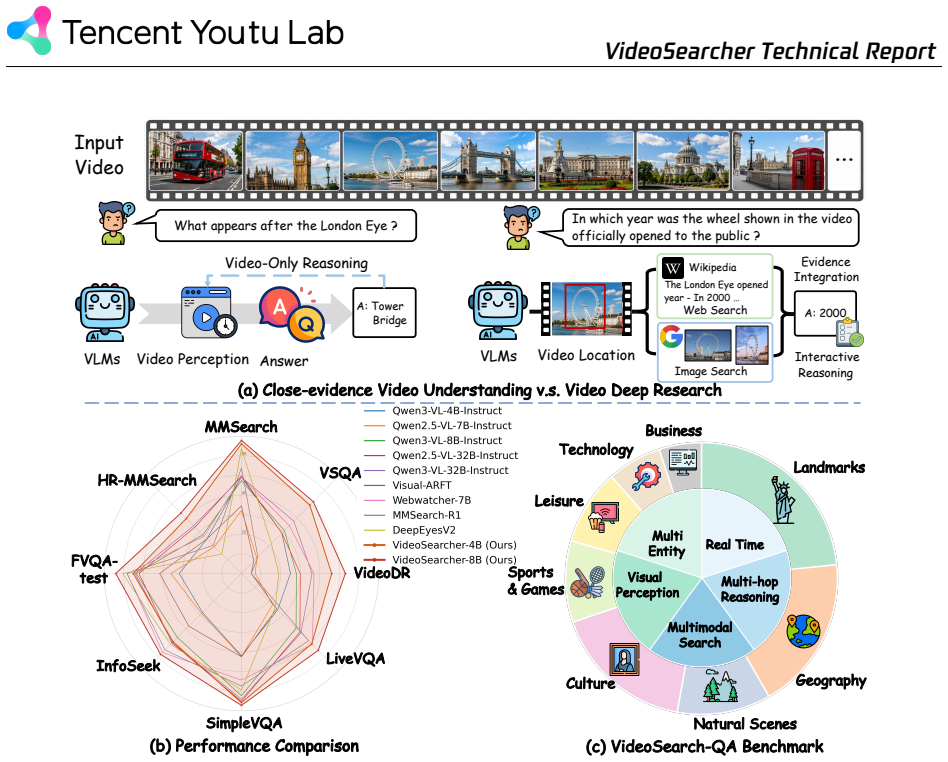
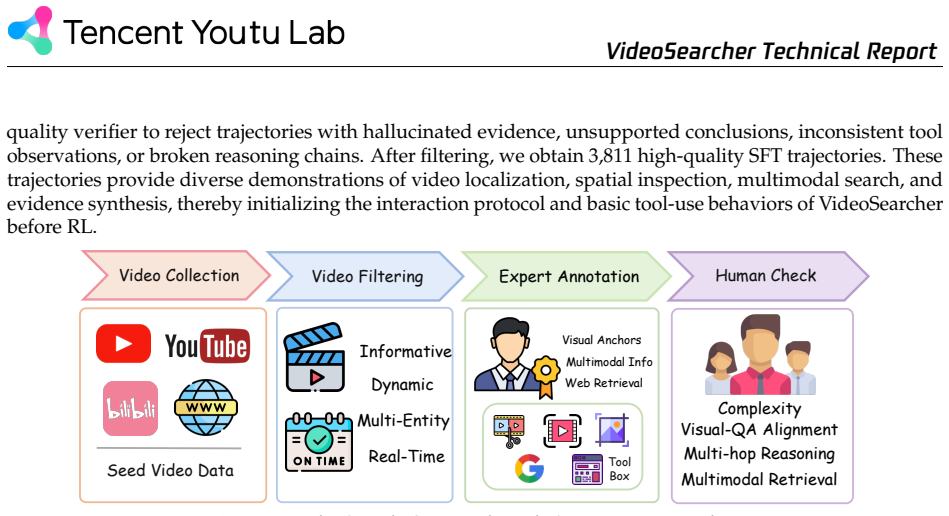
Summary. The paper introduces VideoSearcher, a multi-tool agentic VLM for Video Deep Research (VDR): open-world video QA that requires temporal localization, spatial inspection, and multimodal web/image search within one closed-loop trajectory. It contributes (i) a five-tool action space (choose_frames, find_frame, zoom_in, web_search, image_search), (ii) a video-centric data pipeline that converts knowledge-intensive image–text QA into multi-tool trajectories for SFT then RL, (iii) BiSPO, a GSPO-based dual-branch RL objective that separates answer-accuracy rewards from correctness-gated, bell-shaped tool-behavior rewards (Eqs. 1–7), and (iv) VideoSearch-QA (VSQA), a 278-sample human-annotated VDR benchmark. Initialized from Qwen3-VL-8B and trained with SFT+RL, VideoSearcher reports large gains over open-source agentic baselines on VideoDR/VSQA and transfers to image multimodal-search and general video-understanding suites (Tables 1–4).
Significance. If the reported gains hold under more stable evaluation, this is a timely and useful systems contribution: it moves VDR beyond text-centric retrieval (VideoDR) toward joint video grounding and multimodal search, and BiSPO is a concrete, ablated recipe for long-horizon tool-intensive RL. Strengths include released code, model, and data; clear tool-dependency constraints; ablations isolating sequence-level optimization, bi-branch design, and locate vs. search complementarity (Tables 3–4); and an honest Limitations section on live search and LLM judging. The work is primarily empirical systems research rather than a new theoretical guarantee, but it fills a real gap between static multimodal search agents and closed-evidence video models.
major comments (4)
- Table 1 / §B.3: The central claim of large VDR gains (e.g., VideoDR 28→53, VSQA 30.94→51.80 for the 8B agentic line) rests on single-run LLM-judge scores (Qwen3.5-27B) over live, non-deterministic image/web search. The paper itself shows that one wrong image-search identity can flip the entire answer (Fig. 10; Limitations). Without multi-seed RL variance, re-query variance, or human–judge agreement on VideoDR/VSQA, the magnitude of the headline deltas is not yet a reliable measure of evidence-grounded skill versus favorable retrieval draws or judge style match. Please report at least multi-run means±std (or frozen retrieval caches) and a small human agreement study on open-ended VDR answers.
- §3.3.2, Eqs. (1)–(2): Training optimizes R_judge from an LLM judge while evaluation also uses an LLM judge. This shared noisy oracle can amplify style-matched trajectories rather than verifiable grounding. Clarify whether train-time and eval-time judges differ, and add a sensitivity analysis (e.g., alternate judge model, or exact-match / string-normalized subset) so that BiSPO’s accuracy branch is not circularly validated by the same class of oracle.
- Table 1 agentic baselines: Several strong open-source agentic systems (MMSearch-R1, DeepEyesV2, WebWatcher) are image-centric; it is unclear whether they were given the same video tools (choose_frames/find_frame) or only image/web tools under a matched protocol. If VideoSearcher uniquely receives temporal tools on VideoDR/VSQA while baselines do not, part of the gap is action-space privilege rather than BiSPO. Please state the exact tool set and prompts per baseline on video vs. image benchmarks, and add a same-tool zero-shot Qwen3-VL control already partially present but not fully aligned for all named agents.
- §3.2.2 / Table 5: VSQA (278 items) is positioned as “the first benchmark” for multimodal video-grounded search, but scale and domain balance (e.g., Business 14 samples) limit statistical power for the 20+ point claims. Provide inter-annotator agreement, difficulty stratification results, and confidence intervals or bootstrap estimates on VSQA/VideoDR so that small-N volatility cannot dominate the narrative.
Circularity Check
Empirical agentic-systems paper: reported gains are benchmark scores, not quantities forced by reward definitions or self-citation.
full rationale
VideoSearcher is a two-stage SFT+RL systems paper. The load-bearing claims are empirical outperformance on VideoDR, VSQA, and external multimodal-search / video-understanding suites (Tables 1–2), plus ablations of BiSPO and tools (Tables 3–4). BiSPO’s accuracy and tool branches (Eqs. 1–7) are training signals only; evaluation metrics are separate open-ended or exact-match scores under a fixed tool environment, not algebraic rearrangements of those rewards. Training trajectories are synthesized and filtered, then the policy is tested on held-out benchmarks (including external VideoDR and the MMSearch suite), so success is not guaranteed by construction. Self-citations are ordinary related-work / codebase references, not uniqueness theorems that force the method. Constructing VSQA and reporting on it is standard benchmark introduction, not circular derivation. No fitted parameter is renamed as a prediction, and no first-principles identity reduces the headline results to their inputs. Measurement concerns (LLM judge, live search noise) affect reliability, not circularity.
Axiom & Free-Parameter Ledger
free parameters (5)
- w_tool / w_acc branch weights
- Bell-shaped search marginal rewards
- Video-grounding tool reward constants b, γ
- Format/dependency reward coefficients
- RL clipping and rollout hyperparameters
axioms (5)
- domain assumption Group/sequence policy optimization (GSPO) is a valid base for long multi-turn tool trajectories.
- domain assumption An LLM judge score is a faithful proxy for open-ended answer correctness.
- ad hoc to paper 1-fps resampled frames with overlaid frame indices preserve the visual anchors needed for VDR.
- domain assumption External image/web search returns usable evidence often enough for tool learning and evaluation.
- ad hoc to paper Hard-sample mining with Qwen3-VL-8B (≤1 success in rollouts) yields a useful RL distribution.
invented entities (3)
-
BiSPO (Bi-branch Sequence Policy Optimization)
no independent evidence
-
VideoSearcher multi-tool VDR agent
no independent evidence
-
VideoSearch-QA (VSQA) benchmark
independent evidence
read the original abstract
Video understanding is moving beyond closed-context perception toward open-world evidence exploration, a paradigm formalized as Video Deep Research (VDR). However, existing multimodal search agents primarily target static images, and the current VDR benchmark relies on text-centric retrieval that discards crucial visual information. To address these limitations, we propose VideoSearcher, a closed-loop agentic framework that empowers Vision-Language Models with multi-tool reasoning for VDR. VideoSearcher unifies temporal localization, spatial focusing, and multimodal search within a single reasoning trajectory, enabling agents to progressively ground visual clues, retrieve relevant evidence, and synthesize answers. To optimize knowledge-intensive reasoning trajectories, we propose Bi-branch Sequence Policy Optimization (BiSPO), a reinforcement learning algorithm that decouples tool-invocation optimization from answer-accuracy optimization. This design provides stable learning signals for both evidence-grounded reasoning and purposeful tool use. Furthermore, we construct VideoSearch-QA, the first benchmark designed to evaluate open-world video information grounding and multimodal search-based reasoning. Extensive experiments demonstrate that VideoSearcher significantly outperforms prior open-source agentic baselines across various search-oriented and multimodal understanding benchmarks.
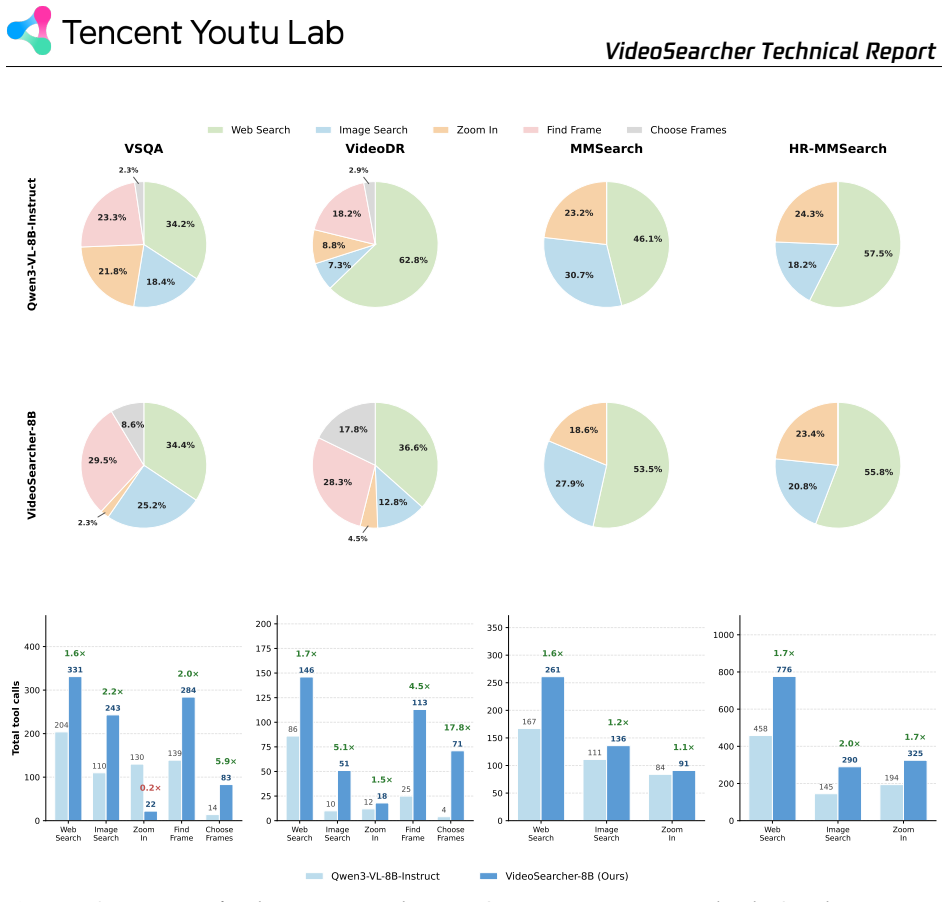
Figures




Forward citations
Cited by 1 Pith paper
-
Memory-Conditioned Tool Calling for Camera-First Visual Agents
Under image-only intake, a three-layer personal visual memory block improves LLM tool choice and arguments; ablating it drops query relevance 11.2% and utility 9.7% on synthetic fixtures.
Reference graph
Works this paper leans on
-
[1]
Vidi Team, Celong Liu, Chia-Wen Kuo, Dawei Du, Fan Chen, Guang Chen, Jiamin Yuan, Lingxi Zhang, Lu Guo, Lusha Li, et al. Vidi: Large multimodal models for video understanding and editing.arXiv preprint arXiv:2504.15681, 2025
Pith/arXiv arXiv 2025
-
[2]
Video-mme: The first-ever compre- hensive evaluation benchmark of multi-modal llms in video analysis
Chaoyou Fu, Yuhan Dai, Yongdong Luo, Lei Li, Shuhuai Ren, Renrui Zhang, Zihan Wang, Chenyu Zhou, Yunhang Shen, Mengdan Zhang, et al. Video-mme: The first-ever compre- hensive evaluation benchmark of multi-modal llms in video analysis. InProceedings of the IEEE/CVF conference on computer vision and pattern recognition, pages 24108–24118, 2025
2025
-
[3]
Video-bench: A comprehensive benchmark and toolkit for evaluating video-based large language models.Computational Visual Media, 2025
Munan Ning, Bin Zhu, Yujia Xie, Bin Lin, Jiaxi Cui, Lu Yuan, Dongdong Chen, and Li Yuan. Video-bench: A comprehensive benchmark and toolkit for evaluating video-based large language models.Computational Visual Media, 2025
2025
-
[4]
Qwen3-vl technical report.arXiv preprint arXiv:2511.21631, 2025
Shuai Bai, Yuxuan Cai, Ruizhe Chen, Keqin Chen, Xionghui Chen, Zesen Cheng, Lianghao Deng, Wei Ding, Chang Gao, Chunjiang Ge, et al. Qwen3-vl technical report.arXiv preprint arXiv:2511.21631, 2025
Pith/arXiv arXiv 2025
-
[5]
Weiyun Wang, Zhangwei Gao, Lixin Gu, Hengjun Pu, Long Cui, Xingguang Wei, Zhaoyang Liu, Linglin Jing, Shenglong Ye, Jie Shao, et al. Internvl3. 5: Advancing open-source multi- modal models in versatility, reasoning, and efficiency.arXiv preprint arXiv:2508.18265, 2025. 13 VideoSearcher Technical Report
Pith/arXiv arXiv 2025
-
[6]
Haoji Zhang, Xin Gu, Jiawen Li, Chixiang Ma, Sule Bai, Chubin Zhang, Bowen Zhang, Zhichao Zhou, Dongliang He, and Yansong Tang. Thinking with videos: Multimodal tool-augmented reinforcement learning for long video reasoning.arXiv preprint arXiv:2508.04416, 2025
Pith/arXiv arXiv 2025
-
[7]
Video-r1: Reinforcing video reasoning in mllms.Advances in Neural Information Processing Systems, 38:99114–99137, 2026
Kaituo Feng, Kaixiong Gong, Bohao Li, Zonghao Guo, Yibing Wang, Tianshuo Peng, Junfei Wu, Xiaoying Zhang, Benyou Wang, and Xiangyu Yue. Video-r1: Reinforcing video reasoning in mllms.Advances in Neural Information Processing Systems, 38:99114–99137, 2026
2026
-
[8]
Scaling rl to long videos.Advances in Neural Information Processing Systems, 38:172842–172870, 2026
Yukang Chen, Wei Huang, Baifeng Shi, Qinghao Hu, Hanrong Ye, Ligeng Zhu, Zhijian Liu, Pavlo Molchanov, Jan Kautz, Xiaojuan Qi, et al. Scaling rl to long videos.Advances in Neural Information Processing Systems, 38:172842–172870, 2026
2026
-
[9]
Video understanding with large language models: A survey.IEEE T ransactions on Circuits and Systems for Video T echnology, 2025
Yunlong Tang, Jing Bi, Siting Xu, Luchuan Song, Susan Liang, Teng Wang, Daoan Zhang, Jie An, Jingyang Lin, Rongyi Zhu, et al. Video understanding with large language models: A survey.IEEE T ransactions on Circuits and Systems for Video T echnology, 2025
2025
-
[10]
Zefeng He, Xiaoye Qu, Yafu Li, Siyuan Huang, Daizong Liu, and Yu Cheng. Frame- thinker: Learning to think with long videos via multi-turn frame spotlighting.arXiv preprint arXiv:2509.24304, 2025
arXiv 2025
-
[11]
Zuhao Yang, Sudong Wang, Kaichen Zhang, Keming Wu, Sicong Leng, Yifan Zhang, Bo Li, Chengwei Qin, Shijian Lu, Xingxuan Li, et al. Longvt: Incentivizing" thinking with long videos" via native tool calling.arXiv preprint arXiv:2511.20785, 2025
Pith/arXiv arXiv 2025
-
[12]
Chengwen Liu, Xiaomin Yu, Zhuoyue Chang, Zhe Huang, Shuo Zhang, Heng Lian, Kunyi Wang, Rui Xu, Sen Hu, Jianheng Hou, et al. Watching, reasoning, and searching: A video deep research benchmark on open web for agentic video reasoning.arXiv preprint arXiv:2601.06943, 2026
Pith/arXiv arXiv 2026
-
[13]
Bowen Jin, Hansi Zeng, Zhenrui Yue, Jinsung Yoon, Sercan Arik, Dong Wang, Hamed Za- mani, and Jiawei Han. Search-r1: Training llms to reason and leverage search engines with reinforcement learning.arXiv preprint arXiv:2503.09516, 2025
Pith/arXiv arXiv 2025
-
[14]
Kartik Narayan, Yang Xu, Tian Cao, Kavya Nerella, Vishal M Patel, Navid Shiee, Peter Grasch, Chao Jia, Yinfei Yang, and Zhe Gan. Deepmmsearch-r1: Empowering multimodal llms in multimodal web search.arXiv preprint arXiv:2510.12801, 2025
arXiv 2025
-
[15]
Search-o1: Agentic search-enhanced large reasoning models
Xiaoxi Li, Guanting Dong, Jiajie Jin, Yuyao Zhang, Yujia Zhou, Yutao Zhu, Peitian Zhang, and Zhicheng Dou. Search-o1: Agentic search-enhanced large reasoning models. InProceedings of the 2025 Conference on Empirical Methods in Natural Language Processing, pages 5420–5438, 2025
2025
-
[16]
Mmsearch-r1: Incentivizing lmms to search.arXiv preprint arXiv:2506.20670, 2025
Jinming Wu, Zihao Deng, Wei Li, Yiding Liu, Bo You, Bo Li, Zejun Ma, and Ziwei Liu. Mmsearch-r1: Incentivizing lmms to search.arXiv preprint arXiv:2506.20670, 2025
Pith/arXiv arXiv 2025
-
[17]
Deepeyesv2: Toward agentic multimodal model.arXiv preprint arXiv:2511.05271, 2025
Jack Hong, Chenxiao Zhao, ChengLin Zhu, Weiheng Lu, Guohai Xu, and Xing Yu. Deepeyesv2: Toward agentic multimodal model.arXiv preprint arXiv:2511.05271, 2025
Pith/arXiv arXiv 2025
-
[18]
Group sequence policy optimization.arXiv preprint arXiv:2507.18071, 2025
Chujie Zheng, Shixuan Liu, Mingze Li, Xiong-Hui Chen, Bowen Yu, Chang Gao, Kai Dang, Yuqiong Liu, Rui Men, An Yang, et al. Group sequence policy optimization.arXiv preprint arXiv:2507.18071, 2025
Pith/arXiv arXiv 2025
-
[19]
Zhenkun Gao, Xuhong Wang, Xin Tan, and Yuan Xie. Tpru: Advancing temporal and procedural understanding in large multimodal models.arXiv preprint arXiv:2602.18884, 2026. 14 VideoSearcher Technical Report
arXiv 2026
-
[20]
Videorft: Incentivizing video rea- soning capability in mllms via reinforced fine-tuning.Advances in neural information processing systems, 38:4350–4376, 2026
Qi Wang, Yanrui Yu, Ye Yuan, Rui Mao, and Tianfei Zhou. Videorft: Incentivizing video rea- soning capability in mllms via reinforced fine-tuning.Advances in neural information processing systems, 38:4350–4376, 2026
2026
-
[21]
Zhaochen Su, Linjie Li, Mingyang Song, Yunzhuo Hao, Zhengyuan Yang, Jun Zhang, Guanjie Chen, Jiawei Gu, Juntao Li, Xiaoye Qu, et al. Openthinkimg: Learning to think with images via visual tool reinforcement learning.arXiv preprint arXiv:2505.08617, 2025
Pith/arXiv arXiv 2025
-
[22]
Xinyu Geng, Peng Xia, Zhen Zhang, Xinyu Wang, Qiuchen Wang, Ruixue Ding, Chenxi Wang, Jialong Wu, Yida Zhao, Kuan Li, et al. Webwatcher: Breaking new frontier of vision-language deep research agent.arXiv preprint arXiv:2508.05748, 2025
Pith/arXiv arXiv 2025
-
[23]
V-thinker: Interactive thinking with images
Runqi Qiao, Qiuna Tan, Minghan Yang, Guanting Dong, Peiqing Yang, Shiqiang Lang, Enhui Wan, Xiaowan Wang, Yida Xu, Lan Yang, et al. V-thinker: Interactive thinking with images. arXiv preprint arXiv:2511.04460, 2025
arXiv 2025
-
[24]
Zheng Chu, Xiao Wang, Jack Hong, Huiming Fan, Yuqi Huang, Yue Yang, Guohai Xu, Chenx- iao Zhao, Cheng Xiang, Shengchao Hu, et al. Redsearcher: A scalable and cost-efficient framework for long-horizon search agents.arXiv preprint arXiv:2602.14234, 2026
arXiv 2026
-
[25]
Ziwei Zheng, Michael Yang, Jack Hong, Chenxiao Zhao, Guohai Xu, Le Yang, Chao Shen, and Xing Yu. Deepeyes: Incentivizing" thinking with images" via reinforcement learning.arXiv preprint arXiv:2505.14362, 2025
Pith/arXiv arXiv 2025
-
[26]
Qwen3.5: Towards native multimodal agents, February 2026
Qwen Team. Qwen3.5: Towards native multimodal agents, February 2026. URL https: //qwen.ai/blog?id=qwen3.5
2026
-
[27]
Kimi Team, Tongtong Bai, Yifan Bai, Yiping Bao, SH Cai, Yuan Cao, Y Charles, HS Che, Cheng Chen, Guanduo Chen, et al. Kimi k2. 5: Visual agentic intelligence.arXiv preprint arXiv:2602.02276, 2026
Pith/arXiv arXiv 2026
-
[28]
Llamafactory: Unified efficient fine-tuning of 100+ language models
Yaowei Zheng, Richong Zhang, Junhao Zhang, Yanhan Ye, and Zheyan Luo. Llamafactory: Unified efficient fine-tuning of 100+ language models. InProceedings of the 62nd annual meeting of the association for computational linguistics (volume 3: system demonstrations), pages 400–410, 2024
2024
-
[29]
Hybridflow: A flexible and efficient rlhf framework
Guangming Sheng, Chi Zhang, Zilingfeng Ye, Xibin Wu, Wang Zhang, Ru Zhang, Yanghua Peng, Haibin Lin, and Chuan Wu. Hybridflow: A flexible and efficient rlhf framework. In Proceedings of the Twentieth European Conference on Computer Systems, pages 1279–1297, 2025
2025
-
[30]
Dongzhi Jiang, Renrui Zhang, Ziyu Guo, Yanmin Wu, Jiayi Lei, Pengshuo Qiu, Pan Lu, Zehui Chen, Chaoyou Fu, Guanglu Song, et al. Mmsearch: Benchmarking the potential of large models as multi-modal search engines.arXiv preprint arXiv:2409.12959, 2024
Pith/arXiv arXiv 2024
-
[31]
Yong Xien Chng, Tao Hu, Wenwen Tong, Xueheng Li, Jiandong Chen, Haojia Yu, Jiefan Lu, Hewei Guo, Hanming Deng, Chengjun Xie, et al. Sensenova-mars: Empowering multimodal agentic reasoning and search via reinforcement learning.arXiv preprint arXiv:2512.24330, 2025
arXiv 2025
-
[32]
Yang Chen, Hexiang Hu, Yi Luan, Haitian Sun, Soravit Changpinyo, Alan Ritter, and Ming- Wei Chang. Can pre-trained vision and language models answer visual information-seeking questions? InProceedings of the 2023 Conference on Empirical Methods in Natural Language Processing, pages 14948–14968, 2023. 15 VideoSearcher Technical Report
2023
-
[33]
Simplevqa: Multimodal factuality evaluation for multimodal large language models
Xianfu Cheng, Wei Zhang, Shiwei Zhang, Jian Yang, Xiangyuan Guan, Xianjie Wu, Xiang Li, Ge Zhang, Jiaheng Liu, Yuying Mai, et al. Simplevqa: Multimodal factuality evaluation for multimodal large language models. InProceedings of the IEEE/CVF International Conference on Computer Vision, pages 4637–4646, 2025
2025
-
[34]
Livevqa: Live visual knowledge seeking.arXiv:2504.05288, 2025
Mingyang Fu, Yuyang Peng, Benlin Liu, Yao Wan, and Dongping Chen. Livevqa: Live visual knowledge seeking.arXiv:2504.05288, 2025
Pith/arXiv arXiv 2025
-
[35]
Mmvu: Measuring expert-level multi-discipline video understanding
Yilun Zhao, Haowei Zhang, Lujing Xie, Tongyan Hu, Guo Gan, Yitao Long, Zhiyuan Hu, Weiyuan Chen, Chuhan Li, Zhijian Xu, et al. Mmvu: Measuring expert-level multi-discipline video understanding. InProceedings of the Computer Vision and Pattern Recognition Conference, pages 8475–8489, 2025
2025
-
[36]
Tempcompass: Do video llms really understand videos? InFindings of the Association for Computational Linguistics: ACL 2024, pages 8731–8772, 2024
Yuanxin Liu, Shicheng Li, Yi Liu, Yuxiang Wang, Shuhuai Ren, Lei Li, Sishuo Chen, Xu Sun, and Lu Hou. Tempcompass: Do video llms really understand videos? InFindings of the Association for Computational Linguistics: ACL 2024, pages 8731–8772, 2024
2024
-
[37]
Kairui Hu, Penghao Wu, Fanyi Pu, Wang Xiao, Yuanhan Zhang, Xiang Yue, Bo Li, and Ziwei Liu. Video-mmmu: Evaluating knowledge acquisition from multi-discipline professional videos.arXiv preprint arXiv:2501.13826, 2025
Pith/arXiv arXiv 2025
-
[38]
Hanoona Rasheed, Abdelrahman Shaker, Anqi Tang, Muhammad Maaz, Ming-Hsuan Yang, Salman Khan, and Fahad Shahbaz Khan. Videomathqa: Benchmarking mathematical reason- ing via multimodal understanding in videos.arXiv preprint arXiv:2506.05349, 2025
Pith/arXiv arXiv 2025
-
[39]
Gpt-4o system card.arXiv preprint arXiv:2410.21276, 2024
Aaron Hurst, Adam Lerer, Adam P Goucher, Adam Perelman, Aditya Ramesh, Aidan Clark, AJ Ostrow, Akila Welihinda, Alan Hayes, Alec Radford, et al. Gpt-4o system card.arXiv preprint arXiv:2410.21276, 2024
Pith/arXiv arXiv 2024
-
[40]
Aaditya Singh, Adam Fry, Adam Perelman, Adam Tart, Adi Ganesh, Ahmed El-Kishky, Aidan McLaughlin, Aiden Low, AJ Ostrow, Akhila Ananthram, et al. Openai gpt-5 system card. arXiv preprint arXiv:2601.03267, 2025
Pith/arXiv arXiv 2025
-
[41]
A new era of intelligence with gemini 3.Google
Sundar Pichai, Demis Hassabis, and Koray Kavukcuoglu. A new era of intelligence with gemini 3.Google. URL: https://blog. google/products-and-platforms/products/gemini/gemini, 3, 2025
2025
-
[42]
Gemini 3 pro model card, May 2026
Google DeepMind. Gemini 3 pro model card, May 2026. URL https://deepmind.google/ models/model-cards/gemini-3-pro
2026
-
[43]
Shuai Bai, Keqin Chen, Xuejing Liu, Jialin Wang, Wenbin Ge, Sibo Song, Kai Dang, Peng Wang, Shijie Wang, Jun Tang, et al. Qwen2. 5-vl technical report.arXiv preprint arXiv:2502.13923, 2025
Pith/arXiv arXiv 2025
-
[44]
Visual agentic reinforcement fine-tuning.arXiv preprint arXiv:2505.14246, 2025
Ziyu Liu, Yuhang Zang, Yushan Zou, Zijian Liang, Xiaoyi Dong, Yuhang Cao, Haodong Duan, Dahua Lin, and Jiaqi Wang. Visual agentic reinforcement fine-tuning.arXiv preprint arXiv:2505.14246, 2025
Pith/arXiv arXiv 2025
-
[45]
Videochat-r1
Ziang Yan, Yinan He, Xinhao Li, Zhengrong Yue, Xiangyu Zeng, Yali Wang, Yu Qiao, Limin Wang, and Yi Wang. Videochat-r1. 5: Visual test-time scaling to reinforce multimodal reasoning by iterative perception.Advances in Neural Information Processing Systems, 38:119152–119184, 2026. 16 VideoSearcher Technical Report
2026
-
[46]
Hanoona Rasheed, Mohammed Zumri, Muhammad Maaz, Ming-Hsuan Yang, Fahad Shahbaz Khan, and Salman Khan. Video-com: Interactive video reasoning via chain of manipulations. arXiv preprint arXiv:2511.23477, 2025. 17 VideoSearcher Technical Report Appendix A Data Pipeline A.1 Training Data Construction We provide more details on the construction of the training...
arXiv 2025
-
[47]
Otherwise, call choose_framesto narrow down the relevant interval
Initial Action: Directly call find_frame if the target is obvious in the initially sampled frames. Otherwise, call choose_framesto narrow down the relevant interval
-
[48]
Interval Narrowing: choose_frames may be called multiple times in succession to progressively narrow the search interval
-
[49]
Frame Locking: Before using zoom_in, image_search, or web_search, the assistant must first call find_frame to lock onto a specific frame
-
[50]
After any choose_frames call, the assistant must callfind_frameagain before using detail/search tools or producing the final answer
Reset Rule: Each call to choose_frames resets the current frame lock. After any choose_frames call, the assistant must callfind_frameagain before using detail/search tools or producing the final answer
-
[51]
Detailing and Searching: After a valid find_frame call, the assistant may use zoom_in for visual inspection, image_searchfor unknown visual entities, orweb_searchfor external factual knowledge
-
[52]
name": "<function-name>
Ending Constraint: The last tool call before the final answer must not be choose_frames. If choose_frames is called, the assistant must continue with either further interval narrowing or afind_framecall before answering. Output Format.At each turn, the assistant must either issueone precise tool callor provide the final answer. All outputs must begin with...
-
[53]
Otherwise, it should callchoose_framesto narrow down the search interval
Initial Action: The assistant may directly callfind_frame if the target is obvious in the initial 64 sparse frames. Otherwise, it should callchoose_framesto narrow down the search interval
-
[54]
Interval to Frame: After calling choose_frames and receiving the sub-frames, the assistant must call find_frame to lock onto a specific single frame before performing any detailed action
-
[55]
After locking a frame, the assistant may call zoom_in to inspect details, then decide whether to use image_search or web_search
Detailing and Searching: zoom_in and image_search must only be used after a successfulfind_frame call. After locking a frame, the assistant may call zoom_in to inspect details, then decide whether to use image_search or web_search. If the locked frame is already clear enough, the assistant may skip zoom_in and directly call image_search or web_search
-
[56]
If the entity is recognized, the assistant should bypass image search and directly use web_search(query)
Search Strategy Selection: If an entity is visually located but not recognized, the assistant should use image_search(bbox). If the entity is recognized, the assistant should bypass image search and directly use web_search(query)
-
[57]
name": "<function-name>
Retry Mechanism: If the current search fails, yields incorrect information, or does not solve the query, the assistant may loop back to choose_frames or find_frame to explore another segment or frame. The assistant has a maximum of10 attemptsto find the answer. If all attempts are exhausted, it should provide the best supported answer with an explicit not...
-
[58]
If a search result already contains the requested fact or enough evidence to infer the answer, the assistant should stop using tools and provide the final<answer>
-
[59]
Near- duplicate queries are not considered useful additional evidence
The assistant should not repeatedly refine the same web search query after it has already returned the same fact. Near- duplicate queries are not considered useful additional evidence
-
[60]
Near the final attempt, the assistant must use the evidence already collected and answer, rather than calling another tool only to confirm the same fact again
-
[61]
Figure 12.System prompt for VideoSearcher reasoning with video navigation, external knowledge retrieval, and strict tool-use constraints
If the evidence is incomplete but the attempt budget is nearly exhausted, the assistant should give the best supported answer in<answer>and mention uncertainty only inside<think>. Figure 12.System prompt for VideoSearcher reasoning with video navigation, external knowledge retrieval, and strict tool-use constraints. 32 VideoSearcher Technical Report Syste...
-
[62]
Evidence Scope: The assistant must use only the provided images, supplemental visual inputs, and its internal knowl- edge
-
[63]
Visual Grounding: The assistant should base its answer on visible evidence in the image, including objects, regions, colors, text, spatial layout, actions, and relationships
-
[64]
5.Multiple-choice Questions: For multiple-choice questions, the final answer must contain only the option letter
Multiple-image Reasoning: If multiple images are provided, the assistant should compare and integrate evidence across the referenced images when necessary. 5.Multiple-choice Questions: For multiple-choice questions, the final answer must contain only the option letter. 6.Short-answer Questions: For short-answer questions, the final answer must contain onl...
-
[65]
Output Format.The assistant may include brief reasoning in <think></think>, followed by the final answer in <answer></answer>
Incomplete Evidence: If the visual evidence is incomplete or ambiguous, the assistant should answer with the best supported conclusion. Output Format.The assistant may include brief reasoning in <think></think>, followed by the final answer in <answer></answer>. The assistant must not output previous reasoning chains. The required format is: <think> ... <...
-
[66]
Issue one specific tool call enclosed in<tool_call></tool_call>tags
-
[67]
name": "<function-name>
Provide the final answer enclosed in<answer></answer>tags. All outputs must begin with a reasoning step enclosed in <think></think> tags, explaining the current reasoning state and the next action. The assistant must not output previous reasoning chains. Output Format.The assistant must strictly follow one of the two formats below. If reasoning continues,...
-
[68]
3.Multiple-choice Questions: For multiple-choice questions, the final answer must contain only the option letter
Evidence Scope: The assistant must use only the provided video frames, supplemental images, and its internal knowl- edge. 3.Multiple-choice Questions: For multiple-choice questions, the final answer must contain only the option letter. 4.Short-answer Questions: For short-answer questions, the final answer must contain only a concise answer
-
[69]
Output Format.The assistant may include brief reasoning in <think></think>, followed by the final answer in <answer></answer>
Incomplete Evidence: If the visual evidence is incomplete, the assistant should answer with the best supported conclusion. Output Format.The assistant may include brief reasoning in <think></think>, followed by the final answer in <answer></answer>. The required format is: <think> ... </think> <answer> Final answer to the user’s query </answer> Figure 15....
discussion (0)
Sign in with ORCID, Apple, or X to comment. Anyone can read and Pith papers without signing in.