REVIEW 3 major objections 6 minor 76 references
Joint Bayesian inference of signals and glitches shows black-hole spin conclusions can flip with the choice of waveform and glitch model.
Reviewed by Pith at T0; open to challenge. T0 means a machine referee read the full paper against a public rubric. the ladder, T0–T4 →
T0 review · grok-4.5
2026-07-13 05:19 UTC pith:DBC2XQAR
load-bearing objection Solid, usable bilby package for joint signal+glitch inference; the GW200129 result correctly shows that precession claims are model-dependent rather than settled. the 3 major comments →
Joint inference for gravitational-wave signal and noise glitch: Method and application
The pith
A machine-rendered reading of the paper's core claim, the machinery that carries it, and where it could break.
Core claim
Simultaneous Bayesian sampling of a gravitational-wave signal and a parametric glitch model yields unbiased recovery of binary parameters on simulations; applied to GW200129 it shows that the strength of spin-precession evidence is controlled by the interplay between the chosen waveform approximant and the glitch model, with NRSur7dq4 plus wavelets weakening the precession signal while IMRPhenomXPHM plus the same wavelets retaining strong precession.
What carries the argument
The joint Whittle likelihood that treats the data as the linear sum of stationary Gaussian noise, a CBC waveform, and a transdimensional glitch (slow-scattering arches, sine-Gaussian wavelets, or chirplets), with analytic marginalisation over luminosity distance.
Load-bearing premise
The residual after subtracting a parametric glitch and a CBC waveform is pure stationary Gaussian noise; any unmodeled non-Gaussian structure or any absorption of genuine signal power by the glitch basis will still bias the spins.
What would settle it
Inject known signals plus realistic glitches into real detector noise, run the joint sampler with each waveform–glitch pair, and check whether the recovered spin-precession posteriors remain consistent with the injected values; any systematic offset that depends on the pair falsifies unbiased recovery.
Editorial analysis
A structured set of objections, weighed in public.
Referee Report
Summary. The manuscript introduces bilby_glitch, a modular bilby extension for simultaneous Bayesian inference of compact-binary signals and non-Gaussian detector glitches. Three glitch models are implemented (physically motivated slow scattering; flexible sine-Gaussian wavelets; chirplets), with the number of components treated as a free discrete parameter via tBilby. Distance marginalisation is extended to the joint likelihood (Appendix A). Reliability is assessed with 145 slow-scattering injections (P–P plots for signal and glitch parameters) and a controlled chirplet-bias recovery that shows joint modelling removes the bias present when the glitch is ignored. The pipeline is then applied to GW191109 (slow scattering) and GW200129 (wavelets with both NRSur7dq4 and IMRPhenomXPHM). Results for GW191109 are consistent with prior work; for GW200129 the authors recover weaker precession evidence with NRSur7dq4+wavelets (consistent with Payne et al.) but strong precession evidence with IMRPhenomXPHM+the same wavelets, arguing that the astrophysical conclusion depends on the interplay of waveform approximant and glitch model.
Significance. Joint signal–glitch inference is more robust than glitch subtraction yet remains outside routine bilby workflows; a public, modular bilby-native implementation is therefore a genuine community contribution. The slow-scattering validation (145 injections, well-behaved signal-parameter P–P) and the controlled chirplet bias-recovery demonstration are concrete, reproducible strengths. The GW200129 result—that precession evidence under wavelet modelling is waveform-dependent—is scientifically useful for an ongoing debate and is presented with appropriate comparison to Payne et al., Hannam et al., and the concurrent Hoy et al. work. Analytic distance marginalisation for the joint likelihood and open code further increase the paper’s lasting value if the reliability claims hold under the stated models.
major comments (3)
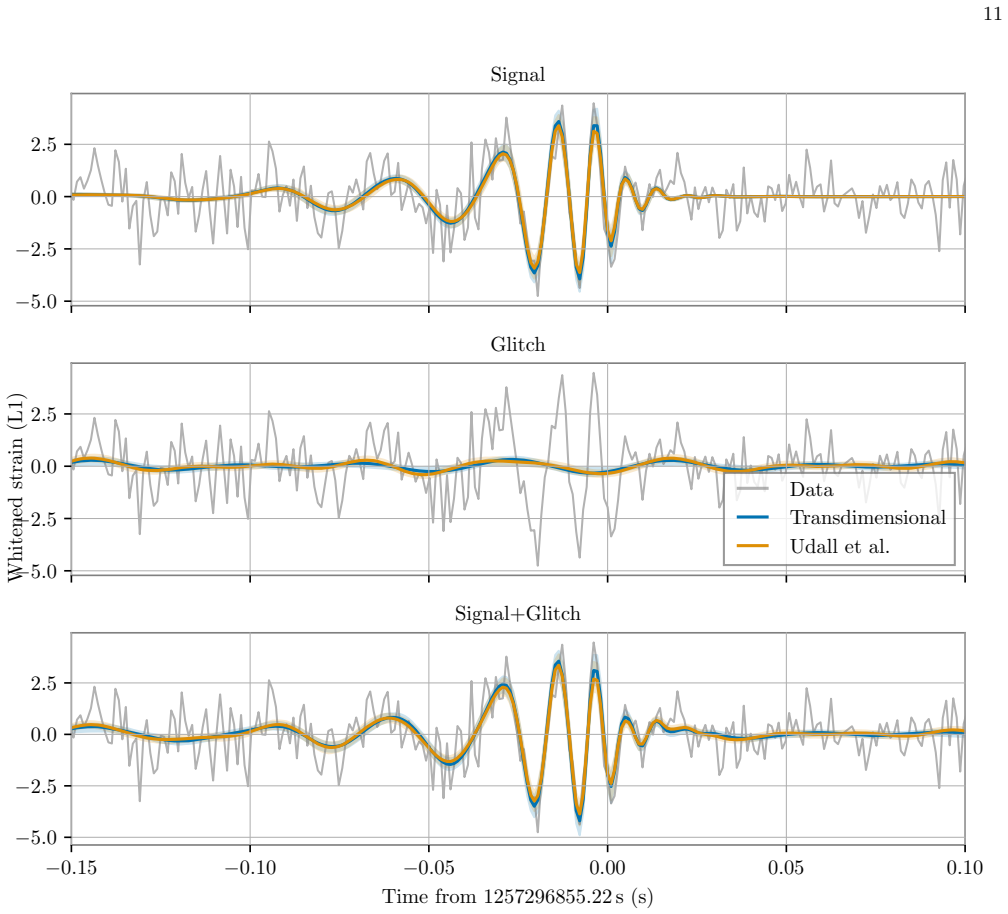
- Sec. V.B and Fig. 11: The wavelet quality factor Q0 differs substantially between NRSur7dq4 and IMRPhenomXPHM and is correlated with q and χp. This entanglement is noted but not interpreted. Please discuss whether the glitch basis is partially absorbing signal power (or residual non-Gaussian structure) in a waveform-dependent way, and what that implies for the robustness of the claimed waveform×glitch interplay on spin-precession.
- Sec. V.B: Restricting wavelet central-frequency priors to 20–50 Hz because “spin-precession evidence is concentrated” in that band is a strong, post-hoc modelling choice that can influence the very conclusion under test. Justify this cut more carefully (e.g., against the known 30–60 Hz glitch band of Davis et al.), and either show a sensitivity check with a broader frequency prior or clearly scope the claim as conditional on that prior.
- Sec. IV.B: Full uninformative-prior P–P validation is provided only for slow scattering (Fig. 4). Wavelet/chirplet reliability rests on a single engineered non-spinning bias-recovery case with IMRPhenomPv2. Given that the modular framework and the GW200129 application both rely on wavelets, please either add a small ensemble under more realistic settings or explicitly narrow the “produces reliable results” claim so that it matches the evidence actually shown for flexible models.
minor comments (6)
- Several section headings in the provided text appear broken by spaces (“W avelets”, “SIMULA TIONS”, “APPLICA TIONS”); check the production PDF for the same artefacts.
- Notation for the package name is inconsistent (bilby glitch / bilby_glitch / bilbyparametricglitch in the git URL). Standardise on one form throughout.
- Eq. (4) and the modified Whittle likelihood assume exact linear superposition of signal, glitch, and stationary Gaussian noise. A brief explicit statement that residual unmodeled non-Gaussianity is outside the scope of the reliability claim would help readers (the point is implicit but easy to miss).
- Fig. 4 legend reports individual p-values; Ag,1 has p=0.01. A one-sentence remark that glitch-parameter calibration is secondary to signal-parameter recovery (as already stated in the text) would prevent over-reading of that single outlier.
- Table V and the GW200129 runs use constrained priors to reduce cost; state clearly in the main text (not only the table caption) which parameters were constrained relative to a standard PE prior so that the posteriors can be compared fairly to published analyses.
- The concurrent Hoy et al. comparison in Sec. VI is useful; ensure the citation status (“in preparation”) is updated at proof stage and that the disagreement is framed solely as model-dependence rather than as a contradiction.
Circularity Check
No significant circularity: joint-inference reliability is demonstrated on independent injections and external event re-analyses, not forced by definition or self-citation.
full rationale
This is a methods-and-application paper whose central claims (unbiased recovery under the joint model; model-dependent spin-precession conclusions for GW200129) rest on (i) the explicit linear-sum likelihood of Eq. 4, (ii) 145 independent slow-scattering injections whose P-P plots (Fig. 4) recover injected signal parameters, (iii) a controlled chirplet-bias recovery demonstration (Figs. 7–8), and (iv) re-analyses of GW191109/GW200129 that are compared, not defined, against prior published results (Udall et al., Payne et al.). Distance marginalisation (Appendix A) is the standard bilby construction extended by one extra inner product; the three glitch families are taken from the literature and treated as modelling choices, not derived uniqueness theorems. Self-citations appear only as external benchmarks or prior implementations of the same models; none supplies a load-bearing premise that is then re-derived. No fitted constant is renamed a prediction, no ansatz is smuggled via self-citation, and no algebraic identity reduces the claimed reliability to an input by construction. The paper is therefore self-contained against its own validation suite.
Axiom & Free-Parameter Ledger
free parameters (4)
- N (number of glitch components)
- Wavelet/chirplet amplitude, Q, central frequency, time, phase (and β for chirplets)
- Slow-scattering amplitude, phase, base harmonic frequency, δf, fmod
- Luminosity-distance prior and analytic-marginalization lookup table
axioms (5)
- domain assumption Data = stationary Gaussian noise + glitch g(γ) + signal h(θ) (linear superposition)
- domain assumption Whittle likelihood (stationary Gaussian noise in the frequency domain) remains valid after subtracting the parametric glitch
- domain assumption Slow-scattering motion is a pure sinusoid in the microseism band, producing harmonic arches with uncorrelated amplitudes and phases
- domain assumption A finite sum of sine-Gaussian wavelets or chirplets is a sufficiently flexible basis for unmodeled glitches without systematically absorbing CBC signal power
- standard math Transdimensional sampling with ghost parameters (tBilby) correctly explores the variable-dimension glitch space
read the original abstract
Non-Gaussian noise transients ("glitches") in gravitational-wave observatories degrade our ability to accurately perform astrophysical inference. We present the analysis pipeline bilby_glitch, which allows for simultaneous Bayesian inference of gravitational-wave signals and glitches. Our framework is modular and built on top of the popular bilby framework, facilitating future extensions with additional glitch and signal models. We integrate transdimensional bilby into our framework and discuss three glitch models: a physically-motivated slow scattering model, and flexible sine-Gaussian and chirplet models. Using a combination of simulated and real data, we demonstrate that bilby_glitch produces reliable results. We then reanalyse two gravitational-wave events - GW191109 and GW200129 - which show signs of interesting black-hole spins, but which may also be affected by data-quality issues. Our results for GW191109 are consistent with previous analysis. For GW200129, we recover results consistent with Payne et al., where the evidence of spin-precession is much weaker when using the waveform approximant NRSur7dq4 in combination with wavelet-based glitch modeling. Furthermore, we show the astrophysical conclusion of this event is dependent on the interplay between the waveform approximant and glitch model, since in contrast to NRSur7dq4 we find that inference with the waveform approximant IMRPhenomXPHM shows strong evidence of spin-precession when used in combination with wavelet-based glitch modeling.
Figures




Reference graph
Works this paper leans on
-
[1]
may, in the worst-case scenario, have the completely wrong effective aligned spin measurement due to the pres- ence of an unmitigated glitch, although the balance of evidence suggests a less dire outcome [31]. The evi- dence of spin-precession in GW200129 065458 (hereafter GW200129; Abbottet al.[26]) has also been shown to ∗ shun.cheung@monash.edu depend ...
Pith/arXiv arXiv 2026
-
[2]
The time priors are relative to GPS time 1264316116.4 s
and are not included in the table for brevity. The time priors are relative to GPS time 1264316116.4 s. Parameter Shape Limits Boundary MUniformInComponent [26, 38 ]M ⊙ - qUniformInComponent [0.167,1] - a1,a 2 Uniform [0, 0.99] - tc,GW Uniform [-0.1, 0.1 ]s - dL PowerLaw (alpha=0.2) [500, 1500 ]Mpc - NDiscreteUniform [0, 5] - SNRn DescendingOrder [0, 20] ...
-
[3]
B. P. Abbottet al.(LIGO Scientific Collaboration and Virgo Collaboration), Properties of the binary black hole merger gw150914, Phys. Rev. Lett.116, 241102 (2016)
2016
-
[4]
B. P. Abbottet al.(LIGO Scientific Collaboration and Virgo Collaboration), Gw170817: Observation of gravi- tational waves from a binary neutron star inspiral, Phys. Rev. Lett.119, 161101 (2017)
2017
-
[5]
A. G. Abacet al.(The LIGO Scientific Collaboration, The Virgo Collaboration, and The KAGRA Collabora- tion), Black hole spectroscopy and tests of general relativ- ity with gw250114, Phys. Rev. Lett.136, 041403 (2026)
2026
-
[6]
A. G. Abacet al.(LIGO Scientific, Virgo, KAGRA), Gw230814: Investigation of a loud gravitational-wave sig- nal observed with a single detector, The Astrophysical Journal Letters1004, L23 (2026)
2026
-
[7]
A. G. Abacet al.(LIGO Scientific, Virgo, KAGRA), GW241011 and GW241110: Exploring Binary Forma- tion and Fundamental Physics with Asymmetric, High- spin Black Hole Coalescences, Astrophys. J. Lett.993, L21 (2025), arXiv:2510.26931 [astro-ph.HE]
arXiv 2025
-
[8]
A. G. Abacet al., Gwtc-4.0: Updating the gravitational- wave transient catalog with observations from the first part of the fourth ligo–virgo–kagra observing run, The Astrophysical Journal Letters1004, L22 (2026)
2026
-
[9]
R. Abbottet al.(KAGRA, VIRGO, LIGO Scien- tific), GWTC-3: Compact Binary Coalescences Observed by LIGO and Virgo during the Second Part of the Third Observing Run, Phys. Rev. X13, 041039 (2023), arXiv:2111.03606 [gr-qc]
Pith/arXiv arXiv 2023
-
[10]
R. Abbottet al.(LIGO Scientific, VIRGO), GWTC-2.1: Deep extended catalog of compact binary coalescences observed by LIGO and Virgo during the first half of the third observing run, Phys. Rev. D109, 022001 (2024), arXiv:2108.01045 [gr-qc]
Pith/arXiv arXiv 2024
-
[11]
Abbottet al., Population properties of compact ob- jects from the second ligo–virgo gravitational-wave tran- sient catalog, The Astrophysical Journal Letters913, L7 (2021)
R. Abbottet al., Population properties of compact ob- jects from the second ligo–virgo gravitational-wave tran- sient catalog, The Astrophysical Journal Letters913, L7 (2021)
2021
-
[12]
A. G. Abacet al.(LIGO Scientific, VIRGO, KAGRA), GWTC-4.0: Population Properties of Merging Compact Binaries, (2025), arXiv:2508.18083 [astro-ph.HE]
Pith/arXiv arXiv 2025
-
[13]
R. Abbottet al.(KAGRA, VIRGO, LIGO Scientific), Population of Merging Compact Binaries Inferred Using Gravitational Waves through GWTC-3, Phys. Rev. X13, 011048 (2023), arXiv:2111.03634 [astro-ph.HE]
Pith/arXiv arXiv 2023
-
[14]
B. P. Abbottet al.(The LIGO Scientific Collaboration and the Virgo Collaboration), Tests of general relativity with the binary black hole signals from the ligo-virgo catalog gwtc-1, Phys. Rev. D100, 104036 (2019)
2019
-
[15]
R. Abbottet al.(LIGO Scientific Collaboration and Virgo Collaboration), Tests of general relativity with bi- nary black holes from the second ligo-virgo gravitational- wave transient catalog, Phys. Rev. D103, 122002 (2021)
2021
-
[16]
Abbottet al.(The LIGO Scientific Collaboration, the Virgo Collaboration, and the KAGRA Collaboration), Tests of general relativity with gwtc-3, Phys
R. Abbottet al.(The LIGO Scientific Collaboration, the Virgo Collaboration, and the KAGRA Collaboration), Tests of general relativity with gwtc-3, Phys. Rev. D112, 084080 (2025)
2025
-
[17]
A. G. Abacet al.(LIGO Scientific, VIRGO, KAGRA), GWTC-4.0: Tests of General Relativity. II. Parameter- ized Tests, (2026), arXiv:2603.19020 [gr-qc]
Pith/arXiv arXiv 2026
-
[18]
A. G. Abacet al.(LIGO Scientific, VIRGO, KAGRA), GWTC-4.0: Tests of General Relativity. I. Overview and General Tests, (2026), arXiv:2603.19019 [gr-qc]
Pith/arXiv arXiv 2026
-
[19]
A. G. Abacet al.(LIGO Scientific, VIRGO, KAGRA), GWTC-4.0: Tests of General Relativity. III. Tests of the Remnants, (2026), arXiv:2603.19021 [gr-qc]
Pith/arXiv arXiv 2026
-
[20]
G. Ashtonet al., BILBY: A user-friendly Bayesian infer- ence library for gravitational-wave astronomy, Astrophys. J. Suppl.241, 27 (2019), arXiv:1811.02042 [astro-ph.IM]
Pith/arXiv arXiv 2019
-
[21]
J. Veitchet al., Parameter estimation for compact bina- ries with ground-based gravitational-wave observations using the LALInference software library, Phys. Rev. D 91, 042003 (2015), arXiv:1409.7215 [gr-qc]
Pith/arXiv arXiv 2015
-
[22]
A. B. Yelikar, V. Delfavero, and R. O’Shaughnessy, Low- latency parameter inference enabled by a Gaussian likeli- hood approximation for RIFT (2023), arXiv:2301.01337 [gr-qc]
Pith/arXiv arXiv 2023
-
[23]
M. Dax, S. R. Green, J. Gair, J. H. Macke, A. Buonanno, and B. Sch¨ olkopf, Real-Time Gravitational Wave Science with Neural Posterior Estimation, Phys. Rev. Lett.127, 241103 (2021), arXiv:2106.12594 [gr-qc]
Pith/arXiv arXiv 2021
-
[24]
N. J. Cornish and T. B. Littenberg, BayesWave: Bayesian Inference for Gravitational Wave Bursts and Instrument Glitches, Class. Quant. Grav.32, 135012 (2015), arXiv:1410.3835 [gr-qc]
Pith/arXiv arXiv 2015
-
[25]
Davis and M
D. Davis and M. Walker, Detector Characterization and Mitigation of Noise in Ground-Based Gravitational-Wave Interferometers, Galaxies10, 12 (2022)
2022
-
[26]
S. Soniet al.(LIGO), LIGO Detector Characterization in the first half of the fourth Observing run, Class. Quant. Grav.42, 085016 (2025), arXiv:2409.02831 [astro-ph.IM]
arXiv 2025
-
[27]
F. Acerneseet al.(Virgo), Virgo detector characteriza- tion and data quality: results from the O3 run, Class. Quant. Grav.40, 185006 (2023), arXiv:2210.15633 [gr- qc]
Pith/arXiv arXiv 2023
-
[28]
R. Abbottet al.(LIGO Scientific Collaboration, Virgo Collaboration, and KAGRA Collaboration), Gwtc-3: Compact binary coalescences observed by ligo and virgo during the second part of the third observing run, Phys. Rev. X13, 041039 (2023)
2023
-
[29]
S. A. Usmanet al., The PyCBC search for gravitational waves from compact binary coalescence, Class. Quant. Grav.33, 215004 (2016), arXiv:1508.02357 [gr-qc]
Pith/arXiv arXiv 2016
-
[30]
S. Sachdevet al., The GstLAL Search Analysis Methods for Compact Binary Mergers in Advanced LIGO’s Sec- ond and Advanced Virgo’s First Observing Runs, (2019), arXiv:1901.08580 [gr-qc]
Pith/arXiv arXiv 2019
-
[31]
D. Davis, T. B. Littenberg, I. M. Romero-Shaw, M. Mill- house, J. McIver, F. Di Renzo, and G. Ashton, Subtract- ing glitches from gravitational-wave detector data during the third LIGO-Virgo observing run, Class. Quant. Grav. 39, 245013 (2022), arXiv:2207.03429 [astro-ph.IM]
Pith/arXiv arXiv 2022
-
[32]
E. Payne, S. Hourihane, J. Golomb, R. Udall, D. Davis, and K. Chatziioannou, Curious case of GW200129: Interplay between spin-precession inference and data- quality issues, Phys. Rev. D106, 104017 (2022), arXiv:2206.11932 [gr-qc]
Pith/arXiv arXiv 2022
-
[33]
Udall, S
R. Udall, S. Hourihane, S. Miller, D. Davis, K. Chatzi- ioannou, M. Isi, and H. Deshong, Antialigned spin of gw191109: Glitch mitigation and its implications, Phys. Rev. D111, 024046 (2025). 17
2025
- [34]
-
[35]
N. Gupteet al., Eccentricity constraints disfavor single- single capture in nuclear star clusters as the origin of all LIGO-Virgo-KAGRA binary black holes, (2026), arXiv:2603.29019 [astro-ph.HE]
Pith/arXiv arXiv 2026
-
[36]
S. Ghonge, J. Brandt, J. M. Sullivan, M. Millhouse, K. Chatziioannou, J. A. Clark, T. Littenberg, N. Cornish, S. Hourihane, and L. Cadonati, Assessing and mitigating the impact of glitches on gravitational-wave parameter estimation: A model agnostic approach, Physical Review D110, 10.1103/physrevd.110.122002 (2024)
-
[37]
Y. Lecoeuche, J. McIver, A. M. Knee, R. Udall, K. Rink, S. Hourihane, S. J. Miller, K. Chatziioannou, T. Massinger, and D. Davis, Coalescing Compact Bi- nary Parameter Estimation with Gravitational Waves in the Presence of non-Gaussian Transient Noise, (2026), arXiv:2604.07668 [gr-qc]
Pith/arXiv arXiv 2026
-
[38]
S. Hourihane and K. Chatziioannou, Glitches far from transient gravitational-wave events do not bias inference, Phys. Rev. D112, 084006 (2025), arXiv:2506.21869 [gr- qc]
arXiv 2025
-
[39]
C. Pankowet al., Mitigation of the instrumental noise transient in gravitational-wave data surround- ing GW170817, Phys. Rev. D98, 084016 (2018), arXiv:1808.03619 [gr-qc]
Pith/arXiv arXiv 2018
-
[40]
M. Hannamet al., General-relativistic precession in a black-hole binary, Nature610, 652 (2022), arXiv:2112.11300 [gr-qc]
Pith/arXiv arXiv 2022
-
[41]
S. Y. Cheung, P. D. Lasky, and E. Thrane, Does space- time have memories? searching for gravitational-wave memory in the third ligo-virgo-kagra gravitational-wave transient catalogue, Classical and Quantum Gravity41, 115010 (2024)
2024
-
[42]
N. J. Cornish, T. B. Littenberg, B. B´ ecsy, K. Chatzi- ioannou, J. A. Clark, S. Ghonge, and M. Millhouse, BayesWave analysis pipeline in the era of gravitational wave observations, Phys. Rev. D103, 044006 (2021), arXiv:2011.09494 [gr-qc]
Pith/arXiv arXiv 2021
-
[43]
R. Bondarescu, A. Lundgren, and R. Macas, Antiglitch: a quasi-physical model for removing short glitches from ligo and virgo data (2023), arXiv:2309.06594 [gr-qc]
Pith/arXiv arXiv 2023
-
[44]
B. P. Abbott, R. Abbott, R. Adhikari, P. Ajith, B. Allen, G. Allen, R. S. Amin, S. B. Anderson, W. G. Ander- son, and M. A. Arain, Ligo: the laser interferometer gravitational-wave observatory, Reports on Progress in Physics72, 076901 (2009)
2009
-
[45]
J. Aasi, J. Abadie, B. P. Abbott, R. Abbott, T. D. Ab- bott, M. Abernathy, T. Accadia, F. Acernese, C. Adams, and T. Adams, The characterization of virgo data and its impact on gravitational-wave searches, Classical and Quantum Gravity29, 155002 (2012)
2012
-
[46]
Y. Aso, Y. Michimura, K. Somiya, M. Ando, O. Miyakawa, T. Sekiguchi, D. Tatsumi, and H. Ya- mamoto (The KAGRA Collaboration), Interferometer design of the kagra gravitational wave detector, Phys. Rev. D88, 043007 (2013)
2013
-
[47]
Gupte, A
N. Gupte, A. Ramos-Buades, A. Buonanno, J. Gair, M. Coleman Miller, M. Dax, S. R. Green, M. P¨ urrer, J. Wildberger, J. Macke, I. M. Romero-Shaw, and B. Sch¨ olkopf, Evidence for eccentricity in the population of binary black holes observed by ligo-virgo-kagra, Phys. Rev. D112, 104045 (2025)
2025
-
[48]
K. Chatziioannou, N. Cornish, M. Wijngaarden, and T. B. Littenberg, Modeling compact binary signals and instrumental glitches in gravitational wave data, Phys. Rev. D103, 044013 (2021), arXiv:2101.01200 [gr-qc]
Pith/arXiv arXiv 2021
-
[49]
S. Hourihane, K. Chatziioannou, M. Wijngaarden, D. Davis, T. Littenberg, and N. Cornish, Accurate mod- eling and mitigation of overlapping signals and glitches in gravitational-wave data, Phys. Rev. D106, 042006 (2022), arXiv:2205.13580 [gr-qc]
Pith/arXiv arXiv 2022
-
[50]
Malz and J
A.-K. Malz and J. Veitch, Joint inference for gravitational wave signals and glitches using a data-informed glitch model, Phys. Rev. D112, 024071 (2025)
2025
-
[51]
Ashton, Gaussian processes for glitch-robust gravitational-wave astronomy, Mon
G. Ashton, Gaussian processes for glitch-robust gravitational-wave astronomy, Mon. Not. Roy. Astron. Soc.520, 2983 (2023), arXiv:2209.15547 [gr-qc]
Pith/arXiv arXiv 2023
-
[52]
Legin, M
R. Legin, M. Isi, K. W. K. Wong, Y. Hezaveh, and L. Perreault-Levasseur, Gravitational-wave parameter es- timation in non-gaussian noise using score-based likeli- hood characterization, The Astrophysical Journal Letters 985, L46 (2025)
2025
-
[53]
M. Emma and G. Ashton, Rnle: Residual neural likeli- hood estimation and its application to gravitational-wave astronomy (2026), arXiv:2601.13857 [gr-qc]
arXiv 2026
-
[54]
Chatterjee and K
C. Chatterjee and K. Jani, Navigating unknowns: Deep learning robustness for gravitational-wave signal recon- struction, The Astrophysical Journal973, 112 (2024)
2024
-
[55]
M. Millhouse, N. J. Cornish, and T. Littenberg, Bayesian reconstruction of gravitational wave bursts using chirplets, Phys. Rev. D97, 104057 (2018), arXiv:1804.03239 [gr-qc]
Pith/arXiv arXiv 2018
-
[56]
H. Tong, N. Guttman, T. A. Clarke, P. D. Lasky, E. Thrane, E. Payne, R. Nathan, B. Farr, M. Fishbach, G. Ashton, and V. D. Marco, Transdimensional inference for gravitational-wave astronomy with bilby, The Astro- physical Journal Supplement Series276, 50 (2025)
2025
-
[57]
E. Thrane and C. Talbot, An introduction to Bayesian inference in gravitational-wave astronomy: parame- ter estimation, model selection, and hierarchical mod- els, Publ. Astron. Soc. Austral.36, e010 (2019), [Erratum: Publ.Astron.Soc.Austral. 37, e036 (2020)], arXiv:1809.02293 [astro-ph.IM]
Pith/arXiv arXiv 2019
-
[58]
Accadiaet al., Noise from scattered light in Virgo’s second science run data, Class
T. Accadiaet al., Noise from scattered light in Virgo’s second science run data, Class. Quant. Grav.27, 194011 (2010)
2010
-
[59]
S. Soni, J. Glanzer, A. Effler, V. Frolov, G. Gonz´ alez, A. Pele, and R. Schofield, Modeling and reduction of high frequency scatter noise at LIGO Livingston, Class. Quant. Grav.41, 135015 (2024), arXiv:2311.05730 [astro- ph.IM]
Pith/arXiv arXiv 2024
-
[60]
R. Udall and D. Davis, Bayesian modeling of scattered light in the LIGO interferometers, Appl. Phys. Lett.122, 094103 (2023), arXiv:2211.15867 [astro-ph.IM]
Pith/arXiv arXiv 2023
-
[61]
A. E. Tolley, G. S. Cabourn Davies, I. W. Harry, and A. P. Lundgren, ArchEnemy: removing scattered-light glitches from gravitational wave data, Class. Quant. Grav.40, 165005 (2023), arXiv:2301.10491 [gr-qc]
Pith/arXiv arXiv 2023
-
[62]
K. Chatziioannou, J. A. Clark, A. Bauswein, M. Mill- house, T. B. Littenberg, and N. Cornish, Inferring the post-merger gravitational wave emission from binary neutron star coalescences, Phys. Rev. D96, 124035 (2017), arXiv:1711.00040 [gr-qc]. 18
Pith/arXiv arXiv 2017
-
[63]
Mann and S
S. Mann and S. Haykin, The chirplet transform: physical considerations, Trans. Sig. Proc.43, 2745–2761 (1995)
1995
-
[64]
Pratten, C
G. Pratten, C. Garc´ ıa-Quir´ os, M. Colleoni, A. Ramos- Buades, H. Estell´ es, M. Mateu-Lucena, R. Jaume, M. Haney, D. Keitel, J. E. Thompson, and S. Husa, Computationally efficient models for the dominant and subdominant harmonic modes of precessing binary black holes, Phys. Rev. D103, 104056 (2021)
2021
-
[65]
J. S. Speagle, dynesty: a dynamic nested sampling package for estimating Bayesian posteriors and evi- dences, Mon. Not. Roy. Astron. Soc.493, 3132 (2020), arXiv:1904.02180 [astro-ph.IM]
Pith/arXiv arXiv 2020
-
[66]
M. Hannam, P. Schmidt, A. Boh´ e, L. Haegel, S. Husa, F. Ohme, G. Pratten, and M. P¨ urrer, Simple Model of Complete Precessing Black-Hole-Binary Gravitational Waveforms, Phys. Rev. Lett.113, 151101 (2014), arXiv:1308.3271 [gr-qc]
Pith/arXiv arXiv 2014
-
[67]
P. Schmidt, F. Ohme, and M. Hannam, Towards mod- els of gravitational waveforms from generic binaries II: Modelling precession effects with a single effective pre- cession parameter, Phys. Rev. D91, 024043 (2015), arXiv:1408.1810 [gr-qc]
Pith/arXiv arXiv 2015
-
[68]
D. Davis, T. J. Massinger, A. P. Lundgren, J. C. Driggers, A. L. Urban, and L. K. Nuttall, Improving the Sensitiv- ity of Advanced LIGO Using Noise Subtraction, Class. Quant. Grav.36, 055011 (2019), arXiv:1809.05348 [astro- ph.IM]
Pith/arXiv arXiv 2019
-
[69]
Islam, A
T. Islam, A. Vajpeyi, F. H. Shaik, C.-J. Haster, V. Varma, S. E. Field, J. Lange, R. O’Shaughnessy, and R. Smith, Analysis of gwtc-3 with fully precessing nu- merical relativity surrogate models, Phys. Rev. D112, 044001 (2025)
2025
-
[70]
R. Macas, A. Lundgren, and G. Ashton, Revisiting the evidence for precession in GW200129 with machine learn- ing noise mitigation, Phys. Rev. D109, 062006 (2024), arXiv:2311.09921 [gr-qc]
Pith/arXiv arXiv 2024
-
[71]
V. Varma, S. E. Field, M. A. Scheel, J. Blackman, D. Gerosa, L. C. Stein, L. E. Kidder, and H. P. Pfeif- fer, Surrogate models for precessing binary black hole simulations with unequal masses, Phys. Rev. Research. 1, 033015 (2019), arXiv:1905.09300 [gr-qc]
Pith/arXiv arXiv 2019
-
[72]
J. D. Merritt, B. Farr, R. Hur, B. Edelman, and Z. Doc- tor, Transient glitch mitigation in advanced ligo data, Phys. Rev. D104, 102004 (2021)
2021
-
[73]
C. Hoy, R. Bondarescu, A. Lundgren, and L. Nuttall, A parametric signal plus noise inference framework for short duration non-Gaussian noise transients, (2026), in preparation
2026
-
[74]
L. P. Singer and L. R. Price, Rapid Bayesian position reconstruction for gravitational-wave transients, Phys. Rev. D93, 024013 (2016), arXiv:1508.03634 [gr-qc]
Pith/arXiv arXiv 2016
-
[75]
R. P. Udall,Robust Gravitational Wave Analysis at the Catalog Scale, Ph.D. thesis, Caltech (2025)
2025
-
[76]
I. M. Romero-Shawet al., Bayesian inference for compact binary coalescences with bilby: validation and applica- tion to the first LIGO–Virgo gravitational-wave transient catalogue, Mon. Not. Roy. Astron. Soc.499, 3295 (2020), arXiv:2006.00714 [astro-ph.IM]
Pith/arXiv arXiv 2020
discussion (0)
Sign in with ORCID, Apple, or X to comment. Anyone can read and Pith papers without signing in.