REVIEW 2 major objections 4 minor 42 references
Cluster-balanced pre-training plus domain-aware fine-tuning lets a Conformer encoder beat larger multilingual ASR models on Kazakh, Kyrgyz and Uzbek, especially spontaneous speech.
Reviewed by Pith at T0; open to challenge. T0 means a machine referee read the full paper against a public rubric. the ladder, T0–T4 →
T0 review · grok-4.5
2026-07-14 12:13 UTC pith:ZEV5662L
load-bearing objection Solid systems paper with clean matched ablations and released weights; the cluster-balancing recipe works for three Central Asian languages, proprietary data is the main limit. the 2 major comments →
GigaAM Multilingual: Foundation Model for Underrepresented Languages
The pith
A machine-rendered reading of the paper's core claim, the machinery that carries it, and where it could break.
Core claim
A Conformer encoder pre-trained on two million hours of audio with cluster-level sampling weights, then fine-tuned with domain-aware sampling, adapts more successfully to Kazakh, Kyrgyz and Uzbek than strong open pretrained encoders of comparable or larger size when all models see the same fine-tuning mixture and decoding setup; the advantage is especially clear on spontaneous in-the-wild test sets while head-language performance remains stable.
What carries the argument
Cluster-level data balancing: languages are first grouped into five clusters by community detection on a normalized co-occurrence graph of recordings, after which pre-training samples according to cluster weights rather than natural or per-language frequencies; this is paired with domain-aware sampling at fine-tuning that explicitly controls the mix of open, crowd, synthetic and weakly-supervised sources inside each language.
Load-bearing premise
The five language clusters built from a pruned co-occurrence graph are a faithful enough proxy for both linguistic relatedness and data scarcity that re-weighting only at the cluster level will improve the target Central Asian languages without harming the head languages.
What would settle it
Re-run the identical pre-training and fine-tuning pipeline but replace the five co-occurrence clusters with either uniform per-language sampling or random clusters of the same sizes; if the WER gains on Kazakh, Kyrgyz and Uzbek disappear or reverse while head-language WER stays comparable, the cluster-balancing claim is falsified.
If this is right
- Released 240 M and 600 M encoders can serve as drop-in starting points for rapid CTC adaptation to other low-coverage Turkic or Caucasian languages with only tens of hours of labeled data.
- The same cluster-reweighting recipe can be applied to any large unlabeled multilingual speech corpus whose language mix is severely skewed.
- Domain-aware sampling that down-weights synthetic speech becomes a standard control when fine-tuning models that mix real and TTS data for tail languages.
- Controlled encoder ablations of this form become a practical way to choose among open foundation models for a new low-resource language.
Where Pith is reading between the lines
- Because the method works even when pre-training coverage of a language is under 500 hours, the same pipeline may transfer to genuinely zero-shot languages once a small amount of in-domain labeled data appears.
- The co-occurrence clustering step effectively discovers language families without an external linguistic taxonomy; the same graph construction could be used to decide which languages should share a joint decoder or vocabulary.
- The large spontaneous-speech gains suggest that synthetic data, when properly regularized by domain weights, can still help models that must handle real conversational audio rather than read speech only.
Editorial analysis
A structured set of objections, weighed in public.
Referee Report
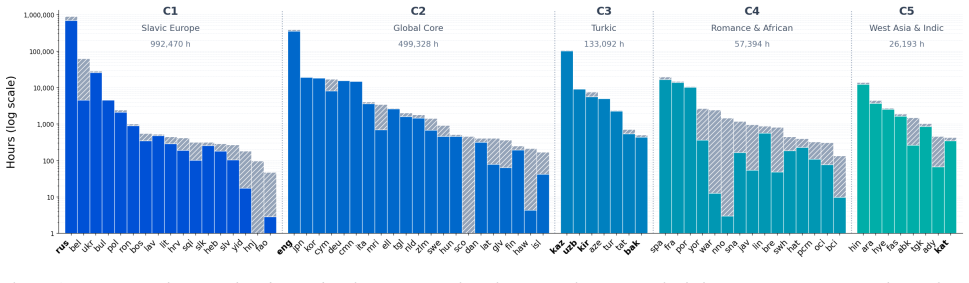
Summary. The paper introduces GigaAM Multilingual, a 600M-parameter Conformer encoder pre-trained with a HuBERT-style masked unit prediction objective on 2M hours of highly imbalanced multilingual audio. The central technical contributions are (i) cluster-level reweighting of the pre-training mixture, obtained by community detection on a normalized language co-occurrence graph (Sec. 3.2, Fig. 1), and (ii) domain-aware sampling during CTC fine-tuning on a multi-source mixture that includes open, crowd-sourced, synthetic and weakly-supervised data for Kazakh, Kyrgyz and Uzbek (Table 2, Sec. 3.3). Under a matched fine-tuning protocol the resulting encoder (and even a 240M variant) yields lower average WER than Whisper Large-v3 and Omnilingual-1B CTC baselines on the three target languages (Table 5: 10.2 % vs 14.1 % / 16.6 %), with the largest gains on spontaneous internal sets (Table 1). Ablations of pre-training mixture (Table 3) and fine-tuning sampling (Table 4) support the claimed benefit of the balancing strategies. Model weights are released.
Significance. If the controlled comparisons hold, the work supplies a concrete, reproducible recipe for adapting a foundation encoder to long-tail Central Asian languages under realistic data imbalance, together with open weights that already outperform substantially larger public encoders on the target languages. The explicit isolation of pre-training mixture and domain-aware fine-tuning (Tables 3–5) is a useful methodological contribution for the multilingual SSL community. The demonstration that a 240M encoder can surpass Whisper Large-v3 and Omnilingual-1B under identical CTC adaptation is particularly valuable for efficiency-constrained settings. Release of both the foundation encoder and the ASR model further increases the paper’s practical impact.
major comments (2)
- [Tables 1, 3–5 / Sec. 4] Tables 1, 3, 4 and 5 report point-estimate WERs without confidence intervals, bootstrap estimates or any statistical significance test. Because several of the claimed gains (especially the spontaneous-speech improvements in Table 1 and the 240M-vs-Whisper comparison in Table 5) are the load-bearing evidence for the central claim, the absence of uncertainty quantification makes it impossible to judge whether the differences are reliable or could be explained by test-set variance. Adding at least bootstrap CIs or a paired significance test on the same utterances would strengthen the result.
- [Sec. 3.3 / Table 4] Section 3.3 and Table 4 introduce “domain-aware sampling” as the decisive fine-tuning strategy, yet the concrete per-domain weights (or the procedure used to set them) are never stated. Without this information the recipe cannot be reproduced from the manuscript alone, even though the authors correctly identify domain composition as critical for spontaneous-speech gains. A short table or paragraph listing the final language-by-domain sampling probabilities would close the gap.
minor comments (4)
- [Fig. 1 / Sec. 3.2] Figure 1 is referenced for the five language clusters, but the figure caption and surrounding text do not list which languages belong to which cluster beyond the bolded experimental languages. A compact legend or appendix table would help readers interpret the co-occurrence clustering.
- [Sec. 4.2] Whisper large-v3 is noted as not supporting Kyrgyz and is run without a language token; Seamless-M4T is forced to the target language. These decoding differences are reasonable but should be stated once in Sec. 4.2 so that readers do not have to reconstruct them from the table footnotes.
- [Sec. 3.3.3–3.3.4] The CER filtering thresholds used for synthetic and weakly-supervised data (Sec. 3.3.3–3.3.4) are mentioned only qualitatively. Reporting the numerical thresholds would improve reproducibility of the data pipeline.
- [Throughout] Minor typographic inconsistencies appear (e.g., “V oice” with a space in several places, “Common V oice”). A final proof-reading pass would clean these up.
Circularity Check
No significant circularity; all claims are empirical WER results on held-out sets under matched protocols.
full rationale
This is a standard empirical ASR paper whose central claims (cluster-aware pre-training + domain-aware fine-tuning yield lower WER than Whisper Large-v3 and Omnilingual-1B under matched CTC fine-tuning) rest on measured word-error rates on Common Voice, FLEURS and internal spontaneous test sets that are never used to set sampling weights or model parameters. Cluster sampling weights (Table 3, E0–E3) are ordinary hyper-parameter choices selected by a small grid search on development performance; the final reported numbers remain held-out evaluations, not tautological reconstructions of the fitted mixture. Domain-aware fine-tuning is likewise ablated (Table 4) and compared under identical data and decoding (Table 5). The single self-citation to the authors’ prior monolingual GigaAM work is background only and is not load-bearing for any uniqueness claim or derivation. No equation, definition, or uniqueness theorem reduces a “prediction” to its own inputs by construction. The derivation chain is therefore self-contained experimental validation, not circular.
Axiom & Free-Parameter Ledger
free parameters (5)
- cluster sampling probabilities [p_C1 … p_C5] =
[0.50, 0.15, 0.25, 0.05, 0.05]
- K-means cluster count for discrete units =
1000
- masking ratio and span length =
0.4
- domain-aware sampling weights inside each language
- CER filtering thresholds for synthetic and weakly-supervised data
axioms (4)
- domain assumption HuBERT-style masked unit prediction on mel-spectrograms yields transferable speech representations.
- ad hoc to paper Language co-occurrence graph + Clauset–Newman–Moore clustering produces clusters that are useful proxies for balancing long-tail languages.
- domain assumption CTC fine-tuning with a shared character vocabulary is a fair and sufficient adaptation protocol for comparing pretrained encoders.
- domain assumption Majority-vote LID (MMS 4017) with 0.7 confidence thresholds correctly assigns language labels to the 2 M-hour corpus.
read the original abstract
Despite recent scaling successes, multilingual ASR performance remains highly uneven, with long-tail languages suffering from severe data scarcity. This work addresses the challenge of building robust foundation models for underrepresented Central Asian languages (Kazakh, Kyrgyz, Uzbek). We present GigaAM Multilingual, a Conformer encoder pre-trained on 2M hours of audio using a HuBERT-style objective. Crucially, we introduce a cluster-level data balancing strategy during pre-training and a domain-aware sampling method during fine-tuning to mitigate head-language dominance. In controlled comparisons, our approach outperforms strong open pretrained encoders (Whisper Large v3, Omnilingual-1B) on target languages, achieving significant gains on spontaneous speech while maintaining efficiency. We release the foundation encoder and ASR model, offering a proven recipe for effective multilingual adaptation under realistic data imbalance.
Figures
Reference graph
Works this paper leans on
-
[1]
Introduction Recent years have seen rapid progress in multilingual automatic speech recognition (ASR), driven by scaling data, model capac- ity, and weakly-supervised and self-supervised training objec- tives [1, 2, 3, 4]. Despite these advances, recognition quality remains highly uneven across languages: performance on high- resource languages is strong,...
-
[2]
Related Work Large-scale ASR models have substantially improved multi- lingual robustness by scaling training data and model capac- ity. Whisper demonstrates strong zero-shot generalization from large-scale weak supervision [1], while USM and MMS im- prove coverage and transfer via large-scale multilingual pre- training and downstream fine-tuning [2, 3]. ...
Pith/arXiv arXiv 2026
-
[3]
uncertain
Method 3.1. Pre-training We pre-train GigaAM Multilingual with a HuBERT-style [9] masked unit prediction objective, where the model predicts dis- crete acoustic units at masked time steps from an input mel- spectrogram sequence. Both the teacher and the student are 600M-parameter Conformer encoders with 24 layers, a hidden dimension of 1024, and Rotary Po...
-
[4]
centre”→“center
Experiments 4.1. Experimental Setup We pre-train the model for 300k steps with a learning rate of 2×10 −4 and a total audio batch size of2048×32s per update (approximately 18.2 hours of audio). We then fine-tune for 200k steps using AdamW, with a peak learning rate of6×10 −5, Table 3:Pre-training data mixture and cluster sampling weights; values are avera...
-
[5]
We introduce GigaAM Multilingual, a Conformer en- coder pre-trained on 2M hours of audio using a cluster-aware sampling strategy
Conclusion This study addresses the challenge of developing high-quality ASR for underrepresented languages under severe data imbal- ance. We introduce GigaAM Multilingual, a Conformer en- coder pre-trained on 2M hours of audio using a cluster-aware sampling strategy. Our experiments demonstrate that explicit data balancing during pre-training and domain-...
-
[6]
The authors reviewed and revised all AI-assisted edits and take full responsibility for the content, claims, experimental results, and conclusions of this paper
Use of Generative AI Disclosure Generative AI tools were used for limited language editing and phrasing support during manuscript preparation (e.g., improv- ing clarity, grammar, and wording of selected paragraphs). The authors reviewed and revised all AI-assisted edits and take full responsibility for the content, claims, experimental results, and conclu...
-
[7]
Robust speech recognition via large-scale weak supervision,
A. Radford, J. W. Kim, T. Xu, G. Brockman, C. Mcleavey, and I. Sutskever, “Robust speech recognition via large-scale weak supervision,” inProceedings of the 40th International Conference on Machine Learning, ser. Proceedings of Machine Learning Research, A. Krause, E. Brunskill, K. Cho, B. Engelhardt, S. Sabato, and J. Scarlett, Eds., vol. 202. PMLR, 23– ...
2023
-
[8]
Google USM: Scaling automatic speech recognition beyond 100 languages,
Y . Zhanget al., “Google USM: Scaling automatic speech recognition beyond 100 languages,” 2023. [Online]. Available: https://arxiv.org/abs/2303.01037
Pith/arXiv arXiv 2023
-
[9]
Scaling speech technology to 1,000+ languages,
V . Pratapet al., “Scaling speech technology to 1,000+ languages,” Journal of Machine Learning Research, vol. 25, no. 97, pp. 1–52,
-
[10]
Available: http://jmlr.org/papers/v25/23-1318
[Online]. Available: http://jmlr.org/papers/v25/23-1318. html
-
[11]
Omnilingual asr: Open-source multilingual speech recognition for 1600+ languages,
Omnilingual ASR team, “Omnilingual asr: Open-source multilingual speech recognition for 1600+ languages,” 2025. [Online]. Available: https://arxiv.org/abs/2511.09690
arXiv 2025
-
[12]
The ML-SUPERB 2.0 Challenge: Towards In- clusive ASR Benchmarking for All Language Varieties,
W. Chenet al., “The ML-SUPERB 2.0 Challenge: Towards In- clusive ASR Benchmarking for All Language Varieties,” inInter- speech 2025, 2025, pp. 2093–2097
2025
-
[13]
mHuBERT-147: A Compact Multilingual HuBERT Model,
M. Zanon Boito, V . Iyer, N. Lagos, L. Besacier, and I. Calapode- scu, “mHuBERT-147: A Compact Multilingual HuBERT Model,” inInterspeech 2024, 2024, pp. 3939–3943
2024
-
[14]
GigaAM: Efficient Self-Supervised Learner for Speech Recognition,
A. Kutsakov, A. Maximenko, G. Gospodinov, P. Bogomolov, and F. Minkin, “GigaAM: Efficient Self-Supervised Learner for Speech Recognition,” inInterspeech 2025, 2025, pp. 1213–1217
2025
-
[15]
wav2vec 2.0: A framework for self-supervised learning of speech representa- tions,
A. Baevski, Y . Zhou, A. Mohamed, and M. Auli, “wav2vec 2.0: A framework for self-supervised learning of speech representa- tions,” inAdvances in Neural Information Processing Systems, H. Larochelle, M. Ranzato, R. Hadsell, M. Balcan, and H. Lin, Eds., vol. 33. Curran Associates, Inc., 2020, pp. 12 449–12 460. [Online]. Available: https://proceedings.neur...
2020
-
[16]
Hubert: Self-supervised speech rep- resentation learning by masked prediction of hidden units,
W.-N. Hsu, B. Bolte, Y .-H. H. Tsai, K. Lakhotia, R. Salakhut- dinov, and A. Mohamed, “Hubert: Self-supervised speech rep- resentation learning by masked prediction of hidden units,” IEEE/ACM Transactions on Audio, Speech, and Language Pro- cessing, vol. 29, pp. 3451–3460, 2021
2021
-
[17]
XLS-R: Self-supervised cross- lingual speech representation learning at scale,
A. Babu, C. Wang, A. Tjandra, K. Lakhotia, Q. Xu, N. Goyal, K. Singh, P. von Platen, Y . Saraf, J. Pino, A. Baevski, A. Conneau, and M. Auli, “XLS-R: Self-supervised cross- lingual speech representation learning at scale,” 2021. [Online]. Available: https://arxiv.org/abs/2111.09296
Pith/arXiv arXiv 2021
-
[18]
GigaSpeech 2: An evolving, large-scale and multi-domain ASR corpus for low-resource languages with automated crawling, transcription and refinement,
Y . Yanget al., “GigaSpeech 2: An evolving, large-scale and multi-domain ASR corpus for low-resource languages with automated crawling, transcription and refinement,” in Proceedings of the 63rd Annual Meeting of the Association for Computational Linguistics (Volume 1: Long Papers). Vienna, Austria: Association for Computational Linguistics, Jul. 2025, pp....
2025
-
[19]
On the Effects of Heterogeneous Data Sources on Speech-to- Text Foundation Models,
J. Tian, Y . Peng, W. Chen, K. Choi, K. Livescu, and S. Watanabe, “On the Effects of Heterogeneous Data Sources on Speech-to- Text Foundation Models,” inInterspeech 2024, 2024, pp. 3959– 3963
2024
-
[20]
OWSM v4: Improving Open Whisper-Style Speech Models via Data Scaling and Cleaning,
Y . Peng, M. Shakeel, Y . Sudo, W. Chen, J. Tian, C.-J. Lin, and S. Watanabe, “OWSM v4: Improving Open Whisper-Style Speech Models via Data Scaling and Cleaning,” inInterspeech 2025, 2025, pp. 2225–2229
2025
-
[21]
Ro- former: Enhanced transformer with rotary position embedding,
J. Su, Y . Lu, S. Pan, A. Murtadha, B. Wen, and Y . Liu, “Ro- former: Enhanced transformer with rotary position embedding,” arXiv preprint arXiv:2104.09864, 2021
Pith/arXiv arXiv 2021
-
[22]
Finding community structure in very large networks,
A. Clauset, M. E. J. Newman, and C. Moore, “Finding community structure in very large networks,”Phys. Rev. E, vol. 70, p. 066111, Dec 2004. [Online]. Available: https://link.aps.org/doi/10.1103/PhysRevE.70.066111
-
[23]
A. Graves, S. Fern ´andez, F. Gomez, and J. Schmidhuber, “Connectionist temporal classification: labelling unsegmented sequence data with recurrent neural networks,” inProceedings of the 23rd International Conference on Machine Learning, ser. ICML ’06, New York, NY , USA, 2006, p. 369–376. [Online]. Available: https://doi.org/10.1145/1143844.1143891
-
[24]
Common voice: A massively-multilingual speech corpus,
R. Ardilaet al., “Common voice: A massively-multilingual speech corpus,” inProceedings of the Twelfth Language Resources and Evaluation Conference. Marseille, France: European Language Resources Association, May 2020, pp. 4218–4222. [Online]. Available: https://aclanthology.org/2020. lrec-1.520/
2020
-
[25]
Fleurs: Few-shot learning evaluation of universal representations of speech,
A. Conneau, M. Ma, S. Khanuja, Y . Zhang, V . Axelrod, S. Dalmia, J. Riesa, C. Rivera, and A. Bapna, “Fleurs: Few-shot learning evaluation of universal representations of speech,” 2022 IEEE Spoken Language Technology Workshop (SLT), pp. 798–805, 2022. [Online]. Available: https://api.semanticscholar. org/CorpusID:249062909
2022
-
[26]
Golos: Russian Dataset for Speech Research,
N. Karpov, A. Denisenko, and F. Minkin, “Golos: Russian Dataset for Speech Research,” inInterspeech 2021, 2021, pp. 1419–1423
2021
-
[27]
A toolbox for construction and analysis of speech datasets,
E. Bakhturina, V . Lavrukhin, and B. Ginsburg, “A toolbox for construction and analysis of speech datasets,” inProceedings of the Neural Information Processing Systems Track on Datasets and Benchmarks, 2021
2021
-
[28]
Europarl-ASR: A large corpus of parliamentary debates for streaming ASR benchmarking and speech data filtering/verbatimization,
G. V . Garc ´es D´ıaz-Mun´ıoet al., “Europarl-ASR: A large corpus of parliamentary debates for streaming ASR benchmarking and speech data filtering/verbatimization,” inInterspeech 2021, 2021, pp. 3695–3699
2021
-
[29]
Lib- riSpeech: An ASR corpus based on public domain audio books,
V . Panayotov, G. Chen, D. Povey, and S. Khudanpur, “Lib- riSpeech: An ASR corpus based on public domain audio books,” inProc. IEEE International Conference on Acoustics, Speech and Signal Processing (ICASSP), 2015, pp. 5206–5210
2015
-
[30]
The people’s speech: A large-scale diverse english speech recognition dataset for commercial usage,
D. Galvezet al., “The people’s speech: A large-scale diverse english speech recognition dataset for commercial usage,” in Proceedings of the Neural Information Processing Systems Track on Datasets and Benchmarks, 2021. [Online]. Available: https: //datasets-benchmarks-proceedings.neurips.cc/paper files/paper/ 2021/file/202cb962ac59075b964b07152d234b70-Pap...
2021
-
[31]
SLURP: A spoken language understanding resource package,
E. Bastianelli, A. Vanzo, P. Swietojanski, and V . Rieser, “SLURP: A spoken language understanding resource package,” inProceed- ings of the 2020 Conference on Empirical Methods in Natural Language Processing (EMNLP), 2020, pp. 7252–7262
2020
-
[32]
SPGISpeech: 5,000 hours of transcribed fi- nancial audio for fully formatted end-to-end speech recognition,
P. K. O’Neillet al., “SPGISpeech: 5,000 hours of transcribed fi- nancial audio for fully formatted end-to-end speech recognition,” inInterspeech 2021, 2021, pp. 1434–1438
2021
-
[33]
TED-LIUM 3: Twice as much data and corpus repar- tition for experiments on speaker adaptation,
F. Hernandez, V . Nguyen, S. Ghannay, N. Tomashenko, and Y . Est`eve, “TED-LIUM 3: Twice as much data and corpus repar- tition for experiments on speaker adaptation,” inProc. Interna- tional Conference on Speech and Computer (SPECOM), ser. Lec- ture Notes in Computer Science, vol. 11096, 2018, pp. 198–208
2018
-
[34]
CSTR VCTK cor- pus: English multi-speaker corpus for CSTR voice cloning toolkit (version 0.92),
J. Yamagishi, C. Veaux, and K. MacDonald, “CSTR VCTK cor- pus: English multi-speaker corpus for CSTR voice cloning toolkit (version 0.92),” 2019
2019
-
[35]
V oxForge,
K. MacLean, “V oxForge,” http://www.voxforge.org, 2018
2018
-
[36]
Usc: An open-source uzbek speech corpus and initial speech recognition experiments,
M. Musaev, S. Mussakhojayeva, I. Khujayorov, Y . Khassanov, M. Ochilov, and H. Atakan Varol, “Usc: An open-source uzbek speech corpus and initial speech recognition experiments,” in Speech and Computer. Cham: Springer International Publish- ing, 2021, pp. 437–447
2021
-
[37]
KSC2: An Industrial-Scale Open-Source Kazakh Speech Corpus,
S. Mussakhojayeva, Y . Khassanov, and H. Atakan Varol, “KSC2: An Industrial-Scale Open-Source Kazakh Speech Corpus,” inIn- terspeech 2022, 2022, pp. 1367–1371
2022
-
[38]
KazakhTTS: An Open-Source Kazakh Text-to-Speech Synthesis Dataset,
S. Mussakhojayeva, A. Janaliyeva, A. Mirzakhmetov, Y . Khas- sanov, and H. A. Varol, “KazakhTTS: An Open-Source Kazakh Text-to-Speech Synthesis Dataset,” inInterspeech 2021, 2021, pp. 2786–2790
2021
-
[39]
Yodas: Youtube-oriented dataset for audio and speech,
X. Li, S. Takamichi, T. Saeki, W. Chen, S. Shiota, and S. Watan- abe, “Yodas: Youtube-oriented dataset for audio and speech,” in2023 IEEE Automatic Speech Recognition and Understanding Workshop (ASRU), 2023, pp. 1–8
2023
-
[40]
A post-processing system to yield reduced word er- ror rates: Recognizer output voting error reduction (rover),
J. Fiscus, “A post-processing system to yield reduced word er- ror rates: Recognizer output voting error reduction (rover),” in 1997 IEEE Workshop on Automatic Speech Recognition and Un- derstanding Proceedings, 1997, pp. 347–354
1997
-
[41]
mT5: A massively multilingual pre-trained text-to-text transformer,
L. Xue, N. Constant, A. Roberts, M. Kale, R. Al-Rfou, A. Siddhant, A. Barua, and C. Raffel, “mT5: A massively multilingual pre-trained text-to-text transformer,” inProceedings of the 2021 Conference of the North American Chapter of the Association for Computational Linguistics: Human Language Technologies. Online: Association for Computational Linguistics...
2021
-
[42]
Seamless: Multilingual expressive and streaming speech translation,
Seamless Communication, “Seamless: Multilingual expressive and streaming speech translation,” 2023. [Online]. Available: https://arxiv.org/abs/2312.05187
Pith/arXiv arXiv 2023
discussion (0)
Sign in with ORCID, Apple, or X to comment. Anyone can read and Pith papers without signing in.