REVIEW 2 major objections 4 minor 1 cited by
The Third-Particle paradox, blamed on quantum superpositions, already occurs in classical mechanics and forbids any unique frame-independent split of the world into subsystems.
Reviewed by Pith at T0; open to challenge. T0 means a machine referee read the full paper against a public rubric. the ladder, T0–T4 →
T0 review · deepseek-v4-flash
2026-08-01 23:37 UTC pith:SPM26YRU
load-bearing objection No-go theorem holds; the concrete classical paradox is only approximate and the abstract overstates the theorem's assumptions. the 2 major comments →
The Paradox of the Third Particle is classical
The pith
A machine-rendered reading of the paper's core claim, the machinery that carries it, and where it could break.
Core claim
The central discovery, stated in the paper's own terms, is that the Paradox of the Third Particle has a classical analogue, making it a symptom of treating reference frames as physical systems rather than of quantum superposition. In the classical model, a random bit M is encoded in the momentum of particle B; from A's perspective a third particle C is factorised and harmless, but the frame transformation fixed by the postulates couples A's momentum in B's frame to the sum of B's and C's momenta. Marginalising over C then erases the bit from A, while omitting C in the first place would have kept it readable. The general consequence is Theorem 2: in any consistent atlas of classical or quantu
What carries the argument
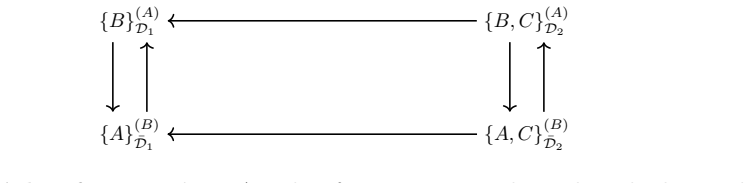
The central object is the 'atlas of perspectives': a directed graph whose nodes are perspectives (a reference system, the set of systems it describes, and a state space) and whose edges are reference-frame transformations, with consistency requiring that any two paths between perspectives compose to the same map. The paradox is the failure of the square in Figure 2 to commute: tracing out the third particle after transforming to B's perspective gives a different state than transforming after tracing it out. In the classical version, the transformation of Lemma 1 — derived from geometry, position-momentum separation, and information preservation — sends A's momentum in B's frame to -p_B - Σ p
Load-bearing premise
The load-bearing assumption is that 'removing a described system' means the ordinary trace/marginalization while reference-frame maps are invertible and information-preserving, and that relationality and decomposability are judged with respect to the same subsystem split; change any one of those and the no-go conclusion can be sidestepped.
What would settle it
Take the classical setup of Eq. (3.2): a bit m encoded in B's momentum, C at position 3 with momentum uniform on [-K,K], and apply the transformation of Lemma 1 to B's perspective. The paper predicts that successful decoding of m from A alone is at most 1/2 + (1/4)||Q_C - S_k Q_C||_1, which tends to 1/2 as K→∞. If, for the same initial state, there exists an information-preserving frame transformation to B's perspective under which A's marginal remains m-dependent, the claimed impossibility would be false.
If this is right
- Any proposed resolution of the paradox must sacrifice at least one of the three properties; the paper shows that known resolution strategies each do exactly this, so the no-go is not bypassed by tweaking details.
- Subsystem relativity is generic: as soon as information-preserving frame changes are relational, what counts as a subsystem (and which correlations exist) depends on the reference frame, classically as well as quantumly.
- A single classical particle cannot serve as an ideal reference frame for both translations and boosts in the sense of symplectically controlled operations; an ideal frame must have a phase space of the cotangent-bundle form G×g*.
- The information-theoretic reading is that an all-satisfying frame transformation would act as an 'information diode', but any non-trivial information-preserving transformation causes bidirectional information flow, so physical reference frames suffer back-action under operations.
Where Pith is reading between the lines
- A natural extension is that the no-go argument would likely survive in any theory whose state spaces have a product structure and whose 'removing a system' operation is a marginalization, since the proof only uses invertibility and factorization; this could be tested on general probabilistic theories.
- The authors flag the 'basis problem' — the transformation is relational in position but not in momentum — which suggests a direct test of whether using a composite frame restores momentum relationality and makes the contradictory diagram commute.
- If subsystem decompositions are genuinely frame-relative, then quantities built from coarse-graining, such as entropy and conditional information, are also frame-relative; the authors mention cryptographic relevance but do not develop the consequences for security definitions that assume a fixed subsystem adversary.
Editorial analysis
A structured set of objections, weighed in public.
Referee Report
Summary. The paper argues that the Paradox of the Third Particle—the inconsistency between two ways of relating descriptions of a bit encoded in a particle when a third particle is included—is not specific to quantum theory. It defines classical reference-frame transformations via three postulates (geometry, position/momentum separation, information preservation), exhibits a phase-space analogue in which the bit becomes non-retrievable from the frame particle when C is included, and then proves a no-go theorem (Theorem 2): any non-trivial atlas of classical or quantum perspectives with a fixed subsystem partitioning must violate at least one of information preservation, relationality, or decomposability. It also proves an equivalence between relationality and relativity of subsystem partitioning (Theorem 3). Full proofs are given in Appendix B.
Significance. The paper's central no-go theorem is a genuine and useful contribution: it formalizes a common structural obstacle in quantum reference frames and shows it is not quantum-specific. The explicit postulates and complete proofs are strengths, and the discussion of known resolution strategies in terms of the three properties is valuable. However, the concrete classical example is only approximate for finite K, and the abstract overstates the logical role of information preservation. These issues are local and fixable, but they affect the strength of the advertised claim.
major comments (2)
- [Section 3, Eq. (3.4); Theorem B.1] The claim that 'retrieval is impossible' is only correct if interpreted as 'perfect retrieval is impossible'. For every finite K, the marginal in (3.4) has total variation distance 1/(2K) between the m=0 and m=1 cases, giving an optimal success probability of 1/2 + 1/(4K), as Theorem B.1 itself shows. Thus the bit remains partially readable; 'effectively independent of M' is not an information-theoretic statement. The main text should be revised to state this bound explicitly and to clarify that the classical paradox is approximate (exact only in the improper K→∞ limit), rather than equating it with the quantum case where the reduced state is exactly M-independent.
- [Abstract and Section 6] The abstract states that 'if one demands that frame transformations be information-preserving, then it is impossible to meaningfully partition the world into subsystems'. This misstates Theorem 2, which requires information preservation together with relationality and decomposability; the theorem concludes that at least one of the three must fail. Information preservation alone is compatible with a non-trivial atlas if one of the other properties is given up. The abstract and the conclusion should present the result as a trilemma.
minor comments (4)
- [Section 5, 'The basis problem'] The paper correctly notes that the classical transformation is relational only in position, not momentum, and that Postulate 2 is the fragile premise. It would help to state explicitly in Section 3 that the concrete paradox depends on this postulate and does not survive if momentum is treated as relative in the same way as position.
- [Figure 2] The check marks in the figure are ambiguous between 'perfect retrieval' and 'any information'. The caption should specify that the diagram is about perfect retrieval, so that the finite-K classical case is not perceived as contradicting the displayed '×'.
- [Section 3, after Eq. (3.4)] Replace the phrase 'for large K' with a quantitative statement: for finite K the decoding advantage is 1/(4K), and zero only in theK→∞ limit, which is not a normalizable probability distribution.
- [Appendix B.2] The heading 'robust version of the classical paradox' may mislead; the theorem gives an upper bound on success probability that is strictly above 1/2 for any finite, normalizable Q_C. Consider calling it an 'approximate version' and clarifying that it does not provide an exact no-information regime.
Circularity Check
No circularity: all results follow from stated postulates and definitions.
full rationale
The paper's derivation chain is self-contained. Lemma 1 (Eq. 2.1) is proved from Postulates 1–3 (Appendix B.1), and the classical Paradox of the Third Particle is obtained by applying that explicitly derived transformation to the distributions in Eqs. (3.1)–(3.4); no parameter is fitted to the target conclusion and no 'prediction' secretly reduces to an input. Theorem 2 is a proof by contradiction from the formal definitions of a non-trivial consistent atlas, information preservation, relationality, and decomposability, with separate classical and quantum arguments in Appendix B.3; the claimed impossibility is not assumed in the premises. Theorem 3 is likewise an independent equivalence proof. The self-citations that appear (e.g., [30], [40], [51], [54]) are contextual or illustrate existing resolutions; none supplies a load-bearing uniqueness theorem, ansatz, or empirical input on which the main results depend. The finite-K approximation noted in Section 3 and Theorem B.1 is a quantitative accuracy concern, not a circularity: the main text's 'impossible to retrieve' statement is an idealization, but this does not make the derivation equivalent to its own assumptions.
Axiom & Free-Parameter Ledger
free parameters (1)
- K (width of C's uniform momentum prior) =
K > 0, considered large; success probability bounded by 1/2 + 1/(4K)
axioms (7)
- standard math Classical states are probability measures on finite-dimensional connected symplectic phase spaces; quantum states are density operators on separable Hilbert spaces.
- domain assumption Postulate 1: relative positions transform by shifting the origin (x_A^(B) = -x_B^(A), x_C^(B) = x_C^(A) - x_B^(A)).
- ad hoc to paper Postulate 2: momenta from B's perspective depend only on momenta from A's perspective, and the phase-space origin maps to itself.
- domain assumption Postulate 3: frame transformations are symplectomorphisms (information preservation).
- domain assumption Decomposability: removing a described system is the trace/marginalization with respect to the subsystem partitioning.
- domain assumption Atlas consistency: any two paths between the same perspectives compose to the same map.
- standard math Darboux theorem and standard symplectic/Poisson-geometry facts.
read the original abstract
The Paradox of the Third Particle arises when particles are described relative to one of them serving as a reference frame. Although it is typically attributed to quantum superpositions, we show that the paradox and its ramifications$\unicode{x2014}$such as the relativity of subsystems$\unicode{x2014}$already occur classically. In light of this insight, we establish a no-go theorem that holds whenever physical subsystems, whether classical or quantum, are used as reference frames: if one demands that frame transformations be information-preserving, then it is impossible to meaningfully partition the world into subsystems, like individual particles, from the perspective of each frame.
Figures



Forward citations
Cited by 1 Pith paper
-
Frame-Dependent Traces and the Third-Particle Paradox
The Third-Particle Paradox is not a contradiction: the authors characterize exactly which states allow consistent subsystem discarding in the perspective-neutral and quantum-information approaches.
Reference graph
Works this paper leans on
-
[1]
Yakir Aharonov and Leonard Susskind. “Charge superselection rule”. In:Phys. Rev. 155 (5 1967), pp. 1428–1431.doi:10.1103/PhysRev.155.1428. 14
-
[2]
Observability of the sign change of spinors under 2πrotations
Yakir Aharonov and Leonard Susskind. “Observability of the sign change of spinors under 2πrotations”. In:Phys. Rev.158 (5 1967), pp. 1237–1238.doi:10 . 1103 / PhysRev.158.1237
1967
-
[3]
Evolution without evolution: dynamics described by stationary observables
Don N. Page and William K. Wootters. “Evolution without evolution: dynamics described by stationary observables”. In:Phys. Rev. D27 (12 1983), pp. 2885–2892. doi:10.1103/PhysRevD.27.2885
-
[4]
Yakir Aharonov and Tirzah Kaufherr. “Quantum frames of reference”. In:Phys. Rev. D30 (2 1984), pp. 368–385.doi:10.1103/PhysRevD.30.368
-
[5]
Carlo Rovelli. “Quantum reference systems”. In:Class. Quant. Grav.8.2 (1991), p. 317.doi:10.1088/0264-9381/8/2/012
-
[6]
Reference frames, superselection rules, and quantum information
Stephen D. Bartlett, Terry Rudolph, and Robert W. Spekkens. “Reference frames, superselection rules, and quantum information”. In:Rev. Mod. Phys.79 (2 2007), pp. 555–609.doi:10.1103/RevModPhys.79.555
-
[8]
Physics within a quantum reference frame
Renato M. Angelo, Nicolas Brunner, Sandu Popescu, Anthony J. Short, and Paul Skrzypczyk. “Physics within a quantum reference frame”. In:J. Phys. A: Math. Theor.44.14 (Mar. 2011), p. 145304.issn: 1751-8121.doi:10.1088/1751-8113/44/ 14/145304
-
[9]
Alexander R. H. Smith, Marco Piani, and Robert B. Mann. “Quantum reference frames associated with noncompact groups: the case of translations and boosts and the role of mass”. In:Phys. Rev. A94 (1 2016), p. 012333.doi:10.1103/PhysRevA. 94.012333
doi:10.1103/physreva 2016
-
[10]
Relativity of quantum states and observables
Leon Loveridge, Paul Busch, and Takayuki Miyadera. “Relativity of quantum states and observables”. In:Europhysics Letters117.4 (2017), p. 40004.doi:10.1209/0295- 5075/117/40004
doi:10.1209/0295- 2017
-
[11]
Symmetry, reference frames, and relational quantities in quantum mechanics
Leon Loveridge, Takayuki Miyadera, and Paul Busch. “Symmetry, reference frames, and relational quantities in quantum mechanics”. In:Found. Phys.48.2 (2018), pp. 135–198.doi:10.1007/s10701-018-0138-3
-
[12]
Quantum mechan- ics and the covariance of physical laws in quantum reference frames
Flaminia Giacomini, Esteban Castro-Ruiz, and ˇCaslav Brukner. “Quantum mechan- ics and the covariance of physical laws in quantum reference frames”. In:Nat. Com- mun.10.494 (Jan. 2019), pp. 1–13.issn: 2041-1723.doi:10 . 1038 / s41467 - 018 - 08155-0
2019
-
[13]
Relativistic quan- tum reference frames: the operational meaning of spin
Flaminia Giacomini, Esteban Castro-Ruiz, and ˇCaslav Brukner. “Relativistic quan- tum reference frames: the operational meaning of spin”. In:Phys. Rev. Lett.123 (9 2019), p. 090404.doi:10.1103/PhysRevLett.123.090404
-
[14]
A change of perspective: switching quantum reference frames via a perspective- neutral framework
Augustin Vanrietvelde, Philipp A. H¨ ohn, Flaminia Giacomini, and Esteban Castro- Ruiz. “A change of perspective: switching quantum reference frames via a perspective- neutral framework”. In:Quantum4 (2020), p. 225.doi:10.22331/q-2020-01-27- 225. 15
-
[15]
How to switch between relational quantum clocks
Philipp A. H¨ ohn and Augustin Vanrietvelde. “How to switch between relational quantum clocks”. In:New J. Phys.22.12 (2020), p. 123048.doi:10.1088/1367- 2630/abd1ac
doi:10.1088/1367- 2020
-
[17]
The group structure of dynamical transformations between quantum reference frames
Angel Ballesteros, Flaminia Giacomini, and Giulia Gubitosi. “The group structure of dynamical transformations between quantum reference frames”. In:Quantum5 (2021), p. 470.doi:10.22331/q-2021-06-08-470
-
[18]
Anne-Catherine de la Hamette, Thomas D. Galley, Philipp A. H¨ ohn, Leon Loveridge, and Markus P. M¨ uller.Perspective-neutral approach to quantum frame covariance for general symmetry groups. 2021. arXiv:2110.13824 [quant-ph]
Pith/arXiv arXiv 2021
-
[19]
Trinity of relational quantum dynamics
Philipp A. H¨ ohn, Alexander R. H. Smith, and Maximilian P. E. Lock. “Trinity of relational quantum dynamics”. In:Phys. Rev. D104.6 (2021), p. 066001.doi:10. 1103/PhysRevD.104.066001
2021
-
[20]
Quantum reference frame transformations as symmetries and the paradox of the third particle
Marius Krumm, Philipp A. H¨ ohn, and Markus P. M¨ uller. “Quantum reference frame transformations as symmetries and the paradox of the third particle”. In:Quantum 5 (Aug. 2021), p. 530.doi:10.22331/q-2021-08-27-530
-
[21]
Transformation of spin in quantum reference frames
Marion Mikusch, Luis C. Barbado, and ˇCaslav Brukner. “Transformation of spin in quantum reference frames”. In:Phys. Rev. Res.3 (4 2021), p. 043138.doi:10.1103/ PhysRevResearch.3.043138
2021
-
[22]
Internal quantum reference frames for finite Abelian groups
Philipp A. H¨ ohn, Marius Krumm, and Markus P. M¨ uller. “Internal quantum reference frames for finite Abelian groups”. In:Journal of Mathematical Physics63.11 (Nov. 2022).issn: 1089-7658.doi:10.1063/5.0088485
-
[23]
Quantum relativity of subsystems
Shadi Ali Ahmad, Thomas D. Galley, Philipp A. H¨ ohn, Maximilian P. E. Lock, and Alexander R. H. Smith. “Quantum relativity of subsystems”. In:Physical Review Letters128.17 (2022).issn: 1079-7114.doi:10.1103/physrevlett.128.170401
-
[24]
Jan G lowacki.Operational quantum frames: an operational approach to quantum ref- erence frames. 2023. arXiv:2304.07021 [quant-ph]
Pith/arXiv arXiv 2023
-
[25]
Augustin Vanrietvelde, Philipp A. H¨ ohn, and Flaminia Giacomini. “Switching quan- tum reference frames in the N-body problem and the absence of global relational perspectives”. In:Quantum7 (2023), p. 1088.doi:10.22331/q-2023-08-22-1088
-
[26]
H¨ ohn, Andrea Russo, and Alexander R
Philipp A. H¨ ohn, Andrea Russo, and Alexander R. H. Smith.Matter relative to quantum hypersurfaces. 2023. arXiv:2308.12912 [quant-ph]
Pith/arXiv arXiv 2023
-
[27]
H¨ ohn, Isha Kotecha, and Fabio M
Philipp A. H¨ ohn, Isha Kotecha, and Fabio M. Mele.Quantum frame relativity of subsystems, correlations and thermodynamics. 2023. arXiv:2308.09131 [quant-ph]
Pith/arXiv arXiv 2023
-
[28]
Quantum reference frames for an indefinite metric
Anne-Catherine de la Hamette, Viktoria Kabel, Esteban Castro-Ruiz, and ˇCaslav Brukner. “Quantum reference frames for an indefinite metric”. In:Communications Physics6.1 (Aug. 2023).issn: 2399-3650.doi:10.1038/s42005-023-01344-4. 16
-
[29]
Quantum conformal symmetries for spacetimes in superposition
Viktoria Kabel, Anne-Catherine de la Hamette, Esteban Castro-Ruiz, and ˇCaslav Brukner. “Quantum conformal symmetries for spacetimes in superposition”. In: Quantum8 (Dec. 2024), p. 1547.issn: 2521-327X.doi:10.22331/q-2024-12-04- 1547
-
[30]
Measure- ment events relative to temporal quantum reference frames
Ladina Hausmann, Alexander Schmidhuber, and Esteban Castro-Ruiz. “Measure- ment events relative to temporal quantum reference frames”. In:Quantum9 (2025), p. 1616.doi:10.22331/q-2025-01-30-1616
-
[31]
Angel Ballesteros, Diego Fernandez-Silvestre, Flaminia Giacomini, and Giulia Gu- bitosi.Quantum Galilei group as quantum reference frame transformations. 2025. arXiv:2504.00569 [quant-ph]
arXiv 2025
-
[32]
Anne-Catherine de la Hamette, Viktoria Kabel, and ˇCaslav Brukner.Quantum refer- ence frames in arbitrary charge sectors: accessibility of global properties from internal perspectives. 2025. arXiv:2510.09100 [quant-ph]
arXiv 2025
-
[33]
Operational quantum reference frame transformations
Titouan Carette, Jan Glowacki, and Leon Loveridge. “Operational quantum reference frame transformations”. In:Quantum9 (Mar. 2025), p. 1680.doi:10.22331/q-2025- 03-27-1680
doi:10.22331/q-2025- 2025
-
[34]
Julian De Vuyst, Philipp A. H¨ ohn, and Artur Tsobanjan.On the relation between perspective-neutral, algebraic, and effective quantum reference frames. 2025. arXiv: 2507.14131 [quant-ph]
Pith/arXiv arXiv 2025
-
[35]
Gravitational entropy is observer-dependent
Julian De Vuyst, Stefan Eccles, Philipp A. H¨ ohn, and Josh Kirklin. “Gravitational entropy is observer-dependent”. In:J. High Energy Phys.2025.7 (July 2025), p. 146. issn: 1029-8479.doi:10.1007/JHEP07(2025)146
-
[36]
H¨ ohn, and Fabio M
Sylvain Carrozza, Aidan Chatwin-Davies, Philipp A. H¨ ohn, and Fabio M. Mele.A cor- respondence between quantum error correcting codes and quantum reference frames
-
[37]
H¨ ohn, and Francesco Sartini.Relational entan- glement entropies and quantum reference frames in gauge theories
Goncalo Araujo-Regado, Philipp A. H¨ ohn, and Francesco Sartini.Relational entan- glement entropies and quantum reference frames in gauge theories. 2025. arXiv:2506. 23459 [hep-th]
2025
-
[38]
Relative subsystems and quantum ref- erence frame transformations
Esteban Castro-Ruiz and Ognyan Oreshkov. “Relative subsystems and quantum ref- erence frame transformations”. In:Commun. Phys.8.187 (Apr. 2025), pp. 1–17.issn: 2399-3650.doi:10.1038/s42005-025-02036-x
-
[39]
Esteban Castro-Ruiz, Thomas D. Galley, and Leon Loveridge.Interpreting quantum reference frame transformations through a simple example. 2025. arXiv:2508.09540 [quant-ph]
arXiv 2025
-
[40]
S´ ebastien Christophe Garmier, Ladina Hausmann, and Esteban Castro-Ruiz.The perspectives of non-ideal quantum reference frames. 2025. arXiv:2512 . 19343 [quant-ph]
2025
-
[41]
Mixed states for reference frame transformations
Gaetano Fiore and Fedele Lizzi. “Mixed states for reference frame transformations”. In:Int. J. Geom. Methods Mod. Phys.(Mar. 2026), p. 2650201.issn: 0219-8878.doi: 10.1142/S0219887826502014
-
[42]
Anne-Catherine de la Hamette.Observer-dependent entropy and diagonal r´ enyi in- variants in quantum reference frames. 2026. arXiv:2603.23598 [quant-ph].url: https://arxiv.org/abs/2603.23598. 17
arXiv 2026
-
[43]
Elias Rothlin, Carla Ferradini, and Lin-Qing Chen.Error correction in lattice quantum electrodynamics with quantum reference frames. 2026. arXiv:2604.06149 [quant-ph]
Pith/arXiv arXiv 2026
-
[44]
Paolo Luppi, Viktoria Kabel, Flaminia Giacomini, and Andrea Smirne.Reduced quantum-reference-frame channels for open quantum systems. 2026. arXiv:2607 . 05578 [quant-ph]
2026
-
[45]
2026.url:https://quantum.physics.sk/ocqg2026/index
Esteban Castro-Ruiz, Kristina Giesel, Giulia Gubitosi, Fedele Lizzi, and Renato Ren- ner.Discussion session at the conference on Observers and Causality in Quantum Gravity, Bratislava. 2026.url:https://quantum.physics.sk/ocqg2026/index. html
2026
-
[46]
unpublished
Marius Krumm, Esteban Castro-Ruiz, and ˇCaslav Brukner. unpublished. 2021
2021
-
[47]
2024.url:https://www.youtube.com/live/APHlNaCTikk?si= ESwk5YqtHcnTrv2q&t=1201
ˇCaslav Brukner.The common misconceptions around quantum reference frames and causal ordering. 2024.url:https://www.youtube.com/live/APHlNaCTikk?si= ESwk5YqtHcnTrv2q&t=1201
2024
-
[48]
Evidence for the epistemic view of quantum states: a toy theory
Robert W. Spekkens. “Evidence for the epistemic view of quantum states: a toy theory”. In:Physical Review A75.3 (Mar. 2007).issn: 1094-1622.doi:10 . 1103 / physreva.75.032110
2007
-
[49]
Quasi-quantization: Classical statistical theories with an epis- temic restriction
Robert W. Spekkens. “Quasi-quantization: Classical statistical theories with an epis- temic restriction”. In:Quantum Theory: Informational Foundations and Foils. Dor- drecht, The Netherlands: Springer, Dec. 2015, pp. 83–135.isbn: 978-94-017-7303-4. doi:10.1007/978-94-017-7303-4_4
-
[50]
Why interference phenomena do not capture the essence of quantum theory
Lorenzo Catani, Matthew Leifer, David Schmid, and Robert W. Spekkens. “Why interference phenomena do not capture the essence of quantum theory”. In:Quantum 7 (2023), p. 1119.issn: 2521-327X.doi:10.22331/q-2023-09-25-1119
-
[51]
Toys can’t play: physical agents in Spekkens’ theory
Ladina Hausmann, Nuriya Nurgalieva, and L ´ ıdia del Rio. “Toys can’t play: physical agents in Spekkens’ theory”. In:New Journal of Physics25.2 (Feb. 2023), p. 023018. issn: 1367-2630.doi:10.1088/1367-2630/acb3ef
-
[52]
On the significance of wigner’s friend in contexts beyond quantum foundations
Caroline L. Jones and Markus P. M¨ uller. “On the significance of wigner’s friend in contexts beyond quantum foundations”. In:Quantum10 (June 2026), p. 2147.doi: 10.22331/q-2026-06-30-2147
-
[53]
Testing quantum theory with thought exper- iments
Nuriya Nurgalieva and Renato Renner. “Testing quantum theory with thought exper- iments”. In:Contemporary Physics61.3 (2020), pp. 193–216.issn: 1366-5812.doi: 10.1080/00107514.2021.1880075
arXiv 2020
-
[54]
The firewall paradox is Wigner’s friend paradox
Ladina Hausmann and Renato Renner. “The firewall paradox is Wigner’s friend paradox”. In:The Black Hole Information Paradox. Singapore: Springer, Aug. 2025, pp. 371–398.isbn: 978-981-96-6170-1.doi:10.1007/978-981-96-6170-1_13
-
[55]
Lucien Hardy.The construction interpretation: conceptual roads to quantum gravity
-
[56]
Quantum formulation of the Einstein equiva- lence principle
Magdalena Zych and ˇCaslav Brukner. “Quantum formulation of the Einstein equiva- lence principle”. In:Nat. Phys.14 (Oct. 2018), pp. 1027–1031.issn: 1745-2481.doi: 10.1038/s41567-018-0197-6. 18
-
[57]
Flaminia Giacomini and ˇCaslav Brukner.Einstein ’s equivalence principle for superpo- sitions of gravitational fields and quantum reference frames. 2020. arXiv:2012.13754 [quant-ph]
Pith/arXiv arXiv 2020
-
[58]
Implementation of the quantum equivalence principle
Lucien Hardy. “Implementation of the quantum equivalence principle”. In:Progress and Visions in Quantum Theory in View of Gravity. Cham, Switzerland: Birkh¨ auser, Apr. 2020, pp. 189–220.isbn: 978-3-030-38941-3.doi:10.1007/978-3-030-38941- 3_8
-
[59]
Quantum superposition of spacetimes obeys Einstein’s equivalence principle
Flaminia Giacomini and ˇCaslav Brukner. “Quantum superposition of spacetimes obeys Einstein’s equivalence principle”. In:A VS Quantum Sci.4.1 (Jan. 2022), p. 015601.doi:10.1116/5.0070018
-
[60]
Paulette Libermann and Charles-Michel Marle.Symplectic Geometry and Analytical Mechanics. Dordrecht, The Netherlands: Springer Netherlands, 1987.isbn: 978-94- 009-3807-6.doi:10.1007/978-94-009-3807-6
-
[61]
Spekkens’ toy model in all dimensions and its relationship with stabiliser quantum mechanics
Lorenzo Catani and Dan E. Browne. “Spekkens’ toy model in all dimensions and its relationship with stabiliser quantum mechanics”. In:New J. Phys.19.7 (July 2017), p. 073035.issn: 1367-2630.doi:10.1088/1367-2630/aa781c
-
[62]
Ladina Hausmann, Nuriya Nurgalieva, and L ´ ıdia del Rio.A consolidating review of Spekkens’ toy theory. 2021. arXiv:2105.03277 [quant-ph]
Pith/arXiv arXiv 2021
-
[63]
Berlin, Germany: Springer, 2008.isbn: 978-3-540-45330-7.url:https://link.springer.com/book/10.1007/ 978-3-540-45330-7
Ana Cannas da Silva.Lectures on Symplectic Geometry. Berlin, Germany: Springer, 2008.isbn: 978-3-540-45330-7.url:https://link.springer.com/book/10.1007/ 978-3-540-45330-7
2008
-
[64]
Causal structure in the presence of sectorial constraints, with application to the quantum switch
Nick Ormrod, Augustin Vanrietvelde, and Jonathan Barrett. “Causal structure in the presence of sectorial constraints, with application to the quantum switch”. In: Quantum7 (June 2023), p. 1028.issn: 2521-327X.doi:10.22331/q-2023-06-01- 1028
-
[65]
Causal and compositional structure of unitary transformations
Robin Lorenz and Jonathan Barrett. “Causal and compositional structure of unitary transformations”. In:Quantum5 (2021), p. 511.issn: 2521-327X.doi:10.22331/q- 2021-07-28-511. 19 Appendix A Classical mechanics In the Hamiltonian formulation of classical mechanics, the state space of the system is its phase space, which, mathematically, is a symplectic mani...
doi:10.22331/q- 2021
-
[2018]
arXiv:1807.10980 [quant-ph]
-
[2025]
arXiv:2412.15317 [quant-ph]
discussion (0)
Sign in with ORCID, Apple, or X to comment. Anyone can read and Pith papers without signing in.