REVIEW 3 major objections 5 minor 19 references
Phonetic forced alignment for low-resource language varieties: Model training and evaluation on Chengdu Mandarin
T0 review · 3 major / 5 minor · reviewed 2026-08-01 · deepseek-v4-flash
Pith's one-line read This paper shows that a fully automatic bootstrapping pipeline—a customized G2P dictionary, a text-dependent aligner, pseudo-labels, then a text-independent aligner—can build accurate forced aligners for a low-resource variety like Chengdu
desk verdict A useful resource paper with a clear bootstrapping pipeline, but the validation is weakened by train/test speaker overlap, so the central generalization claim is not yet supported. read the letter →
The pith
A machine-rendered reading of the paper's core claim, the machinery that carries it, and where it could break.
The reading
What carries the argument
The load-bearing mechanism is the bootstrapping pipeline itself: (1) a custom grapheme-to-phoneme dictionary tailored to the Chengdu sound inventory, where each syllable nucleus plus tone is modeled as a single unit; (2) a GMM-HMM text-dependent aligner (Chengdu-MFA) trained on utterance-level transcripts without manually annotated boundaries; (3) automatic generation of phone-level pseudo-labels from this aligner; and (4) fine-tuning a pretrained speech encoder as a frame classifier (Chengdu-FC) using a boundary-weighted cross-entropy loss that up-weights frames near phone boundaries in later training epochs. The pseudo-labels do the critical work: they convert the aligner's output into sup
What would settle it
Retrain all models with all recordings from the 10 test speakers held out entirely, then realign the same gold-standard test set; if the boundary-error reductions over Standard Mandarin baselines disappear or drop sharply, the claim that the pipeline generalizes to new Chengdu speakers is not supported.
Extended reading notes
Core claim
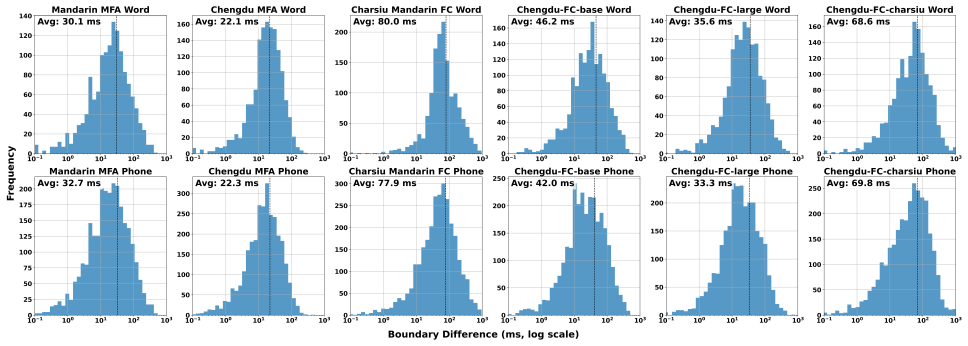
The central claim is that variety-specific forced aligners for Chengdu Mandarin can be trained from about 17 hours of speech plus an expert-reviewed G2P dictionary, and that these aligners significantly outperform Standard Mandarin baselines even though the baselines were trained on far more data. The text-dependent aligner, Chengdu-MFA, a GMM-HMM model, reduced the average phone-tier boundary difference from 32.7 ms to 22.3 ms, a 31.8% improvement. The text-independent frame-classification model, Chengdu-FC-xlsr, reduced the same metric from 77.9 ms to 30.2 ms, a 61.2% improvement, while also supporting transcript-free alignment at inference. The paper establishes an end-to-end bootstrappin
Load-bearing premise
The evaluation mixes test and training speakers, so the measured gains may come partly from the models memorizing those speakers' voices rather than from learning generalizable Chengdu phonology.
Editorial extensions
If this is right
- If the pipeline works as claimed, any low-resource language variety with a few hours of transcribed speech and a curated G2P dictionary can quickly obtain dedicated text-dependent and text-independent aligners.
- Text-independent alignment becomes feasible for under-resourced varieties, enabling phonetic analysis of recordings that lack transcripts.
- Phonetic studies on Chengdu Mandarin gain concrete tools that are markedly more accurate than applying Standard Mandarin models.
- The result strengthens the case that variety-specific training is necessary for regional dialects, not just a nice-to-have refinement.
- The pseudo-label bootstrapping step reduces the need for expensive expert boundary annotation, lowering the barrier for future low-resource alignment projects.
Reading between the lines
- The same pipeline likely transfers to other Southwestern Mandarin varieties, but the G2P dictionary is the bottleneck: it must be re-curated for each variety's sound inventory, and dictionary quality may matter more than corpus size.
- Because the evaluation set shares speakers with the training set, the reported 61.2% error reduction may partly reflect speaker-specific memorization; a clean speaker-split evaluation would likely show smaller but still substantial gains.
- The boundary-weighted curriculum loss is a plausible main driver of the frame-classification model's improvement; ablating it (training without boundary weighting) would isolate its contribution.
- The pipeline could be extended into a self-training loop: use the frame-classification model to re-align the corpus, then retrain the GMM-HMM model on those improved labels, potentially further reducing boundary errors.
Signed reviews
Editorial analysis
A structured set of objections, weighed in public.
Referee Report
Summary. The paper develops forced aligners for Chengdu Mandarin, a low-resource Mandarin variety, using a bootstrapping pipeline: a custom G2P dictionary, a text-dependent GMM-HMM aligner (Chengdu-MFA) trained on a 17-hour corpus, and text-independent frame-classification aligners (Chengdu-FC) fine-tuned on pseudo-labels generated by Chengdu-MFA. Evaluation on an expert-annotated 50-minute test set reports large improvements over Standard Mandarin baselines: 31.8% mean phone boundary error reduction for Chengdu-MFA and 61.2% for Chengdu-FC-xlsr. The paper claims to establish a reproducible workflow for other under-resourced varieties without manual boundary annotation.
Significance. If the results are valid, the paper makes a useful practical contribution: it provides the first dedicated Chengdu Mandarin aligners, a G2P dictionary, and a worked example of a self-supervised bootstrapping pipeline for low-resource language varieties. The methodology is clearly described, uses standard toolkits, and reports hyperparameter choices, which aids reproducibility. The release of models and dictionary would be valuable to phonetic research on Southwestern Mandarin. However, the central empirical claim — that the pipeline is validated for the target use case of unseen speakers — is weakened by the evaluation design, and the headline FC improvement is partly confounded by architecture differences, so the practical significance is currently less well established than the abstract implies.
major comments (3)
- [§3.1/§4] The evaluation is not speaker-independent. Section 3.1 states that the 50-minute test set was sampled from 10 of the 15 speakers and that the MFA training set is 'the full master dataset minus the test set'; the FC training set is derived from the MFA training pseudo-labels. Thus the non-test portions of the same 10 speakers' recordings — likely other segments of the same audio files — remain in training for both Chengdu-MFA and all Chengdu-FC models, whereas the Mandarin baselines have never seen these speakers. The comparison is therefore asymmetric, and the large error reductions could partly reflect speaker/channel memorization rather than generalizable alignment. Section 4's caveat ('future work should assess generalization to unseen speakers') is a direct admission that the present results do not yet validate the pipeline for the target use case. A speaker-disjoint held-out set, or
- [§3.4.1 and Conclusion] The headline 61.2% reduction is confounded by architecture. Table 1 compares Chengdu-FC-xlsr, fine-tuned from XLS-R-300m, against the Charsiu-Mandarin-FC baseline, which appears to use a different pretrained encoder. The only matched-architecture comparison is Chengdu-FC-charsiu vs. Charsiu-Mandarin-FC, which shows a phone-level reduction of about 10.4% (77.9 to 69.8 ms), not 61.2%. The Conclusion's statement that baselines have 'identical architectures' is therefore inaccurate for the best FC model. To quantify the effect of Chengdu-specific adaptation alone, the authors should compare against a Standard Mandarin FC model fine-tuned from the same XLS-R-300m checkpoint, or should present the matched-architecture result as the headline.
- [§3.4.1/Table 1] The statistical claims need to account for speaker-level clustering. The paper reports 'all differences are statistically significant (Welch's t-test, p < .001)' on boundary-level absolute differences. With only 10 test speakers and many boundaries per speaker, boundary-level errors are not independent; treating them as independent inflates significance and ignores speaker-level variance. A mixed-effects model or cluster-robust (by speaker) test should be used, and speaker-level effect sizes or confidence intervals should be reported. In addition, no inter-annotator agreement is reported for the gold-standard phone boundaries; without it, the absolute boundary-difference numbers are difficult to interpret, although the comparison across systems is partially protected because all systems use the same gold standard.
minor comments (5)
- [Abstract/§2.2/§3.2.2] Typos: 'test set show' should be 'test set shows'; 'text-dependentalignment' is missing a space; 'fine-tined' should be 'fine-tuned'.
- [§3.3] The text-independent evaluation is not fully reproducible: the boundary-matching procedure (one-to-one assignment, tolerance window, handling of predicted boundaries near utterance edges) is not described. Please specify the exact algorithm used to compute precision, recall, and R-value.
- [§3.4.2] Table 3 reports R-value and F1 differences without statistical tests. Add bootstrap confidence intervals or a significance test, ideally clustered by speaker, for the text-independent results.
- [Conclusion] The Abstract claims the pipeline works 'without labor- and time-intensive manual annotation,' but the method required a hand-corrected G2P dictionary and an expert gold test set. Clarify that the labor is shifted to dictionary construction and evaluation rather than eliminated.
- [General] The paper claims to release the aligners and G2P dictionary, but no repository URL or download link is provided. An availability statement is needed for reproducibility.
Circularity Check
No significant circularity; the evaluation uses independent gold annotations and the only self-citation is a data source, not a load-bearing derivation.
full rationale
The paper's derivation chain is not circular. Chengdu-MFA is trained from utterance-level transcripts and a G2P dictionary, without manual phone boundaries. Chengdu-FC is trained on pseudo-labels generated by Chengdu-MFA, but the reported evaluation compares both models against a separately expert-annotated gold-standard test set, not against the pseudo-labels or the G2P dictionary. The G2P dictionary was built with Pypinyin/DeepSeek-v3 plus native-speaker review, not derived from the alignment outputs. The only notable self-citation is the master corpus [13], co-authored by one of the present authors, but this is an external audio/text dataset rather than a result that the paper's predictions reduce to. The paper explicitly discloses the speaker-overlap limitation ('Because the current evaluation contains speakers whose other recordings were included in training, future work should assess generalization to unseen speakers and additional speech domains'), which is a validity and generalization concern, not a circularity: it does not make any equation or fitted parameter identical to the target by construction. No 'prediction' is statistically forced by its training input, no uniqueness theorem is imported from the authors, and no ansatz is smuggled in via self-citation. The two reductions in boundary error are measured against manual annotations and therefore have independent content. The result is a legitimate, if limited, empirical comparison; the correct critique is about speaker-independent evaluation, not circular reasoning.
Assumptions & free parameters
free parameters (7)
- learning rate =
not reported (searched [1e-5, 3e-4])
- boundary weight gamma =
not reported (searched [5,15])
- boundary radius r =
not reported (searched [0,2])
- curriculum switch epoch E =
2
- total epochs =
10
- batch size =
8
- weight decay =
1e-4
assumptions (5)
- domain assumption The MFA/Kaldi GMM-HMM training procedure produces valid alignments when given transcripts and a pronunciation dictionary.
- domain assumption Pretrained Wav2Vec2/XLS-R encoders can be fine-tuned on frame-level phone labels to yield accurate boundaries.
- domain assumption The expert-annotated gold test set is correct.
- domain assumption The corpus from Li (2022) is representative of urban Chengdu Mandarin.
- ad hoc to paper Train/test speakers may overlap without materially affecting results.
Cite this review
Pith. "Pith review of Phonetic forced alignment for low-resource language varieties: Model training and evaluation on Chengdu Mandarin." pith.science (2026). https://pith.science/paper/67K5ARIE
@misc{pith2026260721332,
  author       = {Pith},
  title        = {Pith review of: Phonetic forced alignment for low-resource language varieties: Model training and evaluation on Chengdu Mandarin},
  year         = {2026},
  howpublished = {\url{https://pith.science/paper/67K5ARIE}},
  note         = {Machine review of arXiv:2607.21332}
}
read the original abstract
Phonetic forced alignment is a key technique in phonetic research, yet existing alignment systems lack specialized models for low-resource language varieties. We address this by training text-dependent and text-independent aligners for Chengdu Mandarin using a 17-hour corpus and a custom G2P dictionary. We trained a text-dependent GMM-HMM model (Chengdu-MFA) and fine-tuned a pretrained audio encoder on frame classification with Chengdu-MFA's pseudo label for text-independent alignment (Chengdu-FC). Evaluation on an expert-annotated test set show that both methods significantly outperform Standard Mandarin baselines. Chengdu-MFA reduced average phone boundary differences by 31.8%, while Chengdu-FC achieved a 61.2% reduction. This work establishes a practical bootstrapping pipeline for developing accurate aligners for under-resourced varieties without labor- and time-intensive manual annotation.
Figures
Reference graph
Works this paper leans on
-
[1]
Phonetic forced alignment is a critical technique for syn- chronizing speech transcription with audio at the utterance, word, and phone levels [1, 2]
Introduction The increasing availability of spoken language data has height- ened the need for reliable automated methods in phonetic anal- ysis. Phonetic forced alignment is a critical technique for syn- chronizing speech transcription with audio at the utterance, word, and phone levels [1, 2]. By automating time-aligned an- notations, dedicated aligners...
-
[2]
Method 2.1. G2P Dictionary for Chengdu Mandarin While Mandarin varieties share a character-based writing sys- tem, they differ considerably in their sound inventories. The phone set used by Standard Mandarin models does not apply arXiv:2607.21332v1 [cs.CL] 23 Jul 2026 to the sound inventory of Chengdu Mandarin. Therefore, we compiled a Chengdu Mandarin di...
arXiv 2026
-
[3]
Dataset The master dataset for this study consisted of 15 high-quality audio recordings of Chengdu Mandarin and the corresponding text transcriptions drawn from [13]
Experiments 3.1. Dataset The master dataset for this study consisted of 15 high-quality audio recordings of Chengdu Mandarin and the corresponding text transcriptions drawn from [13]. The audios were produced by 15 speakers born and raised in urban Chengdu, a southwest- ern city in Sichuan, China. Each audio ranges from 0.6 to 1.7 hours; the total duratio...
-
[4]
Discussion Our results demonstrate the benefits of variety-specific train- ing for phonetic alignment. Under the present experimental conditions, Chengdu-MFA provided the most accurate text- dependent alignments, despite being trained on only approxi- mately 17 hours of utterance-transcribed speech. GMM-HMM- based systems therefore remain a practical opti...
-
[5]
Conclusion In this study, we created a Chengdu Mandarin phonetic forced alignment dataset with a G2P dictionary covering all characters in the dataset. We trained a MFA acoustic model for Chengdu Mandarin for text-dependent alignment and a Chengdu Man- darin frame classification model capable of performing both text-dependent and -independent alignment. O...
-
[6]
Using forced align- ment for phonetics research,
J. Yuan, W. Lai, C. Cieri, and M. Liberman, “Using forced align- ment for phonetics research,” inChinese language resources: Data collection, linguistic analysis, annotation and language pro- cessing. Springer, 2023, pp. 289–301
2023
-
[7]
Comparing language- specific and cross-language acoustic models for low-resource phonetic forced alignment,
E. Chodroff, E. P. Ahn, and H. Dolatian, “Comparing language- specific and cross-language acoustic models for low-resource phonetic forced alignment,” 2025
2025
-
[8]
Speaker identification on the scotus corpus,
J. Yuan, M. Libermanet al., “Speaker identification on the scotus corpus,”Journal of the Acoustical Society of America, vol. 123, no. 5, p. 3878, 2008
2008
Show all 19 references
-
[9]
Prosodylab-aligner: A tool for forced alignment of laboratory speech,
K. Gorman, J. Howell, and M. Wagner, “Prosodylab-aligner: A tool for forced alignment of laboratory speech,”Canadian acous- tics, vol. 39, no. 3, pp. 192–193, 2011
2011
-
[10]
Fave (forced alignment and vowel ex- traction) suite version 1.1. 3,
I. Rosenfelder, J. Fruehwald, K. Evanini, S. Seyfarth, K. Gorman, H. Prichard, and J. Yuan, “Fave (forced alignment and vowel ex- traction) suite version 1.1. 3,” 2014
2014
-
[11]
Montreal forced aligner: Trainable text-speech align- ment using kaldi
M. McAuliffe, M. Socolof, S. Mihuc, M. Wagner, and M. Son- deregger, “Montreal forced aligner: Trainable text-speech align- ment using kaldi.” inInterspeech, vol. 2017, 2017, pp. 498–502
2017
-
[12]
Phone-to-audio alignment without text: A semi-supervised approach,
J. Zhu, C. Zhang, and D. Jurgens, “Phone-to-audio alignment without text: A semi-supervised approach,” inICASSP 2022 - 2022 IEEE International Conference on Acoustics, Speech and Signal Processing (ICASSP), 2022, pp. 8167–8171
2022
-
[13]
C. N. Li and S. A. Thompson,Mandarin Chinese: A functional reference grammar. Univ of California Press, 1989
1989
-
[14]
Tradition or in- novation: A comparison of modern asr methods for forced align- ment,
R. Rousso, E. Cohen, J. Keshet, and E. Chodroff, “Tradition or in- novation: A comparison of modern asr methods for forced align- ment,”arXiv preprint arXiv:2406.19363, 2024
2024 arXiv
-
[15]
An improved speech segmentation quality measure: the r-value
O. J. R ¨as¨anen, U. K. Laine, and T. Altosaar, “An improved speech segmentation quality measure: the r-value.” inInterspeech, 2009, pp. 1851–1854
2009
-
[16]
Self-supervised contrastive learning for unsupervised phoneme segmentation,
F. Kreuk, J. Keshet, and Y . Adi, “Self-supervised contrastive learning for unsupervised phoneme segmentation,”arXiv preprint arXiv:2007.13465, 2020
2007 arXiv
-
[17]
Deepseek-v3 technical re- port,
A. Liu, B. Feng, B. Xue, B. Wang, B. Wu, C. Lu, C. Zhao, C. Deng, C. Zhang, C. Ruanet al., “Deepseek-v3 technical re- port,”arXiv preprint arXiv:2412.19437, 2024
2024 arXiv
-
[18]
Regional dialect leveling in mandarin chinese: The case of locative variation in the chengdu dialect,
A. Li, “Regional dialect leveling in mandarin chinese: The case of locative variation in the chengdu dialect,”Asia-Pacific Language Variation, vol. 8, no. 1, pp. 32–71, 2022
2022
-
[19]
Elan: a professional framework for mul- timodality research,
P. Wittenburg, H. Brugman, A. Russel, A. Klassmann, and H. Sloetjes, “Elan: a professional framework for mul- timodality research,” inInternational Conference on Lan- guage Resources and Evaluation, 2006. [Online]. Available: https://api.semanticscholar.org/CorpusID:18212263
2006
Reviewed August 1, 2026 · model on record in the stance chip above.
Discussion (0). Continue with ORCID to comment.