REVIEW 2 major objections 5 minor 2 cited by
Magnetic Breakdown and Anomalous Quantum Oscillation in Rhombohedral Tetralayer Graphene
T0 review · 2 major / 5 minor · reviewed 2026-08-05 · deepseek-v4-flash
Pith's one-line read This paper claims that magnetic breakdown among three small Fermi pockets near Van Hove singularities produces the anomalous two-tone Shubnikov-de Haas frequencies seen in rhombohedral tetralayer graphene, with the noninteracting band struc
desk verdict A genuinely new magnetic-breakdown mechanism for the anomalous SdH frequencies in R4G, carefully calculated, but the claimed quantitative agreement with experiment rests on a disorder level six times cleaner than the experimental fit. read the letter →
The pith
A machine-rendered reading of the paper's core claim, the machinery that carries it, and where it could break.
The reading
What carries the argument
The central mechanism is magnetic breakdown in a finite ring of three symmetry-related pockets. In the effective description, three degenerate Landau-level branches are coupled by a tunneling amplitude t_N and a gauge-invariant phase Phi_N = l_B^2 A0 + ... , giving eigenvalues E_N,m = E_N - 2t_N cos[(Phi_N+2*pi*m)/3]; repeated crossings of these branches create the ring-like Landau-fan structures. The full calculation replaces the toy model with exact Peierls-substituted continuum Landau levels and evaluates rho_xx via the Kubo formula with SCBA disorder broadening, which makes the crossings prominent because rho_xx is controlled by products of neighboring spectral functions. The semiclassic
What would settle it
A direct test: measure SdH in R4G at uD about 41.0 meV, where the three-pocket-annular VHS is absent and the paper's map shows no tone I/tone II; if the two high-frequency tones still appear, the breakdown mechanism fails. Alternatively, raise the effective Dingle temperature in the calculation to the experimental about 0.3 K: the paper predicts strong suppression, so persisting peaks there would also refute it.
Extended reading notes
Core claim
The paper's central claim is that the anomalous high-frequency "multitone" Shubnikov-de Haas oscillations measured in rhombohedral tetralayer graphene are produced by magnetic breakdown near Van Hove singularities. In a magnetic field, quasiparticles tunnel coherently between three C3-related small electron pockets separated by VHSs; the three degenerate Landau-level branches hybridize and accumulate a phase that winds as 1/B, so the branches repeatedly cross, forming braided ring-like structures in the Landau fan. Because the longitudinal resistivity is enhanced whenever the disorder-broadened spectral functions of two crossing levels overlap, a fixed-density sweep over B registers an addit
Load-bearing premise
The multitone peaks appear in the calculation only at a disorder level roughly six times cleaner than the experiment's Dingle fit (T_D about 0.05 K versus about 0.3 K), and the paper does not show they survive at the experimental disorder, so the match rests on the assumption that SCBA short-range broadening at the cleaner level remains representative.
Editorial extensions
If this is right
- The recent multitone SdH experiment in R4G can be explained quantitatively by the noninteracting band structure of a spin- and valley-polarized normal state, without invoking additional symmetry breaking or strong correlations.
- The two anomalous frequencies are nearly density-independent only in the density range where the VHS separates the three-pocket and annular Fermi surfaces; outside that range the standard Onsager frequencies (n, n/3, 2n/3, annular areas) appear.
- Magnetic-breakdown-induced SdH peaks are more robust to temperature than ordinary Fermi-surface peaks, but are optimized at an intermediate disorder level and suppressed at larger disorder.
- The multitone response is a normal-state Fermi-surface probe, not a signature of chiral superconductivity or of the topology (C=0 vs C=1) of the superconducting state.
- Similar anomalous oscillations should appear in other rhombohedral multilayer graphene systems (n>4) with analogous band structures.
Reading between the lines
- If the two-tone frequencies are indeed controlled by the zero-density intercept A0 of the annular Fermi surface rather than by any instantaneous pocket area, a naive Onsager inversion of the measured frequencies would systematically overestimate the carrier density; comparisons in other rhombohedral multilayers should use the M-pocket crossing condition instead.
- The semiclassical M-pocket model predicts analogous multitone structure for any finite ring of M symmetry-related pockets (M>=3), so materials with threefold or higher symmetric pockets separated by Van Hove singularities, not just graphene multilayers, may show the same effect.
- A clean testable extension is to measure SdH in R4G at uD about 41.0 meV, where the three-pocket-annular VHS is absent and the paper finds the tones vanish; if the tones persist there, the magnetic-breakdown mechanism is not the whole story.
- Because the resistivity signature relies on spectral-function overlap of crossing Landau levels, improved sample quality (Dingle time closer to the paper's 24 ps than the experimental 4 ps) should make tone I and especially tone II more pronounced, with tone II appearing mainly in higher magnetic-field windows.
Signed reviews
Editorial analysis
A structured set of objections, weighed in public.
Referee Report
Summary. The paper develops a theory of anomalous Shubnikov-de Haas (SdH) oscillations in rhombohedral tetralayer graphene (R4G). Starting from the noninteracting k.p continuum model with parameters taken from prior literature, the authors solve the Landau-level problem by Peierls substitution and compute the longitudinal resistivity using the Kubo formula with SCBA and Lorentzian broadening. They identify two nearly density-independent high SdH frequencies with n_SdH > n, which they attribute to magnetic breakdown among three Fermi pockets separated by van Hove singularities. The same mechanism is argued to explain the multitone SdH response observed in a recent experiment. The paper also examines temperature, disorder, displacement-field, and magnetic-field-window dependence, and presents a semiclassical M-pocket network model to interpret the breakdown-induced Landau-level braiding.
Significance. If the central claim holds, this is a valuable result: it provides a noninteracting, single-particle mechanism for the anomalous multitone SdH response in R4G, without invoking additional symmetry breaking or strong correlations. The paper's strengths include an exact Landau-level calculation, a self-consistent disorder treatment cross-checked with Lorentzian broadening, explicit field-window tests, and a semiclassical derivation that explains the anomalous frequency in terms of the annular Fermi-surface intercept A0. The anomalous frequencies are not fitted to the target experimental peaks; they emerge from the input band structure, which is a clear strength. The main caveats are that the multitone peaks are demonstrated only at a disorder level several times cleaner than the experimental Dingle scale, and that the claimed quantitative agreement with experiment is not directly documented in the manuscript. These issues are load-bearing but appear addressable, so the result is plausible rather than established.
major comments (2)
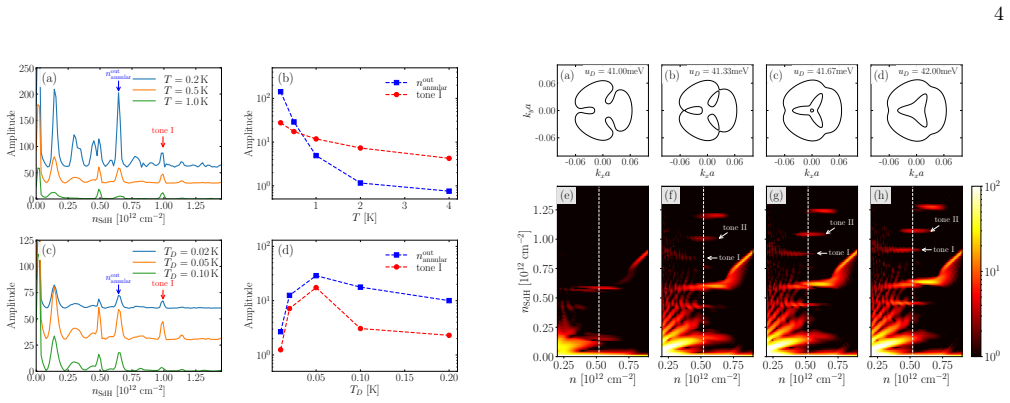
- [End Matter; SM Sec. III.C; Fig. 3(d)] The central calculation of the multitone SdH response is performed at T_D = 0.05 K, which the End Matter equates to tau_q ~ 24 ps. The same manuscript shows that the anomalous tone peaks are very sensitive to disorder: Fig. 3(d) peaks near T_D ~ 0.05 K and falls by T_D = 0.20 K, and in Fig. S4(f) tone II is no longer resolved at T_D = 0.20 K. The experimental sample quoted in Ref. [3] has tau_q ~ 4 ps, i.e. T_D ~ 0.3 K, a factor of six larger. Since the visibility window is narrow, the claimed explanation of the experiment is not established at the experimental operating point. Please compute the SdH spectra at T_D ~ 0.3 K (or at tau_q ~ 4 ps with the Lorentzian scheme) and show whether the tones survive, or provide a concrete argument why the SCBA short-range-disorder model is not the correct damping model for these flat-band breakdown levels. Stating that the calculation is 'a bit clea
- [Quantum oscillations; Figs. 2(c), 2(e); Conclusion] The text states that the two calculated frequencies 'match quantitatively well' with the experimental multitone metal [3], and the Conclusion builds directly on this quantitative agreement. However, the manuscript contains no overlay, table, or residual comparison of the calculated n_SdH(n) branches with the measured ones; the figures show only the calculated tones, and the extrapolation lines in Figs. 2(c)-2(d) are internal to the calculation. As a result, the claimed quantitative agreement cannot be checked. I request a direct comparison (e.g., digitized experimental frequencies overlaid on Figs. 2/4, or a table with density windows and frequencies for both calculation and experiment) or, failing that, a clear downgrading of the language to qualitative agreement. This affects the abstract, the main-text claim, and the conclusion.
minor comments (5)
- [SM Eq. (S25)] The symbol T is used both for the junction scattering amplitude in the semiclassical network model and for temperature throughout the paper. Please rename the scattering amplitude (e.g., t_s or tau_s) to avoid confusion.
- [End Matter, Eq. (S10)-(S13)] The derivation uses sigma_xy ~ ne/B with n defined by the zero-field density. Since the paper works at finite B and the density is field-dependent through n(mu,B), please clarify the procedure used to assign n in the resistivity plots; the current description leaves some ambiguity.
- [SM Sec. II.B, Eq. (S14)] The SCBA self-energy neglects Landau-level-dependent form factors and intervalley scattering. Please add a short sentence stating the expected validity of this structureless-disorder approximation for the flat-band regime studied here.
- [Fig. 3 and Fig. S4] The temperature and disorder line cuts are shown for a single density n=0.45x10^12 cm^-2. A short statement of whether the T_D optimum shifts with density or displacement field would help the reader assess the robustness of the multitone feature.
- [References] Reference [45] is a private communication used to support a substantive physical statement about the relation between multitone SdH and superconductivity. If possible, replace it with a published or preprint citation, or remove it.
Circularity Check
No significant circularity: the anomalous multitone SdH frequencies are computed from the noninteracting R4G band structure and Kubo transport, with no experimental multitone frequency used as input.
full rationale
The derivation chain is self-contained. The multitone SdH frequencies are obtained by exact Peierls-substituted Landau-level diagonalization of the noninteracting R4G Hamiltonian (Eq. (1), SM Eqs. (S1)-(S2)) followed by the Kubo bubble-diagram conductivity (Eq. (10)). The band parameters (gamma_i, delta, Delta_2) are taken from prior literature [3,35], and no experimental multitone frequency, n_SdH value, or A0-like constant is used as an input to set the anomalous peaks. The semiclassical phase Phi in Eq. (5) uses A0, but A0 is computed as the zero-density intercept of the annular Fermi-surface area from the same band structure, and the predicted 2A0 frequency is cross-checked against the full numerical Landau-level calculation (Fig. 2), not inferred from the target experimental peaks. The self-citations [6,10,47] appear only in background and context discussions (VHS relevance to superconductivity, Chern-number transition) and are not load-bearing for the SdH prediction. The End Matter explicitly acknowledges that T_D = 0.05 K corresponds to tau_q ~ 24 ps, 'a bit cleaner' than the experimental tau_q ~ 4 ps, and no calculation is shown at the experimental disorder level; this is a limitation of the quantitative comparison and a correctness risk, but it is not circularity, because the predicted frequencies are still derived independently of the experimental answer. Likewise, the claim of quantitative agreement without overlaying the experimental multitone frequencies is an unverified comparison rather than a circular derivation. No step reduces by construction to its own input, so the circularity score is 0.
Assumptions & free parameters
free parameters (1)
- Effective Dingle temperature T_D =
0.05 K (varied 0.02-0.20 K)
assumptions (5)
- domain assumption Fully spin- and valley-polarized normal state in the K valley.
- domain assumption The noninteracting continuum k·p Hamiltonian with parameters from Refs [3,35] accurately describes the parent metallic state of R4G.
- domain assumption Disorder is structureless white noise treated with SCBA at the bubble level, with a single Dingle temperature T_D.
- standard math Onsager-Bohr-Sommerfeld quantization and the saddle-point magnetic-breakdown scattering matrix (Eq. S25) describe the semiclassical limit.
- standard math Kubo formula at bubble level with semiclassical Hall conductivity σ_xy = ne/B gives the longitudinal resistivity.
Cite this review
Pith. "Pith review of Magnetic Breakdown and Anomalous Quantum Oscillation in Rhombohedral Tetralayer Graphene." pith.science (2026). https://pith.science/paper/HOJWR733
@misc{pith2026260727207,
  author       = {Pith},
  title        = {Pith review of: Magnetic Breakdown and Anomalous Quantum Oscillation in Rhombohedral Tetralayer Graphene},
  year         = {2026},
  howpublished = {\url{https://pith.science/paper/HOJWR733}},
  note         = {Machine review of arXiv:2607.27207}
}
read the original abstract
We investigate magnetic breakdown near Van Hove singularities (VHSs) in the electron-doped rhombohedral tetralayer graphene, where chiral superconductivity has recently been reported. Using the noninteracting band structure and Kubo formula, we identify anomalous Shubnikov-de Haas effects: Ring-like structures in the Landau fan and anomalous high-frequency peaks in the frequency spectra. These anomalous quantum oscillations can be understood by the reconstruction from magnetic breakdown among three nearby Fermi pockets separated by VHSs. Remarkably, these qualitative anomalous features persist into a stronger-VHS regime, where the semiclassical picture breaks down. The temperature and (weak) disorder dependence of the oscillations are also investigated. Our results establish that the magnetic-breakdown-induced anomalous quantum oscillation provides a general distinctive probe for the underlying Fermi-surface geometry associated with VHSs and may explain the recent quantum oscillation experiment in rhombohedral tetralayer graphene [arXiv:2606.05356].
Figures


Figures from the paper (2 more)


Forward citations
Cited by 2 Pith papers
-
Thermal Hall tomography of chiral superconductivity in rhombohedral graphene
Thermal Hall conductance at low temperature returns the BdG Chern number in rhombohedral graphene through the occupied-vortex rule, with trigonal warping and finite pair momentum shown to be topologically inert.
-
Magnetic Field Reorganization of Electronic States in Moir\'e Bilayer Graphene
Magnetic fields reorganize the semiclassical electron orbits in moiré bilayer graphene, causing magnetic breakdown, valley-selective Lifshitz transitions, and electron-hole pocket scattering before the Hofstadter regime.
Reference graph
Works this paper leans on
-
[3]
S. S. Kalantre, B. H. Alexander, J. May-Mann, J. Herzog-Arbeitman, M. Hocking, Q. Cao, K. Watan- abe, T. Taniguchi, D. Goldhaber-Gordon, A. J. Man- nix, T. Devakul, Y. H. Kwan, D. E. Parker, and A. Sharpe, Fermiology and the Candidate Chiral Super- conductor in Rhombohedral Tetralayer Graphene (2026), arXiv:2606.05356
arXiv 2026
-
[1]
T. Han, Z. Lu, Z. Hadjri, L. Shi, Z. Wu, W. Xu, Y. Yao, A. A. Cotten, O. Sharifi Sedeh, H. Weldeyesus, J. Yang, J. Seo, S. Ye, M. Zhou, H. Liu, G. Shi, Z. Hua, K. Watan- abe, T. Taniguchi, P. Xiong, D. M. Zumbühl, L. Fu, and L. Ju, Signatures of chiral superconductivity in rhombo- hedral graphene, Nature643, 654 (2025)
work page 2025
-
[2]
E. Morissette, P. Qin, H. T. Wu, K. Watanabe, T. Taniguchi, and J. I. A. Li, Superconductivity, Anoma- lous Hall Effect, and Stripe Order in Rhombohedral Hex- alayer Graphene (2025), arXiv:2504.05129
arXiv 2025
-
[4]
Z. Hua, S. Ye, P. Pattanakanvijit, G. Shi, T. Han, E. Aitken, J. Yang, J. Seo, H. Liu, R. Hao, K. Xiao, J. Guo, V. T. Phong, K. Watanabe, T. Taniguchi, C. Huang, C. Lewandowski, L. Ju, P. Xiong, and Z. Lu, Multi-Knob Switchable Chiral Superconduc- tivity Quartet in Rhombohedral Graphene (2026), arXiv:2607.06520
work page Pith review arXiv 2026
- [5]
-
[6]
Y.-Z. Chou, J. Zhu, and S. Das Sarma, Intravalley spin- polarized superconductivity in rhombohedral tetralayer graphene, Physical Review B111, 174523 (2025)
2025
-
[7]
H. Yang and Y.-H. Zhang, Topological incommen- surate Fulde-Ferrell-Larkin-Ovchinnikov superconductor and Bogoliubov Fermi surface in rhombohedral tetralayer graphene, Physical Review B112, L020506 (2025)
work page 2025
-
[8]
G. Parra-Martínez, A. Jimeno-Pozo, V. T. Phong, H. Sainz-Cruz, D. Kaplan, P. Emanuel, Y. Oreg, P. A. Pantaleón, J. Á. Silva-Guillén, and F. Guinea, Band Renormalization, Quarter Metals, and Chiral Supercon- ductivity in Rhombohedral Tetralayer Graphene, Physi- cal Review Letters135, 136503 (2025)
work page 2025
Show all 50 references
-
[9]
Gaggioli, D
F. Gaggioli, D. Guerci, and L. Fu, Spontaneous Vortex- Antivortex Lattice and Majorana Fermions in Rhombo- hedral Graphene, Physical Review Letters135, 116001 (2025). 6
2025
-
[10]
Chou, Superconductivity from Phonon-Mediated Retardation in a Single-Flavor Metal, Physical Review Letters137, 10.1103/dcn2-lc8k (2026)
Y.-Z. Chou, Superconductivity from Phonon-Mediated Retardation in a Single-Flavor Metal, Physical Review Letters137, 10.1103/dcn2-lc8k (2026)
2026 doi
-
[11]
Christos, P
M. Christos, P. M. Bonetti, and M. S. Scheurer, Finite- Momentum Pairing and Superlattice Superconductivity in Valley-Imbalanced Rhombohedral Graphene, Phys. Rev. Lett.137, 046505 (2026)
2026
-
[12]
J. D. Sau and S. Wang, Theory of anomalous Hall ef- fect from screened vortex charge in a phase disordered superconductor (2024), arXiv:2411.08969
2024 arXiv
-
[13]
Zhu and C
J. Zhu and C. Huang, Microscopic origin of or- bital magnetization in chiral superconductors (2026), arXiv:2601.12387
2026
-
[14]
Gil and E
A. Gil and E. Berg, Charge and pair density waves in a spin- and valley-polarized system at a Van Hove singu- larity, Physical Review B113, 075154 (2026)
2026
-
[15]
Dong and P
Z. Dong and P. A. Lee, Controlled expansion for pair- ing in a polarized band with strong repulsion, Physical Review B113, 104501 (2026)
2026
-
[16]
Qin and C
Q. Qin and C. Wu, Chiral Finite-Momentum Supercon- ductivity in the Tetralayer Graphene, Chinese Physics Letters43, 030708 (2026)
2026
-
[17]
Y. Chen, M. S. Scheurer, and C. Schrade, Intrinsic su- perconducting diode effect and nonreciprocal supercon- ductivityinrhombohedralgraphenemultilayers,Physical Review B112, L060505 (2025)
2025
-
[18]
Jahin and S.-Z
A. Jahin and S.-Z. Lin, Enhanced Kohn-Luttinger super- conductivity in geometric bands, Physical Review B113, 014504 (2026)
2026
-
[19]
M.-R. Li, Y. H. Kwan, H. Yao, and B. A. Bernevig, Berry Trashcan With Short Range Attraction:Exactp x +ip y Superconductivity in Rhombohedral Graphene (2025), arXiv:2509.16312
2025
-
[20]
May-Mann, T
J. May-Mann, T. Helbig, and T. Devakul, How pairing mechanism dictates topology in valley-polarized super- conductors with Berry curvature, npj Quantum Materi- als11, 53 (2026)
2026
-
[21]
A. S. Patri and M. Franz, Family of multilayer graphene superconductors with tunable chirality: Momentum- space vortices nucleated by a ring of Berry curvature, Physical Review B112, 214505 (2025)
2025
-
[22]
Wang, Z.-Q
Y.-Q. Wang, Z.-Q. Gao, and H. Yang, Chiral supercon- ductivity from a parent Chern band and its non-Abelian generalization, Physical Review B113, 174507 (2026)
2026
-
[23]
C. Yoon, T. Xu, Y. Barlas, and F. Zhang, Quarter-Metal Superconductivity in Rhombohedral Graphene, Physical Review Letters136, 026603 (2026)
2026
-
[24]
A. B. Pippard, Quantization of coupled orbits in metals, Proceedings of the Royal Society of London. A. Mathe- matical and Physical Sciences270, 1 (1962)
1962
-
[25]
A. B. Pippard, Quantization of Coupled Orbits in Metals II. The Two-Dimensional Network, with Special Refer- encetothePropertiesofZinc,PhilosophicalTransactions of the Royal Society of London. Series A, Mathematical and Physical Sciences256, 317 (1964)
1964
-
[26]
R. G. Chambers, Magnetic breakdown in real metals, Proceedings of the Physical Society88, 701 (1966)
1966
-
[27]
Alexandradinata and L
A. Alexandradinata and L. Glazman, Geometric Phase and Orbital Moment in Quantization Rules for Magnetic Breakdown, Physical Review Letters119, 256601 (2017)
2017
-
[28]
Alexandradinata and L
A. Alexandradinata and L. Glazman, Modern semiclas- sical theory of magnetic transport and breakdown, Phys- ical Review B97, 144422 (2018), arXiv:1710.04215
2018 arXiv
-
[29]
R. W. Stark and C. B. Friedberg, Quantum Interference of Electron Waves in a Normal Metal, Physical Review Letters26, 556 (1971)
1971
-
[30]
Lu and H
C.-K. Lu and H. A. Fertig, Magnetic Breakdown in Twisted Bilayer Graphene, Physical Review B89, 085408 (2014)
2014
-
[31]
Hejazi, C
K. Hejazi, C. Liu, and L. Balents, Landau levels in twisted bilayer graphene and semiclassical orbits, Physi- cal Review B100, 035115 (2019)
2019
-
[32]
N. Paul, P. J. D. Crowley, T. Devakul, and L. Fu, Moiré Landau Fans and Magic Zeros, Physical Review Letters 129, 116804 (2022)
2022
-
[33]
N. Paul, P. J. D. Crowley, and L. Fu, Directional Local- ization from a Magnetic Field in Moiré Systems, Physical Review Letters132, 246402 (2024)
2024
-
[34]
Bocarsly, M
M. Bocarsly, M. Uzan, I. Roy, S. Grover, J. Xiao, Z. Dong, M. Labendik, A. Uri, M. E. Huber, Y. Myasoe- dov, K. Watanabe, T. Taniguchi, B. Yan, L. S. Levitov, and E. Zeldov, De Haas–van Alphen spectroscopy and magnetic breakdown in moiré graphene, Science383, 42 (2024)
2024
-
[35]
Auerbach, S
N. Auerbach, S. Dutta, M. Uzan, Y. Vituri, Y. Zhou, A. Y. Meltzer, S. Grover, T. Holder, P. Emanuel, M. E. Huber, Y. Myasoedov, K. Watanabe, T. Taniguchi, Y. Oreg, E. Berg, and E. Zeldov, Isospin magnetic tex- ture and intervalley exchange interaction in rhombohe- dral tetrala...
2025
-
[36]
Ando and Y
T. Ando and Y. Uemura, Theory of Quantum Transport in a Two-Dimensional Electron System under Magnetic Fields. I. Characteristics of Level Broadening and Trans- port under Strong Fields, Journal of the Physical Society of Japan36, 959 (1974)
1974
-
[37]
Ando, Theory of Quantum Transport in a Two- Dimensional Electron System under Magnetic Fields
T. Ando, Theory of Quantum Transport in a Two- Dimensional Electron System under Magnetic Fields. IV. Oscillatory Conductivity, Journal of the Physical Society of Japan37, 1233 (1974)
1974
-
[38]
T. Ando, A. B. Fowler, and F. Stern, Electronic prop- erties of two-dimensional systems, Reviews of Modern Physics54, 437 (1982)
1982
-
[39]
See supplemental material for derivations and extended discussions
-
[40]
Min and A
H. Min and A. H. MacDonald, Chiral decomposition in the electronic structure of graphene multilayers, Physical Review B77, 155416 (2008)
2008
-
[41]
Koshino and E
M. Koshino and E. McCann, Trigonal warping and Berry’s phase Nπin ABC-stacked multilayer graphene, Physical Review B80, 165409 (2009)
2009
-
[42]
Shoenberg,Magnetic Oscillations in Metals(Cam- bridge University Press, 1984)
D. Shoenberg,Magnetic Oscillations in Metals(Cam- bridge University Press, 1984)
1984
-
[43]
G.P.MikitikandYu.V.Sharlai,ManifestationofBerry’s PhaseinMetalPhysics,PhysicalReviewLetters82,2147 (1999)
1999
-
[44]
multitone
The Fourier analysis is performed overB= 0.5–8 T for every fixednafter applying a Hann window. The SdH frequency is expressed as an effective carrier density nSdH ≡ef SdH/h, wheref SdH is the Fourier frequency conjugate to1/B, defined through an oscillatory compo- nent of the ...
-
[45]
SdH oscillations
Strictly speaking, Shubnikov–de Haas oscillations refer to quantum oscillations in longitudinal transport. Through- out this work, we therefore use “SdH oscillations” only for the oscillations ofρxx, while the corresponding oscil- lations in the density of states are referred ...
-
[46]
Ju, private communication (2026)
L. Ju, private communication (2026)
2026
-
[47]
For a chiralp+ipstate, the BdG Chern-number transi- tion is controlled by whether the chemical potential lies above or belowE(k= 0)[10, 47]
-
[48]
Ghosh, J
P. Ghosh, J. D. Sau, S. Tewari, and S. Das Sarma, Non- Abelian topological order in noncentrosymmetric super- conductors with broken time-reversal symmetry, Physical 7 Review B82, 184525 (2010)
2010
-
[49]
Huang and S
Y. Huang and S. Das Sarma, Disorder-induced strong- field strong localization in two-dimensional systems, Physical Review B113, 184203 (2026)
2026
-
[50]
multitone
R. B. Dingle, Some magnetic properties of metals II. The influence of collisions on the magnetic behaviour of large systems, Proceedings of the Royal Society of London. A. Mathematical and Physical Sciences211, 517 (1952). End Matter Here we provide details of the transport ca...
1952
Reviewed August 5, 2026 · model on record in the stance chip above.
Discussion (0). Continue with ORCID to comment.