REVIEW 3 major objections 6 minor 1 cited by
Machine learning the computational cost of quantum chemistry
T0 review · 3 major / 6 minor · reviewed 2026-08-14 · deepseek-v4-flash
Pith's one-line read Quantum machine learning models can learn how long a quantum chemistry calculation will run from molecular structure alone, and packing jobs with those predictions cuts CPU-time overhead by 10 to 90 percent.
desk verdict A genuinely new and mostly solid demonstration that quantum-chemistry wall times are learnable from molecular structure; the scheduling-efficiency headline rests on a simulator with idealized assumptions and is softer than the abstract suggests. read the letter →
The pith
A machine-rendered reading of the paper's core claim, the machinery that carries it, and where it could break.
The reading
What carries the argument
The engine is kernel ridge regression applied to molecular representations: wall time is normalized by electron count, described by either a two-body bond-count representation or a one-, two-, and three-body atomic descriptor, and learned with a Laplacian or Gaussian kernel. The learned absolute run-time estimates are then sorted in decreasing order and packed into compute jobs with a first-fit-decreasing heuristic, so idle time left by long jobs is filled by shorter ones. A secondary mechanism is step splitting for geometry optimizations: because the first optimization step costs about 20 percent more than later steps, modeling it separately improves both the timing model and the scheduler.
What would settle it
Run the published seven task sets on a production cluster that preempts jobs and has load-dependent queue delays, then compare CPU overhead when jobs are ordered by the learned run-time estimates against the conventional job-array approach; if overhead does not drop, the scheduling claim fails. A second check is whether the FLOP-count model, presented as a noise-free cost measure, transfers to a different CPU architecture within the same error bounds.
Extended reading notes
Core claim
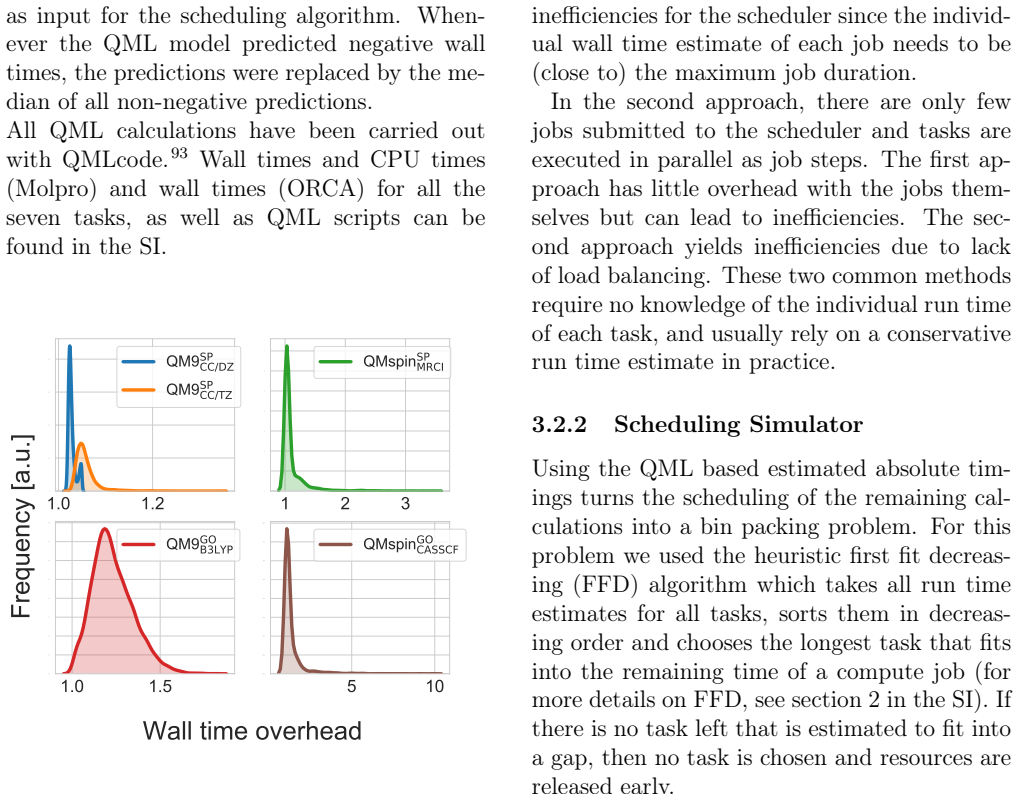
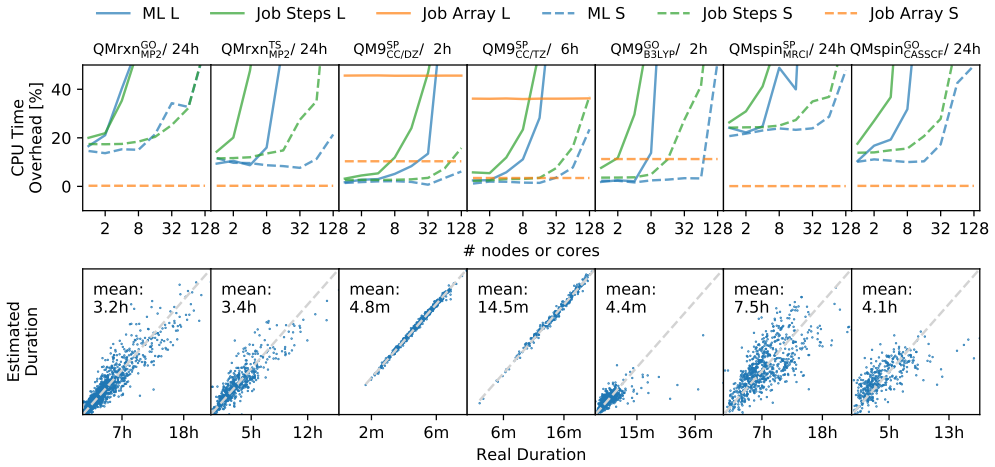
The central claim is that wall time is a molecular quasi-property: from the initial geometry and composition of a molecule, a kernel machine can predict how long a specified electronic-structure calculation will run, accurately enough to improve scheduling. Evidence is given for seven tasks spanning single-point calculations, geometry optimizations, and transition-state searches, with five levels of electronic-structure theory and thousands of closed- and open-shell organic molecules. At the largest training sizes, normalized mean absolute errors range from about 1.3 percent for single-point coupled-cluster timings to roughly 27 to 48 percent for geometry optimizations, and the learned timings, fed into a first-fit-decreasing scheduler, reduce CPU overhead by 10 to 90 percent relative to job arrays or job steps.
Load-bearing premise
The reported savings assume that once a calculation starts it runs to completion without interruption, that starting a new job costs 30 seconds, and that every job waits exactly one hour in the queue; clusters with preemption, variable waiting times, or busy input-output systems may not see those savings.
Editorial extensions
If this is right
- Single-point, geometry-optimization, and transition-state wall times are all learnable from structure alone; the optimization tasks are harder but still accurate enough for scheduling.
- Training sets of a few thousand molecules suffice to beat the baseline assumption that every calculation of a given type takes the mean run time.
- Accurate run-time estimates let clusters pack jobs in decreasing order, roughly halving overhead at large core counts and allowing much larger parallel campaigns at the same overhead.
- For geometry optimizations, predicting individual step durations lets a scheduler release resources early instead of starting a step that cannot finish, cutting overhead by up to 90 percent at small wall-time limits.
Reading between the lines
- The same learned-cost view could extend to other expensive workflows, such as periodic solid-state calculations or ab initio molecular dynamics, where runtime also depends on structure and on the path taken.
- Predicted run times could be used online to detect abnormal jobs: a large gap between predicted and observed duration would flag I/O contention, convergence failure, or a misconfigured input.
- If runtime is truly a molecular quasi-property, cost models could guide generative molecular design by preferring cheaper candidate molecules, not just by scheduling a fixed campaign.
- The reported gains depend on a simulator with fixed startup and queue delays; on real clusters with load-dependent queuing the savings could be larger if backfilling becomes easier, or smaller if preemption breaks the packing.
Signed reviews
Editorial analysis
A structured set of objections, weighed in public.
Referee Report
Summary. The paper introduces kernel ridge regression (KRR) models of computational cost for quantum chemistry, predicting wall times, CPU times, and FLOP counts for seven tasks spanning single-point, geometry-optimization, and transition-state calculations, plus a 2D toy optimization problem. Molecular inputs are represented with Bag of Bonds and FCHL fingerprints, and the authors report learning curves with normalized mean absolute errors, reaching roughly 1.3–48% MAE at the largest training sizes. The predicted absolute wall times are then fed into a first-fit-decreasing job scheduling simulator, and the paper claims reductions in CPU-time overhead of 10–90% relative to conventional job-array and job-step packing. The manuscript makes code, data, and a GitHub repository available.
Significance. If the scheduling claims survive closer scrutiny, this is a useful and novel application of QML to a practical HPC problem, and one of the first demonstrations that computational cost can be treated as a learnable molecular quasi-property across chemical space. The paper's strengths include systematically decaying learning curves, a broad set of tasks and levels of theory, the use of FLOP counts as a cleaner target, and openly available timings and scripts. The main weakness is that the headline efficiency gains are outputs of an idealized simulator, coupled with data-cleaning choices and test-set model selection that may bias the reported gains. The QML accuracy results themselves are honest and reproducible, but the translation from normalized MAEs to production scheduling savings is not yet fully supported.
major comments (3)
- [§3.2.2 and §4.3.1, Figs. 9–10] The headline 10–90% CPU-time overhead reductions are simulator outputs, not cluster measurements. The simulator assumes idempotent uninterruptible tasks, a fixed 30-second startup cost, and a fixed one-hour queue for every job, and it does not model preemption, stochastic queue delays, or I/O contention. The conclusion that the authors 'demonstrably used compute clusters more efficiently' therefore overstates what the evidence shows. Please validate the scheduling claims on a real scheduler trace, or at minimum add a sensitivity analysis over queue-delay distributions, startup costs, and preemption behavior, and revise the wording to 'simulated' rather than 'demonstrably'.
- [§4.2.4 and Fig. 3] Runs with wall-time-to-CPU-time ratios above task-specific thresholds of 3%, 5%, 10%, 30%, and 50% are excluded as 'heavy I/O' before training and evaluation. At scheduling time this ratio is not known before a job executes, so a production scheduler cannot apply the same filter. As a result, the simulator evaluates the QML scheduler on a cleaned distribution that is not available in practice. Please report how many jobs are excluded per task, and show that the learning curves and overhead reductions survive when the excluded jobs are kept or otherwise modeled, since the reported 10–90% range may be optimistically biased.
- [§4.3.1 and Table 2] The representation used for scheduling is selected as the one with the lowest MAE at the maximum training size, where those MAEs are computed on the held-out test set. This constitutes test-set model selection, which inflates the reported generalization accuracy and, consequently, the downstream scheduling gains. Please replace this procedure with nested cross-validation or a pre-registered representation choice, or at least report the scheduling results for both BoB and FCHL models so that the sensitivity to this selection is visible.
minor comments (6)
- [Abstract and text] The abstract says 'three commonly used optimizer' and the body contains several typos, including 'fucntions' and 'obtianed'; please correct them.
- [§4.3.1] The task label 'QM9SP_CC/DT' is a typo for 'QM9SP_CC/TZ'.
- [Fig. 10 caption] The caption refers to task 'QM9GO_CASSCF', but the corresponding task in Table 1 is 'QMspinGO_CASSCF'.
- [Reference 3] The reference to the Argonne Leadership Computing Facility is misspelled as 'Argone'; please fix it.
- [§4.3.1] The lower-panel discussion in Figure 9 contains a repeated sentence; one of the two occurrences should be removed.
- [Fig. 8] The figure caption uses 'FLOPS' while the text and Table 2 refer to 'FLOP count'; please use consistent terminology.
Circularity Check
Mild test-set model selection in the scheduling evaluation; otherwise the learnability results are genuine out-of-sample predictions.
-
other
[Section 4.3.1 (Application: Optimal Scheduling), first paragraph; MAE definition in Section 3.1]
"For the scheduling optimization for all seven tasks ..., the QML model with the best representation (lowest MAE with maximum number of training points) was used which in all cases was FCHL."
The MAE used to select FCHL is the out-of-sample test error defined in Section 3.1: 'the test errors, measured as mean absolute errors (MAE), were calculated as a function of training set size.' The same test labels therefore enter twice: once to choose the representation that will be used in the scheduling simulation, and once to report the prediction accuracy that motivates the resulting 10-90% overhead reductions. This is a mild evaluation leak rather than a definitional collapse: the wall-time predictions are not constructed from the training labels, and the scheduling overhead is computed from real run times, so the central learnability result retains independent content.
full rationale
The paper's central claim—that computational cost is learnable across chemical space—rests on kernel ridge regression models trained on measured wall/CPU/FLOP timings and evaluated on disjoint test molecules. Section 3.1 states that hyperparameters 'were optimized only within the training set using random sub-sampling cross validation,' and learning curves are reported as a function of training-set size, so the prediction errors are genuine out-of-sample errors rather than refits of the training labels. The scheduling application is also not circular in its main mechanism: Section 3.2.2 uses out-of-sample QML timing estimates as input to a first-fit-decreasing bin-packing simulator, and overhead is computed from the real run times in the data, so the 10-90% reduction is a simulation result conditioned on those predictions. No load-bearing self-citation was found: FCHL and QMLcode are cited as tools or representations, not as a uniqueness proof or as the source of the scheduling result. The one mild circular element is in Section 4.3.1, where the representation used for scheduling is selected as the one with the 'lowest MAE'—and MAE is the test-set error defined in Section 3.1. Thus the test labels are used twice: once to choose FCHL over BoB and once to report the prediction quality behind the scheduling improvement. This is an evaluation-protocol leak rather than a definitional reduction; it does not make the predicted wall times equal to the inputs by construction, and it could be fixed by a separate validation split. The simulator's fixed queue-delay/startup assumptions and non-preemptible-task idealization are external validity risks, not circularity.
Assumptions & free parameters
free parameters (4)
- KRR kernel width sigma per task and representation =
sigma_BoB 51.2 to 204.8; sigma_FCHL 12.8 to 409.6 (SI Table 1)
- KRR regularization lambda per task and representation =
1e-9 to 1e-5 (SI Table 1)
- I/O-overhead exclusion thresholds per task =
3%, 5%, 10%, 30%, 50% for the five Molpro tasks
- Scheduler startup and queue parameters =
30 seconds job start, 1 hour queue time
assumptions (5)
- domain assumption KRR interpolation is valid when kernel similarity between molecular representations tracks the target property.
- domain assumption Computational cost is a reasonably smooth function of molecular structure for each task.
- ad hoc to paper High wall-to-CPU ratios are purely I/O noise and can be excluded without biasing the timing distribution.
- ad hoc to paper The scheduling simulator faithfully represents production schedulers with idempotent uninterruptible tasks and fixed startup and queue overhead.
- domain assumption perf FLOP counts measure the computational cost of PNO-LCCSD(T)-F12 single points.
Cite this review
Pith. "Pith review of Machine learning the computational cost of quantum chemistry." pith.science (2026). https://pith.science/paper/EP672L5Z
@misc{pith2026190806714,
  author       = {Pith},
  title        = {Pith review of: Machine learning the computational cost of quantum chemistry},
  year         = {2026},
  howpublished = {\url{https://pith.science/paper/EP672L5Z}},
  note         = {Machine review of arXiv:1908.06714}
}
read the original abstract
Computational quantum mechanics based molecular and materials design campaigns consume increasingly more high-performance compute resources, making improved job scheduling efficiency desirable in order to reduce carbon footprint or wasteful spending. We introduce quantum machine learning (QML) models of the computational cost of common quantum chemistry tasks. For 2D non-linear toy systems, single point, geometry optimization, and transition state calculations the out of sample prediction error of QML models of wall times decays systematically with training set size. We present numerical evidence for a toy system containing two functions and three commonly used optimizer and for thousands of organic molecular systems including closed and open shell equilibrium structures, as well as transition states. Levels of electronic structure theory considered include B3LYP/def2-TZVP, MP2/6-311G(d), local CCSD(T)/VTZ-F12, CASSCF/VDZ-F12, and MRCISD+Q-F12/VDZ-F12. In comparison to conventional indiscriminate job treatment, QML based wall time predictions significantly improve job scheduling efficiency for all tasks after training on just thousands of molecules. Resulting reductions in CPU time overhead range from 10% to 90%.
Figures


Figures from the paper (9 more)




Forward citations
Cited by 1 Pith paper
-
Representative Random Sampling of Chemical Space
A method to approximately uniformly sample molecular graphs and estimate their total count using small-world network distances, applied to assess database representativeness.
Reference graph
Works this paper leans on
-
[1]
Intro- duction to methodology and encoding rules. J. Chem. Inform. Comput. Sci. 1988, 28, 31–36. (44) Weininger, D.; Weininger, A.; Weininger, J. SMILES
work page 1988
-
[2]
Algorithm for generation of unique SMILES notation. J. Chem. Inf. Model.1989, 29, 97–101. (45) Hansen, K.; Biegler, F.; von Lilienfeld, O. A.; Müller, K.-R.; Tkatchenko, A. Interaction potentials in molecules and non-local information in chemical space.J. Phys. Chem. Lett. 2015, 6,
work page 1989
-
[3]
Efficient and accu- rate parallel local coupled cluster with pair natural orbitals (PNO-LCCSD).J. 21 Chem. Theory Comput.2017, 13, 3650–
work page 2017
-
[4]
Parallel explicitly cor- related local coupled cluster with pair natural orbitals (PNO-LCCSD-F12). J. Chem. Theory Comput.2017, 13, 4871–
work page 2017
-
[5]
Parallel pertur- bativetriplescorrectionforexplicitlycor- related local coupled cluster with pair natural orbitals.J. Chem. Theory Com- put. 2018, 14, 198–215. (68) Schwilk, M.; Zaspel, P.; von Lilien- feld, O. A.; Harbrecht, H.to be published 2019, (69) Knowles, P. J.; Werner, H.-J. An efficient method for the evaluation of coupling co- efficients in configur...
work page 2018
-
[8]
(48) Gilmer, J.; Schoenholz, S. S.; Riley, P. F.; Vinyals, O.; Dahl, G. E. Neural Message Passing for Quantum Chemistry.ArXiv 2017, abs/1704.01212. (49) Bartók, A. P.; De, S.; Poelking, C.; Bern- stein, N.; Kermode, J. R.; Csányi, G.; Ceriotti, M. Machine learning unifies the modelingofmaterialsandmolecules. Sci- ence Advances 2017, 3, e1701816. (50) Faber...
arXiv 2017
-
[15]
P.; Liu, F.; Nandy, A.; Kulik, H
(24) Duan, C.; Janet, J. P.; Liu, F.; Nandy, A.; Kulik, H. J. Learning from Failure: Predicting Electronic Struc- ture Calculation Outcomes with Machine Learning Models.J. Chem. Theory Com- put. 2019, (25) von Lilienfeld, O. A. First principles viewonchemicalcompoundspace: Gain- ing rigorous atomistic control of molec- ular properties. International Journ...
work page 2019
-
[21]
Small split-valence basis sets for first-row elements.J. Am. Chem. Soc. 1980, 102, 939–947. (82) Petersson, G. A.; Bennett, A.; Tens- feldt, T. G.; Al-Laham, M. A.; Shirley, W. A.; Mantzaris, J. A com- plete basis set model chemistry. I. The total energies of closed-shell atoms and hydrides of the first-row elements.The Journal of Chemical Physics 1988, 89,...
work page Pith review arXiv 1980
Show all 19 references
-
[94]
(9) Sherrill, C. D. Computational Scal- ing of the Configuration Interaction Method with System Size. 1996; http://vergil.chemistry.gatech. edu/notes/ciscale/ciscale.html, Accessed: 03/06/19. (10) Singh, K.; Ipek, E.; McKee, S. A.; de Supinski, B. R.; Schulz, M.; Caru- ana, R. ...
1996
-
[145]
(32) Ramakrishnan, R.; von Lilienfeld, O. A. Reviews in Computational Chemistry ; John Wiley & Sons, Inc., 2017; Vol. 30; pp 225–256. (33) Faber, F. A.; Hutchison, L.; Huang, B.; Gilmer,J.; Schoenholz,S.S.; Dahl,G.E.; Vinyals, O.; Kearnes, S.; Riley, P. F.; von Lilienfeld, O. ...
2017
-
[182]
19 (31) Huang, B.; von Lilienfeld, O. A. Commu- nication: Understanding molecular rep- resentations in machine learning: The role of uniqueness and target similarity. J. Chem. Phys.2016,
2016
-
[522]
(70) Werner, H.; Knowles, P. J. An efficient internally contracted multiconfiguration- reference configuration interaction method. J. Chem. Phys. 1988, 89, 5803–5814. (71) Shiozaki, T.; Knizia, G.; Werner, H.- J. Explicitly correlated multireference configuration interaction: MRCI-...
1988
-
[1085]
DNA” of chemistry: Scalable quantum machine learning with “amons
(91) Huang, B.; von Lilienfeld, O. A. The “DNA” of chemistry: Scalable quantum machine learning with “amons”.arXiv preprint arXiv:1707.04146 2017, sub- mitted to Nature. (92) Ramakrishnan, R.; Dral, P.; Rupp, M.; von Lilienfeld, O. A. Big Data meets Quantum Chemistry Approxima...
2017 arXiv
-
[1689]
(26) von Lilienfeld, O. A. Quantum Ma- chine Learning in Chemical Com- pound Space. Angewandte Chemie International Edition 2018, 57, 4164, http://dx.doi.org/10.1002/anie.201709686. (27) Rupp, M.; von Lilienfeld, O. A.; Burke, K. Guest Editorial: Special Topic on Data-Enabled ...
2018 doi
-
[1990]
The End of Moore’s Law.Comput
(2) Track, E.; Forbes, N.; Strawn, G. The End of Moore’s Law.Comput. Sci. Eng. 2017, 19, 4–6. (3) Argone Leadership Computing Facil- ity, https://www.alcf.anl.gov/, Ac- cessed: 05.06.2019. (4) Swiss National Supercomput- ing Center, Annual Report 2017, https://www.cscs.ch., Ac...
2017
-
[2087]
S.; Faber, F
(93) Christensen, A. S.; Faber, F. A.; Huang, B.; Bratholm, L. A.; Tkatchenko, A.; Müller, K.-R.; von Lilienfeld, O. A. QML: A Python Toolkit for Quantum Machine Learning, https://github.com/qmlcode/qml. 2017; http://www.qmlcode.org. (94) Intel Corporation, Intel Math Kernel L...
2017 arXiv
-
[2326]
A.; Hutchison, L.; Huang, B.; Gilmer,J.; Schoenholz,S.S.; Dahl,G.E.; Vinyals, O.; Kearnes, S.; Riley, P
(46) Faber, F. A.; Hutchison, L.; Huang, B.; Gilmer,J.; Schoenholz,S.S.; Dahl,G.E.; Vinyals, O.; Kearnes, S.; Riley, P. F.; von Lilienfeld, O. A. Prediction Errors of Molecular Machine Learning Models Lower than Hybrid DFT Error. Jour- nal of Chemical Theory and Computation 20...
2017
-
[5648]
(75) Lee, C.; Yang, W.; Parr, R. G. Devel- opment of the Colle-Salvetti correlation- energy formula into a functional of the electron density.Phys. Rev. B1988, 37, 785–789. (76) Werner, H.; Knowles, P. J. A second order multiconfiguration SCF procedure with optimum convergence....
1985
-
[7077]
S.; Isayev, O.; Roitberg, A
(56) Smith, J. S.; Isayev, O.; Roitberg, A. E. ANI-1, A data set of 20 million calcu- lated off-equilibrium conformations for organic molecules. Scientific data2017, 4, 170193. (57) Janet, J. P.; Kulik, H. J. Predicting elec- tronic structure properties of transition metal compl...
2017
Reviewed August 14, 2026 · model on record in the stance chip above.
Discussion (0). Continue with ORCID to comment.