Systematic study of flow of protons and light clusters in intermediate-energy heavy-ion collisions with momentum-dependent potentials
Pith reviewed 2026-05-23 17:56 UTC · model grok-4.3
The pith
The soft momentum-dependent nuclear equation of state matches measured proton and light-cluster flows in GeV heavy-ion collisions while the static soft equation of state does not.
A machine-rendered reading of the paper's core claim, the machinery that carries it, and where it could break.
Core claim
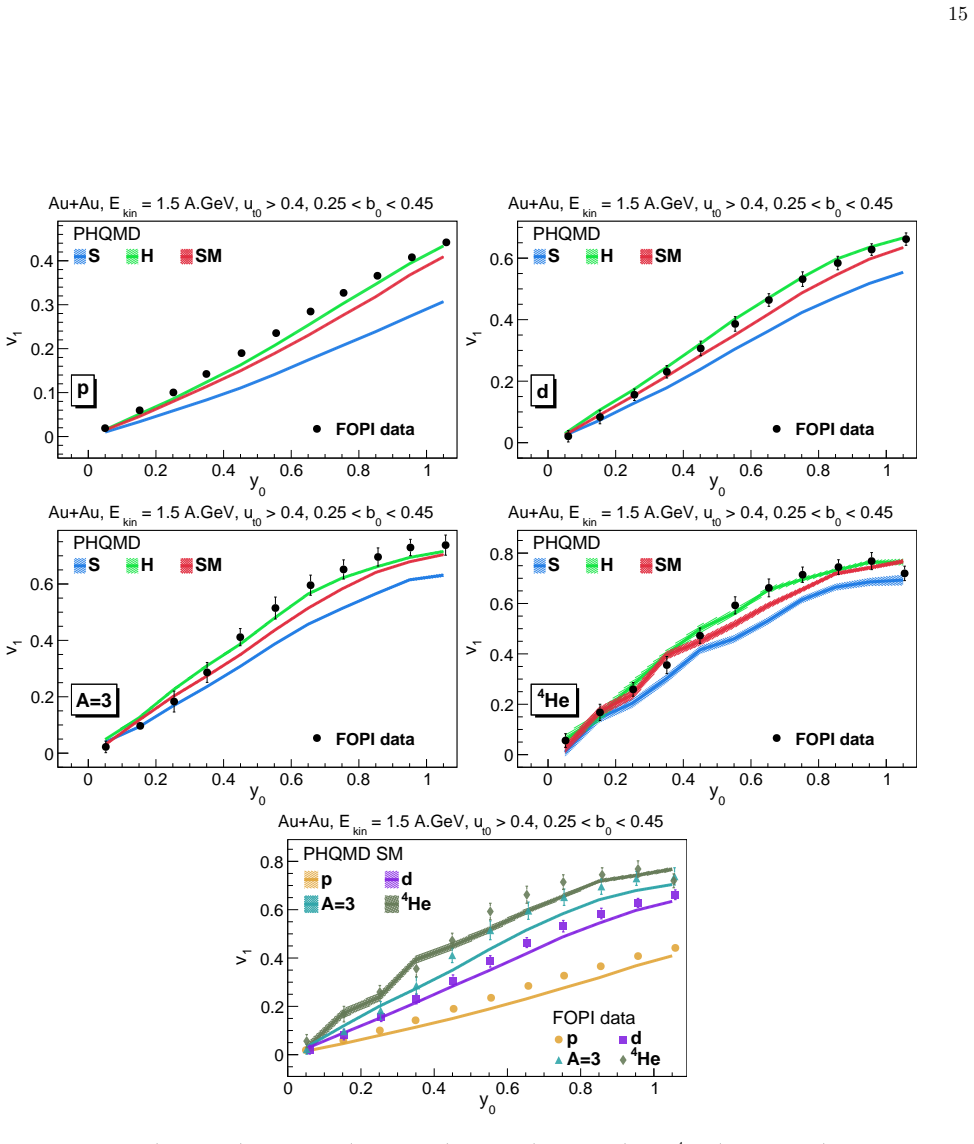
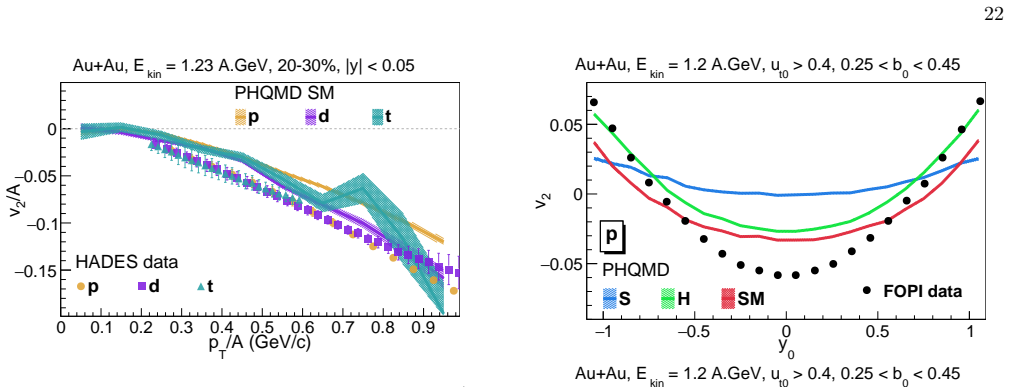
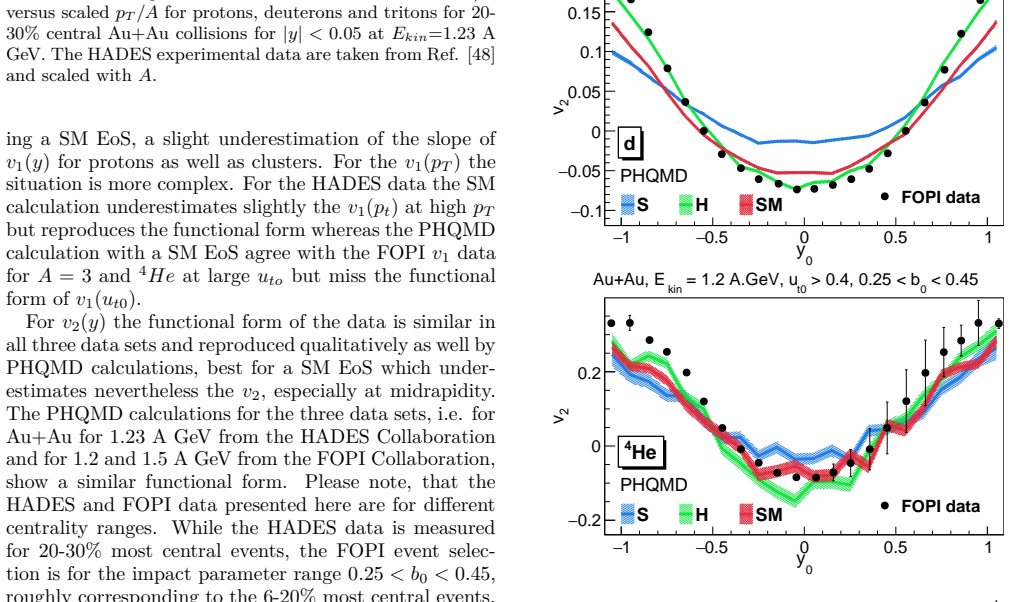
The soft momentum-dependent equation of state yields an overall good agreement with experimental data on proton and cluster rapidity distributions, transverse-momentum spectra, directed flow v1 and elliptic flow v2 from the HADES and FOPI collaborations, while the static soft equation of state does not. Softening the equation of state reduces midrapidity proton yields and increases light-cluster production. For protons the momentum-dependent soft potential slightly raises the magnitudes of v1 and v2 relative to the hard equation of state; cluster flows remain comparable across the soft variants. Elliptic flow v2 scales with cluster mass number A at midrapidity and low pT but breaks at higher
What carries the argument
The momentum-dependent nucleon potential added to the static Skyrme interaction inside the PHQMD model, which distinguishes the effects of momentum dependence from pure density dependence on particle propagation and clustering.
If this is right
- Softening the equation of state reduces proton yields at midrapidity while increasing light-cluster production.
- Proton directed and elliptic flow magnitudes increase slightly when the soft momentum-dependent potential is used instead of the hard equation of state.
- Elliptic flow scales with cluster mass number A at midrapidity and low transverse momentum but the scaling breaks at higher pT.
- Deuterons formed by MST clustering inside the model show different flow patterns from those formed by coalescence at freeze-out.
Where Pith is reading between the lines
- The observed difference in flow between the two cluster-formation prescriptions suggests that flow harmonics could be used experimentally to test which mechanism dominates in real collisions.
- If the mass-number scaling of v2 persists in other collision systems, it may offer a model-independent signature of collective motion at the cluster level.
- The requirement for momentum dependence at these energies implies that static Skyrme forces alone are insufficient for quantitative predictions of cluster observables.
Load-bearing premise
The momentum-dependent potential parameters taken from external proton-nucleus scattering data and the PHQMD clustering or coalescence rules correctly capture the dominant cluster formation physics.
What would settle it
New measurements of light-cluster elliptic flow at moderate to high transverse momentum that deviate from the soft momentum-dependent predictions while agreeing with the static soft equation of state.
Figures






read the original abstract
We study the influence of the nuclear equation-of-state (EoS) on collective observables -- the directed ($v_1$) and elliptic flow ($v_2$) of nucleons and light clusters -- in heavy-ion collisions at GeV energies using the Parton-Hadron-Quantum-Molecular Dynamics (PHQMD) approach. A novel development in this work is the inclusion of a momentum-dependent nucleon potential in the PHQMD in addition to the static, density-dependent Skyrme interaction. This enables three distinct EoS scenarios: two static ("soft" and "hard", differing in compressibility) and a soft, momentum-dependent EoS calibrated to $pA$ elastic scattering data. We find a strong EoS sensitivity in proton and cluster rapidity and $p_T$ distributions: soft and soft momentum-dependent EoS yield similar results, markedly different from the hard EoS. Softening the EoS reduces proton yields at midrapidity while enhancing light-cluster production. The EoS also affects flow observables differently for nucleons and clusters. For protons, a soft momentum-dependent potential increases slightly the magnitude of $v_1$ and $v_2$ relative to the hard EoS, whereas cluster flows are nearly similar. The soft momentum-dependent EoS provides an overall good agreement with experimental data from HADES and FOPI Collaborations while the soft EOS is not in line with the data. A scaling of $v_2$ with cluster mass number $A$ is observed at midrapidity for low $p_T$, which breaks at higher $p_T$. Finally, we examine the sensitivity of flow observables to deuteron production mechanisms. Deuterons formed via MST clustering exhibit different flow patterns from those produced by coalescence at freeze-out, indicating that flow harmonics may help discriminate between cluster formation scenarios.
Editorial analysis
A structured set of objections, weighed in public.
Referee Report
Summary. The manuscript uses the PHQMD transport model to study the sensitivity of directed (v1) and elliptic (v2) flows of protons and light clusters to the nuclear EoS in GeV-energy heavy-ion collisions. Three EoS variants are compared: static soft, static hard, and a soft momentum-dependent EoS whose parameters are fixed from independent pA elastic scattering. The central claim is that soft and soft-md variants produce similar rapidity and pT distributions (distinct from hard), with the soft-md case providing overall good agreement with HADES and FOPI data while the static soft EoS does not; additional results address v2 mass scaling and sensitivity to deuteron production mechanisms (MST vs. coalescence).
Significance. If the quantitative distinction between static soft and soft-md holds, the work demonstrates that momentum dependence in the mean-field potential improves description of collective flows at intermediate densities, offering a route to tighter EoS constraints. The external calibration of the momentum-dependent parameters to pA data is a positive feature that limits circularity with the flow observables.
major comments (2)
- [Abstract] Abstract: The claim that the soft momentum-dependent EoS 'provides an overall good agreement with experimental data' while 'the soft EOS is not in line with the data' is not supported by any quantitative metric (chi-squared, pull distribution, or explicit acceptance criterion). The text states that soft and soft-md produce 'similar results' for rapidity/pT distributions and only a 'slight increase' in proton |v1| and |v2| under the momentum-dependent case, leaving the decisive distinction unquantified relative to HADES/FOPI uncertainties.
- [Results (flow observables)] Flow observables section: The load-bearing distinction between static soft and soft-md rests on small proton flow differences whose statistical significance is not assessed; cluster flows are described as 'nearly similar' between the two, so the overall data-agreement claim depends on whether the proton shift exceeds experimental errors—an assessment absent from the manuscript.
minor comments (1)
- [Abstract] Abstract: The reported v2 scaling with cluster mass number A at low pT is stated without the numerical exponent or the precise pT cutoff at which the scaling breaks.
Simulated Author's Rebuttal
We thank the referee for the careful review and constructive comments. The concerns about lack of quantitative support for the data-agreement claims are valid, and we address them point by point with proposed revisions.
read point-by-point responses
-
Referee: [Abstract] Abstract: The claim that the soft momentum-dependent EoS 'provides an overall good agreement with experimental data' while 'the soft EOS is not in line with the data' is not supported by any quantitative metric (chi-squared, pull distribution, or explicit acceptance criterion). The text states that soft and soft-md produce 'similar results' for rapidity/pT distributions and only a 'slight increase' in proton |v1| and |v2| under the momentum-dependent case, leaving the decisive distinction unquantified relative to HADES/FOPI uncertainties.
Authors: We agree the abstract claim would benefit from qualification. The distinction relies on visual comparison in the figures, where soft-md proton flows align better with data than static soft despite the small shift. We will revise the abstract to state that soft-md 'provides improved agreement with the data' based on the presented comparisons, and add a sentence referencing the figures for the assessment. This avoids overstatement while preserving the central finding. revision: yes
-
Referee: [Results (flow observables)] Flow observables section: The load-bearing distinction between static soft and soft-md rests on small proton flow differences whose statistical significance is not assessed; cluster flows are described as 'nearly similar' between the two, so the overall data-agreement claim depends on whether the proton shift exceeds experimental errors—an assessment absent from the manuscript.
Authors: The referee is correct that no formal significance test or error comparison is provided. The text notes the small proton differences and near-similarity for clusters. We will revise the flow observables section to include a qualitative discussion of the proton |v1| and |v2| shift magnitude relative to the experimental error bars shown in the figures, noting that it improves agreement while the static soft remains offset. A full chi-squared is not added, as model systematics complicate it, but the visual assessment will be explicitly tied to uncertainties. revision: partial
Circularity Check
No significant circularity; EoS parameters from independent pA data and flows compared to separate experiments
full rationale
The paper calibrates the momentum-dependent nucleon potential to external pA elastic scattering data (distinct from the AA collision flows under study) and compares resulting v1/v2 observables to independent HADES/FOPI measurements. No equations or claims reduce a prediction to a fit on the same dataset by construction, and no self-citation load-bearing steps appear in the abstract or described text. The distinction between soft and soft-md EoS rests on direct simulation outputs versus external data, which is self-contained against benchmarks.
Axiom & Free-Parameter Ledger
free parameters (1)
- momentum-dependent potential strength and range parameters
axioms (1)
- domain assumption Skyrme interaction provides the static density-dependent part of the nucleon potential
Forward citations
Cited by 1 Pith paper
-
Proton and kaon production in Au+Au collisions at $\sqrt{s_{\rm NN}}=3$ GeV
Momentum-dependent nuclear mean field with K0=230 MeV provides a good description of proton and kaon production and collective flows in 3 GeV Au+Au collisions, outperforming momentum-independent fields.
Reference graph
Works this paper leans on
-
[1]
2 c -2 dy (GeV T dp T n/p 2 d 3 fm − = 1.5 A.GeV, |y| < 0.2, b = 0 kinAu+Au, EPHQMD S H SM p 0 0.5 1 1.5 2 2.5 (GeV/c) T p3 −102 −101 −101 10 2
-
[2]
2 c -2 dy (GeV T dp T n/p 2 d 3 fm − = 1.5 A.GeV, |y| < 0.2, b = 0 kinAu+Au, EPHQMD S H SM d 0 0.5 1 1.5 2 2.5 3 3.5 (GeV/c) T p3 −102 −101 −101 10 2 103
-
[3]
2 c -2 dy (GeV T dp T n/p 2 d 3 fm − = 1.5 A.GeV, |y| < 0.2, b = 0 kinAu+Au, Ep d t He 3S H SM FIG. 8. Invariant pT spectra of protons (upper), deuterons (middle) and compilation of protons, deuterons, tritons and 3He for mid-rapidity (|y|< 0.2) Au+Au collisions at Ekin = 1.5 A GeV for the impact parameter range 0<b< 3 fm. The dotted lines ”S” correspond ...
-
[4]
We note that with ”protons” we mean only ”free” protons (if not specified explicitly), i.e
Comparison of the PHQMD v1 to the HADES data We start with the comparison of the PHQMD results for the directed flow v1 of protons and light clusters with the experimental data from the HADES Collabo- ration [49] for Au+Au collisions at Ekin = 1.23 A GeV (√sNN = 2.4 GeV). We note that with ”protons” we mean only ”free” protons (if not specified explicitly...
-
[5]
Comparison of the PHQMD v1 to the FOPI data Now we step to a comparison of the PHQMD results for the directed flow for Au+Au collisions at Ekin = 1.2 and 1.5 A GeV with the FOPI data [50]. The FOPI Collabo- ration presents the results using the following kinematic variables: - scaled rapidity y0: y0 = y yproj , where y = 1 2 log (E +pz E−pz ) is the rapid...
-
[6]
Comparison of the PHQMD v2 to the HADES data The PHQMD results for v2(y) in comparison with the HADES data [49] are presented in Fig. 17 for pro- tons for 20-30% central Au+Au collisions at Ekin=1.23 A GeV for different pT intervals: 0 .55 < pT < 0.6 GeV/c (upper), 0 .75 < pT < 0.8 GeV/c (middle) and 0.95 < pT < 1.0 GeV/c (lower). We obtain, in agree- men...
-
[7]
Comparison of the PHQMD v2 to the FOPI data We step now to a comparison of the PHQMD results with the experimental data from the FOPI Collaboration [50]. To allow for a better comparison with the HADES data we have changed the representation of v2 from the FOPI Collaboration by plotting v2 instead of −v2, as done in Ref. [50]. In Figs. 21 and 22 we show t...
work page 2020
-
[8]
H. A. Gustafsson et al., Collective Flow Observed in Rel- ativistic Nuclear Collisions, Phys. Rev. Lett. 52, 1590 (1984)
work page 1984
-
[9]
H. Koehn et al., An overview of existing and new nuclear and astrophysical constraints on the equation of state of neutron-rich dense matter, (2024), arXiv:2402.04172 [astro-ph.HE]
-
[10]
F. Ozel, D. Psaltis, S. Ransom, P. Demorest, and M. Al- ford, The Massive Pulsar PSR J1614-2230: Linking Quantum Chromodynamics, Gamma-ray Bursts, and Gravitational Wave Astronomy, Astrophys. J. Lett.724, L199 (2010), arXiv:1010.5790 [astro-ph.HE]
work page internal anchor Pith review Pith/arXiv arXiv 2010
-
[11]
Strangeness in the cores of neutron stars
R. Lastowiecki, D. Blaschke, H. Grigorian, and S. Typel, Strangeness in the cores of neutron stars, Acta Phys. Polon. Supp. 5, 535 (2012), arXiv:1112.6430 [nucl-th]
work page internal anchor Pith review Pith/arXiv arXiv 2012
-
[12]
S. Bogdanov et al., Constraining the Neutron Star Mass- Radius Relation and Dense Matter Equation of State with NICER. III. Model Description and Verification of Parameter Estimation Codes, Astrophys. J. Lett. 914, L15 (2021), arXiv:2104.06928 [astro-ph.HE]
-
[13]
A. Bauswein, H. T. Janka, K. Hebeler, and A. Schwenk, Equation-of-state dependence of the gravitational-wave signal from the ring-down phase of neutron-star mergers, Phys. Rev. D 86, 063001 (2012), arXiv:1204.1888 [astro- ph.SR]
work page internal anchor Pith review Pith/arXiv arXiv 2012
-
[14]
E. R. Most, A. Motornenko, J. Steinheimer, V. Dex- heimer, M. Hanauske, L. Rezzolla, and H. Stoecker, Prob- ing neutron-star matter in the lab: Similarities and dif- ferences between binary mergers and heavy-ion collisions, Phys. Rev. D 107, 043034 (2023), arXiv:2201.13150 [nucl-th]
-
[15]
W. Botermans and R. Malfliet, Quantum transport the- ory of nuclear matter, Phys. Rept. 198, 115 (1990)
work page 1990
- [16]
-
[17]
C. Gale, G. Bertsch, and S. Das Gupta, Heavy-ion col- lision theory with momentum-dependent interactions, Phys. Rev. C 35, 1666 (1987)
work page 1987
-
[18]
J. Aichelin, A. Rosenhauer, G. Peilert, H. Stoecker, and W. Greiner, Importance of Momentum Dependent In- teractions for the Extraction of the Nuclear Equation of State From High-energy Heavy Ion Collisions, Phys. Rev. Lett. 58, 1926 (1987)
work page 1926
-
[19]
C. M. Ko, Q. Li, and R.-C. Wang, Relativistic Vlasov Equation for Heavy Ion Collisions, Phys. Rev. Lett. 59, 1084 (1987)
work page 1987
-
[20]
J. Aichelin, ’Quantum’ molecular dynamics: A Dynami- cal microscopic n body approach to investigate fragment formation and the nuclear equation of state in heavy ion collisions, Phys. Rept. 202, 233 (1991)
work page 1991
- [21]
-
[22]
P. K. Sahu, A. Hombach, W. Cassing, and U. Mosel, Baryon flow at SIS energies and beyond, Nucl. Phys. A 640, 493 (1998), arXiv:nucl-th/9801043
work page internal anchor Pith review Pith/arXiv arXiv 1998
-
[23]
Disappearance of Elliptic Flow: A New Probe for the Nuclear Equation of State
P. Danielewicz, R. A. Lacey, P. B. Gossiaux, C. Pinken- burg, P. Chung, J. M. Alexander, and R. L. McGrath, Disappearance of elliptic flow: a new probe for the nu- clear equation of state, Phys. Rev. Lett. 81, 2438 (1998), arXiv:nucl-th/9803047
work page internal anchor Pith review Pith/arXiv arXiv 1998
-
[24]
P. K. Sahu, W. Cassing, U. Mosel, and A. Ohnishi, Baryon flow from SIS to AGS energies, Nucl. Phys. A 672, 376 (2000), arXiv:nucl-th/9907002
work page internal anchor Pith review Pith/arXiv arXiv 2000
-
[25]
W. Cassing, E. L. Bratkovskaya, and S. Juchem, Excita- tion functions of hadronic observables from SIS to RHIC energies, Nucl. Phys. A 674, 249 (2000), arXiv:nucl- th/0001024
-
[26]
P. K. Sahu and W. Cassing, Differential flow of protons in Au+Au collisions at AGS energies, Nucl. Phys. A712, 31 357 (2002), arXiv:nucl-th/0208002
work page internal anchor Pith review Pith/arXiv arXiv 2002
- [27]
-
[28]
J. J. Molitoris, D. Hahn, and H. Stoecker, Circumstan- tial Evidence for a Stiff Nuclear Equation of State, Nucl. Phys. A 447, 13C (1986)
work page 1986
-
[29]
E. D. Cooper, S. Hama, and B. C. Clark, Global Dirac optical potential from helium to lead, Phys. Rev. C 80, 034605 (2009)
work page 2009
-
[30]
M. Bleicher and E. Bratkovskaya, Modelling relativis- tic heavy-ion collisions with dynamical transport ap- proaches, Prog. Part. Nucl. Phys. 122, 103920 (2022)
work page 2022
-
[31]
H. Wolter et al. (TMEP), Transport model comparison studies of intermediate-energy heavy-ion collisions, Prog. Part. Nucl. Phys. 125, 103962 (2022), arXiv:2202.06672 [nucl-th]
-
[32]
Sorensen et al., Dense nuclear matter equation of state from heavy-ion collisions, Prog
A. Sorensen et al., Dense nuclear matter equation of state from heavy-ion collisions, Prog. Part. Nucl. Phys. 134, 104080 (2024), arXiv:2301.13253 [nucl-th]
-
[33]
P. Hillmann, J. Steinheimer, T. Reichert, V. Gaebel, M. Bleicher, S. Sombun, C. Herold, and A. Limphi- rat, First, second, third and fourth flow harmonics of deuterons and protons in Au+Au reactions at 1.23 AGeV, J. Phys. G47, 055101 (2020), arXiv:1907.04571 [nucl-th]
- [34]
-
[35]
Systematics of central heavy ion collisions in the 1A GeV regime
W. Reisdorf et al. (FOPI), Systematics of central heavy ion collisions in the 1A GeV regime, Nucl. Phys. A 848, 366 (2010), arXiv:1005.3418 [nucl-ex]
work page internal anchor Pith review Pith/arXiv arXiv 2010
-
[36]
T. Anticic et al. (NA49), Energy and centrality depen- dence of deuteron and proton production in Pb + Pb col- lisions at relativistic energies, Phys. Rev. C 69, 024902 (2004)
work page 2004
-
[37]
T. Anticic et al. (NA49), Production of deuterium, tritium, and He3 in central Pb + Pb collisions at 20A,30A,40A,80A , and 158A GeV at the CERN Super Proton Synchrotron, Phys. Rev. C 94, 044906 (2016), arXiv:1606.04234 [nucl-ex]
work page internal anchor Pith review Pith/arXiv arXiv 2016
-
[39]
Production of light nuclei and anti-nuclei in pp and Pb-Pb collisions at LHC energies
J. Adam et al. (ALICE), Production of light nuclei and anti-nuclei in pp and Pb-Pb collisions at energies avail- able at the CERN Large Hadron Collider, Phys. Rev. C 93, 024917 (2016), arXiv:1506.08951 [nucl-ex]
work page internal anchor Pith review Pith/arXiv arXiv 2016
-
[40]
Beam energy dependence of (anti-)deuteron production in Au+Au collisions at RHIC
J. Adam et al. (STAR), Beam energy dependence of (anti-)deuteron production in Au + Au collisions at the BNL Relativistic Heavy Ion Collider, Phys. Rev. C 99, 064905 (2019), arXiv:1903.11778 [nucl-ex]
work page internal anchor Pith review Pith/arXiv arXiv 2019
-
[41]
M. Abdulhamid et al. (STAR), Beam Energy Depen- dence of Triton Production and Yield Ratio (Nt×Np/N2 d) in Au+Au Collisions at RHIC, Phys. Rev. Lett. 130, 202301 (2023), arXiv:2209.08058 [nucl-ex]
-
[42]
Production of light nuclei, hypernuclei and their antiparticles in relativistic nuclear collisions
A. Andronic, P. Braun-Munzinger, J. Stachel, and H. Stocker, Production of light nuclei, hypernuclei and their antiparticles in relativistic nuclear collisions, Phys. Lett. B 697, 203 (2011), arXiv:1010.2995 [nucl-th]
work page internal anchor Pith review Pith/arXiv arXiv 2011
-
[43]
S. T. Butler and C. A. Pearson, Deuterons from High- Energy Proton Bombardment of Matter, Phys. Rev.129, 836 (1963)
work page 1963
-
[44]
L. Zhu, C. M. Ko, and X. Yin, Light (anti-)nuclei pro- duction and flow in relativistic heavy-ion collisions, Phys. Rev. C 92, 064911 (2015), arXiv:1510.03568 [nucl-th]
work page internal anchor Pith review Pith/arXiv arXiv 2015
- [45]
- [46]
- [47]
-
[48]
V. Kireyeu, J. Steinheimer, J. Aichelin, M. Bleicher, and E. Bratkovskaya, Deuteron production in ultrarelativistic heavy-ion collisions: A comparison of the coalescence and the minimum spanning tree procedure, Phys. Rev. C105, 044909 (2022), arXiv:2201.13374 [nucl-th]
-
[49]
J. Aichelin, E. Bratkovskaya, A. Le F` evre, V. Kireyeu, V. Kolesnikov, Y. Leifels, V. Voronyuk, and G. Coci, Parton-hadron-quantum-molecular dynamics: A novel microscopic n -body transport approach for heavy-ion collisions, dynamical cluster formation, and hypernu- clei production, Phys. Rev. C 101, 044905 (2020), arXiv:1907.03860 [nucl-th]
-
[50]
S. Gl¨ aßel, V. Kireyeu, V. Voronyuk, J. Aichelin, C. Blume, E. Bratkovskaya, G. Coci, V. Kolesnikov, and M. Winn, Cluster and hypercluster production in rel- ativistic heavy-ion collisions within the parton-hadron- quantum-molecular-dynamics approach, Phys. Rev. C 105, 014908 (2022), arXiv:2106.14839 [nucl-th]
-
[51]
G. Coci, S. Gl¨ aßel, V. Kireyeu, J. Aichelin, C. Blume, E. Bratkovskaya, V. Kolesnikov, and V. Voronyuk, Dy- namical mechanisms for deuteron production at mid- rapidity in relativistic heavy-ion collisions from energies available at the GSI Schwerionensynchrotron to those at the BNL Relativistic Heavy Ion Collider, Phys. Rev. C 108, 014902 (2023), arXiv:...
-
[52]
D. Oliinychenko, C. Shen, and V. Koch, Deuteron production in AuAu collisions at √sN N =7–200 GeV via pion catalysis, Phys. Rev. C 103, 034913 (2021), arXiv:2009.01915 [hep-ph]
-
[53]
J. Staudenmaier, D. Oliinychenko, J. M. Torres-Rincon, and H. Elfner, Deuteron production in relativistic heavy ion collisions via stochastic multiparticle reactions, Phys. Rev. C 104, 034908 (2021), arXiv:2106.14287 [hep-ph]
-
[54]
V. Kireyeu, G. Coci, S. Gl¨ aßel, J. Aichelin, C. Blume, and E. Bratkovskaya, Cluster formation near midrapid- ity: How the production mechanisms can be identified experimentally, Phys. Rev. C 109, 044906 (2024)
work page 2024
-
[55]
J. Adamczewski-Musch et al. (HADES), Directed, El- liptic, and Higher Order Flow Harmonics of Pro- tons, Deuterons, and Tritons in Au + Au Collisions at√sN N = 2.4 GeV, Phys. Rev. Lett. 125, 262301 (2020), arXiv:2005.12217 [nucl-ex]
-
[56]
J. Adamczewski-Musch et al. (HADES), Proton, deuteron and triton flow measurements in Au+Au colli- sions at√sNN = 2.4 GeV, Eur. Phys. J. A 59, 80 (2023), arXiv:2208.02740 [nucl-ex]. 32
-
[57]
Systematics of azimuthal asymmetries in heavy ion collisions in the 1 A GeV regime
W. Reisdorf et al. (FOPI), Systematics of azimuthal asymmetries in heavy ion collisions in the 1 A GeV regime, Nucl. Phys. A 876, 1 (2012), arXiv:1112.3180 [nucl-ex]
work page internal anchor Pith review Pith/arXiv arXiv 2012
-
[58]
J. Steinheimer, T. Reichert, Y. Nara, and M. Bleicher, Momentum dependent potentials from a parity doubling CMF model in UrQMD: Results on flow and particle pro- duction, (2024), arXiv:2410.01742 [hep-ph]
-
[59]
J. Aichelin, A. Bohnet, G. Peilert, H. Stoecker, W. Greiner, and A. Rosenhauer, Quantum Molecular Dy- namics Approach to Heavy Ion Collisions: Description of the Model, Comparison With Fragmentation Data, and the Mechanism of Fragment Formation, Phys. Rev. C37, 2451 (1988)
work page 1988
-
[60]
Modelling the many-body dynamics of heavy ion collisions: Present status and future perspective
C. Hartnack, R. K. Puri, J. Aichelin, J. Konopka, S. A. Bass, H. Stoecker, and W. Greiner, Modeling the many body dynamics of heavy ion collisions: Present status and future perspective, Eur. Phys. J. A 1, 151 (1998), arXiv:nucl-th/9811015
work page internal anchor Pith review Pith/arXiv arXiv 1998
-
[61]
Parton transport and hadronization from the dynamical quasiparticle point of view
W. Cassing and E. L. Bratkovskaya, Parton trans- port and hadronization from the dynamical quasipar- ticle point of view, Phys. Rev. C 78, 034919 (2008), arXiv:0808.0022 [hep-ph]
work page internal anchor Pith review Pith/arXiv arXiv 2008
-
[62]
From Kadanoff-Baym dynamics to off-shell parton transport
W. Cassing, From Kadanoff-Baym dynamics to off-shell parton transport, Eur. Phys. J. ST 168, 3 (2009), arXiv:0808.0715 [nucl-th]
work page internal anchor Pith review Pith/arXiv arXiv 2009
-
[63]
Parton-Hadron-String Dynamics: an off-shell transport approach for relativistic energies
W. Cassing and E. L. Bratkovskaya, Parton-Hadron- String Dynamics: an off-shell transport approach for relativistic energies, Nucl. Phys. A 831, 215 (2009), arXiv:0907.5331 [nucl-th]
work page internal anchor Pith review Pith/arXiv arXiv 2009
-
[64]
E. L. Bratkovskaya, W. Cassing, V. P. Konchakovski, and O. Linnyk, Parton-Hadron-String Dynamics at Rela- tivistic Collider Energies, Nucl. Phys. A 856, 162 (2011), arXiv:1101.5793 [nucl-th]
work page internal anchor Pith review Pith/arXiv arXiv 2011
-
[65]
O. Linnyk, E. L. Bratkovskaya, and W. Cassing, Ef- fective QCD and transport description of dilepton and photon production in heavy-ion collisions and elemen- tary processes, Prog. Part. Nucl. Phys. 87, 50 (2016), arXiv:1512.08126 [nucl-th]
work page internal anchor Pith review Pith/arXiv arXiv 2016
- [66]
-
[67]
B. C. Clark, E. D. Cooper, and S. Hama, Global Dirac phenomenology for proton elastic scattering from He4, Phys. Rev. C 73, 024608 (2006)
work page 2006
-
[68]
E. D. Cooper, S. Hama, B. C. Clark, and R. L. Mercer, Global Dirac phenomenology for proton nucleus elastic scattering, Phys. Rev. C 47, 297 (1993)
work page 1993
-
[69]
M. Jaminon, C. Mahaux, and P. Rochus, OPTICAL MODEL POTENTIAL IN A RELATIVISTIC QUAN- TUM FIELD MODEL, Phys. Rev. C 22, 2027 (1980)
work page 2027
-
[70]
A. Le F` evre, Y. Leifels, C. Hartnack, and J. Aichelin, Origin of elliptic flow and its dependence on the equation of state in heavy ion reactions at intermediate energies, Phys. Rev. C 98, 034901 (2018), arXiv:1611.07500 [nucl- th]
work page internal anchor Pith review Pith/arXiv arXiv 2018
-
[71]
O. Buss, T. Gaitanos, K. Gallmeister, H. van Hees, M. Kaskulov, O. Lalakulich, A. B. Larionov, T. Leitner, J. Weil, and U. Mosel, Transport-theoretical Descrip- tion of Nuclear Reactions, Phys. Rept. 512, 1 (2012), arXiv:1106.1344 [hep-ph]
work page internal anchor Pith review Pith/arXiv arXiv 2012
- [72]
- [73]
-
[74]
J. Broeckhove, L. Lathouwers, E. Kesteloot, and P. Van Leuven, On the equivalence of time-dependent varia- tional principles, Chemical Physics Letters 149, 547 (1988)
work page 1988
-
[75]
Feldmeier, FERMIONIC MOLECULAR DYNAM- ICS, Nucl
H. Feldmeier, FERMIONIC MOLECULAR DYNAM- ICS, Nucl. Phys. A 515, 147 (1990)
work page 1990
-
[76]
A. Ono, H. Horiuchi, T. Maruyama, and A. Ohnishi, An- tisymmetrized version of molecular dynamics with two nucleon collisions and its application to heavy ion reac- tions, Prog. Theor. Phys. 87, 1185 (1992)
work page 1992
-
[77]
Reconstructing azimuthal distributions in nucleus-nucleus collisions
J.-Y. Ollitrault, On the measurement of azimuthal anisotropies in nucleus-nucleus collisions, (1997), arXiv:nucl-ex/9711003
work page internal anchor Pith review Pith/arXiv arXiv 1997
-
[78]
A. M. Poskanzer and S. A. Voloshin, Methods for an- alyzing anisotropic flow in relativistic nuclear collisions, Phys. Rev. C 58, 1671 (1998), arXiv:nucl-ex/9805001
work page internal anchor Pith review Pith/arXiv arXiv 1998
-
[79]
B. Towseef, M. Farooq, V. Bairathi, B. Waseem, S. Ka- bana, and S. Ahmad, Elliptic flow of identified hadrons in Au+Au collisions at Elab = 35 A GeV using the PHSD model, Eur. Phys. J. C 83, 649 (2023), [Erratum: Eur.Phys.J.C 83, 682 (2023)], arXiv:2302.11772 [nucl-ex]
-
[80]
A. Z. Mekjian and L. Zamick, Nuclear equation of state and incompressibility in a model with correlations from giant monopole vibrations, Phys. Rev. C 85, 044318 (2012), arXiv:1112.0457 [nucl-th]
work page internal anchor Pith review Pith/arXiv arXiv 2012
- [81]
discussion (0)
Sign in with ORCID, Apple, or X to comment. Anyone can read and Pith papers without signing in.