Non-Hermitian catalysis of spontaneous symmetry breaking on Euclidean and hyperbolic lattices
Pith reviewed 2026-05-23 04:21 UTC · model grok-4.3
The pith
Non-Hermiticity in nearest-neighbor hopping catalyzes charge-density-wave and spin-density-wave orders at weaker repulsions on Euclidean and hyperbolic lattices.
A machine-rendered reading of the paper's core claim, the machinery that carries it, and where it could break.
Core claim
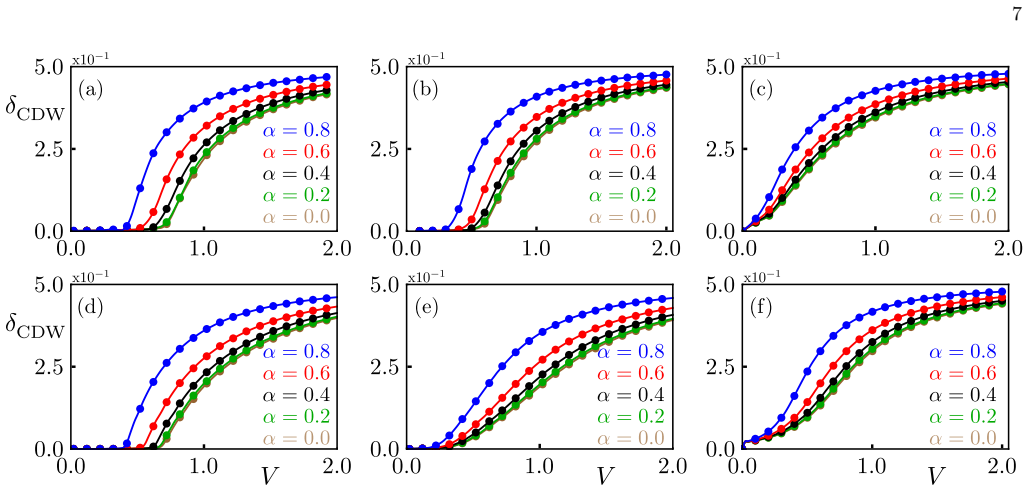
On two-dimensional bipartite Euclidean and hyperbolic lattices, a non-Hermitian generalization of the tight-binding model arising from imbalanced hopping amplitudes in opposite directions between nearest-neighbor sites reduces the bandwidth without changing the characteristic scaling of the density of states near zero energy. This non-Hermiticity catalyzes the formation of charge-density-wave and spin-density-wave orders at weaker nearest-neighbor Coulomb and on-site Hubbard repulsions, respectively, compared to Hermitian systems. Both orders produce staggered patterns that insulate the half-filled systems. These conclusions follow from lattice-based self-consistent numerical mean-field分析 in
What carries the argument
The non-Hermitian imbalance of hopping amplitudes between opposite directions on nearest-neighbor bonds, which reduces bandwidth while keeping density-of-states scaling intact near half-filling.
If this is right
- Both ordered states cause insulation in half-filled systems.
- The associated mass gaps near zero-energy scale with the non-Hermitian parameter.
- Order parameters on hyperbolic lattices with open boundary conditions exhibit specific finite-size scaling.
- A robust general mathematical criterion exists for the non-Hermitian catalysis mechanism of ordered phases.
Where Pith is reading between the lines
- The catalysis mechanism may be tested in engineered non-Hermitian platforms such as photonic lattices or cold-atom arrays where hopping imbalance can be controlled independently of interaction strength.
- Because the density-of-states scaling is preserved, the same non-Hermitian imbalance could lower thresholds for other symmetry-breaking channels not studied here.
- On hyperbolic lattices the combination of negative curvature and non-Hermiticity may produce boundary-localized order that differs qualitatively from Euclidean behavior.
Load-bearing premise
The Hartree-channel mean-field treatment combined with biorthogonal quantum mechanics accurately captures the non-Hermitian catalysis of spontaneous symmetry breaking without requiring corrections from fluctuations or higher-order interactions.
What would settle it
Exact diagonalization or quantum Monte Carlo simulations on small lattices that check whether charge-density-wave or spin-density-wave order parameters remain finite at interaction strengths below the Hermitian critical values predicted by mean-field.
Figures




read the original abstract
Depending on the lattice geometry, the nearest-neighbor (NN) tight-binding model for free fermions gives rise to particle-hole symmetric emergent Dirac liquid, Fermi liquid, and flat bands near the half-filling or zero-energy on bipartite Euclidean and hyperbolic lattices, respectively embedded on the flat and negatively curved spaces. Such noninteracting electronic fluids are characterized by a vanishing, a finite, and a diverging density of states near half-filling, respectively. A non-Hermitian generalization of this scenario resulting from an imbalance of the hopping amplitudes in the opposite directions between any pair of NN sites continues to accommodate a real eigenvalue spectrum over an extended non-Hermitian parameter regime. Most importantly, it reduces the band width without altering the characteristic scaling of the density of states close to the zero-energy. Here, we show that on two-dimensional bipartite Euclidean and hyperbolic lattices such a non-Hermiticity catalyzes the formation of both charge-density-wave and spin-density-wave orders at weaker (in comparison to the counterparts in conventional or Hermitian systems) NN Coulomb and on-site Hubbard repulsions, respectively. These two ordered states correspond to staggered patterns of average electronic density and spin between the NN sites, respectively, and both cause insulation in half-filled systems. We arrive at these conclusions by combining biorthogonal quantum mechanics and lattice-based self-consistent numerical mean-field analysis in the Hartree channel. We discuss the scaling of the associated mass gaps near the zero-energy with the non-Hermitian parameter, and also address the finite size scaling of the order parameters specifically on hyperbolic lattices with open boundary conditions. A robust general mathematical criterion for the proposed non-Hermitian catalysis mechanism for ordered phases is showcased.
Editorial analysis
A structured set of objections, weighed in public.
Referee Report
Summary. The manuscript claims that a non-Hermitian imbalance in nearest-neighbor hoppings on bipartite Euclidean and hyperbolic lattices reduces the bandwidth without changing the characteristic density-of-states scaling near zero energy, and that this catalyzes charge-density-wave and spin-density-wave orders at weaker NN Coulomb and on-site Hubbard interactions than in the Hermitian case. These conclusions are reached via biorthogonal quantum mechanics combined with self-consistent numerical mean-field analysis restricted to the Hartree channel; the work also reports the scaling of mass gaps with the non-Hermitian parameter and finite-size scaling of order parameters on hyperbolic lattices with open boundaries, together with a general mathematical criterion for the catalysis mechanism.
Significance. If the mean-field results survive beyond the approximation, the work supplies a concrete mechanism by which non-Hermiticity can lower the threshold for spontaneous symmetry breaking while preserving real spectra and DOS scaling. The explicit general mathematical criterion and the extension to hyperbolic lattices with open-boundary finite-size analysis are concrete strengths that could be useful for subsequent studies of non-Hermitian fermionic models.
major comments (2)
- [Numerical mean-field analysis and results sections] The catalysis claim (weaker critical U for CDW/SDW) rests entirely on self-consistent Hartree-channel mean-field numerics in the biorthogonal basis; no comparison to fluctuation-corrected treatments (RPA, Goldstone-mode analysis at T=0) or to exact methods is supplied, even though the manuscript acknowledges that the non-Hermitian term modifies the spectrum and the 2D mean-field critical point is known to be sensitive to such corrections.
- [Results on mass gaps and order-parameter scaling] No data tables, error estimates, or convergence diagnostics for the self-consistent solutions are provided, making it impossible to quantify the reported reduction in critical interaction strength or to assess numerical robustness of the mass-gap scaling with the non-Hermitian parameter.
minor comments (1)
- The precise range of the non-Hermitian hopping-imbalance parameter over which the spectrum remains real and the DOS scaling is unchanged should be stated explicitly with the relevant equations.
Simulated Author's Rebuttal
We thank the referee for the careful reading of our manuscript and the constructive feedback. We respond to the major comments point by point below.
read point-by-point responses
-
Referee: [Numerical mean-field analysis and results sections] The catalysis claim (weaker critical U for CDW/SDW) rests entirely on self-consistent Hartree-channel mean-field numerics in the biorthogonal basis; no comparison to fluctuation-corrected treatments (RPA, Goldstone-mode analysis at T=0) or to exact methods is supplied, even though the manuscript acknowledges that the non-Hermitian term modifies the spectrum and the 2D mean-field critical point is known to be sensitive to such corrections.
Authors: Our work is focused on demonstrating the non-Hermitian catalysis mechanism within the self-consistent mean-field approximation, which is a widely used method for investigating interaction-driven orders in lattice models. The mathematical criterion we derive for the catalysis is general and based on the modification of the bandwidth while preserving the DOS scaling near zero energy; this criterion does not rely on the mean-field treatment per se. We note that providing comparisons to RPA or exact methods would require substantial additional computations beyond the scope of the current study. However, we will add a discussion section addressing the potential impact of fluctuations on the observed catalysis effect. revision: partial
-
Referee: [Results on mass gaps and order-parameter scaling] No data tables, error estimates, or convergence diagnostics for the self-consistent solutions are provided, making it impossible to quantify the reported reduction in critical interaction strength or to assess numerical robustness of the mass-gap scaling with the non-Hermitian parameter.
Authors: We will include in the revised manuscript supplementary material with data tables listing the critical interaction strengths, mass gap values, and order parameters for various non-Hermitian parameters. Additionally, we will provide error estimates from the self-consistent iterations and details on convergence criteria and diagnostics to allow assessment of the numerical robustness. revision: yes
Circularity Check
No significant circularity; derivation is numerical self-consistent mean-field
full rationale
The paper introduces an explicit non-Hermitian imbalance in NN hoppings, preserves real spectrum and DOS scaling by construction of the model, then solves for CDW/SDW order parameters via standard self-consistent Hartree-channel mean-field equations in the biorthogonal basis. No step reduces the catalysis result to a fitted parameter renamed as prediction, a self-citation loop, or a definitional identity; the weaker critical U is an output of the numerics on Euclidean and hyperbolic lattices. The mathematical criterion is presented as derived from the same framework rather than smuggled in. This is a self-contained computational claim against the Hermitian baseline.
Axiom & Free-Parameter Ledger
free parameters (1)
- non-Hermitian hopping imbalance parameter
axioms (2)
- domain assumption Mean-field Hartree approximation suffices to capture the catalysis of CDW and SDW orders
- domain assumption Biorthogonal quantum mechanics correctly extends the mean-field treatment to non-Hermitian Hamiltonians
Forward citations
Cited by 1 Pith paper
-
Exceptional flat bands in bipartite non-Hermitian lattices
Bipartite non-Hermitian lattices support exceptional flat bands that arise from sublattice degeneracy mismatch and persist beyond exceptional points with biorthogonal modes spanning both sublattices.
Reference graph
Works this paper leans on
-
[1]
N. F. Mott, Metal-Insulator Transition, Rev. Mod. Phys. 40, 677 (1968)
work page 1968
-
[2]
N. F. Mott, Metal-insulator transitions (CRC Press, Lon- don, UK, 1990)
work page 1990
- [3]
-
[4]
A. Comtet and P. J. Houston, Effective action on the hyperbolic plane in a constant external field, J. Math. Phys. 26, 185 (1985)
work page 1985
-
[5]
A. J. Koll´ ar, M. Fitzpatrick, and A. A. Houck, Hyper- bolic lattices in circuit quantum electrodynamics, Nature (London) 571, 45 (2019)
work page 2019
-
[6]
J. Maciejko and S. Rayan, Hyperbolic band theory, Sci. Adv. 7, eabe9170 (2021)
work page 2021
-
[7]
M. Ludewig and G. C. Thiang, Gaplessness of Landau Hamiltonians on hyperbolic half-planes via coarse geom- 23 etry, Commun. Math. Phys. 386, 87 (2021)
work page 2021
- [8]
-
[9]
I. Boettcher, A. V. Gorshkov, A. J. Koll´ ar, J. Maciejko, S. Rayan, and R. Thomale, Crystallography of hyperbolic lattices, Phys. Rev. B 105, 125118 (2022)
work page 2022
- [10]
-
[11]
J. Maciejko and S. Rayan, Automorphic Bloch theorems for hyperbolic lattices, Proc. Natl. Acad. Sci. USA 119, e2116869119 (2022)
work page 2022
-
[12]
A. Stegmaier, L. K. Upreti, R. Thomale, and I. Boettcher, Universality of Hofstadter butterflies on hy- perbolic lattices, Phys. Rev. Lett. 128, 166402 (2022)
work page 2022
-
[13]
T. Bzduˇ sek and J. Maciejko, Flat bands and band- touching from real-space topology in hyperbolic lattices, Phys. Rev. B 106, 155146 (2022)
work page 2022
-
[14]
R. Mosseri and J. Vidal, Density of states of tight-binding models in the hyperbolic plane, Phys. Rev. B108, 035154 (2023)
work page 2023
-
[15]
A. Chen, Y. Guan, P. M. Lenggenhager, J. Maciejko, I. Boettcher, and T. Bzduˇ sek, Symmetry and topology of hyperbolic Haldane models, Phys. Rev. B 108, 085114 (2023)
work page 2023
-
[16]
A-L. He, L. Qi, Y. Liu, and Y-F. Wang, Hyperbolic fractional Chern insulators, Phys. Rev. B 110, 195113 (2024)
work page 2024
-
[17]
T. Tummuru, A. Chen, P. M. Lenggenhager, T. Neupert, J. Maciejko, and T. Bzduˇ sek, Hyperbolic Non-Abelian Semimetal, Phys. Rev. Lett. 132, 206601 (2024)
work page 2024
-
[18]
A. Chen, J. Maciejko, and I. Boettcher, Anderson Lo- calization Transition in Disordered Hyperbolic Lattices, Phys. Rev. Lett. 133, 066101 (2024)
work page 2024
-
[19]
S. Dey, A. Chen, P. Basteiro, A. Fritzsche, M. Greiter, M. Kaminski, P. M. Lenggenhager, R. Meyer, R. Sorbello, A. Stegmaier, R. Thomale, J. Erdmenger, and I. Boettcher, Simulating Holographic Conformal Field Theories on Hy- perbolic Lattices, Phys. Rev. Lett. 133, 061603 (2024)
work page 2024
- [20]
-
[21]
Roy, Magnetic catalysis in weakly interacting hyper- bolic Dirac materials, Phys
B. Roy, Magnetic catalysis in weakly interacting hyper- bolic Dirac materials, Phys. Rev. B 110, 245117 (2024)
work page 2024
-
[22]
N. Gluscevich, A. Samanta, S. Manna, and B. Roy, Dy- namic mass generation on two-dimensional electronic hy- perbolic lattices, arXiv:2302.04864
-
[23]
V. Juriˇ ci´ c and B. Roy, Yukawa-Lorentz symmetry in non-Hermitian Dirac materials, Commun. Phys. 7, 169 (2024)
work page 2024
-
[24]
S. A. Murshed and B. Roy, Quantum electrodynamics of non-Hermitian Dirac fermions, J. High Energ. Phys. 2024, 143 (2024)
work page 2024
- [25]
- [26]
-
[27]
S. Pino-Alarc´ on and V. Juriˇ ci´ c, Yukawa-Lorentz Symme- try of Tilted Non-Hermitian Dirac Semimetals at Quan- tum Criticality, arXiv:2411.18621
-
[28]
P. R. Wallace, The Band Theory of Graphite, Phys. Rev. 71, 622 (1947)
work page 1947
-
[29]
A. H. Castro Neto, F. Guinea, N. M. R. Peres, K. S. Novoselov, and A. K. Geim, The electronic properties of graphene, Rev. Mod. Phys. 81, 109 (2009)
work page 2009
-
[30]
E. Kogan and G. Gumbs, Green’s Functions and DOS for Some 2D Lattices, Graphene 10, 1 (2021) and references therein
work page 2021
-
[31]
J. W. Negele and H. Orland, Quantum Many-particle Systems (Westview Press, Boulder, CO, 1998)
work page 1998
-
[32]
D. C. Brody, Biorthogonal quantum mechanics, J. Phys. A: Math. Theor. 47, 035305 (2014) and references therein
work page 2014
-
[33]
A. L. Tchougreeff and R. Hoffmann, Charge and spin density waves in the electronic structure of graphite: ap- plication to analysis of STM images, J. Phys. Chem. 96, 8993 (1992)
work page 1992
-
[34]
D. V. Khveshchenko, Ghost Excitonic Insulator Transi- tion in Layered Graphite, Phys. Rev. Lett. 87, 246802 (2001)
work page 2001
-
[35]
I. F. Herbut, Interactions and Phase Transitions on Graphene’s Honeycomb Lattice, Phys. Rev. Lett. 97, 146401 (2006)
work page 2006
-
[36]
S. Raghu, X.-L. Qi, C. Honerkamp, and S.-C. Zhang, Topological Mott Insulators, Phys. Rev. Lett. 100, 156401 (2008)
work page 2008
-
[37]
I. F. Herbut, V. Juriˇ ci´ c, and B. Roy, Theory of interacting electrons on the honeycomb lattice, Phys. Rev. B 79, 085116 (2009)
work page 2009
-
[38]
A. G. Grushin, E. V. Castro, A. Cortijo, F. de Juan, M. A. H. Vozmediano, and B. Valenzuela, Charge insta- bilities and topological phases in the extended Hubbard model on the honeycomb lattice with enlarged unit cell, Phys. Rev. B 87, 085136 (2013)
work page 2013
-
[39]
A. L. Szab´ o and B. Roy, Extended Hubbard model in undoped and doped monolayer and bilayer graphene: Se- lection rules and organizing principle among competing orders, Phys. Rev. B 103, 205135 (2021)
work page 2021
-
[40]
R. Nandkishore and L. Levitov, Dynamical Screening and Excitonic Instability in Bilayer Graphene, Phys. Rev. Lett. 104, 156803 (2010)
work page 2010
- [41]
-
[42]
Vafek, Interacting fermions on the honeycomb bilayer: From weak to strong coupling, Phys
O. Vafek, Interacting fermions on the honeycomb bilayer: From weak to strong coupling, Phys. Rev. B 82, 205106 (2010)
work page 2010
-
[43]
Y. Lemonik, I. Aleiner, and V. I. Fal’ko, Competing nematic, antiferromagnetic, and spin-flux orders in the ground state of bilayer graphene, Phys. Rev. B 85, 245451 (2012)
work page 2012
-
[44]
Roy, Theory of integer quantum Hall effect in insulat- ing bilayer graphene, Phys
B. Roy, Theory of integer quantum Hall effect in insulat- ing bilayer graphene, Phys. Rev. B89, 201401(R) (2014)
work page 2014
- [45]
- [46]
-
[47]
B. Roy, F. F. Assaad and I. F. Herbut, Zero Modes and 24 Global Antiferromagnetism in Strained Graphene, Phys. Rev. X 4, 021042 (2014)
work page 2014
-
[48]
Roy, Interacting nodal-line semimetal: Proximity ef- fect and spontaneous symmetry breaking, Phys
B. Roy, Interacting nodal-line semimetal: Proximity ef- fect and spontaneous symmetry breaking, Phys. Rev. B 96, 041113(R) (2017)
work page 2017
- [49]
-
[50]
Tinkham, Introduction to Superconductivity (Dover Publication, New York, 1975)
M. Tinkham, Introduction to Superconductivity (Dover Publication, New York, 1975)
work page 1975
-
[51]
A. Altland and M. R. Zirnbauer, Nonstandard symme- try classes in mesoscopic normal-superconducting hybrid structures, Phys. Rev. B 55, 1142 (1997)
work page 1997
-
[52]
A. P. Schnyder, S. Ryu, A. Furusaki, and A. W. W. Lud- wig, Classification of topological insulators and super- conductors in three spatial dimensions, Phys. Rev. B 78, 195125 (2008)
work page 2008
-
[53]
S. Ryu, A. P. Schnyder, A. Furusaki, and A. W. W. Lud- wig, Topological insulators and superconductors: Tenfold way and dimensional hierarchy, New J. Phys. 12, 065010 (2010)
work page 2010
-
[54]
J. E. Hirsch and S. Tang, Antiferromagnetism in the Two-Dimensional Hubbard Model, Phys. Rev. Lett. 62, 591 (1989)
work page 1989
-
[55]
Y. Zhang and J. Callaway, Extended Hubbard model in two dimensions, Phys. Rev. B 39, 9397 (1989)
work page 1989
-
[56]
S. Sorella and E. Tosatti, Semi-Metal-Insulator Transi- tion of the Hubbard Model in the Honeycomb Lattice, Europhys. Lett. 19, 699 (1992)
work page 1992
- [57]
-
[58]
T. C. Lang, Z.-Y. Meng, M. M. Scherer, S. Uebelacker, F. F. Assaad, A. Muramatsu, C. Honerkamp, and S. Wessel, Antiferromagnetism in the Hubbard Model on the Bernal-Stacked Honeycomb Bilayer, Phys. Rev. Lett. 109, 126402 (2012)
work page 2012
-
[59]
F. F. Assaad and I. F. Herbut, Pinning the Order: The Nature of Quantum Criticality in the Hubbard Model on Honeycomb Lattice, Phys. Rev. X 3, 031010 (2013)
work page 2013
-
[60]
L. Wang, P. Corboz, and M. Troyer, Fermionic quantum critical point of spinless fermions on a honeycomb lattice, New J. Phys. 16, 103008 (2014)
work page 2014
-
[61]
F. Parisen Toldin, M. Hohenadler, F. F. Assaad, and I. F. Herbut, Fermionic quantum criticality in honey- comb and π-flux Hubbard models: Finite-size scaling of renormalization-group-invariant observables from quan- tum Monte Carlo, Phys. Rev. B 91, 165108 (2015)
work page 2015
- [62]
- [63]
-
[64]
Y. Schattner, S. Lederer, S. A. Kivelson, and E. Berg, Ising Nematic Quantum Critical Point in a Metal: A Monte Carlo Study, Phys. Rev. X 6, 031028 (2016)
work page 2016
- [65]
-
[66]
X. Y. Xu, K. Sun, Y. Schattner, E. Berg, and Z. Y. Meng, Non-Fermi Liquid at (2 + 1)D Ferromagnetic Quantum Critical Point, Phys. Rev. X 7, 031058 (2017)
work page 2017
-
[67]
H.-M. Guo, L. Wang, and R. T. Scalettar, Quantum phase transitions of multispecies Dirac fermions, Phys. Rev. B 97, 235152 (2018)
work page 2018
- [68]
-
[69]
T. Sato, Z. Wang, Y. Liu, D. Hou, M. Hohenadler, W. Guo, and F. F. Assaad, Simulation of fermionic and bosonic critical points with emergent SO(5) symmetry, Phys. Rev. B 108, L121111 (2023)
work page 2023
-
[70]
H. Liu, E. Huffman, S. Chandrasekharan, and R. K. Kaul, Quantum Criticality of Antiferromagnetism and Superconductivity with Relativity, Phys. Rev. Lett. 128, 117202 (2023)
work page 2023
-
[71]
X.-J. Yu, Z. Pan, L. Xu, and Z.-X. Li, Non-Hermitian Strongly Interacting Dirac Fermions, Phys. Rev. Lett. 132, 116503 (2024)
work page 2024
-
[72]
Esslinger, Fermi-Hubbard Physics with Atoms in an Optical Lattice, Annu
T. Esslinger, Fermi-Hubbard Physics with Atoms in an Optical Lattice, Annu. Rev. Condens. Matter Phys. 1, 129 (2010)
work page 2010
-
[73]
M. Aidelsburger, M. Atala, S. Nascimb´ ene, S. Trotzky, Y.-A. Chen, and I. Bloch, Experimental Realization of Strong Effective Magnetic Fields in an Optical Lattice, Phys. Rev. Lett. 107, 255301 (2011)
work page 2011
-
[74]
M. Aidelsburger, M. Atala, M. Lohse, J. T. Barreiro, B. Paredes, and I. Bloch, Realization of the Hofstadter Hamiltonian with Ultracold Atoms in Optical Lattices, Phys. Rev. Lett. 111, 185301 (2013)
work page 2013
-
[75]
T. Uehlinger, G. Jotzu, M. Messer, D. Greif, W. Hofstet- ter, U. Bissbort, and T. Esslinger, Artificial Graphene with Tunable Interactions, Phys. Rev. Lett. 111, 185307 (2013)
work page 2013
-
[76]
L. W. Cheuk, M. A. Nichols, K. R. Lawrence, M. Okan, H. Zhang, E. Khatami, N. Trivedi, T. Paiva, M. Rigol, and M. W. Zwierlein, Observation of spatial charge and spin correlations in the 2D Fermi-Hubbard model, Sci- ence 353, 1260 (2016)
work page 2016
-
[77]
A. Mazurenko, C. S. Chiu, G. Ji, M. F. Parsons, M. Kan´ aszNagy, R. Schmidt, F. Grusdt, E. Demler, D. Greif, and M. Greiner, A cold-atom Fermi–Hubbard antiferro- magnet, Nature (London) 545, 462 (2017)
work page 2017
-
[78]
Aidelsburger, Artificial gauge fields and topology with ultracold atoms in optical lattices, J
M. Aidelsburger, Artificial gauge fields and topology with ultracold atoms in optical lattices, J. Phys. B: At. Mol. Opt. Phys. 51, 193001 (2018)
work page 2018
- [79]
-
[80]
Z. Gong, Y. Ashida, K. Kawabata, K. Takasan, S. Hi- gashikawa, and M. Ueda, Topological Phases of Non- Hermitian Systems, Phys. Rev. X 8, 031079 (2018)
work page 2018
discussion (0)
Sign in with ORCID, Apple, or X to comment. Anyone can read and Pith papers without signing in.