FS-DFM: Fast and Accurate Long Text Generation with Few-Step Diffusion Language Models
Pith reviewed 2026-05-18 13:32 UTC · model grok-4.3
The pith
FS-DFM trains diffusion language models to reach full quality on 1,024-token sequences with only 8 sampling steps.
A machine-rendered reading of the paper's core claim, the machinery that carries it, and where it could break.
Core claim
FS-DFM is a discrete flow-matching model that treats the number of sampling steps as an explicit training parameter so that the model learns to reach the same endpoint with one large update or many small ones. Combined with a reliable update rule that moves probability mass without overshooting and with teacher guidance distilled from long-run trajectories, the model produces 1,024-token sequences whose perplexity matches a 1,024-step discrete-flow baseline when sampled in only 8 steps.
What carries the argument
Consistency training across step budgets in discrete flow-matching, paired with a reliable update rule and distilled teacher guidance.
If this is right
- Sampling time for 1,024 tokens drops by a factor of 128 while keeping the same perplexity.
- Long-sequence generation becomes feasible on hardware where thousands of iterations were previously prohibitive.
- The same model can be used at different speed-quality operating points by changing only the inference step count.
- No additional model size or training data is required beyond the consistency objective and guidance.
Where Pith is reading between the lines
- The consistency training could allow dynamic adjustment of inference steps based on available compute at deployment time.
- Similar objectives might accelerate iterative generation in other sequence domains such as code or dialogue.
- The approach could reduce overall energy cost for high-quality text generation in latency-sensitive settings.
Load-bearing premise
Training the model for consistency across step budgets will ensure that few large moves produce the same distribution as many small moves without introducing artifacts or collapse on long sequences.
What would settle it
Running the 8-step sampler on the same evaluation benchmarks used for the 1,024-step baseline and checking whether perplexity remains equal or diverges.
Figures


read the original abstract
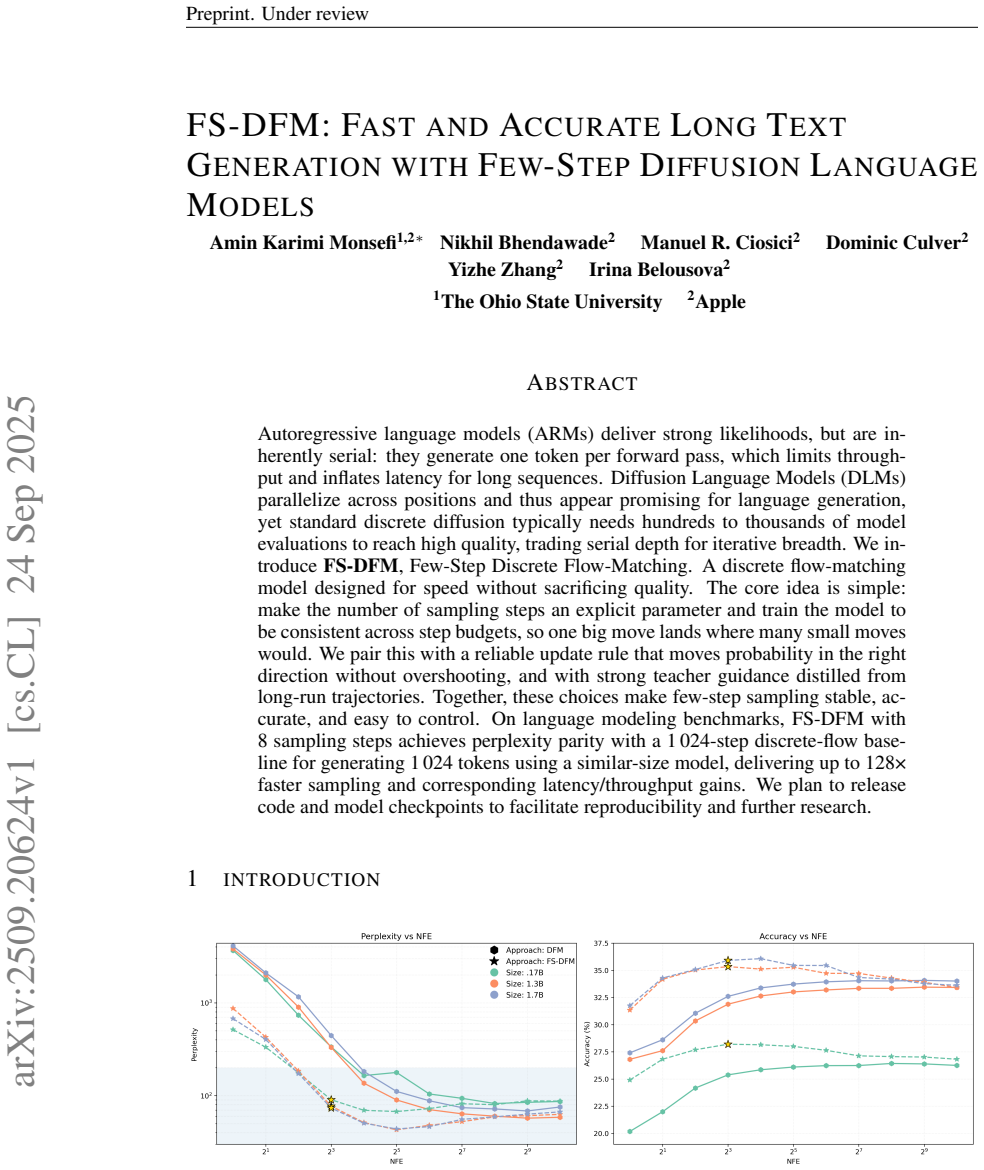
Autoregressive language models (ARMs) deliver strong likelihoods, but are inherently serial: they generate one token per forward pass, which limits throughput and inflates latency for long sequences. Diffusion Language Models (DLMs) parallelize across positions and thus appear promising for language generation, yet standard discrete diffusion typically needs hundreds to thousands of model evaluations to reach high quality, trading serial depth for iterative breadth. We introduce FS-DFM, Few-Step Discrete Flow-Matching. A discrete flow-matching model designed for speed without sacrificing quality. The core idea is simple: make the number of sampling steps an explicit parameter and train the model to be consistent across step budgets, so one big move lands where many small moves would. We pair this with a reliable update rule that moves probability in the right direction without overshooting, and with strong teacher guidance distilled from long-run trajectories. Together, these choices make few-step sampling stable, accurate, and easy to control. On language modeling benchmarks, FS-DFM with 8 sampling steps achieves perplexity parity with a 1,024-step discrete-flow baseline for generating 1,024 tokens using a similar-size model, delivering up to 128 times faster sampling and corresponding latency/throughput gains. Code & pretrained checkpoints: https://github.com/apple/ml-fs-dfm
Editorial analysis
A structured set of objections, weighed in public.
Referee Report
Summary. The paper introduces FS-DFM, a discrete flow-matching model for language generation. The core contributions are training the model for consistency across sampling step budgets (so a single large update approximates many small ones), a reliable probability update rule that avoids overshooting, and distillation of teacher guidance from long-run trajectories. The central empirical claim is that an 8-step FS-DFM matches the perplexity of a 1024-step discrete-flow baseline when generating 1024-token sequences with a comparable model size, yielding up to 128x faster sampling.
Significance. If the central claim holds under rigorous controls, the work would be significant for practical deployment of diffusion language models on long sequences: it directly tackles the iteration-count bottleneck while preserving quality, potentially improving latency and throughput relative to both standard DLMs and serial autoregressive models. The release of code and pretrained checkpoints is a clear strength that supports reproducibility.
major comments (2)
- [Experiments] Experiments section: the reported perplexity parity for 1024-token generation provides no variance across runs, no ablation isolating consistency training from the update rule and teacher distillation, and no secondary metrics (repetition rate, MAUVE, n-gram diversity) that would detect mode collapse or coherence degradation; these omissions are load-bearing because the central claim rests on equivalence of the 8-step and 1024-step distributions in a V^1024 discrete space.
- [Method] Method section: the consistency-training objective is presented as sufficient to align few-step and many-step trajectories, yet no analysis or diagnostic is given showing that local update errors do not compound across 1024 positions when the teacher trajectories are drawn from the long-run regime; this directly affects whether the few-step claim generalizes to the target sequence length.
minor comments (1)
- [Abstract] Abstract: the phrase 'language modeling benchmarks' is used without naming the datasets or reporting the absolute perplexity values, making the parity claim harder to contextualize.
Simulated Author's Rebuttal
We thank the referee for the constructive review and for recognizing the potential significance of FS-DFM for practical long-sequence generation. We address each major comment below and commit to revisions that strengthen the empirical support for the central claims.
read point-by-point responses
-
Referee: [Experiments] Experiments section: the reported perplexity parity for 1024-token generation provides no variance across runs, no ablation isolating consistency training from the update rule and teacher distillation, and no secondary metrics (repetition rate, MAUVE, n-gram diversity) that would detect mode collapse or coherence degradation; these omissions are load-bearing because the central claim rests on equivalence of the 8-step and 1024-step distributions in a V^1024 discrete space.
Authors: We agree that these elements would provide stronger evidence for distributional equivalence. In the revised manuscript we will report perplexity means and standard deviations over multiple independent runs with different random seeds. We will add ablations that isolate consistency training, the reliable update rule, and teacher distillation by training and evaluating variants with each component removed. We will also include secondary metrics (repetition rate, MAUVE, and n-gram diversity) for both the 8-step FS-DFM and the 1024-step baseline on the 1024-token generation task. These additions will appear in the Experiments section and will be supported by the released code and checkpoints. revision: yes
-
Referee: [Method] Method section: the consistency-training objective is presented as sufficient to align few-step and many-step trajectories, yet no analysis or diagnostic is given showing that local update errors do not compound across 1024 positions when the teacher trajectories are drawn from the long-run regime; this directly affects whether the few-step claim generalizes to the target sequence length.
Authors: The consistency objective is explicitly designed to make a single large update approximate the composition of many small updates, which directly targets the compounding concern. The empirical result that an 8-step model matches 1024-step perplexity on 1024-token sequences already provides evidence that any residual local errors do not accumulate to a detectable degree in the final distribution. To make this explicit, we will add a diagnostic analysis in the revised Method section that measures the per-position divergence between few-step predictions and the corresponding teacher (long-run) states across the full sequence length, confirming that alignment holds without progressive degradation. revision: yes
Circularity Check
No significant circularity in FS-DFM method or claims
full rationale
The paper's core contribution is an empirical training procedure that explicitly conditions on the number of sampling steps and enforces consistency across budgets, paired with a reliable update rule and distilled teacher guidance. All reported results consist of direct perplexity comparisons against an external 1,024-step discrete-flow baseline on 1,024-token sequences, with no equations, fitted parameters, or self-citations that reduce the claimed parity or speed-up to a quantity defined by the method itself. The derivation chain is therefore self-contained and relies on standard optimization plus external benchmarking rather than any of the enumerated circular patterns.
Axiom & Free-Parameter Ledger
free parameters (1)
- sampling step budget
axioms (1)
- domain assumption Discrete flow-matching framework can be trained to produce consistent trajectories across varying numbers of denoising steps.
Lean theorems connected to this paper
-
IndisputableMonolith/Cost/FunctionalEquation.leanwashburn_uniqueness_aczel unclear?
unclearRelation between the paper passage and the cited Recognition theorem.
make the number of sampling steps an explicit parameter and train the model to be consistent across step budgets, so one big move lands where many small moves would... Cumulative Scalar... Gt,h = ln((1-kappa(t))/(1-kappa(t+h)))
-
IndisputableMonolith/Foundation/DimensionForcing.leanreality_from_one_distinction (8-tick period) echoes?
echoesECHOES: this paper passage has the same mathematical shape or conceptual pattern as the Recognition theorem, but is not a direct formal dependency.
FS-DFM with 8 sampling steps achieves perplexity parity with a 1,024-step discrete-flow baseline for generating 1,024 tokens
What do these tags mean?
- matches
- The paper's claim is directly supported by a theorem in the formal canon.
- supports
- The theorem supports part of the paper's argument, but the paper may add assumptions or extra steps.
- extends
- The paper goes beyond the formal theorem; the theorem is a base layer rather than the whole result.
- uses
- The paper appears to rely on the theorem as machinery.
- contradicts
- The paper's claim conflicts with a theorem or certificate in the canon.
- unclear
- Pith found a possible connection, but the passage is too broad, indirect, or ambiguous to say the theorem truly supports the claim.
Forward citations
Cited by 4 Pith papers
-
Drifting Objectives for Refining Discrete Diffusion Language Models
TokenDrift refines discrete diffusion language models by applying anti-symmetric drifting to soft-token features during training, yielding large reductions in generation perplexity at low NFEs.
-
Controlla: Learning Controllability via Graph-Constrained Latent Geometry
Controlla learns identity and attribute factors from multimodal inputs and aligns them with graph priors using graph-constrained optimal transport to enforce consistent attribute trajectories while preserving referenc...
-
dFlowGRPO: Rate-Aware Policy Optimization for Discrete Flow Models
dFlowGRPO is a new rate-aware RL method for discrete flow models that outperforms prior GRPO approaches on image generation and matches continuous flow models while supporting broad probability paths.
-
Coupling Models for One-Step Discrete Generation
Coupling Models enable single-step discrete sequence generation via learned couplings to Gaussian latents and outperform prior one-step baselines on text perplexity, biological FBD, and image FID metrics.
Reference graph
Works this paper leans on
-
[1]
Dpad: Efficient diffusion language models with suffix dropout.arXiv preprint arXiv:2508.14148,
Tianqi Chen, Shujian Zhang, and Mingyuan Zhou. Dlm-one: Diffusion language models for one- step sequence generation.arXiv preprint arXiv:2506.00290, 2025a. Xinhua Chen, Sitao Huang, Cong Guo, Chiyue Wei, Yintao He, Jianyi Zhang, Hai ”Hellen” Li, and Yiran Chen. DPad: Efficient Diffusion Language Models with Suffix Dropout.arXiv preprint arXiv:2508.14148, ...
-
[2]
Shansan Gong, Shivam Agarwal, Yizhe Zhang, Jiacheng Ye, Lin Zheng, Mukai Li, Chenxin An, Peilin Zhao, Wei Bi, Jiawei Han, Hao Peng, and Lingpeng Kong. Scaling diffusion language models via adaptation from autoregressive models. InThe Thirteenth International Conference on Learning Representations, 2025a. Shansan Gong, Ruixiang Zhang, Huangjie Zheng, Jiata...
-
[3]
doi: 10.18653/v1/2024.eacl-short.33
Association for Computational Linguistics. doi: 10.18653/v1/2024.eacl-short.33. Amin Karimi Monsefi, Mridul Khurana, Rajiv Ramnath, Anuj Karpatne, Wei-Lun Chao, and Cheng Zhang. Taxadiffusion: Progressively trained diffusion model for fine-grained species generation. arXiv preprint arXiv:2506.01923,
-
[4]
Mercury: Ultra-Fast Language Models Based on Diffusion
Inception Labs, Samar Khanna, Siddhant Kharbanda, Shufan Li, Harshit Varma, Eric Wang, Sawyer Birnbaum, Ziyang Luo, Yanis Miraoui, Akash Palrecha, Stefano Ermon, Aditya Grover, and V olodymyr Kuleshov. Mercury: Ultra-Fast Language Models Based on Diffusion.arXiv preprint arXiv:2506.17298,
work page internal anchor Pith review Pith/arXiv arXiv
-
[5]
Ethan Li, Anders Boesen Lindbo Larsen, Chen Zhang, et al. Apple intelligence foundation language models: Tech report 2025.arXiv preprint arXiv:2507.13575, 2025a. Tianyi Li, Mingda Chen, Bowei Guo, and Zhiqiang Shen. A Survey on Diffusion Language Models. arXiv preprint arXiv:2508.10875, 2025b. doi: 10.48550/arXiv.2508.10875. Xiang Li, John Thickstun, Isha...
-
[6]
Knobgen: Controlling the sophistication of artwork in sketch-based diffusion models
11 Preprint. Under review Pouyan Navard, Amin Karimi Monsefi, Mengxi Zhou, Wei-Lun Chao, Alper Yilmaz, and Rajiv Ramnath. Knobgen: controlling the sophistication of artwork in sketch-based diffusion models. arXiv preprint arXiv:2410.01595,
-
[7]
Large Language Diffusion Models
Shen Nie, Fengqi Zhu, Chao Du, Tianyu Pang, Qian Liu, Guangtao Zeng, Min Lin, and Chongxuan Li. Scaling up masked diffusion models on text. InThe Thirteenth International Conference on Learning Representations, 2025a. Shen Nie, Fengqi Zhu, Zebin You, Xiaolu Zhang, Jingyang Ou, Jun Hu, Jun Zhou, Yankai Lin, Ji-Rong Wen, and Chongxuan Li. Large language dif...
work page internal anchor Pith review Pith/arXiv arXiv
-
[8]
Gemini: A Family of Highly Capable Multimodal Models
Gemini Team, Rohan Anil, Sebastian Borgeaud, Jean-Baptiste Alayrac, Jiahui Yu, Radu Soricut, Johan Schalkwyk, Andrew M Dai, Anja Hauth, Katie Millican, et al. Gemini: a family of highly capable multimodal models.arXiv preprint arXiv:2312.11805,
work page internal anchor Pith review Pith/arXiv arXiv
-
[9]
Fast-dLLM: Training-free Acceleration of Diffusion LLM by Enabling KV Cache and Parallel Decoding
Chengyue Wu, Hao Zhang, Shuchen Xue, Zhijian Liu, Shizhe Diao, Ligeng Zhu, Ping Luo, Song Han, and Enze Xie. Fast-dLLM: Training-free Acceleration of Diffusion LLM by Enabling KV Cache and Parallel Decoding.arXiv preprint arXiv:2505.22618,
work page internal anchor Pith review Pith/arXiv arXiv
-
[10]
An Yang, Anfeng Li, Baosong Yang, Beichen Zhang, Binyuan Hui, Bo Zheng, Bowen Yu, Chang Gao, Chengen Huang, Chenxu Lv, et al. Qwen3 technical report.arXiv preprint arXiv:2505.09388,
work page internal anchor Pith review Pith/arXiv arXiv
-
[11]
Dream 7B: Diffusion Large Language Models
Jiacheng Ye, Zhihui Xie, Lin Zheng, Jiahui Gao, Zirui Wu, Xin Jiang, Zhenguo Li, and Lingpeng Kong. Dream 7B: Diffusion Large Language Models.arXiv preprint arXiv:2508.15487,
work page internal anchor Pith review Pith/arXiv arXiv
-
[12]
A Survey of Large Language Models
Wayne Xin Zhao, Kun Zhou, Junyi Li, Tianyi Tang, Xiaolei Wang, Yupeng Hou, Yingqian Min, Beichen Zhang, Junjie Zhang, Zican Dong, Yifan Du, Chen Yang, Yushuo Chen, Zhipeng Chen, Jinhao Jiang, Ruiyang Ren, Yifan Li, Xinyu Tang, Zikang Liu, Peiyu Liu, Jian-Yun Nie, and Ji-Rong Wen. A survey of large language models.arXiv preprint arXiv:2303.18223,
work page internal anchor Pith review Pith/arXiv arXiv
-
[13]
early” hue, while late edits appear in “late
This experiment probes two intuitions: (a) modest to strong emphasis on the largesthshould sharpen single/few-step accuracy by exposing the student to more shortcut-distilled targets; and (b) annealing the bias away (policy AG) preserves this benefit early while restoring balanced coverage later, stabilizing path-following at smallhwithout sacrificing few...
work page 2024
-
[14]
it must be that they emerged farand away from the most sophisticated local men
When the team achieved full strength, the two Natives asserted performance: - The victory showed the Saturday Higgins was a striking example of what they used to do in practice will moved ... it must be that they emerged farand away from the most sophisticated local men. Throughout the action, they performed speed jumping, dribbling, and running coll yard...
work page 2022
-
[15]
The<R>atives<R><R><R><R> for only the second time<R><R><R>man<R><R><R><R><R> the playing<R><R><R><R>.<R> team<R> travelledback to New Zealand, and<R><R><R><R>carg<R> on 5<R><R> <R> ==<R> to New Zealand == <R><R> days<R><R><R><R><R><R><R> faced South<R><R><R><R><R><R><R> 1<R> front<R><R> crowd of<R>,<R>. The side<R> furtherinjury, to<R><R><R> and<R> South<...
work page 1954
-
[16]
Marieas well as between Dross and Kinross
Two sections of roadway were created in 1963 immediately to the south-east intersection of International City of Sault Ste. Marieas well as between Dross and Kinross. The first two sections built in 1963 connected the northern section of the bridge between M - 75 and Kinross, and the section between Dross and Sault Ste. Marie to Washington. The lower sect...
work page 1963
-
[17]
MDOT disposed of its former routing of the bridge into St
US68 built a new bridge over the Mackinique River in 1971 to bypass the bridge. MDOT disposed of its former routing of the bridge into St. Ignace. The western halfwas initially left unnumbered in 1963 until it was later transferred to local residents as an extension of I -
work page 1971
-
[18]
In the same year, MDOT trunc completed US 41 to end the St
The remainder, including the Susson Bridge, was downtown. In the same year, MDOT trunc completed US 41 to end the St. Ignace by removing it from the I - 75 freeway. The last attempt was made to extend the expressway through Clark County in 1998 bymissioning the bridge that originally marked the bridge over the river in
work page 1998
-
[19]
Bohn, a customized local citizen who later served in politics from 1927 to1933
In2011, MDOT reduced the speed limit on the expressway traffic in Clark County from 55 to 55 mph (67 km / h) max), and the speed limit on bridge remains 55 mph (89 km / h).- Colors ==, elevations and tourist routes ==ed<|endoftext|>In on July 15, 1933, the State Legion established named M - 1870, and God Almighty American followed in distance to the Bohn ...
work page 1933
-
[20]
Bridges to the highway were not installed until 1939 when Governor George W
To connect the gap in the road where US 2 / US Wisconsin / M - 35 and M - 35 were used in place of US 2 between Iron Mountain and Crystal Falls. Bridges to the highway were not installed until 1939 when Governor George W. Romney completed were installed.- The Amvets Minor Drive Center was created for the section of US 2 / US Wisconsin / M - 35, as part of...
work page 1939
-
[21]
In addition, the section of US 2 was part of the overall Great Lakes Road Tour (GLCT): This bridge connects the southern state line between Iron Mountain and southern M - 35 junction in Wakefield State 73 to the east termin Circle H1LSick, and this bridge connects the southern M - 35 junction in Yukanaba to the east terminus in St. Ignace as part of the o...
work page 1939
discussion (0)
Sign in with ORCID, Apple, or X to comment. Anyone can read and Pith papers without signing in.