REVIEW 2 major objections 4 minor 5 cited by
No persistent gravitational-wave source found in eight years of sky-wide search
Reviewed by Pith at T0; open to challenge. T0 means a machine referee read the full paper against a public rubric. the ladder, T0–T4 →
T0 review · deepseek-v4-flash
2026-08-04 09:02 UTC pith:IVLMXDBZ
load-bearing objection A solid, carefully caveated null result with new O4a directional limits; the one real weakness is that the quoted 95% upper limits assume a Gaussian likelihood without a coverage check against the paper's own documented non-Gaussian outliers. the 2 major comments →
Directional Search for Persistent Gravitational Waves: Results from the First Part of LIGO-Virgo-KAGRA's Fourth Observing Run
The pith
A machine-rendered reading of the paper's core claim, the machinery that carries it, and where it could break.
Core claim
The authors' central claim is that no persistent gravitational-wave signal localized in direction and frequency—or in angular power—is present in the combined O1–O4a dataset, at the most restrictive levels yet achieved. Concretely: the all-sky all-frequency radiometer sets a 95% sensitivity to effective strain amplitude between about 2.9×10⁻²⁶ and 8.5×10⁻²⁴ across 20–160 Hz; the targeted narrowband search constrains five celestial targets—Scorpius X-1, SN 1987A, the Galactic Center, Terzan 5, and NGC 6397—to strain amplitudes from about 1.1×10⁻²⁵ to 6.5×10⁻²⁴; the broadband search limits gravitational-wave flux at 25 Hz to (0.008–5.5)×10⁻⁸ erg cm⁻² s⁻¹ Hz⁻¹ for spectral indices 0, 2/3, and 3
What carries the argument
The gravitational-wave radiometer: a cross-correlation estimator between two geographically separated detectors that measures the cross-spectral density of their strain data, weighted by the overlap reduction function, then inverts a Fisher matrix to produce sky maps of gravitational-wave power per pixel or per spherical-harmonic mode. The all-sky all-frequency variant scans every sky pixel and every 1/32 Hz frequency bin; the targeted variant averages neighboring bins to collect Doppler-smeared signal; the broadband variant assumes a power-law spectrum with spectral index α; and the spherical-harmonic variant—including a newly introduced cross-C_ℓ estimator—decomposes the sky into angular m
Load-bearing premise
All quoted numbers hinge on the premise that, after data-quality cuts, the noise in a detector pair is Gaussian and stationary, so that time-shifted data give a true picture of a signal-free sky—a premise the paper itself shows is imperfect, with a persistent excess at 92.8125 Hz and about 4% of α=0 modes exceeding the Gaussian threshold.
What would settle it
Perform a blind injection: hide a simulated persistent source with effective strain near, say, 1.5 times the median all-sky sensitivity into O4a data, run the full search, and check whether it is recovered above the 5% global significance threshold. If the recovery rate falls well below nominal, the upper limits are overconfident; alternatively, if the 92.8125 Hz excess strengthens and localizes in later O4 data, the null hypothesis itself would be in question.
If this is right
- No persistent directional gravitational-wave source—whether from known targets like Scorpius X-1 or unknown all-sky emitters—is present above the quoted strain bounds; any such source must be fainter.
- The spherical-harmonic upper limits lie above the levels predicted for compact-binary and cosmic-string anisotropies, so those cosmological models remain viable rather than excluded.
- The cross-C_ℓ estimator removes the shot-noise bias that would otherwise contaminate future, more sensitive searches for extended anisotropy.
- The hundreds of sub-threshold all-sky candidates provide a concrete list for follow-up with matched-filter searches; some may eventually be identified as weak signals or instrumental artifacts.
- Adding O4a data improves median sensitivity by factors of roughly 1.1–1.7 across the four analyses, and further improvement is expected as the rest of the observing run is processed.
Where Pith is reading between the lines
- If the 92.8125 Hz negative-SNR feature proves to be a detector artifact, similar narrowband non-Gaussianities may lurk below the detection threshold across the full frequency band; monitoring this bin in later data is the cleanest way to tell.
- The fact that about 4% of α=0 spherical-harmonic modes exceed the global Gaussian threshold hints that the α=0 angular-power limits carry a small but nonzero non-Gaussian contamination; the paper's own caution invites treating those particular cross-C_ℓ results with extra skepticism.
- Because the cross-C_ℓ estimator removes shot-noise bias, future measurements of C_ℓ from compact-binary backgrounds may become limited by detector noise rather than by source discreteness, potentially bringing the predicted (0.2–5)×10⁻¹¹ sr⁻¹ anisotropies within reach as sensitivity improves.
- A simple testable extension would be to inject a simulated persistent source with effective strain just below the claimed 95% bound into a blind subset of O4a data; the recovery rate would calibrate how honestly the upper limits reflect the true sensitivity.
Editorial analysis
A structured set of objections, weighed in public.
Referee Report
Summary. The paper presents directional searches for persistent gravitational waves using LIGO-Virgo-KAGRA data from O1 through O4a. Four complementary analyses are performed: an all-sky all-frequency radiometer (ASAF) search for narrowband point sources, a targeted narrowband radiometer (NBR) search toward five astrophysical targets, a broadband radiometer (BBR) search for point-like broadband sources, and a spherical-harmonics (SPH) search for extended sources. No statistically significant signal is found in any analysis. The authors report upper limits on effective strain amplitude for ASAF, strain upper limits for the five targeted sources, energy-flux upper limits for BBR, and angular-power-spectrum upper limits for SPH, claiming these are the most stringent constraints to date on persistent gravitational-wave emissions.
Significance. If the upper limits are valid, the paper provides the most sensitive directional constraints on persistent gravitational-wave backgrounds and continuous-wave-like emitters to date, improving on previous O1–O3 results by factors of 1.1–2.2 depending on the observable. The analysis is technically thorough: the null hypothesis is validated with random time-shift data, global p-values are corrected for trials, hardware injections are used for validation, and calibration uncertainties are marginalized in the Bayesian upper limits. The paper is also commendably transparent about its own caveats, including the inconclusive 92.8125 Hz outlier and the non-Gaussianity noted in the α=0 SPH modes. The central no-detection result is robust and well supported by the time-shift null distributions.
major comments (2)
- [Sec. III A1, App. B3 (Eq. B4), App. E4] The paper documents departures from Gaussian CSD noise: a persistent negative-SNR excess at 92.8125 Hz (Sec. III A1) and approximately 4% of α=0 SPH modes exceeding the global Gaussian p-value threshold (App. E4). However, the Bayesian upper-limit calculation in App. B3, Eq. (B4), assumes a Gaussian likelihood for the point estimate, and the time-shift validation in App. B1 is used for the detection statistic, not for posterior coverage of the upper limits. No injection-recovery or coverage test is provided to quantify how these non-Gaussian features affect the quoted 95% upper limits. Because the abstract's 'most stringent constraints to date' claim rests on these upper limits, the authors should either (a) perform coverage tests by injecting simulated signals into the actual (non-Gaussian) noise and verifying the frequentist coverage of the 95% Bayesian limits, or (b) quantify the sens
- [App. E4, footnote 7; Fig. 4] The cross-Cℓ estimator is introduced to remove shot-noise bias, and its upper limits are reported in Fig. 4 and included in the abstract's SPH range. However, footnote 7 explicitly states that the propagation of calibration uncertainty for the cross-Cℓ estimator differs from the auto-Cℓ case and is left as future work. The quoted cross-Cℓ upper limits therefore omit a systematic uncertainty that is included for the auto-Cℓ limits. The authors should either implement the correct calibration propagation for the cross-Cℓ estimator or present those limits with an added systematic uncertainty and a clear statement that they are provisional. As written, the comparison between auto- and cross-Cℓ limits in Fig. 4 is not fully apples-to-apples.
minor comments (4)
- [Eq. (24)] Typo: there is an extra closing bracket in '... [105, 106]].'
- [Sec. III A; Table I; Table IV] The notch fraction is quoted as 11.4% for O4a in Sec. III A and Table IV, while Table I lists a vetoed-frequency fraction of 7.6% for O4a. The text later clarifies that Table I refers to the below-160 Hz range, but this distinction should be stated explicitly when Table I is first discussed to avoid apparent inconsistency.
- [Fig. 5 caption] The right panel caption reads 'Same as the figure in the right panel' — it should refer to the left panel.
- [Appendix C2] For SN 1987A, the bin combination ignores spin-down over the multi-year observation gap; the paper notes this leads to less conservative upper limits. This is a useful caveat, but it would help to state explicitly that the quoted upper limits for SN 1987A are conditional on the no-spin-down assumption.
Circularity Check
No significant circularity: the no-detection result and upper limits are validated against time-shifted null distributions and hardware injections; self-citations are methodological and not load-bearing.
full rationale
This is a measurement paper, and I find no step in which a claimed prediction or first-principles result is equivalent by construction to its input. The four analyses share one estimator chain: CSD (Eq. 2), dirty map X and Fisher matrix Gamma (Eq. 7), point estimate P-hat and variance sigma^2 (Eq. 8), with the maximum-likelihood structure stated in the text rather than imported as an unverifiable assertion. The ASAF null distribution is built from unphysical time-shifted data (App. B1), the zero-lag data are compared to it, and the 95% Bayesian ULs (Eq. B4) are computed under that null with a Gaussian likelihood whose covariance includes calibration terms (Eq. B5); no fitted quantity is renamed a prediction. The ASAF sensitivity estimate derives from the Fisher matrix (Eqs. 25-26), not from a fitted parameter. Targeted-NBR bin-combination widths N are fixed by source kinematics (Sco X-1 orbital evolution, Earth Doppler N=10 for GC/Terzan 5/NGC 6397, N=1 for SN 1987A), not fitted to data, and p-values come from noise-only Monte Carlo. BBR spectral indices alpha=0, 2/3, 3 are a priori model choices (Eq. 10) cited to external literature. The cross-C_l estimator (Eq. 20) is adopted following Ref. [83], which has overlapping authorship with this paper, but the key property is re-stated in the text as 'by construction unbiased' (App. E3) and follows from forming products of clean maps from disjoint data subsets; the citation is motivational, not load-bearing, and no uniqueness theorem is invoked. SPH ULs are Monte-Carlo 95th percentiles of the noise distribution; the regularization fraction f_keep is tuned via RSS on time-shifted data, but the paper explicitly labels this 'a different way of presenting the results' and recomputes O1-O3 limits with the consistent regularization before any comparison. The paper's own limitation statements - the persistent negative-SNR excess at 92.8125 Hz declared inconclusive (Sec. III A1) and the ~4% of alpha=0 cross-C_l modes exceeding the global Gaussian threshold, for which results 'should be interpreted with caution' (App. E4) - are honest documentation of non-Gaussian noise; they are calibration/coverage risks for the quoted 95% ULs under a Gaussian likelihood, not evidence of circularity, because the no-detection claim and ULs are not constructed to reproduce any input. Self-citations (Refs [51-54], [64], [103]) document the LVC pipeline whose mathematics is reproduced in this text and validated against external benchmarks
Axiom & Free-Parameter Ledger
free parameters (3)
- f_keep (SPH Fisher-matrix mode retention fraction) =
0.3 (α=0), 0.35 (α=2/3), 0.72 (α=3)
- N (targeted-NBR bin-combination width) =
N=10 for GC/Terzan 5/NGC 6397; N=1 for SN 1987A; orbital-derived for Sco X-1
- h_eff prior upper bound =
U[0, 10√(σ·Δf)] per dataset
axioms (6)
- domain assumption After data-quality cuts, the cross-spectral-density estimator is Gaussian and stationary (null distribution obtained via random time-shifts)
- standard math Detector noise is uncorrelated between sites; cross-correlation is a near-optimal statistic for GWB detection
- domain assumption The signal spectrum factorizes into a fixed power law with spectral index α ∈ {0, 2/3, 3} (Eqs. 9–10)
- domain assumption Off-diagonal pixel-pixel Fisher-matrix correlations can be neglected for ASAF/NBR clean maps (Eq. 8)
- domain assumption Weak-signal limit for the Ĉℓ variance formulas; monopole-only injected signal for regularization tuning
- domain assumption HEALPix N_side=16 pixelization resolves all searched point-source directions at all baselines
read the original abstract
The angular distribution of gravitational-wave power from persistent sources may exhibit anisotropies arising from the large-scale structure of the Universe. This motivates directional searches for astrophysical and cosmological gravitational-wave backgrounds, as well as continuous-wave emitters. We present results of such a search using data from the first observing run through the first portion of the fourth observing run of the LIGO-Virgo-KAGRA Collaborations. We apply gravitational-wave radiometer techniques to generate skymaps and search for both narrowband and broadband persistent gravitational-wave sources. Additionally, we use spherical harmonic decomposition to probe spatially extended sources. No evidence of persistent gravitational-wave signals is found, and we set the most stringent constraints to date on such emissions. For narrowband point sources, our sensitivity estimate to effective strain amplitude lies in the range $(0.03 - 8.4) \times 10^{-24}$ across all sky and frequency range $(20 - 160)$ Hz. For targeted sources -- Scorpius X-1, SN 1987A, the Galactic Center, Terzan 5, and NGC 6397 -- we constrain the strain amplitude with best limits ranging from $\sim 1.1 \times 10^{-25}$ to $6.5 \times 10^{-24}$. For persistent broadband sources, we constrain the gravitational-wave flux $F_{\alpha, \hat{n}}^{95\%, \mathrm{UL}}(25\, \mathrm{Hz}) < (0.008 - 5.5) \times 10^{-8}\, \mathrm{erg\, cm^{-2}\, s^{-1}\, Hz^{-1}}$, depending on the sky direction $\hat{n}$ and spectral index $\alpha=0,\,2/3,\,3$. Finally, for extended sources, we place upper limits on the strain angular power spectrum $C_\ell^{1/2} < (0.63 - 17) \times 10^{-10} \,\mathrm{sr}^{-1}$.
Figures




Forward citations
Cited by 5 Pith papers
-
Sub-Torque-Balance Upper Limits on Continuous Gravitational Waves from Scorpius X-1
Resampling cross-correlation search of LIGO O4a data sets Sco X-1 continuous-wave upper limits below torque balance (independent of inclination) for 50–200 Hz.
-
Parameter Estimation of the Gravitational-Wave Angular Power Spectrum in the Dirty-Map Space
A dirty-map space inference method allows recovery of SGWB angular power spectrum parameters from LIGO O3 simulations for strong signals in auto- and cross-correlation searches up to ℓ_max=10.
-
Modeling Uncertainties in Modified Gravity Predictions for the Stochastic Gravitational-Wave Background
Third-generation gravitational-wave detectors can constrain frequency-dependent beyond-GR waveform modifications in the stochastic background, but modified propagation effects remain degenerate with astrophysical popu...
-
No Evidence for Superradiant Axions in LIGO-Virgo-KAGRA GWTC-5 Binary Black Hole Spins
Hierarchical Bayesian analysis of GWTC-5 binary black hole spins finds no evidence for superradiant axions and excludes masses 1.7e-14 to 3.3e-12 eV at 95% CL.
-
Searches for Continuous Gravitational Waves from Supernova Remnants in the first part of the LIGO-Virgo-KAGRA Fourth Observing run
Five pipelines searched 15 supernova remnants in O4a data and found no continuous gravitational-wave signal, with the best 95% upper limits reaching ~4e-26 strain near 300 Hz for Vela Jr.
Reference graph
Works this paper leans on
-
[1]
The null hypothesis assumes that the data contain only Gaussian noise, while the alternative hypothesis is that a GW source is present in at least one frequency-pixel pair
Significance We summarize the statistical framework used here to identify the GW signal in the ASAF search. The null hypothesis assumes that the data contain only Gaussian noise, while the alternative hypothesis is that a GW source is present in at least one frequency-pixel pair. The detection statistic is the SNR (Eq. (22)), which under the null ideally ...
-
[2]
We first determine the sky pixel with the maximum SNR, ˆρmax(f)≡max ˆnˆρˆn(f),(B2) for each frequency bin in both zero-lag and time-shifted data
F ollow-up Candidates Identification After assessing the significance of our data, we identify sub-threshold candidates for follow-up using more sensitive methods, such as matched-filtering-based searches [125]. We first determine the sky pixel with the maximum SNR, ˆρmax(f)≡max ˆnˆρˆn(f),(B2) for each frequency bin in both zero-lag and time-shifted data....
-
[3]
Assuming the point estimate is a sufficient statistic for measuring GW source proper- ties, we apply Bayes’ theorem to construct the posterior distribution
Upper Limit Calculation We adopt a hybrid frequentist-Bayesian approach for setting constraints [128]. Assuming the point estimate is a sufficient statistic for measuring GW source proper- ties, we apply Bayes’ theorem to construct the posterior distribution. For clarity, the dependence of estimatorsh ˆP ˆn(f),σ ˆn(f) i and strain parameterh eff,ˆn(f) on ...
2015
-
[4]
Source direction and its relevance In this section, we list the sources chosen for the tar- geted search, explaining their relevance and selection cri- teria. 4 The uncertainties adopted for different detectors and observing runs in this study are as follows:ϵ O1 H = 0.048,ϵ O1 L = 0.054, ϵO2 H = 0.026,ϵ O2 L = 0.0385,ϵ O3 H = 0.0696,ϵ O3 L = 0.0637,ϵ O3 ...
-
[5]
Bin Combination The value of the numberNof bins to be combined, for the individual sources analyzed, is determined as follows: for Scorpius X-1, assuming torque balance and hence ne- glecting steady spin variation during the observing time, it is computed using the evolution predicted by its orbital parameters (see [146]). For the Galactic Center, Terzan ...
-
[6]
A frequency bin whose SNR corresponds to ap-value of less than 5% is considered an outlier that needs to be analyzed more thoroughly
Significance For a given target ˆn, to assess the significance of the SNR-frequency data results after the bin combination, a p-value is estimated with the following process: 1) a large number (n∼256) noise-only distributions ofP ˆn(f) are generated, drawing for each frequency bin a value from Gaussian distributions with mean 0 and the correspond- ingσ f ...
-
[7]
upper limit ratios
Bayesian posterior and UL plots In the following, the calculation of the upper limits via the integration of Bayesian posteriors will be broken down. The starting point is the definition of expectation value and variance of the cross-correlation statistics for persistent GW signals. They can be written respectively [105]: µP = P j(A+2 F + 1jF + 2j +A ×2 F...
-
[8]
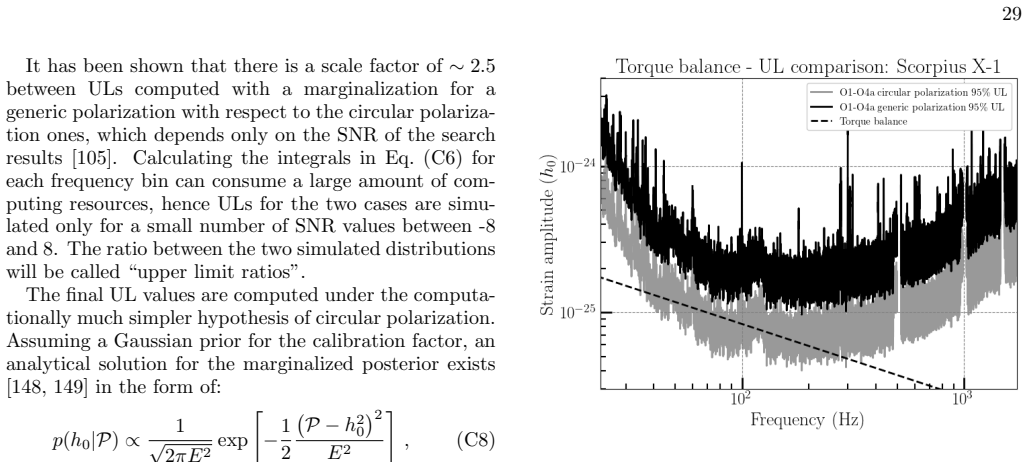
Comparison between UL and torque balance for Scorpius X-1 An order-of-magnitude estimate of the torque-balance level, often used in Sco X-1 CGW searches [113, 114] to FIG. 8. Comparison of the UL for generic polarization (solid black line) and a circularly polarized signal (solid gray line) with the torque-balance level from Eq. (C12) (dashed black line)....
-
[9]
we color the noise in each pixel by using the singular values decomposition of the Fisher matrix to generate 30 the simulated dirty map in the absence of any signal
-
[10]
we use the diagonal of the Fisher matrix to obtain σˆn= (diag{Γ ˆnˆn′})−1/2 and the simulated estimator map ˆPˆn,noisein the absence of a signal; 4) we obtain the SNR map as ˆPˆn,noise/σˆn; 5) we select the maximum SNR and add it to the histogram of the maximum-SNR distribu- tion. AfterN trials, we evaluate the maximum-SNR sta- tistical significance (p-va...
-
[11]
More importantly, the interferome- try in general imposes a minimum angular scale below which a given baseline becomes insensitive to real sig- nals
Angular resolution The number of SPH modes to evaluate scales as (ℓmax + 1)2, and hence, in practice, one cannot search for arbitrary high-order modes due to substantial com- putational costs. More importantly, the interferome- try in general imposes a minimum angular scale below which a given baseline becomes insensitive to real sig- nals. For a monochro...
-
[12]
This issue can be mitigated by regularizing the Fisher matrix; in pre- vious analyses, we addressed this by discarding negligi- ble eigenmodes
Regularization of the Fisher matrix Apart from the angular resolution mentioned above, another numerical issue arises from the fact that the Fisher matrix is oftenill-conditioned—that is, some of its eigenvalues are extremely small, which makes the in- version of the Fisher matrix numerically unstable and introduces additional numerical noise. This issue ...
-
[13]
(17) is unbiased
Cross ˆCℓ estimator In the limiting case where the detector data con- tain only detector noise, the auto- ˆCℓ estimator given by Eq. (17) is unbiased. However, Ref. [83] showed that in the presence of an astrophysical GWB, it is signifi- cantly biased by the shot-noise-dominated nature of the signal, which arises from the discrete spatial or tem- poral re...
-
[14]
UL and significance computation Following the procedure for significance assessment de- scribed in Sec. II E, we compute thep-value for each real and imaginary part of the clean map estimator for the combined dataset across O1-O4a, and compare all thesep-values to the local and globalp-value thresh- olds, respectively. For better visualization, we convert...
-
[15]
Regimbau, The astrophysical gravitational wave stochastic background, Res
T. Regimbau, The astrophysical gravitational wave stochastic background, Res. Astron. Astrophys.11, 369 (2011), arXiv:1101.2762 [astro-ph.CO]
Pith/arXiv arXiv 2011
-
[16]
C. Wu, V. Mandic, and T. Regimbau, Accessibil- ity of the Gravitational-Wave Background due to Bi- nary Coalescences to Second and Third Generation Gravitational-Wave Detectors, Phys. Rev. D85, 104024 (2012), arXiv:1112.1898 [gr-qc]
Pith/arXiv arXiv 2012
-
[17]
X.-J. Zhu, E. Howell, T. Regimbau, D. Blair, and Z.-H. Zhu, Stochastic Gravitational Wave Background from Coalescing Binary Black Holes, Astrophys. J.739, 86 (2011), arXiv:1104.3565 [gr-qc]
Pith/arXiv arXiv 2011
-
[18]
X.-J. Zhu, E. J. Howell, D. G. Blair, and Z.-H. Zhu, On the gravitational wave background from compact bi- nary coalescences in the band of ground-based interfer- ometers, Mon. Not. Roy. Astron. Soc.431, 882 (2013), arXiv:1209.0595 [gr-qc]
Pith/arXiv arXiv 2013
-
[19]
P. A. Rosado, Gravitational wave background from binary systems, Phys. Rev. D84, 084004 (2011), arXiv:1106.5795 [gr-qc]
Pith/arXiv arXiv 2011
-
[20]
S. Marassi, R. Schneider, G. Corvino, V. Ferrari, and S. Portegies Zwart, Imprint of the merger and ring-down on the gravitational wave background from black hole binaries coalescence, Phys. Rev. D84, 124037 (2011), arXiv:1111.6125 [astro-ph.CO]
Pith/arXiv arXiv 2011
-
[21]
K. Crocker, V. Mandic, T. Regimbau, K. Belczynski, W. Gladysz, K. Olive, T. Prestegard, and E. Vangioni, Model of the stochastic gravitational-wave background due to core collapse to black holes, Phys. Rev. D92, 063005 (2015), arXiv:1506.02631 [gr-qc]
Pith/arXiv arXiv 2015
-
[22]
K. Crocker, T. Prestegard, V. Mandic, T. Regimbau, K. Olive, and E. Vangioni, Systematic study of the stochastic gravitational-wave background due to stel- lar core collapse, Phys. Rev. D95, 063015 (2017), arXiv:1701.02638 [astro-ph.CO]
Pith/arXiv arXiv 2017
-
[23]
V. Ferrari, S. Matarrese, and R. Schneider, Gravita- tional wave background from a cosmological population of core collapse supernovae, Mon. Not. Roy. Astron. Soc. 303, 247 (1999), arXiv:astro-ph/9804259
Pith/arXiv arXiv 1999
-
[24]
C.-J. Wu, V. Mandic, and T. Regimbau, Accessibility of the stochastic gravitational wave background from magnetars to the interferometric gravitational wave de- tectors, Phys. Rev. D87, 042002 (2013)
2013
-
[25]
S. Marassi, R. Ciolfi, R. Schneider, L. Stella, and V. Fer- rari, Stochastic background of gravitational waves emit- ted by magnetars, Mon. Not. Roy. Astron. Soc.411, 2549 (2011), arXiv:1009.1240 [astro-ph.CO]
Pith/arXiv arXiv 2011
-
[26]
P. D. Lasky, M. F. Bennett, and A. Melatos, Stochastic gravitational wave background from hydrodynamic tur- bulence in differentially rotating neutron stars, Phys. Rev. D87, 063004 (2013), arXiv:1302.6033 [astro- ph.HE]
Pith/arXiv arXiv 2013
-
[27]
V. Ferrari, S. Matarrese, and R. Schneider, Stochas- tic background of gravitational waves generated by a cosmological population of young, rapidly rotating neu- tron stars, Mon. Not. Roy. Astron. Soc.303, 258 (1999), arXiv:astro-ph/9806357
Pith/arXiv arXiv 1999
-
[28]
X.-J. Zhu, X.-L. Fan, and Z.-H. Zhu, Stochastic Gravi- tational Wave Background from Neutron Star r-mode Instability Revisited, Astrophys. J.729, 59 (2011), arXiv:1102.2786 [astro-ph.CO]
Pith/arXiv arXiv 2011
-
[29]
T. Regimbau and J. A. de Freitas Pacheco, Cosmic back- ground of gravitational waves from rotating neutron stars, Astron. Astrophys.376, 381 (2001), arXiv:astro- ph/0105260
arXiv 2001
-
[30]
C. Caprini and D. G. Figueroa, Cosmological Back- grounds of Gravitational Waves, Class. Quant. Grav. 35, 163001 (2018), arXiv:1801.04268 [astro-ph.CO]
Pith/arXiv arXiv 2018
-
[31]
A. A. Starobinskiˇi, Spectrum of relict gravitational radi- ation and the early state of the universe, Soviet Journal of Experimental and Theoretical Physics Letters30, 682 (1979)
1979
-
[32]
Bar-Kana, Limits on direct detection of gravita- tional waves, Phys
R. Bar-Kana, Limits on direct detection of gravita- tional waves, Phys. Rev. D50, 1157 (1994), arXiv:astro- ph/9401050
arXiv 1994
-
[33]
M. S. Turner, Detectability of inflation produced gravitational waves, Phys. Rev. D55, R435 (1997), arXiv:astro-ph/9607066
Pith/arXiv arXiv 1997
-
[34]
T. Damour and A. Vilenkin, Gravitational radiation from cosmic (super)strings: Bursts, stochastic back- ground, and observational windows, Phys. Rev. D71, 063510 (2005), arXiv:hep-th/0410222
Pith/arXiv arXiv 2005
-
[35]
T. W. B. Kibble, Topology of Cosmic Domains and Strings, J. Phys. A9, 1387 (1976)
1976
-
[36]
S. Sarangi and S. H. H. Tye, Cosmic string production towards the end of brane inflation, Phys. Lett. B536, 185 (2002), arXiv:hep-th/0204074
Pith/arXiv arXiv 2002
-
[37]
X. Siemens, V. Mandic, and J. Creighton, Gravitational wave stochastic background from cosmic (super)strings, Phys. Rev. Lett.98, 111101 (2007), arXiv:astro- ph/0610920
arXiv 2007
-
[38]
L. Marzola, A. Racioppi, and V. Vaskonen, Phase tran- sition and gravitational wave phenomenology of scalar conformal extensions of the Standard Model, Eur. Phys. J. C77, 484 (2017), arXiv:1704.01034 [hep-ph]
Pith/arXiv arXiv 2017
-
[39]
B. Von Harling, A. Pomarol, O. Pujol` as, and F. Rompineve, Peccei-Quinn Phase Transition at LIGO, JHEP04, 195, arXiv:1912.07587 [hep-ph]
Pith/arXiv arXiv 1912
-
[40]
A. C. Jenkins, J. D. Romano, and M. Sakellar- iadou, Estimating the angular power spectrum of the gravitational-wave background in the presence of shot noise, Phys. Rev.D100, 083501 (2019), arXiv:1907.06642 [astro-ph.CO]
Pith/arXiv arXiv 2019
-
[41]
A. C. Jenkins and M. Sakellariadou, Shot noise in the as- trophysical gravitational-wave background, Phys. Rev. D100, 063508 (2019), arXiv:1902.07719 [astro-ph.CO]
Pith/arXiv arXiv 2019
-
[42]
D. Alonso, G. Cusin, P. G. Ferreira, and C. Pitrou, Detecting the anisotropic astrophysical gravitational wave background in the presence of shot noise through cross-correlations, Phys. Rev. D102, 023002 (2020), arXiv:2002.02888 [astro-ph.CO]
Pith/arXiv arXiv 2020
-
[43]
G. Cusin, I. Dvorkin, C. Pitrou, and J.-P. Uzan, Prop- erties of the stochastic astrophysical gravitational wave background: astrophysical sources dependencies, Phys. Rev. D100, 063004 (2019), arXiv:1904.07797 [astro- ph.CO]
Pith/arXiv arXiv 2019
-
[44]
K. Z. Yang, V. Mandic, C. Scarlata, and S. Bana- giri, Searching for Cross-Correlation Between Stochastic Gravitational Wave Background and Galaxy Number Counts, Mon. Not. Roy. Astron. Soc.500, 1666 (2020), arXiv:2007.10456 [astro-ph.CO]
Pith/arXiv arXiv 2020
-
[45]
K. Z. Yang, J. Suresh, G. Cusin, S. Banagiri, N. Feist, 35 V. Mandic, C. Scarlata, and I. Michaloliakos, Measure- ment of the cross-correlation angular power spectrum between the stochastic gravitational wave background and galaxy overdensity, Phys. Rev. D108, 043025 (2023), arXiv:2304.07621 [gr-qc]
Pith/arXiv arXiv 2023
-
[46]
G. Cusin, I. Dvorkin, C. Pitrou, and J.-P. Uzan, First predictions of the angular power spectrum of the astrophysical gravitational wave background, Phys. Rev. Lett.120, 231101 (2018), arXiv:1803.03236 [astro- ph.CO]
Pith/arXiv arXiv 2018
-
[47]
G. Capurri, A. Lapi, C. Baccigalupi, L. Boco, G. Scelfo, and T. Ronconi, Intensity and anisotropies of the stochastic gravitational wave background from merg- ing compact binaries in galaxies, JCAP11, 032, arXiv:2103.12037 [gr-qc]
-
[48]
D. Alonso, M. Nikjoo, A. I. Renzini, E. Bellini, and P. G. Ferreira, Tomographic constraints on the production rate of gravitational waves from astrophysical sources, Phys. Rev. D110, 103544 (2024), arXiv:2406.19488 [astro-ph.CO]
Pith/arXiv arXiv 2024
-
[49]
D. Bertacca, A. Ricciardone, N. Bellomo, A. C. Jenk- ins, S. Matarrese, A. Raccanelli, T. Regimbau, and M. Sakellariadou, Projection effects on the observed an- gular spectrum of the astrophysical stochastic gravi- tational wave background, Phys. Rev. D101, 103513 (2020), arXiv:1909.11627 [astro-ph.CO]
Pith/arXiv arXiv 2020
-
[50]
B. Allen and A. C. Ottewill, Detection of anisotropies in the gravitational wave stochastic background, Phys. Rev. D56, 545 (1997), arXiv:gr-qc/9607068
Pith/arXiv arXiv 1997
-
[51]
G. Cusin and G. Tasinato, Doppler boosting the stochastic gravitational wave background, JCAP08 (08), 036, arXiv:2201.10464 [astro-ph.CO]
-
[52]
L. Valbusa Dall’Armi, A. Ricciardone, and D. Bertacca, The dipole of the astrophysical gravitational-wave back- ground, JCAP11, 040, arXiv:2206.02747 [astro-ph.CO]
-
[53]
A. K.-W. Chung, A. C. Jenkins, J. D. Romano, and M. Sakellariadou, Targeted search for the kinematic dipole of the gravitational-wave background, Phys. Rev. D106, 082005 (2022), arXiv:2208.01330 [gr-qc]
Pith/arXiv arXiv 2022
-
[54]
G. Mentasti, C. R. Contaldi, and M. Peloso, Strong scale-dependence does not enhance the kinematic boosting of gravitational wave backgrounds (2025), arXiv:2507.16901 [astro-ph.CO]
arXiv 2025
-
[55]
S. Dhurandhar, H. Tagoshi, Y. Okada, N. Kanda, and H. Takahashi, The cross-correlation search for a hot spot of gravitational waves, Phys. Rev. D84, 083007 (2011), arXiv:1105.5842 [gr-qc]
Pith/arXiv arXiv 2011
-
[56]
N. Mazumder, S. Mitra, and S. Dhurandhar, Astro- physical motivation for directed searches for a stochas- tic gravitational wave background, Phys. Rev. D89, 084076 (2014), arXiv:1401.5898 [gr-qc]
Pith/arXiv arXiv 2014
-
[57]
D. Agarwal, J. Suresh, V. Mandic, A. Matas, and T. Regimbau, Targeted search for the stochastic gravitational-wave background from the galactic mil- lisecond pulsar population, Phys. Rev. D106, 043019 (2022), arXiv:2204.08378 [gr-qc]
Pith/arXiv arXiv 2022
-
[58]
F. De Lillo, J. Suresh, and A. L. Miller, Stochastic gravitational-wave background searches and constraints on neutron-star ellipticity, Mon. Not. Roy. Astron. Soc. 513, 1105 (2022), arXiv:2203.03536 [gr-qc]
Pith/arXiv arXiv 2022
-
[59]
Talukder, E
D. Talukder, E. Thrane, S. Bose, and T. Regimbau, Measuring neutron-star ellipticity with measurements of the stochastic gravitational-wave background, Phys. Rev. D89, 123008 (2014)
2014
-
[60]
Abbottet al.(LIGO Scientific), Upper limit map of a background of gravitational waves, Phys
B. Abbottet al.(LIGO Scientific), Upper limit map of a background of gravitational waves, Phys. Rev. D76, 082003 (2007), arXiv:astro-ph/0703234
Pith/arXiv arXiv 2007
-
[61]
J. Abadieet al.(LIGO Scientific), Directional lim- its on persistent gravitational waves using LIGO S5 science data, Phys. Rev. Lett.107, 271102 (2011), arXiv:1109.1809 [astro-ph.CO]
Pith/arXiv arXiv 2011
-
[62]
B. P. Abbottet al.(LIGO Scientific, Virgo), Up- per Limits on the Stochastic Gravitational-Wave Back- ground from Advanced LIGO’s First Observing Run, Phys. Rev. Lett.118, 121101 (2017), [Erratum: Phys.Rev.Lett. 119, 029901 (2017)], arXiv:1612.02029 [gr-qc]
Pith/arXiv arXiv 2017
-
[63]
B. P. Abbottet al.(LIGO Scientific, Virgo), Search for the isotropic stochastic background using data from Ad- vanced LIGO’s second observing run, Phys. Rev. D100, 061101 (2019), arXiv:1903.02886 [gr-qc]
Pith/arXiv arXiv 2019
-
[64]
R. Abbottet al.(KAGRA, Virgo, LIGO Scientific), Upper limits on the isotropic gravitational-wave back- ground from Advanced LIGO and Advanced Virgo’s third observing run, Phys. Rev. D104, 022004 (2021), arXiv:2101.12130 [gr-qc]
arXiv 2021
-
[65]
B. P. Abbottet al.(LIGO Scientific, Virgo), Direc- tional Limits on Persistent Gravitational Waves from Advanced LIGO’s First Observing Run, Phys. Rev. Lett.118, 121102 (2017), arXiv:1612.02030 [gr-qc]
Pith/arXiv arXiv 2017
-
[66]
B. P. Abbottet al.(LIGO Scientific, Virgo), Directional limits on persistent gravitational waves using data from Advanced LIGO’s first two observing runs, Phys. Rev. D100, 062001 (2019), arXiv:1903.08844 [gr-qc]
Pith/arXiv arXiv 2019
-
[67]
R. Abbottet al.(KAGRA, Virgo, LIGO Scientific), Search for anisotropic gravitational-wave backgrounds using data from Advanced LIGO and Advanced Virgo’s first three observing runs, Phys. Rev. D104, 022005 (2021), arXiv:2103.08520 [gr-qc]
arXiv 2021
-
[68]
R. Abbottet al.(KAGRA, Virgo, LIGO Scientific), All- sky, all-frequency directional search for persistent grav- itational waves from Advanced LIGO’s and Advanced Virgo’s first three observing runs, Phys. Rev. D105, 122001 (2022), arXiv:2110.09834 [gr-qc]
Pith/arXiv arXiv 2022
-
[69]
S. W. Ballmer, A Radiometer for stochastic gravita- tional waves, Class. Quant. Grav.23, S179 (2006), arXiv:gr-qc/0510096
Pith/arXiv arXiv 2006
-
[70]
S. Mitra, S. Dhurandhar, T. Souradeep, A. Lazzarini, V. Mandic, S. Bose, and S. Ballmer, Gravitational wave radiometry: Mapping a stochastic gravitational wave background, Phys. Rev. D77, 042002 (2008), arXiv:0708.2728 [gr-qc]
Pith/arXiv arXiv 2008
-
[71]
Thrane, S
E. Thrane, S. Ballmer, J. D. Romano, S. Mitra, D. Talukder, S. Bose, and V. Mandic, Probing the anisotropies of a stochastic gravitational-wave back- ground using a network of ground-based laser interfer- ometers, Phys. Rev. D80, 122002 (2009)
2009
-
[72]
K. Wette, Searches for continuous gravitational waves from neutron stars: A twenty-year retrospective, As- tropart. Phys.153, 102880 (2023), arXiv:2305.07106 [gr-qc]
arXiv 2023
-
[73]
O. J. Piccinni, Status and Perspectives of Continuous Gravitational Wave Searches, Galaxies10, 72 (2022), arXiv:2202.01088 [gr-qc]
Pith/arXiv arXiv 2022
-
[74]
Riles, Searches for continuous-wave gravitational ra- diation, Living Rev
K. Riles, Searches for continuous-wave gravitational ra- diation, Living Rev. Rel.26, 3 (2023), arXiv:2206.06447 [astro-ph.HE]
Pith/arXiv arXiv 2023
-
[75]
R. Abbottet al.(LIGO Scientific, Virgo, KAGRA), 36 All-sky search for gravitational wave emission from scalar boson clouds around spinning black holes in LIGO O3 data, Phys. Rev. D105, 102001 (2022), arXiv:2111.15507 [astro-ph.HE]
Pith/arXiv arXiv 2022
-
[76]
D. Jones, L. Sun, N. Siemonsen, W. E. East, S. M. Scott, and K. Wette, Methods and prospects for gravitational- wave searches targeting ultralight vector-boson clouds around known black holes, Phys. Rev. D108, 064001 (2023), arXiv:2305.00401 [gr-qc]
Pith/arXiv arXiv 2023
-
[77]
Directed searches for gravitational waves from ultralight vector boson clouds around merger remnant and galac- tic black holes during the first part of the fourth LIGO- Virgo-KAGRA observing run (2025), arXiv:2509.07352 [gr-qc]
Pith/arXiv arXiv 2025
-
[78]
A. G. Abacet al.(LIGO Scientific, VIRGO, KAGRA), Upper Limits on the Isotropic Gravitational-Wave Background from the first part of LIGO, Virgo, and KA- GRA’s fourth Observing Run (2025), arXiv:2508.20721 [gr-qc]
Pith/arXiv arXiv 2025
-
[79]
Ligo scientific, virgo, kagra collaborations, (in prep.)
-
[80]
J. D. Romano and N. J. Cornish, Detection methods for stochastic gravitational-wave backgrounds: a unified treatment, Living Reviews in Relativity20, 2 (2017)
2017
discussion (0)
Sign in with ORCID, Apple, or X to comment. Anyone can read and Pith papers without signing in.