Modeling Uncertainties in Modified Gravity Predictions for the Stochastic Gravitational-Wave Background
pith:N6G7J7ULreviewed 2026-07-07 16:47 UTCmodel glm-5.2open to challenge →
The pith
Frequency distortions in gravitational-wave background reveal modified gravity
A machine-rendered reading of the paper's core claim, the machinery that carries it, and where it could break.
Core claim
The paper's central technical result is that the two classes of beyond-GR effects produce qualitatively different signatures in the SGWB spectrum. ppE amplitude corrections enter as a multiplicative factor proportional to f^{a/3} (where a is the post-Newtonian exponent), producing frequency-dependent distortions that are distinguishable from astrophysical population effects because they alter spectral shape rather than just normalization. Modified propagation effects, parameterized by the running Planck mass alpha_M0, enter as a redshift-dependent rescaling of the source population that is nearly frequency-independent, making them nearly degenerate with the merger-rate evolution parameters R
What carries the argument
ppE framework; running Planck mass; SGWB energy density spectrum; Power-Law plus Peak mass model; Madau-Dickinson merger rate
If this is right
- Third-generation ground-based detectors, particularly Cosmic Explorer, can constrain frequency-dependent deviations from GR in the SGWB at the level of ~17% on the PN exponent a and ~75% on the amplitude parameter alpha_ppE, providing a genuinely new test of gravity complementary to resolved-binary tests.
- Modified propagation effects (alpha_M0) will remain poorly constrained (~60-70% relative uncertainty) by SGWB observations alone unless astrophysical population parameters — especially the merger-rate normalization R and low-redshift evolution index gamma — are independently constrained by other observations.
- The dominant bottleneck for beyond-GR measurements from the SGWB is astrophysical population modeling, not detector sensitivity. Improved black hole mass distribution or merger-rate constraints from resolved-event catalogs could substantially tighten modified-gravity bounds by breaking parameter degeneracies.
- The SGWB integrates gravitational-wave deviations over cosmic history, making it sensitive to small cumulative effects that may be below detection thresholds in individual events.
Where Pith is reading between the lines
- If spin-induced spectral modulations in the BBH population are significant, including spinning binaries could either introduce additional degeneracies with ppE parameters or break existing ones — the non-spinning assumption may meaningfully bias the forecast constraints in either direction.
- Combining SGWB observations across frequency bands (e.g., LISA at millihertz, ground-based detectors at tens-to-hundreds of Hz, pulsar timing arrays at nanohertz) could help break the amplitude degeneracy for propagation effects, since the redshift-weighting factor depends on the source population at different cosmic epochs probed by different bands.
- If a primordial stochastic background (e.g., from cosmic strings or inflation) contributes to the SGWB, separating it from the astrophysical background would require additional modeling, and cross-contamination could bias both population and modified-gravity parameter recovery.
Load-bearing premise
The forecasts assume idealized detector noise curves and non-spinning binary black holes, and that the astrophysical SGWB can be cleanly separated from other stochastic backgrounds. Real detector noise will include glitches and non-Gaussian contaminants, spin effects are ignored, and overlapping signals from binary neutron stars are excluded — so the true constraining power could be substantially worse than these optimistic projections.
What would settle it
If real Cosmic Explorer data shows that non-stationary noise, glitch contamination, or confusion from overlapping multi-messenger populations prevents clean spectral-shape reconstruction below ~200 Hz, the ppE constraints would degrade substantially and the qualitative distinction between waveform and propagation effects could be washed out.
Figures



read the original abstract
We investigate the impact of modified gravity on the stochastic gravitational-wave background (SGWB) generated by a cosmological population of unresolved binary black hole mergers. We consider two complementary classes of beyond-General Relativity (GR) effects: waveform-generation modifications described within the parametrized post-Einsteinian (ppE) framework and cosmological propagation effects associated with a modified gravitational-wave luminosity distance. Astrophysical uncertainties in the binary black hole population are consistently incorporated using a Power-Law plus Peak mass model combined with a Madau--Dickinson merger-rate evolution. Using SGWB forecasts for Advanced LIGO, the Einstein Telescope (ET), and Cosmic Explorer (CE), we perform injection-recovery analyses jointly varying modified-gravity and astrophysical population parameters. We show that frequency-dependent ppE corrections produce characteristic distortions in the SGWB spectral shape and can be meaningfully constrained by third-generation detectors, particularly CE. In contrast, modified propagation effects mainly induce smooth amplitude rescalings and exhibit stronger degeneracies with astrophysical uncertainties. Our results demonstrate that future SGWB observations will provide a complementary probe of gravitational physics across cosmic history and may open new avenues for testing deviations from GR beyond individually resolved compact-binary events.
Editorial analysis
A structured set of objections, weighed in public.
Referee Report
Summary. This manuscript forecasts constraints on modified-gravity effects in the stochastic gravitational-wave background (SGWB) from unresolved binary black hole (BBH) mergers, using next-generation ground-based detectors (Einstein Telescope, Cosmic Explorer, Advanced LIGO). Two beyond-GR scenarios are considered: (i) waveform-generation modifications in the parametrized post-Einsteinian (ppE) framework, which introduce frequency-dependent spectral distortions, and (ii) modified gravitational-wave propagation via a running Planck-mass parameterization, which primarily rescales the SGWB amplitude. The authors derive compact analytical expressions for both effects within the SGWB integral, employ the PopStock framework with a Power-Law plus Peak mass model and Madau-Dickinson merger rate, and perform injection-recovery analyses jointly varying modified-gravity and astrophysical population parameters. The main finding is that ppE corrections (particularly the PN exponent a) can be meaningfully constrained by CE and ET, while the propagation parameter alpha_M0 exhibits strong degeneracies with astrophysical uncertainties (relative uncertainty ~60-70%). The pipeline is validated via GR injections and is stated to be publicly available upon publication.
Significance. The manuscript addresses a timely question: whether SGWB observations can probe beyond-GR physics in the presence of astrophysical population uncertainties. The joint variation of modified-gravity and full population hyperparameters is a methodological strength, as it avoids artificially optimistic constraints. The derivation of the compact analytical form for the ppE-corrected SGWB (Eq. 18) and the energy-weighted propagation correction (Eq. 24) is clean and useful. The commitment to public code release is commendable. The qualitative distinction between frequency-dependent ppE distortions (better constrained) and smooth propagation rescalings (more degenerate) is physically well-motivated and clearly demonstrated.
major comments (3)
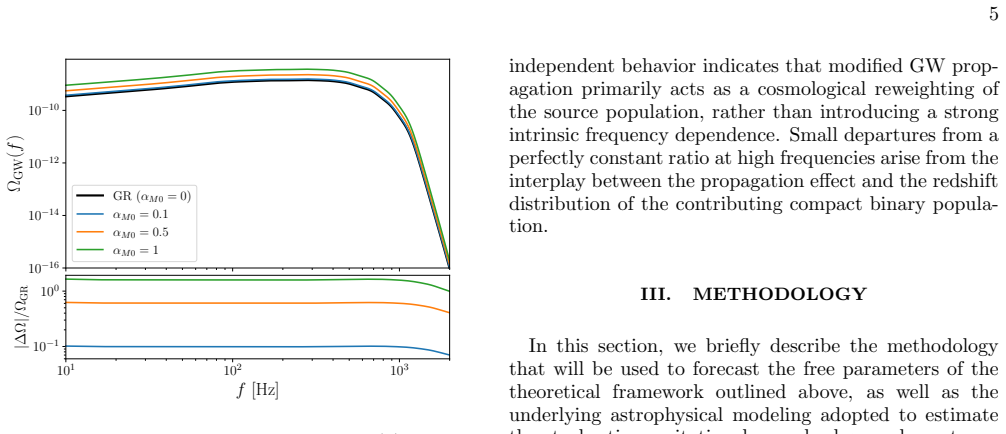
- §II, Eqs. (13)-(14) and §III (injection parameters): The perturbative expansion P_d^{ppE} ≃ P_d^{GR}(1 + 2*alpha_ppE*u^a) is stated to be valid when |alpha_ppE * u^a| << 1 (Eq. 14). However, the injection-recovery analysis uses (a=4, alpha_ppE=0.5). For a typical BBH chirp mass M ~ 30 M_sun at f = 100-200 Hz (where constraining power is concentrated per §III), u = (pi*M*f_s)^{1/3} is of order 10-15, so u^4 ~ 10^4-5*10^4, making alpha_ppE * u^a ~ 5*10^3-2.5*10^4. This is vastly outside the perturbative regime. The manuscript does not verify the perturbative condition for the injected parameters or discuss whether the inference pipeline uses the exact Eq. (13) or the linearized Eq. (14)/(18). If the pipeline uses the exact expression, the linearization leading to Eq. (18) is not load-bearing for the numerical results, but the physical interpretation and the compact analytical form are. If,
- §II, Eqs. (10)-(13): The ppE waveform correction (1 + alpha_ppE * u^a)^2 can become negative when alpha_ppE * u^a < -1, which is unphysical. For the injected parameters (a=4, alpha_ppE=0.5), the correction factor (1 + 0.5*u^4)^2 at high frequencies is enormous (e.g., ~10^8 at u~15), meaning the ppE-corrected SGWB is orders of magnitude larger than GR across much of the frequency band. This raises a question about whether the injected signal represents a 'small but non-negligible deviation' as stated in §III. The manuscript should clarify: (a) whether the exact or linearized expression is used in the pipeline, (b) the magnitude of the spectral distortion at the relevant frequencies, and (c) whether the injected parameters are in a physically meaningful regime of the ppE parameter space.
- §IV.A, Table I (GR Signal, CE row): The recovered value of a for the GR injection (alpha_ppE = 0) is a = 3.220^{+1.275}_{-1.248}, with a relative uncertainty of ~39% (Table II). Since alpha_ppE = 0, the parameter a is unidentifiable (the likelihood should be flat in a). The fact that the posterior is centered near 3.2 rather than being broad and flat suggests either the prior is informative or there is a subtle numerical artifact. The manuscript should clarify the prior on a and explain why the posterior is not flat, as this affects the interpretation of the pipeline validation.
minor comments (7)
- §II, Eq. (18): The notation ⟨(pi*M)^{a/3} * (1+z)^{a/3}⟩_E is ambiguous regarding whether the average is over M and z jointly or separately. Clarifying this would help readers reproduce the result.
- Figure 1, right panels: The caption states alpha_ppE varies as [0.10, 0.50, 1.00], but the y-axis label on the lower-right panel appears to show deviations up to ~10^3. Given the perturbative concerns above, it would help to annotate the figure with the value of |alpha_ppE * u^a| at a reference frequency to indicate the regime.
- §III: The statement that BNS/NSBH contributions are 'significantly smaller' than BBH is generally true for the amplitude, but these populations could affect the spectral shape at high frequencies (>200 Hz) where BBH contributions fall off. A brief quantitative comparison or a reference supporting this claim would strengthen the justification.
- Table I: The cosmological signal injection row lists alpha_M0 = 0.5 but the text in §IV.B quotes CE recovering alpha_M0 = 0.396 (Eq. 39), which is offset from the injected 0.5 by roughly 0.3 sigma. This is acceptable but worth noting whether any bias is expected from the degeneracy with R and gamma.
- §IV.D: The phrase 'optimistic but physically motivated forecasts' is used. Given the idealized noise assumptions (no glitches, no non-stationarity, no overlapping foregrounds), 'optimistic' is appropriate, but the degree of optimism should be briefly quantified or referenced (e.g., how much worse might constraints become with realistic noise?).
- References [12] and [13] cite arXiv papers from 2026; if these are not yet published, they should be marked as 'in preparation' or 'submitted' to avoid confusion.
- Eq. (33): The prefactor is written as 4*pi^2*f^3 / (3*H_0^2), while Eq. (1) and (4) use f^3 / (4*pi^2) * (3*H_0^2). These appear to differ by a factor of (4*pi^2)^2. Please check for consistency.
Simulated Author's Rebuttal
We thank the referee for a careful reading and for identifying a genuine issue with the perturbative regime of our ppE parameter choice. We agree that the linearized expression (Eq. 18) is not valid for the injected parameters (a=4, alpha_ppE=0.5), and we will revise the manuscript accordingly. We also address the prior on a and the GR-injection posterior.
read point-by-point responses
-
Referee: §II, Eqs. (13)-(14) and §III: The perturbative expansion is stated to require |alpha_ppE * u^a| << 1, but the injected parameters (a=4, alpha_ppE=0.5) give alpha_ppE * u^a ~ 10^3-10^4 at relevant frequencies, far outside the perturbative regime. Does the pipeline use the exact Eq. (13) or the linearized Eq. (14)/(18)?
Authors: The referee is correct on all counts. We have verified that the pipeline currently uses the linearized expression Eq. (18), not the exact Eq. (13). For the injected parameters (a=4, alpha_ppE=0.5) with a typical chirp mass M ~ 30 M_sun at f ~ 100 Hz, the quantity |alpha_ppE * u^a| is indeed of order 10^3-10^4, which is far outside the perturbative regime |alpha_ppE * u^a| << 1 under which Eq. (18) was derived. This is a genuine inconsistency in our analysis that we will fix. We see two viable paths: (i) update the pipeline to use the exact expression Eq. (13), i.e., P_d^{ppE} = P_d^{GR} (1 + alpha_ppE * u^a)^2, which requires replacing the compact analytical form Eq. (18) with a direct numerical evaluation of the full integrand; or (ii) choose injected parameters that remain within the perturbative regime (e.g., alpha_ppE ~ 10^{-4} for a=4). We will adopt option (i) — using the exact expression — as it is the more robust approach and does not artificially restrict the parameter space. The compact analytical form Eq. (18) will be retained in the manuscript as a pedagogical illustration of the leading-order behavior, but we will explicitly state that the numerical pipeline uses the exact Eq. (13). We will re-run the full injection-recovery analysis with the exact expression and update all results in Tables I-III and Figures 3-5 accordingly. We expect the qualitative conclusions (frequency-dependent ppE distortions are better constrained than smooth propagation rescalings) to remain unchanged, but the quantitative constraints may shift. revision: yes
-
Referee: §II, Eqs. (10)-(13): The ppE correction (1 + alpha_ppE * u^a)^2 can become negative when alpha_ppE * u^a < -1, and for the injected parameters the correction factor is enormous (~10^8 at u~15). Is the injected signal really a 'small but non-negligible deviation'? Clarify (a) exact vs. linearized expression, (b) magnitude of spectral distortion, (c) whether injected parameters are physically meaningful.
Authors: We agree with the referee's assessment. The description 'small but non-negligible deviation' in §III is inaccurate for the injected parameters as currently chosen. With a=4 and alpha_ppE=0.5, the ppE correction factor (1 + 0.5*u^4)^2 reaches ~10^8 at u~15, meaning the ppE-corrected SGWB is orders of magnitude larger than GR across much of the frequency band. This is not a small perturbation. We will address all three sub-questions: (a) As stated in our response to the first comment, the pipeline will be updated to use the exact expression Eq. (13). (b) We will add a quantitative discussion of the magnitude of the spectral distortion at relevant frequencies, including a plot or table showing the ratio Omega^{ppE}/Omega^{GR} as a function of frequency for the injected parameters. (c) Regarding physical meaningfulness: the ppE framework is phenomenological, and the parameter space is a priori unconstrained. However, the specific choice (a=4, alpha_ppE=0.5) produces a signal that is unrealistically large compared to any plausible beyond-GR scenario. We will either (i) reduce alpha_ppE to a value that produces a spectrally distinguishable but physically reasonable deviation (e.g., a factor of a few enhancement at peak frequencies), or (ii) if we retain the current injection for illustrative purposes, we will explicitly state that these parameters are chosen to test pipeline recovery capability rather than to represent a realistic beyond-GR signal. We lean toward option (i) as the more honest approach. revision: yes
-
Referee: §IV.A, Table I: For the GR injection (alpha_ppE=0), the recovered a = 3.220^{+1.275}_{-1.248} is not broad and flat as expected when alpha_ppE=0 makes a unidentifiable. Clarify the prior on a and explain why the posterior is not flat.
Authors: The referee raises a valid point. When alpha_ppE = 0, the SGWB spectrum is independent of a, so the likelihood should be flat in a and the posterior should simply reproduce the prior. The prior on a is uniform on [1, 8] (this was not clearly stated in the manuscript and we will add it). If the prior is uniform on [1, 8], the posterior should be approximately flat over this range, not peaked near 3.2. The fact that the posterior is centered at 3.2 with a relative uncertainty of ~39% suggests a numerical artifact, most likely related to finite effective sample size (N_eff) in the PopStock importance-sampling reweighting. When alpha_ppE = 0, the reweighting may introduce spurious structure in the a-direction due to statistical noise in the Monte Carlo sample, particularly if certain combinations of a and population parameters lead to low N_eff. We will investigate this by: (i) checking N_eff as a function of a for the GR injection, (ii) increasing the Monte Carlo sample size if needed, and (iii) verifying that the posterior on a flattens to the prior when alpha_ppE is fixed to exactly zero. If the artifact persists, we will report it transparently and note that the GR-injection results for a should be interpreted as a diagnostic of pipeline behavior rather than a physical measurement. We will also add the prior ranges for all varied parameters to Table I or the text of §III. revision: yes
Circularity Check
No circularity found: derivation uses external frameworks and standard injection-recovery methodology
full rationale
The paper is a forecast study whose derivation chain is built entirely from external, independently developed frameworks. The ppE waveform parametrization (Eq. 10) is from Yunes & Pretorius [28-30]. The modified GW propagation formalism (Eqs. 23-28) draws from Belgacem et al. [21], Lagos et al. [37], and Alonso et al. [38] / Bellini et al. [39]. The PopStock importance-sampling framework is from Renzini & Golomb [31]. The SGWB energy-density formalism (Eqs. 1-9) is from [32,33,44,45]. The BBH population model (PLPP + Madau-Dickinson) is from [40,42]. The derivation from Eq. (10) to Eq. (18) is a straightforward algebraic manipulation: squaring the ppE-corrected waveform to get spectral power (Eq. 13), linearizing (Eq. 14), and factoring out the GR spectrum to obtain the compact energy-weighted form (Eq. 18). No step reduces to its own inputs by construction. The injection-recovery methodology is standard: known signals are injected and recovered through a parameter-estimation pipeline, which is a validation exercise, not a circular derivation. The one self-citation by author R.C. Nunes ([26]) is a contextual reference to prior representative studies and is not load-bearing for any derivation step. The skeptic's concern about perturbative expansion validity at high frequencies is a correctness/validity risk, not a circularity issue.
Axiom & Free-Parameter Ledger
free parameters (9)
- alpha_ppE =
0.5 (injected)
- a (ppE PN exponent) =
4 (injected)
- alpha_M0 =
0.5 (injected)
- alpha_IMF =
3.5 (injected)
- lambda_peak =
0.03 (injected)
- R_0 =
17 Gpc^-3 yr^-1 (injected)
- gamma =
3 (injected)
- beta (mass ratio index)
- m_min, m_max, delta_m, mu_peak, sigma_peak, kappa, z_peak
axioms (5)
- domain assumption Statistical independence between redshift z and intrinsic source parameters theta, allowing factorization p_d(Theta|Lambda) = p(z)p(theta|z,Lambda)
- ad hoc to paper BBHs are non-spinning
- ad hoc to paper Idealized detector noise (no glitches, no non-stationarity, no magnetic/Newtonian noise)
- domain assumption BBH population is the dominant SGWB contributor in the relevant frequency band
- domain assumption The ppE perturbative regime |alpha_ppE * u^a| << 1 holds for the injected parameters
Reference graph
Works this paper leans on
-
[1]
B. P. Abbottet al.(LIGO Scientific, Virgo), Phys. Rev. Lett.116, 061102 (2016), arXiv:1602.03837 [gr-qc]
work page internal anchor Pith review Pith/arXiv arXiv 2016
- [2]
-
[3]
R.-G. Cai, Z. Cao, Z.-K. Guo, S.-J. Wang, and T. Yang, Natl. Sci. Rev.4, 687 (2017), arXiv:1703.00187 [gr-qc]
work page internal anchor Pith review Pith/arXiv arXiv 2017
-
[4]
The stochastic gravity-wave background: sources and detection
B. Allen, inLes Houches School of Physics: Astrophysical Sources of Gravitational Radiation(1996) pp. 373–417, arXiv:gr-qc/9604033
work page internal anchor Pith review Pith/arXiv arXiv 1996
-
[5]
B. Allen and J. D. Romano, Phys. Rev. D59, 102001 (1999), arXiv:gr-qc/9710117
work page internal anchor Pith review Pith/arXiv arXiv 1999
-
[6]
The astrophysical gravitational wave stochastic background
T. Regimbau, Res. Astron. Astrophys.11, 369 (2011), arXiv:1101.2762 [astro-ph.CO]
work page internal anchor Pith review Pith/arXiv arXiv 2011
-
[7]
Stochastic Gravitational Wave Backgrounds
N. Christensen, Rept. Prog. Phys.82, 016903 (2019), arXiv:1811.08797 [gr-qc]
work page internal anchor Pith review Pith/arXiv arXiv 2019
-
[8]
A. I. Renzini, B. Goncharov, A. C. Jenkins, and P. M. Meyers, Galaxies10, 34 (2022), arXiv:2202.00178 [gr-qc]
work page internal anchor Pith review Pith/arXiv arXiv 2022
-
[9]
A. G. Abacet al.(LIGO Scientific, VIRGO, KAGRA), (2025), arXiv:2508.20721 [gr-qc]
work page internal anchor Pith review Pith/arXiv arXiv 2025
- [10]
-
[11]
The NANOGrav 15-year Data Set: Evidence for a Gravitational-Wave Background
G. Agazieet al.(NANOGrav), Astrophys. J. Lett.951, L8 (2023), arXiv:2306.16213 [astro-ph.HE]
work page internal anchor Pith review Pith/arXiv arXiv 2023
-
[12]
Agazieet al., (2026), arXiv:2601.09481 [astro-ph.HE]
G. Agazieet al., (2026), arXiv:2601.09481 [astro-ph.HE]
-
[13]
The NANOGrav 15 yr Data Set: Targeted Searches for Supermassive Black Hole Binaries
N. Agarwalet al.(NANOGrav), Astrophys. J. Lett.998, L11 (2026), arXiv:2508.16534 [astro-ph.HE]
work page internal anchor Pith review Pith/arXiv arXiv 2026
-
[14]
The Science of the Einstein Telescope
A. Abacet al.(ET), JCAP03, 081 (2026), arXiv:2503.12263 [gr-qc]
work page internal anchor Pith review Pith/arXiv arXiv 2026
-
[15]
A Horizon Study for Cosmic Explorer: Science, Observatories, and Community
M. Evanset al., (2021), arXiv:2109.09882 [astro-ph.IM]
work page internal anchor Pith review Pith/arXiv arXiv 2021
-
[16]
P. A. Seoaneet al.(LISA), Living Rev. Rel.26, 2 (2023), arXiv:2203.06016 [gr-qc]
work page internal anchor Pith review Pith/arXiv arXiv 2023
-
[17]
Testing General Relativity with Present and Future Astrophysical Observations
E. Bertiet al., Class. Quant. Grav.32, 243001 (2015), arXiv:1501.07274 [gr-qc]
work page internal anchor Pith review Pith/arXiv arXiv 2015
-
[18]
Testing General Relativity in Cosmology
M. Ishak, Living Rev. Rel.22, 1 (2019), arXiv:1806.10122 [astro-ph.CO]
work page internal anchor Pith review Pith/arXiv arXiv 2019
-
[19]
Modified Gravity and Cosmology
T. Clifton, P. G. Ferreira, A. Padilla, and C. Sko- rdis, Phys. Rept.513, 1 (2012), arXiv:1106.2476 [astro- ph.CO]
work page internal anchor Pith review Pith/arXiv arXiv 2012
-
[20]
Generalized framework for testing gravity with gravitational-wave propagation. I. Formulation
A. Nishizawa, Phys. Rev. D97, 104037 (2018), arXiv:1710.04825 [gr-qc]
work page internal anchor Pith review Pith/arXiv arXiv 2018
-
[21]
Modified gravitational-wave propagation and standard sirens
E. Belgacem, Y. Dirian, S. Foffa, and M. Maggiore, Phys. Rev. D98, 023510 (2018), arXiv:1805.08731 [gr-qc]
work page internal anchor Pith review Pith/arXiv arXiv 2018
-
[22]
Generalized framework for testing gravity with gravitational-wave propagation. III. Future prospect
A. Nishizawa and S. Arai, Phys. Rev. D99, 104038 (2019), arXiv:1901.08249 [gr-qc]
work page internal anchor Pith review Pith/arXiv arXiv 2019
-
[23]
A. G. Abacet al.(LIGO Scientific, VIRGO, KAGRA), (2026), arXiv:2603.19019 [gr-qc]. 13
work page internal anchor Pith review Pith/arXiv arXiv 2026
-
[24]
A. G. Abacet al.(LIGO Scientific, VIRGO, KAGRA), (2026), arXiv:2603.19020 [gr-qc]
work page internal anchor Pith review Pith/arXiv arXiv 2026
-
[25]
A. G. Abacet al.(LIGO Scientific, VIRGO, KAGRA), (2026), arXiv:2603.19021 [gr-qc]
work page internal anchor Pith review Pith/arXiv arXiv 2026
-
[26]
R. C. Nunes, Phys. Rev. D102, 024071 (2020), arXiv:2007.07750 [gr-qc]
work page internal anchor Pith review Pith/arXiv arXiv 2020
-
[27]
J. M. Ezquiaga, Phys. Lett. B822, 136665 (2021), arXiv:2104.05139 [astro-ph.CO]
work page internal anchor Pith review Pith/arXiv arXiv 2021
-
[28]
N. Yunes and F. Pretorius, Phys. Rev. D80, 122003 (2009), arXiv:0909.3328 [gr-qc]
work page internal anchor Pith review Pith/arXiv arXiv 2009
-
[29]
Gravitational Wave Tests of General Relativity with the Parameterized Post-Einsteinian Framework
N. Cornish, L. Sampson, N. Yunes, and F. Pretorius, Phys. Rev. D84, 062003 (2011), arXiv:1105.2088 [gr-qc]
work page internal anchor Pith review Pith/arXiv arXiv 2011
-
[30]
Parameterized Post-Einsteinian Gravitational Waveforms in Various Modified Theories of Gravity
S. Tahura and K. Yagi, Phys. Rev. D98, 084042 (2018), [Erratum: Phys.Rev.D 101, 109902 (2020)], arXiv:1809.00259 [gr-qc]
work page internal anchor Pith review Pith/arXiv arXiv 2018
-
[31]
A. I. Renzini and J. Golomb, Astron. Astrophys.691, A238 (2024), arXiv:2407.03742
work page internal anchor Pith review Pith/arXiv arXiv 2024
-
[32]
D. Meacher, M. Coughlin, S. Morris, T. Regimbau, N. Christensen, S. Kandhasamy, V. Mandic, J. D. Ro- mano, and E. Thrane, Phys. Rev. D92, 063002 (2015), arXiv:1506.06744 [astro-ph.HE]
work page internal anchor Pith review Pith/arXiv arXiv 2015
- [33]
-
[34]
Cosmology and modified gravitational wave propagation from binary black hole population models
M. Mancarella, E. Genoud-Prachex, and M. Maggiore, Phys. Rev. D105, 064030 (2022), arXiv:2112.05728 [gr- qc]
work page internal anchor Pith review Pith/arXiv arXiv 2022
-
[35]
A. G. Abacet al.(LIGO Scientific, VIRGO, KAGRA), (2025), arXiv:2509.04348 [astro-ph.CO]
work page internal anchor Pith review Pith/arXiv arXiv 2025
-
[36]
GWTC-5.0: Constraints on the Cosmic Expansion Rate and Modified Gravitational-wave Propagation
T. L. S. Collaboration, the Virgo Collaboration, and the KAGRA Collaboration, “Gwtc-5.0: Constraints on the cosmic expansion rate and modified gravitational-wave propagation,” (2026), arXiv:2605.27227 [astro-ph.CO]
work page internal anchor Pith review Pith/arXiv arXiv 2026
-
[37]
Standard sirens with a running Planck mass
M. Lagos, M. Fishbach, P. Landry, and D. E. Holz, Phys. Rev. D99, 083504 (2019), arXiv:1901.03321 [astro- ph.CO]
work page internal anchor Pith review Pith/arXiv arXiv 2019
-
[38]
The Observational Future of Cosmological Scalar-Tensor Theories
D. Alonso, E. Bellini, P. G. Ferreira, and M. Zu- malac´ arregui, Phys. Rev. D95, 063502 (2017), arXiv:1610.09290 [astro-ph.CO]
work page internal anchor Pith review Pith/arXiv arXiv 2017
-
[39]
Constraints on deviations from ${\Lambda}$CDM within Horndeski gravity
E. Bellini, A. J. Cuesta, R. Jimenez, and L. Verde, JCAP02, 053 (2016), [Erratum: JCAP 06, E01 (2016)], arXiv:1509.07816 [astro-ph.CO]
work page internal anchor Pith review Pith/arXiv arXiv 2016
- [40]
-
[41]
Abbottet al.(LIGO Scientific, Virgo, KAGRA), Phys
R. Abbottet al.(LIGO Scientific, Virgo, KAGRA), Phys. Rev. X13, 011048 (2023)
work page 2023
- [42]
-
[43]
P. A. R. Adeet al.(Planck), Astron. Astrophys.594, A13 (2016)
work page 2016
-
[44]
E. S. Phinney, (2001), arXiv:astro-ph/0108028
work page internal anchor Pith review Pith/arXiv arXiv 2001
- [45]
- [46]
-
[47]
S. Khan, S. Husa, M. Hannam, F. Ohme, M. P¨ urrer, X. Jim´ enez Forteza, and A. Boh´ e, Phys. Rev. D93, 044007 (2016)
work page 2016
- [48]
-
[49]
A. I. Renzini, A. Romero-Rodr´ ıguez, C. Talbot, M. Lalle- man, S. Kandhasamy,et al., The Astrophysical Journal 952, 25 (2023), arXiv:2303.15696 [gr-qc]
work page internal anchor Pith review Pith/arXiv arXiv 2023
discussion (0)
Sign in with ORCID, Apple, or X to comment. Anyone can read and Pith papers without signing in.