Stochastic Inflation in Numerical Relativity
Pith reviewed 2026-05-16 21:55 UTC · model grok-4.3
The pith
Stochastic inflation equations are re-derived gauge-invariantly and implemented in BSSN numerical relativity, reproducing full non-linear dynamics with gradients and anisotropic expansion in slow-roll and ultra-slow-roll cases.
A machine-rendered reading of the paper's core claim, the machinery that carries it, and where it could break.
Core claim
The central claim is that a gauge-invariant 3+1 formulation of stochastic inflation, when implemented in the BSSN system, yields accurate real-space realizations of the fully non-linear stochastic dynamics with gradients and anisotropic expansion retained; this is demonstrated by numerical evolutions that correctly reproduce all dynamical variables and preserve the energy and momentum constraints throughout slow-roll and ultra-slow-roll inflation.
What carries the argument
The gauge-invariant 3+1 stochastic inflation equations implemented inside the BSSN formulation of numerical relativity.
Load-bearing premise
The re-derivation is free of gauge artifacts and the BSSN code preserves the stochastic noise properties and constraint satisfaction over the entire inflationary interval without uncontrolled discretization errors.
What would settle it
A long-duration simulation in which the energy or momentum constraints grow beyond a few percent of the total energy density while the stochastic noise is active would falsify the claim of numerical robustness.
Figures



read the original abstract
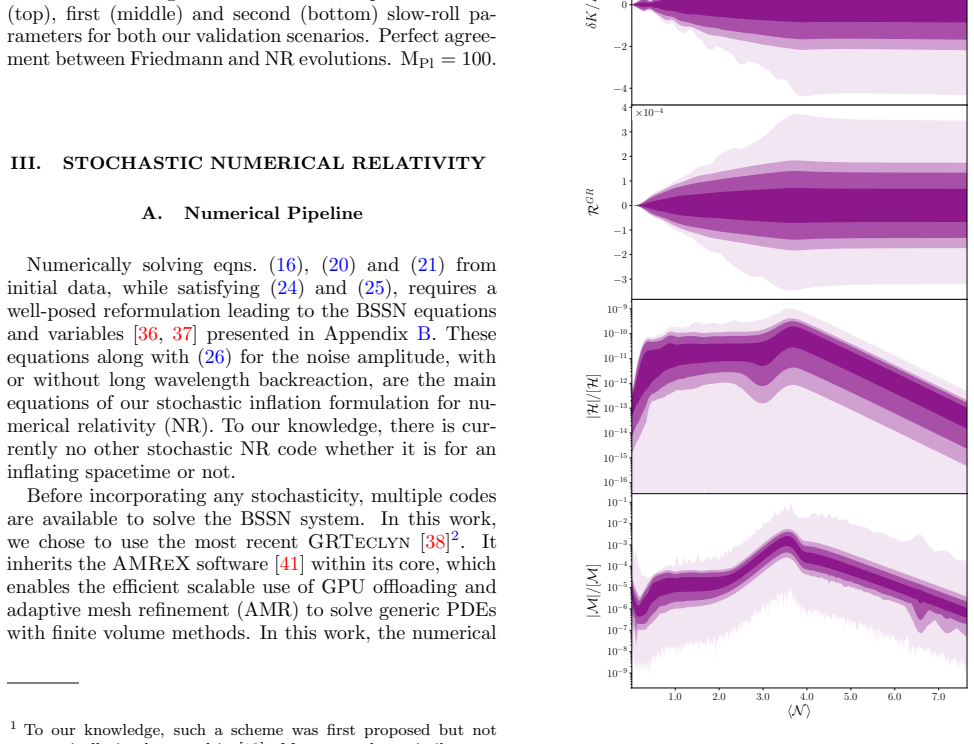
A set of 3+1 equations for stochastic inflation incorporating all metric and scalar matter degrees of freedom, first presented in previous work, are re-derived in a gauge invariant manner. We then present numerical implementations of these stochastic equations, cast in the BSSN formulation of Numerical Relativity, demonstrating their efficacy in both a slow-roll and an ultra slow-roll scenario. We find the evolution is correctly reproduced for all the dynamical variables, and the energy and momentum constraints are well-satisfied. This demonstrates that the stochastic equations are theoretically and numerically robust and ready to be applied to a wider inflationary landscape. Our simulations result in real space realizations of the fully non-linear stochastic dynamics with \new{gradients and anisotropic expansion retained. This work generalizes standard stochastic inflation, inflationary numerical relativity and lattice cosmology, opening up the possibility for reliable predictions of non-perturbative phenomena and providing} precise initial conditions for subsequent cosmological eras.
Editorial analysis
A structured set of objections, weighed in public.
Referee Report
Summary. The manuscript re-derives a set of 3+1 stochastic inflation equations incorporating all metric and scalar degrees of freedom in a gauge-invariant manner from prior work. It then presents numerical implementations of these equations in the BSSN formulation of numerical relativity, tested in both slow-roll and ultra slow-roll scenarios. The central claims are that the evolution of all dynamical variables is correctly reproduced, energy and momentum constraints are well-satisfied, and the approach yields real-space realizations of fully non-linear stochastic dynamics with gradients and anisotropic expansion retained, demonstrating theoretical and numerical robustness for wider inflationary applications.
Significance. If the numerical implementation is shown to preserve the stochastic noise correlators without uncontrolled discretization artifacts, this work would meaningfully advance the field by unifying stochastic inflation with full numerical relativity. It would enable non-perturbative, real-space predictions that standard perturbative stochastic inflation cannot access, while generalizing lattice cosmology techniques and supplying reliable initial conditions for subsequent eras. The retention of gradients and shear addresses a key limitation of existing approaches.
major comments (2)
- [Numerical results] Results section (slow-roll and ultra slow-roll tests): The claims that 'evolution is correctly reproduced' and 'constraints are well-satisfied' are supported only by qualitative statements. No quantitative error measures (e.g., time-integrated L2 norms of constraint violations), convergence tests with respect to grid resolution or noise realization, or direct comparisons of simulated two-point functions (such as the curvature power spectrum) to analytic expectations are provided. This directly bears on the central claim of numerical robustness, as the skeptic concern notes that BSSN constraint damping may alter noise statistics under anisotropic expansion.
- [Numerical implementation] BSSN implementation of stochastic source terms: The manuscript does not demonstrate that the discretized stochastic noise retains its exact two-point correlators when added to the conformal metric and extrinsic curvature sectors. The interaction between stochastic kicks and BSSN constraint-damping terms under retained gradients and shear is not quantified, leaving open the possibility that the scheme effectively filters or correlates the noise in a gauge-dependent manner, which would invalidate the 'fully non-linear stochastic dynamics' assertion even if mean constraints appear acceptable.
minor comments (2)
- [Abstract] The abstract's added sentence on 'precise initial conditions for subsequent cosmological eras' would benefit from a concrete example of what quantities are provided as output.
- [Equation derivation] The gauge-invariant re-derivation would be clearer if a short outline of the key steps (distinct from the prior work) were included in the main text rather than assumed from self-reference.
Simulated Author's Rebuttal
We thank the referee for the detailed and constructive review. We address each major comment below and will revise the manuscript to include the requested quantitative validations, thereby strengthening the evidence for numerical robustness.
read point-by-point responses
-
Referee: [Numerical results] Results section (slow-roll and ultra slow-roll tests): The claims that 'evolution is correctly reproduced' and 'constraints are well-satisfied' are supported only by qualitative statements. No quantitative error measures (e.g., time-integrated L2 norms of constraint violations), convergence tests with respect to grid resolution or noise realization, or direct comparisons of simulated two-point functions (such as the curvature power spectrum) to analytic expectations are provided. This directly bears on the central claim of numerical robustness, as the skeptic concern notes that BSSN constraint damping may alter noise statistics under anisotropic expansion.
Authors: We agree that quantitative metrics are needed to support the claims of correct evolution and constraint satisfaction. In the revised manuscript we will add time-integrated L2 norms of the energy and momentum constraint violations, averaged over multiple independent noise realizations, for both the slow-roll and ultra slow-roll cases. We will also report convergence tests under grid refinement and direct comparisons of the simulated curvature power spectrum to analytic expectations in the slow-roll regime. For ultra slow-roll we will discuss the limited applicability of perturbative analytic benchmarks. To address the possible influence of BSSN damping on noise statistics under anisotropic expansion, we will include ensemble-averaged diagnostics showing that the damping terms do not measurably alter the retained stochastic properties within the tested resolutions. revision: yes
-
Referee: [Numerical implementation] BSSN implementation of stochastic source terms: The manuscript does not demonstrate that the discretized stochastic noise retains its exact two-point correlators when added to the conformal metric and extrinsic curvature sectors. The interaction between stochastic kicks and BSSN constraint-damping terms under retained gradients and shear is not quantified, leaving open the possibility that the scheme effectively filters or correlates the noise in a gauge-dependent manner, which would invalidate the 'fully non-linear stochastic dynamics' assertion even if mean constraints appear acceptable.
Authors: We recognize the need to verify preservation of the noise correlators after discretization. The revised manuscript will include explicit checks: ensemble-averaged two-point correlation functions computed directly from the simulated conformal metric and extrinsic curvature will be compared against the theoretical noise correlators. We will further quantify the coupling between the stochastic source terms and the BSSN constraint-damping terms under retained gradients and shear, demonstrating that any residual gauge-dependent effects remain below the level of our numerical truncation error and do not compromise the fully non-linear stochastic evolution. revision: yes
Circularity Check
Re-derivation from authors' prior work introduces modest self-reference; numerical BSSN tests supply partial independent check
specific steps
-
self citation load bearing
[Abstract]
"A set of 3+1 equations for stochastic inflation incorporating all metric and scalar matter degrees of freedom, first presented in previous work, are re-derived in a gauge invariant manner."
The load-bearing theoretical framework (the stochastic 3+1 equations) is imported from the authors' own prior publication and only re-derived here; the claim that the equations are 'theoretically and numerically robust' therefore rests in part on self-citation whose independent verification is not supplied within this manuscript.
full rationale
The paper explicitly re-derives its 3+1 stochastic equations from previous work by the same research group and presents this as the theoretical foundation. The numerical BSSN implementations and constraint tests in slow-roll and ultra-slow-roll regimes provide some independent empirical content that does not reduce directly to the prior derivation. This yields modest self-citation load-bearing without forcing the entire result by construction. No fitted-input-as-prediction or self-definitional reductions are exhibited in the provided text.
Axiom & Free-Parameter Ledger
axioms (1)
- domain assumption Standard 3+1 decomposition of Einstein equations and stochastic noise from quantum fluctuations remain valid when all metric degrees of freedom are retained.
Forward citations
Cited by 4 Pith papers
-
Nonlinear Lattice Framework for Inflation: Bridging stochastic inflation and the $\delta{N}$ formalism
A shear-free lattice method bridges stochastic inflation and δN formalism by enabling fully nonlinear calculations of curvature perturbations in single-field models with ultra-slow-roll phases.
-
Stochastic inflation from a non-equilibrium renormalization group
A generalized Fokker-Planck equation for stochastic inflation is derived from a Polchinski-type renormalization group flow on the density matrix, incorporating dissipative and diffusive corrections beyond the leading order.
-
A consistent formulation of stochastic inflation I: Non-Markovian effects and issues beyond linear perturbations
The conventional truncation in stochastic inflation is inconsistent because quadratic-noise contributions are the same perturbative order as the deterministic non-Markovian corrections.
-
Nonperturbative stochastic inflation in perturbative dynamical background
Derives stochastic equations from Schwinger-Keldysh formalism that include quantum diffusion and classical metric perturbations for non-perturbative ultra-slow-roll inflation, validated on Starobinsky and critical Hig...
Reference graph
Works this paper leans on
-
[1]
Y. L. Launay, G. I. Rigopoulos, and E. P. S. Shellard, Phys. Rev. D109, 123523 (2024)
work page 2024
-
[2]
Planck 2018 results. IX. Constraints on primordial non-Gaussianity
Planck Collaboration, Y. Akrami, and et al., Astronomy & Astrophysics641, A9 (2020), arXiv:1905.05697
work page internal anchor Pith review Pith/arXiv arXiv 2020
-
[3]
Chaussidon and et al., Journal of Cosmology and As- troparticle Physics2025, 029 (2025)
E. Chaussidon and et al., Journal of Cosmology and As- troparticle Physics2025, 029 (2025)
work page 2025
-
[4]
A. Chudaykin, M. M. Ivanov, and O. H. E. Philcox, (2025), arXiv:2512.04266
-
[5]
R. M. Wald,Quantum Field Theory in Curved Space- Time and Black Hole Thermodynamics, Chicago Lec- tures in Physics (University of Chicago Press, Chicago, IL, 1995)
work page 1995
-
[6]
Maldacena, Journal of High Energy Physics2003, 013 (2003)
J. Maldacena, Journal of High Energy Physics2003, 013 (2003)
work page 2003
-
[7]
D. J. Mulryne and J. W. Ronayne, J. Open Source Softw. 3, 494 (2018)
work page 2018
-
[8]
Cosmological Flow of Primordial Correlators,
D. Werth, L. Pinol, and S. Renaux-Petel, “Cosmological Flow of Primordial Correlators,” (2023)
work page 2023
-
[9]
A. Costantini, L. Iacconi, and D. J. Mulryne, JCAP09, 077 (2025), arXiv:2503.15194
-
[10]
A. A. Starobinsky, inField Theory, Quantum Gravity and Strings, Vol. 246, edited by H. J. De Vega and N. S´ anchez (Springer Berlin Heidelberg) pp. 107–126
- [11]
-
[12]
D. S. Salopek and J. R. Bond, Physical Review D43, 1005 (1991)
work page 1991
- [13]
-
[14]
V. Vennin and A. A. Starobinsky, The European Physical Journal C75(2015)
work page 2015
-
[15]
K. Clough,Scalar Fields in Numerical General Relativity: Inhomogeneous inflation and asymmetric bubble collapse, Ph.D. thesis, King’s Coll. London, Cham (2017)
work page 2017
-
[16]
G. Felder and I. Tkachev, Computer Physics Communi- cations178, 929 (2008)
work page 2008
-
[17]
Simulating the inflationary universe: from single-field to the axion-u(1) model,
A. Caravano, “Simulating the inflationary universe: from single-field to the axion-u(1) model,” (2022)
work page 2022
-
[18]
F. Finelli, G. Marozzi, A. A. Starobinsky, G. P. Vacca, and G. Venturi, Physical Review D79, 044007 (2009)
work page 2009
-
[19]
F. Finelli, G. Marozzi, A. A. Starobinsky, G. P. Vacca, and G. Venturi, Physical Review D82, 064020 (2010)
work page 2010
-
[20]
C. Pattison, V. Vennin, H. Assadullahi, and D. Wands, Journal of Cosmology and Astroparticle Physics2019, 031 (2019)
work page 2019
-
[21]
J. H. Jackson, H. Assadullahi, K. Koyama, V. Vennin, and D. Wands, Journal of Cosmology and Astroparticle Physics2022, 067 (2022)
work page 2022
-
[22]
D. G. Figueroa, S. Raatikainen, S. Rasanen, and E. Tomberg, Physical Review Letters127, 101302
-
[23]
D. G. Figueroa, S. Raatikainen, S. R¨ as¨ anen, and E. Tomberg, Journal of Cosmology and Astroparticle Physics2022, 027 (2022)
work page 2022
-
[24]
Tomberg, Journal of Cosmology and Astroparticle Physics2023, 042 (2023)
E. Tomberg, Journal of Cosmology and Astroparticle Physics2023, 042 (2023)
work page 2023
-
[25]
Y. Mizuguchi, T. Murata, and Y. Tada, Journal of Cos- mology and Astroparticle Physics2024, 050 (2024)
work page 2024
-
[26]
D. Artigas, J. Grain, and V. Vennin, Journal of Cosmol- ogy and Astroparticle Physics2022, 001
- [27]
- [28]
- [29]
- [30]
-
[31]
Y. L. Launay, G. I. Rigopoulos, and E. S. Shellard, Jour- nal of Cosmology and Astroparticle Physics2025, 071 (2025)
work page 2025
-
[32]
L. P. Levasseur and E. McDonough, Physical Review D 91, 063513
- [33]
-
[34]
Y. Hamada, H. Kawai, K.-y. Oda, and S. C. Park, Phys. Rev. Lett.112, 241301 (2014), arXiv:1403.5043
work page internal anchor Pith review Pith/arXiv arXiv 2014
- [35]
-
[36]
T. W. Baumgarte and S. L. Shapiro, Physical Review D 59, 024007 (1998)
work page 1998
- [37]
- [38]
- [39]
-
[40]
Andrade and et al., Journal of Open Source Software 6, 3703 (2021)
T. Andrade and et al., Journal of Open Source Software 6, 3703 (2021)
work page 2021
-
[41]
Zhang and et al., Journal of Open Source Software4, 1370 (2019)
W. Zhang and et al., Journal of Open Source Software4, 1370 (2019)
work page 2019
-
[42]
D. Alic, C. Bona-Casas, C. Bona, L. Rezzolla, and C. Palenzuela, Physical Review D85(2012), 10.1103/physrevd.85.064040
-
[43]
D. Alic, W. Kastaun, and L. Rezzolla, Physical Review D88(2013), 10.1103/physrevd.88.064049
-
[44]
Cosmology using numerical relativity,
J. C. Aurrekoetxea, K. Clough, and E. A. Lim, “Cosmology using numerical relativity,” (2024), arXiv:2409.01939
-
[45]
F. J. Agocs, W. J. Handley, A. N. Lasenby, and M. P. Hobson, Phys. Rev. Res.2, 013030 (2020)
work page 2020
- [46]
-
[47]
S. M. Leach, M. Sasaki, D. Wands, and A. R. Liddle, Phys. Rev. D64, 023512 (2001), arXiv:astro-ph/0101406
work page internal anchor Pith review Pith/arXiv arXiv 2001
- [48]
-
[49]
D. Artigas, S. Pi, and T. Tanaka, Phys. Rev. Lett.134, 221001 (2025), arXiv:2408.09964
-
[50]
G. Franciolini, A. J. Iovino, M. Taoso, and A. Urbano, Phys. Rev. D109, 123550 (2024)
work page 2024
-
[51]
A. Caravano, G. Franciolini, and S. Renaux-Petel, (2024), arXiv:2410.23942
-
[52]
K. Burrage, P. Burrage, D. J. Higham, P. E. Kloeden, and E. Platen, Phys. Rev. E74, 068701 (2006)
work page 2006
- [53]
- [54]
-
[55]
D. S. Salopek and J. R. Bond, Physical Review D42, 3936 (1990)
work page 1990
-
[56]
G. I. Rigopoulos and E. P. S. Shellard, Physical Review D68, 123518 (2003). 11
work page 2003
- [57]
-
[58]
D. Artigas, E. Frion, T. Miranda, V. Vennin, and D. Wands, JCAP08, 032 (2025), arXiv:2504.05937. Appendix A: Gauge invariants as functionals ofR The scalar linear constraints of general relativity write 4∆Φ−4Hκ−2M −2 Pl δρ= 0, −2∂i " ∆χ+κ− 3 2M−2 Pl ˙ϕb αb δϕ # = 0, (A1) whereχ≡ − a2 αb (B− ˙E),κ≡3 ˙Φ αb +HΨ −∆χ, and δρ= ˙ϕb αb δ ˙ϕ αb + dV dϕ (ϕb...
-
[59]
through the concept of non-adiabatic pressure, the anisotropic sector cannot be neglected a priori for the satisfaction of the momentum constraint in regimes such as this one. Further quantitative comparison between the isotropic and anisotropic parts of the extrinsic curvature is left for future work
discussion (0)
Sign in with ORCID, Apple, or X to comment. Anyone can read and Pith papers without signing in.