REVIEW 4 major objections 6 minor 1 cited by
Cavity Multimodes as an Array for High-Frequency Gravitational Waves
T0 review · 4 major / 6 minor · reviewed 2026-08-03 · deepseek-v4-flash
Pith's one-line read A single microwave cavity's multiple resonant modes can act as a gravitational-wave detector array, recovering direction, polarization, and frequency drift from one high-frequency signal.
desk verdict Good idea, honest derivation, but the fourfold directional degeneracy the authors admit to leaving unresolved is exactly what undercuts the headline 'localization' claim. read the letter →
The pith
A machine-rendered reading of the paper's core claim, the machinery that carries it, and where it could break.
The reading
What carries the argument
The central machinery is the set of near-degenerate electromagnetic modes of a multi-cell cavity, each with a distinct antenna pattern: the dimensionless overlap functions η^a_{+/×}(k̂) between the effective current induced by the inverse Gertsenshtein effect (graviton-to-photon conversion in a background magnetic field) and the cavity's electric field. In the 9-cell geometry, the 18 TE111± modes have phase-matching peaks at different polar angles, so a frequency-drifting gravitational wave excites them at successive times. Relative amplitudes and phases among the loud modes break the degeneracies among the waveform parameters; at least five modes must be resolved for the full eight-paramete
What would settle it
Take the benchmark 18-mode cavity with a uniform magnetic field and inject a calibrated chirped signal with known direction and polarization; run the MCMC parameter recovery. If the posterior for (φ, θ) shows four disconnected equal-height peaks—or if the recovered parameters are not unique—then the single-cavity localization claim fails unless inhomogeneous-field hardware is added.
Extended reading notes
Core claim
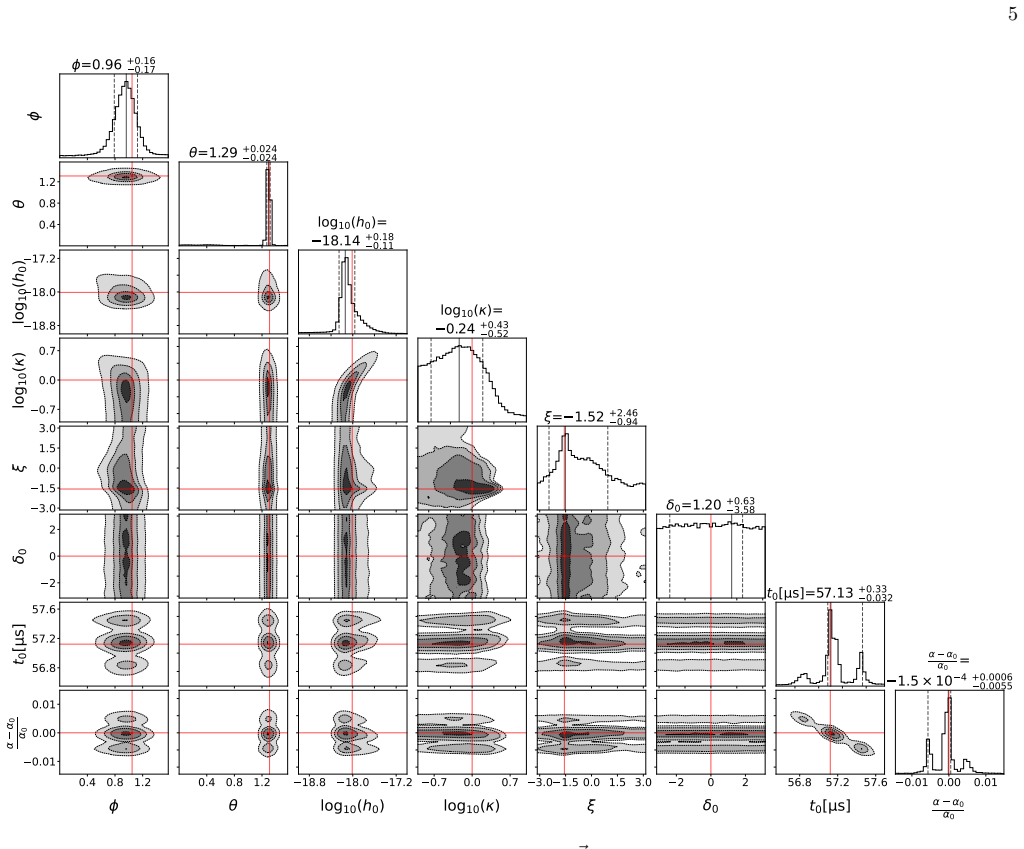
The paper claims, for the first time, that the distinct antenna patterns of multiple electromagnetic modes in one cavity localize and reconstruct key properties of an incoming high-frequency gravitational wave, including polarization ratio and frequency drift rate. In a 9-cell elliptical accelerator cavity, 18 nearly degenerate TE111± modes are excited sequentially by a chirped inspiral signal. Comparing mode amplitudes and phases—at least five loud modes are required—recovers all eight waveform parameters: direction (φ, θ), strain h0, polarization ratio κ and phase ξ, initial phase δ0, reference time t0, and chirp rate α. Benchmark MCMC recovery succeeds with SNR ~10, and sensitivity scales
Load-bearing premise
The direction-and-polarization reconstruction rests on lifting the fourfold sky degeneracy with magnetic-field inhomogeneities (deferred to future work) and on reading out all 18 modes through two couplers with comparable coupling; if either fails, the unique localization claim weakens.
Editorial extensions
If this is right
- A single cavity can localize the propagation direction of a high-frequency gravitational-wave source and recover its polarization ratio and relative phase, functions previously expected to require a network of synchronized detectors.
- Sensitivity to chirped or pulsed signals scales as the square root of the number of read-out modes, so a multi-cell cavity with many usable modes is intrinsically more powerful than a single-mode cavity of the same volume.
- At least five sufficiently loud modes are required for full waveform reconstruction; multi-cell designs provide the mode count necessary to meet this requirement.
- The reconstruction applies to binary inspiral signals and can be extended to more complex waveforms, including merger and ringdown phases, within the same parametric framework.
- For the benchmark parameters, the total signal-to-noise ratio is about 10, making astrophysically plausible primordial-black-hole binary sources detectable and characterizable by a single device.
Reading between the lines
- If the deferred magnetic-field inhomogeneity is implemented, the same cavity would acquire a unique directional response, effectively turning one compact device into a directional high-frequency gravitational-wave telescope; without it, the fourfold sky degeneracy leaves source direction ambiguous.
- The mode-diversity principle transfers naturally to axion and dark-photon haloscopes: any multi-mode resonant readout that preserves relative phases could extract directional or polarization information about a vector or pseudoscalar signal, not just a gravitational wave.
- Photon-counting or other quantum-limited readouts, which the paper mentions as an alternative, would sacrifice time-domain phase information; this trade-off suggests that the demonstrated reconstruction power is specific to phase-coherent linear readout.
- The N^{-1/2} sensitivity scaling means practical gains come from engineering many well-separated modes with comparable couplings, rather than from simply stacking single-mode cavities; this motivates further cavity-geometry optimization beyond the 9-cell example.
Editorial analysis
A structured set of objections, weighed in public.
Referee Report
Summary. The manuscript proposes to treat the multiple near-degenerate electromagnetic modes of a 9-cell TESLA cavity as an internal detector array for high-frequency gravitational waves (HFGWs). It starts from the inverse Gertsenshtein effective current, derives the cavity-mode equation, defines the overlap/antenna functions, and solves the time-domain response for a linearly chirping GW using a Green's function. The authors compute the 18 TE111± mode properties with COMSOL, give an analytic SNR formula, and perform a Gaussian-noise mock-injection MCMC for an 8-parameter inspiral waveform (direction, strain, polarization ratio and phase, initial phase and time, chirp rate). They claim that this is the first demonstration that a single cavity can localize and reconstruct an incoming HFGW event, with sensitivity scaling as the square root of the number of modes. The main quantitative evidence is the SNR scaling in Eq. (III.9) and the posterior plots in Fig. 4.
Significance. If the localization/reconstruction claim held in full generality, this would be a significant methodological advance: a single cavity acting as an N-mode array would avoid the phase-synchronization challenge of a distributed detector network and would add directional, polarimetric, and chirp information that single-mode searches lack. The first-principles derivation of the mode response, the closed-form Green's-function solution, the COMSOL-simulated mode properties, and the explicit injection test are concrete strengths. However, the unresolved fourfold directional degeneracy, the single favorable benchmark, and the unverified simultaneous-readout assumption mean that the strongest claims are not yet fully supported. The paper is a promising starting point but requires additional analysis before the advertised demonstration is established.
major comments (4)
- [Sec. II / Supp. B2] The central 'localization' claim is not supported as stated. The main text (Sec. II) asserts that the eightfold degeneracy of the antenna patterns 'can be lifted by incorporating phase information or by applying external magnetic fields in transverse directions,' but Supp. B2 states that relative phases among modes only reduce the Z8 degeneracy to a fourfold degeneracy, and that lifting the remaining fourfold requires 'controlled inhomogeneities in the background magnetic field' whose implementation is 'defer[red] ... to future work.' No such field enters the mock analysis. The MCMC in Fig. 4 uses uniform priors 'within the figure range,' and the displayed phi, theta ranges lie within one octant; the likelihood therefore has at least four equal-maximum octants. Consequently the demonstrated 'localization' is localization modulo the fourfold symmetry, not unique direction reconstruction.
- [Supp. B1 / Table I] The assumption that two straight antenna couplers can simultaneously read out all 18 modes with comparable coupling strengths is asserted, not demonstrated. Table I lists coupling coefficients beta_a between 1.0 and 40.6, spanning critical to strongly over-coupled. The Supplemental simply states that one coupler 'predominantly' reads out TE111+ and the other TE111-; no coupling matrix, S-parameter simulation, or simultaneous-readout noise budget is provided. The relative phases among modes—central to reducing the directional degeneracy and to reconstructing xi and delta_0—require simultaneous or well-calibrated multi-mode readout. If only a few modes are accessible with adequate SNR, the reconstruction shown in Fig. 4 is not representative. Please provide a quantitative readout model or clearly state this as an idealization.
- [Sec. III, Eq. (III.9), Table I] The stated sensitivity scaling h0 ~ N^{-1/2} and the analogy to an N-detector network are not supported by the actual mode population. Equation (III.9) sums Q_L^a (omega_a^2 eta_eff^a)^2, and Table I shows that the SNR_a^2 distribution is highly nonuniform: for example, mode a=3 TE111+ contributes SNR^2 = 34.9 while modes a=5,7,8 TE111+ contribute SNR^2 <= 0.3; only 7 of 18 modes have SNR > 1 in the benchmark. The effective number of useful modes is therefore much smaller than 18. The N^{1/2} enhancement holds only if additional modes have comparable eta_eff Q_L. A statement of the scaling should either use the effective participation sum or be demonstrated over the mode set under varied directions.
- [Sec. III, Fig. 4] The MCMC demonstration is a single favorable benchmark: a source at 0.19 AU, direction (pi/3, 5pi/12), kappa = 1, xi = -pi/2, and parameters chosen so that 7 modes are loud. The text says 'all 8 parameters are successfully resolved,' but the figure shows secondary-peaked structures in alpha and t0, and delta_0 is weakly constrained. To support the claim that the method reconstructs key properties of an incoming HFGW in general, the authors should show at least a few realizations covering different sky directions (especially outside the displayed octant), different polarization ratios/phases, and different chirp rates, or report the full-sky posterior and the distribution of loud modes. Without this, the 'first demonstration' is one fine-tuned realization rather than a demonstrated capability.
minor comments (6)
- [Eq. (III.1)] The waveform is written in terms of complex exponentials, but physical strain is real. State explicitly that the real part is taken and that the complex mode amplitude in Eq. (III.2) is the analytic response.
- [Fig. 2] The caption says overlap functions in other sky regions and for TE111- modes follow from symmetry relations, but the TE111- analogue is not shown. Since TE111- modes are used in the reconstruction, include their antenna patterns in the main text or state more explicitly how they are related by phi -> phi + pi/2.
- [Table I / Supp. B1] The coupling coefficient beta_a is defined only in the Supplemental. Define it in the main text and state how the loaded quality factor Q_L^a is related to the intrinsic Q_0 for each mode.
- [Sec. III] The statement that 'at least 5 cavity modes must be clearly resolved' is heuristic. A short argument connecting the number of loud modes to the rank of the Fisher information matrix, or to the number of unknown parameters, would make the requirement quantitative.
- [Eq. (III.6)] The effective noise temperature T_eff = 10 mK is quoted, but the composition of T_eff (amplifier noise, quantum noise, thermal noise) is not specified. A brief sentence on the noise model would improve reproducibility.
- [References] Reference [5] (Bernard, Elouadrhiri, Meissner, 'Axial structure of the nucleon') appears unrelated to the HFGW context in which it is cited. Please verify the citation.
Circularity Check
No significant circularity: the derivation is a self-contained first-principles forward model validated by injection-recovery, not a fit disguised as a prediction.
full rationale
The paper's derivation chain starts from the inverse Gertsenshtein effective current and the cavity-mode equation of motion; although Eq. (II.1) cites [11] and Eq. (II.2) cites [48,67], the same equations are re-derived in Supplemental Appendix A from the minimal-coupling action (S1), so the self-citations are not load-bearing in a way that defines the result. The antenna patterns are computed from COMSOL electric-field profiles via the overlap integral (II.4), and the SNR formula (III.9) follows arithmetically from summing the per-mode responses, with no fitted parameter later renamed as a prediction. The MCMC analysis in Fig. 4 is an injection-recovery test using mock data generated from the same forward model with known benchmark parameters, which is the standard way to validate an estimator rather than a circular prediction. The most serious caveat is the fourfold directional degeneracy: Supplemental B2 states that the remaining degeneracy requires magnetic-field inhomogeneities whose implementation is 'defer[red] ... to future work', and the main-text claim of single-cavity localization is accordingly stronger than what the current setup demonstrates. However, this is a correctness/overclaim issue (the likelihood is not unique in direction), not a circularity in which a result is equivalent by construction to an input or a self-citation chain. No step reduces to its own inputs, so the circularity score is 0.
Assumptions & free parameters
free parameters (3)
- Benchmark waveform parameter vector Θ =
φ=π/3, θ=5π/12, h0=9.75×10⁻¹⁹, κ=1, ξ=−π/2, δ0=0, t0=57.12 μs, α=1.2×10¹⁴ rad/s²
- Loaded quality factors Q_L^a and coupling coefficients β_a for the 18 modes =
Q_L from 542 to 9112; β_a from 1.0 to 40.6 (Table I)
- Effective noise temperature T_eff =
10 mK
assumptions (7)
- domain assumption GW–EM coupling is described by the inverse Gertsenshtein effective current j^μ_eff = ∂_ν(½ h F_0^{μν} + h^ν_σ F_0^{σμ} − h^μ_σ F_0^{σν}) (Eq II.1 / S2).
- standard math The cavity field can be expanded in orthonormal eigenmodes with the mode equation (II.2/S5), retaining only the effective three-current source.
- domain assumption COMSOL-computed mode frequencies, Q factors, and overlap functions for the 9-cell TESLA TE111± modes are accurate.
- ad hoc to paper Two straight antenna couplers read out all 18 modes with comparable coupling strengths.
- domain assumption The GW waveform is an 8-parameter plane wave with linear frequency drift (Eq III.1); merger/ringdown and higher-order chirp terms are negligible.
- domain assumption Noise is independent, Gaussian, white, with σ²_a=2T_eff/(ω_a Δt) and no cross-mode correlations.
- ad hoc to paper The Z8 directional degeneracy of the antenna patterns can be lifted sufficiently (phase information plus future magnetic-field inhomogeneities) to provide unique localization.
Cite this review
Pith. "Pith review of Cavity Multimodes as an Array for High-Frequency Gravitational Waves." pith.science (2026). https://pith.science/paper/UBFKDD7G
@misc{pith2026260103341,
  author       = {Pith},
  title        = {Pith review of: Cavity Multimodes as an Array for High-Frequency Gravitational Waves},
  year         = {2026},
  howpublished = {\url{https://pith.science/paper/UBFKDD7G}},
  note         = {Machine review of arXiv:2601.03341}
}
read the original abstract
Microwave cavities operated in the presence of a background magnetic field provide a promising avenue for detecting high-frequency gravitational waves (HFGWs). We demonstrate for the first time that the distinct antenna patterns of multiple electromagnetic modes within a single cavity enable localization and reconstruction of key properties of an incoming HFGW signal, including its polarization ratio and frequency drift rate. Using a 9-cell cavity commonly employed in particle accelerators as a representative example, we analyze the time-domain response of 18 nearly degenerate modes, which can be sequentially excited by a frequency-drifting signal. The sensitivity is further enhanced by the number of available modes, in close analogy to the scaling achieved by a network of independent detectors, enabling sensitivity to astrophysically plausible binary sources.
Figures


Figures from the paper (1 more)
Forward citations
Cited by 1 Pith paper
-
Scalar-induced gravitational waves from inflation with symmetry breaking
Late gauge-field excitation in charged symmetry-breaking inflation pushes enhanced SIGWs into the GHz band, where longitudinal and charge-mixing parameters reshape the spectrum in opposite, distinguishable ways.
Reference graph
Works this paper leans on
-
[1]
Obser- vation of Gravitational Waves from a Binary Black Hole Merger,
B. P. Abbottet al.(LIGO Scientific, Virgo), “Obser- vation of Gravitational Waves from a Binary Black Hole Merger,” Phys. Rev. Lett.116, 061102 (2016), arXiv:1602.03837 [gr-qc]
arXiv 2016
-
[2]
Challenges and opportunities of gravitational-wave searches at MHz to GHz frequencies,
Nancy Aggarwalet al., “Challenges and opportunities of gravitational-wave searches at MHz to GHz frequencies,” Living Rev. Rel.24, 4 (2021), arXiv:2011.12414 [gr-qc]
arXiv 2021
-
[3]
Challenges and Opportunities of Gravitational Wave Searches above 10 kHz,
Nancy Aggarwalet al., “Challenges and Opportunities of Gravitational Wave Searches above 10 kHz,” (2025), arXiv:2501.11723 [gr-qc]
arXiv 2025
-
[4]
An electromagnetic detector for very- high-frequency gravitational waves,
A. M. Cruise, “An electromagnetic detector for very- high-frequency gravitational waves,” Class. Quant. Grav. 17, 2525–2530 (2000)
2000
-
[5]
Axial structure of the nucleon: Topical Review,
Veronique Bernard, Latifa Elouadrhiri, and Ulf-G. Meissner, “Axial structure of the nucleon: Topical Review,” J. Phys. G28, R1–R35 (2002), arXiv:hep- ph/0107088
arXiv 2002
-
[6]
Fang-Yu Li, Meng-Xi Tang, and Dong-Ping Shi, “Elec- tromagnetic response of a Gaussian beam to high fre- quency relic gravitational waves in quintessential in- flationary models,” Phys. Rev. D67, 104008 (2003), arXiv:gr-qc/0306092
arXiv 2003
-
[7]
A detector of high frequency gravitational waves based on coupled microwave cavities,
R. Ballantini, P. Bernard, E. Chiaveri, A. Chincarini, G. Gemme, R. Losito, R. Parodi, and E. Picasso, “A detector of high frequency gravitational waves based on coupled microwave cavities,” Class. Quant. Grav.20, 3505–3522 (2003)
2003
-
[8]
Microwave apparatus for gravita- tional waves observation,
R. Ballantiniet al., “Microwave apparatus for gravita- tional waves observation,” (2005), arXiv:gr-qc/0502054
arXiv 2005
Show all 92 references
-
[9]
Gravitational Wave Detection with High Frequency Phonon Trapping Acoustic Cavities,
Maxim Goryachev and Michael E. Tobar, “Gravitational Wave Detection with High Frequency Phonon Trapping Acoustic Cavities,” Phys. Rev. D90, 102005 (2014), [Er- ratum: Phys.Rev.D 108, 129901 (2023)], arXiv:1410.2334 [gr-qc]
2014 arXiv
-
[10]
Detecting planetary-mass primordial black holes with resonant electromagnetic gravitational- wave detectors,
Nicolas Herman, Andr´ e F¨ uzfa, L´ eonard Lehoucq, and S´ ebastien Clesse, “Detecting planetary-mass primordial black holes with resonant electromagnetic gravitational- wave detectors,” Phys. Rev. D104, 023524 (2021), arXiv:2012.12189 [gr-qc]
2021 arXiv
-
[11]
Detecting high-frequency gravita- tional waves with microwave cavities,
Asher Berlin, Diego Blas, Raffaele Tito D’Agnolo, Se- bastian A. R. Ellis, Roni Harnik, Yonatan Kahn, and Jan Sch¨ utte-Engel, “Detecting high-frequency gravita- tional waves with microwave cavities,” Phys. Rev. D105, 116011 (2022), arXiv:2112.11465 [hep-ph]
2022 arXiv
-
[12]
Novel Search for High-Frequency Gravitational Waves with Low-Mass Axion Haloscopes,
Valerie Domcke, Camilo Garcia-Cely, and Nicholas L. Rodd, “Novel Search for High-Frequency Gravitational Waves with Low-Mass Axion Haloscopes,” Phys. Rev. Lett.129, 041101 (2022), arXiv:2202.00695 [hep-ph]
2022 arXiv
-
[13]
Searches for New Particles, Dark Matter, and Gravitational Waves with SRF Cavities,
Asher Berlinet al., “Searches for New Particles, Dark Matter, and Gravitational Waves with SRF Cavities,” (2022), arXiv:2203.12714 [hep-ph]
2022 arXiv
-
[14]
Comparing Instrument Spectral Sensitivity of Dissimilar Electromagnetic Haloscopes to Axion Dark Matter and High Frequency Gravitational Waves,
Michael E. Tobar, Catriona A. Thomson, William M. Campbell, Aaron Quiskamp, Jeremy F. Bourhill, Ben- jamin T. McAllister, Eugene N. Ivanov, and Maxim Goryachev, “Comparing Instrument Spectral Sensitivity of Dissimilar Electromagnetic Haloscopes to Axion Dark Matter and High Fr...
2022 arXiv
-
[15]
Electromagnetic field in a cavity induced by grav- itational waves,
Danho Ahn, Yeong-Bok Bae, Sang Hui Im, and Chan Park, “Electromagnetic field in a cavity induced by grav- itational waves,” Phys. Rev. D110, 064061 (2024), arXiv:2312.09550 [gr-qc]
2024 arXiv
-
[16]
The future search for low-frequency axions and new physics with the FLASH resonant cavity experiment at Frascati National Laboratories,
David Alesiniet al., “The future search for low-frequency axions and new physics with the FLASH resonant cavity experiment at Frascati National Laboratories,” Phys. Dark Univ.42, 101370 (2023), arXiv:2309.00351 [physics.ins-det]
2023 arXiv
-
[17]
Electromagnetic cavities as mechanical bars for gravitational waves,
Asher Berlin, Diego Blas, Raffaele Tito D’Agnolo, Se- bastian A. R. Ellis, Roni Harnik, Yonatan Kahn, Jan Sch¨ utte-Engel, and Michael Wentzel, “Electromagnetic cavities as mechanical bars for gravitational waves,” Phys. Rev. D108, 084058 (2023), arXiv:2303.01518 [hep- ph]
2023 arXiv
-
[18]
High-frequency gravitational wave de- tection via optical frequency modulation,
Torsten Bringmann, Valerie Domcke, Elina Fuchs, and Joachim Kopp, “High-frequency gravitational wave de- tection via optical frequency modulation,” Phys. Rev. D 108, L061303 (2023), arXiv:2304.10579 [hep-ph]
2023 arXiv
-
[19]
Simultaneous resonant and broadband detection of ultralight dark matter and high- frequency gravitational waves via cavities and circuits,
Yifan Chen, Chunlong Li, Yuxin Liu, Jing Shu, Yut- ing Yang, and Yanjie Zeng, “Simultaneous resonant and broadband detection of ultralight dark matter and high- frequency gravitational waves via cavities and circuits,” Rept. Prog. Phys.88, 057601 (2025), arXiv:2309.12387 [hep-ph]
2025 arXiv
-
[20]
Symmetries and selection rules: optimising axion haloscopes for Gravitational Wave searches,
Valerie Domcke, Camilo Garcia-Cely, Sung Mook Lee, and Nicholas L. Rodd, “Symmetries and selection rules: optimising axion haloscopes for Gravitational Wave searches,” JHEP03, 128 (2024), arXiv:2306.03125 [hep- ph]
2024 arXiv
-
[21]
Novel high-frequency gravitational waves detec- tion with split cavity,
Chu-Tian Gao, Yu Gao, Yiming Liu, and Sichun Sun, “Novel high-frequency gravitational waves detec- tion with split cavity,” Phys. Rev. D109, 084004 (2024), arXiv:2305.00877 [gr-qc]
2024 arXiv
-
[22]
A M¨ ossbauer Scheme to Probe Gravitational Waves,
Yu Gao, Huaqiao Zhang, and Wei Xu, “A M¨ ossbauer Scheme to Probe Gravitational Waves,” Sci. Bull.69, 2795–2798 (2024), arXiv:2310.06607 [gr-qc]
2024 arXiv
-
[23]
Study of a cubic cavity resonator for gravitational waves detection in the microwave frequency range,
Pablo Navarro, Benito Gimeno, Juan Monz´ o-Cabrera, Alejandro D ´ ıaz-Morcillo, and Diego Blas, “Study of a cubic cavity resonator for gravitational waves detection in the microwave frequency range,” Phys. Rev. D109, 104048 (2024), arXiv:2312.02270 [hep-ph]
2024 arXiv
-
[24]
A Global Net- work of Cavities to Search for Gravitational Waves (GravNet): A novel scheme to hunt gravitational waves signatures from the early universe,
Kristof Schmieden and Matthias Schott, “A Global Net- work of Cavities to Search for Gravitational Waves (GravNet): A novel scheme to hunt gravitational waves signatures from the early universe,” PoSEPS- HEP2023, 102 (2024), arXiv:2308.11497 [gr-qc]
2024 arXiv
-
[25]
Magnets are Weber Bar Gravitational Wave Detectors,
Valerie Domcke, Sebastian A. R. Ellis, and Nicholas L. Rodd, “Magnets are Weber Bar Gravitational Wave Detectors,” Phys. Rev. Lett.134, 231401 (2025), arXiv:2408.01483 [hep-ph]
2025 arXiv
-
[26]
Superconducting Levitated Detector of Gravitational Waves,
Daniel Carney, Gerard Higgins, Giacomo Marocco, and Michael Wentzel, “Superconducting Levitated Detector of Gravitational Waves,” Phys. Rev. Lett.134, 181402 (2025), arXiv:2408.01583 [hep-ph]
2025 arXiv
-
[27]
Dielectric haloscopes as gravitational wave detectors,
Valerie Domcke, Sebastian A. R. Ellis, and Joachim Kopp, “Dielectric haloscopes as gravitational wave detectors,” Phys. Rev. D111, 035031 (2025), arXiv:2409.06462 [hep-ph]
2025 arXiv
-
[28]
Search for gravitational waves using a network of RF cavities,
Tim Schneemann, Kristof Schmieden, and Matthias Schott, “Search for gravitational waves using a network of RF cavities,” Nucl. Instrum. Meth. A1068, 169721 (2024)
2024
-
[29]
High- frequency gravitational waves detection with the BabyI- AXO haloscopes,
Jos´ e Reina Valero, Jose R. Navarro Madrid, Diego Blas, Alejandro D ´ ıaz Morcillo, Igor Garc ´ ıa Irastorza, Benito Gimeno, and Juan Monz´ o Cabrera, “High- frequency gravitational waves detection with the BabyI- AXO haloscopes,” Phys. Rev. D111, 043024 (2025), arXiv:2407.20...
2025 arXiv
-
[30]
Gravi- tational wave detection with plasma haloscopes,
Rodolfo Capdevilla, Graciela B. Gelmini, Jonah Hyman, Alexander J. Millar, and Edoardo Vitagliano, “Gravi- tational wave detection with plasma haloscopes,” Phys. Rev. D112, 055011 (2025), arXiv:2412.14450 [hep-ph]
2025 arXiv
-
[31]
First characterisation of the MAGO cavity, a superconducting RF detector for kHz–MHz gravitational waves,
Lars Fischeret al., “First characterisation of the MAGO cavity, a superconducting RF detector for kHz–MHz gravitational waves,” Class. Quant. Grav.42, 115015 (2025), arXiv:2411.18346 [gr-qc]
2025 arXiv
-
[32]
Polarimetric searches for axion dark matter and high-frequency gravitational waves us- ing optical cavities,
Camilo Garc ´ ıa-Cely, Luca Marsili, Andreas Ringwald, and Aaron D. Spector, “Polarimetric searches for axion dark matter and high-frequency gravitational waves us- ing optical cavities,” Phys. Rev. D112, 023031 (2025), arXiv:2501.08382 [hep-ph]
2025 arXiv
-
[33]
Experimental Limits on Planetary Mass Primordial Black Hole Mergers,
William M. Campbell, Leonardo Mariani, Michael E. To- bar, and Maxim Goryachev, “Experimental Limits on Planetary Mass Primordial Black Hole Mergers,” (2025), 10.1103/c1kj-rj3c, arXiv:2506.03609 [gr-qc]
2025
-
[34]
High-Frequency Gravi- tational Wave Search with ABRACADABRA-10 cm,
Kaliro¨ e M. W. Pappaset al., “High-Frequency Gravi- tational Wave Search with ABRACADABRA-10 cm,” (2025), arXiv:2505.02821 [hep-ex]
2025 arXiv
-
[35]
High-frequency gravitational wave de- tection by the BREAD experiment,
Rodolfo Capdevilla, Roni Harnik, Taegyun Kim, and Tom Krokotsch, “High-frequency gravitational wave de- tection by the BREAD experiment,” Phys. Rev. D112, 035031 (2025), arXiv:2505.21628 [hep-ph]
2025 arXiv
-
[36]
QuGrav: Bringing gravitational waves to light with Qumodes,
Dmitri E. Kharzeev, Azadeh Maleknejad, and Saba Sha- lamberidze, “QuGrav: Bringing gravitational waves to light with Qumodes,” (2025), arXiv:2506.09459 [gr-qc]
2025
-
[37]
Search for high-frequency grav- itational waves via re-analysis of cavity axion data,
Younggeun Kimet al., “Search for high-frequency grav- itational waves via re-analysis of cavity axion data,” (2025), arXiv:2511.17817 [hep-ex]
2025 arXiv
-
[38]
Detecting gravitational waves with spin systems,
Jiamin Liang, Mingqiu Li, Yu Gao, Wei Ji, Sichun Sun, and Qi-Shu Yan, “Detecting gravitational waves with spin systems,” (2025), arXiv:2510.11009 [gr-qc]
2025
-
[39]
Probing high-frequency gravitational waves with entangled vibrational qubits in linear Paul traps,
Ryoto Takai, “Probing high-frequency gravitational waves with entangled vibrational qubits in linear Paul traps,” (2025), arXiv:2509.22475 [hep-ph]
2025 arXiv
-
[40]
Signatures of High-Frequency Gravi- tational Waves in Electromagnetic Cavities,
Sebastian Schenk, Kristof Schmieden, and Pe- dro Schwaller, “Signatures of High-Frequency Gravi- tational Waves in Electromagnetic Cavities,” (2025), arXiv:2512.20592 [hep-ph]
2025
-
[41]
High frequency gravitational wave sensing with superconducting microwave cavities,
Giovanni Marconato, Julien Branlard, Can Dokuyucu, Bianca Giaccone, Wolfgang Hillert, Tom Krokotsch, Gu- drid Moortgat-Pick, Krisztian Peters, Andreas Ringwald, and Marc Wenskat, “High frequency gravitational wave sensing with superconducting microwave cavities,”
-
[42]
Identifying the quadrupolar nature of gravitational wave background through space-based mis- sions,
Yifan Chen, Yuxiang Liu, Jing Shu, Bin Xu, Xiao Xue, and Yanjie Zeng, “Identifying the quadrupolar nature of gravitational wave background through space-based mis- sions,” JCAP08, 063 (2025), arXiv:2410.07329 [gr-qc]
2025 arXiv
-
[43]
Planck 2018 results. VI. Cosmological parameters,
N. Aghanimet al.(Planck), “Planck 2018 results. VI. Cosmological parameters,” Astron. Astrophys.641, A6 (2020), [Erratum: Astron.Astrophys. 652, C4 (2021)], arXiv:1807.06209 [astro-ph.CO]
2018 arXiv
-
[44]
Dark Mat- ter Interferometry,
Joshua W. Foster, Yonatan Kahn, Rachel Nguyen, Nicholas L. Rodd, and Benjamin R. Safdi, “Dark Mat- ter Interferometry,” Phys. Rev. D103, 076018 (2021), arXiv:2009.14201 [hep-ph]
2021 arXiv
-
[45]
Dissecting axion and dark photon with a net- work of vector sensors,
Yifan Chen, Min Jiang, Jing Shu, Xiao Xue, and Yan- 8 jie Zeng, “Dissecting axion and dark photon with a net- work of vector sensors,” Phys. Rev. Res.4, 033080 (2022), arXiv:2111.06732 [hep-ph]
2022 arXiv
-
[46]
Search for dark photons with synchro- nized quantum sensor network,
Min Jianget al., “Search for dark photons with synchro- nized quantum sensor network,” Nature Commun.15, 3331 (2024), arXiv:2305.00890 [quant-ph]
2024 arXiv
-
[47]
Hunt for magnetic signatures of hidden-photon and axion dark matter in the wilderness,
Ibrahim A. Sulaiet al., “Hunt for magnetic signatures of hidden-photon and axion dark matter in the wilderness,” Phys. Rev. D108, 096026 (2023), arXiv:2306.11575 [hep- ph]
2023 arXiv
-
[48]
Cavity as radio telescope for galactic dark photon,
Yanjie Zenget al.(SHANHE), “Cavity as radio telescope for galactic dark photon,” Sci. Bull.70, 661–666 (2025), arXiv:2402.03432 [hep-ph]
2025 arXiv
-
[49]
Searches for exotic spin-dependent inter- actions with spin sensors,
Min Jiang, Haowen Su, Yifan Chen, Man Jiao, Ying Huang, Yuanhong Wang, Xing Rong, Xinhua Peng, and Jiangfeng Du, “Searches for exotic spin-dependent inter- actions with spin sensors,” Rept. Prog. Phys.88, 016401 (2025), arXiv:2412.03288 [quant-ph]
2025 arXiv
-
[50]
Searching for dark matter with a spin-based interferometer,
Daniel Gavilan-Martinet al., “Searching for dark matter with a spin-based interferometer,” Nature Commun.16, 4953 (2025), arXiv:2408.02668 [hep-ph]
2025
-
[51]
Multiple-cavities interferometric anal- ysis for dark matter axions directional-sensitive search based on signal cross-correlation processing,
Jos´ e Reina-Valero, Alejandro D ´ ıaz-Morcillo, Benito Gi- meno, Antonio Jos´ e Lozano-Guerrero, Iv´ an Mart ´ ı-Vidal, Juan Monz´ o-Cabrera, Jose R. Navarro-Madrid, and Car- los Pe˜ na-Garay, “Multiple-cavities interferometric anal- ysis for dark matter axions directional-se...
2025 arXiv
-
[52]
Search for Ultralight Dark Matter with Quantum Magnetometry in the Earth’s Cavity,
Ariel Arzaet al., “Search for Ultralight Dark Matter with Quantum Magnetometry in the Earth’s Cavity,” (2025), arXiv:2511.16553 [hep-ph]
2025
-
[53]
Search for a solar-bound axion halo using the Global Network of Optical Magnetometers for Exotic physics searches,
Tatum Z. Wilsonet al., “Search for a solar-bound axion halo using the Global Network of Optical Magnetometers for Exotic physics searches,” (2025), arXiv:2512.10221 [physics.atom-ph]
2025 arXiv
-
[54]
The superconducting TESLA cavi- ties,
B. Auneet al., “The superconducting TESLA cavi- ties,” Phys. Rev. ST Accel. Beams3, 092001 (2000), arXiv:physics/0003011
2000 arXiv
-
[55]
High- beta Cavity Design: A Tutorial,
S. Belomestnykh and V. Shemelin, “High- beta Cavity Design: A Tutorial,” (2006)
2006
-
[56]
Multiple-Cell Cavity for High Mass Axion Dark Matter Search,
Junu Jeong, SungWoo Youn, and Yannis K. Semertzidis, “Multiple-Cell Cavity for High Mass Axion Dark Matter Search,” Springer Proc. Phys.245, 131–137 (2020)
2020
-
[57]
Hunt for light primordial black hole dark matter with ultrahigh-frequency gravita- tional waves,
Gabriele Franciolini, Anshuman Maharana, and Francesco Muia, “Hunt for light primordial black hole dark matter with ultrahigh-frequency gravita- tional waves,” Phys. Rev. D106, 103520 (2022), arXiv:2205.02153 [astro-ph.CO]
2022 arXiv
-
[58]
Prospects for detection of ultra high frequency gravitational waves from compact binary coalescences with resonant cavities,
Aur´ elien Barrau, Juan Garc ´ ıa-Bellido, Thierry Grenet, and Killian Martineau, “Prospects for detection of ultra high frequency gravitational waves from compact binary coalescences with resonant cavities,” Eur. Phys. J. C85, 320 (2025), arXiv:2303.06006 [gr-qc]
2025 arXiv
-
[59]
Cavity detection of gravitational waves: Where do we stand?
Claudio Gatti, Luca Visinelli, and Michael Zant- edeschi, “Cavity detection of gravitational waves: Where do we stand?” Phys. Rev. D110, 023018 (2024), arXiv:2403.18610 [gr-qc]
2024 arXiv
-
[60]
Maximal gravitational wave signal from asteroid-mass primordial black hole mergers at resonant microwave cavities,
Stefano Profumo, Lucas Brown, Christopher Ewasiuk, Sean Ricarte, and Henry Su, “Maximal gravitational wave signal from asteroid-mass primordial black hole mergers at resonant microwave cavities,” Phys. Rev. D 111, 063072 (2025), arXiv:2410.15400 [astro-ph.HE]
2025 arXiv
-
[61]
Mega-Hertz Gravi- tational Waves from Neutron Star Mergers,
Jorge Casalderrey-Solana, David Mateos, and Mikel Sanchez-Garitaonandia, “Mega-Hertz Gravi- tational Waves from Neutron Star Mergers,” (2022), arXiv:2210.03171 [hep-th]
2022
-
[62]
Clas- sical (and quantum) heuristics for gravitational wave de- tection,
Raffaele Tito D’Agnolo and Sebastian A. R. Ellis, “Clas- sical (and quantum) heuristics for gravitational wave de- tection,” JHEP04, 164 (2025), arXiv:2412.17897 [gr-qc]
2025 arXiv
-
[63]
There is Room at the Top: Fun- damental Quantum Limits for Detecting Ultra-high Fre- quency Gravitational Waves,
Xinyao Guo, Haixing Miao, Zhi-Wei Wang, Huan Yang, and Ye-Ling Zhou, “There is Room at the Top: Fun- damental Quantum Limits for Detecting Ultra-high Fre- quency Gravitational Waves,” (2025), arXiv:2501.18146 [gr-qc]
2025
-
[64]
On the de- tection of low frequency gravitational waves,
M. E. Gertsenshtein and V. I. Pustovoit, “On the de- tection of low frequency gravitational waves,” Sov. Phys. JETP16, 433–435 (1962)
1962
-
[65]
We thank Jordan Gu´ e and Tom Krokotsch for helpful discussions on the use of TT gauge for our signals
-
[66]
A coordinate-independent formalism for de- tecting high-frequency gravitational waves,
Wolfram Ratzinger, Sebastian Schenk, and Pedro Schwaller, “A coordinate-independent formalism for de- tecting high-frequency gravitational waves,” JHEP08, 195 (2024), arXiv:2404.08572 [gr-qc]
2024 arXiv
-
[67]
First Scan Search for Dark Photon Dark Matter with a Tunable Supercon- ducting Radio-Frequency Cavity,
Zhenxing Tanget al.(SHANHE), “First Scan Search for Dark Photon Dark Matter with a Tunable Supercon- ducting Radio-Frequency Cavity,” Phys. Rev. Lett.133, 021005 (2024), arXiv:2305.09711 [hep-ex]
2024 arXiv
-
[68]
Axion detection with precision frequency metrol- ogy,
Maxim Goryachev, Ben Mcallister, and Michael E. To- bar, “Axion detection with precision frequency metrol- ogy,” Phys. Dark Univ.26, 100345 (2019), [Erratum: Phys.Dark Univ. 32, 100787 (2021)], arXiv:1806.07141 [physics.ins-det]
2019 arXiv
-
[69]
Axion Dark Matter Detection by Superconducting Res- onant Frequency Conversion,
Asher Berlin, Raffaele Tito D’Agnolo, Sebastian A. R. Ellis, Christopher Nantista, Jeffrey Neilson, Philip Schus- ter, Sami Tantawi, Natalia Toro, and Kevin Zhou, “Axion Dark Matter Detection by Superconducting Res- onant Frequency Conversion,” JHEP07, 088 (2020), arXiv:1912.1...
2020 arXiv
-
[70]
Heterodyne broadband detec- tion of axion dark matter,
Asher Berlin, Raffaele Tito D’Agnolo, Sebastian A. R. Ellis, and Kevin Zhou, “Heterodyne broadband detec- tion of axion dark matter,” Phys. Rev. D104, L111701 (2021), arXiv:2007.15656 [hep-ph]
2021 arXiv
-
[71]
Up- conversion Loop Oscillator Axion Detection Experiment: A Precision Frequency Interferometric Axion Dark Mat- ter Search with a Cylindrical Microwave Cavity,
Catriona A. Thomson, Ben T. McAllister, Maxim Gory- achev, Eugene N. Ivanov, and Michael E. Tobar, “Up- conversion Loop Oscillator Axion Detection Experiment: A Precision Frequency Interferometric Axion Dark Mat- ter Search with a Cylindrical Microwave Cavity,” Phys. Rev. Lett...
2021 arXiv
-
[72]
Searching for low-mass axions using reso- nant upconversion,
Catriona A. Thomson, Maxim Goryachev, Ben T. McAl- lister, Eugene N. Ivanov, Paul Altin, and Michael E. Tobar, “Searching for low-mass axions using reso- nant upconversion,” Phys. Rev. D107, 112003 (2023), arXiv:2301.06778 [hep-ex]
2023 arXiv
-
[73]
A Prototype Hybrid Mode Cavity for Heterodyne Axion Detection,
Zenghai Li, Kevin Zhou, Marco Oriunno, Asher Berlin, Sergio Calatroni, Raffaele Tito D’Agnolo, Sebastian A. R. Ellis, Philip Schuster, Sami G. Tantawi, and Natalia Toro, “A Prototype Hybrid Mode Cavity for Heterodyne Axion Detection,” (2025), arXiv:2507.07173 [physics.ins-det]
2025
-
[74]
David A Hill,Electromagnetic fields in cavities: deter- ministic and statistical theories(John Wiley & Sons, 2009)
2009
-
[75]
Enhancement of dark photon haloscope sensitivity with degenerate modes: Toward axion-level form factor and polariza- tion determination,
Jose R. Navarro-Madrid, Jos´ e Reina-Valero, Alejan- dro D ´ ıaz-Morcillo, and Benito Gimeno, “Enhancement of dark photon haloscope sensitivity with degenerate modes: Toward axion-level form factor and polariza- tion determination,” Phys. Rev. D112, 103029 (2025), 9 arXiv:2507...
2025 arXiv
-
[76]
Michele Maggiore,Gravitational Waves. Vol. 2: Astro- physics and Cosmology(Oxford University Press, 2018)
2018
-
[77]
Axion haloscope array with PT symme- try,
Yifan Chen, Minyuan Jiang, Yiqiu Ma, Jing Shu, and Yuting Yang, “Axion haloscope array with PT symme- try,” Phys. Rev. Res.4, 023015 (2022), arXiv:2103.12085 [hep-ph]
2022 arXiv
-
[78]
Cavity Entangle- ment and State Swapping to Accelerate the Search for Axion Dark Matter,
K. Wurtz, B. M. Brubaker, Y. Jiang, E. P. Ruddy, D. A. Palken, and K. W. Lehnert, “Cavity Entangle- ment and State Swapping to Accelerate the Search for Axion Dark Matter,” PRX Quantum2, 040350 (2021), arXiv:2107.04147 [quant-ph]
2021 arXiv
-
[79]
Accelerated Weak Signal Search Using Mode Entanglement and State Swapping,
Yue Jiang, Elizabeth P. Ruddy, Kyle O. Quinlan, Maxime Malnou, Nicholas E. Frattini, and Konrad W. Lehnert, “Accelerated Weak Signal Search Using Mode Entanglement and State Swapping,” PRX Quantum4, 020302 (2023), arXiv:2211.10403 [quant-ph]
2023 arXiv
-
[80]
Searching for Dark Matter with a Supercon- ducting Qubit,
Akash V. Dixit, Srivatsan Chakram, Kevin He, Ankur Agrawal, Ravi K. Naik, David I. Schuster, and Aaron Chou, “Searching for Dark Matter with a Supercon- ducting Qubit,” Phys. Rev. Lett.126, 141302 (2021), arXiv:2008.12231 [hep-ex]
2021 arXiv
-
[81]
Stimulated Emission of Signal Pho- tons from Dark Matter Waves,
Ankur Agrawal, Akash V. Dixit, Tanay Roy, Srivatsan Chakram, Kevin He, Ravi K. Naik, David I. Schuster, and Aaron Chou, “Stimulated Emission of Signal Pho- tons from Dark Matter Waves,” Phys. Rev. Lett.132, 140801 (2024), arXiv:2305.03700 [quant-ph]
2024
-
[82]
Quantum-enhanced dark mat- ter detection using Schr¨ odinger cat states,
Pan Zhenget al., “Quantum-enhanced dark mat- ter detection using Schr¨ odinger cat states,” (2025), arXiv:2507.23538 [quant-ph]
2025 arXiv
-
[83]
Scalable Architec- ture for Dark Photon Searches: Superconducting-Qubit Proof of Principle,
Runqi Kang, Qingqin Hu, Xiao Cai, Wenlong Yu, Jingwei Zhou, Xing Rong, and Jiangfeng Du, “Scalable Architec- ture for Dark Photon Searches: Superconducting-Qubit Proof of Principle,” Phys. Rev. Lett.135, 181004 (2025), arXiv:2503.18315 [hep-ph]
2025 arXiv
-
[84]
Dark matter axion search using a Josephson Traveling wave parametric amplifier,
C. Bartramet al.(ADMX), “Dark matter axion search using a Josephson Traveling wave parametric amplifier,” Rev. Sci. Instrum.94, 044703 (2023), arXiv:2110.10262 [hep-ex]
2023 arXiv
-
[85]
Elementary considerations on gravitational waves from hyperbolic encounters,
Martin Teuscher, Aur´ elien Barrau, and Killian Mar- tineau, “Elementary considerations on gravitational waves from hyperbolic encounters,” Gen. Rel. Grav.56, 89 (2024), arXiv:2402.10706 [gr-qc]
2024 arXiv
-
[86]
Prospects for detection of ul- trahigh frequency gravitational waves from hyperbolic encounters with resonant cavities,
Aur´ elien Barrau, Juan Garc ´ ıa-Bellido, Killian Martineau, and Martin Teuscher, “Prospects for detection of ul- trahigh frequency gravitational waves from hyperbolic encounters with resonant cavities,” Phys. Rev. D111, 063535 (2025), arXiv:2404.08379 [gr-qc]
2025 arXiv
-
[87]
Boosting gravitational waves: a review of kinematic effects on amplitude, po- larization, frequency and energy density,
Giulia Cusin, Cyril Pitrou, Camille Bonvin, Aur´ elien Barrau, and Killian Martineau, “Boosting gravitational waves: a review of kinematic effects on amplitude, po- larization, frequency and energy density,” Class. Quant. Grav.41, 225006 (2024), arXiv:2405.01297 [gr-qc]
2024 arXiv
-
[88]
Emission and detection of ultrahigh frequency gravi- tational waves from highly eccentric orbits of compact binary systems,
Pierre Jamet, Aur´ elien Barrau, and Killian Martineau, “Emission and detection of ultrahigh frequency gravi- tational waves from highly eccentric orbits of compact binary systems,” Phys. Rev. D111, 103032 (2025), arXiv:2412.01582 [gr-qc]. Supplemental Materials: Cavity Multim...
2025 arXiv
-
[89]
Cavity Mode Equations in the Presence of High F requency Gravitational W aves and a Magnetic Field Background We focus on the direct coupling of gravitational waves (GWs) to electromagnetic (EM) fields and their conversion into photon signals in the presence of a static backgr...
-
[90]
(III.1) of the main text, which is motivated by a binary inspiral
Time-Domain W aveforms of GW-Excited Cavity Modes We next compute the time evolution of GW-excited cavity modes driven by the waveform given in Eq. (III.1) of the main text, which is motivated by a binary inspiral. To this end, we first reparameterize the source term on the ri...
-
[91]
Mode Properties In this work, we adopt a 9-cell elliptical TESLA cavity as the benchmark configuration, as shown in Fig. S1. Such a multi-cell cavity can be viewed as a natural generalization of a single-cell cavity: each mode with indices (m, n, p) in an axisymmetric single-c...
-
[92]
In this subsection, we explain the origin of their angular dependence and the symmetry relations connecting different regions of the sky
Overlap F unctions Figure 2 in the main text shows the overlap functionsη a A for GWs incident from direction ˆk= (ϕ, θ), for the two polarizationsA= +,×. In this subsection, we explain the origin of their angular dependence and the symmetry relations connecting different regi...
Reviewed August 3, 2026 · model on record in the stance chip above.
Discussion (0). Continue with ORCID to comment.