REVIEW 4 major objections 6 minor 52 references
MMD guidance steers pretrained diffusion models to match a reference distribution at sampling time, with no retraining and only a small reference set.
Reviewed by Pith at T0; open to challenge. T0 means a machine referee read the full paper against a public rubric. the ladder, T0–T4 →
T0 review · deepseek-v4-flash
2026-08-03 10:50 UTC pith:OL5Q2FDI
load-bearing objection A useful, mostly sound training-free adaptation method with honest experiments; the theory is thinner than the framing suggests and the per-step guidance mechanism is not fully justified, but the empirical case is solid enough to referee seriously. the 4 major comments →
MMD Guidance: Training-Free Distribution Adaptation for Diffusion Models via Maximum Mean Discrepancy Guidance
The pith
A machine-rendered reading of the paper's core claim, the machinery that carries it, and where it could break.
Core claim
On its own terms, the paper's central claim is that distribution matching can be folded directly into diffusion sampling: replace surrogate objectives such as classifier likelihoods with the gradient of a kernel-based distributional distance. The proposed update subtracts lambda_t times the gradient of empirical squared MMD between the noisy generated batch and a fixed set of reference latents from each denoising step. The gradient splits naturally into an intra-batch repulsion term, which promotes diversity, and a cross-attraction term toward reference samples, which drives alignment. Concentration theorems show the empirical cross-term gradient is close to its population value with high pr
What carries the argument
The central object is the maximum mean discrepancy (MMD), a kernel-based distance between two distributions estimated from samples. The load-bearing identity is the gradient update z_{t-1} = sampler(z_t, t, epsilon_theta) - lambda_t * grad_{z_t} MMD^2(P_hat_t, Q_hat), applied at each denoising step. For a Gaussian or polynomial kernel this gradient decomposes into an intra-batch repulsion term and a cross-attraction term toward references. For prompt-aware adaptation, the machinery is the product kernel k_p(p,p')*k_z(z,z'), which weights each reference by prompt similarity. The method lives in the latent space of the diffusion model's autoencoder, so the MMD and its gradient are computed on
Load-bearing premise
The load-bearing assumption is that the MMD gradient computed on noisy latents stays informative about the clean reference distribution at every denoising step; the paper's concentration theorems bound the gradient estimate for fixed points, but do not prove that iterating the update drives the generated distribution to the target or keeps samples on the model's manifold, and with very few references the gradient estimate's variance grows.
What would settle it
Generate from a model whose support is far from a high-dimensional target, with N_r = 10 references and a strong guidance schedule; if FD/KD against the target do not improve (or sample quality collapses) while N_r = 100 improves under the same schedule, the claim that a handful of references reliably steers distribution matching fails in exactly the sparse, out-of-support regime the paper targets.
If this is right
- Users of a frozen diffusion model can adapt it to a private or niche style with tens of reference images, with no fine-tuning, no stored per-user parameters, and no access to training data.
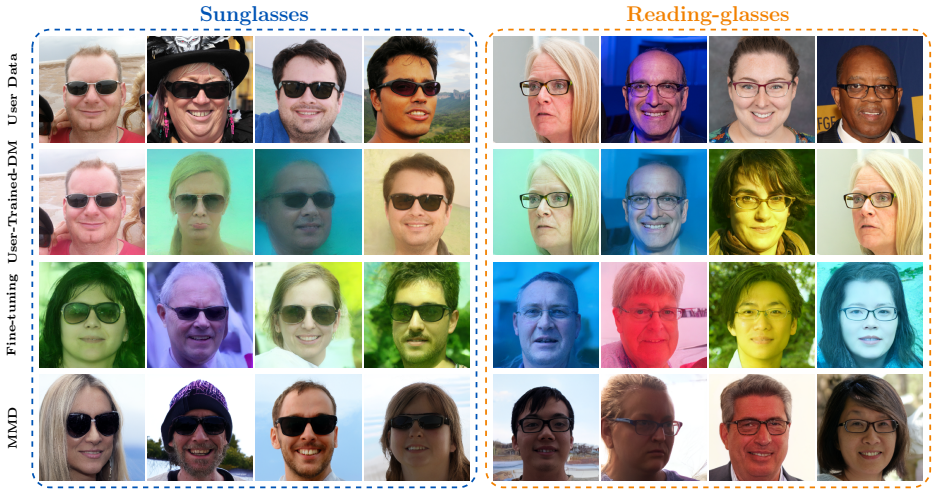
- In text-to-image models, the same guidance can impose a visual style on top of a text prompt by weighting reference images according to prompt similarity, so 'a bicycle' can be rendered in the user's reference style.
- Because the gradient has closed form and operates in latent space, the added compute is a small fraction of unguided sampling, making batch generation with guidance practical.
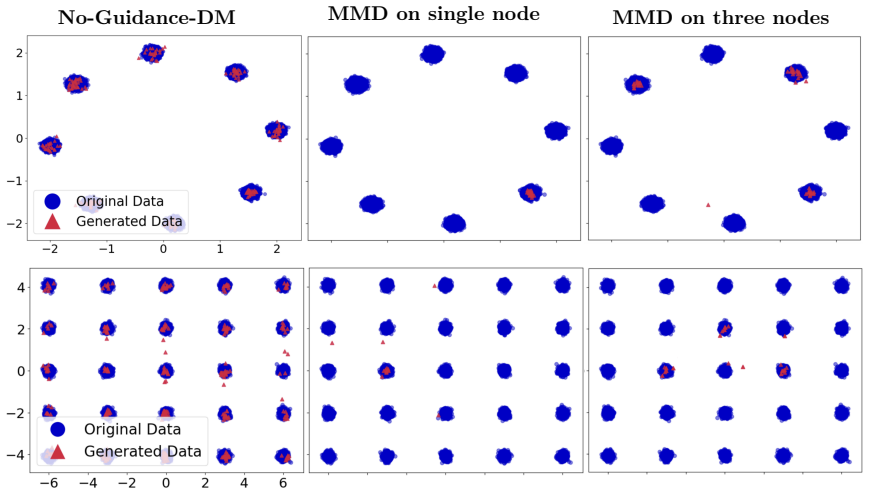
- Reference-count ablations show measurable gains over no guidance with as few as 10 references and near-saturation by 50-150 references, so the method's few-shot promise is empirically supported.
- The repulsion term in the gradient increases diversity relative to classifier guidance, which typically collapses modes; coverage and density scores improve in the paper's comparisons.
Where Pith is reading between the lines
- Inference: the O(1/sqrt(N_r)) concentration rate for the cross-term gradient suggests a principled guidance schedule lambda_t proportional to 1/sqrt(N_r) (or tied to the kernel bandwidth) could replace grid-searched constants; the paper does not test this.
- Inference: because the intra-batch repulsion term scales with batch size, batch size at fixed lambda_t is an implicit diversity knob; the paper does not isolate this trade-off, but it is a direct consequence of the update.
- Inference: the mechanism is not image-specific; any generative model with a differentiable latent space and a kernel - audio, video, molecular graphs - could receive the same guidance, with video requiring an additional temporal kernel for consistency.
- Inference: the sharpest untested boundary is a target distribution far outside the pretrained model's support; the style-shift experiments suggest partial generalization, but a truly disjoint domain would clarify whether MMD guidance steers or merely reweights nearby modes.
Editorial analysis
A structured set of objections, weighed in public.
Referee Report
Summary. The paper proposes MMD Guidance, a training-free inference-time method that steers a pre-trained diffusion model toward a target distribution specified by a small reference set. The reverse sampling update in Eq. (5) subtracts a scaled gradient of the empirical squared MMD between the current batch of noisy latents and clean reference latents. The method is extended to prompt-aware conditional generation via a product kernel over prompt embeddings and latents (Sec. 5, Eq. (10)-(11)), and is implemented in the latent space of LDMs for efficiency. Experiments cover synthetic GMMs, FFHQ, CelebA-HQ, Stable Diffusion v1.4/SDXL, PixArt, and AFHQ, reporting FD, KD, RRKE, density, and coverage. The paper includes two concentration theorems for the empirical cross-term gradient, plus extensions to the product-kernel setting. The main claim is that MMD Guidance achieves distributional alignment while preserving sample fidelity.
Significance. If the claims hold, MMD Guidance would be a useful, practical tool for few-shot domain adaptation with diffusion models: it requires no retraining, no classifier, and no per-user optimization, and the latent-space implementation is cheap. The paper's strengths are its clear algorithmic formulation, broad empirical evaluation across multiple model families, ablations of kernel choice and guidance scale, and public code release. The empirical improvements on FD, coverage, and density in most settings are substantial and credible. However, the theoretical support is considerably weaker than the paper's framing: the theorems only establish concentration of a one-step gradient estimate for a fixed z0, not that the iterated guidance steers the final distribution toward the target or preserves the denoiser's manifold. The proof of Theorem 1 also appears to contain a typo in the main-text statement. These issues do not invalidate the empirical contribution, but they do mean the central 'distribution alignment while preserving fidelity' claim is not established by the theory presented, and the evaluation partially relies on an MMD-family metric (KD).
major comments (4)
- [Sec. 4.2, Theorem 1 / Eq. (8)] The statement of Theorem 1 in the main text gives the bound 4L√N_r (1 + sqrt(2 log(1/δ))), which grows with N_r and therefore cannot be a concentration bound. The proof in Appendix A.1 correctly obtains 4L/√N_r. Since Theorem 1 is the paper's only theoretical justification for the cross-term gradient, this typo must be corrected, and the corollary and Theorem 2 should be re-checked against the corrected rate. As written, the theorem statement is false for large N_r.
- [Sec. 4.2, Eq. (5); Theorems 1–2] The theory analyzes the empirical cross-term gradient for a fixed z0, under the assumption that reference samples are independent of z0. In the actual update, after the first guidance step z_t depends on the reference set through previous gradients, so the independence used in the proof is violated. More importantly, Theorems 1–2 do not analyze the iterated closed-loop map z_t -> z_{t-1}; they provide no guarantee that repeatedly subtracting λ_t ∇MMD² moves the final z_0 distribution toward Q, nor that the perturbed latents stay on the denoiser's expected manifold. This is not a purely formal gap: Appendix C, Table 13 shows that applying MMD guidance separately from denoising (every 10 steps) improves over the simultaneous every-step update, and Table 14 shows that noisy reference latents perform comparably to clean ones. These results suggest the per-step mechanism is more subtle than t
- [Sec. 6, evaluation metrics; Ref. [35]] The reported KD (kernel distance) is an MMD-based distance from the MMD-GAN literature [35]. Since the guidance objective is precisely empirical MMD, improvements in KD are partly aligned with the objective being minimized and are not fully independent evidence of distributional alignment. The paper also reports FD, RRKE, coverage, and density, which are not MMD-based, and these generally improve in the main tables (e.g., Tables 1, 2, 7, 8, 9). The central claim is therefore not circularly supported, but the paper should either include a held-out MMD computed on final generated samples with a kernel not used for guidance, or explicitly de-emphasize KD and base the alignment claim on FD/RRKE/coverage/density.
- [Appendix C, hyperparameter selection] The appendix states that the MMD guidance scale is chosen via grid search on a held-out validation split using FD, and that different kernel types/bandwidths/degrees are used across experiments (RBF vs. polynomial, σ ∈ {1.25,1.5,2}, d ∈ {2,3,4}). The paper calls the method training-free, which is true in the sense of no parameter training, but the method has several tuned hyperparameters. For a fair assessment and to make the method usable in practice, the authors should report the selection procedure for the baselines as well, state whether the main tables use the validation-selected hyperparameters, and clarify how a real user would choose these values when no target-validation set is available. The ablation in Figures 14–16 is useful and suggests robustness, but the main comparisons should not silently hide the tuning burden.
minor comments (6)
- [Eq. (2)] The notation {α_t} is used without defining β_t; please specify the noise schedule and the relationship between α_t, β_t, and ᾱ_t.
- [Appendix A.4, Corollary 2] The corollary is stated only in the appendix after its proof, which is confusing. Also, the final bound contains an expression 'dlog R√Nr σ' that is ambiguous; please clarify the parentheses and the dependence on σ and d.
- [Appendix C, Tables 2, 4, 10–15] Several tables report only point estimates without standard deviations or number of seeds. Given that the paper emphasizes statistical reliability of MMD, please add error bars or state the number of seeds for each table.
- [Appendix C, Table 13] The 'separate steps' ablation reports improved FD/KD/RRKE, but no standard deviations or seed count is given. Since this result is cited in the reviewer discussion as evidence that the per-step simultaneous update is not optimal, please provide repeated-seed statistics and a brief explanation of why decoupling helps.
- [General] Minor typos: 'have have' in Sec. 4.2 (Gaussian kernel example); 'hodl' in Appendix A.5 proof; 'Figure 17: Caption' is left empty; some equation formatting is inconsistent (e.g., in Eq. (5) and elsewhere).
- [Sec. 5 / Appendix A.5, Theorem 3] Theorem 3 assumes reference pairs (p_r, z_r) are i.i.d. from a joint distribution Q × Π'. For prompt-aware generation, prompts are typically user-specified and not drawn from a fixed distribution; please clarify whether the theorem is meant for the synthetic prompt-conditioned GMM setting or for the real text-to-image experiments, and whether the i.i.d. assumption is realistic there.
Circularity Check
No significant circularity in the derivation; the only partially circular element is that the KD evaluation metric is an MMD-based distance, which is closely aligned with the optimized objective.
specific steps
-
fitted input called prediction
[Section 4.2, Eq. (5); Section 6, Evaluation]
"The MMD-guided sampling update will thus become: z(i) t−1 = sampler(z(i) t , t, ϵθ) − λt ∇z(i) t MMD^2(hat Pt, hat Q) ... For fidelity, we measure Fréchet distance (FD) [42] and kernel distance (KD) [35]."
KD is the MMD-based kernel distance from the MMD-GAN paper ([35]), while Eq. (5) directly minimizes the squared MMD between generated samples and a reference set. Thus a reported improvement in KD is substantially a restatement of the optimization objective, not fully independent evidence of distributional alignment. This is only partial circularity: the guidance is computed in latent space with a different kernel/feature space than the KD evaluation, and the paper also reports independent metrics (FD, RRKE, Coverage, Density) that generally improve.
full rationale
The core derivation of MMD Guidance is self-contained: Eq. (5) defines the sampler modification via the gradient of empirical squared MMD, and Theorems 1–2 provide concentration bounds for the cross-term gradient (even though those bounds do not analyze the iterated closed-loop dynamics—a rigor gap, not circularity). The prompt-aware extension via product kernels is a standard construction and is not justified by a load-bearing self-citation. The main experimental claim that MMD Guidance improves distributional alignment with preserved fidelity is supported by FD, RRKE, Coverage, and Density, which are not the optimized MMD objective and show consistent improvements. The one notable overlap is the use of KD, an MMD-based metric, as a reported fidelity measure; since KD decreases by the same mechanism the method is designed to optimize, it should not be treated as independent confirmation. This does not invalidate the central contribution, which retains independent empirical support. Overall, the paper's derivation is not circular in its central claim, so the score is low.
Axiom & Free-Parameter Ledger
free parameters (4)
- Guidance scale lambda_t =
1e-1 (GMM), 1e-4 (FFHQ), 1e-5 (CelebA-HQ), 1e-2 (SD v1.4), 1e-1 (AFHQ)
- Kernel bandwidth sigma (RBF) =
1 (8-GMM), 4 (25-GMM), 1.25-2 (ablation)
- Polynomial degree d =
3 for real-image experiments (ablation d=2,4)
- Kernel type (RBF vs polynomial) =
RBF for GMM, polynomial for images
axioms (5)
- domain assumption The latent space of the VAE used by the LDM provides a semantically meaningful metric for MMD-based comparison.
- domain assumption A single gradient step on the noisy latent remains within the manifold of plausible latents of the pre-trained diffusion model.
- domain assumption A few hundred reference samples in latent space sufficiently characterize the target distribution for MMD gradient estimation.
- standard math The product kernel k_p(p,p') * k_z(z,z') is characteristic on the joint prompt-latent space.
- domain assumption Pretrained diffusion model score is used as an unconditional prior; guidance only modifies the sampler, not the score.
read the original abstract
Pre-trained diffusion models have emerged as powerful generative priors for both unconditional and conditional sample generation, yet their outputs often deviate from the characteristics of user-specific target data. Such mismatches are especially problematic in domain adaptation tasks, where only a few reference examples are available and retraining the diffusion model is infeasible. Existing inference-time guidance methods can adjust sampling trajectories, but they typically optimize surrogate objectives such as classifier likelihoods rather than directly aligning with the target distribution. We propose \emph{MMD Guidance}, a training-free mechanism that augments the reverse diffusion process with gradients of the \textit{Maximum Mean Discrepancy (MMD)} between generated samples and a reference dataset. MMD provides reliable distributional estimates from limited data, exhibits low variance in practice, and is efficiently differentiable, which makes it particularly well-suited for the guidance task. Our framework naturally extends to prompt-aware adaptation in conditional generation models via product kernels. Also, it can be applied with computational efficiency in latent diffusion models (LDMs), since guidance is applied in the latent space of the LDM. Experiments on synthetic and real-world benchmarks demonstrate that MMD Guidance can achieve distributional alignment while preserving sample fidelity. The project code is available at github.com/matinamehdizadeh/MMD-Guidance.
Figures




Reference graph
Works this paper leans on
-
[1]
On the opportunities and risks of foundation models.arXiv preprint arXiv:2108.07258, 2021
Rishi Bommasani, Drew A Hudson, Ehsan Adeli, Sylvia Altman, Simran Arora, Sydney von Arx, Michael S Bernstein, Jeannette Bohg, Antoine Bosselut, Emma Brunskill, et al. On the opportunities and risks of foundation models.arXiv preprint arXiv:2108.07258, 2021
Pith/arXiv arXiv 2021
-
[2]
Language models are few-shot learners
Tom Brown, Benjamin Mann, Nick Ryder, Melanie Subbiah, Jared D Kaplan, Prafulla Dhariwal, Arvind Neelakantan, Pranav Shyam, Girish Sastry, Amanda Askell, et al. Language models are few-shot learners. InAdvances in neural information processing systems, volume 33, pages 1877–1901, 2020
1901
-
[3]
Denoising diffusion probabilistic models
Jonathan Ho, Ajay Jain, and Pieter Abbeel. Denoising diffusion probabilistic models. InAdvances in Neural Information Processing Systems, volume 33, pages 6840–6851, 2020
2020
-
[4]
Denoising diffusion implicit models
Jiaming Song, Chenlin Meng, and Stefano Ermon. Denoising diffusion implicit models. InInternational Conference on Learning Representations, 2021
2021
-
[5]
High-resolution image synthesis with latent diffusion models
Robin Rombach, Andreas Blattmann, Dominik Lorenz, Patrick Esser, and Björn Ommer. High-resolution image synthesis with latent diffusion models. InProceedings of the IEEE/CVF conference on computer vision and pattern recognition, pages 10684–10695, 2022
2022
-
[6]
Diffusion models beat gans on image synthesis
Prafulla Dhariwal and Alex Nichol. Diffusion models beat gans on image synthesis. InAdvances in Neural Information Processing Systems (NeurIPS), 2021
2021
-
[7]
Classifier-free diffusion guidance.arXiv preprint arXiv:2207.12598, 2022
Jonathan Ho and Tim Salimans. Classifier-free diffusion guidance.arXiv preprint arXiv:2207.12598, 2022
Pith/arXiv arXiv 2022
-
[8]
Dreamfusion: Text-to-3d using 2d diffusion
Ben Poole, Ajay Jain, Jonathan T Barron, and Ben Mildenhall. Dreamfusion: Text-to-3d using 2d diffusion. InInternational Conference on Learning Representations, 2023
2023
-
[9]
A kernel two-sample test.The journal of machine learning research, 13(1):723–773, 2012
Arthur Gretton, Karsten M Borgwardt, Malte J Rasch, Bernhard Schölkopf, and Alexander Smola. A kernel two-sample test.The journal of machine learning research, 13(1):723–773, 2012
2012
-
[10]
Dustin Podell, Zion English, Kyle Lacey, Andreas Blattmann, Tim Dockhorn, Jonas Müller, Joe Penna, and Robin Rombach. Sdxl: Improving latent diffusion models for high-resolution image synthesis.arXiv preprint arXiv:2307.01952, 2023
Pith/arXiv arXiv 2023
-
[11]
Classifier-free guidance with adaptive scaling.arXiv preprint arXiv:2502.10574, 2025
Dawid Malarz, Artur Kasymov, Maciej Zieba, Jacek Tabor, and Przemyslaw Spurek. Classifier-free guidance with adaptive scaling.arXiv preprint arXiv:2502.10574, 2025
Pith/arXiv arXiv 2025
-
[12]
CFG++: Manifold- constrained classifier free guidance for diffusion models
Hyungjin Chung, Jeongsol Kim, Geon Yeong Park, Hyelin Nam, and Jong Chul Ye. CFG++: Manifold- constrained classifier free guidance for diffusion models. InThe Thirteenth International Conference on Learning Representations, 2025
2025
-
[13]
Tenenbaum
Nan Liu, Shuang Li, Yilun Du, Antonio Torralba, and Joshua B. Tenenbaum. Compositional visual generation with composable diffusion models. InEuropean Conference on Computer Vision (ECCV), LNCS, 2022
2022
-
[14]
Prompt- to-prompt image editing with cross-attention control
Amir Hertz, Ron Mokady, Jay Tenenbaum, Kfir Aberman, Yael Pritch, and Daniel Cohen-Or. Prompt- to-prompt image editing with cross-attention control. InInternational Conference on Learning Repre- sentations (ICLR), 2023
2023
-
[15]
SDEdit: Guided image synthesis and editing with stochastic differential equations
Chenlin Meng, Yutong He, Yang Song, Jiaming Song, Jiajun Wu, Jun-Yan Zhu, and Stefano Ermon. SDEdit: Guided image synthesis and editing with stochastic differential equations. InInternational Conference on Learning Representations (ICLR), 2022
2022
-
[16]
Diffusionclip: Text-guided diffusion models for robust image manipulation
Gwanghyun Kim, Taesung Kwon, and Jong Chul Ye. Diffusionclip: Text-guided diffusion models for robust image manipulation. InProceedings of the IEEE/CVF conference on computer vision and pattern recognition, pages 2426–2435, 2022. 12
2022
-
[17]
Glide: Towards photorealistic image generation and editing with text-guided diffusion models
Alexander Quinn Nichol, Prafulla Dhariwal, Aditya Ramesh, Pranav Shyam, Pamela Mishkin, Bob Mcgrew, Ilya Sutskever, and Mark Chen. Glide: Towards photorealistic image generation and editing with text-guided diffusion models. InInternational Conference on Machine Learning, pages 16784–16804. PMLR, 2022
2022
-
[18]
More control for free! image synthesis with semantic diffusion guidance
Xihui Liu, Dong Huk Park, Samaneh Azadi, Gong Zhang, Arman Chopikyan, Yuxiao Hu, Humphrey Shi, Anna Rohrbach, and Trevor Darrell. More control for free! image synthesis with semantic diffusion guidance. InProceedings of the IEEE/CVF Winter Conference on Applications of Computer Vision, 2023
2023
-
[19]
T2I-Adapter: Learning adapters to dig out more controllable ability for text-to-image diffusion models
Chong Mou, Xintao Wang, Liangbin Xie, Yanze Wu, Jian Zhang, Zhongang Qi, Ying Shan, and Xiaohu Qie. T2I-Adapter: Learning adapters to dig out more controllable ability for text-to-image diffusion models. InProceedings of the AAAI Conference on Artificial Intelligence (AAAI), volume 38, pages 4296–4304, 2024
2024
-
[20]
Adding conditional control to text-to-image diffusion models
Lvmin Zhang, Anyi Rao, and Maneesh Agrawala. Adding conditional control to text-to-image diffusion models. InProceedings of the IEEE/CVF international conference on computer vision, pages 3836–3847, 2023
2023
-
[21]
Human motion diffusion model
Guy Tevet, Sigal Raab, Brian Gordon, Yoni Shafir, Daniel Cohen-or, and Amit Haim Bermano. Human motion diffusion model. InThe Eleventh International Conference on Learning Representations, 2023
2023
-
[22]
Egsde: Unpaired image-to-image translation via energy-guided stochastic differential equations.Advances in Neural Information Processing Systems, 35:3609–3623, 2022
Min Zhao, Fan Bao, Chongxuan Li, and Jun Zhu. Egsde: Unpaired image-to-image translation via energy-guided stochastic differential equations.Advances in Neural Information Processing Systems, 35:3609–3623, 2022
2022
-
[23]
Dreambooth: Fine tuning text-to-image diffusion models for subject-driven generation
Nataniel Ruiz, Yuanzhen Li, Varun Jampani, Yael Pritch, Michael Rubinstein, and Kfir Aberman. Dreambooth: Fine tuning text-to-image diffusion models for subject-driven generation. InIEEE/CVF Conference on Computer Vision and Pattern Recognition (CVPR), 2023
2023
-
[24]
Manifold preserving guided diffusion
Yutong He, Naoki Murata, Chieh-Hsin Lai, Yuhta Takida, Toshimitsu Uesaka, Dongjun Kim, Wei-Hsiang Liao, Yuki Mitsufuji, J Zico Kolter, Ruslan Salakhutdinov, and Stefano Ermon. Manifold preserving guided diffusion. InThe Twelfth International Conference on Learning Representations, 2024
2024
-
[25]
Universal guidance for diffusion models
Arpit Bansal, Hong-Min Chu, Avi Schwarzschild, Soumyadip Sengupta, Micah Goldblum, Jonas Geiping, and Tom Goldstein. Universal guidance for diffusion models. InProceedings of the IEEE/CVF conference on computer vision and pattern recognition, pages 843–852, 2023
2023
-
[26]
Freedom: Training-free energy-guided conditional diffusion model
Jiwen Yu, Yinhuai Wang, Chen Zhao, Bernard Ghanem, and Jian Zhang. Freedom: Training-free energy-guided conditional diffusion model. InProceedings of the IEEE/CVF International Conference on Computer Vision, pages 23174–23184, 2023
2023
-
[27]
Tfg: Unified training-free guidance for diffusion models.Advances in Neural Information Processing Systems, 37:22370–22417, 2024
Haotian Ye, Haowei Lin, Jiaqi Han, Minkai Xu, Sheng Liu, Yitao Liang, Jianzhu Ma, James Y Zou, and Stefano Ermon. Tfg: Unified training-free guidance for diffusion models.Advances in Neural Information Processing Systems, 37:22370–22417, 2024
2024
-
[28]
Bermano, Gal Chechik, and Daniel Cohen-Or
Rinon Gal, Yuval Alaluf, Yuval Atzmon, Or Patashnik, Amit H. Bermano, Gal Chechik, and Daniel Cohen-Or. An image is worth one word: Personalizing text-to-image generation using textual inversion. arXiv preprint arXiv:2208.01618, 2022
Pith/arXiv arXiv 2022
-
[29]
Hu, Yelong Shen, Phillip Wallis, Zeyuan Allen-Zhu, Yuanzhi Li, Shean Wang, Lu Wang, and Weizhu Chen
Edward J. Hu, Yelong Shen, Phillip Wallis, Zeyuan Allen-Zhu, Yuanzhi Li, Shean Wang, Lu Wang, and Weizhu Chen. LoRA: Low-rank adaptation of large language models. InInternational Conference on Learning Representations (ICLR), 2022
2022
-
[30]
Adding conditional control to text-to-image diffusion models
Lvmin Zhang and Maneesh Agrawala. Adding conditional control to text-to-image diffusion models. In IEEE/CVF International Conference on Computer Vision (ICCV), 2023. 13
2023
-
[31]
Domain guidance: A simple transfer approach for a pre-trained diffusion model
Jincheng Zhong, XiangCheng Zhang, Jianmin Wang, and Mingsheng Long. Domain guidance: A simple transfer approach for a pre-trained diffusion model. InThe Thirteenth International Conference on Learning Representations, 2025
2025
-
[32]
Mingsheng Long, Yue Cao, Jianmin Wang, and Michael I. Jordan. Learning transferable features with deep adaptation networks. InProceedings of the 32nd International Conference on Machine Learning (ICML), volume 37 ofProceedings of Machine Learning Research, 2015
2015
-
[33]
Yujia Li, Kevin Swersky, and Richard S. Zemel. Generative moment matching networks. InProceedings of the 32nd International Conference on Machine Learning (ICML), volume 37 ofProceedings of Machine Learning Research, 2015
2015
-
[34]
MMD GAN: Towards deeper understanding of moment matching network
Chun-Liang Li, Wei-Cheng Chang, Yu Cheng, Yiming Yang, and Barnabás Póczos. MMD GAN: Towards deeper understanding of moment matching network. InAdvances in Neural Information Processing Systems (NeurIPS), 2017
2017
-
[35]
Sutherland, Michael Arbel, and Arthur Gretton
Mikołaj Bińkowski, Dougal J. Sutherland, Michael Arbel, and Arthur Gretton. Demystifying MMD GANs. InInternational Conference on Learning Representations (ICLR), 2018
2018
-
[36]
Learn to guide your diffusion model, 2025
Alexandre Galashov, Ashwini Pokle, Arnaud Doucet, Arthur Gretton, Mauricio Delbracio, and Valentin De Bortoli. Learn to guide your diffusion model, 2025
2025
-
[37]
On the empirical estimation of integral probability metrics.Electronic Journal of Statistics, 6:1550–1599, 2012
Bharath K Sriperumbudur, Kenji Fukumizu, Arthur Gretton, Bernhard Schölkopf, and Gert RG Lanckriet. On the empirical estimation of integral probability metrics.Electronic Journal of Statistics, 6:1550–1599, 2012
2012
-
[38]
Sharp asymptotic and finite-sample rates of convergence of empirical measures in wasserstein distance.Bernoulli, 25(4A):2620–2648, 2019
Jonathan Weed and Francis Bach. Sharp asymptotic and finite-sample rates of convergence of empirical measures in wasserstein distance.Bernoulli, 25(4A):2620–2648, 2019
2019
-
[39]
Johnson–lindenstrauss embeddings with kronecker structure.SIAM Journal on Matrix Analysis and Applications, 43(4):1806–1850, 2022
Stefan Bamberger, Felix Krahmer, and Rachel Ward. Johnson–lindenstrauss embeddings with kronecker structure.SIAM Journal on Matrix Analysis and Applications, 43(4):1806–1850, 2022
2022
-
[40]
Fusing cross-modal and uni-modal representations: A kronecker product approach
Youqi Wu, Jingwei Zhang, and Farzan Farnia. Fusing cross-modal and uni-modal representations: A kronecker product approach. InAdvances in Neural Information Processing Systems (NeurIPS), 2025
2025
-
[41]
Junsong Chen, Jincheng Yu, Chongjian Ge, Lewei Yao, Enze Xie, Yue Wu, Zhongdao Wang, James Kwok, Ping Luo, Huchuan Lu, et al. Pixart-alpha: Fast training of diffusion transformer for photorealistic text-to-image synthesis.arXiv preprint arXiv:2310.00426, 2023
Pith/arXiv arXiv 2023
-
[42]
Gans trained by a two time-scale update rule converge to a local nash equilibrium.Advances in neural information processing systems, 30, 2017
Martin Heusel, Hubert Ramsauer, Thomas Unterthiner, Bernhard Nessler, and Sepp Hochreiter. Gans trained by a two time-scale update rule converge to a local nash equilibrium.Advances in neural information processing systems, 30, 2017
2017
-
[43]
Reliable fidelity and diversity metrics for generative models
Muhammad Ferjad Naeem, Seong Joon Oh, Youngjung Uh, Yunjey Choi, and Jaejun Yoo. Reliable fidelity and diversity metrics for generative models. InInternational conference on machine learning, pages 7176–7185. PMLR, 2020
2020
-
[44]
An information-theoretic evaluation of generative models in learning multi-modal distributions.Advances in Neural Information Processing Systems, 36:9931–9943, 2023
Mohammad Jalali, Cheuk Ting Li, and Farzan Farnia. An information-theoretic evaluation of generative models in learning multi-modal distributions.Advances in Neural Information Processing Systems, 36:9931–9943, 2023
2023
-
[45]
Dinov2: Learning robust visual features without supervision.arXiv preprint arXiv:2304.07193, 2023
Maxime Oquab, Timothée Darcet, Théo Moutakanni, Huy Vo, Marc Szafraniec, Vasil Khalidov, Pierre Fernandez, Daniel Haziza, Francisco Massa, Alaaeldin El-Nouby, et al. Dinov2: Learning robust visual features without supervision.arXiv preprint arXiv:2304.07193, 2023. 14
Pith/arXiv arXiv 2023
-
[46]
Exposing flaws of generative model evaluation metrics and their unfair treatment of diffusion models.Advances in Neural Information Processing Systems, 36:3732–3784, 2023
George Stein, Jesse Cresswell, Rasa Hosseinzadeh, Yi Sui, Brendan Ross, Valentin Villecroze, Zhaoyan Liu, Anthony L Caterini, Eric Taylor, and Gabriel Loaiza-Ganem. Exposing flaws of generative model evaluation metrics and their unfair treatment of diffusion models.Advances in Neural Information Processing Systems, 36:3732–3784, 2023
2023
-
[47]
A style-based generator architecture for generative adversarial networks
Tero Karras, Samuli Laine, and Timo Aila. A style-based generator architecture for generative adversarial networks. InProceedings of the IEEE/CVF conference on computer vision and pattern recognition, pages 4401–4410, 2019
2019
-
[48]
Tero Karras, Timo Aila, Samuli Laine, and Jaakko Lehtinen. Progressive growing of gans for improved quality, stability, and variation.arXiv preprint arXiv:1710.10196, 2017
Pith/arXiv arXiv 2017
-
[49]
Efficient and principled score estimation with nyström kernel exponential families
Danica J Sutherland, Heiko Strathmann, Michael Arbel, and Arthur Gretton. Efficient and principled score estimation with nyström kernel exponential families. InInternational Conference on Artificial Intelligence and Statistics, pages 652–660. PMLR, 2018
2018
-
[50]
Rethinking the inception architecture for computer vision
Christian Szegedy, Vincent Vanhoucke, Sergey Ioffe, Jon Shlens, and Zbigniew Wojna. Rethinking the inception architecture for computer vision. InProceedings of the IEEE conference on computer vision and pattern recognition, pages 2818–2826, 2016
2016
-
[51]
Consistent diffusion models: Mitigating sampling drift by learning to be consistent.Advances in Neural Information Processing Systems, 36:42038–42063, 2023
Giannis Daras, Yuval Dagan, Alex Dimakis, and Constantinos Daskalakis. Consistent diffusion models: Mitigating sampling drift by learning to be consistent.Advances in Neural Information Processing Systems, 36:42038–42063, 2023
2023
-
[52]
Gowthami Somepalli, Anubhav Gupta, Kamal Gupta, Shramay Palta, Micah Goldblum, Jonas Geiping, Abhinav Shrivastava, and Tom Goldstein. Measuring style similarity in diffusion models.arXiv preprint arXiv:2404.01292, 2024. 15 Appendix A Proofs A.1 Proof of Theorem 1 Define the centered random vectors: Yj =∇ z0 k(z0, z(r) j )−E z′∼Q[∇z0 k(z0, z′)], j= 1, . . ...
Pith/arXiv arXiv 2024
discussion (0)
Sign in with ORCID, Apple, or X to comment. Anyone can read and Pith papers without signing in.