Distribution amplitudes and functions of ground-state scalar and pseudoscalar charmonia
Pith reviewed 2026-05-10 18:18 UTC · model grok-4.3
The pith
Ground-state charmonia like χ_c0 and η_c are not simple hydrogen-like systems but have mixed orbital angular momentum and nontrivial distribution amplitudes with symmetry-driven negative support.
A machine-rendered reading of the paper's core claim, the machinery that carries it, and where it could break.
Core claim
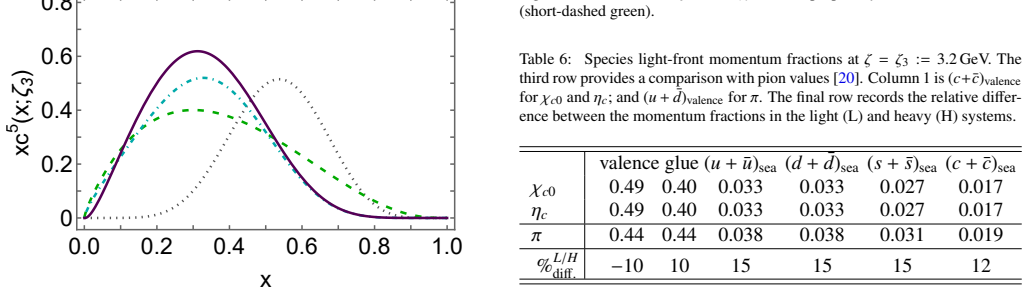
Continuum Schwinger function methods applied to ground-state scalar and pseudoscalar charmonia show that the χ_c0 is not a simple P-wave system and the η_c wave function contains more than S-wave contributions. The associated distribution amplitudes are nontrivial, with the χ_c0 DA exhibiting domains of positive and negative support due to QCD symmetries; the same sign structure appears in the χ_c0 distribution function. Differences between the χ_c0 and η_c distribution functions diminish under evolution, and both states carry an identical glue momentum fraction that is ten percent smaller than the glue fraction in the pion.
What carries the argument
Continuum Schwinger function methods that compute wave functions, distribution amplitudes, and distribution functions, exposing orbital angular momentum mixing and QCD symmetry constraints on the sign of the χ_c0 distribution amplitude.
If this is right
- Charmonium models must include mixed orbital angular momentum rather than assuming pure S- or P-wave states.
- Distribution amplitudes of scalar charmonia contain negative domains required by QCD symmetries.
- The glue light-front momentum fraction is identical in χ_c0 and η_c and ten percent lower than the pion value.
- Differences between χ_c0 and η_c distribution functions shrink with increasing resolution scale.
Where Pith is reading between the lines
- Comparable angular-momentum mixing and sign structures may appear in bottomonium states.
- The results supply concrete benchmarks for lattice QCD or potential-model studies of heavy-meson structure.
- Predictions for charmonium production rates or decay distributions in high-energy collisions may need adjustment for the reduced glue fraction.
Load-bearing premise
The chosen interaction kernel and truncation in the continuum Schwinger function approach reproduce the non-perturbative dynamics of charmonia without artifacts that change the reported wave-function mixing or sign structure of the distribution amplitudes.
What would settle it
An independent lattice QCD calculation of the χ_c0 distribution amplitude that finds it strictly positive definite everywhere would show that the negative-support domains are a method-specific artifact.
Figures
read the original abstract
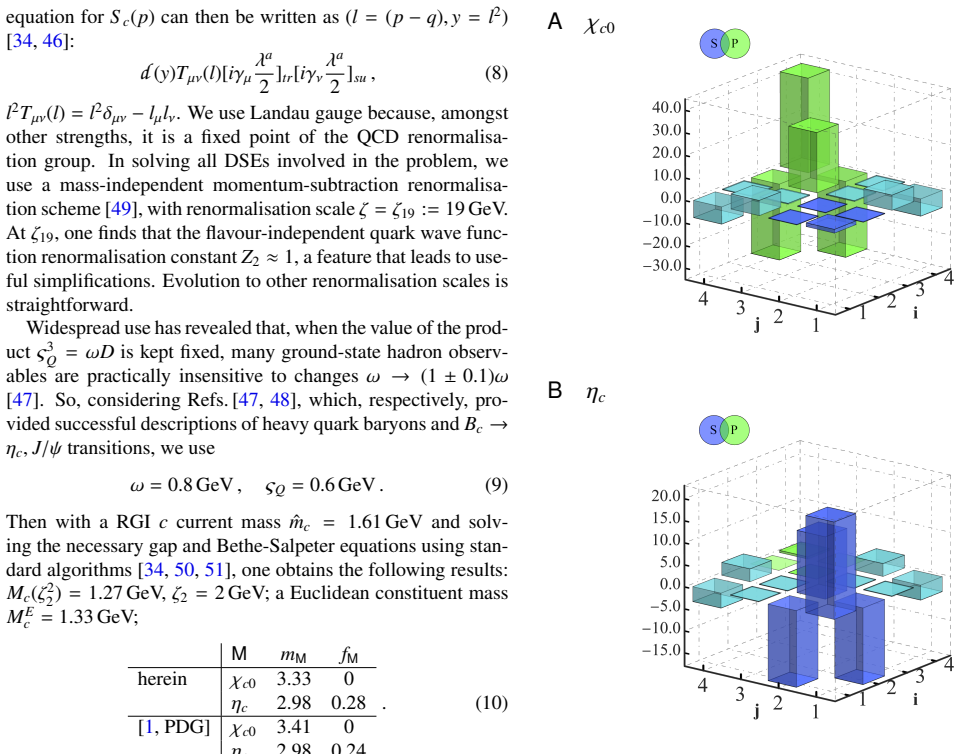
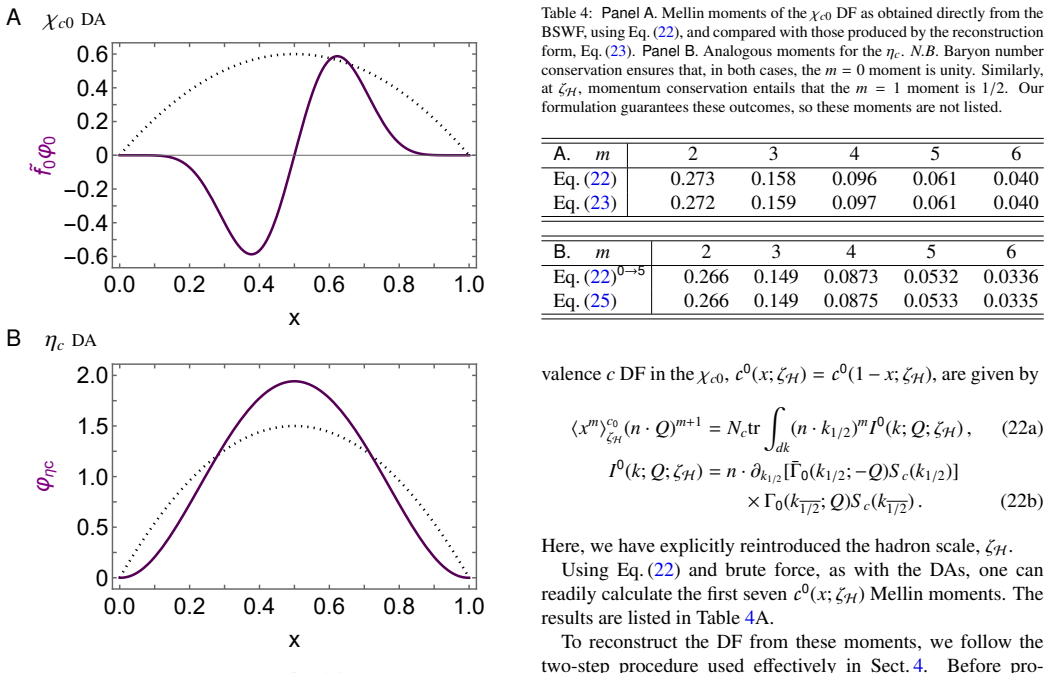
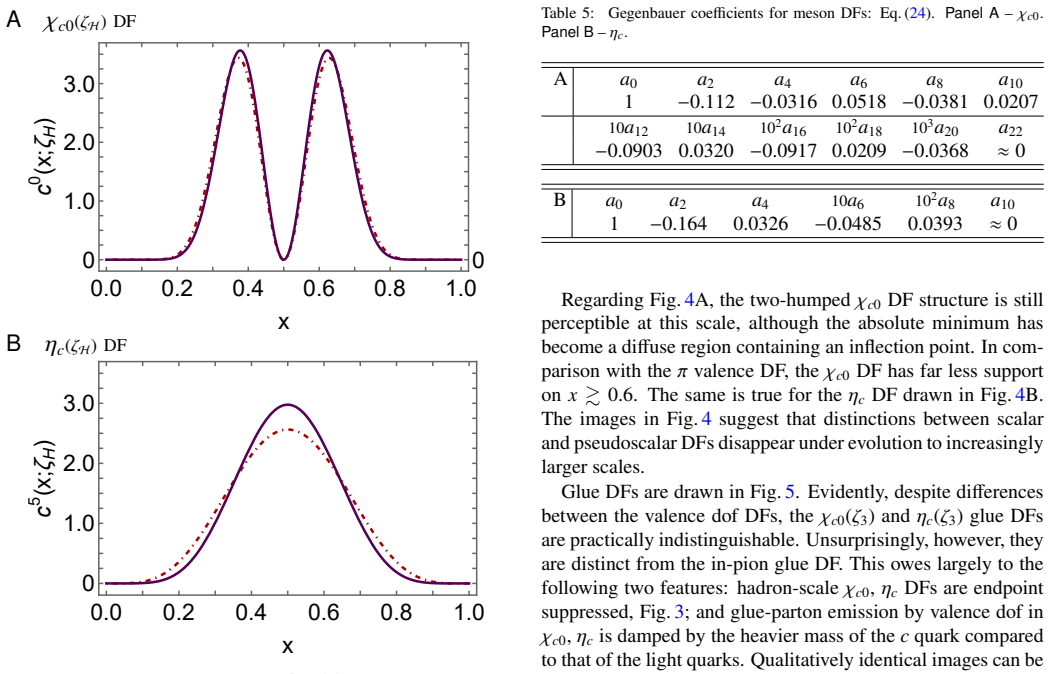
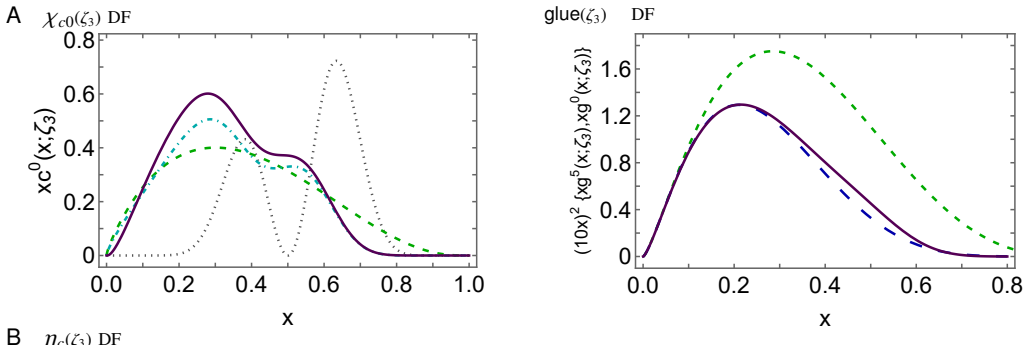
Charmonia are often supposed to provide simple hydrogen-like ``atomic'' systems that can be used to obtain insights into heavier-quark QCD. We use continuum Schwinger function methods to analyse this hypothesis in connection with ground-state scalar and pseudoscalar charmonia and find that a more complex picture of these states may be necessary. For instance, considering orbital angular momentum, the $\chi_{c0}$ is not a simple $P$-wave system; similarly, the $\eta_c$ wave function contains more than merely $S$-wave contributions. The distribution amplitudes (DAs) and distribution functions (DFs) of these mesons are also nontrivial. For instance, the $\chi_{c0}$ DA is not positive definite: owing to QCD symmetries, it possesses domains of balanced negative and positive support. This feature is also expressed in the $\chi_{c0}$ DF, but differences between $\chi_{c0}$ and $\eta_c$ DFs diminish under scale evolution. Notably, the light-front momentum fraction carried by glue is the same in both states: it is 10\% less than the in-pion glue momentum fraction. Whilst experimental confirmation of the predictions herein is unlikely, our results should serve as benchmarks for complementary theory attempts to understand local and global structural features of heavier-quark hadrons.
Editorial analysis
A structured set of objections, weighed in public.
Referee Report
Summary. The paper employs continuum Schwinger function methods to study the ground-state scalar χ_c0 and pseudoscalar η_c charmonia, arguing that these states deviate from simple quark-model pictures: the χ_c0 is not a pure P-wave and the η_c wave function includes non-S-wave components. It computes their distribution amplitudes (DAs) and distribution functions (DFs), showing that the χ_c0 DA has sign-changing support (negative and positive domains) protected by QCD symmetries, with analogous features in the DF that diminish under evolution; both states carry the same light-front glue momentum fraction, which is 10% lower than in the pion. These findings are offered as benchmarks for other theoretical approaches to heavier-quark hadron structure.
Significance. If the central results hold, the work is significant for hadron physics because it supplies concrete, non-perturbative predictions for charmonium DAs and DFs that challenge the hydrogen-like model and quantify gluon contributions and orbital mixing. The continuum Schwinger-function framework provides access to these quantities in a manner complementary to lattice QCD, and the symmetry-protected negativity of the χ_c0 DA is a robust qualitative feature. The paper explicitly positions its outputs as benchmarks, which is a strength when the underlying truncation is controlled.
major comments (2)
- [Abstract] Abstract and the section presenting the glue momentum fractions: the quantitative claim that both χ_c0 and η_c carry a glue momentum fraction 10% lower than the pion is not protected by symmetry and depends on the specific rainbow-ladder truncation and one-parameter interaction kernel. No variation of the kernel infrared strength or inclusion of beyond-rainbow-ladder diagrams is shown, so the 10% deficit cannot yet be regarded as robust against the truncation artifacts highlighted in the stress-test note.
- [Results on wave functions] The results section on Bethe-Salpeter amplitudes and orbital angular momentum decomposition: the claims that χ_c0 is not a simple P-wave and η_c contains non-S-wave contributions rest on the same truncation. Because these mixing fractions are not symmetry-protected, a direct demonstration that they survive reasonable changes to the kernel or truncation scheme is required to establish that the deviations from the quark model are physical rather than artifacts.
minor comments (1)
- The notation for the distribution amplitudes and functions could be clarified with an explicit table comparing the support properties of χ_c0 and η_c at the initial and evolved scales.
Simulated Author's Rebuttal
We thank the referee for their careful reading of the manuscript and for the constructive major comments. We address each point below, indicating the revisions we will make to qualify our claims appropriately while preserving the work's value as a benchmark within the rainbow-ladder framework.
read point-by-point responses
-
Referee: [Abstract] Abstract and the section presenting the glue momentum fractions: the quantitative claim that both χ_c0 and η_c carry a glue momentum fraction 10% lower than the pion is not protected by symmetry and depends on the specific rainbow-ladder truncation and one-parameter interaction kernel. No variation of the kernel infrared strength or inclusion of beyond-rainbow-ladder diagrams is shown, so the 10% deficit cannot yet be regarded as robust against the truncation artifacts highlighted in the stress-test note.
Authors: We agree that the glue momentum fraction is a dynamical quantity without symmetry protection and that its precise numerical value is tied to the rainbow-ladder truncation and the chosen kernel. The result is presented as a concrete prediction of this standard approach, which has been validated for charmonium masses and other observables in earlier work. To respond to the concern, we will revise the abstract and the relevant results section to state explicitly that the 10% reduction is obtained within the rainbow-ladder truncation, and we will add a short paragraph referencing the stress-test note and discussing the expected stability of this feature for heavy-quark systems based on prior applications of the method. revision: yes
-
Referee: [Results on wave functions] The results section on Bethe-Salpeter amplitudes and orbital angular momentum decomposition: the claims that χ_c0 is not a simple P-wave and η_c contains non-S-wave contributions rest on the same truncation. Because these mixing fractions are not symmetry-protected, a direct demonstration that they survive reasonable changes to the kernel or truncation scheme is required to establish that the deviations from the quark model are physical rather than artifacts.
Authors: The orbital angular momentum content is extracted from the Bethe-Salpeter amplitudes solved in the rainbow-ladder truncation. These deviations from pure S- or P-wave states are a direct consequence of the relativistic bound-state dynamics and are consistent with results obtained for lighter mesons in the same framework. While we cannot perform new explicit kernel variations or beyond-rainbow-ladder calculations in the present study, we will expand the results section with additional discussion of the truncation's reliability for heavy quarks, drawing on existing literature where analogous mixing persists under modest parameter changes. The statements will be qualified to make clear that the reported mixing fractions are predictions of the employed truncation. revision: yes
- Direct demonstration that the orbital mixing fractions and glue momentum deficit survive explicit variations of the kernel infrared strength or inclusion of beyond-rainbow-ladder diagrams, as this would require substantial new computations outside the scope of the current manuscript.
Circularity Check
No significant circularity in derivation chain
full rationale
The paper applies established continuum Schwinger-function methods (DSE/BSE) to compute charmonium wave functions, DAs and DFs. Central features such as the sign-changing support of the χ_c0 DA are explicitly attributed to QCD symmetries rather than model details, while the reported glue momentum fraction and orbital-angular-momentum mixing are presented as outputs of the calculation. No equations or steps in the provided text reduce by construction to fitted parameters, self-citations, or ansätze that render the claims tautological. The method is self-contained against external benchmarks once the interaction kernel is fixed by independent observables, satisfying the criteria for a non-circular analysis.
Axiom & Free-Parameter Ledger
free parameters (1)
- interaction kernel parameters
axioms (1)
- domain assumption The chosen truncation and kernel form capture the essential non-perturbative QCD dynamics for ground-state charmonia
Lean theorems connected to this paper
-
IndisputableMonolith/Foundation/RealityFromDistinction.leanreality_from_one_distinction unclear?
unclearRelation between the paper passage and the cited Recognition theorem.
We use continuum Schwinger function methods to analyse this hypothesis... Bethe-Salpeter wave functions (BSWFs)... leading-twist quasiparticle distribution amplitudes (DAs) and distribution functions (DFs)
-
IndisputableMonolith/Cost/FunctionalEquation.leanwashburn_uniqueness_aczel unclear?
unclearRelation between the paper passage and the cited Recognition theorem.
the χ_c0 DA is not positive definite: owing to QCD symmetries, it possesses domains of balanced negative and positive support
What do these tags mean?
- matches
- The paper's claim is directly supported by a theorem in the formal canon.
- supports
- The theorem supports part of the paper's argument, but the paper may add assumptions or extra steps.
- extends
- The paper goes beyond the formal theorem; the theorem is a base layer rather than the whole result.
- uses
- The paper appears to rely on the theorem as machinery.
- contradicts
- The paper's claim conflicts with a theorem or certificate in the canon.
- unclear
- Pith found a possible connection, but the passage is too broad, indirect, or ambiguous to say the theorem truly supports the claim.
Reference graph
Works this paper leans on
-
[1]
Navas, et al., Review of particle physics, Phys
S. Navas, et al., Review of particle physics, Phys. Rev. D 110 (3) (2024) 030001
work page 2024
-
[2]
M. Ding, C. D. Roberts, S. M. Schmidt, Emergence of Hadron Mass and Structure, Particles 6 (1) (2023) 57–120
work page 2023
- [3]
-
[4]
Y . Y . Xiao, Z. N. Xu, Z. Q. Yao, C. D. Roberts, J. Rodríguez-Quintero, Orbital angular momentum in the pion and kaon: Rest-frame and light-front, Phys. Lett. B 876 (2026) 140361
work page 2026
-
[5]
N. Brambilla, A. Pineda, J. Soto, A. Vairo, Potential NRQCD: An Effective theory for heavy quarkonium, Nucl. Phys. B 566 (2000) 275
work page 2000
- [6]
-
[7]
C. S. Fischer, S. Kubrak, R. Williams, Spectra of heavy mesons in the Bethe-Salpeter approach, Eur. Phys. J. A 51 (2015) 10
work page 2015
- [8]
-
[9]
K. Raya, M. Ding, A. Bashir, L. Chang, C. D. Roberts, Partonic structure of neutral pseudoscalars via two photon transition form factors, Phys. Rev. D 95 (2017) 074014
work page 2017
-
[10]
J. Chen, M. Ding, L. Chang, Y .-x. Liu, Two Photon Tran- sition Form Factor of ¯ccQuarkonia, Phys. Rev. D 95 (1) (2017) 016010
work page 2017
-
[11]
Grunberg, Renormalization Group Improved Perturba- tive QCD, Phys
G. Grunberg, Renormalization Group Improved Perturba- tive QCD, Phys. Lett. B 95 (1980) 70, [Erratum: Phys. Lett. B 110, 501 (1982)]
work page 1980
-
[12]
Grunberg, Renormalization Scheme Independent QCD and QED: The Method of Effective Charges, Phys
G. Grunberg, Renormalization Scheme Independent QCD and QED: The Method of Effective Charges, Phys. Rev. D 29 (1984) 2315
work page 1984
-
[13]
A. Deur, S. J. Brodsky, C. D. Roberts, QCD Running Cou- plings and Effective Charges, Prog. Part. Nucl. Phys. 134 (2024) 104081
work page 2024
-
[14]
P.-L. Yin, Y .-Z. Xu, Z.-F. Cui, C. D. Roberts, J. Rodríguez-Quintero, All-Orders Evolution of Parton Distributions: Principle, Practice, and Predictions, Chin. Phys. Lett.Express40 (9) (2023) 091201
work page 2023
-
[15]
Y . L. Dokshitzer, Calculation of the Structure Functions for Deep Inelastic Scattering ande + e− Annihilation by Perturbation Theory in Quantum Chromodynamics. (In Russian), Sov. Phys. JETP 46 (1977) 641–653
work page 1977
-
[16]
V . N. Gribov, L. N. Lipatov, Deep inelastic electron scatte- ring in perturbation theory, Phys. Lett. B 37 (1971) 78–80
work page 1971
-
[17]
L. N. Lipatov, The parton model and perturbation theory, Sov. J. Nucl. Phys. 20 (1975) 94–102
work page 1975
-
[18]
G. Altarelli, G. Parisi, Asymptotic Freedom in Parton Language, Nucl. Phys. B 126 (1977) 298–318
work page 1977
-
[19]
C. Han, G. Xie, R. Wang, X. Chen, An Analysis of Parton Distribution Functions of the Pion and the Kaon with the Maximum Entropy Input, Eur. Phys. J. C 81 (2021) 302
work page 2021
-
[20]
Y . Lu, L. Chang, K. Raya, C. D. Roberts, J. Rodríguez- Quintero, Proton and pion distribution functions in coun- terpoint, Phys. Lett. B 830 (2022) 137130
work page 2022
-
[21]
X. Wang, M. Ding, L. Chang, Sieving parton distribution function moments via the moment problem, Phys. Lett. B 851 (2024) 138568
work page 2024
-
[22]
Y .-Z. Xu, K. Raya, Z.-F. Cui, C. D. Roberts, J. Rodríguez- Quintero, Empirical Determination of the Pion Mass Dis- tribution, Chin. Phys. Lett.Express40 (4) (2023) 041201
work page 2023
- [23]
-
[24]
Z.-N. Xu, D. Binosi, C. Chen, K. Raya, C. D. Roberts, J. Rodríguez-Quintero, Kaon distribution functions from empirical information, Phys. Lett. B 865 (2025) 139451
work page 2025
-
[25]
Z. Q. Yao, Y . Z. Xu, D. Binosi, Z. F. Cui, M. Ding, K. Raya, C. D. Roberts, J. Rodríguez-Quintero, S. M. Schmidt, Nucleon gravitational form factors, Eur. Phys. J. A 61 (5) (2025) 92
work page 2025
-
[26]
A. R. Castro, C. Mezrag, J. M. Morgado Chávez, B. Pire, Backward DVCS in a Sullivan process, Phys. Rev. D 112 (3) (2025) 034009
work page 2025
-
[27]
H.-Y . Xing, W.-H. Bian, Z.-F. Cui, C. D. Roberts, Kaon and pion fragmentation functions, Eur. Phys. J. C 85 (11) (2025) 1305
work page 2025
- [28]
-
[29]
J. R. Pelaez, From controversy to precision on the sigma meson: a review on the status of the non-ordinaryf 0(500) resonance, Phys. Rept. 658 (2016) 1
work page 2016
-
[30]
A. Höll, P. Maris, C. D. Roberts, S. V . Wright, Schwinger functions and light-quark bound states, and sigma terms, Nucl. Phys. Proc. Suppl. 161 (2006) 87–94
work page 2006
-
[31]
G. Eichmann, C. S. Fischer, W. Heupel, The light scalar mesons as tetraquarks, Phys. Lett. B 753 (2016) 282–287
work page 2016
- [32]
-
[33]
Nakanishi, A General survey of the theory of the Bethe-Salpeter equation, Prog
N. Nakanishi, A General survey of the theory of the Bethe-Salpeter equation, Prog. Theor. Phys. Suppl. 43 (1969) 1–81
work page 1969
- [34]
-
[35]
Q.-W. Wang, S.-X. Qin, C. D. Roberts, S. M. Schmidt, Proton tensor charges from a Poincaré-covariant Faddeev equation, Phys. Rev. D 98 (2018) 054019
work page 2018
- [36]
-
[37]
H. D. Politzer, Effective Quark Masses in the Chiral Limit, Nucl. Phys. B 117 (1976) 397
work page 1976
-
[38]
C. D. Roberts, D. G. Richards, T. Horn, L. Chang, Insights into the emergence of mass from studies of pion and kaon structure, Prog. Part. Nucl. Phys. 120 (2021) 103883
work page 2021
-
[39]
C. D. Roberts, A. G. Williams, Dyson-Schwinger equa- tions and their application to hadronic physics, Prog. Part. Nucl. Phys. 33 (1994) 477–575
work page 1994
-
[40]
C. D. Roberts, Strong QCD and Dyson-Schwinger Equa- tions, IRMA Lect. Math. and Theor. Phys. 21 (2015) 356– 458
work page 2015
-
[41]
H. J. Munczek, Dynamical chiral symmetry break- ing, Goldstone’s theorem and the consistency of the Schwinger-Dyson and Bethe-Salpeter Equations, Phys. Rev. D 52 (1995) 4736–4740
work page 1995
- [42]
-
[43]
M. S. Bhagwat, A. Höll, A. Krassnigg, C. D. Roberts, P. C. Tandy, Aspects and consequences of a dressed-quark- gluon vertex, Phys. Rev. C 70 (2004) 035205
work page 2004
-
[44]
S.-X. Qin, L. Chang, Y .-X. Liu, C. D. Roberts, D. J. Wil- son, Interaction model for the gap equation, Phys. Rev. C 84 (2011) 042202(R)
work page 2011
- [45]
- [46]
-
[47]
S.-X. Qin, C. D. Roberts, S. M. Schmidt, Poincaré- covariant analysis of heavy-quark baryons, Phys. Rev. D 97 (2018) 114017
work page 2018
-
[48]
Z.-Q. Yao, D. Binosi, Z.-F. Cui, C. D. Roberts, Semilep- tonicB c →η c,J/ψtransitions, Phys. Lett. B 818 (2021) 136344
work page 2021
-
[49]
L. Chang, Y .-X. Liu, C. D. Roberts, Y .-M. Shi, W.-M. Sun, H.-S. Zong, Chiral susceptibility and the scalar Ward iden- tity, Phys. Rev. C 79 (2009) 035209
work page 2009
- [50]
-
[51]
Krassnigg, Excited mesons in a Bethe-Salpeter ap- proach, PoS CONFINEMENT 8 (2008) 075
A. Krassnigg, Excited mesons in a Bethe-Salpeter ap- proach, PoS CONFINEMENT 8 (2008) 075
work page 2008
-
[52]
M. Ding, F. Gao, L. Chang, Y .-X. Liu, C. D. Roberts, Leading-twist parton distribution amplitudes of S-wave heavy-quarkonia, Phys. Lett. B 753 (2016) 330–335
work page 2016
-
[53]
G. P. Lepage, S. J. Brodsky, Exclusive Processes in Per- turbative Quantum Chromodynamics, Phys. Rev. D 22 (1980) 2157–2198
work page 1980
-
[54]
B.-L. Li, L. Chang, M. Ding, C. D. Roberts, H.-S. Zong, Leading-twist distribution amplitudes of scalar- and vector-mesons, Phys. Rev. D 94 (2016) 094014
work page 2016
-
[55]
Z. N. Xu, Z. Q. Yao, D. Binosi, M. Ding, C. D. Roberts, J. Rodríguez-Quintero, Distribution functions of a radially excited pion, Eur. Phys. J. C 85 (3) (2025) 330
work page 2025
-
[56]
M. Ding, K. Raya, D. Binosi, L. Chang, C. D. Roberts, S. M. Schmidt, Drawing insights from pion parton distri- butions, Chin. Phys. C (Lett.) 44 (2020) 031002
work page 2020
-
[57]
K. Raya, Z.-F. Cui, L. Chang, J.-M. Morgado, C. D. Ro- berts, J. Rodríguez-Quintero, Revealing pion and kaon structure via generalised parton distributions, Chin. Phys. C 46 (26) (2022) 013105
work page 2022
-
[58]
K. Raya, A. Bashir, D. Binosi, C. D. Roberts, J. Rodríguez-Quintero, Pseudoscalar Mesons and Emer- gent Mass, Few Body Syst. 65 (2) (2024) 60
work page 2024
- [59]
-
[60]
Z.-F. Cui, M. Ding, F. Gao, K. Raya, D. Binosi, L. Chang, C. D. Roberts, J. Rodríguez-Quintero, S. M. Schmidt, Kaon and pion parton distributions, Eur. Phys. J. C 80 (2020) 1064. 10
work page 2020
discussion (0)
Sign in with ORCID, Apple, or X to comment. Anyone can read and Pith papers without signing in.