Inflationary magnetogenesis from non-minimal coupling in large- and small-field potentials
Pith reviewed 2026-05-10 16:23 UTC · model grok-4.3
The pith
Non-minimal Yukawa coupling between inflaton and Ricci scalar times backreaction to produce magnetic fields up to 10^{-13} G in large-field inflation.
A machine-rendered reading of the paper's core claim, the machinery that carries it, and where it could break.
Core claim
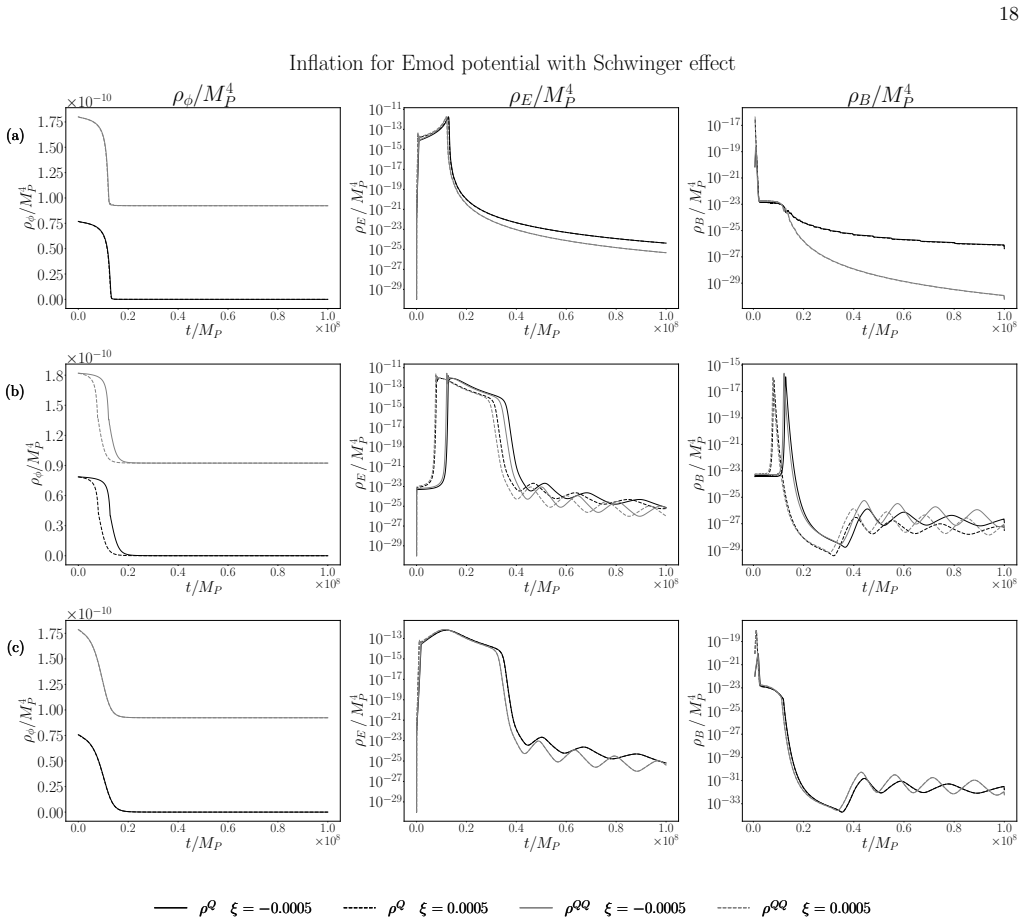
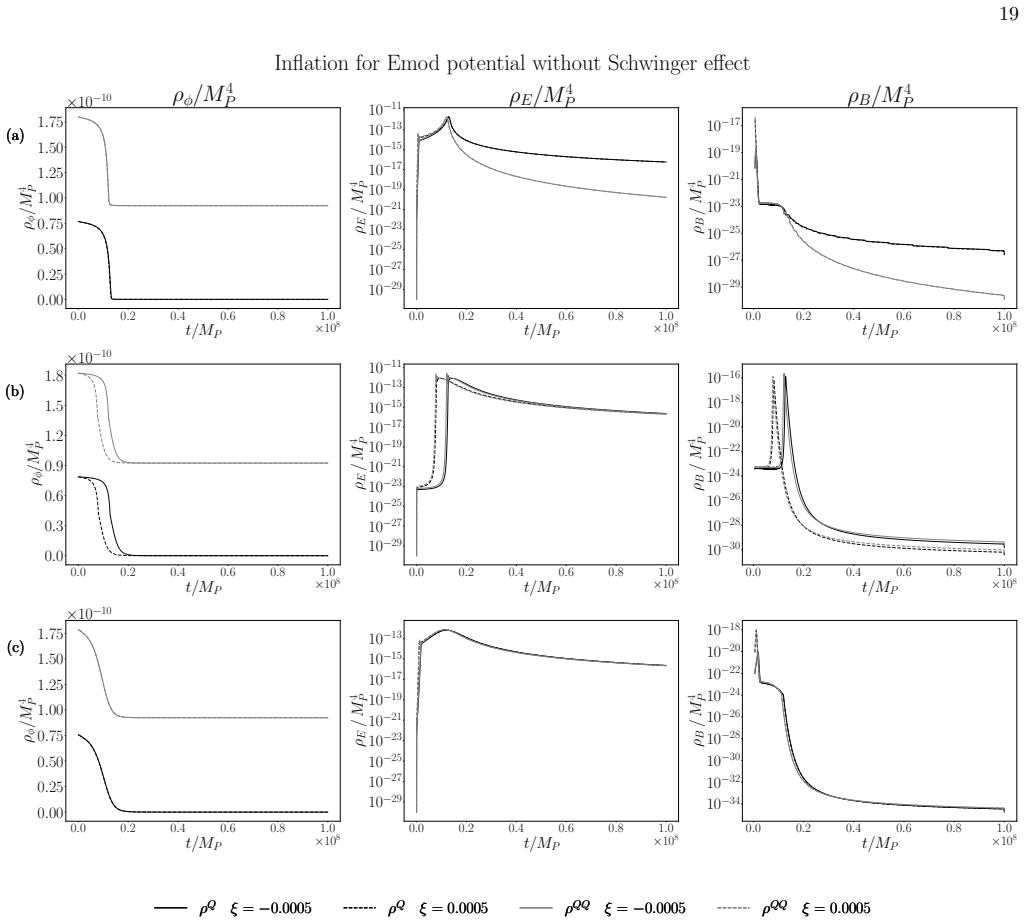
The non-minimal Yukawa-like coupling between the inflaton and the Ricci scalar plays a central role in controlling the dynamics, acting as a timing parameter that regulates the onset of electric backreaction and the Schwinger regime. This leads to a deep modification of the magnetogenesis process. The amplitude of the generated magnetic fields can be enhanced by several orders of magnitude with respect to the minimally coupled case, reaching present-day values up to B_0 ~ 10^{-13} G in large-field scenarios, which appear as the only ones compatible with observational bounds. Small-field models yield negligible magnetic amplitudes and appear non-predictive within this non-minimal framework.
What carries the argument
The non-minimal Yukawa-like coupling of the inflaton to the Ricci scalar, which breaks conformal invariance and serves as a timing parameter for the onset of backreaction and Schwinger effect.
If this is right
- Large-field potentials become the only viable class for generating observable primordial magnetic fields under this non-minimal coupling.
- Small-field hilltop models are ruled out as predictive sources of primordial magnetism in the presence of the coupling.
- The Schwinger effect and electromagnetic backreaction must be included self-consistently to obtain realistic field amplitudes.
- Both standard single-field inflation and quasi-quintessence frameworks produce qualitatively similar outcomes when the same coupling is applied.
Where Pith is reading between the lines
- Observations of intergalactic magnetic fields at the 10^{-13} G level could provide an independent test that distinguishes large-field from small-field inflation.
- The timing role of the coupling may generalize to other non-minimal interactions that affect early-universe phase transitions.
- Precise scale-dependent measurements of magnetic fields could constrain the functional form of the coupling ansatz.
Load-bearing premise
The coupling functions purely as a timing parameter that controls backreaction onset without introducing new instabilities or violating the slow-roll conditions demanded by Planck data.
What would settle it
A direct measurement showing primordial magnetic fields well below 10^{-13} G at the relevant scales, while large-field inflation remains consistent with CMB data, would falsify the claimed enhancement.
Figures





read the original abstract
We investigate inflationary magnetogenesis in a scenario where conformal invariance of electromagnetism is broken through a \emph{non-minimal Yukawa-like coupling between the inflaton and the Ricci scalar}. We account for electromagnetic backreaction and the Schwinger effect, analyzing both standard single-field inflation and a generalized K-essence framework, \emph{dubbed quasi-quintessence}. We consider inflationary potentials compatible with Planck satellite constraints, including Starobinsky and $\alpha$-attractor models for large fields, as well as hilltop scenarios for small fields. Moreover, we explore very different functional electromagnetic couplings, introducing a novel ansatz modeled for small-fields. We show that the non-minimal coupling plays a central role in controlling the dynamics, \emph{acting as a timing parameter that regulates the onset of electric backreaction and the Schwinger regime}. This leads to a deep modification of the magnetogenesis process. Indeed, the amplitude of the generated magnetic fields can be enhanced by several orders of magnitude with respect to the minimally coupled case, reaching present-day values up to $B_0 \sim 10^{-13}\,\mathrm{G}$ in large-field scenarios, \emph{which appear as the only ones compatible with observational bounds}. Conversely, small-field models yield negligible magnetic amplitudes and appear non-predictive within our non-minimal framework.
Editorial analysis
A structured set of objections, weighed in public.
Referee Report
Summary. The manuscript investigates inflationary magnetogenesis via a non-minimal Yukawa-like coupling of the inflaton to the Ricci scalar in both standard single-field inflation and a generalized K-essence 'quasi-quintessence' framework. Using Planck-compatible potentials (Starobinsky, α-attractors for large fields; hilltop for small fields) and various electromagnetic coupling functions, including a novel ansatz for small fields, the authors account for electromagnetic backreaction and the Schwinger effect. They conclude that the coupling acts as a timing parameter regulating the onset of backreaction, leading to magnetic field enhancements of several orders of magnitude over the minimal case, with present-day amplitudes up to B_0 ≈ 10^{-13} G achievable in large-field models, which are the only ones compatible with observational bounds; small-field models produce negligible fields.
Significance. Should the central claims be substantiated, this work would represent a notable advance in inflationary magnetogenesis by demonstrating how non-minimal couplings can significantly boost generated magnetic fields while remaining consistent with CMB constraints. The quasi-quintessence generalization and the new coupling ansatz provide additional flexibility in model construction. It addresses key challenges like backreaction and Schwinger pair production, potentially offering a pathway to explain observed intergalactic magnetic fields without invoking new physics beyond the inflaton sector.
major comments (3)
- [Abstract and background equations] The abstract claims that large-field models reach B_0 ~ 10^{-13} G while remaining compatible with Planck data at the coupling strengths required for this enhancement. However, the non-minimal term modifies the Einstein-frame Friedmann and Klein-Gordon equations, rescaling the effective potential and Hubble friction; for the values that delay the Schwinger regime sufficiently to achieve the reported enhancement, shifts in slow-roll parameters ε and η of order unity are possible, which could invalidate the compatibility. This must be shown explicitly via parameter scans at the specific coupling values used for the magnetogenesis results.
- [Background dynamics and equations of motion] The treatment of the non-minimal coupling as a pure 'timing parameter' that regulates only the onset of electric backreaction and the Schwinger regime without introducing new instabilities or violating slow-roll conditions requires quantitative demonstration. The coupling enters the background dynamics, so the reported enhancement cannot be assessed independently of re-checking the inflationary observables (n_s, r) at those exact parameter points.
- [Numerical results and methods] The soundness of the reported field amplitudes is difficult to assess without the full derivations, numerical integration methods, or error analysis for the inclusion of backreaction and the Schwinger effect, making it impossible to verify whether the central enhancement claim is supported by the equations.
minor comments (1)
- [Framework introduction] The term 'quasi-quintessence' is introduced for the generalized K-essence framework; its precise definition and distinction from standard K-essence should be clarified in the relevant section to avoid potential confusion.
Simulated Author's Rebuttal
We thank the referee for the thorough and constructive report. We address each major comment below, providing clarifications and committing to revisions that strengthen the presentation of our results without altering the central claims.
read point-by-point responses
-
Referee: [Abstract and background equations] The abstract claims that large-field models reach B_0 ~ 10^{-13} G while remaining compatible with Planck data at the coupling strengths required for this enhancement. However, the non-minimal term modifies the Einstein-frame Friedmann and Klein-Gordon equations, rescaling the effective potential and Hubble friction; for the values that delay the Schwinger regime sufficiently to achieve the reported enhancement, shifts in slow-roll parameters ε and η of order unity are possible, which could invalidate the compatibility. This must be shown explicitly via parameter scans at the specific coupling values used for the magnetogenesis results.
Authors: We agree that the non-minimal coupling modifies the background dynamics and that explicit verification is required. In our analysis the coupling strengths yielding B_0 ≈ 10^{-13} G keep ε and η well below unity throughout inflation, preserving Planck compatibility. To make this transparent we will add a dedicated subsection with parameter scans (including tables of ε, η, n_s and r) evaluated precisely at the coupling values used for the magnetogenesis results. revision: yes
-
Referee: [Background dynamics and equations of motion] The treatment of the non-minimal coupling as a pure 'timing parameter' that regulates only the onset of electric backreaction and the Schwinger regime without introducing new instabilities or violating slow-roll conditions requires quantitative demonstration. The coupling enters the background dynamics, so the reported enhancement cannot be assessed independently of re-checking the inflationary observables (n_s, r) at those exact parameter points.
Authors: The coupling does enter the background equations, yet our numerical evolution shows it primarily shifts the epoch at which backreaction and Schwinger effects become important while leaving the slow-roll trajectory intact. We will augment the manuscript with explicit plots of ε( N ) and η( N ) for the relevant coupling values, together with the recomputed n_s and r at those points, confirming that no new instabilities arise and that the enhancement is evaluated on a consistent inflationary background. revision: yes
-
Referee: [Numerical results and methods] The soundness of the reported field amplitudes is difficult to assess without the full derivations, numerical integration methods, or error analysis for the inclusion of backreaction and the Schwinger effect, making it impossible to verify whether the central enhancement claim is supported by the equations.
Authors: We acknowledge that the current presentation of the numerical implementation is insufficient for full reproducibility. In the revised version we will add an appendix containing (i) the complete set of equations including backreaction and Schwinger pair production, (ii) a description of the numerical integrator, time-stepping criteria and convergence tests, and (iii) an error analysis for the computed magnetic-field amplitudes. These additions will allow direct verification of the reported enhancement. revision: yes
Circularity Check
No significant circularity detected
full rationale
The paper derives the enhanced magnetic field amplitudes by solving the modified background equations (Einstein-frame Friedmann and Klein-Gordon) with the non-minimal Yukawa coupling f(φ)R, electromagnetic backreaction, and Schwinger pair production included explicitly. It employs standard large-field potentials (Starobinsky, α-attractors) already known to satisfy Planck constraints on n_s and r, then computes the resulting B_0 after the coupling shifts the onset of the Schwinger regime. No equation reduces by construction to a fitted parameter renamed as a prediction, no load-bearing premise rests solely on self-citation, and the compatibility statement is presented as an output of the same parameter scan that produces B_0 ~ 10^{-13} G rather than an input assumption. The derivation therefore remains self-contained against external Planck benchmarks.
Axiom & Free-Parameter Ledger
free parameters (2)
- non-minimal coupling strength
- potential parameters
axioms (2)
- domain assumption Electromagnetic conformal invariance is broken solely by the non-minimal inflaton-Ricci coupling
- domain assumption Slow-roll conditions remain valid throughout the epoch of magnetogenesis
invented entities (1)
-
quasi-quintessence
no independent evidence
Reference graph
Works this paper leans on
-
[1]
Inflationary magnetogenesis from non-minimal coupling in large- and small-field potentials
Non-minimally coupled extensions of the power spectra definition 14 B. Plots and numerical computation 15 I. INTRODUCTION The origin of the large-scale magnetic fields observed in the Universe remains one of the significant open prob- lems in modern cosmology [1]. In particular, a major challenge concerns the generation of magnetic fields pos- sessing ver...
work page internal anchor Pith review Pith/arXiv arXiv 2026
-
[2]
The effective gravitational coupling Geff = 1 M2 P −ξϕ 2 ,(16) is positive definite in order to avoid repulsive effects [33]. For field excursions up toϕ max ∼5M P , this impliesξ≲4×10 −2, guaranteeing the background evolution consistency
-
[3]
The non-minimal coupling modifies the effective poten- tial and may prevent the inflaton decay [39]
Inflationary dynamics further constrainsξ. The non-minimal coupling modifies the effective poten- tial and may prevent the inflaton decay [39]. For instance, in Starobinsky-like models [59, 60], one requiresV ′ eff(ϕin)>0, implyingξ≳−10 −3. Al- though model-dependent, this bound avoids signif- icant departures from standard inflation
-
[4]
1−exp − r 2 3 ϕ MP !#2 ,(34a) V (n) E (ϕ) =Λ4
Finally, magnetogenesis imposes a stronger restric- tion. Forξ >10 −3, the electric field develops rapid oscillations together with an unphysical growth of its energy density, while a smooth evolution is phe- nomenologically required. This selectsξ≲10 −3. Combining the above bounds, we can adopt the con- servative constraint: |ξ|≲10 −3 ,(17) which ensures...
- [5]
-
[6]
P. A. R. Ade et al. Planck 2015 results. XIX. Con- straints on primordial magnetic fields.Astron. Astro- phys., 594:A19, 2016
work page 2015
-
[7]
F. Tavecchio, G. Ghisellini, L. Foschini, G. Bonnoli, G. Ghirlanda, and P. Coppi. The intergalactic magnetic field constrained by Fermi/LAT observations of the TeV blazar 1ES 0229+200.Monthly Notices of the Royal As- tronomical Society: Letters, 406(1):L70–L74, July 2010
work page 2010
-
[8]
Andrii Neronov and Ievgen Vovk. Evidence for strong extragalactic magnetic fields from Fermi observations of TeV blazars.Science, 328(5974):73–75, April 2010
work page 2010
-
[9]
Shin’ichiro Ando and Alexander Kusenko. Evidence for gamma-ray halos around active galactic nuclei and the first measurement of intergalactic magnetic fields.The Astrophysical Journal Letters, 722(1):L39, 2010
work page 2010
-
[10]
Sethi and Kandaswamy Subramanian
Shiv K. Sethi and Kandaswamy Subramanian. Primor- dial magnetic fields in the post-recombination era and early reionization.Monthly Notices of the Royal Astro- nomical Society, 356(2):778–788, 2005
work page 2005
-
[11]
J. Martin and J. Yokoyama. Generation of large scale magnetic fields in single-field inflation.J. Cosmol. As- tropart. Phys., 01:025, 2008
work page 2008
-
[12]
Widrow, Dongsu Ryu, Dominik Schle- icher, Kandaswamy Subramanian, Christos G
Lawrence M. Widrow, Dongsu Ryu, Dominik Schle- icher, Kandaswamy Subramanian, Christos G. Tsagas, and Rudolf A. Treumann. The first magnetic fields. Space Science Reviews, 166(1–4):37–70, May 2012. arXiv:1109.4052 [astro-ph]
-
[13]
D. Grasso and H. R. Rubinstein. Magnetic fields in the early universe.Physics Reports, 348:163–266, 2001
work page 2001
-
[14]
Cosmological magnetogenesis: The biermann battery during the epoch of reionization
Omar Attia, Romain Teyssier, Harley Katz, Tay- sun Kimm, Sergio Martin-Alvarez, Pierre Ocvirk, and Joakim Rosdahl. Cosmological magnetogenesis: The biermann battery during the epoch of reionization. Monthly Notices of the Royal Astronomical Society, 504(2):2346–2359, April 2021
work page 2021
-
[15]
Primordial Spectrum of Gauge Fields from Inflation.Physics Letters B, 501(3- 4):165–172, March 2001
Anne-Christine Davis, Konstantinos Dimopoulos, Tomis- lav Prokopec, and Ola Tornkvist. Primordial Spectrum of Gauge Fields from Inflation.Physics Letters B, 501(3- 4):165–172, March 2001
work page 2001
-
[16]
Kulsrud, Renyue Cen, Jeremiah P
Russell M. Kulsrud, Renyue Cen, Jeremiah P. Ostriker, and Dongsu Ryu. The protogalactic origin for cosmic magnetic fields.The Astrophysical Journal, 480(2):481– 491, 1997
work page 1997
-
[17]
R. Durrer and A. Neronov. Cosmological magnetic fields: Their generation, evolution and observation.Astron. As- trophys. Rev., 21:62, 2013
work page 2013
-
[18]
T. Vachaspati. Magnetic fields from cosmological phase transitions.Phys. Lett. B, 265:258, 1991
work page 1991
-
[19]
S. Vilchinskii, O. Sobol, E. V. Gorbar, and I. Rudenok. Magnetogenesis during inflation and preheating in the Starobinsky model.Phys. Rev. D, 95:083509, 2017
work page 2017
-
[20]
O. O. Sobol, E. V. Gorbar, M. Kamarpour, and S. I. Vilchinskii. Influence of backreaction of electric fields and schwinger effect on inflationary magnetogenesis.Physical Review D, 98:063534, 2018
work page 2018
-
[21]
T. Hayashinaka, T. Fujita, and J. Yokoyama. Fermionic 12 schwinger effect and induced current in de sitter space. J. Cosmol. Astropart. Phys., 07:010, 2016
work page 2016
-
[22]
C. Stahl and S.-S. Xue. Schwinger effect and backreaction in de sitter spacetime.Phys. Lett. B, 760:288, 2016
work page 2016
-
[23]
E. Bavarsad, C. Stahl, and S.-S. Xue. Scalar current of created pairs by schwinger mechanism in de sitter space- time.Phys. Rev. D, 94:104011, 2016
work page 2016
-
[24]
T. Kobayashi and N. Afshordi. Schwinger effect in 4d de sitter space and constraints on magnetogenesis in the early universe.J. High Energy Phys., 10:166, 2014
work page 2014
-
[25]
Redouane Fakir and William G. Unruh. Improvement on cosmological chaotic inflation through nonminimal cou- pling.Phys. Rev. D, 41:1783–1791, 1990
work page 1990
- [26]
-
[27]
Nobuyoshi Makino and Misao Sasaki. The Density Per- turbation in the Chaotic Inflation with Non-Minimal Coupling.Progress of Theoretical Physics, 86(1):103–118, 07 1991
work page 1991
-
[28]
Eiichiro Komatsu and Toshifumi Futamase. Complete constraints on a nonminimally coupled chaotic inflation- ary scenario from the cosmic microwave background. Physical Review D, 59(6), 1999
work page 1999
-
[29]
Andrei Linde, Mahdiyar Noorbala, and Alexander West- phal. Observational consequences of chaotic inflation with nonminimal coupling to gravity.Journal of Cosmol- ogy and Astroparticle Physics, 2011(03):013–013, 2011
work page 2011
- [30]
-
[31]
Behavior of chaotic inflation in anisotropic cosmologies with nonminimal coupling.Phys
Toshifumi Futamase, Tony Rothman, and Richard Matzner. Behavior of chaotic inflation in anisotropic cosmologies with nonminimal coupling.Phys. Rev. D, 39:405–411, 1989
work page 1989
-
[32]
F. Lucchin, S. Matarrese, and M.D. Pollock. Inflation with a non-minimally coupled scalar field.Physics Letters B, 167(2):163–168, 1986
work page 1986
-
[33]
Higgs inflation.Frontiers in Astronomy and Space Sciences, 5, jan 2019
Javier Rubio. Higgs inflation.Frontiers in Astronomy and Space Sciences, 5, jan 2019
work page 2019
-
[34]
Dhong Yeon Cheong, Sung Mook Lee, and Seong Chan Park. Progress in Higgs inflation.J. Korean Phys. Soc., 78(10):897–906, 2021
work page 2021
-
[35]
L. H. Ford. Cosmological particle production: A review. Reports on Progress in Physics, 84(11):116901, November
- [36]
-
[37]
R. P. L. Azevedo and P. P. Avelino. Big-bang nucleosyn- thesis and cosmic microwave background constraints on non-minimally coupled theories of gravity.Physical Re- view D, 98(6):064045, September 2018
work page 2018
-
[38]
Pre- heating of the nonminimally coupled inflaton field.Phys- ical Review D, 61(10), 2000
Shinji Tsujikawa, Kei ichi Maeda, and Takashi Torii. Pre- heating of the nonminimally coupled inflaton field.Phys- ical Review D, 61(10), 2000
work page 2000
-
[39]
Derivative coupling of the inflaton toR (3).Phys
Yan-Li He and Yun-Song Piao. Derivative coupling of the inflaton toR (3).Phys. Rev. D, 99(8):083511, 2019
work page 2019
-
[40]
Equivalence of the einstein and jordan frames.Phys
Marieke Postma and Marco Volponi. Equivalence of the einstein and jordan frames.Phys. Rev. D, 90:103516, Nov 2014
work page 2014
-
[41]
S Capozziello, R de Ritis, and A A Marino. Some aspects of the cosmological conformal equivalence between the `jordan frame'and the`einstein frame'.Classical and Quantum Gravity, 14(12):3243–3258, dec 1997
work page 1997
-
[42]
Alessio Belfiglio, Orlando Luongo, and Tommaso Men- goni. Comparing geometric and gravitational particle production in jordan and einstein frames.Physical Re- view D, 111(12):123512, 2025
work page 2025
-
[43]
Rocco D’Agostino, Orlando Luongo, and Marco Muc- cino. Healing the cosmological constant problem dur- ing inflation through a unified quasi-quintessence mat- ter field.Classical and Quantum Gravity, 39(19):195014, 2022
work page 2022
-
[44]
Generalized K- essence inflation in Jordan and Einstein frames.Class
Orlando Luongo and Tommaso Mengoni. Generalized K- essence inflation in Jordan and Einstein frames.Class. Quant. Grav., 41(10):105006, 2024
work page 2024
-
[45]
Phase-space analysis of dark energy models in non-minimally coupled theories of gravity.Class
Youri Carloni and Orlando Luongo. Phase-space analysis of dark energy models in non-minimally coupled theories of gravity.Class. Quant. Grav., 42(7):075014, 2025
work page 2025
-
[46]
Alleviating the cosmological constant problem from par- ticle production.Class
Alessio Belfiglio, Roberto Giamb` o, and Orlando Luongo. Alleviating the cosmological constant problem from par- ticle production.Class. Quant. Grav., 40(10):105004, 2023
work page 2023
-
[47]
Alessio Belfiglio, Youri Carloni, and Orlando Luongo. Particle production from non-minimal coupling in a sym- metry breaking potential transporting vacuum energy. Phys. Dark Univ., 44:101458, 2024
work page 2024
-
[48]
Anna Chiara Alfano and Youri Carloni. Parameterizing quasi-quintessence and quasi-phantom fields without the nearly flat potential approximation.Arxivlens, 9 2025
work page 2025
-
[49]
Speeding up the universe using dust with pressure.Physical Review D, 98(10), 2018
Orlando Luongo and Marco Muccino. Speeding up the universe using dust with pressure.Physical Review D, 98(10), 2018
work page 2018
-
[50]
Planck 2018 results. X. Constraints on inflation
Y. Akrami et al. (Planck Collaboration). Planck 2018 results. x. constraints on inflation.arXiv, 2018. arXiv:1807.06211
work page internal anchor Pith review arXiv 2018
-
[51]
O. O. Sobol, E. V. Gorbar, O. M. Teslyk, and S. I. Vilchinskii. Generation of an electromagnetic field non- minimally coupled to gravity during higgs inflation.Phys. Rev. D, 104(4):043509, 2021
work page 2021
-
[52]
Takeshi Chiba and Kazunori Kohri. Consistency relations for large-field inflation: Non-minimal cou- pling.Progress of Theoretical and Experimental Physics, 2015(2):023E01, February 2015
work page 2015
-
[53]
Alexander B. Kaganovich. Higgs inflation model with small non-minimal coupling constant.Journal of Cos- mology and Astroparticle Physics, 2026(03):006, March 2026
work page 2026
-
[54]
Introductory review of cosmic inflation, 2003
Shinji Tsujikawa. Introductory review of cosmic inflation, 2003
work page 2003
-
[55]
Bassett, Shinji Tsujikawa, and David Wands
Bruce A. Bassett, Shinji Tsujikawa, and David Wands. Inflation dynamics and reheating.Reviews of Modern Physics, 78(2):537–589, may 2006
work page 2006
-
[56]
Inflation and the theory of cosmological perturbations, 2002
Antonio Riotto. Inflation and the theory of cosmological perturbations, 2002
work page 2002
-
[57]
Lev Kofman, Andrei D. Linde, and Alexei A. Starobin- sky. Towards the theory of reheating after inflation.Phys. Rev. D, 56:3258–3295, 1997
work page 1997
-
[58]
Spacetime curvature and the Higgs sta- bility during inflation.Phys
Matti Herranen, Tommi Markkanen, Sami Nurmi, and Arttu Rajantie. Spacetime curvature and the Higgs sta- bility during inflation.Phys. Rev. Lett., 113(21):211102, 2014
work page 2014
-
[59]
Y. Akrami et al. Planck results 2018.Astrononomy and Astrophysics, 641:A10, sep 2020
work page 2018
-
[60]
Inflation and quintessence with nonmin- imal coupling.Physical Review D, 62:023504, 2000
Valerio Faraoni. Inflation and quintessence with nonmin- imal coupling.Physical Review D, 62:023504, 2000
work page 2000
-
[61]
Alan H. Guth. Inflationary universe: A possible solu- tion to the horizon and flatness problems.Phys. Rev. D, 23:347–356, 1981
work page 1981
-
[62]
A.D. Linde. Chaotic inflation.Physics Letters B, 13 129(3):177–181, 1983
work page 1983
-
[63]
Standard Model Higgs boson mass from inflation: two loop analysis
F. Bezrukov and M. Shaposhnikov. Standard model higgs boson mass from inflation: two loop analysis.Jour- nal of High Energy Physics, 2009(07):089–089, 2009. arXiv:0904.1537 [hep-ph]
work page Pith review arXiv 2009
-
[64]
A.A. Starobinsky. A new type of isotropic cosmological models without singularity.Physics Letters B, 91(1):99– 102, 1980
work page 1980
-
[65]
A. A. Starobinskii. The Perturbation Spectrum Evolving from a Nonsingular Initially De-Sitter Cosmology and the Microwave Background Anisotropy.Soviet Astronomy Letters, 9:302–304, 1983
work page 1983
-
[66]
David H. Lyth and David Seery. Classicality of the primordial perturbations.Physics Letters B, 662(4):309–313, May 2008
work page 2008
-
[67]
Kevin Goldstein and David A. Lowe. Real time perturba- tion theory in de Sitter space.Phys. Rev. D, 69:023507, 2004
work page 2004
-
[68]
Maciej Kowalczyk and Guillermo A. Mena Marug´ an. Choice of vacuum state and the relation between infla- tionary and planck scales.Phys. Rev. D, 110:103502, Nov 2024
work page 2024
-
[69]
T. S. Bunch and P. C. W. Davies. Quantum Field Theory in de Sitter Space: Renormalization by Point Splitting. Proc. Roy. Soc. Lond. A, 360:117–134, 1978
work page 1978
-
[70]
Francois Gelis and Naoto Tanji. Schwinger mechanism revisited.Progress in Particle and Nuclear Physics, 87:1–49, March 2016. arXiv:1510.05451 [hep-ph]
-
[71]
Worldline Instantons and Pair Production in Inhomogeneous Fields
Gerald V. Dunne and Christian Schubert. World- line instantons and pair production in inhomogeneous fields.Physical Review D, 72(10):105004, November 2005. arXiv:hep-th/0507174
work page Pith review arXiv 2005
-
[72]
S. A. Smolyansky, G. Roepke, S. Schmidt, D. Blaschke, V. D. Toneev, and A. V. Prozorkevich. Dynamical deriva- tion of a quantum kinetic equation for particle production in the schwinger mechanism. (arXiv:hep-ph/9712377), December 1997. arXiv:hep-ph/9712377
work page internal anchor Pith review arXiv 1997
-
[73]
Schwartz.Quantum Field Theory and the Standard Model
Matthew D. Schwartz.Quantum Field Theory and the Standard Model. Cambridge University Press, December
-
[74]
DOI: 10.1017/9781139540940
- [75]
-
[76]
Schwinger Effect in Inflaton-Driven Electric Field
H. Kitamoto. Schwinger effect in inflaton-driven electric field.arXiv, 2018. arXiv:1807.03753
work page Pith review arXiv 2018
-
[77]
Inflation generated cosmological magnetic field
Bharat Ratra. Inflation generated cosmological magnetic field. 10 1991
work page 1991
-
[78]
Gabriel Germ´ an, R. Gonzalez Quaglia, and A. M. Moran Colorado. Model independent bounds for the number of e-folds during the evolution of the universe.JCAP, 03:004, 2023
work page 2023
-
[79]
Orlando Luongo, Tommaso Mengoni, and Paulo M. S´ a. Gravitational waves from two scalar fields unify- ing the dark sector with inflation.Physical Review D, 113(2):023541, January 2026
work page 2026
-
[80]
V. Demozzi, V. M. Mukhanov, and H. Rubinstein. Mag- netic fields from inflation?J. Cosmol. Astropart. Phys., 08:025, 2009
work page 2009
discussion (0)
Sign in with ORCID, Apple, or X to comment. Anyone can read and Pith papers without signing in.